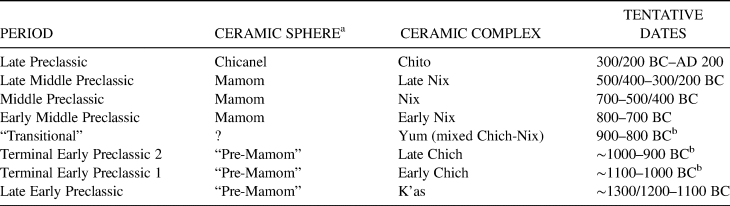
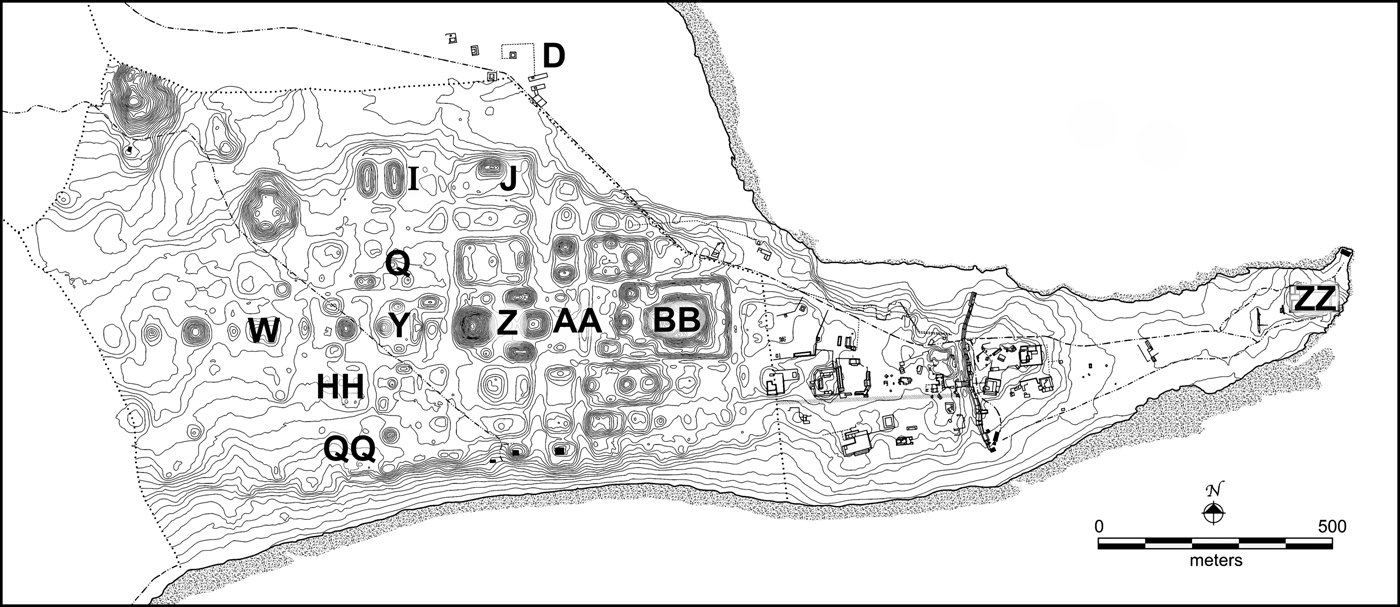
Recent excavations at the long-lived city of Nixtun-Ch'ich’, on the western edge of Lake Petén Itzá, indicate that occupation and construction began in the Late and Terminal Early Preclassic or “Pre-Mamom” periods (Table 1). The site's distinctive grid of corridors—nine north–south alphabetically designated “avenues” and six east–west numbered “streets”—was established during the succeeding Middle Preclassic (Mamom) period (Pugh Reference Pugh2018; Pugh and Rice Reference Pugh and Rice2017). These thoroughfares divided the city into 52 trapezoidal construction blocks or sectors, labeled from A (northwest) to ZZ (southeast; Figure 1). In this article, I discuss early construction at 10 loci, with particular interest in the civic-ceremonial core made up of four sectors—Y, Z, AA, and BB—on the east–west axis urbis (azimuth 94.5°). I interpret these developments in terms of cooperative labor organization and evolutionary game/selectionist theory.
Preclassic Ceramic Spheres, Complexes, and Dates of Early Pottery at Nixtun-Ch'ich’.

a Spheres at Uaxactun and Tikal.
b Preliminary dates from interpolation between radiometrically dated deposits.
Map showing sectors of Nixtun-Ch'ich'.

Materials and Methods
The ceramic artifacts discussed here were recovered by Proyecto Arqueológico Itza (PAI), which focused on the site's grid corridors (Pugh Reference Pugh2018). Radiocarbon assays principally were used to date the construction of corridors that border monumental architecture. Substructural platforms and structures themselves were tested less often and were dated stratigraphically by ceramic chronologies. The pottery came from test units excavated to bedrock in 10 constructional loci (Figure 1): 9 on the mainland plus Mound ZZ1 on the Candelaria Peninsula. Deposits directly atop bedrock typically represent efforts to create a level surface for construction, although sometimes the bedrock itself was leveled. These earliest levels incorporated few sherds (sometimes barely a handful), which were usually small (often the size of a thumbnail) and heavily eroded. Strata overlying such basal deposits yielded more and larger fragments.
Materials are assigned to two Early Preclassic ceramic complexes (K'as and Chich, along with new type-variety designations), Yum Transitional, and Nix (Mamom) Middle Preclassic (South and Rice Reference South, Rice and Walker2020). Bagged lots for review were selected purposively through varied criteria, primarily whether they were from sequential levels above bedrock. The material was analyzed in the PAI field laboratory on Flores Island.
Pottery of the Early Ceramic Complexes
Late Early Preclassic (Pre-Mamom) K'as Complex
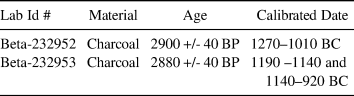
The K'as complex was identified in a single-component deposit (Level AA) on uneven bedrock underlying more than 4 m of construction exposed in a salvage trench into Structure ZZ1 on the tip of the Candelaria Peninsula (Rice Reference Rice2009:405–406). Level AA is dated by two AMS radiocarbon assays, which returned 95% probability calibrated dates at the end of the second millennium BC (Table 2). No single-component K'as deposits have yet been recognized in excavations at mainland Nixtun-Ch'ich’, although fragments have been identified in early mixed fills, especially in the city's civic-ceremonial nucleus.
Dates on K'as Pottery, Level AA, Mound ZZ1, 2-σ Range.

Note: Data from Rice (Reference Rice2009:Table 2).
Of 348 K'as sherds from Mound ZZ1 (119 from Level AA plus 229 in the overlying Chich stratum), all but 12 were unslipped and were sorted into five types (Table 3; see South and Rice Reference South, Rice and Walker2020 for detailed descriptions). Caldo Unslipped, with volcanic ash inclusions, is relatively well fired (“clinky”). T'ot’ Unslipped has a coarse gray carbonate paste with flat spiral shell inclusions. Tunel Unslipped has a similar but variably colored (gray to reddish) carbonate paste lacking shells; these “generic” sherds were likely frequently overlooked in later deposits. Brisas Unslipped, with a “pinkish-brown” paste, includes a brushed variety (Cepillada). Lunada Unslipped is cream with small dark-gray fireclouds, especially at the rim. Brisas and Lunada sherds continued through the Chich and Nix complexes at Nixtun-Ch'ich’ and in Mamom complexes throughout the western and central lakes area, although Lunada was uncommon at Nixtun-Ch'ich’. The scant evidence for forms includes a short-necked jar and neckless jar or tecomate (Brisas), a narrow-necked jar (T'ot’), a flat base (Tunel), and a small flaring-sided bowl (Caldo).
K'as (Late Early Preclassic) and Chich (Terminal Early Preclassic) Complex Type and Variety Names.

Note: Aside from black, orange, and dark-red slips and some simple pre-slip incising, virtually all slip colors and decorative types/modes are Late Chich (South Reference South2019).
The absence of single-component K'as deposits on the mainland might be a consequence of the ancient clearing of soils over bedrock and the removal of refuse from earlier occupations. Excavations into the corridor (Avenue H2) near Platform AA1 revealed that bedrock had been cut to extract construction stone, with removal of overlying natural or cultural material (Pugh and Rice Reference Pugh and Rice2017:586, Figure 5). Bedrock cutting and leveling were also noted near the southeast corner of the platform and on the south edge of Platform J1 to the north.
Terminal Early Preclassic (Pre-Mamom) Chich Complex
Pottery of the Chich complex (Table 3) is contemporary with—but distinct from—that of the Eb complex at Tikal, Xe in the Río Pasión/Seibal area, and Cunil in western Belize and eastern Petén. It is associated with the earliest platform construction at Nixtun-Ch'ich’, which was typically built directly on uneven bedrock. In some sectors this complex can be separated stratigraphically into early and late components.
Early Chich deposits are readily identifiable by the predominance of black-to-dark gray (e.g., Estero Unslipped) and pinkish-tan or pinkish-brown (Brisas Unslipped) colors. Striation (Viento Striated) is rare. Compared with K'as, sherds at Early Chich are distinguished by more common slipping: predominantly black (Belisario) but also red—dark Fosa Red and streaky Chapito Red-orange—and some orange (Ainil). There is relatively little decoration or information on the forms. Late Chich pottery exhibits a greater prominence of slipping, more red than black slips, a wider variety of slip colors (Candelaria Cream, Boolay Brown, Baadz Tan, and Caprese Gray types, with bichromes present but uncommon), and more varied plastic decoration: pre-slip groove-incising, fluting, chamfering, and some combined modes (“composite”).
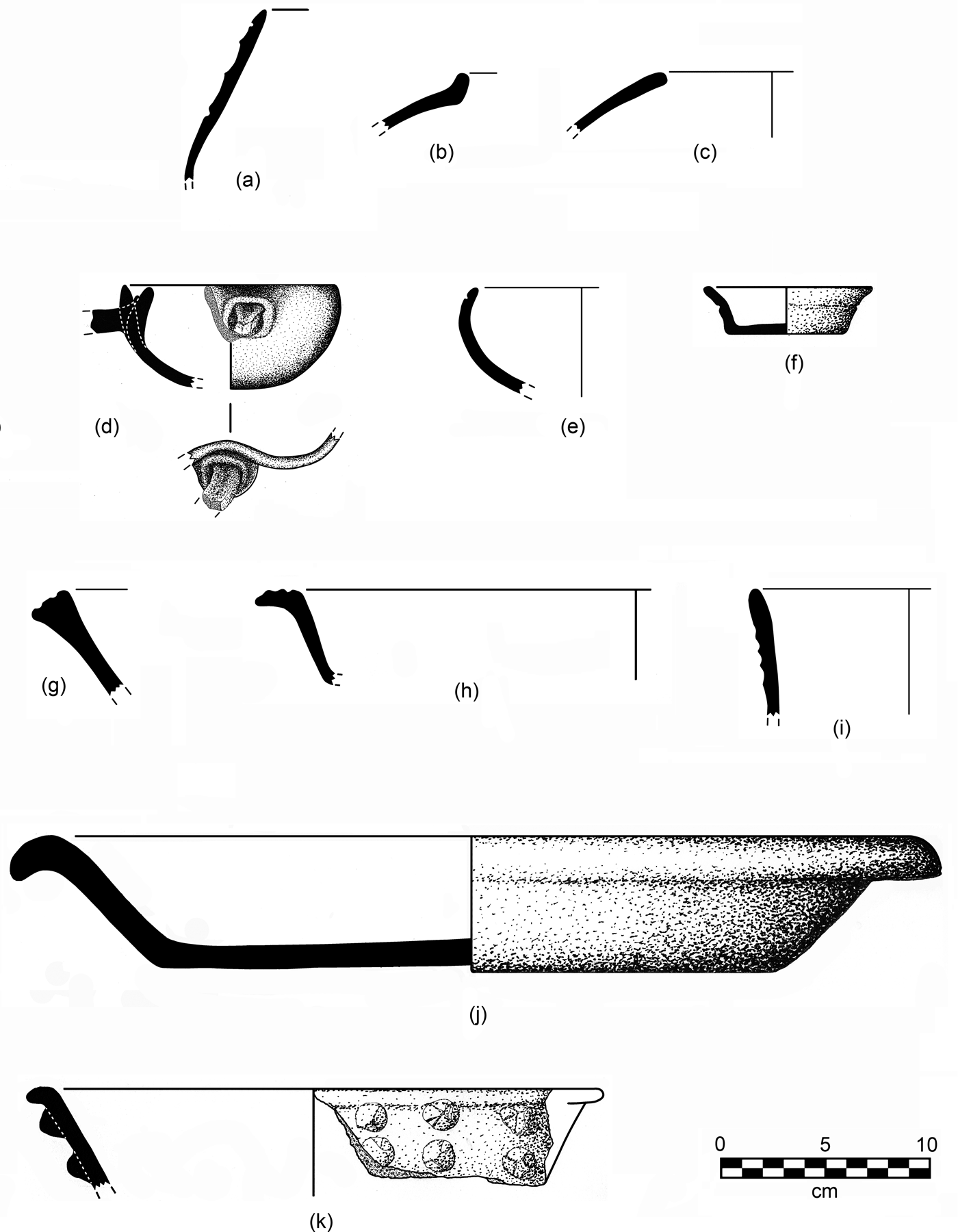
Slipped forms include tecomates (Figure 2a–c); small jícara-like bowls or cups, about 10 cm in diameter (Figure 2d, e); small shallow “condiment dishes” (Figure 2f); and dishes or plates with two groove-incised encircling lines on the rims (Late Chich; Figure 2g, h) or “hook” rims (Figure 2j). Slipped vessels are generally thin walled and medium to small in size. Unslipped vessels are typically large wide-mouth jars with short necks and everted rims (Figure 4a), but spiked censers (Figure 2k) and one unslipped condiment dish were also noted.
Chich complex forms and types: (a) Marielos Composite (incised and fluted, cream-slipped) tecomate, Structure J1; (b) Chapito Red-orange tecomate, Structure J1; (c) Fosa Red tecomate, Structure W1/1; (d) Candelaria Cream jícara-like cup with broken stem/handle, Structure W1/1; (e) Tono Incised (Chapito group) cup, Structure W1/1; (f) Belisario Black “condiment dish,” Structure Z1; (g) Vínculos (Fosa group) incised dish with groove-incised lip, Fosa Y; (h) Unnamed dichrome (cream interior; red exterior) dish with groove-incised lip, Structure J1; (i) Xtoyil (Ainil group) Fluted dish?, Fosa Y; (j) Chapito Red-orange “hook-rim” dish, Fosa Y; (k) Brisas Unslipped: Cepillado variety spiked censer, Structure D1.

Three pastes were distinguished in red-slipped pottery in Chich levels of Structure W1/1: (1) tan, thick, and dark-cored (similar to Late Preclassic pastes), particularly in the Chapito Red-orange type; (2) light reddish-tan and sandy; and (3) red with a dark core. The first two were also noted at Structure HH1 to the southwest. Another paste, pinkish and fine, had ash temper.
Middle Preclassic Nix Complex
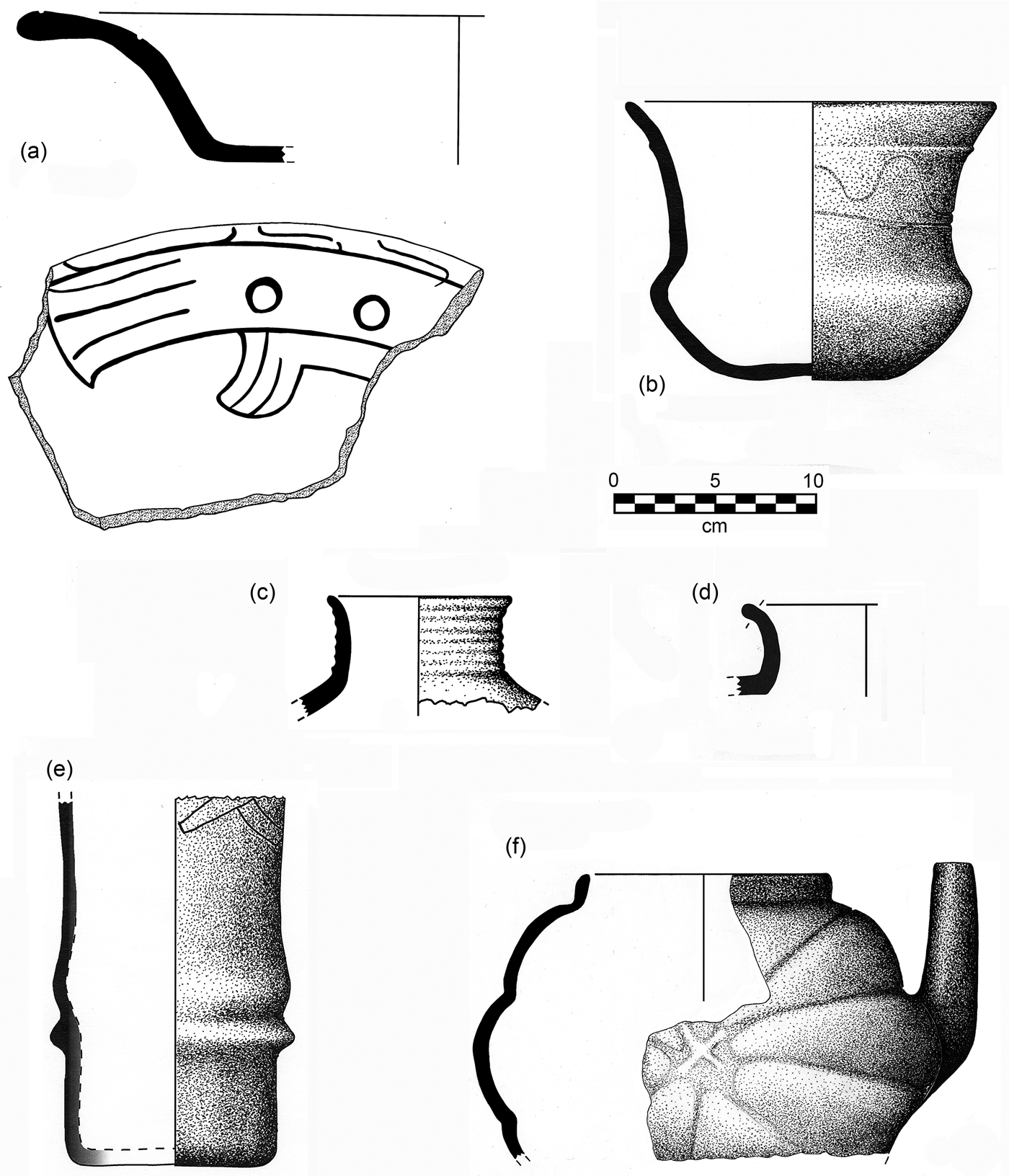
Pottery of the Nix complex, particularly Late Nix, has already been described (Rice and Pugh Reference Rice and Pugh2017). The complex is best characterized by two primarily red-slipped forms: large platters and cuspidors. The platters (tamaleras), often thick walled and heavy, have broad, flat everted rims, sometimes faintly ridged or with groove-incised designs (Figure 3a). Cuspidors are beaker-like vessels, possibly for drinking (Figure 3b). Other typical forms, which are also red-slipped and groove-incised, fluted, or chamfered, include varied bowls and dishes. The cream-slipped and fluted narrow-neck jar (Figure 3c) is unusual because jars are primarily globular with short narrow necks and everted rims and are slipped black (Figure 3d). Rare Late Nix forms include ridged cylinders (Figure 3e), found only in Fosa Y, and modeled and spouted vessels, sometimes shaped like squashes or cacao pods (Figure 3f). More common are black-slipped open bowls with broad bands of chevron-like incising (Deprecio Incised; Figure 4d), which also appear in Yum Transitional deposits.
Nix complex forms and types: (a) Chapo Red-Orange design-incised tamalera, Fosa Y midden; (b) Tormenta Groove-Incised (Juventud group) cuspidor, Fosa Y midden; (c) Cacao Fluted (cream-slipped) jar neck, Platform BB1; (d) Belisario Black jar rim, lip worn, Structure W1/1; (e) Juventud Red ridged cylinder, Fosa Y midden; (f) Golondrina Modeled (Chunhinta group), spouted vessel in form of a cacao pod, Fosa Y midden.

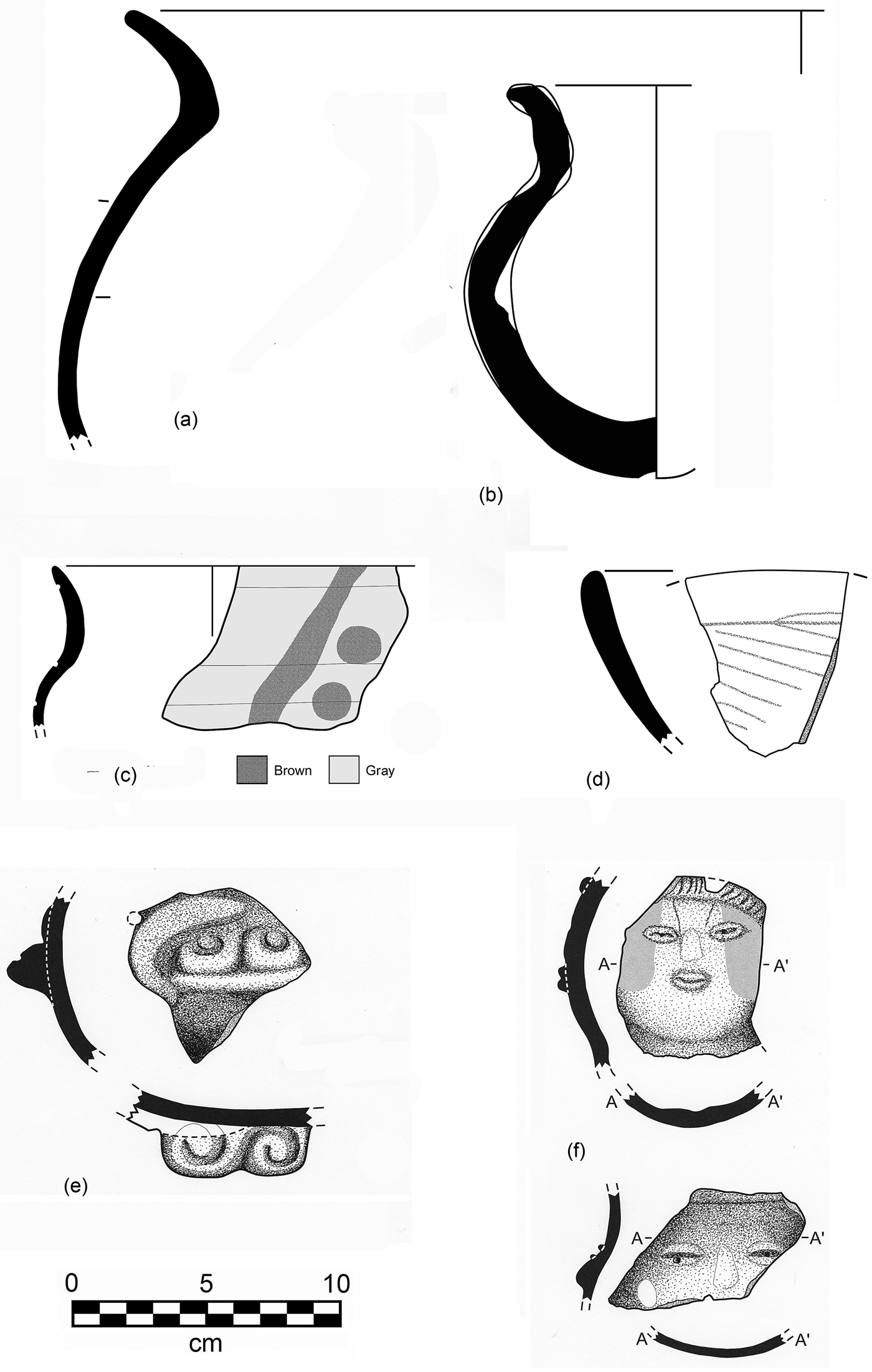
Miscellaneous: (a) Brisas Unslipped jar, lower interior and exterior fire-clouded to marks, Fosa Y midden (Chich and Nix); (b) Uck Red small asymmetrical jar, Fosa Y (Chich); (c) unnamed composite silhouette bowl with incising and brown-and-gray resist decoration, Structure Q1/1 (Nix); (d) Deprecio Incised (Chunhinta group), incised bowl, Fosa Y (Nix); (e) muyal(?) glyph on lug-like applique to side of Belisario black-slipped jar(?), Structure W1/1 (Chich); (f) “face jars,” Structure W1/1 (Nix): top, with braided headband and red paint over center of face; bottom, Belisario Black.

Pottery and Construction by Sector
Of the 10 sector loci discussed in this section, 3 (D1/1, BB1/2, ZZ1) exhibit stratigraphic superposition of two Terminal Early Preclassic (Chich) construction fills. Two—Structure AA1/1 and Structure/Fosa Q—reveal Early Chich construction but no clearly Late Chich strata. Two other sectors (Y, J1) yielded primarily Late Chich ceramic artifacts, and two others (HH, QQ1) can only be described as general Chich because excavations were not taken to bedrock.
Sector BB: Platform BB1
Sector BB is the easternmost of four blocks comprising the core of Preclassic monumental architecture on the central axis. The massive BB1 substructural platform supports a Triadic Group (Structure BB1/1–1) on its eastern end, which at 27 m above ground level is the site's tallest edifice. Triadic Groups are primarily Late, rather than Middle, Preclassic architectural forms.
Of four excavations around the platform, only one reached bedrock and the Chich construction: a 1 x 4 m trench on the north–northwest corner where a ramp or stairway gives access to the platform summit from adjacent 4th Street to the north (Darroch et al. Reference Darroch, Reyes, Pugh, Pugh and Chan Nieto2015). An uneven cut into bedrock was covered with a layer of clay (Level 23), which incorporated Early Chich pottery: Fosa Red, Ainil Orange, and possibly Reforma Incised (Mars Orange ware or an imitation). Six conjoinable Caldo Unslipped (K'as complex) sherds, likely representing a globular jar body, were also present. Levels 22–20 appeared to be Late Chich. Pottery included Ainil Orange, Chapito Red-orange, Fosa Red, Vínculos Incised, Savana Orange (including a spout), and Belisario Black: Púrpura variety. A red-slipped dish with a grooved lip, 28 cm in diameter, had a dark Fosa interior and an orangey Chapito exterior slip. Level 20 was a stratum of packed sticky black clay (see Rice et al. Reference Rice, Cordell, Kidder, Harris, Pugh and Chan2018), above which a plaster floor (Level 19) extended north across the corridor. Mixed Chich-Nix pottery, plus a K'as sherd, was recovered in Yum Transitional fills above this floor.
Sector AA: Structure AA1/1
Structure AA1/1, immediately west of Platform BB1, is thought to be the elongated eastern range structure of an E-Group, a quasi-astronomical assemblage (see Freidel et al. Reference Freidel, Chase, Dowd and Murdock2017). A pozo de registro cronológico on its west (front) side penetrated 2.91 m in 21 levels to bedrock, whereas another unit in the center of the structure reached bedrock below Level 9 at 2.52 m (Chan and Pugh Reference Chan, Pugh, Pugh, Góngora and Nieto2014). The lowest levels in the western unit, Levels 21–15, incorporated three thin floors or surfacings, the lowermost (Level 19) covered with two layers of orange plaster and the uppermost, Level 15, painted red-orange. Only 20 sherds, generally very small, were recovered from these seven levels; at least one and perhaps all represented the K'as complex.
The top of Level 15 in the western excavation unit and the bottom of Level 9 (sticky black clay above bedrock) in the center unit coincided at about 2.5 m below datum, suggesting construction of a Terminal Early Preclassic (Early Chich) platform ~1.10 m high. Several fragments of K'as pottery were mixed with this material, and one T'ot’ Unslipped sherd was noted in a later level. Strata above yielded substantial quantities of pottery, in contrast with the levels below, although fragments were generally very small and often eroded. This material included one to three sherds each of Fosa Red and Festejo Fluted, Xtoyil Fluted (one a tecomate sherd), common black-slipped fragments (Belisario, including the Púrpura variety), Ensenada Incised, Brisas Unslipped, and several K'as fragments, as well as abundant Estero Unslipped (several representing a jar). Upper construction fills in these and other units in Structure AA1/1 include quantities of these and other Middle and Late Preclassic pottery fragments, which are typically small and eroded, with occasional Late Classic sherds mixed in.
Sector Y
Sector Y, the westernmost of the four blocks of Preclassic monumental architecture, features two contiguous substructural platforms: Y1 (west) supports an E-Group, and Y2 (east) was built around a large depression, Fosa Y (Rice and Pugh Reference Rice and Pugh2017; Rice et al. Reference Rice, Pugh and Chan Nieto2019). Both constructions begin with Late Chich bedrock leveling. No K'as types were securely identified, but some of the abundant black-gray-brown sherds in the lower Chich deposits might be K'as.
A deep test-sounding into the platform in front (west) of the elongated eastern structure (Y1/1) of the E-Group penetrated a series of fills and floors representing two sequential constructions. The first was Yum Transitional, incorporating a mix of Chich (mostly gray and black) and Early Nix (cuspidors) complex pottery to create a platform rising 2 m above bedrock. Above this level, 3 m of Nix Mamom fills raised the platform, with the upper portion encasing the low walls of what may be the earliest versions of Structure Y1/1. In Platform Y2 to the east, excavations in three locations failed to reach bedrock, including units nearly 7 m deep in the Fosa Y depression. A Late Nix feasting midden with primary breakage of large beautifully slipped vessels occupied the 20 m wide interior of an amphitheater-like tier of rocks in the fosa (Rice and Pugh Reference Rice and Pugh2017).
Both Platforms Y1 and Y2 were raised and expanded in the Late Preclassic period.
Sector W: Structure W1/1
Platform W1 and Structure W1/1 lie on the city's central axis, west of the civic-ceremonial core. Excavations in a test-sounding proceeded through 20 construction levels, including 7 floors or surfacings, to bedrock. Level 20 incorporated small quantities of small eroded mixed Chich sherds; Level 19, below a floor, yielded a large quantity of pottery, some as sizable sherds, but much was unidentifiable. Types include Estero Unslipped, Chirmol (red) Chamfered, Belisario Black, Ensenada Incised, fluted Mars Orange, and two unnamed composite types, both with pre-slip groove incising: Chapito-group red-orange with chamfering and a cream and red-orange dichrome. A few possible Tunel Unslipped (K'as) sherds were also noted.
Sherds in Levels 18 to 13, below and above floors, were Late Chich, with varied slips and decoration, but were small and included few rims. Levels 15–13 penetrated fill of large undressed limestone blocks. Types in these strata include Brisas Unslipped: Brisas and Cepillado varieties; Estero Unslipped; Fosa Red: Moteado variety; Vínculos Incised; Belisario Black: Pizarra and Belisario varieties; Ensenada Incised (with hematite or cinnabar in the incised lines); and Caprese Gray: Caprese and Plateado varieties. Several K'as sherds (five Caldo Unslipped and two Tunel Unslipped from a thin-walled “clinky” jar) were found in these levels. Also present was one horizontally fluted Mars Orange sherd and rare Boolay Brown, Baadz Tan, and Ainil Orange fragments. Other unidentified sherds include a few cream slips (Candelaria Cream?), two sherds with fine post-slip incising (Cunil products?), several Chapito cups, a spout of orange paste (local version of Mars Orange), and miscellaneous (Fosa?) red-slipped body sherds on red paste.
Some of the upper units excavated in the broad surface clearing of Structure W1/1 suggested reverse stratigraphy in that Level 3 (and sometimes Level 2) yielded quantities of Middle Preclassic pottery. These included one red-slipped and one black-slipped fragment of modeled “face jars” (Figure 4f). At Uaxactun, similar modeled fragments were identified in the Pital Cream (Mamom) ceramic group (Smith Reference Smith1955:II:Figure 78e; Smith and Gifford Reference Smith and Gifford1966:162).
Sector Q: Platform Q1 and Fosa Q
Platform Q1 features a depression or fosa just north of Structure Q1/1-2, which has collapsed partly over its southern edge. The fosa features a 20 m diameter tiered arrangement of rocks, some visible on the surface, similar to that around Fosa Y. Excavations to bedrock revealed a few tiny Chich sherds in Level 18, sealed by Floor 9. Above, Levels 15 to 13 incorporated moderate quantities of Yum Transitional pottery (including a face jar fragment and censer fragment), as well as bone, shell, and lithic artifacts. The deposit, possibly a primary midden but lacking any refits between sherds, was sealed by Floor 8. Levels 12 through 4 above Floor 8 included Early Nix Mamom pottery: Brisas Unslipped jars, Chapo Red-orange dishes (one with a pre-slip incised everted rim), and Candelaria Cream cups, plus anthropomorphic figurines. An unusual fragment of a small composite-silhouette bowl features brown-and-gray resist decoration and incised encircling grooves (Figure 4c).
Pottery in the upper levels of Fosa Q is Late Preclassic and later.
Sector D: Structure D1/1
A 5 m deep unit on the north side of Structure D1/1, in the northeastern part of the site, was excavated to bedrock through 43 levels, revealing nearly 4 m of Preclassic construction. Levels 42 and 43 consisted of the compact dark gray clay frequently found to underlie early constructions at Nixtun-Ch'ich’ (Rice et al. Reference Rice, Cordell, Kidder, Harris, Pugh and Chan2018). Levels 43–41, 27 cm thick, yielded only 31 very small Early Chich sherds. Most were unidentifiable except for one Fosa Red, three Brisas Unslipped, and two Estero Unslipped (black) fragments, plus several worked sherds, including one possible net sinker.
Levels 40 through 38, 28 cm thick, were distinct strata of sandy soil of different colors and textures; they incorporated tiny eroded sherds of Late Chich pottery (or possibly mixed Early and Late). Identifiable types included Fosa Red and Chapito Red-orange, Belisario Black, one possible Candelaria, Xpokol Incised (Ainil orange group), and three Brisas Unslipped. These sandy fills were surmounted by seven thin strata of various colored fills and four probable “floors” or surfacings representing a structure rising 1 m above bedrock. These levels included the same types as in the sandy strata below, plus one sherd of probable K'as ware, all small and eroded. Black, dark gray, and brown slipped and unslipped sherds predominated.
Levels 30 through 27, above the Level 31 floor, were Yum Transitional, evidenced by the greater quantities and sizes of sherds in general; the greater presence of red, orange, and cream slips; and more and more varied decoration.
Sector J: Platform J1
In Sector J, north of the civic-ceremonial core, clearing excavations explored the southern edge of the platform to investigate its constructional intersection with 4th Street, and two soundings reached leveled bedrock ~3.2 m below surface. Both units revealed a complex sequence of thin floors or surfacings—as many as seven in the northernmost unit—that yielded little datable pottery (probably Late Chich or Yum Transitional). The lowest level in the southern unit (in 4th Street itself)—Level 12—yielded large quantities of pottery and clay figurines. These pozos may have penetrated an area that was once an open plaza and repeatedly resurfaced before being overbuilt in the Late Preclassic period.
Sector HH: Structure HH1
Excavations of a small test unit east of low mounded Structure HH1 encountered Nix Middle Preclassic pottery under a floor at 1.41 m and quantities of Yum Transitional pottery below a floor at 2.06 m below the surface. Unfortunately, these 1995 excavations were halted before they reached bedrock.
The material in Level 12, below the lowest floor, was Late(?) Chich or, more likely, early Yum in date. It included Brisas Unslipped; Candelaria Cream (Cacao Fluted and Chocolate Incised) cups; a wide range of red-slipped pottery including cuspidors, spouted vessels, and plates or dishes with everted and hook rims; and two clay figurines. Black (Belisario) and brown (Boolay) bowls of medium to large sizes bore wide encircling bands with both pre- and post-slip incised decoration. Similar types and forms appeared in the fills between the two floors.
Sector QQ: Structure QQ1/1
Structure QQ1, a large substructural platform on the southwestern edge of Nixtun-Ch'ich’, faces the narrow western finger of Lake Petén Itzá. The platform is dominated by two large, south-facing, Postclassic open halls with C-shaped benches (Pugh et al. Reference Pugh, Rice, Chan and Rice2016). Structure QQ1/1, excavated in 1995, is the easternmost of the two, which shared a wall.
Feature 2 appears to be a Preclassic structure underlying and interior to the footprint of Structure QQ1/1. It yielded a sizable deposit of large sherds of mixed Preclassic pottery, about 70 cm below the surface, including rims of at least two enormous Brisas Unslipped jars with mouth diameters of 56–58 cm. Two early Late Preclassic (Chuen at Tikal) vessels in Feature 2 suggest overbuilding of the Preclassic structure. Twenty-six solid modeled-clay figurines were recovered in the Postclassic construction, doubtless originating in the earlier building.
Sector ZZ: Mound ZZ1
Mound ZZ1 on the Candelaria Peninsula, excavated by an axial salvage trench through the south face of this two-tiered platform (Rice Reference Rice2009; South Reference South2019), yielded our only primary deposit (Level AA) of Late Early Preclassic K'as pottery, directly on bedrock in the north end of the trench. Interpretation of the early construction history of Mound ZZ1 is difficult: at least two renovations removed plaster surfaces and mixed the fills, and our excavations penetrated to bedrock at the southern and northern ends of the 38 meter long trench but not between them.
In the northern part of the trench, dry-core Chich fill overlay Level AA. In the southern part of the trench, similar fill overlay bedrock, possibly representing two depositional events. Identified as Platform ZZ1-sub-8, it incorporated Yum Transitional pottery and was capped with a thick plaster floor (Floor 6/12). This floor was destroyed in the south when the Platform ZZ1-sub-8 platform was remodeled to create Platform ZZ1-sub-7, which expanded the structure southward over a 20–30 cm thick Early Nix deposit overlying bedrock (Levels 15 and 16) and abutting four low construction-cell or retaining walls. In the northern part of the trench, north of three small buildings, Floor 6/12 and Platform ZZ1-sub-8 were also destroyed and replaced by thick Early Nix fill (Level U1).
The pottery in these fills is similar to that in the Fosa Y Late Nix feasting deposit: large sherds with refits, resulting from the primary breakage of beautifully slipped large platters, medium-sized dishes and cuspidors; and small dishes and cups. An important difference between the two fills is the abundance of cream-slipping in the ZZ1 deposit, compared with the prevalence of red slips in Fosa Y. The vessels are thought to represent a community celebration, perhaps a work-party feast, on the occasion of the refurbishment of Platform ZZ1-sub-8 and construction of Platform ZZ1-sub-7 (Rice Reference Rice2009:409). No surfacing of the ZZ1-sub-7 platform was evident in the trench excavations, and it was likely destroyed by the subsequent enlargement. These later levels are also mixed, incorporating Chich, Nix, and Late Preclassic Chito complex sherds.
Intra- and Intersite Comparisons of Ceramic Complexes
The pottery from these structures can be compared with early material from nearby western Lake Petén Itzá sites and from the more distant Tikal (45 km northeast) and Seibal (45 km south) sites. Of the nearby sites, only the small hamlet of Buenavista-Nuevo San José, 6 km to the northeast, yielded Pre-Mamom pottery (Castellanos and Foias Reference Castellanos and Foias2017). No complex earlier than Mamom was securely identified in the Tayasal-Paxcaman zone, where excavations focused on the Postclassic period and were not consistently taken to bedrock (Chase and Chase Reference Chase and Chase1983:11, 77). Similarly, Preclassic pottery on Flores Island begins with the Mamom sphere (Cowgill Reference Cowgill1963:17; Forsyth Reference Forsyth1996:6–7).
K'as Pre-Mamom Complex
Only two areas of K'as pottery were identified at Nixtun-Ch'ich’: the Mound ZZ1 Level AA primary deposit and on the mainland in early levels below what became the civic-ceremonial core. In the former, this pottery occurred with chert flakes, two El Chayal obsidian fragments, fragments of edible Pomacea (apple snail) shell, a worked-sherd fishing net sinker, a metate fragment, and a figurine fragment, all of which suggest domestic debris (Rice Reference Rice2009:406). On the mainland, K'as pottery appeared as a few tiny eroded sherds, typically dark colored, incorporated into Chich fills in Structures AA1/1 and BB1/2 and in nearby Structure W1/1. Their presence—probably undercounted—raises the likelihood that a small Late Early Preclassic (pre-~1100 BC) occupation might have existed here, more than 1 km west of Mound ZZ1.
The scarcity and condition of the earliest ceramic artifacts at Nixtun-Ch'ich’ may reflect a small pottery-using population, low levels of production/import of pottery vessels, impermanent settlement, refuse disposal involving exposure and comminution of broken vessels, or some combination of these and other factors. Although the early K'as sherds in later construction fills are small and uncommon, they are nonetheless significant as evidence for early pottery use in the lowlands.
The K'as pottery locations also support observations about “early ritual areas” (Powis and Cheetham Reference Powis and Cheetham2007; Rice Reference Rice, Freidel, Chase, Dowd and Murdock2017:138): the earliest public structures and gathering places are often established in or near the domestic compounds of early community founders or elders, becoming venerated ground for later civic-ceremonial construction and the elders or founders becoming named ancestors. This process is part of “place-making” and building a sense of community identity, along with the loss of egalitarianism (see Canuto Reference Canuto, Traxler and Sharer2016:482, 503–505).
Chich Pre-Mamom Complex
The Chich complex at Nixtun-Ch'ich’ occurs in two components, sometimes stratigraphically superposed. Early Chich is characterized by the predominance of black, dark gray, and tan or brownish colors of unslipped pottery, perhaps signifying continuities with earlier K'as clay resources and firing technology. Slips—primarily black, dark red, and some orange—are of highly variable quality: some are thick and lustrous, but others often have mottled, blotchy, spotty, and streaky colors. One wonders whether Early Chich potters were acquainting themselves with new fuels and their burning characteristics, as well as new clay resources for vessel bodies and slips. The slips they produced were not the “dull” slips characteristic of Real Xe pottery at Seibal. Colors in the brown-tan range were particularly difficult to pigeonhole into types because of color variations (to orangey or gray), streakiness, and rarity. Little decoration is seen in Early Chich, incising being the primary decoration that does appear. There is often little information on forms.
The Late Chich complex is distinguished by a greater prominence of slipping, especially red, and some is of excellent quality. Chapito Red-orange slipping is probably a predecessor of later Nix Mamom Chapo Red-orange, which in turn may be related to Baclam Red-orange of the early Late Preclassic (Chuen complex) at Tikal. The complex is also characterized by a wider variety of slip colors (including cream, brown, and gray, as well as bichromes), more and more varied plastic decoration (fluting, chamfering, and groove and design incising), and better “quality control” overall. In both Early and Late Chich complexes the pottery often has disproportionately thin walls and especially thin bases, suggesting fragility, and vessels are mostly medium to small in size, perhaps for individual servings of food. The round-sided incurved-rim bowls or cups (Figure 2d, e) are a good example.
Mars Orange (paste) ware occurs in both Chich phases; sherds are hard and thin walled in the early component, but thick and “soft” in the late. Mars Orange—more common in the Middle Preclassic and a presumed Belize Valley product—occasionally includes volcanic ash, which may indicate a different production locus (Callaghan et al. Reference Callaghan, Pierce and Gilstrap2018). A Reforma Incised fragment was recovered in the Early Chich stratum of Structure BB1/2, and a fluted sherd was found in Structure W1/1; at Barton Ramie, fluted decoration became an unnamed variety of the Reforma Incised type (Gifford Reference Gifford1976:77, Figure 27r). Oddly, Mars Orange is not reported at Buenavista-Nuevo San José, which otherwise appears to have strong eastern connections (Castellanos and Foias Reference Castellanos and Foias2017). Calam Buff, a widely recognized type in the central Petén lakes (including nearby Buenavista-Nuevo San José; Castellanos and Foias Reference Castellanos and Foias2017:17) and farther east in the Cunil complex, is very rare at Nixtun-Ch'ich’. Two sherds of another Cunil type, Uck Red, represented small but thick-walled jars in an Early Chich deposit in Structure AA1 and later at Fosa Y (Figure 4b). A nearly identical jar was recovered at Buenavista-Nueva San José (Castellanos and Foias Reference Castellanos and Foias2017:Figure 25a). One hallmark of Cunil pottery, post-slip fine-line incising, is rare at Nixtun-Ch'ich’.
The Chich complex is found over a wide area at Nixtun-Ch'ich’ including the peninsula. On the mainland, it goes from the northeast at Structure D1 to the southwest at Structures HH1 and QQ1. Chich pottery exhibits considerable variability from excavation locus to locus and grid sector to sector. For example, four distinct pastes were used for red-slipped vessels. Production of Chich complex pottery was likely carried out by multiple small potting households scattered over the ~2 km2 area that eventually became the gridded urban landscape. Because of this high variability, especially in terms of decoration, it is difficult to discern whether the early differences among sectors reflect distinct co-residential descent groups/lineages, barrios/hamlets, time, social ranking, function, ethnolinguistic differences/affiliations, or some combination. In Structure W1/1, for example, on the central axis just west of the civic-ceremonial nucleus, chamfered, incised, and composite (but not fluted) decoration and red-cream dichromes appear in what I parsed as Early Chich in the lower of two Chich construction fills. Perhaps both levels are Late Chich, or the decorative complexity might represent social/functional differences. I wonder if Sector W, because of its relatively elaborate pottery, complex construction, and proximity to monumental architecture, might have been a high-rank residence or another functioning structure. One jar fragment displays a glyph-like sign (Figure 4e), common on Olmec and other early pottery, called an ilhuitl (Nah. “festival”), infinity scroll, lazy S, or opposed volutes. It may be the Maya muyal (cloud) glyph or the fifth-day “serpent” sign in early calendars (Edmonson Reference Edmonson1988:Figure 15a).
Quantities of similarly early pottery have not been identified elsewhere in the western basin of Lake Petén Itzá. Early pottery at Trinidad de Nosotros on the northwest shore comprised only 40 sherds, provisionally identified as Pre-Mamom and Early Middle Preclassic, dated 800–650 BC (Moriarty Reference Moriarty, Foias and Emery2012:201–205). At Buenavista-Nuevo San José, approximately 6 km to the north-northeast of Nixtun-Ch'ich’, the abundance of post-slip incising and slip characteristics in the Buenavista complex led the investigators to identify some types with the Cunil complex in western Belize and eastern Petén (Castellanos and Foias Reference Castellanos and Foias2017). Four calibrated radiocarbon dates on carbon samples associated with the Buenavista complex have 2-σ ranges between 790 BC and 410 BC (Castellanos and Foias Reference Castellanos and Foias2017:Table 1), placing them within Mamom times. Buenavista-Nuevo San José’s seemingly close ties with eastern pottery producers may have contributed to the presence of Mars Orange ware at Nixtun-Ch'ich’. Nevertheless, the Buenavista and Chich complexes suggest closer relations with Eb pottery at Tikal, and a Pre-Mamom Eb ceramic sphere has been posited (Castellanos and Foias Reference Castellanos and Foias2017).
Compared with Pre-Mamom complexes at other sites, Chich pottery is finer textured than Eb at Tikal and often has volcanic ash; slips are thicker and more lustrous than those of Real Xe at Seibal.Footnote 1 Decoration is predominantly pre-slip groove incising as opposed to the predominant post-slip fine-incising mode of the Cunil complex of eastern Petén and western Belize; Cunil motifs are also absent (see, e.g., Garber and Awe Reference Garber and Awe2009). The distinctive groove-incised lip/rim treatment of slipped dishes is uncommon at best at Tikal and Buenavista-Nuevo San José, but it seems to have some longevity at Seibal, where it appears in the Real Xe and Escoba Mamom complexes (Sabloff Reference Sabloff1975:Figures 35, 79, 116); however, the rim-to-wall angles of the Seibal vessels are more vertical than those of the Nixtun-Ch'ich’ pottery.
Early construction fills characterized by Pre-Mamom Chich pottery were typically overlaid by strata incorporating a mix of Chich and Nix Mamom sherds. We have identified these levels as a Yum Transitional complex/phase/period in the history of Nixtun-Ch'ich’, with construction taking place at the start of the Early Middle Preclassic.
Nix Mamom Complex
Construction incorporating pottery of the Nix Middle Preclassic ceramic complex, around 800–400/300 BC, is found almost everywhere at Nixtun-Ch'ich’, suggesting significant population growth. As mentioned, the Nix complex, like other coeval complexes in Petén, is most readily characterized by two forms: cuspidors and large platters. At Flores, vessels are slipped red, black, or cream and are decorated by pre-slip groove incising and chamfering; platters lack the exaggerated everted rims of Late Mamom/Nix vessels (Forsyth Reference Forsyth1996:6–7). Bichromes are rare or absent, although Tierra Mojada Resist is noted. A relatively abundant but unnamed resist type is gray with blotches of reddish orange, a possible example of which may have been found in Nixtun-Ch'ich’ Structure Q1/1 (Figure 4c). In the Tayasal-Paxcaman zone, pottery of the Chunzalam Mamom complex (Chase and Chase Reference Chase and Chase1983:77–79) exhibited hard well-fired pastes and lustrous slips. Highly variable slip colors, ranging “from black to grey [sic] to brown to red to cream,” were grouped into a Vexcanxan Mottled type in the Pital (cream) group. Decoration included postfire incising, grooving, and horizontal fluting. At Trinidad, Mamom pottery is comparable to that at Tayasal, with abundant orange to red-orange slips and rare cream slips, and uncommon decoration (Moriarty Reference Moriarty, Foias and Emery2012:205–206). Rare types include Palma Daub (Jocote ceramic group), possibly Tierra Mojada, Mars Orange, and a local copy of the ware.
Construction and Complexity
Because events and processes of the Terminal Early and Middle Preclassic periods established the foundations for sociopolitical complexity in the Maya Lowlands, it is appropriate to further consider the contexts of the pottery of the Chich and Nix complexes.
Pottery and Construction
The earliest settlers of Nixtun-Ch'ich’ were likely one or more small kin groups with a mixed-subsistence economy—groups known in other culture areas as “affluent” hunter-gatherer-fisher-forager-collectors—plus horticulture. They were the prestigious founders or firstcomers to the location. Late in the second millennium BC, they began using pottery (the K'as complex) and deposited occupational refuse on the tip of the Candelaria Peninsula. They also occupied an elevated area on the mainland east of a sinkhole, now called Fosa Y, and possibly other places.
By Early Chich times, pottery was more widely adopted at Nixtun-Ch'ich’; vessels were generally small and fragile with little decoration. Architectural investments in the form of low platforms were made in multiple areas, especially east of the fosa in what later became the civic-ceremonial core. These platforms were built over in Late Chich times, with pottery evidencing considerable sitewide variability in forms and decoration. Subsequently, the platforms were raised and enlarged laterally at the beginning of the Nix Early Middle Preclassic: pottery in construction fills consists of Yum Transitional Chich-Nix types and forms.
Occasionally, platform surfaces, such as those of Early Chich Structure AA1/1, the eastern structure of an E-Group, were decorated with orange or red-orange paint or stucco. In addition, there are hints that some structures were given seven resurfacings, possibly within a brief time span. In Structure AA1/1, for example, the three colored surfaces helped define seven refurbishings of a 1 m high platform. In Structure D1, Late (or mixed) Chich fills were topped by seven variously colored fills and four floors of another meter-high structure. Seven thin floors or surfacings were noted in the probable Late Chich construction of Platform J1. It is unclear what these seven sequences might mean, if anything. Seven may be symbolic in relation to creation and origins in late Mesoamerica, but it is not certain that such symbolism holds true in the first millennium BC.
Nix complex pottery evinces still increasing variability in forms, decoration, and overall quality compared with that of Chich, suggesting rank distinctions among social segments, as well as more varied functions and contexts of use. Of particular interest is the widespread presence of large platters and other serving pieces, which suggest that community-wide feasts had become important for ostentatious displays of prestige goods and preferred foods by emerging elites. The ubiquity of Nix pottery also suggests population growth, although at this point we cannot estimate population numbers. The increase likely is partially due to reproductive success internal to the center, but it is more probably a consequence of in-migration. As long as cities have existed, they have been demographic magnets, luring residents from rural peripheries by the promise of new social and economic opportunities.
The broad occurrence of Nix pottery also coincides with massive construction efforts throughout the city. In the monumental core, the early platforms of Chich times were structurally elaborated into an E-Group and a later Triadic Structure to the east and another E-Group immediately west of Fosa Y. Moreover, the Middle Preclassic period witnessed the establishment of the urban grid over the site. Calibrated radiocarbon dates suggest that the grid corridors were emplaced—with fills and plaster surfacing—between ca. 750 and 450 BC (Pugh Reference Pugh2018; Pugh and Rice Reference Pugh and Rice2017. (More precise radiometric dates—early, middle, or late Middle Preclassic—cannot be reliably achieved because of a plateau in the calibration curve.) These corridors, which define ~52 trapezoidal blocks or sectors, modeled the regular rectangular array of scutes on a crocodile's back and created a sacred landscape with Fosa Y as its centering point (Pugh and Rice Reference Rice, Freidel, Chase, Dowd and Murdock2017; Rice Reference Rice2018; Rice and Pugh Reference Rice and Pugh2017).
It is of interest that, on the east side of the site, broad north–south Avenues G and H halt at east–west 3rd and 4th Streets and do not cross through the civic-ceremonial nucleus of the site (nor do Avenues I and J, but their situation cannot be addressed with available excavation data). Four possible explanations, not mutually exclusive, may pertain (see Pugh Reference Pugh2018): (1) the earliest platforms in Sectors Z, AA, and BB already existed as ritual structures, perhaps separated by plazas, when the corridors were constructed; (2) the earliest site layout had a north–south orientation, seen at early Middle Formative sites in Chiapas, on the Gulf Coast, and at Seibal (see Inomata et al. Reference Inomata, Triadan and Aoyama2017:191–194); (3) access to the monumental center was by broad pedestrian walkways that were primary—and perhaps ceremonial—entrances for visitors entering the site from south and north; and (4) by the Late Preclassic and perhaps from the outset, the civic-ceremonial center restricted ordinary pedestrian access from the two main east–west axial pathways.
The Chito Late Preclassic complex is associated with major remodeling of parts of Nixtun-Ch'ich and perhaps all of it. This is seen in horizontal and vertical enlarging of the earlier platforms and modification of the grid corridors as well (Pugh Reference Pugh2018). Before the Late Preclassic (and later) expansion of the substructural platforms that encroached over the edges of the corridors, the core zone might initially have been one or more plaza-like spaces.
Three Fossae
Fosa Y, most probably a cenote, gave access to the watery underworld, the home of the rain gods, and is considered the centering point of the axis of Nixtun-Ch'ich’ and its sacred landscape (Rice and Pugh Reference Rice and Pugh2017). Two other fossae, in Sectors Q and I, may exist in some symbolic relationship to each other and to Fosa Y. Fosa Y in the south is a fixed point of the natural landscape; Fosa I lies about 300 m directly north of Fosa Y; and Fosa Q is about 175 m equidistant from I and Y, approximately 100 m west of the north–south centerline they establish. Together, the locations of the three fossae form a shallow isosceles triangle, making it difficult to believe that Fosas Q and I are also natural features; deliberate creation of these reservoirs may be more likely. Fosa I, east of the large Ball Court 1 complex northwest of the monumental core, has not been test-excavated, but Fosa Q has been, as discussed earlier.
If the ritual use of all three fossae is contemporaneous (Middle Preclassic), they might illustrate some now-lost components of early mythology, sacred landscapes, and ritual settings (particularly in association with E-Groups; see Reese-Taylor Reference Reese-Taylor, Freidel, Chase, Dowd and Murdock2017:496–497). “Three” is a significant number for the Maya, especially with respect to origins/Creation and the Preclassic period, with three of all the following: markers of the major sunrise points in E-Groups, buildings in triadic groups, (hearth)stones of Creation, stars of Orion's Belt, lineages or gods of the Palenque Triad, pairs of gods at Creation, sets of twins in the Popol Vuh, and so on. One wonders if the fossae might be associated with ritual activities of three social collectivities (founders? lineages? political leadership kin groups? tutelary supernaturals?) cycling through the Maya's increasingly formalized calendars. They also support the possibility of an early north–south axis defined by central Avenues F, G, and H leading into the civic-ceremonial core.
Cooperation and Complexity
Archaeologists have increasingly turned to the work of evolutionary game theorists and others in highlighting the roles of prosocial behavior, cooperation, and collective action in societal integration and the development of social, economic, political, and ideological complexity (see Carballo Reference Carballo2013). The Middle Preclassic imposition of the formal bilaterally symmetrical east–west grid of axial cardinally oriented corridors over the early construction of Nixtun-Ch'ich’ was a significant feat of ideological supremacy and labor management in a “trans-egalitarian,” “simple chiefdom,” or “intermediate”-level society. How and why was it accomplished?
Collective action theorists’ ideas about the role of cooperation in the development of societal complexity direct us to consider the labor involved in building early architecture at Nixtun-Ch'ich’. Complex corporate labor organization in ethnographic intermediate societies is based on cooperation and persuasive, not coercive, power by emergent leaders (Stanish and Haley Reference Stanish, Haley, Vaughn, Ogburn and Conlee2004). The early (Chich phase) platforms thus might be considered examples of corporate labor and corporate architecture, “the product of an organized work force greater than several nuclear families” (Moseley and Willey Reference Moseley and Willey1973:459).
Labor is frequently embedded in a schedule or cycle of politico-religious ritual and feasting in the service of a belief system or an ideology. In such a “ritualized economy,” Charles Stanish (Reference Stanish and Carballo2013:88) writes, “Ritual schedules labor; it provides a series of benchmarks that people can count on to guarantee a return on their labor investment in the form of known periodic feasts.” He reviews ethnographic studies of agricultural labor and ritual in Melanesia, concluding that “the degree to which an activity requires complex coordination and involves risks is the degree to which ritual regulation and taboo will be important to that activity” (Stanish Reference Stanish and Carballo2013:90, emphasis in original; see also Rice Reference Rice2008:278–279).
A ritual basis for labor organization is implicit in the Middle Preclassic layout of Nixtun-Ch'ich’, which I proposed (Rice Reference Rice2018) was related to an ideology centering on a mythical, sacrificed, “hole-backed starry-deer” crocodile responsible for world creation (Stuart Reference Stuart2005). The “hole” in the back of the crocodile is Fosa Y, a focal point of the sacred landscape. At least two feasts, possibly labor rewarding, are attested by the Fosa Y midden and the Mound ZZ1-sub-8/7 deposit. Both incorporated large beautifully made, intentionally broken, and reconstructible Nix vessels of varied sizes (along with animal bone, figurines, and other items); the Fosa Y feast occurred in a dramatic amphitheater-like setting. Such a feast in this primal location lends support to the role of cooperative labor in service to a larger ideal and ideological imperative in the Middle Preclassic. Moreover, such displays and celebrations contribute to collective memories, a sense of community, and place-making (see Canuto Reference Canuto, Traxler and Sharer2016:504). At least some of the ritual scheduling was likely based on annual solar stations, such as equinoxes and solstices (also zeniths?), commemorated by E-Groups (Rice Reference Rice, Freidel, Chase, Dowd and Murdock2017): three E-Groups lie on the central axis of Nixtun-Ch'ich’, and the Fosa Y feast took place immediately east of the Sector Y E-Group.
Some of the early scheduling doubtless involved agricultural labor: in Melanesia, for example, the ritual leader of agricultural labor scheduling and ceremonialism was the chief and “garden magician” (Stanish Reference Stanish and Carballo2013:89; see also Santos Granero [Reference Santos Granero1986] for Amazonian South America). At Nixtun-Ch'ich’, a large labor commitment between planting and harvesting and replanting was undoubtedly dedicated to creating the grid. Among the early Maya, scheduling of agricultural and construction labor and ritual was likely in the hands of archaeologically invisible early specialists in “sky-watching” or “day-keeping” (Rice Reference Rice2008). These now-unknown but then-illustrious individuals were preoccupied with the creation of one of the Mayas’ unparalleled achievements: formal calendars based on cycles of the sun and moon and the underlying mathematical computations. The many Middle Preclassic and earlier anthropomorphic figurines recovered at Nixtun-Ch'ich’ were, I propose, didactic devices in formalizing concepts, particularly numbers, in the 260-day sacred almanac (Rice Reference Rice, Pugh and Chan Nieto2019). Unfortunately, no carved stone monuments or other media have thus far come to light at the site to suggest the identity of Middle Preclassic individuals or group leaders with the vision to design this site's innovative layout or the persuasive powers to organize the corporate labor regimens to impose it.
Conclusions
Identifying very early—Late or Terminal Early Preclassic (Pre-Mamom)—occupation and construction in the southern Maya lowlands is a fraught exercise. Obstacles include the time and cost of safely excavating through many meters of later construction to reach bedrock. Another problem is the likelihood of ancient removal of the refuse evidencing the earliest occupations over bedrock, with or without its incorporation into subsequent construction fills.
Pre-Mamom occupation and construction at Nixtun-Ch'ich’ are evidenced by early pottery recovered in test units excavated to bedrock in multiple sectors of the grid. This material has been organized into two ceramic complexes: K'as (ca. 1300–1100/1000 BC) and Chich (ca. 1100–900 BC). Absent the serendipitous finding of the Level AA deposit in Mound ZZ1, it is unlikely that K'as pottery would have been recognized as a separate, very early complex. The Chich complex has two phases, early and late, and Chich pottery also mixes with later Nix Mamom complex pottery in multiple Yum Transitional (ca. 900–800 BC) construction fills. This dating is preliminary and may be revised with further work at the site.
Pottery of these complexes, primarily Chich, was identified in the earliest construction of low platforms overlying bedrock in nearly all excavations, including central sectors Y, AA, and BB. During the succeeding Transitional and Middle Preclassic periods, the latter witnessing population growth, a system of cooperative/corporate labor scheduling transformed these sectors into the civic-ceremonial core of the city, with two E-Groups and a Triadic Structure on the site's east–west axis. The urban grid was also put into place. The overall impression is that between about 1100 and 500 BC or so, settlement in this location on the western edge of Lake Petén Itzá was transformed from small clusters of interacting but autonomous households into organized cohesive sectors of a sizable city (for later comparisons, see Arnauld et al. Reference Arnauld, Manzanilla and Smith2016). As far as we can tell from existing data, this complex transformation involved the development of place-making ideologies (and related sociopolitical institutions) that included a spatial layout based on a crocodilian creation myth and growth of a sociospatial center and gathering place(s) distinguished by civic-ceremonial architecture.
It is not unreasonable to propose that, given evidence for widespread Pre-Mamom construction at Nixtun-Ch'ich’, this site became the largest or most influential in the western Lake Petén Itzá region by the Middle Preclassic. Buenavista-Nuevo San José (and Trinidad, as well as probably others) were likely satellites. The early monumental structures of Nixtun-Ch'ich’ and of much of the city itself were subsequently modified and enlarged in the Late Preclassic and later periods, although the formal gridded layout remains to this day.
Acknowledgments
My work in Petén was facilitated through the National Science Foundation, Wenner-Gren, and other grants to Timothy W. Pugh and permitting by the Guatemalan Instituto de Antropología e Historia. Thanks to Evelyn Chan and Sheily Hernández for support in the field and lab and to Don Rice for finalizing the illustrations. No financial or institutional conflicts of interest exist.
Data Availability
The pottery discussed here is housed in the Proyecto Arqueológico Itza lab in Flores. Data are available in the published sources cited in this paper and project reports compiled by Timothy W. Pugh. Additional data may be made available for research purposes by contacting the author.