INTRODUCTION
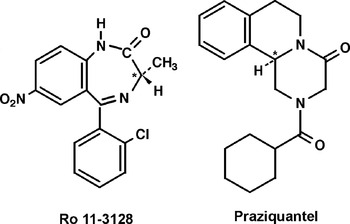
In the 1970s, more than 400 benzodiazepine derivatives were tested for anti-schistosomal activity at Hoffman-La Roche, Switzerland, and 1 of these compounds, called Ro 11-3128 (Fig. 1), emerged as an interesting schistosomicide (Stohler, Reference Stohler, Siegenthaler and Lüthy1978). It is the methyl derivative of clonazepam, another benzodiazepine endowed with anti-schistosomal properties. A single oral dose of 25 mg/kg of Ro 11-3128 was curative against rodent and monkey infections of S. mansoni and S. haematobium, while no activity was observed against S. japonicum. A particularly attractive feature of Ro 11-3128 was its efficacy against both mature and immature forms of S. mansoni. Pilot human trials confirmed the anti-schistosomal activity (Baard et al. Reference Baard, Sommers, Honiball, Fourie and du Toit1979), but also revealed a strong sedative action, which discouraged further development of the compound.
Chemical structures of the active stereoisomers of Ro 11-3128 and of praziquantel. Asterisks indicate asymmetric carbon atoms.

Pax et al. (Reference Pax, Bennett and Fetterer1978) carried out a parallel study on the effects of Ro 11-3128 and praziquantel (PZQ) on the musculature and ion movements of schistosomes, which revealed a number of striking similarities between the two compounds. Both drugs cause an almost immediate spastic paralysis in S. mansoni adults kept in vitro, a phenomenon that is dependent on the presence of Ca2+ in the medium. Neither drug is blocked in its paralysing activity by compounds known to interact with neurotransmitter receptors. Both drugs cause a rapid accumulation of Ca2+ and Na+ in the schistosome, whereas K+ uptake is inhibited. Both drugs produce a rapid disruption of the parasite's tegument (Bricker et al. Reference Bricker, Depenbusch, Bennett and Thompson1983). Both drugs are chiral compounds and only 1 of the respective enantiomers (Fig. 1) is capable of inducing the above effects and the death of schistosomes. Thus, it is tempting to wonder whether the two compounds might have a similar mechanism of schistosomicidal activity.
It has recently been suggested that a functional alteration of the schistosome voltage-gated calcium channels may explain the anti-schistosomal activity of PZQ (Greenberg, Reference Greenberg2005). According to this hypothesis, the altered intracellular calcium homeostasis would be the ultimate cause of schistosome death. We have then asked whether the apparent similarity in the final effects (i.e. intra-worm calcium excess) of Ro 11-3128 and PZQ is achieved through different pathways or whether the two drugs also share the same initial events, e.g. the same receptor sites. To answer this question, we took advantage of the known differences between the two compounds and we tested whether an excess Ro 11-3128 would compete with PZQ against adult S. japonicum and whether an excess PZQ would compete with Ro 11-3128 against immature S. mansoni. We also collected further evidence suggesting similarity in the final anti-schistosomal mechanisms of Ro 11-3128 and PZQ, since we showed that the activity of both drugs could be suppressed by cytochalasin D and – to a lesser extent – by some of the classical calcium channel blockers.
MATERIALS AND METHODS
Parasites and hosts
A Puerto Rican strain of S. mansoni is routinely maintained by alternate passages in Biomphalaria glabrata snails and CB6F1 hybrid mice. Adult worms were obtained by perfusion at 7 weeks or more after infection, while immature worms were obtained at 4 weeks after infection. Single-sex S. mansoni infections were obtained as previously described (Pica-Mattoccia and Cioli, Reference Pica-Mattoccia and Cioli2004). Oncomelania hupensis snails infected with a Chinese strain of S. japonicum were obtained through the kindness of Professor Yonglong Li (University of Science and Technology, Wuhan, China) and the cercariae produced were used to infect CB6F1 mice. Adult S. japonicum were obtained by perfusion at 7 weeks after infection. Single-sex S. japonicum infections were obtained by infecting each mouse with cercariae shed by individual snails.
In vivo treatments
PZQ and Ro 11-3128 were suspended in 2·5% Cremophor EL in water and administered by gavage to individually weighed mice. When both drugs were administered to the same mouse in order to test their possible competition/interaction, PZQ was given twice, 5 min before and 15 min after Ro 11-3128, in an attempt to compensate for the faster removal of the former drug from the host circulation (Pax et al. Reference Pax, Bennett and Fetterer1978).
In vitro cultures
The methods for in vitro cultures have been previously described (Pica-Mattoccia and Cioli, Reference Pica-Mattoccia and Cioli2004). Briefly, 10–12 adult worms or 20–50 immature worms were distributed in duplicate tissue culture dishes in Dulbecco-modified Minimum Eagle's Medium (bicarbonate buffered) supplemented with 20% newborn calf serum, 100 U/ml penicillin, 100 μg/ml streptomycin and 0·5 μg/ml amphotericin B. Cultures were kept at 37°C in an atmosphere of 5% CO2 in air and were observed daily for about 10 days under a stereo-microscope. In competition experiments, cultures were exposed for 15–60 min to different concentrations of either PZQ or Ro 11-3128, added with the other drug and then incubated overnight. In experiments testing the suppressive effects of cytochalasin D and of calcium channel blockers, schistosomes were pre-exposed to these drugs for 60 min before the addition of either Ro 11-3128 or PZQ. After the overnight incubation, worms were washed 3 times and resuspended in drug-free medium. PZQ, Ro 11-3128, cytochalasin D and calcium channel blockers were dispensed from stock solutions in DMSO and control cultures contained DMSO at the highest resulting concentration (0·5% maximum). At the end of the observation period (usually 7–10 days), worms were defined ‘dead’ if they remained contracted, did not resume movements and acquired an opaque appearance. Microphotographs were recorded using a digital camera mounted on the stereo-microscope phototube.
RESULTS
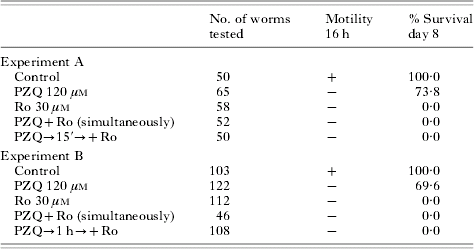
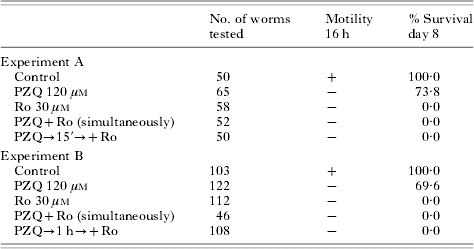
Since PZQ is largely ineffective against immature S. mansoni whereas Ro 11-3128 is active, we first tested whether an excess of PZQ would compete with the action of Ro 11-3128 against these parasites. The results of 2 in vitro experiments are presented in Table 1. As expected, a very high concentration of PZQ (120 μm) only killed between one third and one fourth of the immature parasites, whereas 30 μm Ro 11-3128 eliminated 100% of them. Pre-incubating the worms with PZQ had no effect on the schistosomicidal activity of Ro 11-3128, irrespective of whether the two drugs had been added simultaneously or with an interval of 15 or 60 min. Both drugs caused initially a massive spastic paralysis of immature S. mansoni, but the majority of parasites resumed normal shape and movements upon PZQ removal, whereas the effects of Ro 11-3128 were completely irreversible.
Praziquantel (PZQ) does not compete with the activity of Ro 11-3128 (Ro) on immature Schistosoma mansoni in vitro
(Twenty-eight-day-old S. mansoni were exposed to PZQ for various times before the addition of Ro. Motility was assessed after the standard overnight treatment (16 h), while survival was assessed on day 8.)
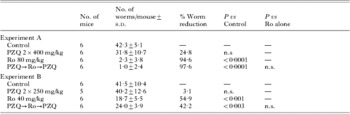
The same competition experiment was also performed in vivo. A batch of mice was infected with single-sex male S. mansoni cercariae and 28 days after infection animals were divided into 4 groups of 6 mice each. Group 1 received no treatment and served as a control; group 2 received 2 oral PZQ treatments, given 20 min apart; group 3 received 1 treatment of Ro 11-3128; group 4 received one PZQ dose, after a 5-min interval 1 dose of Ro 11-3128, and after a further 15-min interval a second dose of PZQ. All mice were perfused 21 days later and the number of worms in each animal was recorded. Table 2 shows the results of 2 similar experiments that differ only for the drug doses employed. It can be seen that, as expected, PZQ had no significant effect on the immature schistosomes, whereas Ro 11-3128 was highly effective. The efficacy of Ro 11-3128 was not affected by the administration of 2 doses of the ineffective PZQ, given 5 min previously and 15 min subsequently.
Praziquantel (PZQ) does not compete with the activity of Ro 11-3128 (Ro) on immature Schistosoma mansoni in vivo
(Mice were infected with single-sex male S. mansoni cercariae 28 days before treatment. PZQ and Ro were administered by gavage either as single drugs or in a sequence consisting of 1 dose of PZQ, a 5-min interval, 1 dose of Ro, a 15-min interval, a second dose of PZQ. Mice were perfused 3 weeks later. The Student's t-test was used to assess statistical significance; n.s.: not significant.)

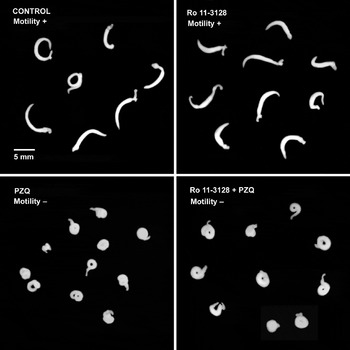
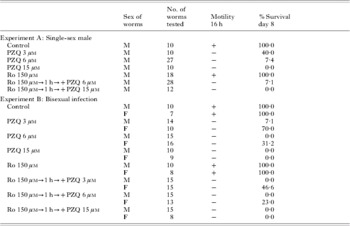
The complementary competition experiment was performed in vitro on adult S. japonicum and the results are presented in Table 3. In Experiment A, only male worms were tested and, as expected, they proved highly sensitive to low PZQ concentrations (6 and 15 μm), whereas 150 μm of Ro 11-3128 was completely ineffective. Pre-incubation with Ro 11-3128 for 1 h did not interfere with the activity of subsequently added PZQ. When S. japonicum of the two sexes were tested (Experiment B), PZQ proved to be more active against male than against female worms, as previously observed with S. mansoni using this in vitro assay (Pica-Mattoccia and Cioli, Reference Pica-Mattoccia and Cioli2004). In any event, 1 h of pre-incubation with Ro 11-3128 did not compromise (in fact, somewhat enhanced) the anti-schistosomal activity of PZQ. The effects of the two compounds on the morphological appearance and motility of S. japonicum on day 8 after drug exposure are depicted in Fig. 2, while the motility in the presence of drug (after the standard overnight incubation) is summarized with a +/− sign in Table 3. PZQ caused the classical body contraction with complete cessation of movements, whereas Ro 11-3128 actually promoted a slightly increased spring-like motility. Upon the addition of both drugs, a spastic paralysis was observed that was identical to the one caused by PZQ alone. Thus, Ro 11-3128 failed to interfere with either the contraction or the killing effects produced by PZQ.
Morphology and motility of male Schistosoma japonicum adult worms exposed in culture to various drugs. Observations were made on day 8 after the beginning of cultures (day 7 after drug removal). Motility is based on simple visual inspection and is indicated with a +/− score. The size scale in the first panel applies to all pictures. Concentration of praziquantel (PZQ) was 6 μm, while Ro 11-3128 was 150 μm and was added 1 h before PZQ.

Ro 11-3128 (Ro) does not compete with the activity of Praziquantel (PZQ) on adult Schistosoma japonicum in vitro
(Adult S. japonicum were exposed in culture to Ro for 1 h before the addition of PZQ. Motility was assessed after the standard overnight treatment (16 h), while survival was assessed on day 8. None of the differences in survival between PZQ alone and Ro+PZQ are statistically significant when analysed with Fisher's exact test.)

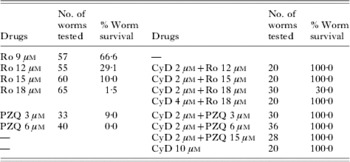
We recently showed that cytochalasin D completely abolishes the anti-schistosomal effects of PZQ in vitro (Pica-Mattoccia et al. Reference Pica-Mattoccia, Valle, Basso, Troiani, Vigorosi, Liberti, Festucci and Cioli2007), which prompted us to ask whether a similar phenomenon could also be observed with Ro 11-3128. To this purpose, adult male S. mansoni were pre-incubated for 1 h with cytochalasin D before the addition of Ro 11-3128 and the incubation with the two drugs was continued overnight. The same protocol was adopted for PZQ. Worms were then washed, resuspended in drug-free medium and observed during the next 7–10 days. Table 4 shows that 12 and 15 μm Ro 11-3128 were able to eliminate 71% and 90%, respectively, of S. mansoni in vitro. This effect was completely suppressed by pre-treatment with 2 μm cytochalasin D. When a higher concentration (18 μm) of Ro 11-3128 was employed, 98·5% of worms were eliminated, but this effect could be completely suppressed only if cytochalasin D concentration was raised to 4 μm. As a comparison, Table 4 also shows that PZQ was considerably more susceptible to inhibition by 2 μm cytochalasin D, since schistosomicidal effects were completely abolished even at PZQ concentrations higher than the 100% effective dose, i.e. not only at 3 μm, but also at 6 and 15 μm.
Effect of cytochalasin D (CyD) on the schistosomicidal effect of Ro 11-3128 (Ro) and praziquantel (PZQ) in vitro
(Adult male Schistosoma mansoni were exposed overnight to various drugs, washed and subsequently cultured in drug-free medium. Worm survival was assessed on day 8. CyD, when present, was added 1 h before the addition of the schistosomicidal drug.)

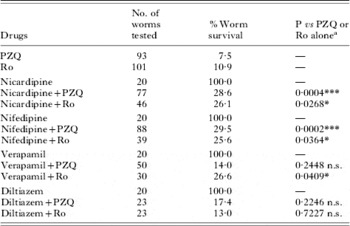
In our previous study (Pica-Mattoccia et al. Reference Pica-Mattoccia, Valle, Basso, Troiani, Vigorosi, Liberti, Festucci and Cioli2007), we reported that some of the classical calcium channel blockers (nicardipine and nifedipine) were also capable of partially suppressing the schistosomicidal activity of PZQ. An even lower level of suppression was exerted by nicardipine and nifedipine on the schistosomicidal effects of Ro 11-3128, as shown in Table 5. Verapamil did not inhibit PZQ activity, while its effects on Ro 11-3128 were just at the threshold of statistical significance. In any event, it should be pointed out that the suppressive effects of calcium channel blockers were not as impressive as those of cytochalasin D and were no longer detectable at higher doses of PZQ and Ro 11-3128 (not shown).
Effect of various calcium channel blockers on the schistosomicidal activity of 3 μm praziquantel (PZQ) and of 15 μm Ro 11-3128 (Ro) in vitro
(All calcium channel blockers were tested at the concentration of 10 μm.)

a Fisher's exact test; n.s., not significant.
DISCUSSION
PZQ is currently the drug of choice for the treatment of schistosomiasis and its mass use has recently seen a significant increase with the implementation of the Schistosomiasis Control Initiative (SCI) funded by The Bill and Melinda Gates Foundation in sub-Saharan Africa (Fenwick et al. Reference Fenwick, Rollinson and Southgate2006). PZQ, however, has a significant limitation due to the fact that it is practically ineffective against recently acquired infections (Gönnert and Andrews, Reference Gönnert and Andrews1977; Sabah et al. Reference Sabah, Fletcher, Webbe and Doenhoff1986; Pica-Mattoccia and Cioli, Reference Pica-Mattoccia and Cioli2004), a phenomenon that may drastically reduce cure rates in areas of intense transmission of infection, as it probably occurred in the Richard Toll focus in northern Senegal (Stelma et al. Reference Stelma, Talla, Sow, Kongs, Niang, Polman, Deelder and Gryseels1995; Gryseels et al. Reference Gryseels, Mbaye, De Vlas, Stelma, Guissé, Van Lieshout, Faye, Diop, Ly, Tchuem-Tchuenté, Engels and Polman2001). Another reason for concern is the fact that PZQ is virtually the only available drug against schistosomiasis, a precarious situation in view of the possible emergence of drug resistance (Cioli, Reference Cioli2000; Doenhoff and Pica-Mattoccia, Reference Doenhoff and Pica-Mattoccia2006).
The benzodiazepine Ro 11-3128 (methyl-clonazepam) has an excellent in vivo activity against S. mansoni and S. haematobium and has the additional appeal of efficacy against immature parasites (Stohler, Reference Stohler, Siegenthaler and Lüthy1978; Baard et al. Reference Baard, Sommers, Honiball, Fourie and du Toit1979). Its use in humans is unfortunately prevented by its strong sedative effects (O'Boyle et al. Reference O'Boyle, Lambe and Darragh1985), which – in principle – could be abolished by the co-administration of the benzodiazepine antagonist Ro 15-1788 (Hunkeler, Reference Hunkeler, Mohler, Pieri, Polc, Bonetti, Cumin, Schaffner and Haefely1981). The antagonistic effects of the latter drug, however, are not of sufficient duration to cover the whole period of Ro 11-3128 sedation (Darragh et al. Reference Darragh, Lambe, Brick and Downie1981), a fact that – among other things – makes the drug combination totally unpractical.
We were struck by the multiple similarities (outlined in the Introduction section) that appear to exist between the mode of action of Ro 11-3128 and that of PZQ (Pax et al. Reference Pax, Bennett and Fetterer1978; Bricker et al. Reference Bricker, Depenbusch, Bennett and Thompson1983) and wondered whether some useful information could be derived from a further comparison between the two drugs. In particular, since some knowledge has been gathered on benzodiazepine receptors in schistosomes (Bennett, Reference Bennett1980; Noel et al. Reference Noel, Mendonca-Silva, Thibaut and Lopes2007), if the two drugs had the same binding sites, one could possibly make some useful inference. On the other hand, the β-subunit of the schistosome calcium channel has been convincingly proposed as the PZQ target (Greenberg, Reference Greenberg2005), and if such a target also functions as the drug receptor, it could possibly be shared by Ro 11-3128. The fact that S. japonicum is sensitive to PZQ and insensitive to Ro 11-3128 could be interpreted as an a priori indication that the binding sites of the two drugs are different. Since Kohn et al. (Reference Kohn, Anderson, Roberts-Misterly and Greenberg2001) showed that the sequences of S. mansoni and S. japonicum are identical in the ‘beta interaction domain’ of the schistosome variant β-subunit – the proposed target of PZQ – one would conclude that the receptor of Ro 11-3128 must be elsewhere. However, it could also be argued that the primary binding site is the same for the two drugs and that the relevant differences reside in the chain of events that presumably exist between drug binding and schistosome death, a possibility put to the test by our competition experiments.
According to the present results, an excess of PZQ did not interfere with the schistosomicidal effects of Ro 11-3128 against immature S. mansoni, both in vitro and in vivo. On the other hand, an excess of Ro 11-3128 did not inhibit the activity of PZQ against S. japonicum in vitro. Although the binding constant of one of the two drugs may be significantly higher than the other, the fact that no inhibition was observed by performing the competition in both directions strongly indicates that PZQ and Ro 11-3128 are unlikely to share the same receptors. The fact that PZQ causes an initial muscle contraction in immature as well as in adult S. mansoni (Table 1; see also Pica-Mattoccia and Cioli, Reference Pica-Mattoccia and Cioli2004) suggests that both stages possess a receptor for the drug, but that events subsequent to drug binding differ in such a way that only the adult worm is eventually killed. If indeed immature S. mansoni do possess a PZQ receptor, the finding that an excess of PZQ does not compete with the activity of Ro 11-3128 makes this drug/parasite combination a particularly compelling piece of evidence for the existence of a separate receptor for Ro 11-3128.
While a definitive identification of PZQ receptors is still lacking, some attractive hypothesis exists on the effector mechanisms leading to schistosome death. It has long been known that parasites exposed to PZQ undergo a strong calcium influx accompanied by intense muscular contraction (Pax et al. Reference Pax, Bennett and Fetterer1978). In addition, recent evidence suggests that the schistosome beta subunit of voltage-operated calcium channels has structural and functional properties that may well represent the specific target of PZQ (Greenberg, Reference Greenberg2005). The basic assumption that an altered calcium homeostasis is the crucial event in PZQ anti-schistosomal activity has recently received indirect support by experiments showing that cytochalasin D – an agent known to block calcium fluxes as a consequence of actin cytoskeleton disruption – can completely abolish the anti-schistosomal activity of PZQ (Pica-Mattoccia et al. Reference Pica-Mattoccia, Valle, Basso, Troiani, Vigorosi, Liberti, Festucci and Cioli2007). Although cytochalasin D could also interfere with the function of a variety of other receptors and channels, the fact that some of the classical calcium channel blockers also show some – albeit partial – PZQ inhibition seems to suggest an effect on calcium channels.
If a disturbance of calcium homeostasis is the fundamental cause of schistosome death in the case of Ro 11-3128, cytochalasin D should be able to suppress the schistosomicidal effects of this drug as well. Our experiments show that this is indeed the case and thus reinforce the hypothesis that PZQ and Ro 11-3128 may share the same basic anti-schistosomal mechanisms.
Our data support the proposition that PZQ and Ro 11-3128 bind to different binding sites in the schistosome, but eventually converge into a similar schistosomicidal mode of action. This can be taken as good news, as it encourages the prospect of new drugs that exploit the same powerful schistosomicidal effector mechanism of PZQ, yet may use different binding sites and different pathways in the parasite.
We are indebted to Professor Yonglong Li, University of Science and Technology, Wuhan, China, for the supply of S. japonicum-infected snails. The Rome laboratory was supported in part by Fondazione Ivo de Carneri, Milan, Italy. The Heidelberg laboratory received support from the Ministry of Science and Art Baden-Wuerttemberg.