Introduction
This article follows the wakes of these vessels through little known aspects of Arctic maritime history, including the Napoleonic wars in Arctic Norway, the protection of Norwegian sovereignty in the far north shortly after those wars, the prevention of the spread of the cholera into Norway from Archangel, the charting of the Gulf Stream in Arctic Russia, and the development, in 1869, of new sealing grounds at Novaya Zemlya.
In 1810, the Danish national poet Adan Gottlob Oehlenschläger published a ballad entitled Axel and Walborg. The two Danish-Norwegian gunboats that are the subject of this paper, were named after the two principal characters in the ballad, Axel Thorsen and Skjøn Walborg. Axel Thorsen was launched from Trondhjems Skibsverft on 28th April 1810 and Skjøn Walborg on 28th May. The two-masted schooners were fast sailing vessels. They were designed by Herman Bruchorst who had constructed several vessels for the Norwegian navy during the Napoleonic Wars and they were designed for patrol and convoy services along the Norwegian coast.
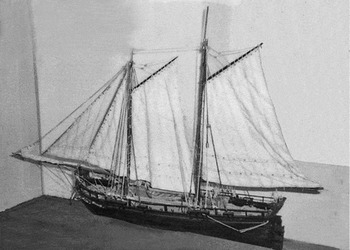
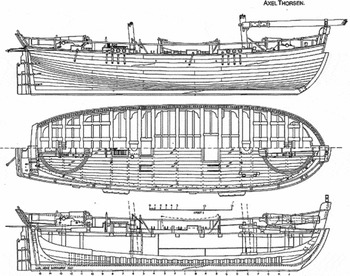
They were built of pine and had dimensions of 56 × 16 × 6 feet. Fully equipped, their displacements were 74 tons. They were equipped with 15 pairs of oars. Twenty-four pound howitzers, mounted in carriages which were removable so that they could be stowed along the gunwales, were positioned at the bow and the stern. The guns had a range of some 1300 m. Two 4 lb howitzers were installed at the gunwales. The jib boom, fastened to the mast and to the top of the stem-post, was erected 5.5 feet above the deck which made it possible for the crew to work with the guns while under sail (Figs. 1, 2). The schooners each had crews of 45 men (Marquardt Reference Marquardt2005; Beutlich Reference Beutlich1940).
Model of Axel Thorsen. Horten: Marinemuseet.

Plans of Axel Thorsen. The great size of the ordnance in comparison with that of the vessel can be appreciated from this illustration.

The Napoleonic wars in Arctic Norway
On 9 July 1807, Alexander I, Czar of Russia made an alliance with the Emperor Napoleon under the Treaty of Tilsit. A part of their plan included the adherence by the dual monarchy of Denmark-Norway to the French-Russian alliance and the closure of Norwegian harbours to trade with the United Kingdom. Information concerning the secret plan soon reached the British government as a result of which, on 21 October 1807, the Royal Navy captured the common Danish-Norwegian fleet in Copenhagen and sailed 10 ships of the line, 10 frigates, 5 corvettes, 8 brigs, a fleet battery, a hulk, 29 small craft and 92 transport vessels loaded with all kinds of war storage to England (Sparre Reference Sparre1914). They also instituted a rigorous blockade of the Norwegian coast.
As a result of these events, Norway was at war with Great Britain. Maritime trade was absolutely essential for the coastal population of northern Norway. The people there depended upon flour from Russia, which was traded for dried fish and this was especially the case during the British blockade from 1807 until 1814 when the supply of flour from the continent of Europe virtually ceased. The Norwegian authorities were forced to send a squadron that included Axel Thorsen and Skjøn Walborg to protect vessels carrying flour and other consumer goods from Archangel from British attacks.
In the summer of 1810, Axel Thorsen, commanded by Lieutenant B. H. Holm, sailed north with the armed schooner Valkyrje and arrived in Hammerfest on 28 June after which they took up patrol service and escorted trading ships up and down of the coast of Finnmark. Some 30 vessels, of various nationalities, were inspected and eight of them were impounded including an American brig that was presumably transporting goods to Britain. This was brought to Hammerfest by Axel Thorsen, and it arrived on 11 August. Axel Thorsen was not directly involved in any incident with the Royal Navy (Beutlich Reference Beutlich1940). Only ten days before, on the other hand, Skjøn Walborg, commanded by Lieutenant J. Stabell, was involved in an action with the British frigate Belvidera while serving as a patrol ship along the coast of central Norway (Beutlich Reference Beutlich1940).
In 1811, three Royal Navy frigates (Alexander, Niobe and Venus) and two gun sloops (Snake and Trincalo) were operating in the Arctic off the coast of northern Norway. The Government therefore decided to build 12 armed schooners to protect the coastal trading (Beutlich Reference Beutlich1940).
Axel Thorsen continued escorting trading vessels off the coast of Finnmark in 1811, 1812 and early in 1813 when she was accompanied by her sister ship Skjøn Walborg (Sparre Reference Sparre1914). During the winters several armed schooners were involved in actions with British warships on the coast of Finnmark and Troms, but not Axel Thorsen and Skjøn Walborg that were laid up in Trondheim (Moen Reference Moen1991; Kristiansen Reference Kristiansen1997).
In 1812 the British frigate Horatio attacked Tromsø in an attempt to destroy the granary there. Axel Thorsen and Skjøn Walborg were on convoy service when the incident took place. These two ships, each with armed tenders, a sloop and another schooner were stationed in Tromsø. This small fleet was waiting for an armed cutter to convoy an American prize to Trondheim when the British frigate approached. After half an hour of fighting between the two tenders and boats from Horatio, during which five Norwegians were killed and eight were wounded, Horatio sailed out of Tromsø harbour with the American ship and the two Norwegian tenders as prizes and some prisoners of war (Schancke Reference Schancke1910).
In 1812 Napoleon attacked Russia and the latter joined an alliance with Great Britain. As a result the export of flour from Archangel to northern Norway was stopped and the role of the Danish-Norwegian squadron on the coast of northern Norway was ended. Axel Thorsen and Skjøn Walborg were transferred to the west coast of Norway where they served as patrol ships stationed in Ålesund.
In 1813, by which time the United States and the United Kingdom were at war, two American privateers operated off the coast of northern Norway attacking ships transporting goods from Archangel to Britain. These were the brig Rattlesnake under Captain David Meffet of Philadelphia and the schooner Scourge under Captain Samuel Nicolls of New York. ‘The Scourge and the Rattlesnake took more than twenty ships out of the Archangel fleet; indeed the Rattlesnake was said to have sold her prizes in Norway for the sum of a million dollars’ (Lubbock 1937). During the months of July and August the American privateers captured 23 British vessels off North Cape and took them into Hammerfest. Two of these vessels were later released so the crews could sail home to Britain. These vessels had cargoes of ‘colonial produce’, ‘tar’ and ‘linseed’ (Lloyd's 1813: 24 September 1813). One had a cargo of 2500 barrels of wheat and sugar. The latter was temporarily laid up in Norway because the American captain would not accept Danish currency as payment for the ship and the cargo (Beutlich Reference Beutlich1940). Also the American frigate President made attacks on vessels in the Archangel fleet (Lloyd's 1813: 17 August 1813). The latter had a wide range of operation in the Arctic. She also attacked several British whalers on their return from Greenland, including John of Greenock captained by William Scoresby (Lloyd's 1813: 20 August 1813, 27 August 1813). Several vessels arriving in the United Kingdom informed the authorities that they had been pursued by the American privateers off the coast of northern Norway. As a result the Royal Navy in late August sent the frigate Alexandria and two gun sloops to the coast off North Cape to protect the Archangel fleet (Lloyd's 1813: 1 October 1813).
In January 1814, the allies fighting Napoleon determined that the union of Denmark and Norway should be dissolved. Norway was forced to join a union with Sweden. The French Marshall Jean Bernadotte who had fought against Napoleon, had become the king of Sweden. The union of Norway with the Kingdom of Sweden was a part of a special arrangement with the new king. The decision caused considerable frustration in Norway and representatives from each county were elected and met at Eidsvold (north of Oslo) to draw up a Norwegian constitution. The youngest representative in the assembly was a navy officer Thomas Konow who was just 17 years of age. Two years later he was appointed the master of Axel Thorsen although by that time the entire Norwegian navy was laid up by order of the Swedish General Governor in Norway owing to a several mutinies. No Norwegian navy vessels were in active service the following year.
Patrol ships for the maintenance of Norwegian sovereignty
Between 1816 and 1818 and again in 1821, the newly established Norwegian navy sent patrol ships to northern Norway to maintain Norwegian sovereignty in the face of a potential threat from Russia. Northern Norway was less integrated and less fortified than other parts of the country and there was no fixed boarder with Russia. A series of complaints from pubic servants in Finnmark had reached the central authorities indicating that the Russians were pressing the Norwegians out of the best fishing grounds. These activities were interpreted as colonisation.
The previous situation had completely reversed. During the Napoleonic wars and the British blockade, trading flour and other products with Russia in return for dried fish had been most welcome to the coastal population of northern Norway. Now the Norwegian authorities wanted the Russian fishermen and traders to leave and to demolish the houses they had built. Although the Russian were required to register all the goods they removed with the Norwegian customs, they were not required to pay customs duty on products brought into the country or on fish products they took out.
There were no charts of the coast of northern Norway at this time, no pilot service and none of the harbours were equipped with mooring rings. Axel Thorsen and Skjøn Walborg were therefore given the task of charting parts of the northern coastline, making meteorological observations, recording magnetic variation and making a record of mooring facilities and the condition of the harbours (Sparre Reference Sparre1914). The diary of the master of Axel Thorsen in 1816, Second Lieutenant Thomas Konow, then aged 19, documents confrontations between Russian settlers and Norwegian authorities (Kristiansen Reference Kristiansen1997).
The Finnmark Squadron served a tour of duty that lasted from 7 May 1816 until 11 January 1819. The squadron that sailed out of Trondheim consisted of Axel Thorsen and Tender No 57 with a total crew of 59 men of which 44 men sailed onboard the former vessel. The expedition was lead by Lieutenant-Commander H. C. Christie.
On 10 June the squadron anchored in Tromsø. Discipline was harsh. The boatswain and four sailors from the Axel Thorsen were court-martialled for having been drunk when the vessel was moored at Sandtorv (present day Harstad) and where they had forced a woman from a farm to serve them milk. The boatswain was degraded and sentenced to 50 lashes while the four others were sentenced to 27 lashes. In addition they had to pay appropriate compensation to the farmer. Several other courts martial were held during the northward voyage.
On 21 June, the squadron weighed anchor, and after a short stop in Hammerfest, continued to Vardø where it arrived on 29 June. Here an interpreter joined the expedition and the squadron received instruction about the purpose of the expedition from the county governor Johan C. Krogh. The main task was to maintain Norwegian sovereignty in Finnmark by demolishing Russian settlements and to inspect foreign vessels for illegal trading. The squadron's second task was to chart parts of the coast and make reports concerning the harbour conditions.
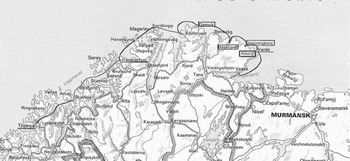
At Kiberg, close to Vardø (Fig. 3) the squadron came upon the first significant settlement of Russians. They were informed that their houses had to be removed by the autumn. The voyage continued eastward. At Hamningberg (Fig. 3) Axel Thorsen came upon another Russian settlement. Konow wrote: ‘I went ashore and told the Russians there that they must dismantle their buildings and take them away by the autumn’ (Konow Reference Konow1816). According to Konow's diary, all the Russian settlements were located on the Varanger peninsula with the exception of a settlement at Gamvik (Fig. 3) The Russians had built villages in Båtsfjord, Kiberg and Hamningberg (Moen Reference Moen1991).
The sailing route of the Finnmark squadron 1816. The Russian settlements are indicated with their present names in boxes.

On 12 July the doctor diagnosed some of the crew as having scurvy. The crew was ordered ashore at Sværholt, a bird cliff, for a couple of days and ordered to find the plant Cochlearia and eat it. This was good advice because Cochlearia is rich in vitamin C, and is therefore a useful antiscorbutic.
The squadron returned to Hammerfest to replenish firewood before sailing to Gamvik where it arrived on 11 August. It was discovered that Russians had continued building houses after the order for demolition had been given. This time the owners were given only until the following morning to remove their buildings. In Båtsfjord, some Russians came onboard Axel Thorsen in an attempt to bribe Commander Christie but they were told to leave the vessel and to begin dismantling their houses at once. The soldiers were armed and the guns onboard Axel Thorsen were loaded and trained on the settlement, whereupon the houses were pulled down by their Russian owners. By 6 pm all the houses had been dismantled with the exception of one that a Russian had sold to a Norwegian for 700 kilos of fish (Konow Reference Konow1816).
On 18 October, Lieutenant Andreas Falch replaced Thomas Konow as the master of Axel Thorsen which then sailed to Tromsø. The master and the ship spent the winter there. Konow sailed the tender to Trondheim. He had an outstanding career in the navy and retired in 1863 as a Rear Admiral.
Axel Thorsen remained on duty as patrol ship until 1 of July 1817 when she was replaced by Skjøn Walborg to which Second Lieutenant Hans J. Horn was transferred and assumed command. Skjøn Walborg continued to the patrol the coast of northern Norway until January 1819 when she was laid up for the winter in Tromsø.
In 1821, patrol duty was carried out for one more season. In 1826 Norway and Russia agreed on a border between the two countries and the need for these operations ceased (Bjørgo and others Reference Bjørgo, Kaartvedt and Rian1995).
Patrol ships enforcing quarantine
In June 1831 an epidemic of cholera broke out in Archangel. The Norwegian authorities feared that it would spread to Norway through Finnmark during the summer via trading ships from the White Sea. A courier from Stockholm brought a message instructing Christie, who was by then a Captain and who had led the Finnmark squadron onboard Axel Thorsen and Skjøn Walborg between 1816 an 1819, to decide, in cooperation with the county governor, where a quarantine station should be established and to make it operational. They were also required to develop a plan to avoid cholera being spread into Norway via the Arctic coast route.
The quarantine station was built in Hammerfest and opened on 5 August 1831. Thus doctors were appointed in the northernmost city in the world for the first time (Sivertsen Reference Sivertsen1973). On 20 June, Axel Thorsen and Skjøn Walborg and two tenders were ordered to Hammerfest in order to start patrolling the coast. Christie was the leader of the expedition. The master of Axel Thorsen was Second Lieutenant N. S. Klingenberg and the master of Skjøn Walborg was Second Lieutenant C. F. Proet. The vessels patrolled the coast from 28 July until 30 December when they were laid up in Hammerfest for the winter.
The patrol continued the following year with Christie continuing as expedition leader while the two masters seem to have exchanged ships (Moen Reference Moen1991). Fortunately no cholera was detected. On 15 September 1832, the quarantine station was closed and the two schooners returned to Trondheim where they arrived on 27 November. They were laid up and taken out of active service. One of the three cholera doctors who had served at Hammerfest, Henrik Rachlew, stayed on for another two years serving as a medical officer in Finnmark.
The history of the two vessels between 1840 and 1863 is unknown but it is certain that they were not in active service for the navy. In 1863 the navy decided that they should be broken up. Instead, however, they were sold to Hilbert Pettersen, a merchant, of Tromsø. He owned a fleet of sealers and Axel Thorsen and Skjøn Walborg were converted into vessels for this service. Captain Johan Helstad signed on as master of Axel Thoresen. He was an experienced sealing master both in the Hammerfest and the Tromsø sealing fleets. He purchased a 1/4 share of Axel Thorsen. The following years both vessels served as sealers, coastal freighters and were engaged in shark fishing off Bjørnøya and Spitsbergen (Tromsø Stiftstidende 1864–1872; Tromsø Tollsted Vaktljournal 1864–1872.
The Nordenskiöld expedition to Spitsbergen, 1864
Adolf Erik Nordenskiöld had sailed with Otto Torell's expedition to Spitsbergen in 1861 (Torell Reference Torell1865). In 1864 he returned, this time leading his first Arctic expedition. Its purpose was to explore and carry out a scientific programme in Storfjorden on the east coast of Spitsbergen for 4–5 months. The expedition's local manager in Tromsø, Andreas Aagaard, advertised for an expedition vessel and a crew of 9 men. Several vessels were suggested but Axel Thorsen, skippered by Helstad, with a crew of 11 mostly experienced sealers from Tromsø, was selected. She sailed from Tromsø on 7 June with the Nordenskiöld and scientists N. Dunér and A. Malmgren onboard.
Axel Thorsen had a new deck and new rigging but was extremely cramped both on and below the deck. Malmgren named his cabin ‘Orcus’, subterranean. He could get into and out of his bed but could hardly turn in it because of a cross beam. However, even though they could not stand upright in the cabins the scientists found the bunks most comfortable and warm with reindeer skins. Axel Thorsen carried 4 boats lashed to the deck.
Nordenskiöld knew Helstad well. They had met onboard Ælous in 1861 when Helstad was second mate and Nordenskiöld was a member of the scientific staff. The first mate was Isak Isaksen who six years later purchased Skjøn Walborg. Isaksen was an outstanding master in the Tromsø sealing fleet for more than 30 years. In 1875 he was the master on Nordenskiöld's expedition ship Prøven and in 1896 he was the ice pilot on Salomon August Andrée's expedition ship Virgo. The original plan had been to carry provisions for one year in case there was a forced overwintering but there was insufficient space for them all.
On 18 June 1864, the expedition landed at Bjørnøya and a chart of the island was made before continuing north. This remained the best chart of the island until 1898 (Nathorst Reference Nathorst1900). Axel Thorsen was still a fast vessel. The hand log showed that she could make 9 knots despite high seas. On the voyage Helstad spent most of the time in the crow's nest giving commands.
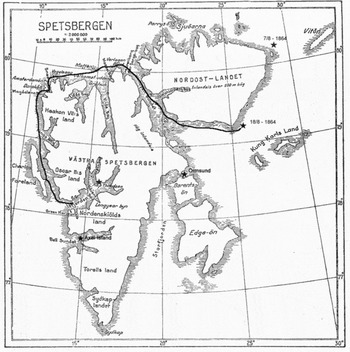
During the expedition, Axel Thorsen took onboard 37 men from several wrecked sealers and their story constitutes an interesting saga in Svalbard history. The vessel Venskabet had been sealing among the ice floes off Nordaustlandet [North East Land] in early July 1864 when thick fog descended and the skipper Israel Sundstrøm and his crew in two boats lost sight of their ship. On 4 July, Venskabet’s crew was picked up by the sealer Ælous. On 11 August, Ælous spoke to Anne Elisabeth and Danoline. They had been east of Nordaustlandet at Storøya where they came upon a herd of walrus resting ashore. Blocks of ice on the beach prevented the animals from escaping into the water and many were killed. Ælous with Venskabet’s crew onboard sailed in convoy with Anna Elisabeth and Danoline southeast of Nordaustlandet where the vessels became beset in the ice and on 18 August all were abandoned. The crews of Anne Elisabeth, Danoline, Vendskabet and Ælous rowed north to Hinlopen, then south along the west coast of Spitsbergen to Isfjorden covering some 700 km (Fig. 4) in three weeks. Unfortunately, they did not know of the short cut, Ormsund (present day Helesundet), which had been discovered by Captain Johannes Nilsen of the sloop Prøven in 1860. He had discovered that Storfjorden had an exit to the northeast and called it Ormsund. It became a shortcut for vessels sailing east-west and the reverse. Even though the discovery was published in Tromsø Stiftstidende in 1860, it was not generally known (Tromsø Stiftstidende 1860).
The line shows the journey under oars of the wrecked crews that were taken up by Axel Thorsen in 1864.

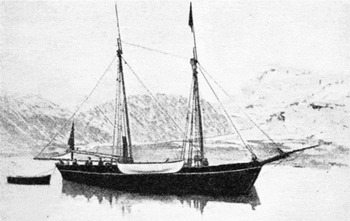
On 30 August, the first boat reached Isfjorden and the crew was taken up by Axel Thorsen (Fig. 5). They urged the Nordenskiöld expedition to wait for the other boats to arrive. They had spread out at the entrance of Isfjorden searching for vessels. On the night of 2/3 September, four boats with 21 men and a ship's dog reached the expedition ship and on 4 September the crew of Ælous arrived. Captain Tobisen informed them that Venskabet had been found and that Sundstrøm and his crew had been restored their ship. 37 men had came onboard the crowded Axel Thorsen. Ten men were transferred to the sealer Speculationen and another vessel, presumably Venskabet that was about to start homeward. Axel Thorsen with 15 men (crew and scientists) and 27 men from the wrecked sealers, 42 in all, set sail for Tromsø. The voyage lasted 10 days and the ship finally reached Tromsø on 14th September (Ælous 1864).
Axel Thorsen in 1864. Nordenskiöld had a camera with him on the expedition.

The following year Captain Tobisen of Ælous overwintered at Bjørnøya. Nordenskiöld equipped him with instruments and instructed him how to make weather observations.
The expedition had been most successful. Storfjorden and the west coast of Spitsbergen had been charted and an extensive geological research programme had been carried out. Two names in Svalbard commemorate the expedition vessel: Axel Island in Bellsund and Cape Thordsen in Isfjorden. It is interesting that the Swedish usage, Thordsen, was used in naming the cape.
From 1865 until 1869, when the new sealing ground opened at Novaya Zemlya, Axel Thorsen captained by her owner, Johan Helstad, sailed annually to the Arctic on fishing expeditions to Spitsbergen catching Greenland shark for the valuable oil rich liver. The sharks were caught by line and seal blubber was used as bait. Skjøn Walborg, skippered by various masters, was engaged in the same trade. In 1870 Captain Isak Isaksen was wrecked in the schooner Sydkap off Cape Kanin, adjacent to the White Sea, before the sealing season had started. Isaksen returned home to Tromsø and purchased Skjøn Walborg. He was about to sail to Novaya Zemlya when the ship was chartered by Graf Waldburg-Zeil and Baron von Heuglin for an expedition to eastern Spitsbergen. (Tromsø Stiftstidende 10 July 1870, 14 July 1870; Sæther Reference Sæther1932.)
Graf Waldburg-Zeil and Baron von Heuglin expedition to Spitsbergen, 1870
The expedition sailed out of Tromsø on 3 July bound for eastern Spitsbergen (Holland Reference Holland1994:281). Landfall was made at Stans Forlandet (present day Edgøya) and Barents Island from where the expedition sighted Kong Karls Land. Skjøn Walborg’s sister ship, Axel Thorsen, captained by Petter Bjørvig was sent north to get in touch with the expedition and deliver an important letter from the authorities in Germany. The letter requested that the Waldburg-Zeil return to Germany as soon as possible and participate in the French-Prussian war (Saether 1932). However, Axel Thorsen failed to meet Skjøn Walborg and therefore returned to Tromsø on 24 August and waited for the expedition to arrive. Skjøn Walborg reached Tromsø in early October with a catch of 80 bearded seal.
Details of the voyage of Skjøn Walborg were published in Petermanns Geographische Mittheilungen. Heuglin claimed that he had observed ‘new land’ east of Svalbard that he believed was Gilles Land that had been discovered 1707 by Cornelius Gille (Heuglin Reference Heuglin1871). Sealing masters of Tromsø opposed this information strongly because they knew that the expedition ship Skjøn Walborg had sailed only as far as Storfjorden and Stans Forlandet. Heuglin and a harpooner from Axel Thorsen had been on an excursion and made a landing on Stans Forlandet from where they saw ‘new land’ at 78° North. The accusations were strongly opposed by Heuglin in a front page article. He claimed that he had seen ‘new land’ and that he had discussed his discovery with Captain Elling Carlsen in Hammerfest. Heuglin's article led to a heated discussion among the Arctic enthusiasts in Tromsø (Tromsø Stiftstidende 12 March 1871, 21 May 1871).
Novaya Zemlya: a new area for the northern Norwegian sealing fleet
In 1859 Svalbard was circumnavigated for the first time. This feat was achieved by the brig Jan Mayen with Elling Carlsen as master. In 1864 Jan Mayen, still captained by Carlsen, was lost on her outward voyage to the sealing ground. Carlsen subsequently purchased his own sealer, the sloop Solid. However, he had no success as a ship owner and, in 1868, he was forced to sell 3/4 of the vessel to the merchant Finchenhagen of Hammerfest on condition that Carlsen should try hunting walrus at Novaya Zemlya instead of the traditional sealing at Svalbard. Carlsen was the first recorded master of a vessel to have circumnavigated Novaya Zemlya and the voyage was a great commercial success. As a result an armada of sealing vessels sailed from northern Norway to Novaya Zemlya in 1869 and the following years. However, so heavy was the take of walrus during the next 3–4 years that stocks were quickly depleted and the area became unprofitable. Both Axel Thorsen and Skjøn Walborg were vessels that participated in the heavy slaughter of walrus and seals in the Russian Arctic.
In 1869 Captain Helstad advertised his shares in Axel Thorsen for sale after he had signed on as ice pilot and harpooner onboard Sir James Lamont's steam ship Diana. Diana of Glasgow sailed to Novaya Zemlya and was the first ship steam ship recorded sailing to Spitsbergen (Holland Reference Holland1994:279). Petter Bjørvig, an experienced sealer, was appointed master of Axel Thorsen. He had been the master of the sealers Speculationen and Elisabeth in the Hilbert Pettersen fleet. Axel Thorsen, however, did not go sealing in 1869. Instead she was employed as a coastal freighter transporting fish products and salt.
In 1870, the Tromsø sealing fleet reached its zenith by sending some 55 sealers to the Arctic ice compared with 23 vessels the previous year. Of the 55 vessels, 16 sailed to Spitsbergen and Novaya Zemlya where they were mostly engaged in seine netting of beluga, while rest of the fleet went sealing at Novaya Zemlya. Six vessels were lost. Axel Thorsen, captained by Petter Bjørvig, left Tromsø on 21 March. In her crew of 12 was the skipper's son, Paul, just 13 years of age. It was his first voyage to the Arctic. Young Paul Bjørvig became a well-known polar veteran. He sailed with Walter Wellman's North Pole expeditions in 1894, 1998, 1906, 1907 and 1909 both as an ice pilot and as a member of overwintering parties. From 1901–1903 he sailed as an ice pilot onboard Gauss on the Drygalski Antarctic expedition (Headland Reference Headland1989:225). On 23 August Axel Thorsen returned from Novaya Zemlya with 73 walrus, 4 polar bear, 52 bearded seal and blubber.
In 1871 Tromsø sent out some 50 sealers. Some of these were engaged in seine netting of beluga but most headed to Novaya Zemlya. Axel Thorsen, again under Petter Bjørvig, sailed in May to Novaya Zemlya and returned home in September with 23 walrus and 23 seals. Skjøn Walborg returned home in November from with 24 walrus, 50 seals, 8 polar bear and 1 beluga (Tromsø Tollsted Vaktjournal 1871). After the vessels had discharged their cargoes they continued to sail as coastal freighters carrying fish products and salt.
Since its foundation in 1866, the Meteorological Institute had used vessels in the southern Norwegian sealing fleet for recording air and water temperatures. From 1870, the Metrological Institute started co-operation with some sealers in the Tromsø fleet that sailed to the new sealing grounds at Novaya Zemlya. These vessels recorded temperature, barometric pressure, currents, ice conditions, exact latitudes and longitudes and sent these observations to the institute. The director of the institute, Professor Mohn, led a team that charted the Gulf Stream. In a front page article Mohn thanked the vessels and their masters by name for having carried out their important task. Neither Axel Thorsen nor Skjøn Walborg participated in this programme, probably because their masters did not have sufficient knowledge of navigation to make accurate record of their positions. Poor technical knowledge of navigation was common among the sealing masters in those days. In 1865, the masters in the Hammerfest sealing fleet were asked to fill out a questionnaire regarding catches, latitude, longitude, temperature etc. It turned out that most of them could not read (Tromsø Stiftstidende 29 October 1865).
In 1872 the Tromsø sealing fleet was reduced to 41 vessels. It was a disastrous year. Five vessels were lost north of Spitsbergen and four were lost at Novaya Zemlya.
Axel Thorsen, again under Bjørvig was the first vessel to leave Tromsø for the Arctic Ocean. She sailed on 5 April, while Skjøn Walborg and the rest of the fleet followed early in June. Bjørvig decided to try the White Sea but the catches were low and he continued eastwards to Novaya Zemlya. Axel Thorsen was lost on 13 June 1872 shortly after having passed Cape Kanin. She was trapped, squeezed and abandoned in the ice at Tsjesjekaja Bay. The crew walked ashore and was found by a Russian vessel. They arrived in Norway over land and sailed home with a coastal steamer, arriving in Tromsø on 15 August. It was Petter Bjørvig's last command as a sealing master. He had been a master for nine years. In August the same year Skjøn Walborg was caught in the ice at Birska, northwest of Novaya Zemlya. Her crew, sealing gear and some cargo were transferred to the sealer Eliezer of Tromsø before drifting ice crushed and sank the schooner (Tromsø Stiftstidende 7 November 1872; Nordland 1872).
Acknowledgements
Thanks are due to Johnny Mikalsen, Vannareid Tove Halvorsen and the other librarians at Tromsø University Library; Jan Fyhn Johansen, Tromsø; Tom Kristensen, Defence Studies, Oslo; Anne Melgård, National Library, Oslo, Hans Petter Oset and Helge Rønnes, Marinemuseet, Horten, and Tore Sørensen, Statsarkivet, Tromsø. A special acknowledgement goes to Nicholas Tyler, University of Tromsø.