Introduction
The serotonin receptor 1A (5-HT1A-R) is noted to have high concentration levels in the hippocampus, which is known for its role in memory.Reference Buhot, Martin and Segu 1 In human postmortem tissue, 5-HT1A-R levels were found to be significantly higher in the hippocampus than in the prefrontal cortex and the striatum.Reference Marazziti, Marracci and Palego 2 Animal studies have shown consistently that the 5-HT1A-R plays a key role in learning and memory function.Reference Yasuno, Suhara and Nakayama 3 With extensive literature on the role of 5-HT1A-R in cognition, several experimental studies in rodents showed procognitive properties of 5-HT1A-R ligands in models of working, episodic, reference, and/or spatial memory.Reference Steckler and Sahgal 4 , Reference Meneses 5 Ogren et al Reference Ogren, Eriksson and Elvander-Tottie 6 obtained further support for the ability of the 5-HT1A-R to influence aspects of cognition including memory. Yasuno et al identified that postsynaptic 5-HT1A-R localized in the hippocampal formation had a negative influence on explicit memory function.Reference Yasuno, Suhara and Nakayama 3
Gene variants of the 5-HT1A-R have been implicated in the etiology of a number of conditions, including major depressive disorder (MDD).Reference Savitz, Lucki and Drevets 7 , Reference Drago, De Ronchi and Serretti 8 Furthermore, patients diagnosed with MDD are known to suffer from episodic and working memory impairments.Reference Kuffel, Eikelmann and Terfehr 9 The localization and function of the 5-HT1A-R and its stimulation are thought to enhance or suppress glutamatergic neurotransmission, and therefore could have a 2-phased effect on mood and/or cognitive function.Reference Pehrson and Sanchez 10
Bosia et al Reference Bosia, Anselmetti and Bechi 11 studied the effects of 5-HT1A-R genotype on cognition in schizophrenic patients using the C(1019)G polymorphism. They identified that patients with the C/C genotype had significantly higher scores on a Theory of Mind (ToM) picture-sequencing task than those with the C/G and G/G genotypes. Terzić et al Reference Terzić, Kastelic, Dolžan and Plesničar 12 also evaluated the C(1019)G polymorphism in schizophrenic patients and identified that the Global Assessment of Functioning score was superior in the C/C genotype.
Heightened expression of the 5-HT1A-R receptor has been associated with reducing serotonergic neurotransmission, which is linked with major depression and suicide.Reference Albert, Le François and Millar 13 Albert et al Reference Albert, Le François and Millar 13 showed MDD patients to have an increased 5-HT1A-R expression, which resulted in reduced neuronal firing and 5-HT release. A number of studies have concluded that the 5-HT1A-R is as an important factor in predisposition to mental illness.Reference Drevets, Thase and Moses-Kolko 14 , Reference Boldrini, Underwood, Mann and Arango 15 Outside of animal studies, little work has been conducted in investigating 5-HT1A-R genotypes and human cognitive function. Thus the observations by Bosia et al Reference Bosia, Anselmetti and Bechi 11 led us to evaluate the role of 5-HT1A-R genotype on cognitive function in a large population of patients with MDD.
Methods
Sample
The study sample was 455 patients who met the Diagnostic and Statistical Manual of Mental Disorders, Fourth Edition (DSM-IV) criteria for MDD, between the ages of 18 and 55 years, with current episode duration of at least 1 month but not longer than 6 months. They had been screened to enter a multicenter clinical trial (ClinicalTrials.gov Identifier: NCT00584974), which was conducted at 51 sites in the USA between 2007 and 2009. The patients studied were those (from a total of 523) who had consented to provide a blood sample for 5-HT1A-R genotyping for (SNP ID rs6295) during the study screening period. The study inclusion and exclusion criteria that could be pertinent to this article are as follows:
Inclusion criteria:
-
∙ Body mass index (BMI) >16 and <32 kg/m2
-
∙ At least 1 previous, diagnosed episode of MDD in the past 5 years
-
∙ Normal neurological examination at screening
-
∙ Negative urine drug test at screening
Exclusion criteria:
-
∙ Has participated in another trial within 30 days
-
∙ Has known failure to respond (in the past 5 years) to 2 adequate (dose and duration) antidepressant medications with distinct mechanisms of action including tricyclics and SSRIs
-
∙ Has undergone ECT treatment
-
∙ Treatment with fluoxetine, in the 6 weeks before baseline
-
∙ Treatment with an investigational drug within 30 days of baseline
-
∙ Psychotic disorders, anorexia nervosa, bulimia, or posttraumatic stress disorder
-
∙ A history or presence of bipolar disorder (ie, current or past history of manic episode)
-
∙ Family history (first-degree relative) of bipolar disorder (self-report)
-
∙ Obsessive compulsive disorder
-
∙ Lifetime diagnosis of panic disorder
-
∙ Depression that, in the opinion of the investigator, is so severe that hospitalization is required
-
∙ In the investigator’s judgment, subject would require electroconvulsive therapy (ECT) or treatment with additional psychotherapeutic drugs, including lithium and neuroleptics
-
∙ Requires an introduction, or change in intensity, of psychotherapy (including behavioral therapies) from 3 months prior to the baseline visit through the duration of the study
-
∙ Subject received treatment with antidepressants within 2 weeks or 5 half-lives (whichever is longer)
-
∙ Lifetime history of suicidal attempts, alcohol dependence or abuse, drug(s) dependence or abuse (excluding nicotine and caffeine), or has a positive urine drug screen
-
∙ Is a current smoker, or has smoked within the last 12 months, or has a urine cotinine measurement indicating nicotine use
-
∙ Current (within 6 month prior to baseline) primary DSM-IV Axis I psychiatric diagnosis of any of the following disorders: dementia, delirium, schizophrenia, psychosis, other psychotic disorders, dysthymic disorder, cyclothymic disorder, other mood disorders, nocturnal panic disorder, primary anxiety disorders, primary panic disorders, or any other psychiatric disorder that would compromise the investigator’s ability to evaluate the safety and efficacy of the study medication
-
∙ Any of the following DSM IV Axis II personality disorders diagnoses: schizotypal, schizoid, borderline personality disorder, mental retardation, or any other personality disorder that would compromise the investigator’s ability to evaluate the safety and efficacy of the study medication or the subject’s ability to comply with protocol requirements
-
∙ A history of significant risk of suicide or homicide, or is considered at risk for suicide or homicide during the study
-
∙ Bereavement (defined as death of a loved one within 3 months)
-
∙ A documented history of HIV, hepatitis B, or hepatitis C
-
∙ A history of clinically significant and currently relevant or active hematological, renal (including single kidney), hepatic, gastrointestinal, endocrine, pulmonary, dermatological, oncological, or neurological disease, including all forms of seizures, including febrile seizures, and epilepsy
-
∙ A history of significant cardiovascular disease, including uncontrolled hypertension (as defined above); hypotension; first (PR greater than 220 msec)-, second-, or third-degree heart block; congestive heart failure; angina pectoris; bypass surgery; angioplasty; or recent myocardial infarction (within the last 6 months)
-
∙ Likelihood of being hospitalized (for any reason) during the study
-
∙ Using beta blockers for psychiatric reasons or is not on a stable dose for any condition for a minimum of 30 days prior to Visit 1
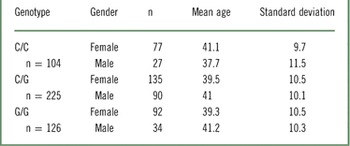
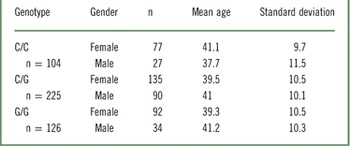
The demographics of the sample are presented in Table 1.
Demographics of study population by 5-HT1A-R genotype
Assessments
The data from the various assessments were all collected before the first dose of study medication was administered. The following scales were administered during the screening period: Clinician Global Impression–SeverityReference Guy 16 (CGI-S), Sheehan Disability ScaleReference Sheehan 17 (SDS), and the 25-Item Hamilton Depression ScaleReference Hamilton 18 (HAM-D-25). In addition, the first 17 items from the Hamilton Depression Scale were analyzed (HAM-D-17). The CDR System was also administered to assess cognitive function. This is an automated set of cognitive tests that has been widely used in clinical trials for over 30 years in a variety of clinical populations including MDD.Reference Ferguson, Wesnes and Schwartz 19 , Reference Reddy, Focht, Musgnung, Edgar, Gucio-Pabia and Wesnes 20 The tests have been described in detail previously.Reference Ferguson, Wesnes and Schwartz 19 , Reference Wesnes, Ward, McGinty and Petrini 21 , Reference Wesnes, Luthringer and Ambrosetti 22 Three of the tests assess attention, information processing, and vigilance: Simple Reaction Time, Choice Reaction Time, and Digit Vigilance. Two tests assess working memory: Numeric and Spatial Working Memory. Four tests assess episodic memory: Immediate and Delayed Word Recall, Word Recognition, and Picture Recognition. The tests were administered by a trained test administrator, with the information being presented on the screen of a notebook computer and the responses gathered with the use of a button box containing a “yes” and a “no” button. The selection of tests took approximately 20 minutes to complete. Each subject performed the CDR System on 2 occasions during screening to overcome any training and familiarity effects.Reference Wesnes and Pincock 23 Immediately before dosing on the first study day, a baseline assessment on the CDR System was performed. The data from this administration are evaluated in this article. Caffeine consumption was not permitted during the hour preceding this assessment.
Analysis
The CDR System has a validated factor structure,Reference Frey and Colliver 24 and composite factor scores derived from the various test measures are routinely used to evaluate function in major cognitive domains. The core CDR System factor scores derived from the tests were as follows:
-
∙ Power of Attention is derived by summing the reaction times of the 3 tasks involving attention: Simple Reaction Time, Choice Reaction Time, and Digit Vigilance. This measure reflects the ability to focus attention and process information while ignoring distraction.
-
∙ Continuity of Attention is derived by combining the percentage accuracy of the Digit Vigilance Task and the Choice Reaction Time with adjustment for false alarms from the Digit Vigilance Task. This score reflects the ability to sustain attention.
-
∙ Quality of Working Memory is derived by combining the signal detection theory sensitivity indices24 from the Spatial and the Numeric Working Memory tasks, and reflecting how much information can be held temporarily in short term memory.
-
∙ Quality of Episodic Secondary Memory is derived by combining the overall percentage accuracy scores from the 4 memory tests: Immediate Word Recall, Delayed Word Recall, Delayed Word Recognition, and Delayed Picture Recognition. This measure reflects the amount of information that can be stored and successfully retrieved in episodic memory.
-
∙ Speed of Memory is derived by summing the reaction times 4 four memory tasks: Spatial Working Memory Task, Numeric Working Memory, Word Reaction, and Picture Recognition. This measure reflects how quickly information can be successfully retrieved from working and episodic memory. Quality of Memory, an overall index of memory performance combining the scores used to derive the quality of working and episodic memory factors, was also derived.
The balance of males and females in the 3 genotypes was evaluated using chi square analysis. The between-genotype differences were analyzed using SAS Mixed Model analyses of variance (ANOVAs) and analyses of covariance (ANCOVAs). Based on the results of the analysis of the clinical scales and the gender balance, appropriate terms and covariates were fitted to the models for the CDR System factor scores. Where appropriate, Cohen’s d effect sizes were calculated.
Results
It can be seen from Table 1 that the ratio of males to females was higher in the C/G genotype. This was confirmed using chi square analysis (p=0.0093). Due to the possibility that this imbalance may influence the comparisons between genotype groups, a term was fitted to the ANOVAs for gender and the interaction between gender and genotype. There was no interaction between gender and genotype for any of the 6 scores (all p>0.3), and thus the analysis proceeded without further consideration of gender.
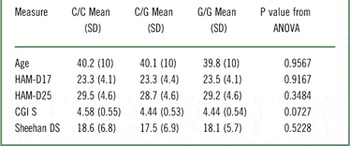
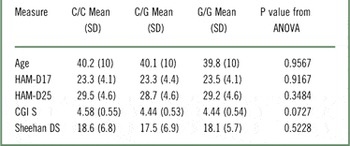
The results the influence of genotype on age and the 4 clinical scales is summarized in Table 2, which shows there were no significant differences for the main effect of genotype, although there was a trend (p<0.1) for CGI-S. For this reason, the analyses of genotype differences on the performance measures had CGI-S fitted as a covariate.
Comparisons of age and clinical scales by 5-HT1A-R genotype
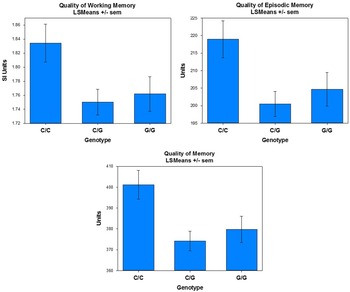
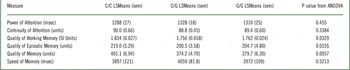
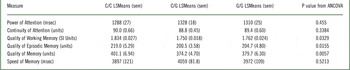
The outcome of the ANCOVAs is summarized in Table 3. The 3 scores that reflected the working and episodic memory accuracy all showed significant main effects of genotype. These effects are illustrated in Figure 1. The pattern can be seen to be virtually identical for both the accuracy scores from the 2 working memory tasks and the 4 episodic memory tasks, with the C/C genotype being superior on each measure to both the C/G and the G/G genotypes. The individual comparisons from the ANCOVAs between the C/C genotype and either the C/G or G/G genotypes confirmed the statistical reliability of these differences (Quality of Working Memory: C/C v C/G p=0.0104 and C/C v G/G p=0.0478; Quality of Episodic Memory: C/C v C/G p=0.041 and C/C v G/G p=0.0461; Quality of Memory: C/C v C/G p=0.014 and C/C v G/G p=0.023). There were no differences on any of the measures between the C/G and G/G genotypes. The Cohen’s d effect sizes were in the small to medium range. For Quality of Memory for example, the superiority of the C/C over the C/G groups had an effect size of 0.38, and for C/C over G/G it was 0.3.
Least Squares Mean (LS Means) is the mean which is estimated from the Mixed linear model used to analyse the data. LS means with standard error bars for Quality of Working Memory, Quality of Episodic Memory, and Quality of Memory results by genotype.

Comparisons of the CDR System factor scores by 5-HT1A-R genotype (The p-values are for the main effect to genotype)
Discussion
MDD patients with the C/C genotype for 5-HT1A-R are selectively superior in retaining information in both working and episodic memory, compared to C/G and G/G genotypes, showing effect sizes that are in the small to medium range. A trend for a higher CGI-S in the C/C group was identified; however, none of the other clinical or behavioral scales shown in Table 2 showed any difference between the 3 genotypes, and, further, there were no differences found for the measures of focused or sustained attention or for the time taken to retrieve information from working and episodic memory. This is, to our knowledge, the first time an association between cognitive function and 5-HT1A has been identified in MDD. This was a large sample size (n=455) compared to the 2 other studies of this genotype on cognition and function, which were evaluated in patients with schizophrenia (ie, Bosia et al: n=11811; Terzić et al: n=13812).
While these results confirm those of Bosia et al Reference Bosia, Anselmetti and Bechi 11 regarding the differences in tests of cognitive function for individuals with the C/C genotype and those with either C/G or G/G, it should be noted that the schizophrenic patients in the Bosia et al study did not show deficits in the Brief Assessment of Cognition in Schizophrenia tests of working and verbal episodic memory. The deficit in that study was a ToM picture-sequencing task, which assesses the ability to infer other people’s mental states, thoughts, and feelings. In the present study, none of the cognitive assessments covered this aspect of social cognition, so whether or not this aspect of function was selectively impaired in this MDD population cannot be determined. Nonetheless, it is clear that the memory differences between the 5-HT1A-R genotypes in the present study were not identified by Bosia et al in a schizophrenic population, thus indicating that the 5-HT1A-R genotypes do not have the same consequences for this aspect of cognition in the 2 clinical conditions.
The 5-HT1A gene carries the common polymorphism at position C(−1019)G, which alters the regulation of 5-HT1A receptor function and affects response to antidepressants, and risk for depressive episodes and suicide.Reference Albert and Lemonde 25 , Reference Schatzberg and Nemeroff 26 Human imaging studies (by PET) have demonstrated that the density of 5-HT1A receptors in serotonergic brain regions is affected by this polymorphism and antidepressant treatment response.Reference Miller, Hesselgrave and Ogden 27 , Reference Parsey, Olvet and Oquendo 28 Albert et al Reference Albert, Le François and Millar 13 found that C/G and G/G patients with depression showed a decreased firing of 5HT neurones and reduced postsynaptic 5-HT1A-R. MeeterReference Meeter, Talamini, Schmitt and Riedel 29 et al demonstrated in depressed patients that memory impairments were related to 5-HT undertransmission. Furthermore, improvements to working and episodic memory have been demonstrated with the 5-HT1A-R agonist vortioxetine in depressed adults.Reference McIntyre, Lophaven and Olsen 30 Thus the decreased firing of 5-HT neurons could be a possible explanation for the findings of the present study, ie, that the patients with C/G and G/G genotypes exhibited poorer memory performance than those with the C/C genotype.
Conclusion
The present study identified that depressed patients with the C/C genotype of the 5-HT1A receptor show superior performance on tests of working and episodic memory compared to patients with C/G and G/G genotypes. Such findings, together with those of Bosia et al,Reference Bosia, Anselmetti and Bechi 11 indicate that the relationships between 5-HT1A-R genotypes and cognitive function are worthy of further evaluation in normal volunteers and other clinical conditions.
Disclosures
Keith Wesnes developed the CDR System used in this study. It is now proprietary to Bracket (http://www.bracketglobal.com). He holds stock in Bracket, and until February 2014 was an employee of the company. He currently runs Wesnes Cognition Ltd., a consultancy that helps groups and companies evaluate the cognitive properties of their products. Helen Brooker currently consults for Wesnes Cognition Ltd. Kenneth Koblan and Seth Hopkins are employees for Sunovion Pharmaceuticals, Inc.