Unlike most married women in England during the late medieval and early modern periods, femme sole traders had an independent economic and legal status. Whereas the common law normally defined wives as an appendage of their husbands, lacking a separate identity, femmes soles were allowed to conduct their business dealings by themselves. Should legal action ensue, the case focused on the woman's own activities, and she was held responsible for payment of her debts. Femme sole status was emerging by around 1300 in London, and by the fifteenth century similar patterns were found in a number of other urban centers as well. In some parts of continental Europe too, working wives had a measure of independence from their husbands, but in no other setting were femme sole practices and legal forms so fully developed as in London.
For scholars of women and urban life during the late medieval and early modern periods, femme sole status has been of considerable interest. What appeared to be an unusual opportunity for married women to have their own economic lives and acquire legal agency was described by early feminist historians like Mary Bateson, Annie Abram, and Alice Clark, who opened up research into the experiences of working women in London and some of the other towns.Footnote 1 Writing during the opening decades of the twentieth century, they contrasted the freedom and autonomy enjoyed by femme sole traders with the limited opportunities available to wives who remained femmes couvertes de baron (“covered” by their husbands). Clark felt that the activity of these independent businesswomen supported her wider argument that, during the preindustrial period, English women had enjoyed rough economic equality with men. Although she did not specify exact dates for that “golden age,” she implied that it lay within the late medieval period, ending during the sixteenth and seventeenth centuries.
More recent treatments of femme sole standing must be placed within the context of the late twentieth-century debate over working women and their status.Footnote 2 The historiography may be crudely divided into two broad camps. Some scholars have suggested that during the 100–150 years after the plague of 1348-49, continued demographic decline opened up unusual opportunities for urban women in craftwork, trade, and other desirable kinds of employment. Caroline Barron, an expert on late medieval London, while pointing out that all women faced some limitations vis-à-vis men, nonetheless argues that femmes soles were among those who enjoyed what was in relative terms a “golden age.”Footnote 3 Jeremy Goldberg similarly emphasizes the favorable position enjoyed by women in late medieval York, agreeing with Barron that those conditions did not extend into the sixteenth century.Footnote 4Femme sole status is also mentioned, though not discussed in detail, in other studies of medieval women's economic activities in London and some of the lesser cities and towns.Footnote 5
The second—and currently more popular—view challenges the entire notion that there was a time when working women in England enjoyed a status that approached that of men. Maryanne Kowaleski and Judith Bennett in particular emphasize the handicaps, stemming from patriarchal assumptions and practices, faced by women at all levels and at all times within the late medieval and early modern span.Footnote 6 Although Bennett acknowledges that there were changes in women's experiences over time, she stresses the continuities of their economic activities and position across the late medieval and early modern period. Any temporary improvements were insignificant when compared with the ongoing pattern of poorly paid, low-skilled, low-status work that conferred little if any occupational identity.Footnote 7 These historians give at most a passing nod to femme sole status, probably because they regarded it as applicable to only a small group of atypical urban businesswomen. Newer surveys of women's experiences in the sixteenth and seventeenth centuries likewise merely acknowledge the existence of this legal position.Footnote 8
In bringing femme sole status onto center stage, this article argues that it conveyed fewer economic and legal benefits than earlier historians assumed and that it was not always seen as desirable by working women. Evidence from London and the central equity courts makes clear that, because it was accompanied by serious potential drawbacks, some married women with their own businesses decided that it was preferable not to declare themselves formally as femmes soles. Remaining a femme couverte in the eyes of the law while in fact working independently of one's husband provided considerable legal flexibility, enabling a woman to claim either status depending on the situation. Assertions or denials of femme sole status thus joined the diverse array of other legal dodges practiced by both women and men during these centuries.Footnote 9 The greatest pressure to register officially as a femme sole may have come in situations where the economic credit of one member of a marriage was poor. If the wife had established her independent standing, neither spouse could be held responsible for the other's debts. Further, actual use of femme sole status was concentrated within the later fourteenth and fifteenth centuries, diminishing across the sixteenth. Though this article clearly demonstrates that being a femme sole was of qualified utility, its evidence may be interpreted as consistent with either a positive or a negative assessment of the broader position of working women.
The following discussion first describes femme sole status and traces its evolution. The next sections examine how cases involving femme sole issues appeared in the courts and what the uses, benefits, and drawbacks of this status were for wives and husbands. At the end we return to the larger issue of working women and their status vis-à-vis men.
I. THE EVOLVING DEFINITION OF FEMME SOLE STATUS
During the late medieval and early modern periods, nearly all married women in England were assigned a subordinate economic and legal status. Although many wives assisted their husbands in their work and some had income-generating activities of their own, they faced gender-based disadvantages in such areas as accessing credit, hiring labor, and traveling in connection with their work.Footnote 10 Married women were not allowed to take apprentices by themselves: though they commonly provided much of the training, the apprenticeship contract bound the young person jointly to husband and wife and did not specify that the apprentice would learn the wife's skills. In the eyes of the common law, even if a woman had an independent business activity, she was considered a femme couverte de baron, with no legal existence apart from his. She could not enter into any contracts or obligations without his participation, and he was held responsible for her debts, even if she had incurred them before their marriage. Should legal action ensue, he was named as a party in her place and pleaded on her behalf. If the court found against her, his goods could be seized by her creditors, and he could be imprisoned until her debts were cleared.
Only in London and some of the other urban centers were working wives allowed to claim a distinct legal status. There, a married woman who traded independently, separate from her husband, might function as a femme sole. As such, she could make agreements and sign contracts in her own right, without her husband's approval. In case of a legal dispute stemming from her business, her husband would be named with her as a courtesy coparty, but the pleadings would focus on her own activity and any penalties would be levied against her alone. She could also take her own apprentices.Footnote 11 She thus had in effect the same standing in the secular courts as a man or a not-married woman.Footnote 12
Femme sole status brought some valuable practical benefits for married women in their day-to-day economic activities. It meant that a wife could acquire equipment and supplies for her business, arranging to pay for them later, without her husband's involvement in the credit relationship. If she needed to borrow money or pawn some of her goods in return for cash, she was again free to act on her own. Potential creditors trying to determine her financial reliability would have needed to assess only her own economic situation, not that of her husband as well. Those features would have been attractive for women working at all levels.Footnote 13 For a skilled craftswoman, taking apprentices conveyed occupational recognition and enabled her to expand the size of her operation through their skilled labor.
An early form of femme sole status is visible by around 1300 in London, where it became one of the customs of the city. Over the following centuries, most femme sole trading took place in the capital because of its size, wealth, and concentration of working women. By the fifteenth century, however, similar practices were found in some other cities and towns as well, most fully in Bristol, which adopted many of London's customs, but also—in more limited form—in Lincoln, York, Sandwich, Rye, Carlisle, Chester, and Exeter.Footnote 14 In London, femme sole trading apparently reached its peak in the fifteenth century, though it remained an option in later centuries. The concept of femme sole rights was also carried to several of the British colonies in North America, which enacted laws establishing this status in the early eighteenth century.Footnote 15
Late medieval and early modern cities in some parts of the continent likewise developed procedures whereby working wives could acquire some degree of legal and economic separation from their husbands. Urban authorities recognized that the highly dependent position of wives as defined by most law codes did not accord with their actual economic roles.Footnote 16 A variety of provisions were therefore introduced that enabled married women in business on their own to declare themselves unmarried for legal purposes. Henceforth they could make contracts and borrow or loan money on their own, and they could be jailed for debt. In medieval Montpellier, married women who exercised a trade were allowed to act as sureties for others and by implication to contract obligations of their own.Footnote 17 In many of the German cities, where married women were normally barred from making legally binding contracts, exceptions were being made by the second half of the fourteenth century for those whose occupations required that they buy and sell goods or loan and borrow money.Footnote 18 The special rights and status of economically independent married women were defined with increasing precision during the late fifteenth and sixteenth centuries. On the continent, however, the concept of femme sole trading was less formalized than in London, lacking specific legal forms through which it could be prosecuted.
The gradual evolution of a practice whereby married women might trade “sole” can be traced in London. This process of development is seen in both formal definitions and changing terminology. The earliest known description was contained in a lost custumal of the early fourteenth century.Footnote 19 The version of that custumal copied later into London's Liber Albus states that “where a woman, couverte de baron, follows a craft of her own in the city in which the husband does not intermeddle, such a woman shall be bound as a single woman as to all that concerns her craft.”Footnote 20 If the woman leases a shop or house, she alone is responsible for paying the rent. The statement emphasizes that if an independent craftswoman and her husband are sued together in a court, she shall plead as if she were a “singlewoman.” If judgment is made against her, “she shall be committed to prison until she shall have made satisfaction; and neither the husband nor his goods shall in such case be charged or interfered with.”Footnote 21 While this early definition referred only to women pursuing a craft, it was applied in practice to all female traders, including those who ran an alehouse or inn.
Over the following centuries, the benefits of being a femme sole were laid out more clearly at the same time that the scope of that status expanded. By the mid-fourteenth century it had been established that a craftswoman working as a femme sole could take her own apprentices.Footnote 22Femme sole status was extended around the middle of the fifteenth century to women who defined themselves as merchants, wealthier businesspeople often engaged in import and export activity. Nearly all the women described as femme sole merchants between 1450 and 1530 dealt in textiles such as silk, flax, or canvas, in most cases importing materials from the continent.Footnote 23 By the early sixteenth century, wives of men who were not freemen of the city might claim femme sole status, and the term “femme sole merchant” was used interchangeably with “femme sole trader.”Footnote 24 The Bankruptcy Act of 1571 pertained to independent businesswomen as well as to men. In 1702 William Bohun wrote that London's customs stipulated that a femme sole had to work in a trade separate from that of her husband; if she worked in the same trade, “she doth it as a Servant.”Footnote 25 That had been a disputed question in earlier periods. Alexander Pulling's definition of London's customs and courts, published originally in 1785 and commonly cited as the authority since then, based its discussion of femme sole status on the Liber Albus.Footnote 26
Terminology concerning femme sole status likewise developed over time. The exact meaning of the phrase “a femme sole” generated some confusion among medieval and early modern people, as it has among more recent historians and editors.Footnote 27 Legally speaking, only married women were eligible for the particular definition of femme sole. Not-married women (singlewomen and widows) already enjoyed the same legal status as men, trading in their own names and coming before the courts as parties in their own right. They were femmes soles in the generic sense that they did not have husbands, but they did not qualify for further benefits. Yet in practice the term femme sole was sometimes applied to them too.
The phrase “a woman alone” might be used to draw attention to a widow's weak and unprotected state, justifying her ignorance or an inability to plead in the common law.Footnote 28 Here there was no claim that they were femme sole traders in the more specific sense. In January, 1376/7, Ellen, widow of John Sage, a haberdasher, was charged with having exposed her wares for sale on feast days, contrary to the recent London ordinance regulating the sale of haberdashery.Footnote 29 She was therefore liable to a fine of 20s. In her defense, Ellen argued that she did not know about the ordinance and emphasized that she was a femme sole. On those grounds, the penalty was respited, but under condition that, if she offended again, she would have to pay 40s. As a widow, of course she was sole, nor would it have mattered in this instance if she had previously traded independently, but her claim of impotence may have contributed to the court's willingness to allow her a reprieve. At the end of the fifteenth century, Joan Lucas, a widow of Dunster, Somerset, claimed that she could not proceed in the common law to recover goods that had been wrongly obtained by John Helyar because she was “a woman sole and not of ability to sue and try” with John.Footnote 30
Alternatively, singlewomen or widows might be described as femmes soles to emphasize that they had the right to make economic or legal contracts in their own names. Such usages occur mainly in the later fourteenth and fifteenth centuries. In some cases they turn up in descriptions of a woman's economic activities before her current marriage. At some point in the past, at the time of the agreement in question, she was sole and therefore able to enter into her own contracts or debts, whereas after her marriage her husband had to assume responsibility for her debts.Footnote 31 Or the term could be used to highlight the contrast between a widow's current ability to act independently and her previous situation while married.Footnote 32
Even if the meaning of femme sole status were clear, how did a married woman acquire the right to claim the benefits of that standing? During the fourteenth and early fifteenth centuries, one finds no references to a process whereby a woman could officially declare and register her independent status. During the second half of the fifteenth century, however, a period of low population in most urban areas when women were economically active and their contributions valued, some kind of formal mechanism appeared in several communities. Married women in Bristol between 1460 and 1535 occasionally paid to register as femmes soles or were described as such in accounts.Footnote 33 Likewise, York's chamberlains’ accounts from 1453–54 note that Robert Horman, a tailor, paid 3s. 4d. “in order that his wife shall follow the trade of the cardmaker by herself, and whichever of her servants,” and this was duly entered in the record.Footnote 34
By the mid-fifteenth century, London too had a procedure for granting married women permission to do business on their own and for keeping a record of their names. A woman who wanted to acquire femme sole status appeared before the mayor and aldermen to declare her intention to avail herself of the privilege. If approved, she was sworn to observe the usual regulations concerning trading and taking apprentices.Footnote 35 Her name was then entered in the record after payment of a fee. Existing references to this practice all concern female merchants, presumably because the lesser traders did not want to spend the time and money needed to register. Thus, in 1457, Agnes Gower, wife of John, told the mayor and aldermen that she practiced the art of a silkwoman on her own; she asked to be allowed “to merchandise” without her husband and to answer alone for her own contracts, according to city custom.Footnote 36 Her request was granted and entered officially in the journal of the Common Council “for record.” In the 1490s, John Fynkell, knight, sold silk worth £56 to Joan Horne, wife of William Horne, a salter and alderman of London.Footnote 37 Although Joan's husband was alive at the time, she told John that “she was sole merchant and that she after the custom of London might in her own name buy and sell, and that all contracts and bonds by her and in her sole name made should notwithstanding her couverture be good and effectual in the law to all her creditors.” She did not, however, repay the £56 before her husband's death, and John then found that he could not plead against her as a femme sole “inasmuch as it appeareth not in record in the said City that ever she was admitted to be sole merchant.”
II. FEMME SOLE ISSUES IN THE COURTS
Suits in which a party pleaded as a femme sole or alleged problems stemming from that status could be heard in several courts. In London, the Sheriffs’ Court almost certainly handled the largest number of pleas in which women trading on their own were likely to be parties.Footnote 38 The Mayor's Court heard cases of similar nature, on the basis of common law and custom, as well as cases that had been removed from the Sheriffs’ or other courts. But it was also prepared to receive either oral or written petitions asking that a problem be heard on equitable grounds, on the basis of conscience. The central equity courts dealt with cases from around the country.Footnote 39 Functioning as an outgrowth of the king's medieval right to administer justice when it was not available elsewhere, the Courts of Chancery and Requests were generally willing to hear three kinds of cases: those that did not fall within one of the jurisdictional categories of the common law courts; those in which the complainant alleged that he or she could not get a fair trial in the common law court where the case would normally be filed; and appeals from parties in suits heard in a lower court who claimed they had not received justice when the case was originally handled.Footnote 40Femme sole cases might be heard under any of these headings.
Documentation of how femme sole status actually functioned in economic and legal terms comes almost entirely from court evidence. For London, incomplete records survive from the Sheriffs’ and Mayor's Courts during the period of concern to us, and they rarely provide much detail about the circumstances that led to legal action (see the appendix). Richer information comes from the central equity courts. A person requesting a hearing had to submit a petition (or bill) describing the problem and how it arose and justifying why only an equity court could provide redress. Some of these bills alleged a peculiarity of femme sole status in asking that a case be heard; appeals occasionally claim that the petitioner had not received justice in a London court in a suit involving femme sole matters. Records from Chancery are abundant from the 1470s onward, while Requests was active from the early sixteenth century. The equity court petitions, though they cannot be taken at face value as accurate representations of events, provide useful evidence about the problems encountered by married women who traded alone and those who did business with them and about how people used the courts to address such disputes.Footnote 41
Specific legal practices for handling suits involving femme sole issues emerged only gradually. In London, early fourteenth-century cases did not follow what was later to become the normal procedure. When Agnes, wife of William le Chaundeler, was sued by John of Kingeston and his wife in the Sheriffs’ Court in July 1320 concerning money she owed for 13s. of barley malt she had purchased from them, she was not described as a femme sole or a sole trader, nor was her husband named with her as a coparty.Footnote 42 Agnes was allowed to “wage her law” (i.e., to support her claim of innocence by bringing in other people who backed her honesty), though this was done “with the consent of her husband.” An intermediate evolutionary stage is seen in a case heard in the Mayor's Court in March 1365, when Richard Curteys, a butcher, sued Adam le Gaoler of Newgate and his wife Alice for unjust detinue of 20s.Footnote 43 Richard said in his pleading that he had entrusted that sum to Alice the previous year, to be delivered to Walter de Baldeswell. Because he mentioned only Alice in his charge, the implication was that she was working femme sole, but that was not stated. Alice and Adam together denied the debt, but then Alice alone went on to wage her law. By the mid-fifteenth century, legal practices had become more clearly defined. In the 1440s, William Thornhill, mercer, pleaded in the Mayor's Court against John Howghton, boatman, and Margaret his wife for 8s. due to him.Footnote 44 Although both husband and wife were named as defendants, William made clear that his claim lay against Margaret, who traded sole as a “shipster” (a cutter of fabrics or dressmaker) and owed him that money for woolen cloth she purchased from him.
Most of the cases heard by London's courts and the central equity bodies raised more complex questions about what exactly femme sole status entailed or how suits involving it should be prosecuted. Some female defendants tried to free themselves of a charge by claiming that they either were or were not working independently of their husbands, as the situation required, while plaintiffs might appeal to the equity courts on the grounds that they could not seek common law justice because of particular features of the defendant's femme sole status.
The earliest dispute in the surviving Mayor's Court records concerning a married woman working “sole” introduces us to some of the issues. In this case, from August 1305, Gilbert le Brasour (brewer) of Hingham, Norfolk, pleaded against John le Heymogger (hay trader) and his wife Mabel for a debt of 13s. 10d.Footnote 45 Although both husband and wife were listed as codefendants, Gilbert referred only to Mabel's actions in his charge: he claimed she owed him that amount for beer she had bought over time at his house in Wodestrete, London. Mabel said in response that she should not have to answer because her husband John was not mentioned in Gilbert's charge. Since the action was nominally brought against both of them, they should both have been mentioned in the charge. Implicit in this statement is that she was a femme couverte. Gilbert defended the form of his suit by saying that Mabel kept an inn and received guests on her own, trading sole, and that she had bought the beer from him without her husband's knowledge. To settle this issue, a jury was summoned, composed of men from the neighborhood of Wodestreet and around the brewhouse of St. Paul’s. They reported that Mabel did indeed trade sole, keeping an inn and dealing in hay and oats. At the next court session, however, when judgment should have been given, Mabel's husband did not appear, so the case was postponed, and the final judgment is not recorded.
This case brings up a number of interesting problems. For Mabel to win, she needed to establish that she did not trade on her own. If she were indeed a femme couverte, Gilbert's charge should have alleged that her husband was responsible for her debt. But if the jury's finding that she traded alone was accepted by the court, the decision should probably have been made in Gilbert's favor, for he had followed what was later to be the correct procedure in pleading against a femme sole. Three additional questions implied by this case were to turn up in other suits too. One concerned the relationship between Mabel's trade and that of her husband. The jury of witnesses said that one of Mabel's business activities was trading in hay, the same as her husband's primary occupation. A persistent ambiguity concerning femme sole was whether a woman had to be engaged in an occupation different from that of her husband to claim this status. Another issue was whether a woman became a femme sole trader simply through the opinion of her neighbors and those with whom she did business or had to be registered through some formal means. In this 1305 case an ad hoc jury of local men was asked to describe the nature of her trading and whether it occurred in conjunction with her husband's business or separately, with no mention of any official recording process. Finally, it should be noted that although Mabel's independent status was evidently assumed by Gilbert in his suit, the issue was not brought up until Mabel implicitly denied it, saying that she could only be sued together with her husband. The term femme sole was not used.
One of the most common disputes in femme sole cases—and one of the areas within which female defendants were best able to maneuver—was whether a woman who was trading on her own also worked with or for her husband. Since many women were involved in their husband's productive or mercantile activities even if they had independent business ventures, it was often difficult to be sure whether a given transaction by a married woman was carried out in her capacity as her husband's wife and agent or in her own role as a femme sole trader who dealt with the same type of goods. In legal actions where this became an issue, as with Mabel above, one is more likely to see women denying femme sole status than claiming it, thereby making their husbands responsible for the debt. Around 1480, Rose Smyth, wife of Robert, a London shearman, asked Chancery to intervene in a suit brought against her in the Sheriffs’ Court of London by John Holden.Footnote 46 Rose claimed that her husband had sent her to John's place to fetch as much linen cloth as she could buy for 16s.; Robert then signed a bond for £3 to ensure payment of that sum to John. At a later time when her husband was away from London, John sued Rose for part of the £3, claiming that she was a “sole merchant, wherefore she may not plead covered de baron.” Rose denied that she was working femme sole when she bought the cloth, alleging that she had acted only on her husband's behalf.Footnote 47
Questions about the relation between a wife's work and that of her husband were also confronted by the court of King's Bench, the normal court of appeal against decisions made on the basis of common law and custom in London's superior courts.Footnote 48 In spring 1627, the justices discussed a request that a writ of habeas corpus be issued to London's sheriffs on behalf of John Bewett's wife, who had been imprisoned in the city. She claimed that an action of debt had been wrongly brought against her and her husband (named as a codefendant) concerning wine she had bought allegedly while trading on her own, as a femme sole. Denying that charge, she said that in making the purchase she was acting on behalf of her husband, who likewise dealt in wine. Two of the justices argued that she should be freed from the charge: because “she used the trade which her husband used, she in law is but servant to her husband” and therefore could not be sued as a femme sole.Footnote 49 Any action should have been brought against her husband. Three of the judges, however, argued against Mistress Bewett's claim. Among their reasons was that although she and her husband were in the same trade, her husband was “in the king's service beyond seas as a soldier” at the time when the contract in question was signed.Footnote 50 Because he “did not meddle with the trade,” leaving her to work alone, she was functioning as a femme sole, so there was no reason she should be released from jail.Footnote 51
The issue of whether a woman could trade sole in the same type of activity as her husband was one of the problems that had been raised several centuries before in a complicated suit brought in the London Mayor's Court. In March 1382, John Yerdele pleaded against William Grenyngham, demanding that William render account concerning thirteen great woolen cloths.Footnote 52 John claimed that he had delivered the cloths, made to the required size and valued at 102 marks (£68), to William on 22 May 1374 through the hands of Simon Gardiner, a fuller. By their agreement, John alleged, William was to have sold those cloths and submitted his account to John when required. When William refused to do so, John brought suit, claiming heavy damages.
William told a conflicting story in his own defense. He said that John's wife Isabel had “always used the art of making woolen cloths” and sold them “as a femme sole.” It was she who had taken the cloths at issue to Simon to be fulled, and it was she who ordered Simon to deliver them to William, which he did. According to the custom of London, John alleged, “contracts made by married women engaged in a mercantile art were as effectual as contracts made by their husbands.” On 20 May 1374, Isabel came to William's house in Lothbury and told him that she had sold the cloths in question to William Sutton and some other people for 102 marks. She asked Grenyngham to deliver the cloths to Sutton and to furnish a security bond for 204 marks to guarantee payment of the 102 marks he owed for the cloth. John replied in turn that he had no knowledge of any such custom concerning femmes soles and that he was in possession of the cloth himself until it was delivered to William. Even if William had made a contract on 20 May with Isabel, as William alleged, it would not invalidate the contract that John made with William on 22 May. Since William did not deny receiving the cloth, John asked for judgment in his favor and for the appointment of auditors of account.Footnote 53
Several interesting issues emerge here. The core question, though not stated explicitly, was whether Isabel was indeed operating as a femme sole. If so, and if William had indeed received the cloths from her, not John, and had made a contract about their sale with her, William would not have needed to answer a charge brought by John alone about those cloths. Any suit against William would have had to be brought by Isabel and John as coplaintiffs, with the charge making it clear that her activity was at issue. John's denial of any knowledge of a special custom concerning femmes soles is intriguing. While it may have been a blatant lie, his statement suggests that the custom was poorly enough defined and understood in the 1370s that there was at least a chance the court would accept his claim. Additional confusion may have resulted from John's description of Isabel as a femme sole merchant, a position not yet normally regarded as falling within the confines of femme sole status.
At least by the early sixteenth century, women from the continent were doing business sole in London, even if their husbands were not citizens or freemen. During the 1520s, a Flemish couple, Margaret and Launcelot Wytton, were living in London, where she worked as a femme sole “dealer in merchandise.”Footnote 54 Ostensibly without the consent and knowledge of her husband, Margaret became indebted to John Sadoke of London for £11. Thanks to a Flemish merchant living in their house who sold his fish at a loss in order to provide her with cash, she was able—she claimed in her later petition—to repay Sadoke in full. Margaret and Launcelot then returned to Flanders, where she lived for three years before returning to London on business. When she came into the city, Sadoke sued her in the Sheriffs’ Court for part of the earlier debt and had her arrested. To exonerate herself, she would have needed to wage her law with the support of six Londoners, but she told the Court of Chancery that because she was a stranger she did not know enough people who could speak on her behalf.
London's custom of allowing some married women to trade sole was especially confusing to non-English people. Around 1490, Barnard de Via Cava, a merchant of Genoa, petitioned the Court of Chancery against Cecily Walcote, silkwoman, widow of John Walcote, a London mercer.Footnote 55 Barnard alleged that he had sold some expensive Venetian cloth worth nearly £153 to Cecily. Thinking that “she was a sole merchant after the custom of the city of London,” he delivered the goods to her without interacting with her husband. She then paid him all but £60 of her obligation, at which point her husband died without leaving a will. Cecily subsequently refused to pay Barnard the rest, “knowing that there is no matter of record that she after the custom of the City was admitted sole merchant.”
Whereas the disputes discussed thus far come from London, other communities too were struggling with how to handle the legal situation of married women who engaged in business independently of their husbands. Some towns had their own versions of femme sole status. In late fourteenth-century Exeter, several husbands successfully avoided legal responsibility for the debts of their wives on the grounds that the latter were trading as femmes soles.Footnote 56 Married women in late medieval Chester were allowed to trade as femmes soles, but only if they were “hucksters of bread or ale.”Footnote 57 The potential threat posed by working women to the economic power of men probably led to their confinement in that low-status work, which involved obtaining food or drink from other people and selling it on the streets. In Bristol, Alice, wife of William Cornewell, a dyer, was sued around 1480 by John Baylly for a debt of £14 and was arrested.Footnote 58 In her petition to Chancery, one that displays an unusual familiarity with the law and Bristol's customs, Alice (or her lawyer) claimed that the action should not have been brought against her as the sole defendant because she was a married woman. “By reason that she is a covert baron, the said John cannot recover no duty of [her]. … If any part [of the £14] be due, it is the duty of her said husband and not of her.”
It is less clear how towns that lacked formal provision for femme sole activity—such as Canterbury and Shrewsbury—handled disputes arising from the independent economic dealings of married women. One suspects that the generally terse and formulaic notations in borough court rolls concerning suits whose parties were men only or both spouses often conceal the economic activities of wives. We get a hint of such practices from Canterbury in the mid-fifteenth century, where Hugh Tansey and his wife Alice were sued together in a local court for a debt of 19s. 10d. But her subsequent plea for Chancery's intervention makes clear that the debt was Alice’s, that she was the only one arrested, and that she alone was about to be found guilty.Footnote 59 (Alice attempted to hide behind the common law definition of femmes couvertes in her petition, reminding Chancery that it was “contrary to the laws of this land to make a woman that hath a husband to answer as a woman sole.”)
Problems arose also in smaller communities and fairs. In 1439 John Paynell sold nineteen bundles of wood to Maud, wife of Robert Hynde, of Sudbury, Suffolk.Footnote 60 When she failed to pay the amount due, John found himself in a difficult legal position because of her ill-defined status. He alleged in his petition to Chancery that in her business she acted independently of her husband: she made her own contracts and paid her debts to merchants, “her husband not privy thereto” nor interfering with her business. Yet because she was married, and hence “under couverture de baron” rather than being legally a sole merchant, John would be required to plead against her husband in a suit before the common law. If he did so, however, Robert would answer that “he never bought nor sold with [John] nor hath to do with him.” Hence John asked that the case be heard in Chancery.
Places outside London faced the familiar problem of whether a woman was acting in her own behalf or as her husband's agent. Thomas Byldon of Chester carried a large volume of fish to the fair held at Lichfield, Staffordshire, in March 1557.Footnote 61 There he contracted to sell one and one-half barrels of herring to Dorothy Rostyll, wife of Robert Rostyll of Birmingham, Warwickshire, for £16 4s. Thomas handed the fish over to Dorothy in return for a down payment of 40s. and her promise to pay the remainder on the following Palm Sunday. Thomas alleged that Dorothy immediately took the fish to Birmingham and put them to her husband's use, but she later failed to pay the balance of her debt. Robert refused to pay, claiming that he did not know about Dorothy's purchase, but he did not expressly claim that she was working as a femme sole trader.
A fuller articulation of whether a woman was actually working independently from her husband comes from a petition submitted to the Court of Requests around 1580 by Richard Davies of King's Lynn, Norfolk.Footnote 62 Pleading against William Indey and his wife Elizabeth, also of Lynn, Richard claimed that about two years earlier he had loaned Elizabeth 20 marks (£13 6s. 8d.). She used that money to buy malt, corn, wood, and other supplies necessary for her work as a brewer of ale. Richard said he had made the loan because Elizabeth was regarded as “a very honest, careful, and painful woman” who had been a commercial brewer of ale in Lynn for the past twenty years. He emphasized that she worked separately from her husband, that she was “a sole merchant.” Although her husband had “from time to time very well liked, approved, ratified, and allowed of her dealing, travail, and labor,” Elizabeth made her particular transactions without his knowledge or consent. Further, she used the “benefit, commodity, lucre, profit, and gain” she made from her trade to help cover the expenses of maintaining their household and family, not only the daily costs but also some “extraordinary sums of money payments.” Richard claimed that he could not plead effectively under the common law. If he took his case to a normal court, he would have to name William as the defendant, but William would respond that he did not owe Richard anything and was ignorant of the supposed loan to his wife. Hence Richard asked to have his case heard on an equity basis.
The complex situation of a woman who had independent economic dealings while married but was then widowed was the issue in a case heard before the Coventry assizes, a common law court, in the 1560s or 1570s. Alice Denton, a married woman who acted on her own in financial terms, loaned money to Henry Groves.Footnote 63 Shortly thereafter, her husband died. When Henry did not repay his debt to her, Alice brought suit against him in her own name. This was appealed to a higher court, which ruled that she should have brought the action as executrix to her late husband. In the eyes of the common law, any loan she had made during John's lifetime was due to him, because she had been a femme couverte.
III. USE AND BENEFITS OF FEMME SOLE STATUS
To assess the actual popularity and impact of femme sole status, one would need to know what fraction of all married women who worked on their own chose to avail themselves of this supposed privilege and what benefits (or drawbacks) it conveyed to them and their husbands. Because we have no lists of femme sole traders in London or elsewhere, we cannot measure their number directly, but the infrequency with which femme sole issues were mentioned in disputes that came before the courts suggests that this status was of limited importance in economic and legal terms and that its use was concentrated in the late medieval years.Footnote 64
For London, our assessment is restricted by fragmentary sources. As the appendix lays out more fully, the records that survive from the Mayor's Court and the scant material we have from the Sheriffs’ Court demonstrate that married women regularly came before these courts and that they were sometimes parties in the types of suits that might have concerned women working on their own. But in those cases for which we can identify the actual problem at issue, married women did not bring suit about their own trading activity as femmes soles, and rarely were they impleaded as defendants in such cases.
Petitions submitted to the equity courts provide some reflection of changing levels of femme sole activity. Cases that mention femme sole issues are relatively common during the later fifteenth century, when the records first become ample, but decline thereafter. (This evidence probably exaggerates the real importance of femme sole standing owing to the nature of the suits the court was willing to hear, the grounds for eligible appeals, and the rhetorical strategies used by complainants in submitting their bills.) In a sample of 229 petitions involving working women between 1470 and 1619, twelve mentioned femme sole activity.Footnote 65 Seven of the latter date from the late fifteenth century, three from 1515–44, and one each from the 1550s and 1579–80. When this distribution is compared with the total sample, it shows that 13 percent of all cases between 1470 and 1499 involved femme sole issues, compared with 8 percent between 1500 and 1559 and less than 1 percent between 1560 and 1619. A few additional cases from the late fifteenth or early sixteenth century have been encountered by other scholars.
The period in which femme sole status was actively utilized by women thus appears to have been relatively limited. The London records indicate that femme sole came into regular use only around the middle of the fourteenth century, reaching its peak during the fifteenth. These were generations in which women enjoyed unusual economic prominence in many of England's major centers. After 1560, femme sole was rarely mentioned in the central equity court petitions, nor does it appear to have been a common issue in London's courts during the sixteenth and early seventeenth centuries (see the appendix). Although other studies refer to the continued existence of femme sole as a legal status in London during the later seventeenth and early eighteenth centuries, they do not indicate that it was widely used.Footnote 66
The possibility that femme sole status was less popular even in its peak period than has previously been assumed is supported by material from London and the central equity courts showing that some married women who were in fact trading independently decided to proceed economically and legally through the forms appropriate to femmes couvertes. Two examples may illustrate this pattern. Probably in the late 1470s, a generation in which femme sole status and legal procedures were well established, textile merchant Catherine Porter, wife of John, a citizen and fishmonger of London, bought Venice ribbon worth £46 from Anthony Calvo and Francis de Aurea, merchants of Genoa.Footnote 67 For that debt, her husband (not Catherine herself) signed an obligation to the two Genoans. Catherine then paid £43 to them, but—she later claimed—they refused to accept the remaining £3 or to return the written obligation to her. Instead they brought suit against John for the full amount. John accepted financial responsibility for his wife's debts and did not assert her independent status in his response. Around 1500 Sanche Akent alias Snoth, a petty trader married to John Akent, was asked by a London skinner surnamed Benson to sell “3 furs of black shanks and 6 furs of black lamb” for him if she could do so at a certain price.Footnote 68 She found a buyer for only one of the furs at that price, so she gave Benson the money she had received and returned the other furs to him. There is no indication that Sanche's husband played any part in these transactions, but when Benson later sued her for the price of all nine furs, John was named as a real codefendant, not a courtesy party, and he did not claim that Sanche was trading as a femme sole.
Clearly businesswomen were exercising choice about whether to declare themselves as femmes soles. That some—perhaps many—married women decided not to operate as femmes soles or at least did not claim that position in court cases indicates that this status was not seen as uniformly desirable. Why not? The answer is that femme sole standing brought economic and legal handicaps as well as advantages for both married women and their husbands.
In economic terms, as was noted initially, a wife who established herself as a femme sole trader or merchant enjoyed certain immediate practical benefits, including the right to take her own apprentices. Another potential gain was that if her husband was irresponsible or insolvent, she could claim that she bore no responsibility for his debts because her finances were legally distinct from his. She could not be sued for his obligations, was not liable to having her own goods seized to cover his debts, and could not be imprisoned on his behalf. An example of this situation comes from around 1480, when John Kirton owed Thomas Bailly five marks. Thomas sued John in London and had him arrested.Footnote 69 John was later freed from jail but still did not repay the debt. At that point Thomas sued John's wife Juliane, “surmising that she should take upon her … to pay the said duty.” When she was herself jailed, Juliane appealed to Chancery, claiming that she was a “sole merchant” and staunchly denying any responsibility for the debt, “which she never undertook to pay nor ever bought or sold with [Thomas].” Establishing a legally separate identity would have been especially important if a woman's husband was about to go bankrupt, a mounting problem in the sixteenth century: as a femme couverte, her goods could be seized to cover his obligations. Yet while a married woman working on her own may thus have had a particular incentive to declare herself publicly as a femme sole if her husband's business credit were poor, she may have feared that doing so would be regarded as a statement of no confidence in his reliability, thus encouraging his creditors to pounce on him.
Femme sole status also imposed some economic handicaps for wives. Once a woman was designated as an independent trader, she was not supposed to receive help from her husband. She could maintain her femme sole position only if he “did not intermeddle” at all, if he had no involvement with his wife's work and could legitimately claim no knowledge of her economic doings. In practice, however, most spouses did participate in each other's business activities to some extent, putting in money when needed, helping with purchases, or at least offering information and advice. Cutting off one's best source of assistance and emergency capital may have seemed a high price to pay. Yes, it was convenient to be able to sign contracts or borrow money on your own, but losing your husband's help might not be worth it. Further, even if a woman wanted to declare herself a femme sole, it might be difficult to establish that she was working entirely on her own. Another problem by the later fifteenth century was that, to register formally, she had to appear before city officials and pay a fee to get her new designation entered on the records.
In legal terms, femme sole status brought few advantages to women. If a wife were registered officially as a femme sole, she would have to plead on her own in the courts concerning her economic transactions. In a social and legal world where men were accepted as dominant, that could place her at a disadvantage. Many women who traded independently may have felt that if they needed to prosecute a debtor, their position would be stronger if their husband initiated the action for them and spoke on their behalf, the normal practice in the common law. The woman's own economic position would be bolstered by the added weight of her husband's participation and in some cases by his personal financial or political standing. Similarly, if a female trader were being sued by someone else, she might be glad to have her husband named as the defendant to gain his advocacy and the protection that implied. The more important and economically secure her husband, the more benefit a woman would have gained from his participation. Conversely, a poor huckster married to a man with scant economic or legal credit would lose little by declaring herself independent of him.
Femmes soles also lost the potential for legal maneuverability. If a woman who was actually trading on her own remained a femme couverte in the eyes of the law, she was free either to claim or to deny femme sole status if she were sued, depending on which worked to her benefit in that particular case. Once she was listed officially as a femme sole trader or merchant, she lost the opportunity to manipulate the confusion surrounding her status to her own advantage. A number of cases show women denying that they were femmes soles to escape legal actions. In a damaged petition submitted to the equity side of the Mayor's Court in or shortly after 1458, Gerardus Vert, a German merchant, pleaded against Nicholas Johnson, tailor, and his wife Isabel for a debt of £11 13s. 4d.Footnote 70 Gerardus alleged that Isabel, trading in her own right according to the custom of London, had bought from him one and one-half lasts of flax weighing fifteen hundred pounds, for which she owed him the sum demanded. In her defense, Isabel protested that she was not a sole merchant and hence did not need to answer the allegation without her husband. She asked to wage her law in support of her claim that she was not a femme sole and did so successfully, whereupon it was decided by the court that the plaintiff should gain nothing from his petition. Sometime around 1480, Elizabeth Petyrson rented a building in London from Thomas Sutton for £10.Footnote 71 In their negotiations she led Sutton to believe that she was a sole merchant, in business on her own and responsible for her own financial transactions. When she did not pay her rent and Sutton sued her for £10, Elizabeth petitioned Chancery, denying that she was a sole merchant or that she rented the house in her own right. Stressing that as a married woman she could not answer alone, she requested temporary immunity from Thomas's suit because her husband was out of the country, at the Coldmart in Antwerp, one of the great continental cloth fairs.
As the latter case suggests, a woman who was in business on her own might be especially grateful to have remained legally a femme couverte at times when her husband was overseas. In those circumstances, creditors could not plead against her until her husband returned to England and could answer for her. In the 1550s, William Sparrowe complained to Chancery against Margaret Harvyll and her husband John, who was then out of the country.Footnote 72 William alleged that Margaret had borrowed £10 from him, for which she gave a security bond of £20. She failed to repay the loan as specified, but because her husband purposely stayed out of the country, William could not sue him. Nor could he bring an action against Margaret in the common law, despite the fact that she had more than enough goods to satisfy that debt, because she was legally a femme couverte. He therefore appealed to Chancery to hear the case, alleging that Margaret “is a sole merchant and occupieth buying and selling with the said £10 and hath had great gains by the same and daily yet doth use and convert the same to her own profit and to the profit of her said husband.”
Another legal dodge—whether or not a woman had officially registered as a femme sole—was opened up by the discrepancy between London's legal practices and the common law patterns found in most other parts of the country. A wife who traded sole in London but ran into financial problems could potentially move away from the city, where she could no longer be sued directly for her own debts. If her creditors then prosecuted her through a common law suit lodged against her husband, as required, he might claim that he was not responsible for her transactions as a femme sole. This problem confronted Peter Malyarde, a merchant of Rouen, who sold canvas worth £30 14d. to Agnes Thornton of London around 1530.Footnote 73 Although Agnes was married, she was trading as a sole merchant at the time of that purchase. When, however, she did not pay her debt to Peter but instead “fled out of London” with her husband and took up residency in Southwark, Peter found that he was unable to prosecute her. He could not sue her in her own name in London since she was no longer a resident, but outside the city he would have to prosecute her husband, who would deny responsibility. Hence he requested Chancery's assistance.
Femme sole status had powerful implications for the husbands of female traders and merchants. At first glance it might appear that a man could gain from confusion about his wife's position, acquiring freedom to manipulate the situation just as she did. But the problem was that if she remained a femme couverte, which was often advantageous for her, he was legally responsible for her debts. A husband whose wife was having financial problems might thus have wanted to get her recognized as a femme sole so that he could not be forced to pay whatever debts she had incurred. Thereafter he could not be sued on her behalf, be required to pay any damages levied against her, or face imprisonment if he was unable to satisfy her creditors.
Several cases illustrate what could befall husbands whose wives had not registered as femmes soles. In the mid-1510s, Edgar van Kempen, a merchant of the Hanse, sued Margaret Dene, wife of London leatherseller William Dene, in the Mayor's Court of London.Footnote 74 Edgar claimed that Margaret owed him £21 13s. 4d. for three packs of flax she had bought from him. She denied owing the debt and successfully waged her law. Edgar then sued her husband and won his case. William, in his subsequent appeal to Chancery, claimed that Margaret traded as “a sole merchant by the custom of the city of London” and that he had nothing to do with the purchase of the flax. On those grounds the jury should have declared him innocent, but—he alleged—Edgar had subverted justice by bribing the twelve men to decide in his favor. At about the same time Mistress Hudson, the wife of Richard, a London pewterer, agreed with William Goddard, a brewer, that he would deliver a number of barrels of beer each week to the alehouse she ran on her own.Footnote 75 Her debts were allowed to accumulate until a reckoning showed that she owed William a total of £7. When she did not pay, William brought an action of debt against Richard in the London Sheriffs’ Court and had him arrested. Richard then appealed to Chancery, on the grounds that he had never agreed to the delivery of beer to his wife.
A man married to a businesswoman not officially recognized as a femme sole might try other ways of avoiding responsibility for her debts, including warning people that her credit was not good. Around 1540, Elizabeth Bate, wife of Cuthbert, ran an eating house in London.Footnote 76 In a suit lodged after her death concerning money owed for bread she had bought, Cuthbert was named as the defendant. He argued that he should not have to pay any debts Elizabeth might have incurred, for she operated “as a sole merchant according to the custom of London” for her own “lucre and advantage.” As proof of this separation, he said that if he or one of the servants who assisted him in his craft of cloth working happened to eat in Elizabeth's house, they “took and spent in the house as all other strangers did.” Further, Cuthbert claimed that he had told the plaintiff and all others from whom Elizabeth received provisions that they should not “deliver to her any meat, drink, or any other thing without ready money, for if they did, the same to be at their peril. … [He] would not be charged for the payment of the same.”
The desire of a husband to get his financially unstable wife registered as a femme sole must have increased in parallel with the amount of the woman's debts, becoming critical if she declared bankruptcy. It is probably not coincidental that the only statute in sixteenth-century England that deviated from the standard linguistic convention of using “he/him” as generic pronouns was the Bankruptcy Act of 1571.Footnote 77 In referring to the traders and merchants to whom its provisions extended, the act speaks always of “his or her” business activity and of “his or her” efforts to avoid creditors; its definition of bankruptcy explicitly applied to women as well as men. The act thus suggests that contemporaries were well aware that a wife's economic problems could threaten her husband's financial situation. While there is no evidence that London men pushed their wives into registering as femmes soles, it is certainly true that this status had the potential to free husbands from unwelcome responsibility for secondhand debts.
This article has demonstrated that femme sole status was less desirable, was used less actively, and was concentrated within a shorter period than historians have previously assumed. Being a femme sole carried potential disadvantages as well as practical benefits for working wives. While some women took advantage of the opportunity to run their businesses without any involvement by their husbands, others felt they were better off if they were not officially femmes soles, thereby keeping the economic and legal flexibility generated by their ambiguous position. The strongest motivation for acquiring femme sole designation may have been the financial insecurity of one's spouse. Further, it appears that use actual of femme sole status occurred primarily during the later fourteenth and fifteenth centuries, with a marked decline visible by the mid-sixteenth century.
The devaluation of femme sole status proposed here does not have unambiguous implications for our broader understanding of the situation of working women in late medieval and early modern England. The independent economic activity of some married women in London during the later fourteenth and fifteenth centuries, ranging from prosperous merchants dealing in imported fabrics to sellers on the streets, makes clear that femme sole status could be beneficially utilized amid the atypical demographic and economic circumstances of that period. But the unexpected observation that some married businesswomen chose not to become femmes soles is open to several interpretations. From a more positive perspective, one could argue that their decision not to avail themselves of what has characteristically been seen as a privileged position implies that their normal status as married women was less restrictive than we have assumed. Modern historians may well feel that denying a woman her own existence in the eyes of the law after she married was one of the most egregious forms of patriarchy. Yet since not all women were eager to throw off that definition, being a femme couverte must have had some relative advantages in practice. A female merchant who traded separately from her husband while remaining a femme couverte presumably felt that having his economic backing, his participation in case of legal action, and a chance to manipulate her poorly defined position in the courts was of greater benefit than gaining nominal independence. While this does not argue that women in late medieval English cities enjoyed a golden age, it does suggest that being a femme couverte under the common law was not uniformly perceived as a handicap.
Alternatively, one could use the evidence presented here to support a more pessimistic assessment of the position of women. Even among the relatively small number of married businesswomen in London and some of the other centers who were eligible for femme sole status, only a fraction actually signed up for it. The proportion of all working women in England who enjoyed the benefits conferred by this position was therefore minuscule, and those benefits were qualified. Married women could only become independent from their husbands by accepting considerable economic and legal risk. Hence they were faced with a choice between two undesirable options: remaining a femme couverte, with the dependency and legal erasure that implied, or becoming a femme sole, with its mixed bag of advantages and drawbacks. Since these were the only options open to urban women at all levels of the socioeconomic hierarchy, one could reasonably conclude that patriarchy imposed such powerful economic, legal, and cultural limitations on all working wives that their status could never have approached that of men.
Appendix USE OF THE LONDON MAYOR'S AND SHERIFFS' COURTS BY WOMEN, 1298–1611
An indirect way to evaluate the practical importance of femme sole status is to assess how frequently it was an issue in court cases. If many married women who traded on their own were parties in suits concerned their business dealings, it would suggest that becoming a femme sole was seen as desirable in economic terms and was useful in legal actions. Such an evaluation can be carried out only to a limited extent for London, the setting in which married women who traded on their own were most plentiful. Though survival of London court records is poor, the available evidence makes clear that married women appeared regularly before these bodies, as both plaintiffs and defendants, and that they were named as parties jointly with their husbands, the form in which cases involving femme sole problems should have appeared. But cases concerning disputes that arose from married women's independent business activity are relatively rare.
Between 1300 and 1630, London had three main secular courts, as well as the local wardmotes.Footnote 78 The oldest body was the Court of Hustings, but by the fifteenth century it dealt only with actions concerning real property. It would therefore have been unlikely to hear disputes involving women trading on their own. The Sheriffs’ Court almost certainly heard the largest number of civil pleas. As early as 1320 it was probably handling at least 2,400 suits each year; during the 1460s and 1470s, Penny Tucker estimates that it dealt with somewhere between 1,200 and 3,500 pleas per year, based on the number of cases appealed to the Court of Chancery.Footnote 79
The Mayor's Court, which evolved as a formal legal body during the fourteenth century, likewise heard personal actions. By around 1400, ordinary cases based on common law and custom were distinguished from those in which a petitioner alleged that he or she could not obtain justice within the normal procedures and asked for a hearing on the basis of equity or conscience. Tucker believes that the Mayor's Court dealt with many fewer cases than did the Sheriffs’ Court, though there may have been some increase in its business during the first half of the fifteenth century.
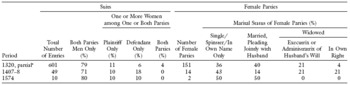
The surviving records of the Sheriffs’ and Mayor's Court are limited in number and coverage. For the Sheriffs’ Court, good information is available only for three months in 1320, with scattered cases from 1407–8 and the second half of the sixteenth century.Footnote 80 (See table A1.) For the Mayor's Court, the rolls for 1298–1307 apparently include all business that came before the court. Thereafter, between 1323 and 1482, the surviving plea and memoranda rolls mention an unknown but probably small and declining fraction of the total number of suits heard by the court.Footnote 81 The published calendars of the early court rolls and the plea and memoranda rolls have been used for the analyses in tables A2 and A3. People requesting that their disputes be considered under the Mayor's Court's equitable jurisdiction could submit a petition, either orally or—increasingly during the late medieval years—through a written bill. Bills survive for many years from the fourteenth through the seventeenth centuries, some dealing with equity issues but others with ordinary (i.e., common law/custom) cases. The bills remain unpublished. For this study, manuscript calendars of bills at the Corporation of London Record Office were used for various periods between 1327 and 1471 and for 1554–58, together with original files for 1456–57, 1573–74, and 1610–11 (see table A4).
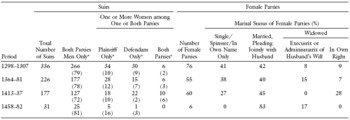
Though the coverage is thus poor, the evidence confirms that women were using London's courts during the fourteenth and fifteenth centuries. For the Mayor's Court, table A2 uses selected subperiods between 1298 and 1482 to explore several issues. The left side lays out what fraction of suits in the surviving records had female parties and whether they appeared as plaintiffs, defendants, or both. This helps us understand the extent to which women were making active use of the court to pursue their own interests, as opposed to being summoned before it by those who charged them with some kind of wrongdoing. Women did use the courts, but at a far lower level than men: in 72–81 percent of the cases in each subperiod, all members of both parties were male. Between 1298 and 1437, 10–12 percent of the cases had female plaintiffs, 7–12 percent had female defendants, and, in a handful, both parties were women. By the mid-fifteenth century, the few women were generally plaintiffs.
—Suits and Female Parties, Sheriffs’ Court of London, Selected Periods, 1320–1574

Sources.—For 1320, CLRO, Miscellaneous Roll CC, mm. 1–10, plus handwritten transcription/index at CLRO (Sheriffs’ Court 313A); for 1407–8, CLRO, Sheriffs’ Court, Box 1A, 1407–8, original rolls; for 1574, CRLO, Sheriffs’ Court, Box 1A, 1574, original rolls. Rolls for the latter two years are fragmentary.
Note.—In this table, “Total Number of Entries” gives the number of entries within a given roll rather than the number of cases; some cases are listed more than once, at various stages in the process. There is, however, no reason to suspect systematic skewing by gender or marital status between cases mentioned just once and those for which there are several entries.
a For July–September, first 10 mm., plus one case from 1318.
—Suits and Female Parties, Mayor's Court of London: Early Court Rolls, 1298–1307, and Plea and Memoranda Rolls, Selected Periods, 1364–1482

Sources.—CEMCRL; CPMRL, 1364–1381; CPMRL, 1413–1437; and CPMRL, 1458–1482.
Note.—This analysis excludes suits brought by city officials or “the commonalty” concerning public offences but includes cases removed from other courts as well as private suits initiated here. The number of suits can be counted fairly securely for 1298–1307, as the plea rolls survive. After that, the rolls include a decreasing number of suits and a growing proportion of memoranda. In the latter, suits may be mentioned only indirectly, as when a writ was sent from a higher court demanding the record of a case heard in the Mayor's Court. Because deciding which entries to count as suits in the later rolls is not always straightforward, the numbers provided here and in table A3 for periods after 1340 should be taken as approximate.
a Number of suits, with percentage in parentheses below.
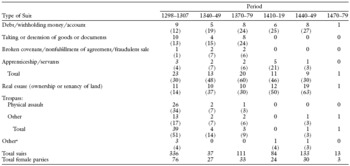
Types of Suits with Female Parties, Mayor's Court of London: Early Court Rolls, 1298–1307, and Plea and Memoranda Rolls, Selected Decades, 1340–1479

Sources.—CEMCRL; CPMRL, 1323–64; CPMRL, 1364–1381; CPMRL, 1381–1412; CPMRL, 1413–1437; CPMRL, 1437–1457; and CPMRL, 1458–1482.
Note.—Number of suits, with percentage in parentheses below. This table counts female parties, not cases with female parties. Thus, if a given case included two female parties, it would be entered twice here.
a Includes, for 1300–1307, three unspecified; for 1410–19, one unspecified; for 1440–49, one orphan's property.
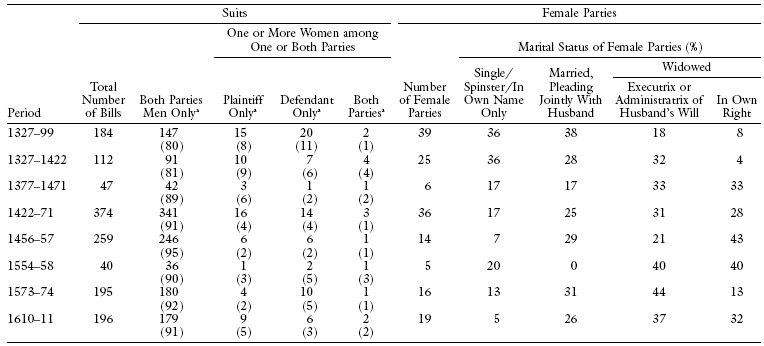
Suits and Female Parties, Bills Submitted to the Mayor's Court of London, Selected Periods, 1327–1611
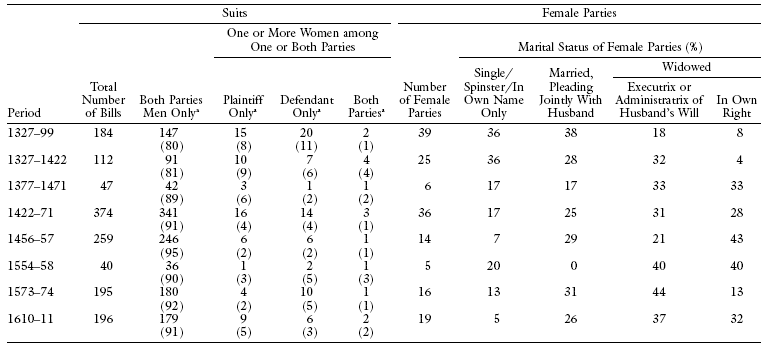
Sources.—1327–99, CLRO, MC1/1, used via unpublished calendar at CLRO; 1327–1422, CLRO, MC1/2, nos. 1–122, used via calendar; 1377–1471, CLRO, MC1/2A, used via calendar; 1422–71, CLRO, MC1/3, used via calendar; 1456–57, CLRO, MC1/3A, original file used; 1554–58, CLRO, MC1/4, used via calendar; 1573–74, CLRO, MC1/7, nos. 1–200, original file used; 1610–11, CLRO, MC1/27 and 28, original files used.
Note.—The periods used here derive from how the bills were bundled up in the original files, resulting in chronological overlap.
a Number of suits, with percentage in parentheses below.
The marital status of women parties is also relevant because, in London's legal practice, cases involving femme sole traders were supposed to name the husband and wife jointly as coparties, even though the actual issue concerned only the wife's economic activities. As the right side of table A2 shows, between 1298 and 1437, 27–41 percent of the female parties were described as singlewomen or spinsters or were listed in their own first and last name, suggesting that they were not married at the time. Another 15–28 percent were widows, some of whom appeared as executrices or administratrices of their late husbands' wills. This leaves 40–45 percent of the women who were married and pleaded jointly with their husbands. Many of these were prosecuting cases involving land that was held jointly by both spouses or by the wife for term of her life as dower from a former husband.Footnote 82 Relatively few of the married women were thus involved in the kinds of suits that could have concerned femme sole issues. By 1458–82, when notation of private suits on the plea and memoranda rolls has become even more fragmentary, women's apparent involvement had dropped far lower, and nearly all female parties were married.
Table A3 looks more closely at the types of suits in which female parties appeared in the Mayor's Court records during selected decades. Of the various categories of actions, problems stemming from femme sole trading were most likely to have been an issue in cases of debt, detention of goods or documents, or broken covenant, plus those dealing with apprentices and servants. Femme sole should not have been an issue in land actions or those trespass suits that alleged physical assaults or were used as a way to test the title to a tenancy or ownership of real estate. Between 1298 and 1307, when the record is fairly complete, only twenty-three women were parties in the first cluster of suits, with a considerably larger number appearing in actions of trespass. Between 1340 and 1419, partial information suggests that somewhere around half of all suits fell into the relevant categories, with a smaller fraction thereafter.
Bills submitted to the Mayor's Court concerning equity or ordinary issues reveal a similar situation. As table A4 displays, the proportion of bills with female complainants/plaintiffs or respondents/defendants was slightly lower than noted above. During the fourteenth century, bills with a woman as one of the parties formed about 20 percent of the total, but thereafter the proportion began to drop. Between the mid-fifteenth and early seventeenth centuries, women were parties in 5–10 percent of the bills. Women appeared as petitioners and respondents with roughly equal frequency in all periods. Married women pleading jointly with their husbands who might have sued or been sued for femme sole issues constituted 38 percent of all female parties in one set of calendared files spanning the period 1327–99 but just 17–29 percent in other files during the fourteenth and fifteenth centuries. During the later sixteenth and early seventeenth centuries, their share fluctuated widely, but a higher fraction were now involved in land actions.
Table A1 displays information from the Sheriffs’ Court. The only extensive record comes from 1320. Of 601 entries on the first ten membranes (which refer to a smaller number of actual cases, since some cases had several entries), 21 percent had a female party; of the 151 women named in those entries, 40 percent were married and pleaded jointly with their husbands. In 1407–8 and 1574, when only scattered cases survive, 20–29 percent of the entries included a female party, but few of them were married and pleading with their husbands.
To assess the frequency with which legal disputes grew out of femme sole trading, we have information only for the Mayor's Court, and even there for an unknown fraction of all cases. (The 1320 Sheriffs’ Court roll gives the detailed pleadings for just a few cases involving women traders, and the other years are too fragmentary.) Of 770 cases recorded on the early Mayor's Court rolls for 1298–1307 and on the plea and memoranda rolls between 1364 and 1482, as shown on table A2, there are no instances in which a femme sole trader brought suit against someone else, using the formula of naming her husband as the coplaintiff but making it clear in the pleadings that the action concerned her own trading activity. Nor were women commonly impleaded as femmes soles by those who had a complaint against them: just four of the 770 cases revolved around femme sole issues. In three of these suits, the defendants were a married couple but the pleadings concerned the wife's trading activity, while the last dealt with the economic activities of a widow who had traded femme sole while married. Similarly, among the 1407 Mayor's Court bills between 1327 and 1611 laid out in table A4, no female petitioners appear to have claimed femme sole status.Footnote 83 Of the 976 bills between 1327 and 1471, only a handful were brought against women who claimed to be femmes soles; none of the 431 petitions between 1554 and 1611 seem to have concerned femme sole issues.
This analysis makes clear that London women were using the courts on a regular basis at least during the fourteenth and fifteenth centuries and that some married women pleaded jointly with their husbands, but it does not indicate that these bodies dealt with many disputes concerning femme sole status. Although the fragmentary nature of the evidence precludes any firm conclusions, the limited appearance of femme sole issues in the surviving cases supports the suggestion that many married women who were in fact trading on their own did not choose to declare themselves as femmes soles or to plead on that basis in the courts.