Introduction
The prognosis of children with conotruncal CHD improved markedly, but the morbidity remains high in infants with complex heart defects and extracardiac anomalies. Conotruncal heart defects associated with the 22q11.2 deletion, such as interrupted aortic arch and truncus arteriosus communis, are typically surgically corrected during the neonatal period, whereas tetralogy of Fallot is usually repaired during infancy. The frequency of 22q11.2 deletion in these patients varies between 10% and 90%.Reference Goldmuntz1
22q11.2 deletion syndrome is the most common chromosomal deletion syndrome affecting genes critical for embryonic development. The 22q11.2 region is prone to misalignment during meiosis and to non-allelic homologous recombination. Most patients have a 3 Mb (megabase) deletion, although some have smaller or nested deletions. T-box transcription factor is the leading candidate gene responsible for the disorder. During embryogenesis, 22q11.2 deletion impairs neural crest cell migration and disrupts the development of structures derived from the third and fourth pharyngeal arches, including the thymus, parathyroid glands, and the conotruncal region of the heart. Affected individuals often present with conotruncal CHD and thymic hypoplasia or aplasia.Reference McDonald-McGinn, Hain, Emanuel, Adam, Feldman and Mirzaa2
It is known that infants with 22q11.2 deletion have multiple immune issues; typically, low T cell counts, low T cell receptor excision circle levels, and impaired antibody production due to diminished cooperation between T and B lymphocytes.Reference Davey, Elder and Cloutier3 The critical role of the thymus in the development of immune regulation is described.Reference Gul, Strand and Pettersen4 However, thymic atrophy occurs in highly complex CHD cases even before thymectomy.Reference Bremer, Boxnick and Glau5,Reference Cabrera, Dyamenahalli and Gossett6 As immune dysregulation may impact recovery in both 22q11.2 deleted patients and in patients without genetic syndrome, identifying immune dysfunction before surgery may help optimise patient management.
The aim of the study is to analyse the immunological profile of neonates and infants with conotruncal CHD prior to surgery or comfort care and to assess the impact of 22q11.2 deletion on immunological status and postoperative outcomes.
Material and methods
Study population and data collection
A prospective clinical study was designed to evaluate the immunological and genetic profile, including 22q11.2 deletion, thymus morphology, and postoperative complications in neonates and infants with conotruncal CHD hospitalised at the Paediatric Heart Centre between the years 2018 and 2022. The inclusion criteria were conotruncal CHD cases, comprising interrupted aortic arch type B, truncus arteriosus communis, and tetralogy of Fallot, including the most severe forms associated with pulmonary atresia and a dysplastic pulmonary valve. Patients with recognised genetic syndromes other than 22q11.2 deletion were excluded from the study. Genetic testing was performed using multiplex ligation-dependent probe amplification. Fluorescence in situ hybridisation was used for one neonate and two infants.
The study was approved by the institutional ethics committee. Written informed consent was obtained from the parents of all patients enrolled in the study. Blood samples for genetic and immunologic testing were taken from patients prior to corrective or palliative cardiac surgery and before or during the comfort care. Patients were divided into four groups according to age and the presence of 22q11.2 deletion:
-
1. Neonates with 22q11.2 deletion
-
2. Neonates without a genetic syndrome
-
3. Infants with 22q11.2 deletion
-
4. Infants without a genetic syndrome
The following laboratory parameters were assessed:
-
1) Blood count: total leukocyte, neutrophil, and lymphocyte counts. Blood count was evaluated using Sysmex XN-1000 haematology analyser (Sysmex America, Inc. Lincolnshire, IL, USA).
-
2) Flow cytometry-lymphocyte subsets: The surface markers of peripheral lymphocytes were identified by flow cytometry and CD3+ (total T-lymphocytes), CD4+ (helper T-lymphocytes), CD8+ cytotoxic T lymphocytes, CD16+ (natural killer cells), and CD19+ (B-lymphocytes) positive cells were counted. Flow cytometry analysis was performed with Cytomics FC500 flow cytometer using 488 nm argon laser (Beckman Coulter, Lismeehan Ireland Inc.).
-
3) Immunoglobulins M, A, G, and E: Immunoglobulins M, A, and G levels were measured by Cobas Integra 800 analyser (Roche, Basel, Switzerland) and IgE levels by Hytec-288 (Hycor Garden Grove, CA, USA).
-
4) T cell receptor excision circle and kappa-deleting recombination excision circle copies: Levels of T cell receptor excision circle and kappa-deleting recombination excision circle measured on whole blood were evaluated using Stratagene Mx3005P Real Time PCR System (Agilent Technologies, USA) and calculated as number of copies per 106 cells according to the following formula:
 $$ {\it TREC\,\,or\,\,KREC}\,\,\,{\it copies}/10^{6}\,{\it cells}={\it TREC \,\,{\it alebo} \,\,KREC \,\,Qty \over \it TRAC\,\,gene\,\,Qty/2}\times 10^{6} $$

The results were evaluated using a predetermined cut-off values based on the same T cell receptor excision circle and kappa-deleting recombination excision circle quantification method.Reference Medova, Hulinkova and Laiferova7 The cut-off values reported as the 5th percentile for T cell receptor excision circle molecules per 106 cells were 18.825 for neonates and 20.387 for infants. The 95th percentile for T cell receptor excision circle molecules was 185.762 for neonates and 151.823 for infants. The cut-off values stated as the 5th percentile for kappa-deleting recombination excision circle molecules per 106 cells were 3.681 for neonates and 4.708 for infants. The 95th percentile for kappa-deleting recombination excision circle molecules was reported as 66.641 for neonates and 41.685 for infants.
The distribution of normal and abnormal (below and above) values was compared between 22q11.2 deletion neonates and neonates without a genetic syndrome and between 22q11.2 deletion infants and infants without a genetic syndrome, respectively. Data from complete blood count, flow cytometry, and immunoglobulin analyses were interpreted in accordance with normal values adjusted for patient age. Comfort care was indicated and provided for patients with life-limiting cardiac pathology when curative or disease-modifying interventions were no longer feasible. Palliative cardiac surgery was performed in patients who underwent modified Blalock–Taussig shunt placement or pulmonary artery banding.
The presence and size of the thymus were assessed during open heart surgery through visual inspection by the surgeon. In comfort care patients, the thymus was considered present if thymic tissue was visible on chest X-ray and/or CT. Thymus not visible on chest X-ray and/or CT was considered as an aplasia, although ectopic thymic tissue location could be a feature of 22q11.2 deletion syndrome. The effect of 22q11.2 deletion presence on invasive mechanical ventilation duration, the need for non-invasive ventilation after extubation, incidence of postoperative chylothorax and infection, ICU and hospital length of stay was evaluated. Non-invasive ventilation was defined as the use of nasal continuous positive airway pressure, pressure support, or control mode ventilation. Chylothorax was considered if the pleural effusion was lymphocyte predominant, lasted more than seven days, and the amount of fluid was more than 10 millilitres per kilogram per day. Infection was identified as a clinical condition with positive inflammatory markers leading to antibiotic administration.
Mortality was defined as death before hospital discharge, regardless of the hospital stay duration. Length of hospital stay was determined for all subjects who survived to discharge.
Data analysis and presentation
Demographic and clinical characteristics of the study population were summarised using standard descriptive statistics. Categorical variables are presented as frequencies (percentages), and continuous variables are reported as medians (ranges). Laboratory values were categorised as below, within, or above the age-specific normal range and visualised using 100% stacked column charts in Microsoft Excel. The distributions of normal and abnormal laboratory values were compared between 22q11.2 deletion neonates and neonates without a genetic syndrome, as well as between 22q11.2 deletion infants and infants without a genetic syndrome, using the chi-squared test. Continuous variables were assessed using the Mann–Whitney U test. Statistical significance was defined as P < 0.05. All analyses were performed using JMP version 5.0.1a (SAS Institute, Inc.).
Results
Patient characteristics
Our cohort included 93 children (58 boys, 35 girls) with conotruncal CHD undergoing corrective or palliative cardiac surgery or receiving comfort care. Patients were allocated into 4 groups:
-
Group 1: 9 neonates with 22q11.2 deletion and median age of 7 (2–22) days,
-
Group 2: 13 neonates without a genetic syndrome and median age of 11 (5–26) days,
-
Group 3: 5 infants with 22q11.2 deletion and median age of 2.1 (1.2–4) months,
-
Group 4: 66 infants without a genetic syndrome and median age of 5.5 months (1.1 month–2.8 years).
Of all patients, 14 patients (15%) had 22q11.2 deletion. Eight of them had tetralogy of Fallot, four patients had truncus arteriosus communis, one patient had interrupted aortic arch type B, and one patient had an atypical conotruncal septal defect. Eleven neonates without a genetic syndrome had tetralogy of Fallot and two neonates had truncus arteriosus communis. None of the patients had asplenia. Incidence of 22q11.2 deletion was 11% in patients with tetralogy of Fallot, 44% in patients with truncus arteriosus communis, and 100% in patients with interrupted aortic arch type B. Infants with 22q11.2 deletion had lower weight at admission compared to infants without a genetic syndrome (P = 0.02) with no significant difference in terms of age between the groups. Preoperative invasive or non-invasive ventilation was used in 44% of neonates with 22q11.2 deletion and in 39% of neonates without a genetic syndrome. None of the infants required preoperative invasive or non-invasive ventilation. Comorbid conditions were identified in neonates and infants with 22q11.2 deletion syndrome (multicystic kidney dysplasia, hypothyroidism, hypospadias, and hydrocephalus) as well as in neonates and infants without a genetic syndrome (duplex kidney, retinal coloboma, liver haemangiomas, hydrocephalus, and hypospadias). None of the patients’ parents declined participation in the study. Patients with genetic syndromes other than 22q11.2 deletion were excluded from the study (four patients with trisomy 21, one patient with Klinefelter syndrome, one patient with an inverted duplication of the short arm of chromosome 4, and one patient with a 16p11.2 microdeletion).
Thymus morphology, thymectomy
Neonates
All neonates without a genetic syndrome had normal thymus size. Of these neonates, 85% underwent total thymectomy and 15% partial thymectomy. Seventy-eight percent of 22q11.2 deletion neonates had thymic hypoplasia; in the remaining, 22% patients the thymus was described as normal. All 22q11.2 deletion neonates with normal thymus or thymus hypoplasia underwent total thymectomy.
Infants
Normal thymus was found in 98% of the infants without a genetic syndrome, of whom 83% underwent total thymectomy and 17% partial thymectomy. Twenty percent of 22q11.2 deletion infants had thymic hypoplasia, and 80% of them had a normal thymus. Fifty percent of 22q11.2 deletion infants underwent total thymectomy, and 50% underwent partial thymectomy.
Our study showed that among all patients with 22q11.2 deletion, thymus hypoplasia was observed in 100% of neonates with truncus arteriosus communis, 100% of neonates with interrupted aortic arch type B, and 38% of infants with tetralogy of Fallot.
Leukocyte counts prior to surgery or comfort care
Neonates
The total leucocyte counts were normal in all 22q11.2 deletion neonates and in 84% of those without a genetic syndrome. Elevated neutrophil counts were observed in 38% of neonates without a genetic syndrome. Sixty-seven percent of 22q11.2 deletion neonates had total lymphocyte counts below the normal range. The incidence of lymphopenia in neonates without a genetic syndrome was 54%. The median lymphocyte count was 2.5 (range: 1.4–3.5) × 109/L in neonates with 22q11.2 deletion compared to 3.0 (range: 1.5–7.0) × 109/L in those without a genetic syndrome.
Infants
Leucocyte counts were within the normal range in 40% of infants with 22q11.2 deletion and in 71% of those without a genetic syndrome. Lymphopenia was observed in 80% of 22q11.2 deletion infants and 29% of non-syndromic infants. Infants with 22q11.2 deletion had a median lymphocyte count of 2.2 (range: 1.4–4.4) × 109/L, whereas those without a genetic syndrome had a median count of 3.9 (range: 0.4–5.4) × 109/L.
Lymphocyte subsets prior to surgery or comfort care
Neonates
Majority of 22q11.2 deletion neonates had low CD3+, CD4+, and CD8+ counts. CD19+ counts showed mixed results.
Infants
Most infants with 22q11.2 deletion had low CD3+, CD4+, and CD8+ counts. Among infants without a genetic syndrome, 51% had decreased CD3+ counts, 59% had reduced CD4+ counts, and 56% had CD8+ counts below the normal range. CD19+ cell counts showed variable results, while natural killer cells (CD16+) were reduced in 33% of infants without a genetic syndrome (Figure 1).
Percentage of patients with CD3+, CD4+, CD8+, CD16+, CD19+ cells, levels being below, within, and above normal range. GS = Genetic syndrome.

Immunoglobulin levels, T cell receptor excision circle, and kappa-deleting recombination excision circle levels prior to surgery or comfort care
Neonates
Immunoglobulin G, M, and A levels were decreased across all patient groups, with variable patterns observed among the different immunoglobulin classes. Immunoglobulin E was above the normal range in 15% of neonates without a genetic syndrome. T cell receptor excision circle levels below the 5th percentile were present in majority of 22q11.2 deletion neonates. Kappa-deleting recombination excision circle levels above the 95th percentile were observed in a subset of both 22q11.2 deletion neonates and neonates without a genetic syndrome.
Infants
Low immunoglobulin G, M, and A levels were found in both groups of infants. Immunoglobulin E was above the normal range in 25% of infants without a genetic syndrome. T cell receptor excision circle levels below the 5th percentile were present in 40% of 22q11.2 deletion infants and in 8% of infants without a genetic syndrome, respectively. We observed kappa-deleting recombination excision circle levels above the 95th percentile in 20% of 22q11.2 deletion infants and in 42% of infants without a genetic syndrome (Figure 2).
Percentage of patients with immunoglobulins (Ig) G, M, A, and E and TREC and KREC levels being below, within, and above normal range. GS = Genetic syndrome; Ig = Immunoglobulin; KREC = Kappa-deleting recombination excision circle; TREC = T cell receptor excision circle.

Postoperative course
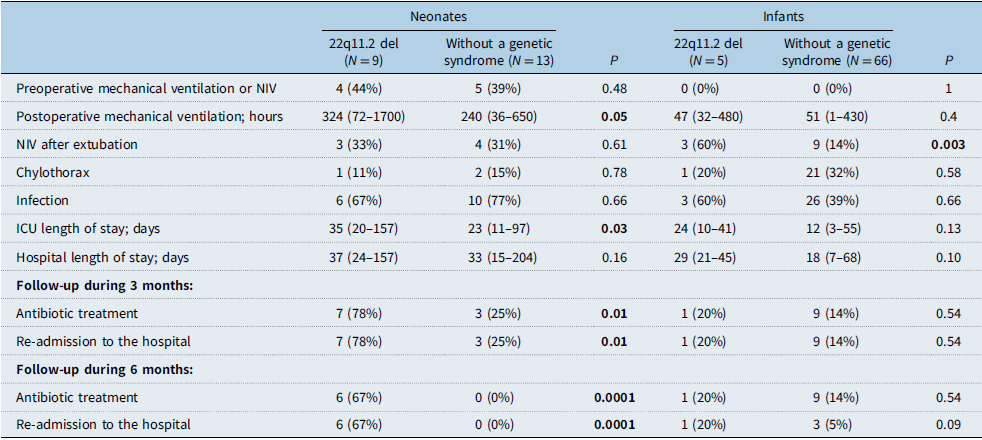
In our study cohort, the presence of a 22q11.2 deletion with conotruncal heart defects was associated with a longer duration of mechanical ventilation and a longer ICU length of stay in neonates after cardiac surgery. Infants with 22q11.2 deletion and conotruncal heart defects had a significantly greater use of non-invasive ventilation after corrective cardiac surgery. Sixty-seven percent of 22q11.deletion neonates and 77% of neonates without a genetic syndrome developed postoperative infection (Table 1).
Patient characteristics and follow-up

NIV = Non-invasive ventilation; 22q11.2 del = 22q11.2 deletion.
P-values ≤ 0.05 were considered statistically significant and are shown in bold.
The presence of 22q11.2 deletion was not associated with the development of chylothorax.
Four patients died; three 22q11.2 deletion neonates and one 22q11.2 deletion infant. Of these patients, two neonates with 22q11.2 deletion received comfort care prior to cardiac surgery due to extreme forms of CHD: one neonate with 22q11.2 deletion and tetralogy of Fallot with dysplastic pulmonary valve and one neonate with 22q11.2 deletion and tetralogy of Fallot with pulmonary atresia.
Discussion
This study analysed in neonates and infants with conotruncal CHD: (1) the immunological profile prior to surgery or prior to/during comfort care and (2) the impact of 22q11.2 deletion with regard to the immunological status on postoperative course and mid-term postoperative outcomes.
We identified a high incidence of immune abnormalities in patients with conotruncal CHD. More than a half of 22q11.2 deletion infants and 26% of infants without a genetic syndrome had leucopenia. Data on leucopenia in patients with conotruncal CHD prior to surgery are limited, unlike thrombocytopenia, which is a well-known condition in 22q11.2 deletion syndrome.Reference Griesman, Karahalios and Prendergast8 Our study provides new evidence by assessing leucopenia in infants with conotruncal CHD, particularly those with 22q11.2 deletion, prior to surgery. These findings suggest the need for future research involving larger patient cohorts.
Incidence of lymphopenia was elevated in 22q11.2 deletion neonates and infants; however, lymphopenia was present also in neonates and infants without a genetic syndrome.
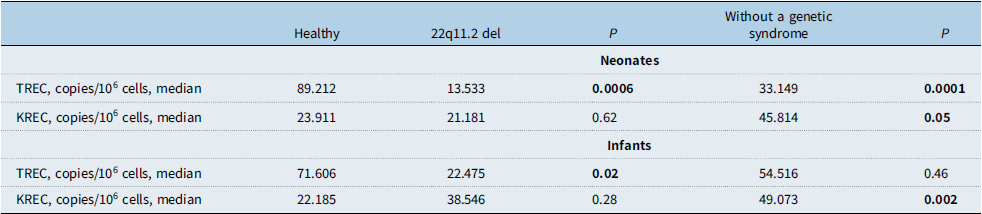
CD3+, CD4+, and CD8+ cells were low in most of the 22q11.2 deletion patients, but also in patients without a genetic syndrome. It is known that CD16+ and CD19+ lymphocytosis could be a response to CD3+, CD4+, and CD8+ lymphopenia.Reference Kovacikova, Krasnanova and Skrak9 Recent literature focused mainly on T cell receptor excision circle markers, which are easily estimated during routine newborn screening. T cell receptor excision circle molecules are generated during the final stages of T cell development, just before they leave to the periphery. Therefore, their levels in the peripheral circulation represent thymic activity.Reference Bremer, Boxnick and Glau5 Our study showed that except infants without a genetic syndrome, all other patient groups had T cell receptor excision circle levels lower than healthy population (Table 2). Evenmore, the levels were lower in 22q11.2 deletion neonates than in neonates without a genetic syndrome (P = 0.06). Although the difference in T cell receptor excision circle levels between neonates with 22q11.2 deletion and those without a genetic syndrome did not reach conventional statistical significance (P = 0.06), this trend is consistent with existing literature. Given the limited sample size and the rarity of the condition, this near-significant result still provides valuable insight in this patient group. We believe these findings warrant further investigation in larger cohorts.
Comparison of TREC and KREC values in our patient groups and the healthy population

KREC = Kappa-deleting recombination excision circle; TREC = T cell receptor excision circle; 22q11.2 del = 22q11.2 deletion.
P-values ≤ 0.05 were considered statistically significant and are shown in bold.
Previous research linked compromised T cell populations and premature immune ageing to early thymectomy during cardiac surgery.Reference Cramer, Yang and Riemann10,Reference Wong, Hamidzada and Epelman11 New insights were provided by the finding of thymic atrophy in patients with complex CHD even before thymectomy. Thymic atrophy and subsequent T cell lymphopenia can be caused by the release of glucocorticoids during stressful situations such as hypoxia.Reference Bremer, Boxnick and Glau5 Furthermore, proinflammatory markers may facilitate lymphopenia-induced proliferation of autoreactive T lymphocytes and contribute to impaired adaptive immune function in CHD patients. This phenomenon is known as non-severe combined immunodeficiency T cell lymphopenia, which is thought to be 3 to 4 times more frequent than severe combined immunodeficiency and can be identified by T cell receptor excision circle assay. Therefore, it is important to note that neonatal screening, primarily aimed at detecting severe combined immunodeficiency, may also identify mild forms of T cell lymphopenia.
One of the features of 22q11.2 deletion syndrome is thymic aplasia or hypoplasia. However, according to surgeons’ assessment, 80% of infants and 22% of neonates with 22q11.2 deletion in our study had a normal thymus size; all of these patients had tetralogy of Fallot. In the cohort of 22q11.2 deletion neonates and infants, all patients with thymic aplasia or hypoplasia had severe forms of complex conotruncal CHD (truncus arteriosus communis, tetralogy of Fallot with dysplastic pulmonary valve, interrupted aortic arch type B and tetralogy of Fallot with dysbalanced atrioventricular canal). Our finding supports previous evidence that thymic malformation during embryogenesis and severe conotruncal CHD are common manifestations of 22q11.2 deletion syndrome.
Changes in immunoglobulin levels were found in all patient groups. However, no significant difference was found between 22q11.2 deletion patients and patients without a genetic syndrome. Immunoglobulin A deficiency may be transient and can resolve within the first years of life, with no established association with CHD.Reference Justiz Vaillant and Wilson12,Reference Koenen, van Montfrans and Sanders13 Elevated IgE levels are historically known as a marker of atopy or parasitic infection. Recent data suggest that children with elevated IgE should be screened for inborn errors of immunity.Reference El-Sayed, El-Ghoneimy and Ortega-Martell14 This may be consistent with our study, which found a skewed T cell population in all patient groups. Li et al.Reference Li, Zhu and Chen15 described a correlation between elevated IgE levels and prolonged mechanical ventilation after cardiopulmonary bypass. Our study did not show such an association. Among 17 neonates and infants without a genetic syndrome and with high IgE levels, only one patient had a high eosinophil count.
Kappa-deleting recombination excision circle molecules are a small fragment of DNA that shows the B-lymphocyte output. High kappa-deleting recombination excision circle levels represent a compensatory response to T cell imbalances. According to our findings, we may suggest that patients without a genetic syndrome compensate T cell imbalances in a greater extent that children with 22q11.2 deletion syndrome.
Previous research has identified in patients with 22q11.2 deletion several different respiratory tract disorders including airway impairment by vascular abnormalities, tracheomalacia, and subglottic stenosis.Reference Krasnanova, Kovacikova and Hrubsova16,Reference Sacca, Zur and Crowley17 Our study found an increased duration of invasive mechanical ventilation in 22q11.2 deletion neonates and infants, as well as a higher use of postextubation non-invasive ventilation in 22q11.2 deletion infants. However, infants with 22q11.2 deletion underwent cardiac surgery much earlier due to severe respiratory or cardiac findings, such as respiratory tract stenosis or severe pulmonary artery stenosis with major aortopulmonary collateral arteries.
A high incidence of early postoperative infections was observed not only in neonates and infants with 22q11.2 deletion but also in those patients without a genetic syndrome. The incidence of infection in our population was higher than previously reported.Reference Barker, O’Brien and Welke18 This may be due to the types of infections included. In our study, all clinical situations requiring antibiotic therapy were involved, whereas previous studies primarily focused on specific types of postoperative infections. The factors that may contribute to high incidence of postoperative infections are young age and high complexity of CHD as well as preoperative haemodynamic instability and severe acidosis related to the low rate of prenatal diagnosis, longer time of surgery, and left open chest following cardiac surgery. However, this study does not address practices to prevent postoperative infections in high-risk individuals.
The impact of 22q11.2 deletion was observed in neonates who had longer ICU stay and higher need of antibiotic treatment and re-admission to the hospital during 3 and 6 months of follow-up. The incidence of postoperative chylothorax across all groups was consistent with published data.Reference Mery, Moffett and Khan19 Thus, we can conclude that patients with 22q11.2 deletion are not at increased risk for development of chylothorax.
In our study, the overall mortality rate was 4% and 29% among deleted patients (4 patients). Two neonates without surgery died after transitioning to comfort care. Other two patients died following cardiac surgery and postoperative extracorporeal membrane oxygenation; one neonate with truncus arteriosus communis and interrupted aortic arch type B and one infant with pulmonary atresia and major aortopulmonary collateral arteries. The postoperative mortality in our 22q11.2 deletion patient groups is 14%, similar to the published data.Reference Putotto, Pugnaloni and Unolt20
Study limitations
Firstly, the neonatal cohort consists of patients with varying pathophysiological conditions, including differences in conotruncal CHD haemodynamic and the severity of critical illness. Secondly, the patient groups with 22q11.2 deletion are small, as this genetic condition is rare. Thirdly, the analysis may have been influenced by several confounding factors, including the type of corrective or palliative surgery, prematurity, thymectomy, and the genetic testing technique. One neonate and two infants without extracardiac malformation were tested using fluorescence in situ hybridization technique which may results in false negative finding. Furthermore, the use of multiplex ligation-dependent probe amplification does not exclude conditions resembling 22q11.2 deletion syndrome, such as CHARGE syndrome or TBX1 haploinsufficiency. Despite these limitations, the study offers insights for further investigation of compensatory mechanisms for immune dysregulation and interactions between immune, cardiac, respiratory, and other organ systems in patients with congenital heart defects. Also, the results may suggest to consider routine T cell receptor excision circle screening as a clinical tool for the management of patients with CHD.
Conclusion
Neonates and infants with conotruncal CHD have low preoperative counts of T lymphocytes, T cell receptor excision circle and immunoglobulin levels and high incidence of postoperative infections. In our study cohort, the presence of a 22q11.2 deletion with conotruncal heart defects was associated with a longer duration of mechanical ventilation, a longer ICU length of stay, a higher need for antibiotic treatment after discharge from the hospital and risk of hospital readmission in neonates after cardiac surgery. Infants with 22q11.2 deletion and conotruncal heart defects had a significantly greater use of non-invasive ventilation after corrective cardiac surgery. These findings highlight the need for comprehensive perioperative management of patients with conotruncal CHD.
Acknowledgements
The authors would like to thank all the colleagues from the Pediatric Cardiac Intensive Care Unit at the National Institute of Cardiovascular Diseases, the Department of Laboratory Medicine at the National Institute of Children’s Diseases, and the Institute for Clinical and Translational Research at the Slovak Academy of Sciences for their cooperation, support, and assistance.
Author contributions
All authors contributed to the study conception and design. Material preparation and analysis were performed by Veronika Krasnanova. The first draft of the manuscript was written by Veronika Krasnanova with support from Lubica Kovacikova. All authors read and approved the final form of the manuscript.
Financial support
The authors received no financial support for the research, authorship, and/or publication of this article.
Competing interests
The authors declare none.
Ethical standard
The study was approved by the institutional ethics committee and complied with the ethical standards as laid down in the 1964 Declaration of Helsinki and its later amendments and has been approved by the institutional committees.
Informed consent
Written informed consent for participation and for publication of the data was obtained from the parents of all patients enrolled in the study.