Kochia is a problematic, summer annual broadleaf weed, prevalent in cropland and noncropland throughout the U.S. Great Plains, including Montana and in Canada (Friesen et al. Reference Friesen, Beckie, Warwick and Van Acker2009). Kochia is a monoecious, C4 diploid (2n=18) that possesses several unique biological characteristics, including early seedling emergence, rapid growth, and high tolerance to abiotic stresses (heat, cold, salt, drought) (Friesen et al. Reference Friesen, Beckie, Warwick and Van Acker2009; Schwinghamer and Van Acker Reference Schwinghamer and Van Acker2008). Because of its protogynous flowering, kochia exhibits a high degree of outcrossing and pollen-mediated gene flow (Beckie et al. Reference Beckie, Blackshaw, Hall and Johnson2016; Mengistu and Messersmith Reference Mengistu and Messersmith2002; Stallings et al. Reference Stallings, Thill, Mallory-Smith and Shafii1995). Kochia is a prolific seed producer (>100,000 seeds plant−1) and disperses its seeds long distances through wind-mediated tumbling of the matured plant (Baker et al. Reference Baker, Withrow, Brown and Beck2010; Beckie et al. Reference Beckie, Blackshaw, Hall and Johnson2016; Christoffoleti et al. Reference Christoffoleti, Westra and Moore1997; Kumar and Jha Reference Kumar and Jha2015a). Consequently, kochia manifests considerable genetic diversity within a field population (Mengistu and Messersmith Reference Mengistu and Messersmith2002; Stallings et al. Reference Stallings, Thill, Mallory-Smith and Shafii1995).
Herbicide-resistant (HR) kochia is an increasing problem for growers in the U.S. Great Plains and Canada (Heap Reference Heap2016). To date, kochia has developed resistance to four different herbicide sites of action, including photosystem II (PS II) inhibitors (atrazine; Group 5), acetolactate synthase (ALS) inhibitors (sulfonylurea and imidazolinone herbicides; Group 2), synthetic auxins (dicamba and fluroxypyr; Group 4), and 5-enolpyruvyl-shikimate-3-phosphate synthase (EPSPS) inhibitor (glyphosate; Group 9) (Heap Reference Heap2016). Glyphosate-resistant (GR) kochia was first identified in western Kansas in 2007 and has also been reported from 10 other states in the U.S. Great Plains, including Montana, and in three Canadian provinces (Hall et al. Reference Hall, Beckie, Low, Shirriff, Blackshaw, Kimmel and Neeser2014; Kumar et al. Reference Kumar, Jha and Reichard2014, Reference Kumar, Jha, Giacomini, Westra and Westra2015; Waite et al. Reference Waite, Thompson, Peterson, Currie, Olson, Stahlman and Al-Khatib2013; Wiersma et al. Reference Wiersma, Gaines, Preston, Hamilton, Giacomini, Buell, Leach and Westra2015). A majority of these GR kochia cases have been reported from no-till wheat–fallow fields with a history of intensive glyphosate use in chemical fallow, often at low rates, resulting in poor overall weed control.
The EPSPS gene amplification (increased EPSPS copy number) confers glyphosate resistance in GR kochia populations reported from U.S. Great Plains and Canada (Godar et al. Reference Godar, Stahlman, Jugulam and Dille2015; Kumar et al. Reference Kumar, Jha, Giacomini, Westra and Westra2015; Wiersma et al. Reference Wiersma, Gaines, Preston, Hamilton, Giacomini, Buell, Leach and Westra2015). GR kochia plants from Colorado, North Dakota, South Dakota, and Kansas showed 3 to 10 times more EPSPS gene copies relative to susceptible plants (one copy of EPSPS gene) (Godar et al. Reference Godar, Stahlman, Jugulam and Dille2015; Wiersma et al. Reference Wiersma, Gaines, Preston, Hamilton, Giacomini, Buell, Leach and Westra2015). In Montana, GR kochia biotypes with 3- to 15-fold increase in EPSPS gene copies have been reported (Kumar et al. Reference Kumar, Jha, Giacomini, Westra and Westra2015; Kumar and Jha Reference Kumar and Jha2015b). A cytogenetic study on GR kochia from Kansas indicated that the increase in EPSPS gene copies was possibly due to an unequal crossover during meiosis, resulting in tandem gene duplication, and the extra EPSPS gene copies followed a single locus inheritance (Jugulam et al. Reference Jugulam, Niehues, Godar, Koo, Danilova, Friebe, Sehgal, Varanasi, Wiersma, Westra, Stahlman and Gill2014).
Novel herbicide-resistance alleles may alter other unrelated physiological processes that are directly associated with the fitness attributes of an HR weed biotype (Vila-Aiub et al. Reference Vila-Aiub, Neve and Powles2009). A fitness cost is generally defined as the reduction of fitness caused by the negative pleiotropic effects of a resistance allele on seed germination, emergence, vegetative growth, phenology, and fecundity characteristics of an HR relative to an herbicide-susceptible (HS) weed biotype (Vila-Aiub et al. Reference Vila-Aiub, Neve and Powles2009, Reference Vila-Aiub, Gundel and Preston2015). In the literature, no fitness cost due to EPSPS gene amplification has been reported in GR Palmer amaranth (Amaranthus palmeri S. Wats.) biotypes from Georgia (Giacomini et al. Reference Giacomini, Westra and Ward2014; Vila-Aiub et al. Reference Vila-Aiub, Goh, Gaines, Han, Busi, Yu and Powles2014). Similarly, no differences in vegetative growth (plant height, plant width, primary branches, total leaf area, shoot dry weights) and reproductive (harvest index and 1,000-seed weights) characteristics have been found between glyphosate-susceptible (GS) and GR kochia biotypes (Kumar and Jha Reference Kumar and Jha2015b).
Less information is available in the literature on seed germination characteristics of HR and HS weed biotypes, and variable results have been observed, depending on the resistance trait and the weed species. For example, Mapplebeck et al. (Reference Mapplebeck, Souza Machado and Grodzinski1982) documented that seeds of triazine-resistant birdsrape mustard (Brassica campestris L.) had a slower germination rate (12 to 18 h later) compared with seeds from susceptible plants. In contrast, an ALS-resistant prickly lettuce (Lactuca serriola L.) biotype germinated much faster than the susceptible biotype after 2.5 d of incubation; however, both biotypes had cumulative germination of ≥98% after 7d at 20C (Alcocer-Ruthling et al. Reference Alcocer-Ruthling, Thill and Shafii1992). Dyer et al. (Reference Dyer, Chee and Fay1993) reported that ALS-resistant kochia seeds germinated faster than the susceptible seeds at 4.6 C but not at higher temperatures. Thompson et al. (Reference Thompson, Thill and Shafii1994) also found that ALS-resistant kochia seeds from Kansas and North Dakota had faster germination rate (12 to 70 h early) and total cumulative germination (100 to 300 h earlier) than the susceptible seeds at 8C. In a recent study, dicamba-resistant kochia lines had lower cumulative germination than the susceptible line at a majority of constant temperatures from 10 to 35C and alternating temperatures from 5/10 to 30/35 C (Kumar and Jha Reference Kumar and Jha2016). Nevertheless, there is a lack of information in the literature on the germination characteristics of kochia populations with resistance to glyphosate conferred by EPSPS gene amplification. Also, it is unclear whether there is any relationship between increased glyphosate resistance levels (as a result of increased EPSPS gene copies) and seed dormancy in GR kochia.
Therefore, the objectives of this research were to: (1) determine the relative EPSPS gene copy number (glyphosate resistance mechanism) to confirm glyphosate resistance in selected GR vs. GS kochia populations collected from wheat–fallow fields in Montana, (2) compare the seed germination characteristics of those populations under different constant and alternating temperatures, and (3) investigate a possible link between the EPSPS gene copy number and observed cumulative (total) germination of those GR and GS kochia populations at each temperature.
Materials and Methods
Plant Material
Kochia seeds were collected from 8 to 10 fully matured putative GR plants in the chemical fallow phase of wheat–fallow rotation in Hill, Liberty, and Toole counties of north-central Montana in the fall of 2012. Seeds from GR plants in a field were composited into a single sample, referred to as a population. Three GR populations collected from Hill County were designated as MT2 (45°54′58.55″N, 108°14′36.66″W), MT4 (45°54′59.39″N, 108°14′37.87″W), and MT9 (45°54′54.76″N, 108°14′44.15″W); a GR population from Liberty County was designated as MT37 (48°41′49.44″N, 111°13′0.49″W); and GR populations from Toole County were designated as MT70 (48°38′33.15″N, 112°4′56.06″W), MT74 (48°44′41.30″N, 112°0′45.70″W), and MT75 (48°33′51.77″N, 111°59′30.79″W). Similarly, two GS kochia populations, designated as GS1 (45°54′54.80″N, 108°14′44.74″W) and GS2 (45°54′53.50″N, 108°14′38.78″W), were collected from two different wheat–fallow fields in Hill County; these two fields were in close proximity to the fields where the Hill County GR populations were collected. The sampled fields had a history (>8 yr) of at least three applications of glyphosate per year for weed control in the summer fallow prior to winter wheat planting in the fall.
After threshing and cleaning with an air-propelled column blower, kochia seeds from each population were separately sown on germination flats (53 by 35 by 10 cm) containing commercial potting mix (VermiSoilTM, Vermicrop Organics, 4265 Duluth Avenue, Rocklin, CA) in a greenhouse at the Montana State University Southern Agricultural Research Center (MSU-SARC) near Huntley, MT. The greenhouse conditions were maintained at 25/23 C day/night temperatures and 16/8 h day/night photoperiods supplemented with metal-halide lamps (400 mmol m−2 s−1). At least 200 kochia plants (8 to 10 cm tall) from each population were treated with 435 (0.5X), 870 (1X), and 1,740 (2X) g ae ha−1 of glyphosate (Roundup PowerMax®, Monsanto Company, St. Louis, MO) plus 20gL−1 ammonium sulfate (AMS) in a stationary spray chamber fitted with an even flat-fan nozzle (TeeJet 8001EXR, Spraying System Company, Wheaton, IL) calibrated to deliver 94 L ha−1 of spray solution at 276 kPa. Plants from all GR populations survived the 2X rate of glyphosate 21 d after treatment (DAT); confirming the resistance to glyphosate. In contrast, plants from both GS1 and GS2 populations failed to survive the 1X rate of glyphosate 21 DAT (unpublished data).
Development of GR and GS Selected Lines
Kochia plants from each GR population that survived the 2X glyphosate rate were transplanted into 20 L plastic pots (two to three plants per pot) containing the commercial potting mix in the greenhouse as previously described. A group of 20 phenotypically uniform plants of each GR and GS population were selected. Plants were watered as needed to avoid moisture stress and fertilized (Miracle-Gro water-soluble fertilizer [24–8–16], Scotts Miracle-Gro Products, 14111 Scottslawn Road, Marysville, OH) on a biweekly basis to maintain good growth. Prior to flower initiation, groups of three to four GR or GS plants (to avoid inbreeding depression) were covered with pollination bags (DelStar Technologies, 601 Industrial Drive, Middletown, DE) to restrict cross-pollination between GR and GS kochia. Fully matured seeds were collected from the GR plants, and the progeny seedlings were further subjected to two more generations of recurrent group selection (to eliminate heterozygosity) using the 2X rate of glyphosate. Seeds of each of the two GS populations were also obtained after three generations of recurrent group selection without glyphosate under restricted cross-pollination; a subsample of each GS population at each generation was grown and sprayed to confirm susceptibility to the 1X rate of glyphosate. This procedure enabled the development of selected lines from individual GR and GS populations, referred to as GR and GS selected lines, respectively. The selected lines were subsequently used for determining EPSPS gene copy numbers and for germination experiments. This methodology not only reduced within-population variability but also minimized the seed germination differences due to differences in maternal environment (Fenner Reference Fenner1991; Thompson et al. Reference Thompson, Thill and Shafii1994). Generally, kochia seed does not exhibit a high degree of primary dormancy and is capable of germinating rapidly (within 24 h) under favorable conditions (Dyer et al. Reference Dyer, Chee and Fay1993; Everitt et al. Reference Everitt, Alaniz and Lee1983; Thompson et al. Reference Thompson, Thill and Shafii1994; Zorner et al. Reference Zorner, Zimdahl and Schweizer1984).
EPSPS Gene Copy Number
Laboratory experiments were conducted in the fall of 2014 to determine the EPSPS gene copy number of the seven GR and two GS selected kochia lines and were repeated in time (run 1 and run 2). Seeds of each selected line were sown on germination flats as described earlier. Three plants per line were sampled, and a 100 mg sample of young leaf tissue per plant was collected when plants attained 8 to 10 cm height. The genomic DNA (gDNA) was extracted as per the DNeasy plant mini kit (Qiagen Inc., Valencia, CA) standard protocol. The gDNA quantity and quality were checked using an Epoch 2 spectrophotometer (BioTekTM SynergyTM 2 multimode microplate reader, Winooski, VT), and the gDNA integrity was ensured using 1% agarose gel electrophoresis. High-quality gDNA samples (260/280 ratio of ≥1.8) were used for determining the EPSPS gene copy number and were processed for use in a quantitative PCR (qPCR) assay as described in Kumar et al. (Reference Kumar, Jha, Giacomini, Westra and Westra2015).
For the qPCR assay, the ALS gene was chosen as a reference gene due to its stability across kochia populations (Godar et al. Reference Godar, Stahlman, Jugulam and Dille2015; Kumar et al. Reference Kumar, Jha, Giacomini, Westra and Westra2015; Wiersma et al. Reference Wiersma, Gaines, Preston, Hamilton, Giacomini, Buell, Leach and Westra2015). For both the EPSPS and ALS primer pairs (described in Kumar et al. Reference Kumar, Jha, Giacomini, Westra and Westra2015), primer efficiency curves were generated. The primer efficiency for the EPSPS gene was 100% and for the ALS gene it was 101%. The qPCR reaction was carried out in a CFX Connect Real-Time qPCR detection system (Bio-Rad Laboratories, Hercules, CA) using a previously established protocol (Kumar et al. Reference Kumar, Jha, Giacomini, Westra and Westra2015). The qPCR reaction efficiency was 102% (R2=0.99, slope=−3.22). The EPSPS:ALS gene copy number was determined by the comparative CT method (ΔCT=CT ALS − CT EPSPS). The relative increase in the EPSPS gene copy number in a GR selected line was calculated as 2ΔCT. Each sample was run in triplicate (three technical replications) to calculate the mean and standard error of the increase in the relative EPSPS copy number.
Germination Experiments
Seeds of GR and GS selected kochia lines were stored in paper bags at 4 C until being used in germination experiments. Germination assays were conducted in the fall of 2014 (2 mo after harvest of selected lines) and repeated in time (run 1 and run 2). Germination characteristics of GR and GS selected lines were compared at seven different constant temperatures: 5, 10, 15, 20, 25, 30, and 35 C; and six different alternating temperatures: 5/10, 10/15, 15/20, 20/25, 25/30, and 30/35 C at a 12 h/12 h cycle. The temperature regimes were chosen based on previous studies on kochia seed germination (Dyer et al. Reference Dyer, Chee and Fay1993; Everitt et al. Reference Everitt, Alaniz and Lee1983; Kumar and Jha Reference Kumar and Jha2016; Thompson et al. 1994). Treatments were arranged in a completely randomized design with three replications.
Fifty, fully intact seeds were placed with even spacing between two filter-paper layers (Whatman®, Grade 2, Sigma-Aldrich, St. Louis, MO) and moistened with 5 ml of distilled water in a 10-cm-diameter petri dish (Sigma-Aldrich). Light is not required for seed germination of kochia (Everitt et al. Reference Everitt, Alaniz and Lee1983); therefore, petri dishes were placed in the dark inside incubators (VMR International, Sheldon Manufacturing, Cornelius, OR) set at either constant or alternating temperatures. A seed with a visible and uncoiled radicle tip (length of protruding radicles greater than or equal to seed diameter) was considered germinated (Dyer et al. Reference Dyer, Chee and Fay1993). Germination was quantified daily for 15 d, after which germination ceased. Any nongerminated seed was tested for viability by soaking the seed in a 10gL−1 solution of tetrazolium chloride for 24 h at room temperature (Kumar and Jha Reference Kumar and Jha2015a; Sbatella and Wilson Reference Sbatella and Wilson2010). A seed with a red-stained embryo was considered viable (Thompson et al. Reference Thompson, Thill and Shafii1994). Seed germination was expressed as a percentage of total viable seeds, and cumulative germination percentages were calculated.
Statistical Analyses
Data on percent cumulative germination were subjected to ANOVA using PROC MIXED in SAS (v. 9.3, SAS Institute, Cary, NC) to test the significance of experimental run, selected line, temperature (constant or alternating), and their interactions. Transformation of data did not improve homogeneity of variance; therefore, analysis was performed on nontransformed data. A three-parameter log-logistic model (Equation 1) was fit to describe the percent cumulative germination dynamics of each selected kochia line over time at different constant and alternating temperatures, using the ‘drc’ package in R software (R Core Team 2015):
 $$Y=\left\{ {d/1{\plus}{\rm exp}\left[ {b\left( {{\rm log}\,t-{\rm log}\,I_{{50}} } \right)} \right]} \right\}$$
where Y is the percent cumulative germination over time t; d is the final cumulative germination (%); I50 is the incubation time (h) to reach 50% cumulative germination; b denotes the slope around the inflection point “I50.” The slope parameter (b) indicates the germination rate of each selected line over time (i.e., slope with a larger negative value indicates more rapid germination of that selected kochia line). Parameter estimates, standard errors, and I50 values of GS and GR selected lines of kochia at each temperature treatment were determined using the ‘drc’ package in R software. Parameter estimates of GS vs. GR selected lines at each temperature treatment were compared with an approximate t-test using the compParm statement in the ‘drc’ package (Ritz et al. Reference Ritz, Baty, Streibig and Gerhard2015). Correlation analyses were performed between EPSPS gene copy number and observed percent cumulative germination of GR and GS selected lines at each constant/alternating temperature using PROC CORR in SAS.
Results and Discussion
EPSPS Gene Copy Number
The main effect of experimental run or experimental run by treatment interaction was not significant; therefore, data on EPSPS gene copy number from both runs were combined. Results from the qPCR assay revealed that GR selected lines from Hill County, e.g., MT2, MT4, and MT9, had an average of 9.6, 4.1, and 10.8 relative EPSPS copies, respectively. The GR selected line MT37 from Liberty County had an average of 6.8 relative EPSPS copies. The EPSPS gene copies for the GR selected lines MT70, MT74, and MT75 from Toole County averaged 5.0, 5.7, and 10.5, respectively. In contrast, all kochia plants from GS1 and GS2 selected lines had only one relative EPSPS gene copy. The EPSPS gene amplification with similar magnitudes (4- to 10-fold) has also been reported in previously confirmed GR kochia populations from Montana (Kumar et al. Reference Kumar, Jha, Giacomini, Westra and Westra2015). The levels of EPSPS gene amplification observed in the current study are also comparable to those reported (3- to 11-fold) in GR kochia populations from other U.S. Great Plains states, including Kansas, Colorado, South Dakota, and North Dakota (Godar et al. Reference Godar, Stahlman, Jugulam and Dille2015; Wiersma et al. Reference Wiersma, Gaines, Preston, Hamilton, Giacomini, Buell, Leach and Westra2015). A few kochia populations recently identified from eastern Colorado and Alberta, Canada, had 15 to 20 EPSPS gene copies (T Gaines, personal communication). In previous research, there was a positive linear relationship between EPSPS gene copy number and glyphosate resistance level (based on I50 values) in GR kochia populations collected from wheat–fallow fields in Montana (Kumar et al. Reference Kumar, Jha, Giacomini, Westra and Westra2015). In that study, plants with 4 to 10 EPSPS gene copies demonstrated 4.6- to 11-fold levels of resistance (based on R/S ratios from whole-plant dose–response assays). Similarly, GR kochia plants from Kansas with 6.7 to 8.3 EPSPS gene copies had higher levels of resistance compared with those with 4.2 to 4.9 EPSPS gene copies (Godar et al. Reference Godar, Stahlman, Jugulam and Dille2015).
Seed Germination in Response to Temperature
The main effect of experimental run or interactions involving experimental run were not significant; therefore, germination data were pooled over runs. Seeds of all selected kochia lines (GR or GS) had ≥96% viability at all constant or alternating temperatures tested (unpublished data). Lack-of-fit tests (P>0.05) indicated that the nonlinear regression model (Equation 1) acceptably described the percent cumulative germination data for all selected line and incubation temperature combinations. The four GR selected lines of MT37 (Liberty), MT70 (Toole), MT74 (Toole), and MT75 (Toole) differed in their germination responses compared with the other three GR lines of MT2 (Hill), MT4 (Hill), and MT9 (Hill) and with the two GS lines of GS1 (Hill) and GS2 (Hill) (Tables 1 to 4). The differential response could possibly be because the populations were geographically distinct (separate wheat–fallow fields) and might not have been exposed to identical agronomic selection practices.
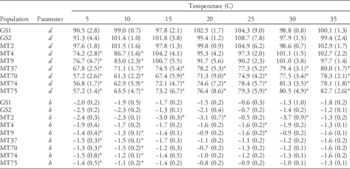
Estimated parameters d and b (± SE) obtained from the log-logistic model fit to describe the cumulative germination pattern of glyphosate-susceptible (GS) and glyphosate-resistant (GR) kochia selected lines over time (h) under different constant temperatures.Footnote a , Footnote b

a Abbreviations: GS1 and GS2 are GS kochia lines from Hill County, MT; MT2, MT4, and MT9 are GR kochia lines from Hill County, MT; MT37 is GR kochia line from Liberty County, MT; and MT70, MT74, and MT75 are GR kochia lines from Toole County, MT.
b d is the final percent germination; b is the slope parameter, indicating the germination rate of a selected line over time.
* Denotes a significant difference for the regression parameter (d or b) between a GR selected line and GS1 or GS2 selected line within a temperature treatment according to approximate t-test (Ritz et al. Reference Ritz, Baty, Streibig and Gerhard2015).
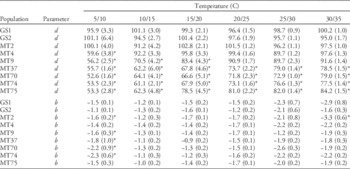
Estimated parameters d and b (± SE) obtained from the log-logistic models that were fit to describe the cumulative germination pattern of glyphosate-susceptible (GS) and glyphosate-resistant (GR) kochia selected lines over time (h) under different alternating temperatures.Footnote a , Footnote b

a Abbreviations: GS1 and GS2 are GS kochia lines from Hill County, MT; whereas, MT2, MT4, and MT9 are GR kochia lines from Hill County, MT; MT37 is GR kochia line from Liberty County, MT; and MT70, MT74, and MT75 are GR kochia lines from Toole County, MT.
b d is the final percent germination; b is the slope parameter, indicating the germination rate of a selected line over time.
*Denotes a significant difference for the regression parameter (d or b) between a GR selected line and GS1 or GS2 selected line within a temperature treatment according to approximate t-test (Ritz et al. Reference Ritz, Baty, Streibig and Gerhard2015).
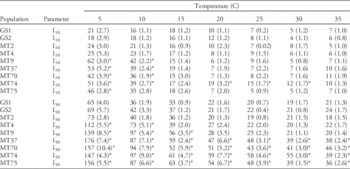
Estimated parameters I10 and I50 (± SE) obtained from the log-logistic models fit to describe the cumulative germination pattern of glyphosate-susceptible (GS) and glyphosate-resistant (GR) kochia selected lines over time (h) under different constant temperatures.Footnote a , Footnote b

a Abbreviations: GS1 and GS2 are GS kochia lines from Hill County, MT; whereas, MT2, MT4, and MT9 are GR kochia lines from Hill County, MT; MT37 is GR kochia line from Liberty County, MT; and MT70, MT74, and MT75 are GR kochia lines from Toole County, MT.
b I10 and I50 refer to the incubation period (h) required to reach 10 and 50% of cumulative germination by a selected line, respectively.
*Denotes a significant difference for the regression parameter (I10 or I50) between a GR selected line and GS1 or GS2 selected line within a temperature treatment according to approximate t-test (Ritz et al. Reference Ritz, Baty, Streibig and Gerhard2015).
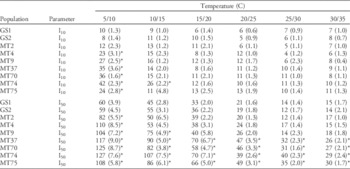
Estimated parameters I10 and I50 (± SE) obtained from the log-logistic models that were fit to describe the cumulative germination pattern of glyphosate-susceptible (GS) and glyphosate-resistant (GR) kochia selected lines over time (h) under different alternating temperatures.Footnote a , Footnote b
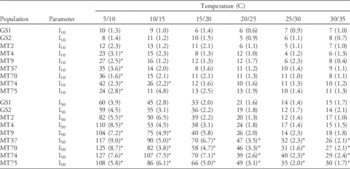
a Abbreviations: GS1 and GS2 are GS kochia lines from Hill County, MT; whereas, MT2, MT4, and MT9 are GR kochia lines from Hill County, MT; MT37 is GR kochia line from Liberty County, MT; and MT70, MT74, and MT75 are GR kochia lines from Toole County, MT.
b I10 and I50 refer to the incubation period (h) required to reach 10 and 50% of cumulative germination by a selected line, respectively.
*Denotes a significant difference for the regression parameter (I10 or I50) between a GR selected line and GS1 or GS2 selected line within a temperature treatment according to approximate t-test (Ritz et al. Reference Ritz, Baty, Streibig and Gerhard2015).
The GR selected lines of MT37, MT70, MT74, and MT75 had lower final germination (d parameter) at lower constant temperatures of 5 and 10 C, and they also had lower final germination at higher constant temperatures of 15 to 35 C compared with the GS lines (Table 1). However, the final germination (d parameter) of the GR selected line of MT2 did not differ from the GS lines, either at lower or higher constant temperatures. Additionally, GR selected lines of MT4 and MT9 had final germinations similar to GS lines at 15 to 35 C. These results indicate that the viable seeds of the four GR lines from Liberty and Toole counties were relatively dormant compared with GS and three GR lines from Hill County in response to temperatures tested. Furthermore, those four GR lines showed a temperature-sensitive dormancy response, lower final germination at lower temperatures and higher at higher temperatures (Table 1). In contrast, the GS and other GR lines (especially MT2) were relatively nondormant, with >90% final germination across all temperatures.
Similarly, at all alternating temperatures tested (5/10 to 30/35 C), the GR selected lines of MT37, MT70, MT74, or MT75 had considerably less final germination than the GS selected lines (Table 2). Consistent with the constant temperature treatments, the final germination of GR lines of MT2, MT4, and MT9 did not differ from GS lines at the majority of the alternating temperatures tested.
The rate of germination (slope, b parameter) of GR selected lines (except MT2 and MT4) was different from GS1 or GS2 selected line at 5 and 10 C (Table 1). GR selected lines of MT37, MT70, MT74, or MT75 had lower germination rates at 5 and 10C relative to GS lines. However, no differences in the germination rate between any of those four GR lines and GS lines were evident at temperatures from 15 to 35 C. Conversely, GR selected lines of MT2, MT4, or MT9 germinated faster than the GS1 or GS2 selected line at one or more of the temperatures ranging from 15 to 30 C.
At alternating temperatures, there were no differences in the germination rates (b) between GR and GS selected lines, except for a few instances at 5/10 C (Table 2). The GR selected lines of MT2 and MT9 germinated faster than the GS2 selected line at 5/10 C.
The fitted model also provided two other biological parameters, i.e., the incubation time (h) to reach 10 and 50% cumulative germination (I10 and I50 values, respectively) for each selected kochia line. Compared with GS, all GR selected lines showed a delay in germination initiation (higher I10 values) at constant temperatures of 5 and 10 C, except GR selected lines of MT2 and MT4 (Table 3). The I10 values between these two GR lines (MT2 and MT4) and GS selected lines did not differ at 5 or 10 C. At constant temperatures ≥15 C, no differences were evident in the I10 values among the majority of GR and GS selected lines.
At an alternating temperature of 5/10 C, seeds of all GR selected lines except MT2 took more time to initiate germination (greater I10 values) compared with GS selected lines (Table 4). Consistent with the constant temperature data, there were no differences in I10 values among a majority of the GR and GS selected lines at alternating temperatures ≥10/15 C.
In general, kochia seeds (GR and GS) germinated more rapidly (took less time) at constant temperatures ≥15 C than at low temperatures of 5 or 10 C, indicated by the lower I50 values at temperatures of 15 C or higher (Table 3). Kochia can germinate over a wide range of temperatures from 5 to 30 C, with an optimum temperature of 15 to 25 C (≥50% germination within 24 h) (Everitt et al. Reference Everitt, Alaniz and Lee1983; Jami Al-Ahmadi and Kafi Reference Jami Al-Ahmadi and Kafi2007). GR selected lines of MT37, MT70, MT74, and MT75 germinated more slowly (greater I50 values) than GS lines at all constant temperatures tested. In other words, the germination period of these four GR selected lines would be more prolonged compared with the GS selected lines. However, the I50 values for GR selected line MT2 did not differ from GS lines at any of the constant temperatures. Also, the I50 values of GR selected lines of MT4 and MT9 were comparable to GS lines at temperatures ≥20 C.
At all alternating temperatures tested, the I50 values of GR selected lines of MT37, MT70, MT74, and MT75 were higher than GS selected lines (Table 4), further indicating the relatively slow germination pattern of those four GR vs. GS lines. Nevertheless, the I50 values for the GR selected lines of MT2 and MT4 did not differ from any of the GS lines at the majority of the alternating temperatures tested, and those of GR MT9 line were comparable to GS lines at temperatures ≥15/20 C.
Relationship between EPSPS Gene Copy Number and Cumulative Germination
There was no significant correlation between the EPSPS gene copy number and observed percent cumulative germination of GR and GS selected lines at any of the constant (r=−0.154 to −0.391; P-value= 0.159 to 0.548) or alternating (r=−0.045 to −0.235; P-value=0.091 to 0.824) temperatures tested. Therefore, the reduced final germination or temperature-dependent reduction of germination and a slower germination pattern of GR selected lines MT37, MT70, MT74, and MT75 relative to GS lines are less likely attributed to the pleiotropic effects of the EPSPS gene amplification.
The glyphosate resistance and temperature-mediated seed dormancy in the four GR selected lines reflect coselection of resistance and avoidance imposed by decades of intensive cropping practices. Long-term, intensive crop management practices are used in the no-till, dryland cereal belt of Montana and other U.S. Great Plains states and in Canada, with heavy reliance on nonselective herbicides, predominantly glyphosate, applied preseeding. If germination is delayed, as evident in the four GR selected lines, particularly at lower temperatures (5 to 10 C constant or 5/10 C alternating), then parts of the weed population may avoid preseeding control. This would also allow these GR kochia cohorts to survive against tillage during early-spring seedbed preparation or against early-spring frosts, thereby, increasing the proportion of GR plants in the population. Kochia generally exhibits little seed dormancy and seed persistence of less than 2 yr in the soil (Everitt et al. Reference Everitt, Alaniz and Lee1983; Zorner et al. Reference Zorner, Zimdahl and Schweizer1984; JA Dille, personal communication); therefore, the defense against preseeding control methods may be more important considering the transient nature of the seedbank. Previous researchers have also documented the impact of long-term crop management practices on selection of dormancy and herbicide resistance traits in other HR weed populations (Owen et al. Reference Owen, Michael, Renton, Steadman and Powles2010; Shergill et al. Reference Shergill, Fleet, Preston and Gill2015). Management practices in an intensive cropping system, including the continuous use of selective/nonselective herbicides or soil-residual herbicides with longer selection, tend to favor the survival of late-emerging (delayed germination) weed cohorts (avoiding preseeding or early in-crop weed control), and relatively dormant weed cohorts dominate the weed seedbank over time (Fleet and Gill Reference Fleet and Gill2012; Owen et al. Reference Owen, Goggin and Powles2015; Sbatella and Wilson Reference Sbatella and Wilson2010).
Additionally, the GR trait may allow those kochia cohorts to survive subsequent glyphosate applications in chemical fallow/postharvest wheat stubble or in-crop (in GR corn [Zea mays L.], sugar beet [Beta vulgaris L.], or soybean [Glycine max L.]). This also highlights the importance of diverse in-crop and late-season weed control methods to prevent those late-emerging GR kochia populations from replenishing the soil seedbank. Although these GR populations originated in the dryland, cereal-based cropping systems, GR kochia has also been reported from GR corn, sugar beet, and soybean fields in the U.S. Great Plains (Heap Reference Heap2016). Evident from this research, selection by herbicides/cropping practices can lead to more than one response, including an alteration in the time of germination and possibly seed dormancy in weed populations, which implicates the need to adopt more diversified cropping and weed control practices.
Acknowledgments
The authors greatly appreciate MSU extension agents and growers from Hill, Toole, and Liberty counties in Montana for their valuable assistance in GR kochia seed collection. We thank Anjani J., Shane Leland, and Charlemagne A. Lim for their technical assistance. We also thank the Montana Wheat and Barley Committee for funding this research.