INTRODUCTION
The Indian scad Decapterus russelli (Rüppell, 1830) is classified as a species of the Carangidae family. This species is extensively found to be distributed from the Red Sea to the Indian Ocean and Indo-Pacific (Smith-Vaniz, Reference Smith-Vaniz, Fischer and Bianchi1984; FAO-FIGIS, 2001; Jaiswar et al., Reference Jaiswar, Chakraborty and Swamy2001; Manojkumar, Reference Manojkumar2005). In the Mediterranean the first occurrence of D. russelli was reported by Golani (Reference Golani2006) on the coast of Haifa, Israel. This species has become an important target species in fisheries off the Israeli–Lebanese coast (Golani et al., Reference Golani, Massuti, Orsi Relini, Quignard, Dulčić and Azzurro2009).
The dispersal of lessepsian fish has been studied by several authors (Spanier & Galil, Reference Spanier and Galil1991; Golani, Reference Golani1998; Shefer et al., Reference Shefer, Abelson, Mokady and Geffen2004; Galil, Reference Galil2007; Ben Rais Lasram et al., Reference Ben Rais Lasram, Tomasini, Guilhaumon, Romdhane, Do Chi and Mouillot2008). Lessepsian immigrants to the Mediterranean Sea are generally first reported on the coast of Israel owing to its proximity to the Suez Canal. In the Mediterranean Sea, more than 72 lessepsian fish species have been found to have migrated from the Red Sea since the opening of the Suez Canal in 1869 (Golani et al., Reference Golani, Massuti, Orsi Relini, Quignard, Dulčić and Azzurro2009). In addition to the reported 42 species on the coast of the Turkish Mediterranean (Mavruk & Avsar, Reference Mavruk and Avsar2008), the current study presents the first record of the lessepsian migrant Decapterus russelli.
MATERIALS AND METHODS
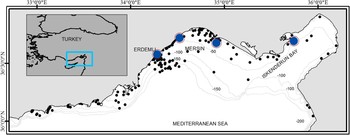
Sampling was carried out from January 2008 to March 2010 on the coast of Turkey, north-eastern Mediterranean with the RV ‘Lamas’ (Figure 1). A total of 203 tows between 5 and 230 m depth were conducted using two different trawl systems from namely, the demersal trawl and a modified demersal trawl with an enlarged opening in order to collect small pelagic fish at speeds ranging between 3.5 and 5 knots.
Location of trawl stations between January 2008 and March 2010 along the Turkish Mediterranean coast (black lines). Blue dots represent the location where Decapterus russelli was found.

Specimens' morphometric measurements and meristic counts were adapted from Smith-Vaniz (Reference Smith-Vaniz, Fischer and Bianchi1984) and Golani (Reference Golani2006). Some specimens were kept in 4% buffered formaldehyde for the purpose of preserved samples at the Museum of Marine Biology and Fisheries, Institute of Marine Sciences, Middle East Technical University.
Description
Slender, elongated and almost rounded body. Moderate eyes (24.2–32.6% of head length (HL)), wide interorbital space (25.0–29.8% of HL) and the pointed snout (24.3–36% of HL). The transparent eyelid covers larger part of the eye. Two dorsal fins; the first one has eight spines in triangular form, and the second has only one spine with 30–33 rays and a separate finlet. Anal fin consists of two separate spines one of which is followed by 25–28 rays with a separate finlet. Acute pectoral fin (26.4–33.2% of HL) with 18–22 rays. The first upper gill comprises 10 to 15 rakers whilst the lower gill arch has 31 to 36 rakers. There are small teeth on both jaws. Lateral line curves slightly downward under the 9th–12th dorsal rays, anterior part and posterior part of lateral line have 44 to 55 scales and 35 to 41 scutes. There are two small papillae on the edge of the shoulder girdle (cleithrum), the lower one relatively larger than upper.
The specimen has a bluish-green dorsal and silvery-white belly. A small black blotch is located on the margin of the operculum near the upper edge. The colour of the caudal fin is yellowish-brown. Dorsal fin is almost transparent membrane with dark spots on the spines. The remaining fins are transparent.
RESULTS AND DISCUSSION
Species meristic formula for Decapterus russelli obtained from the current study (Turkish Mediterranean coast) was as follows: D1, VIII; D2, I + 30–33; A, II + I + 25–27; P, 18–22; V, I + 5; LL, 8 –96 which is in agreement with the previous publications (FAO-FIGIS, 2001; Golani, Reference Golani2006).
A total of 67 specimens of the lessepsian migrant D. russelli were caught with modified trawl nets in October 2009, and in March 2010 (Figure 1; Table 1). During the study period, the first occurrence of the aforementioned species was 11 individuals recorded in Iskenderun Bay on 17 October 2009. On 17 and 18 March 2010, 16 specimens were obtained from Mersin Bay, and a total of 40 individuals were observed in Erdemli Bay on 23 March 2010 (Table 1). In addition, carangid fish such as Caranx rhoncus Geoffroy Saint-Hilaire, 1817, Trachurus mediterraneus (Steindachner, 1868), and lessepsian fish Alepes djeddaba (Swainson, 1839) were recorded during trawling studies. It is worth mentioning that D. russelli constituted 88% of the total amount of the carangid abundance obtained from Iskenderun Bay (Table 1).
Sampling details and average total length (TL, cm), weight (W, g) of collected individuals.

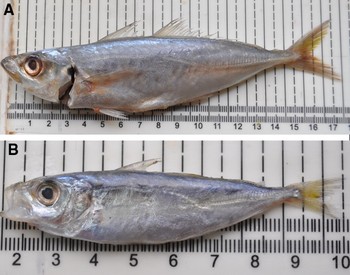
Decapterus russelli can easily be distinguished from T. mediterraneus and other carangids by applying three main individual characteristics: (a) the lack of scutes on the anterior part of the lateral line; (b) the presence of widely detached finlets at terminal dorsal and anal rays; and (c) the existence of two small papillae on the shoulder girdle (cleithrum) margin where the lower papilla is larger (Figure 2).
Specimens of Decapterus russelli found on the Turkish Mediterranean coast: (A) 14.7 cm SL, Iskenderun Bay; (B) 8.6 cm SL, Mersin Bay. (Photograph: S. Sakınan.)

The first maturity of D. russelli females has been reported at 155 mm total length in the south-western Indian Ocean (Manojkumar, Reference Manojkumar2005). The average total length of the specimen was found to range from 7.9 to 16.82 cm in the study area (Table 1). Larger individuals, all of which were females, were obtained from Iskenderun Bay; whereas almost all specimens observed in Mersin Bay and Erdemli Bay (Figure 1) were collected as juveniles.
Smith-Vaniz (Reference Smith-Vaniz, Fischer and Bianchi1984) reported that D. russelli most commonly inhabited inshore waters shallower than 100 m in the Indian Ocean. However, current trawling results suggest that all individuals are likely to habituate water depths less than 20 m.
In contrast to the open waters, the coastal part of the north-eastern Mediterranean Sea has been characterized by relatively warm seawater temperatures, broad coastal shelf and high productivity due to riverine inputs (Dogan-Saglamtimur & Tugrul, Reference Dogan-Saglamtimur and Tugrul2004; Ozsoy, Reference Ozsoy and Moniz2008). Success of this small pelagic lessepsian species might be attributed to prevailing conditions on the coast of the north-eastern Mediterranean. Furthermore, occurrence of D. russelli in different areas dictates that this species has already become a resident in the north-eastern Mediterranean. Considering the favourable conditions in the eastern Mediterranean and rapid expansive pattern of this small pelagic (Golani et al., Reference Golani, Massuti, Orsi Relini, Quignard, Dulčić and Azzurro2009) it is possible that D. russelli may play an important role in the pelagic realm of the region in the near future.
ACKNOWLEDGEMENTS
We would like to thank Dr Ali Cemal Gücü, Dr Bettina A. Fach Salihoglu and Dr Mustafa Kocak for valuable comments on the draft of the manuscript. Special thanks also to academic and technical staff of the Institute of Marine Sciences of METU. This study has been conducted as part of the TOVAG-108O566 project supported by the Turkish Scientific and Technical Research Council of Turkey (TÜBITAK).