Introduction
The first presumptive case of coronavirus 2019 (COVID-19) in Saskatchewan was officially confirmed and reported on March 12, 2020, 1 with the first death reported on March 29, 2020. 2 As of February 2022, there were approximately 123,258 COVID-19 cases in Saskatchewan, resulting in 1,012 deaths with a case-fatality rate of 0.8%. 3 The impact of the COVID-19 pandemic in Saskatchewan was significant, as it was one of the provinces and territories in Canada with the highest per capita case counts and COVID-19-related deaths.Reference Quon 4
Early in the pandemic, public health measures, such as lockdowns of socioeconomic activities, physical distancing, and masking, were implemented to slow down the transmission of the virus. These measures were critical in reducing the spread, particularly before vaccines became widely available. While vaccination is among the most controversial and highly debated medical interventions, the distribution and administration of safe and effective COVID-19 vaccines were prevalent medical countermeasures taken to control the pandemic and reduce further morbidity and mortality. The success of the COVID-19 vaccination campaigns depended not only on the availability of vaccines but also on the strategies used to distribute them and encourage uptake.
In Canada, COVID-19 vaccines were introduced on December 14, 2020, 5 with Saskatchewan beginning its vaccination efforts a day later, on December 15, 2020. 6 As more people were vaccinated, there was a gradual relaxation of the public health countermeasures that had been in place. This easing of restrictions was largely due to reduced transmission rates and the immunological protection vaccines provided against severe infection. However, this relaxation was not absolute; it was closely tied to continuous monitoring of COVID-19 incidence. Whenever there was a surge in new cases, particularly due to the emergence of variants of concern, public health measures were reintroduced or strengthened.
As of December 3, 2023, 16.9% of Saskatchewan residents have completed their COVID-19 vaccine series and received a COVID-19 booster dose, compared to the national coverage of 15%. 5 However, coverage rates were higher for people who received at least one dose of the primary COVID-19 vaccine series (Saskatchewan: 82.4% vs. Canada: 83.7%). 5 Studies have shown that one dose of COVID-19 vaccine offers some level of protection against the virus and reduces the likelihood of hospitalization and deaths, compared to unvaccinated individuals.Reference Kaura, Trickey and Shah 7 , Reference Tenforde, Olson and Self 8 However, two or more doses provide better protection than one dose due to waning immunity over time.Reference Kaura, Trickey and Shah 7 , Reference Tenforde, Olson and Self 8 The effectiveness of one dose also varies depending on factors such as age, vaccine type, health status, and possibility of immune escape due to the presence of COVID-19 variants.Reference Kaura, Trickey and Shah 7 , Reference Tenforde, Olson and Self 8
Following the COVID-19 pandemic, vaccine mandates have been reported to have worked well in increasing vaccination rates among Canadians.Reference Iwok and Okpe 9 , Reference Miller 10 However, no known published study in Saskatchewan has assessed the impact of vaccine initiatives on the incidence and mortality rates of COVID-19 during the pandemic. Moreover, the emergence of new variants of COVID-19, such as the XBB.1.5 Omicron subvariant, posed new challenges to vaccine effectiveness and necessitated the development of new strategies.Reference Quon 11 The objective of this study was therefore to evaluate whether the implementation of the vaccine initiatives resulted in a shift in trends (treatment effects) of new COVID-19 cases and deaths in Saskatchewan during the first year of vaccine rollout. Insights from this study can help shape future strategies and policies for responding to pandemics in the province and similar settings.
Material and Methods
A multivariable single-group interrupted time series analysis (ITSA), using an autoregressive segmented regression model, was conducted to assess the impact of multiple interventions of COVID-19 vaccine mandates on daily trends in COVID-19 incidence and mortality rates between April 1, 2020 and January 20, 2022. Due to concerns about data quality, data beyond January 2022 were not retrieved, as COVID-19 indicators were not actively tracked beyond that date.
ITSA is a quasi-experimental study design used to evaluate the effectiveness of population-based interventions and policy changes.Reference Linden and Arbor 12 In ITSA, the outcome variable is measured before and after the implementation of an intervention that is expected to change the trajectory of the outcome, either immediately (change in level) or gradually (change in trend).Reference Linden and Arbor 12 This study adjusted for temporal confounding effects and variability of public health countermeasures such as stringency index, economic support index, and number of vaccine doses administered.
In Saskatchewan, vaccination policies were implemented on December 15, 2020. For this study, the pre-intervention period spanned from April 1 to December 14, 2020. During the implementation phase (December 15, 2020 to January 20, 2022), a phased approach targeted age and at-risk groups. The implementation phase began with the rollout of the primary vaccine series for frontline workers in emergency departments and COVID-19 units. Subsequent initiatives included: prioritization of high-risk Saskatchewan residents (such as frontline workers, seniors, and residents of long-term care and remote northern remote communities—January 4, 2021), launch of a centralized virtual vaccination booking system (March 10, 2021), decentralization of vaccines to local pharmacies (April 27, 2021), vaccination extended to adults and youth (May 18, 2021), introduction of vaccine booster doses for long-term care residents, personal care home residents and some immunocompromised individuals (September 7, 2021, Phase I), implementation of proof-of-vaccination (POV) policy (October 1, 2021), eligibility expanded to children aged 5 to 11 years (November 24, 2021), booster doses extended to people aged 50 years and above (December 7, 2021, Phase II), and booster doses made available to all adults (18 years or older) (December 20, 2021, Phase III).
We hypothesized that reaching key vaccine campaign milestones would increase vaccine uptake, thereby reducing COVID-19 incidence and deaths. On this note, this study measured the counterfactual effects of vaccine mandates—i.e., the hypothetical scenario in which the interventions were not introduced.Reference Linden and Arbor 12 The counterfactual provided a comparison for evaluating the impact of the vaccine mandates.
We extracted provincial-level aggregated data on daily COVID-19 incidence and mortality rates in the Saskatchewan province of Canada, along with the number of COVID-19 vaccine doses administered, stringency index, and economic support index from publicly available data sources. COVID-19 incidence and mortality data were retrieved from the Government of Canada website, 13 the stringency and economic support indices were retrieved from the University of Oxford’s COVID-19 Government Response Tracker website, 14 and vaccination data were retrieved from the Government of Saskatchewan’s website. 15
COVID-19 incidence is the daily number of newly confirmed cases per 1 million population, and mortality rate is the daily number of newly confirmed COVID-19 deaths per 1 million population. The stringency index measures the strictness of policy relating to lockdowns and restrictions on movement, while the economic support index reflects the government’s financial assistance programs (e.g., income support and debt relief) implemented to alleviate the economic impacts of the pandemic. Notably, these indices did not assess the effectiveness of the policies, but rather the degree of their implementation. The number of vaccine doses administered refers to the total daily doses of COVID-19 vaccines given. A 7-day moving average was used for all variables. Given that COVID-19 vaccines are generally considered effective 14 days after administration, we considered potential delays in the intervention’s effect. 16 , Reference Menegale, Manica and Zardini 17 To account for autocorrelation and ensure stationarity of the outcome variables, a 14-order (AR(14)) model was applied based on the Cumby-Huizinga test.
Following the parametrization proposed by Linden,Reference Linden and Arbor 12 the model was specified as:
 $$ {\displaystyle \begin{array}{c}{Y}_t={\beta}_0+{\beta}_1{T}_t+\sum \limits_{i=1}^{10}\left({\beta}_{2i}{X}_{it}+{\beta}_{3i}{X}_{it}{T}_{it}\right)\\ {}\hskip-4em +{\beta}_4{S}_t+{\beta}_5{E}_t+{\beta}_6{D}_t+{\varepsilon}_t\end{array}} $$
Where
 $ {Y}_t $
is the outcome variable at time t,
 $ {T}_t $
is time since the start of the study,
 $ {X}_{it} $
is the binary indicator of intervention i (presence = 1, absence = 0),
 $ {\beta}_0 $
is the intercept (baseline level of outcome),
 $ {\beta}_1 $
is the pre-intervention trend,
 $ {\beta}_{2i} $
is the change in level following intervention i,
 $ {\beta}_{3i} $
is changes in slope following intervention i,
 $ {S}_t $
is stringency index,
 $ {E}_t $
is the economic support index,
 $ {D}_t $
is the number of vaccine doses administered, and
 $ {\varepsilon}_t $
is the error term.
The error term
 $ {\varepsilon}_t $
followed an AR(14) process:
 $$ {\varepsilon}_t={\rho}_1{\varepsilon}_{t-1}+{\rho}_2{\varepsilon}_{t-2}+\dots +{\rho}_{14}{\varepsilon}_{t-14}+{u}_t $$
Where
 $ {u}_t $
represents the white-noise
 $ \left({U}_t\sim N\left(0,{\sigma}^2\right)\right) $
, and ρ is the autocorrelation coefficient.
Residual autocorrelation was tested with the Cumby-Huizinga test.Reference Cumby and Huizinga 18
The 7-day order moving average autocorrelation, MA(7) was specified as:
 $$ {\varepsilon}_t={u}_t+{\lambda}_1{u}_{t-1}+{\lambda}_2{u}_{t-2}+\dots +{\lambda}_7{u}_{t-7} $$
The effects of individual vaccine mandates on the outcome variables were estimated by comparing post-implementation slopes with pre-implementation slopes using lincom command. All estimated effects reflected cumulative changes in trend relative to the pre-vaccine period. A two-sided P < 0.05 was considered statistically significant. Analyses were conducted in STATATM version 18.5 (College Station, TX). 19
This study used aggregated data from publicly available data sources; hence, no ethical approval was required.
Results
COVID-19 Incidence Rates
The baseline COVID-19 incidence rate was 5.8 cases per million population. The incidence rate appeared to increase daily prior to rollout of primary vaccine series among frontline workers in emergency departments and COVID-19 units, at a rate of 0.5 new cases per million population per day (Figure 1). However, following the vaccine rollout, the incidence decreased daily by 4.9 cases per million population (95% CI: −5.9 to −3.8), compared to pre-implementation trend (Table 1). Similarly, after prioritizing high-risk populations such as frontline health care workers and long-term care residents, incidence decreased by 2.9 cases per million population per day (95% CI: −3.9 to −1.9), compared to pre-vaccination trend. This reflects the combined effect of both the initial vaccine rollout and the expanded prioritization of high-risk groups. Counterintuitively, a significant surge in new cases was observed following the implementation of a centralized virtual booking system, with COVID-19 incidence cumulatively increased by 3.3 new cases per million population per day (95% CI: 2.0 to 4.7), relative to pre-vaccination trend. Conversely, the stage in the pandemic response of decentralizing vaccine distribution to local pharmacies was associated with a significant cumulative decrease in COVID-19 incidence (
 $ \hat{\beta} $
= −1.1, 95% CI: −2.1 to −0.1), compared to pre-vaccination trend. No significant effect was observed after individuals aged 12 years and older became eligible for vaccination (
 $ \hat{\beta} $
= 0.6, 95% CI: −1.0 to 2.2). Surprisingly, a cumulative daily increase of 6.2 cases per million population (95% CI: 4.2 to 8.2) was observed after the introduction of COVID-19 booster doses for long-term care residents, personal care home residents, and some immunocompromised individuals (Phase I), compared to pre-vaccination trend. In contrast, after the POV policy was implemented, there was a significant cumulative daily decrease in incidence: 9.5 cases per million population per day (95% CI: −10.9 to −8.1). The period of expanding vaccination to children aged 5 to 11 years, was not associated with a statistically significant effect on COVID-19 incidence (
 $ \hat{\beta} $
= −1.0, 95% CI: −2.9 to 0.8). Similarly, after administering booster doses for people aged 50 years and older (Phase II), there were significant changes in incidence (
 $ \hat{\beta} $
= 1.3, 95% CI: −0.6 to 3.2). However, the expansion of booster doses to all adults (18 years or older) in phase III was significantly associated with a cumulative increase in COVID-19 incidence by 41 cases per million population per day (95% CI: 37.0 to 44.8). COVID-19 incidence ended up increasing much faster after the full sequence of interventions, compared with the pre-vaccination trend. This pattern is consistent with the timing of major variant shifts. As the province moved from wild-type circulation to Alpha and Delta, and eventually to the highly transmissible Omicron variant, the underlying force of infection increased markedly (Table 1). These variant-driven surges likely amplified incidence trajectories regardless of policy efforts, contributing to the cumulative upward shift observed in the model.
Effects of COVID-19 vaccine initiatives on daily incidence among Saskatchewan residents, April 1, 2020-January 20, 2022. A: COVID-19 vaccination rollout of the primary series among frontline workers in emergency departments and COVID-19 units (December 15, 2020). B: Vaccination for priority populations (frontline health care workers, and long-term care residents) (January 4, 2021). C: Centralized virtual booking system launched (March 10, 2021). D: Decentralized vaccine distribution to pharmacies (April 27, 2021). E: Eligibility extended to adults and youth (May 18, 2021). F: Introduction of booster doses in long-term care facilities and for some immunocompromised individuals (September 7, 2021, Phase I). G: Proof-of-vaccination policy implementation (October 1, 2021). H: Expansion of vaccination to children aged 5 to 11 years (November 24, 2021). I: Extension of booster doses to people aged 50 years and older (December 7, 2021, Phase II). J: Booster doses made available to all adults (18 years or older) (December 20, 2021, Phase III).

Cumulative changes in trend of daily COVID-19 incidence and mortality rate in Saskatchewan before and after implementation of COVID-19 vaccine policies, April 1, 2020-January 20, 2022

***significant at p < 0.001; **significant at p < 0.01; *significant at p < 0.05. All
 $ \hat{\beta} $
coefficients represented the cumulative change in daily trend relative to the pre-vaccination baseline period, meaning each intervention’s coefficient represented the net change in slope from the original baseline, incorporating the impact of all preceding interventions.
CI, Confidence Interval.
a Vaccination among frontline workers, in emergency departments and COVID-19 units.
b People who were at higher risk of exposures to COVID-19 or more at risk of serious illness such as health care workers, elderly residents in care homes, seniors over 80 years, and residents in northern remote communities.
c Phase I: long-term care facilities, personal care home residents, and some immunocompromised individuals.
d Phase II: for people aged 50 years and above.
e For all adults (18 years or older).
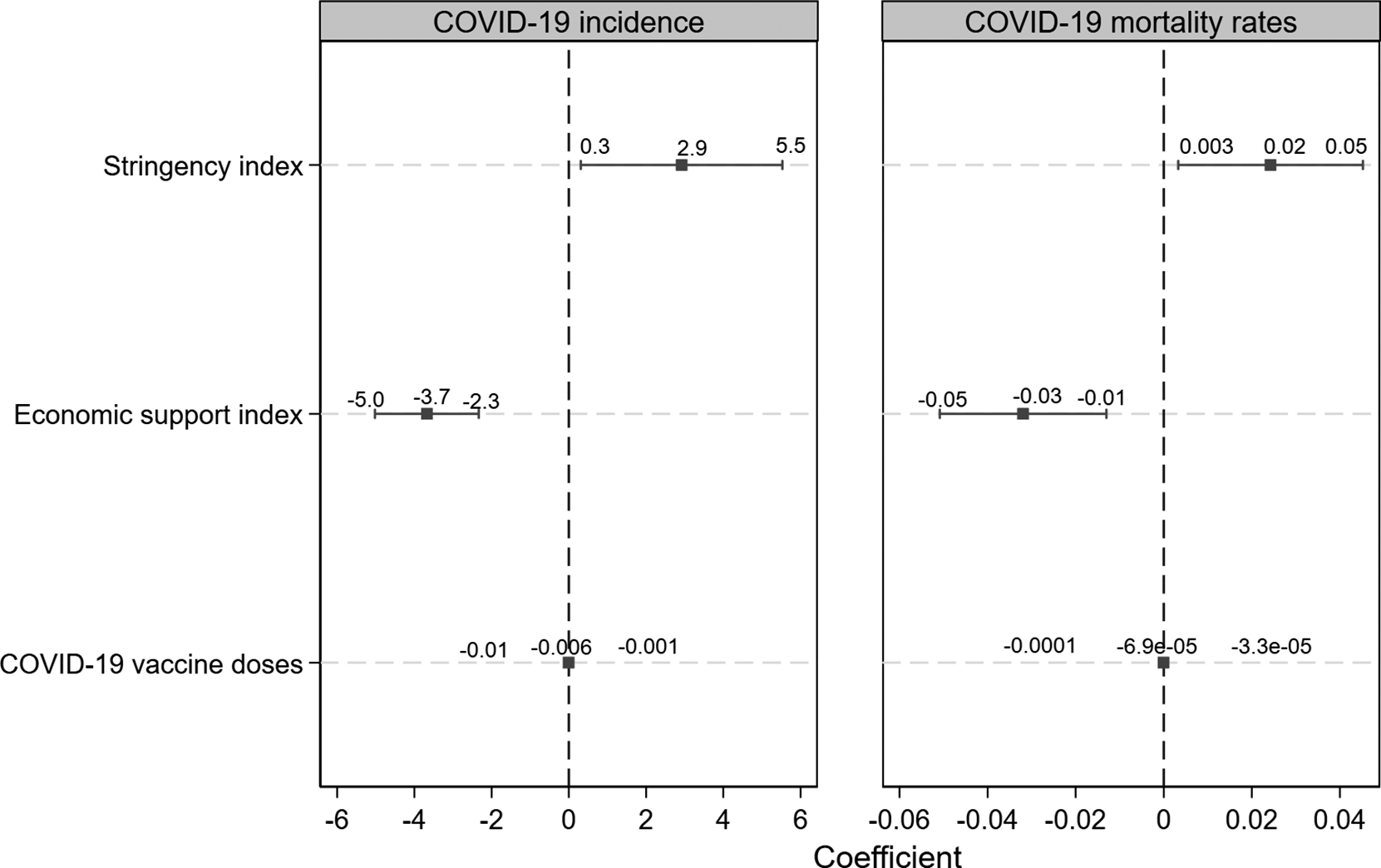
A 1% increase in the economic support index was significantly associated with a decrease of 3.7 cases per million population per day (Figure 2). There was also a significant inverse association between the number of COVID-19 vaccine doses administered and incidence (
 $ \hat{\beta} $
= −0.001, 95% CI: −0.001 to −0.0001). However, 1% increase in stringency index was significantly associated with an increase of 2.9 cases per million population per day.
Adjusted effects of stringency index, economic support index, and number of COVID-19 vaccine doses administered in the interrupted time series analysis, April 1, 2020-January 20, 2022.

COVID-19 Mortality Rates
The baseline COVID-19 mortality rate was 0.3 deaths per million population. After accounting for the potential confounding effects of the stringency index, economic support, and number of doses of COVID-19 vaccines administered, the daily COVID-19-related deaths hardly changed before the vaccine rollout (Figure 3). However, after the vaccine rollout, the daily mortality rates decreased by 0.08 deaths per million population per day (95% CI: −0.09 to −0.07), compared to the pre-implementation trend (Table 1). The mortality rates continued to cumulatively decrease by 0.04 deaths per million population per day after vaccines were prioritized for the high-risk population (95% CI: −0.08 to −0.01), compared to pre-vaccination trend. The centralized virtual booking system, decentralization of vaccines to local pharmacies, and vaccination of adults and children aged 12 years or older did not show a significant effect on daily COVID-19 mortality rates, compared to pre-vaccination trend. Unexpectedly, the trend of COVID-19 deaths cumulatively increased at a rate of 0.17 deaths per million population per day (95% CI: 0.15 to 0.19) during the period when vaccine booster doses were introduced to long-term care residents, personal care home residents, and some immunocompromised individuals (Phase I). The implementation of POV policy and vaccination of children aged 5 to 11 years old cumulatively reduced the mortality rates by 0.08 deaths per million population per day (95% CI: −0.09 to 0.06). Introduction of vaccine boosters to people aged 50 years and above (Phase II) and all adults (Phase III) was not statistically associated with changes in mortality rates. Across the sequence of interventions, the cumulative change in COVID-19–related deaths was not statistically significant. This finding remained consistent even as the dominant COVID-19 variant shifted from the original wild-type strain to Alpha, Delta, and later Omicron (Table 1). These transitions did not produce measurable changes in the overall mortality trend, compared to pre-vaccination period.
Effects of COVID-19 vaccine initiatives on daily mortality rates among Saskatchewan residents, April 1, 2020-January 20, 2022. A: COVID-19 vaccination rollout of the primary series among frontline workers in emergency departments and COVID-19 units (December 15, 2020). B: Vaccination for priority populations (frontline health care workers and long-term care residents) (January 4, 2021). C: Centralized virtual booking system launched (March 10, 2021). D: Decentralized vaccine distribution to pharmacies (April 27, 2021). E: Eligibility extended to adults and youth (May 18, 2021). F: Introduction of booster doses in long-term care facilities and for some immunocompromised individuals (September 7, 2021). G: Proof-of-vaccination policy implementation (October 1, 2021). H: Expansion of vaccination to children aged 5 to 11 years old (November 24, 2021). I: Extension of vaccine booster doses to people aged 50 years and older (December 7, 2021, Phase II). J: Booster doses made available to all adults (18 years or older) (December 20, 2021, Phase III).

As the average economic support index increased by 1%, the average mortality rates decreased by 0.03 deaths per million population per day (95% CI: −0.05 to −0.01) (Figure 2). There was also a significant inverse association between the number of doses of COVID-19 vaccines administered and the COVID-19 mortality rate. Surprisingly, a 1% increase in the stringency index was significantly associated with an increase of 0.02 deaths per million population per day (95% CI: 0.003 to 0.05).
Discussion
This study provides novel insights into the complexities and impact of vaccination strategies and public health policies on the trajectory of the COVID-19 pandemic in Saskatchewan during the first year of the vaccine deployment. Our findings show that a combination of targeted vaccination rollouts, responsive public health infrastructure, and social protection measures played a vital role in reducing both the incidence and mortality rates associated with COVID-19 in the province. The cumulative impact of the interventions was associated with a marked increase in COVID-19 incidence compared with the pre-implementation trend. Early reductions were eventually outweighed by larger increases that coincided with the transition from the wild-type strain to Alpha, Delta, and Omicron, which significantly heightened transmissibility and likely drove higher case levels regardless of policy measures. In contrast, the cumulative change in COVID-19–related deaths was not statistically significant. This stability may reflect the protective effects of vaccination, improvements in treatment, and the characteristics of later variants, which produced large surges in cases but did not lead to proportional increases in mortality.
Following the initial distribution of COVID-19 vaccines across Canada, a significant gap emerged between vaccine demand and limited supply due to a substantial portion of the population being susceptible to COVID-19. 20 As a result, the National Advisory Committee on Immunization (NACI) recommended that vaccine allocation follow a prioritization matrix.Reference Ismail, Zhao and Tunis 21 This included protecting at-risk groups both directly through vaccination and indirectly by immunizing individuals in close contact with them, such as health care workers in long-term care facilities or those directly involved in the care of COVID-19 patients. Furthermore, an age-based approach was implemented, specifically targeting individuals aged 80 years and older as a proxy for severe medical risk. Our study showed that the initial rollout of primary vaccine series among frontline workers, emergency departments, and COVID-19 units, and the prioritization of high-risk populations such as health care workers, elderly residents in care homes, and individuals in remote communities, were associated with a significant decrease in COVID-19 incidence and mortality rates. These findings align with previous studies supporting the effectiveness of prioritizing vaccination for those at high risk of exposure and transmission.Reference McNamara, Wiegand and Burke 22 –Reference Mulberry, Tupper and Kirwin 25 For example, in a model-based dynamic study, Patón et al.,Reference Patón, Acuña and Rodríguez 23 reported that prioritizing population groups with high daily person-to-person interactions and elderly people is the most effective vaccine allocation strategy for reducing COVID-19 incidence and related deaths.
Age-based rollout strategies, while important, did not achieve the same level of protection in reducing incidence as risk-based rollouts. This may be due to delayed vaccine access among younger adults, who represented a more mobile and socially active demographic during the peak transmission periods. Mulberry et al.,Reference Mulberry, Tupper and Kirwin 25 suggested that risk-based vaccine prioritization may be more effective and equitable than age-based rollouts, where young people might be vaccinated late. The presence of Simpson’s paradoxReference Jordan 26 , Reference Ameratunga, Woon and Lea 27 in our findings illustrates how aggregated data can mask critical subgroup effects, emphasizing the need for disaggregated and stratified epidemiological analyses in future policy assessments. Further analysis to explore Simpson’s paradox revealed that after prioritizing vaccination for adults and youth (12 years or older) between May 18 and September 16, 2021, and expanding campaigns to include children aged 5 to 11 years between November 24 and December 6, 2021, the average daily COVID-19 incidence rates for these periods decreased with advancing age (≤19 years old: 100 per million population, 20-59 years old: 79 per million, 60-79 years old: 44 per million and 80+ years old: 41 per million). 28 It is important to note that this post-vaccination paradox does not imply that COVID-19 vaccines are ineffective or harmful. In fact, numerous studies have shown that COVID-19 vaccines are highly effective in preventing severe disease, hospitalization, and death.Reference Mohammed, Nauman and Paul 29 , Reference Link-Gelles, Levy and Natarajan 30
As of December 4, 2021, vaccination coverage increased with age: the highest cumulative coverage of fully vaccinated individuals (who had completed the primary vaccine series) was seen in those aged 80 years and older (93.2%), while teenagers had the lowest rate (74.1%). 5 At that time, only 68.7% of Saskatchewan residents had completed their primary vaccine series. 5 In addition, new COVID-19 cases were mostly seen among the unvaccinated younger population. 31 , 32 During these periods, which coincided with the third and fourth waves—dominated by the Alpha and Delta variants respectively—several challenges emerged. 31 , 32 The challenges included waning vaccine-induced immunity, gaps in herd immunity, reduced vaccine effectiveness against the Delta variant, and increased social interactions due to relaxed public health measures.Reference Ogden, Turgeon and Fazil 33 These factors likely contributed to the paradoxical rise in incidence rates, especially among younger age groups, despite higher vaccination coverage in older populations. On the other hand, we found that vaccinating the general population (including children aged 5 to 12 years) was negatively associated with COVID-19 fatalities. This finding is not surprising because differences in age distribution between vaccinated and unvaccinated individuals likely influenced the observed decreased mortality rates. 34 Since unvaccinated populations were generally younger, younger people typically have lower mortality risk due to fewer age-related vulnerabilities, comorbidities, and better immune responses, the impact of vaccination was likely more substantial in reducing mortality among older populations.
The introduction of a centralized virtual booking system, while intended to streamline access, was paradoxically associated with an uptick in COVID-19 cases. This unexpected outcome might be partly attributed to delays or logistical challenges in accessing the centralized booking system.Reference Rowein, Allin and Camillo 35 Previous evidence in Saskatchewan suggested that residents of remote areas, low-income neighborhoods, and new immigrants faced barriers to accessing COVID-19 vaccines during this period.Reference Rowein, Allin and Camillo 35 These barriers included limited appointment options, poor digital literacy, lack of transportation, poor internet connectivity, and phone inaccessibility.Reference Rowein, Allin and Camillo 35 To address these challenges, the provincial government shifted toward decentralized, community-based vaccine distribution, including through local pharmacies, door-to-door vaccine campaigns in rural areas (particularly northern Saskatchewan), expanded clinic options via pop-up vaccine sites, and vaccination buses.Reference Rowein, Allin and Camillo 35 Interestingly, decentralizing vaccine administration was associated with increased vaccine uptake, thereby resulting in a significant decrease in COVID-19 incidence, although the effect on mortality rates was less pronounced. This highlights the importance of adaptive service delivery models that can address structural barriers to health care access. Notably, the average number of vaccine doses administered daily increased from 6,455 doses during the centralization phase to 9,511 doses after decentralization. These further stress the advantages of enhancing vaccine availability and accessibility, particularly in rural and remote areas with limited primary health care facilities. However, additional measures may be needed to enhance the effectiveness of decentralization to prevent severe health outcomes such as COVID-19-related deaths.
Our findings also reveal the dual role of policy and behavior in driving epidemiological outcomes. The implementation of the POV policy was temporally associated with a significant decline in both COVID-19 incidence and deaths. The mandatory POV requirement may have incentivized Saskatchewan residents to get vaccinated (especially first doses for the vaccine-hesitant group and booster doses for others), contributing to these positive outcomes. Recent evidence showed that first dose vaccination rates increased by 17.5% in the seven weeks following POV policy announcements across Canada.Reference Fitzpatrick, Camillo and Hillis 36 Beyond directly encouraging vaccine uptake, POV policies likely contributed to a reduction in virus transmission through behavior modification—such as reduced public interaction among unvaccinated individuals and increased perception of risk among the general population. Vaccination programs accompanied by incentives promise to effectively prevent virus spread among the unvaccinated groups. As vaccine doses administered increased, COVID-19 incidence and deaths decreased, underscoring the importance of high vaccination coverage to curb transmission and prevent outbreaks.
Further, we observed a temporal association between booster dose campaigns and rising incidence rates, particularly during the Delta and Omicron waves.Reference Sask 37 This paradox was likely driven not by the booster campaigns themselves but by broader epidemiological dynamics, including waning immunity, the immune escape capacity of emerging variants, and higher testing rates. The average number of daily tests conducted during these periods (phases I and III) was 3,765 and 2,921, respectively, higher than the pre-vaccination rollout average of 1,476 tests per day. 38 During the Delta and Omicron-dominated periods, a Canada-wide studyReference Dam, Merali and Chen 39 and other studies conducted elsewhereReference Kim and Lee 40 , Reference Johnson, Amin and Ali 41 observed surges in COVID-19 incidence among individuals who had completed the primary vaccine series, raising concerns about waning immunity and reduced effectiveness against immune-escape variants. Nonetheless, these findings underscore the importance of ongoing vaccine efficacy monitoring, timely booster campaigns, and rapid response to emerging variants.
Importantly, socioeconomic support measures were independently associated with improved COVID-19 outcomes. Financial assistance and social protection programs likely enabled vulnerable populations to adhere more effectively to public health guidelines by alleviating economic stressors, facilitating isolation, and reducing exposure risks. This finding reinforces a study conducted by Finch and Hernández,Reference Finch and Hernández Finch 42 advocating for integrated pandemic responses that combine biomedical interventions with equity-focused social policies. Evidence also suggests that building community trust in government policies and providing support to financially disadvantaged groups is a better approach than coercion through stringent lockdowns, which are often not sustainable. Etemad-SajadiReference Etemad-Sajadi 43 and Erim et al.,Reference Erim, Oke and Adisa 44 reported that in settings with high trust in government, population adhered to public health recommendations (i.e., reduced mobility, consistent mask wearing, hand washing and social distancing) voluntarily due collective responsibility. Our study also found a positive correlation between higher stringency of public health restrictions, and incidence and mortality rates, which may reflect indirect harms such as reduced access to non-COVID health care, especially in the early pandemic phase.Reference Quon 45 –Reference Eneas and Issa 47 This suggests that strict measures must be accompanied by safeguards for essential services, particularly for populations with chronic health needs.
An important limitation of this study is the possibility of undercounting or overcounting of COVID-19-related deaths, especially when other comorbidities are present. The study was also limited by inability to account for different variants of concern and vaccine types, which could confound the observed associations. However, these findings contribute to understanding the impact of COVID-19 vaccination campaigns on incidence and deaths, which can inform future pandemic responses. Due to the ecological study design, the findings are generalizable to the Saskatchewan population but cannot be used to draw conclusions about individual-level risk. Also, the findings should be interpreted as associations rather than causal relationships.
In conclusion, this study underscores the multifaceted impact of vaccination strategies and public health policies on COVID-19 incidence and mortality. While targeted vaccination efforts such as early prioritization of vulnerable populations, decentralized booking systems, and vaccination verification mechanisms clearly benefit pandemic control, other measures like centralized virtual booking systems, and widespread booster doses require careful evaluation to optimize their effectiveness. Economic support, policy measures, and vaccination efforts played important roles in managing public health crises; hence the need for an integrated approach to managing public health crises. It is also important to continue monitoring vaccination effectiveness amid emerging variants (such as XBB.1.5 Omicron subvariant) and booster doses, adjusting policies accordingly to ensure public safety. Future studies should compare the cost-effectiveness of different vaccination strategies and policies in the province. Drawing on lessons from Saskatchewan’s COVID-19 vaccine policies, it is necessary to maintain a flexible framework that can swiftly adapt to future public health crises.
Data availability statement
Available upon request from the corresponding author.
Authors contribution
Conceptualization: DAA and BO Olakunde; Data curation: DAA; Formal analysis: DAA; Investigation: DAA, BO Olakunde, BO Ologunagba, and O Oluwole; Methodology: DAA and BO Olakunde; Writing—original draft: DAA; and Writing—review and editing: DAA, BO Olakunde, BO Ologunagba, O Oladimeji, and O Oluwole.
Funding statement
This research did not receive any specific grant from funding agencies in the public, commercial, or not-for-profit sectors.
Competing interests
None.
Ethical approval
This study used aggregated data from publicly available data sources; hence, no ethical approval was required.
Consent to participate
Not applicable
Consent for publication
Not applicable
Code availability
Available upon request from the corresponding author.