

Background
The military conflict in Ukraine, which has been ongoing since 2014 and assumed the scale of a full-scale war since 2022, has created unprecedented psychosocial pressure on the country’s population, particularly on youth and higher education students. In wartime conditions, students face high levels of stress, anxiety, depressive symptoms, and sleep disorders, which negatively affect their learning, social functioning, and overall well-being [Reference Pinchuk, Leventhal, Ladyk-Bryzghalova, Lien, Yachnik and Casanova Dias1–Reference Ogorenko, Shornikov, Kokashynskyi, Makoviichuk and Kachan5].
Research shows that under conditions of prolonged exposure to stressors, young people have an increased risk of developing mental disorders, which necessitates timely, accessible, and scalable psychosocial interventions [Reference Pinchuk, Feldman, Seleznova and Virchenko6–Reference Patel, Saxena, Lund, Thornicroft, Baingana and Bolton8].
One of the promising avenues for supporting mental health is evidence-based self-help programs and interventions that can be implemented in broad populations without a significant burden on the healthcare system [Reference Andersson, Cuijpers, Carlbring, Riper and Hedman9, Reference Cuijpers, Noma, Karyotaki, Cipriani and Furukawa10].
One such intervention is Self-Help Plus (SH+), a group stress management course developed by the World Health Organization (WHO). The program consists of five sessions, is delivered using audio materials and guided group discussions led by non-professional facilitators, and is aimed at reducing stress levels and preventing the development of mental disorders in large groups of people exposed to significant stressors [11]. The course is based on the principles of Acceptance and Commitment Therapy (ACT) – a cognitive-behavioral approach that promotes the development of psychological flexibility and more effective coping with stress.
Such scalable interventions have demonstrated effectiveness in reducing symptoms of anxiety and depression under conditions of humanitarian crises, armed conflicts, and emergencies [Reference Bryant12–Reference Nosè, Muriago, Turrini, Tedeschi, Forlani and Sartori15].
At the same time, despite evidence of the effectiveness of such programs in controlled trials, their implementation in real-world conditions, especially in the context of a full-scale war, warrants separate study. Implementation research focuses on evaluating how interventions function in everyday practice, what factors facilitate or hinder their use, and how the process of implementation and dissemination can be optimized [Reference Proctor, Silmere, Raghavan, Hovmand, Aarons and Bunger16, Reference Damschroder, Aron, Rosalind, Kirsh and Bradley17].
Given that higher education students represent a particularly vulnerable demographic facing the combined burden of academic demands and wartime stressors, applying implementation research to this population in Ukraine is critical. Consequently, it is essential to consider access barriers, cultural and organizational characteristics, as well as the students’ own experiences regarding the acceptability of the intervention and their retention in the program [Reference Polyvianaia, Yachnik, Fegert, Sitarski, Stepanova and Pinchuk3].
Existing studies focused on the mental health of students during wartime demonstrate high levels of anxiety and depression and highlight the need for accessible forms of psychosocial support [Reference Ogorenko, Shornikov, Kokashynskyi, Makoviichuk and Kachan5]. At the same time, most existing studies focus on describing the levels of mental well-being and the need for assistance, without paying sufficient attention to the implementation processes of specific programs [Reference Kurapov, Pavlenko, Drozdov, Bezliudna, Reznik and Isralowitz4].
To date, there are almost no studies that systematically analyze the implementation of structured and scalable self-help programs, particularly such as SH+, among higher education students in Ukraine under conditions of a protracted military conflict.
Thus, the purpose of this study is to evaluate the implementation process of the SH+ course among students of Ukrainian higher education institutions in wartime conditions, particularly determining the level of its acceptance, main barriers and facilitating factors, as well as formulating recommendations for further implementation and scaling of similar programs in crisis contexts.
Methods
This article presents a multicenter longitudinal implementation study using a 3-month follow-up to evaluate early outcomes of a crisis intervention while minimizing war-related participant attrition. The purpose of the work was to evaluate the effectiveness of the SH+ intervention among students of Ukrainian universities under wartime conditions. The project was implemented in the format of five structured group sessions according to the official WHO protocol.
This study was conducted in 2025 from April to October at five universities in Ukraine: Taras Shevchenko National University of Kyiv, National Pirogov Memorial Medical University, Mariupol State University, Volodymyr Hnatiuk Ternopil National Pedagogical University, and Kharkiv National University of Radio Electronics.
At the pre-test stage (T1), baseline indicators were established prior to the intervention. The post-test (T2) was administered immediately after the intervention. The follow-up (T3) took place 3 months after the intervention. This structure enabled the evaluation of the intervention’s immediate impact and the sustainability of its medium-term changes.
Quantitative assessment was performed using standardized scales: PSS-10, PHQ-9, GAD-7, PCL-5, CD-RISC-10, WHO-5, WHODAS 2.0. In line with standard implementation research frameworks [Reference Proctor, Silmere, Raghavan, Hovmand, Aarons and Bunger16], key implementation outcomes – specifically acceptability, feasibility, participant retention, and contextual barriers – were systematically evaluated. These were assessed through attendance and retention logs, post-intervention participant feedback surveys, and standardized facilitator report forms.
The SH+ program was implemented in the Ukrainian context. The facilitators, 4 specialists from each university, completed a 30-hour certified training. The intervention – comprising 5 weekly offline sessions (90–160 min) mostly in small groups (8–12 individuals) – was conducted in May–June 2025. Audio materials, exercises, and reflection were utilized; participants received the manual “Doing What Matters in Times of Stress.”
Statistical data processing was performed using RStudio software version 2025.09.1 (R version 4.5.1). Descriptive statistics are presented as means and standard deviations (M ± SD), as well as absolute (n) and relative (%) frequencies for categorical variables. Given the specific nature of psychometric data and their non-normal distribution, non-parametric analytical methods were utilized. To evaluate the dynamics of indicators across the three stages (T1, T2, T3), the Friedman test for dependent samples was applied. Pairwise post-hoc comparisons between stages were conducted using Dunn’s test with a Bonferroni correction for multiple comparisons. The level of statistical significance was set at α = 0.05. This study was approved by the Committee on Bioethics of Scientific Research, Taras Shevchenko National University of Kyiv, Ukraine. All participants provided written informed consent.
Results
Data collection was conducted in four stages. Initially, 4,170 students (Figure 1) were invited to participate in the project, of whom 1,560 provided written informed consent. At the screening stage, 1,264 participants completed the screening questionnaires. Following the removal of duplicate submissions and incomplete questionnaires, responses were evaluated against the inclusion criteria – the presence of mild or moderate perceived stress symptoms on the PSS-10 scale. Consequently, 1,019 individuals (80.62%) were enrolled in the subsequent stages of the study, while the remaining 245 participants (19.38%) were excluded due to subclinical scores (absence of clinically significant symptoms) or severe impairments.
The study flowchart.

Figure 1. Long description
The flowchart begins at the top with Proposed participation in the project N = 4170. An arrow points down to Informed consents obtained N = 1560. The next step down is Questionnaires completed at the screening stage N = 1264. This leads to Meet the inclusion criteria N = 1019. From this box, the path splits. One arrow points right to Refused further participation N = 142. Another arrow points down and left to a horizontal sequence of three stages. The first is T 1 stage N = 877. An arrow points right to T 2 stage N = 677. A subsequent arrow points right to T 3 stage N = 619. Finally, an arrow from the T 3 stage points down to the concluding box at the bottom center: Included in the final statistical analysis (Screening, T 1, T 2, T 3) N = 297.
The final longitudinal analysis of the intervention’s effectiveness was conducted on a sample of 297 students who completed the full study cycle (screening, T1, T2, T3) in an offline format and provided valid data across all primary psychometric scales. The mean age of the respondents was 20.0 years (SD = 3.53) (Table 1). Respondents aged 18–19 years predominated in the sample (170 individuals).
Key socio-demographic characteristics of the sample and wartime impact factors (N = 297)

Table 1. Long description
The table is organized into two columns: Characteristic and Value.
* Age: M plus or minus S D is 20.0 plus or minus 3.53 years.
* Gender:
- Female: 214 (72.1 percent)
- Male: 82 (27.6 percent)
- Other identity: 1 (0.3 percent)
* Wartime impact factors (respondents could select multiple):
- Relatives in the Armed Forces of Ukraine: 142 (47.8 percent)
- Forced separation from family: 91 (30.6 percent)
- Change of educational institution due to the war: 53 (17.8 percent)
- Official I D P status: 36 (12.1 percent)
- Living in a temporarily occupied territory: 22 (7.4 percent)
Abbreviations used: I D P s (internally displaced persons), M (mean), S D (standard deviation).
Abbreviations: IDPs, internally displaced persons; M, mean; SD, standard deviation.
a The total percentage in the “Wartime impact factors” section exceeds 100% because respondents could select multiple options simultaneously.
The gender structure of the sample showed a predominance of females (72.1%, n = 214), while males accounted for 27.6% (n = 82). The vast majority of participants were unmarried (95.6%, n = 284) and lived with their parents or other family members (83.8%, n = 249). An assessment of wartime impact factors confirmed a high stress load on the study participants.
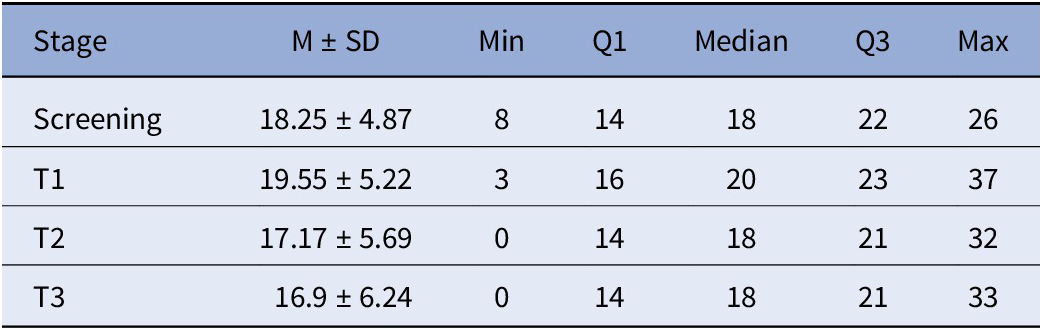
An evaluation of the SH+ program’s effectiveness revealed a statistically significant positive dynamic regarding key mental health indicators (Tables 2–4). Non-parametric analysis of variance using the Friedman test confirmed highly significant changes between stages (Screening, T1, T2, T3) for the perceived stress scale PSS-10 (χ 2 = 78.2; p < 0.0001) (Table 2). Based on the results of pairwise comparisons (Dunn’s test with a Bonferroni correction), the stress level significantly decreased after the completion of the course (Т1: M = 19.55, SD = 5.22; Т2: M = 17.17, SD = 5.69; Z = 4.939, padj < 0.0001) and remained stable at the 3-month follow-up (T3: M = 16.90, SD = 6.24; comparison Т1–Т3: Z = 5.329, padj < 0.0001). The difference between stages T2 and T3 was statistically non-significant (padj = 1.0), indicating a stabilization of the effect.
Stress level indicators on the PSS-10 scale at different stages of implementation, n = 297

Table 2. Long description
The table consists of seven columns: Stage, M plus or minus S D, Min, Q 1, Median, Q 3, and Max.
* Screening stage: Mean 18.25 plus or minus 4.87, Minimum 8, Q 1 14, Median 18, Q 3 22, Maximum 26.
* T 1 stage (pre-test): Mean 19.55 plus or minus 5.22, Minimum 3, Q 1 16, Median 20, Q 3 23, Maximum 37.
* T 2 stage (post-test): Mean 17.17 plus or minus 5.69, Minimum 0, Q 1 14, Median 18, Q 3 21, Maximum 32.
* T 3 stage (3-month follow-up): Mean 16.9 plus or minus 6.24, Minimum 0, Q 1 14, Median 18, Q 3 21, Maximum 33.
Abbreviations used include M for mean, S D for standard deviation, Min for minimum, Max for maximum, Q 1 for the first quartile, and Q 3 for the third quartile.
Abbreviations: M, mean; Max, maximum value; Min, minimum value; PSS-10, perceived stress scale; SD, standard deviation.
Note: Median, median; Q1, first (lower) quartile; Q3, third (upper) quartile; Screening, baseline level at the selection stage; T1, prior to the intervention (pre-test); T2, immediately after the intervention (post-test); T3, follow-up stage (3 months post-intervention).
Dynamics of changes in depression, anxiety, and post-traumatic stress indicators across the main study stages (T1–T3)

Table 3. Long description
The table consists of 8 columns and 4 rows.
Header Row: Scales, T 1 (M plus or minus S D), T 2 (M plus or minus S D), T 3 (M plus or minus S D), Friedman test (chi-squared, p), and Dunn’s test (Z; P adj) for three comparisons: T 1–T 2, T 1–T 3, and T 2–T 3.
Row 1: P H Q-9 (Patient Health Questionnaire).
- T 1: 8.39 plus or minus 4.53.
- T 2: 6.39 plus or minus 4.47.
- T 3: 6.20 plus or minus 4.62.
- Friedman test: 92.92, p less than 0.0001.
- Dunn’s test: T 1–T 2 (5.41; p less than 0.0001), T 1–T 3 (5.98; p less than 0.0001), T 2–T 3 (0.57; p equals 1.0).
Row 2: G A D-7 (Generalized Anxiety Disorder scale).
- T 1: 6.42 plus or minus 4.07.
- T 2: 4.99 plus or minus 3.60.
- T 3: 4.45 plus or minus 3.84.
- Friedman test: 92.61, p less than 0.0001.
- Dunn’s test: T 1–T 2 (4.16; p less than 0.0001), T 1–T 3 (6.42; p less than 0.0001), T 2–T 3 (2.26; p equals 0.0719).
Row 3: P C L-5 (P T S D checklist).
- T 1: 21.8 plus or minus 14.1.
- T 2: 16.5 plus or minus 13.7.
- T 3: 14.9 plus or minus 13.9.
- Friedman test: 115.2, p less than 0.0001.
- Dunn’s test: T 1–T 2 (4.81; p less than 0.0001), T 1–T 3 (6.59; p less than 0.0001), T 2–T 3 (1.78; p equals 0.2275).
Abbreviations: GAD-7, Generalized Anxiety Disorder scale; M, mean; PCL-5, PTSD checklist; PHQ-9, Patient Health Questionnaire; SD, standard deviation.
Note: χ 2, empirical value of the Friedman test; p, statistical significance level for the global Friedman test; padj, adjusted statistical significance level for pairwise comparisons using Dunn’s test with a Bonferroni correction; T1, prior to the intervention (pre-test); T2, immediately after the intervention (post-test); T3, follow-up stage (3 months post-intervention); Z, empirical value of Dunn’s test.
Dynamics of indicators for overall well-being, psychosocial functioning, and resilience across the main study stages (T1–T3)

Table 4. Long description
The table consists of 8 columns and 4 rows.
Header Row: Scale, T 1 (M plus or minus S D), T 2 (M plus or minus S D), T 3 (M plus or minus S D), Friedman test (chi-squared, p), and Dunn’s test (Z; Padj) divided into three sub-columns for T 1-T 2, T 1-T 3, and T 2-T 3.
Row 1: C D - R I S C - 10.
- T 1: 26.8 plus or minus 6.16.
- T 2: 27.9 plus or minus 6.67.
- T 3: 27.5 plus or minus 7.63.
- Friedman test: chi-squared = 18.01; p < 0.001.
- Dunn’s test: T 1-T 2 = -1.987 (p = 0.141); T 1-T 3 = -1.775 (p = 0.228); T 2-T 3 = 0.212 (p = 1.0).
Row 2: W H O - 5.
- T 1: 12.5 plus or minus 4.69.
- T 2: 14.4 plus or minus 5.31.
- T 3: 14.3 plus or minus 5.64.
- Friedman test: chi-squared = 55.43; p < 0.0001.
- Dunn’s test: T 1-T 2 = -4.254 (p < 0.0001); T 1-T 3 = -4.120 (p < 0.001); T 2-T 3 = 0.134 (p = 1.0).
Row 3: W H O D A S 2.0.
- T 1: 10.1 plus or minus 5.95.
- T 2: 8.54 plus or minus 6.58.
- T 3: 8.05 plus or minus 6.41.
- Friedman test: chi-squared = 48.09; p < 0.0001.
- Dunn’s test: T 1-T 2 = 3.459 (p < 0.01); T 1-T 3 = 4.376 (p < 0.0001); T 2-T 3 = 0.917 (p = 1.0).
Abbreviations: CD-RISC-10, Connor–Davidson Resilience Scale; M, mean; SD, standard deviation; WHO-5, WHO Well-Being Index; WHODAS 2.0, WHO Disability Assessment Schedule.
Note: χ 2, empirical value of the Friedman test; p, statistical significance level for the global Friedman test; Padj, adjusted statistical significance level for pairwise comparisons using Dunn’s test with a Bonferroni correction; T1, prior to the intervention (pre-test); T2, immediately after the intervention (post-test); T3, follow-up stage (3 months post-intervention); Z, empirical value of Dunn’s test.
A similar pattern was observed for other clinical indicators (Table 3). A reduction in depressive symptoms was revealed on the PHQ-9 scale (χ 2 = 92.92; p < 0.0001). Scores significantly decreased between T1 (M = 8.39, SD = 4.53) and T2 (M = 6.39, SD = 4.47) with Z = 5.408 (padj < 0.0001). At stage T3, the results remained stable (M = 6.20, SD = 4.62; comparison Т2–Т3: padj = 1.0).
The anxiety level on the GAD-7 scale also demonstrated significant dynamics (χ 2 = 92.61; p < 0.0001), with a decrease from T1 (M = 6.42, SD = 4.07) to T2 (M = 4.99, SD = 3.60; Z = 4.165, padj < 0.0001) and a further decrease to T3 (M = 4.45, SD = 3.84). At the same time, the difference between T2 and T3 did not reach the level of statistical significance (padj = 0.072).
Post-traumatic stress symptoms on the PCL-5 scale significantly decreased (χ 2 = 115.2; p < 0.0001). Mean scores declined from 21.8 (SD = 14.1) at stage T1 to 16.5 (SD = 13.7) at stage T2 (Z = 4.813, padj < 0.0001) and further to 14.9 (SD = 13.9) at stage T3. No statistically significant difference was detected between stages T2 and T3 (padj = 0.228).
Participation in the program contributed to a significant improvement in overall well-being scores on the WHO-5 scale (χ 2 = 55.43; p < 0.0001) (Table 4). Pairwise comparisons confirmed a significant increase in well-being levels from T1 (M = 12.5, SD = 4.69) to T2 (M = 14.4, SD = 5.31; Z = −4.254, padj < 0.001) and the maintenance of this positive outcome at stage T3 (M = 14.3, SD = 5.64; padj < 0.001).
Furthermore, a significant decrease in the level of functional limitations on the WHODAS 2.0 scale was observed (χ 2 = 48.09; p < 0.0001). Students reported significantly fewer difficulties in performing daily and academic tasks: the mean score decreased from 10.1 (SD = 5.95) at T1 to 8.54 (SD = 6.58) at T2 and 8.05 (SD = 6.41) at T3 (for both comparisons with the baseline level, padj < 0.05).
An analysis of the dynamics of psychological resilience on the CD-RISC-10 scale revealed overall variability in scores (χ 2 = 18.01; p < 0.001). However, post-hoc pairwise comparisons with a Bonferroni correction did not confirm statistically significant differences between the baseline level (M = 26.8, SD = 6.16) and the post-intervention results (Т1–Т2: Z = −1.987, padj = 0.141; Т1–Т3: Z = −1.775, padj = 0.228). Although the CD-RISC-10 shows an upward trend from the first (T1) to subsequent stages (T2, T3), these changes are not statistically significant after Bonferroni correction. There is a complete absence of difference between T2 and T3, indicating a stabilization of the level after the initial increase.
Discussion
This study is one of the first to evaluate the effectiveness and implementation characteristics of the WHO-scalable psychological intervention SH+ among university students in the context of a full-scale war [Reference Abujamei, Tedeschi, Purgato, Abdulkhaleq, Abu-Khousa and Al-Ghussein18]. The obtained results confirm the hypothesis that short-term SH+ interventions are an effective tool for the prevention and reduction of distress among youth experiencing chronic stress during an ongoing war.
Our results align with global data regarding the effectiveness of SH+ in crisis populations. Specifically, in the final longitudinal sample (N = 297), a highly significant reduction in depressive (PHQ-9), anxiety (GAD-7), and post-traumatic (PCL-5) symptoms was observed immediately upon completion of the course (T1–T2; all p < 0.0001). Similar intervention effectiveness has been previously demonstrated in randomized controlled trials (RCTs) among South Sudanese female refugees in Uganda [Reference Tol, Leku, Lakin, Carswell, Augustinavicius and Adaku19], Syrian refugees in Turkey [Reference Acarturk, Uygun, Ilkkursun, Carswell, Tedeschi and Purgato20], as well as resettled conflict-affected populations in Western Europe [Reference Turrini, Purgato, Tedeschi, Abdulkhaleq, Abu-Khousa and Al-Ghussein21], confirming the transcultural validity and adaptability of the SH+ protocol across diverse crisis and resettlement settings.
An analysis of longitudinal data revealed a classic pattern of a successful short-term intervention: stabilization of the achieved effect in the medium term. At the 3-month follow-up stage (T3), the difference in scores compared to T2 was statistically non-significant for most scales (e.g., p = 1.0 for PHQ-9; p = 0.22 for PCL-5 using Dunn’s test). In addition to the reduction in clinical symptoms, participants’ daily functioning improved significantly (decrease in WHODAS 2.0 scores; p < 0.0001). For the student population, the restoration of functionality directly correlates with academic productivity, making SH+ a relevant program for the educational environment.
In contrast, psychological resilience scores (CD-RISC-10) did not demonstrate statistically significant dynamics (T1–T2: p = 0.141; T1–T3: p = 0.228). The absence of pronounced changes likely suggests that the 5-week course specifically alleviates acute emotional reactions, whereas transforming deep-seated adaptive constructs (such as resilience) requires a longer duration or more intensive interventions. At the same time, maintaining a stable level of resilience amid the ongoing war can serve as a protective buffer against further maladaptation.
Limitations
A key strength of this study is its high ecological validity: the multicenter design and implementation under real-world crisis conditions allow the results to be extrapolated to the broader population of Ukrainian university students. However, the results should be interpreted in light of several significant methodological limitations.
First, this study design without a randomized control group limits the ability to draw definitive causal conclusions. The reduction in symptoms may be partially explained by the natural course of stress adaptation or regression to the mean, although the stability of the effect at the T3 stage makes this risk less likely. Second, the use of self-report measures inherently carries the risk of subjective distortion and social desirability bias, despite guarantees of anonymity. Third, the study is characterized by a high attrition rate, which is typical for longitudinal field research in conflict zones [Reference Blanchet, Ramesh, Frison, Warren, Saso and Smith22]. Of the 1,560 students who provided consent, only 297 completed the full cycle (in-person attendance and correct completion of the screening and T1, T2, and T3 questionnaires), forming the final sample. Analysis revealed that the dominant predictors of attrition were objective security threats (regular air raid alerts), infrastructure disruptions (blackouts), and competition for time resources due to the overlapping of the SH+ session schedule with university examination periods. This high attrition rate introduces a risk of survivorship bias, as the program may have been completed primarily by students with higher baseline motivation or better time-management skills.
Conclusions
Despite the methodological limitations inherent in conducting research during an active armed conflict, the present study provides encouraging evidence that SH+ is a potentially effective intervention for reducing psychological distress among university students exposed to prolonged war-related stress. The observed improvements in depression, anxiety, post-traumatic stress symptoms, and daily functioning, together with the maintenance of gains over time, suggest that brief, scalable psychological interventions can play an important role in supporting student mental health in humanitarian settings. Importantly, the successful implementation of SH+ across multiple universities demonstrates that evidence-based mental health support can be delivered even under conditions of significant instability and disruption. These findings contribute to the growing international evidence base supporting low-intensity psychological interventions and highlight their potential as accessible public mental health tools for universities and other educational institutions facing large-scale crises. Future controlled studies with longer follow-up periods are warranted to further establish effectiveness and identify strategies to improve participant retention; nevertheless, the present results offer a hopeful indication that meaningful psychological support can be provided to young people even amid ongoing adversity.
Acknowledgments
The authors express their sincere gratitude to all students who participated in the study, as well as to the specialists who conducted the training and contributed to the project’s implementation.
Author contribution
Conceptualization: I.P., S.K., S.C.; Data curation: I.P., S.K., N.P., R.Y.; Formal analysis: R.Y.; Funding acquisition: I.P.; Investigation: I.P., S.K., S.C., N.S.; Methodology: I.P., S.K., S.C.; Project administration: I.P.; Supervision: I.P., C.B., M.P.; Writing – original draft: S.K., S.C., N.S.; Writing – review and editing: I.P., S.K., S.C., N.S., N.P., C.B., M.P.
Financial support
We obtained funding from the World Health Organization (WHO) under Contract No. 2026/1632324-0 with Taras Shevchenko National University of Kyiv. The funders were not involved in the study design, data collection, data analysis, interpretation, or writing of the report.
Competing interests
The authors declare no conflicts of interest.
Ethics statement
The Committee on Bioethics of Scientific Research, Taras Shevchenko National University of Kyiv, Ukraine (No. 3, as of 10.04.2025). Informed consent was obtained from students.
Declaration of generative AI and/or AI-assisted technologies in the preparation of the manuscript
The authors attest that AI tools were not used in the preparation of this manuscript nor during any phase of research involved.




 Open access


Comments
No Comments have been published for this article.