





Introduction
The first five years of life is a critical stage of development, rapid growth, and laying foundations for children’s health behaviours relating to dietary intake, physical activity, sedentary behaviours, and sleep habits (Birch and Fisher, Reference Birch and Fisher1998; Kuzik et al., Reference Kuzik, Poitras, Tremblay, Lee, Hunter and Carson2017; The Royal Australian College of General Practitioners, 2015). These key modifiable health behaviours track and influence health across the life course (Craigie et al., Reference Craigie, Lake, Kelly, Adamson and Mathers2011; Wang et al., Reference Wang, Jansen, van Grieken, Vlasblom, Boere-Boonekamp, L’Hoir and Raat2020; Wang et al., Reference Wang, Bentley, Zhai and Popkin2002). Primary Health Care (PHC) is a familiar and valued setting for caregivers of young children due to the long and trusted relationships developed during regular encounters (Australian Institute of Health and Welfare, 2016). This includes a schedule of regular PHC visits including routine health and development checks and immunisation appointments in general practice settings, as well as multi-disciplinary allied health in primary care and child and family health services (Mayne et al., Reference Mayne, Hannan, Faerber, Anand, Labrusciano-Carris, DiFiore, Biggs and Fiks2021). Core elements of these services include health and developmental screening, health promotion, early identification of family need and risk, and responding to identified need through education and intervention (Australian Health Ministers Advisory Council, 2011; Jeyendra et al., Reference Jeyendra, Rajadurai, Chanmugam, Trieu, Nair, Baskaran and Schmied2013). PHC is therefore an ideal setting for health promotion and early intervention to support optimal growth, health, and development in the early years.
Monitoring and promoting child health behaviours are key responsibilities of universal PHC, supported by national PHC guidelines and policy priorities (Australian Government, 2024; Australian Health Ministers Advisory Council, 2011; Dutch et al., Reference Dutch, Bell, Hunter, Johnson, Denney-Wilson and Golley2025; The Royal Australian College of General Practitioners, 2024). Screening for child health behaviours provides an opportunity to monitor and provide tailored health promotion advice and support to families. This approach aligns with the 5A’s Framework (ask, assess, advise, assist, and arrange) which is used to guide the delivery of preventive care in routine PHC practice in Australia (The Royal Australian College of General Practitioners, 2024). Screening tools to measure child health behaviours in PHC exist internationally (Dutch et al., Reference Dutch, Bell, Zarnowiecki, Johnson, Denney-Wilson, Byrne, Cheng, Rossiter, Manson, House, Davidson and Golley2024; Krijger et al., Reference Krijger, Ter Borg, Elstgeest, van Rossum, Verkaik-Kloosterman, Steenbergen, Raat and Joosten2022). However, there is a lack of tools that comprehensively assess all four key health behaviour domains of diet, physical activity, sedentary behaviour, and sleep, and that have been designed or evaluated with children aged 0–5 years in an Australian PHC context (Dutch et al., Reference Dutch, Bell, Zarnowiecki, Johnson, Denney-Wilson, Byrne, Cheng, Rossiter, Manson, House, Davidson and Golley2024). As a result, existing international tools may not measure child health behaviours against age-appropriate Australian guidelines, and may include questions and response options that are not contextually relevant, such as differing food group classifications, terminology, or culturally specific examples. In addition, existing tools lack published evidence of their psychometric properties, limiting our understanding of their validity and reliability in PHC (Dutch et al., Reference Dutch, Bell, Zarnowiecki, Johnson, Denney-Wilson, Byrne, Cheng, Rossiter, Manson, House, Davidson and Golley2024). Collectively, these limitations underscore the need to develop screening tools specifically tailored to the Australian PHC setting to ensure feasibility, acceptability, and contextual relevance for PHC practitioners and families. Valid and reliable screening tools for comprehensively measuring health behaviours in Australian children that can be used in PHC settings are needed to identify opportunities for early intervention and target strategies for health promotion (Byrne et al., Reference Byrne, Bell, Taylor, Mauch, Mihrshahi, Zarnowiecki, Hesketh, Wen, Trost and Golley2019; Dutch et al., Reference Dutch, Bell, Zarnowiecki, Johnson, Denney-Wilson, Byrne, Cheng, Rossiter, Manson, House, Davidson and Golley2024; Krijger et al., Reference Krijger, Ter Borg, Elstgeest, van Rossum, Verkaik-Kloosterman, Steenbergen, Raat and Joosten2022).
Therefore, this study aimed to (1) identify and prioritise practitioner generated features of a child health behaviour screening tool for use in routine PHC, and (2) understand prioritised practitioner generated supports needed to implement child health behaviour screening in routine PHC in Australia.
Methods
Study design
This cross-sectional study employed the Nominal Group Technique method to engage PHC practitioners to generate prioritised ideas on child health behaviour screening in PHC. Ethics approval was obtained from the Flinders University Human Research Ethics Committee (HREC 6514) and the Women’s and Children’s Health Network Human Research Ethics Committee (HRE 00322). Reporting follows the Strengthening the Reporting of Observational Studies in Epidemiology (STROBE) Statement (Supplementary Table 1).
This study was informed by an integrated knowledge translation framework, the Knowledge to Action (KTA) Framework (Graham et al., Reference Graham, Logan, Harrison, Straus, Tetroe, Caswell and Robinson2006). The KTA Framework is a conceptual model to support knowledge translation of evidence-based interventions from research into practice by demonstrating the dynamic relationship between knowledge creation and action (Graham et al., Reference Graham, Logan, Harrison, Straus, Tetroe, Caswell and Robinson2006). As child health behaviour screening poses a new approach for monitoring and promoting health behaviours in Australian PHC, the KTA Framework provides a useful framework to guide knowledge creation and synthesis, as well as the important considerations for implementation in practice.
The Nominal Group Technique method is an orderly, collaborative, consensus process designed to generate, filter, and prioritise ideas and solutions to questions posed to a small group of participants (Harvey and Holmes, Reference Harvey and Holmes2012; Humphrey-Murto et al., Reference Humphrey-Murto, Varpio, Gonsalves and Wood2017). The Nominal Group Technique is a structured and resource efficient method for group idea generation and prevents dominance of individuals and minimizes group thinking (McMillan et al., Reference McMillan, Kelly, Sav, Kendall, King, Whitty and Wheeler2014; McMillan et al., Reference McMillan, King and Tully2016). Virtual workshops allow for scheduling flexibility (Lee et al., Reference Lee, ten Cate, Gottlieb, Horsley, Shea, Fournier, Tran, Chan, Wood and Humphrey-Murto2024), particularly to accommodate busy PHC practitioner schedules and encourage participation regardless of location.
The Nominal Group Technique process involves four stages: (1) silent idea generation, (2) round robin discussion, (3) clarification and collapsing, and (4) voting. Silent idea generation requires participants to independently, and silently, reflect and record their ideas to answer a research question. Round robin discussion involves participants sharing one idea from their list to the group at a time. During clarification and collapsing, participants are asked to clarify their ideas, as well as exclude, include, combine, or alter ideas. In the final stage, participants are asked to vote for their top three ideas.
Participant recruitment
Eligible participants were South Australian PHC practitioners that work with children aged five years or under in a PHC setting and who had adequate computer and English literacy skills.
Guidelines for Nominal Group Technique workshops recommend no more than 7–10 participants per workshop (McMillan et al., Reference McMillan, Kelly, Sav, Kendall, King, Whitty and Wheeler2014; McMillan et al., Reference McMillan, King and Tully2016). This study used a convenience sampling approach with snowball recruitment strategies. PHC practitioners were recruited via email invitation, social media, and at in-person professional development events. Professional organizations were also contacted to distribute recruitment information within internal newsletters and email distribution lists. Workshop participants were also asked to share recruitment information to their networks and colleagues.
PHC practitioners eligible to participant include diverse General Practice (GP) and Allied Health practitioners including dietitians, speech pathologists, occupational therapists, exercise physiologists, and physiotherapists. Child and Family Health Nurses were recruited via the South Australian Child and Family Health Service requiring separate ethical and organizational approval processes. Therefore, workshops were conducted separately for the two practitioner groups and results are presented to reflect this; (1) GP/Allied Health workshops and (2) Child and Family Health workshops.
Practitioners completed a brief demographic questionnaire via online survey software (Qualtrics, Provo, UT) including gender, role, experience in role, in addition to questions confirming eligibility and informed consent to participate.
Remuneration for PHC practitioner’s time taken to be involved in the workshop was provided based on published sitting fees of $35AUD per hour (Government of South Australia, 2021). To account for 1-hour preparation time and 2-hour workshop, practitioners were remunerated up to $105AUD per workshop to cover potential loss of income. Child and Family Health Nurses were supported to participate during their workload/role and therefore weren’t remunerated as per organizational policy, as there was no associated loss of income.
Data collection
All participants attended an Idea Generation workshop to complete steps 1–3 of the Nominal Group Technique method, including silent idea generation, round robin discussion, and clarification and collapsing. Participants were then invited to participate in a second consensus workshop to vote and prioritise ideas to complete the fourth step of the Nominal Group Technique method. A two-phase workshop approach was used to maximise participation and ensure that PHC practitioners with busy and variable schedules could contribute meaningfully. Separating idea generation from the consensus voting allowed a wider group of PHC practitioners to engage in the initial development of ideas, while enabling those available for a second workshop to review, discuss, and prioritise these ideas in a focused consensus workshop.
Workshop 1: Idea generation
Participants attended a 60–90 minute online exploratory workshop to identify, define, and discuss key features and resources to support implementation of child health behaviour screening in PHC. At the commencement of the workshop, participants were provided with a 10–15-minute introductory presentation that set the context and provided background information on health behaviour screening tools that have been developed and tested internationally and the rationale for the current research.
Idea Generation workshops followed the Nominal Group Technique process for two questions:
Question 1 – ‘Imagine a screening tool for health behaviours (i.e. diet, physical activity, sedentary behaviour, and sleep), what are the key features of the tool to enable effective use in your practice?
Question 2 – What training, resources and supports would you need to implement health behaviour screening within your primary health care setting?
All workshops were conducted, recorded, and transcribed via Microsoft Teams and note-taking was facilitated via a live shared Microsoft Word document (Version 16). Idea Generation workshops were held between October 2023 and March 2024, with the same workshop facilitator (DD) and workshop scribe and notetaker (AM).
Workshop 2: Consensus
At the completion of each Idea Generation workshop, participants were asked if they were happy to be contacted to be involved in a second workshop.
A 60-minute consensus workshop was confirmatory in nature and aimed to collapse, refine, and agree on key features and resources required to support implementation of child health behaviour screening in PHC. To be flexible, those who were interested in participating in a second workshop, but were unable to attend, were given the opportunity to contribute to consensus voting via an online survey. Consensus workshops and surveys were conducted between December 2023 and March 2024.
Data analysis
During each Idea Generation workshop, ideas generated and their associated discussions were recorded on a live Microsoft Word document (AM) and shared on the screen for participants to view during the workshop. This ensured that the notetaking accurately reflected the practitioners ideas and discussions. Workshops were video-recorded and transcribed using Microsoft Teams, and following each workshop, workshop transcripts and discussion notes were checked manually by the workshop facilitator (DD) to ensure accuracy. Results from Idea Generation workshops were collated and synthesized by the workshop facilitator (DD) prior to the consensus workshop using Miro, an online whiteboard software. An inductive content-focused approach was used to refine and synthesise the ideas generated across workshops. After each workshop, newly identified ideas were compared with those from previous workshops to determine whether they represented new ideas or variations of existing ideas. Ideas determined to be conceptually similar were grouped together, with descriptions refined through comparison of transcripts and discussion notes.
During the consensus voting process, participants were asked to vote for their top three ideas via online survey. Participants were asked to allocate a score of 3 for their top idea, through to a 1 for their third idea. Key results include the total votes, voting frequency, and the relative importance score for each idea to allow comparison between practitioner groups who participated in online consensus voting. Relative importance score was calculated by dividing total votes by the total maximum potential votes the idea could receive and is presented as a percentage, with higher scores demonstrating higher importance to participants. The three top-ranked ideas were then shared back to participants. Quantitative voting data were analysed using Microsoft Excel (Version 16).
Following the completion of all workshops, full transcripts were reviewed to identify illustrative quotations to provide context and rationale to the identified and prioritised ideas (Manera et al., Reference Manera, Hanson, Gutman, Tong and Liamputtong2019; McMillan et al., Reference McMillan, Kelly, Sav, Kendall, King, Whitty and Wheeler2014).
Researcher positionality
The research team brings together expertise in public health (DD, AM, SH, LB, EDW, and RG), dietetics (DD, AM, LB, and RG), nursing (EDW), psychology (SH), knowledge translation (SH), and implementation science (SH). The data collection team (DD and AM) consisted of white females with previous experience working as dietitians in PHC settings. The analysis team (DD, AM, LB, SH, EDW, and RG) comprised of white females experienced in researching health behaviour measurement, Nominal Group Technique methodology, qualitative analysis, implementation science, and conducting research with PHC practitioners and in PHC settings.
Results
Participants
A total of eight Idea Generation workshops were held with twenty-nine PHC practitioners, including allied health practitioners (n = 15), Child and Family Health nurses (n = 8), and General Practitioners (n = 3). All participants were female and had two to 27 years of experience in their current role. See Supplementary Table 2 for further details of participant characteristics. Of the 29 practitioners who participated in an Idea Generation workshop, seven attended a second consensus workshop, and 27 contributed to online consensus voting. Two practitioners were lost to follow up and did not contribute to online consensus voting.
Supplementary Figure 1 demonstrates participants flow through Idea Generation and Consensus workshops. Supplementary Table 3 includes details of GP/Allied Health and Child and Family Health workshops, including the date workshops were held and the number of participants that attended. GP/Allied Health workshops were conducted separately and prior to the Child and Family Health workshops due to logistical and pragmatic considerations including separate ethical, recruitment, and organisational processes.
Idea generation workshops summary of results
GP/Allied Health (n = 6 workshops) and Child and Family Health (n = 2 workshops) practitioners identified 59 and 23 features, respectively for a health behaviour screening tool and 46 and 15 supports, respectively, to facilitate adoption and use of the screening tool in PHC. See Supplementary Tables 4 and 5 for a full list of ideas generated in the GP/Allied Health and Child and Family Health workshops respectively.
These ideas were synthesised and summarised following the Idea Generation workshops, resulting in 10 unique tool features and 10 unique supports to facilitate tool adoption which were carried through to consensus voting (Table 1). See Supplementary Figures 2 and 3 demonstrating synthesis of GP/Allied Health ideas, and Supplementary Figures 4 and 5 for Child and Family Health nurse ideas.
Ideas for tool features and supports to facilitate tool adoption identified by GP/Allied Health and Child and Family Health practitioners

Table 1. Long description
The table presents ideas for tool features and supports to facilitate tool adoption, identified by GP/Allied Health and Child and Family Health practitioners. It is divided into two main sections: Q1 and Q2. Q1 focuses on key features of a screening tool for child health behaviors, while Q2 addresses the training, resources, and supports needed to implement screening in practice. Each section lists ideas along with their explanations. Key features include tool length, question design, administration methods, clear results, inclusive language, images and visuals, psychometric properties, technological functions, multidisciplinary use, and clear purpose. Supports include practitioner training, practitioner resources, caregiver resources, community awareness, workplace and IT support, tool monitoring and evaluation, access and availability, interprofessional exchange and communication, partnership with other services, and staff roles and capacity. The table emphasizes the importance of practical, user-friendly, and comprehensive tools and supports to effectively implement screening in practice.
Consensus workshop results
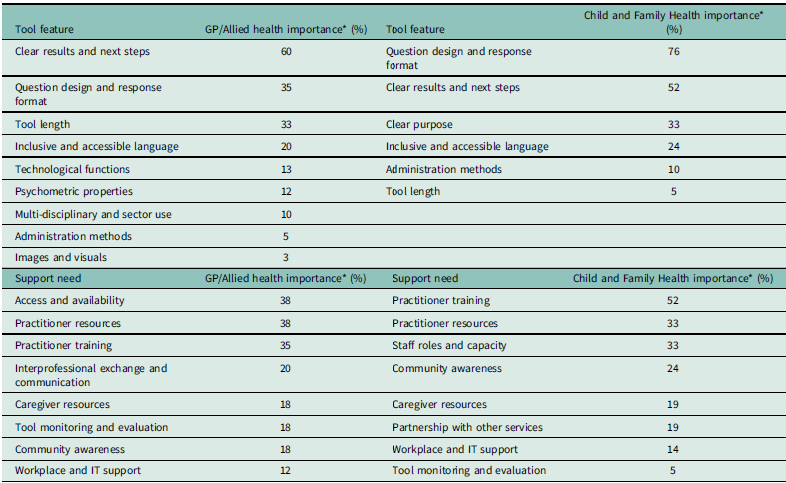
Table 2 presents prioritised ideas for features of a child health behaviour screening tool and support needs for tool use as determined by consensus voting. See Supplementary Table 6 for full details of consensus voting results. Supporting participant quotes from Idea Generation workshops are presented to provide context to the prioritised features and support needs. See Supplementary Table 7 for full list of relevant participant quotes.
Prioritised ideas for tool features and support needs identified during consensus voting by GP/Allied health (n = 20) and Child and Family Health (n = 7) practitioners

Table 2. Long description
A table comparing tool features and support needs for GP/Allied health and child and family health practitioners. The table is divided into two main sections: Tool features and Support need. Each section has two columns: one for GP/Allied health importance and one for Child and family health importance. The table has 9 rows under Tool features and 9 rows under Support need. Row 1: Clear results and next steps, 60, Question design and response format, 76. Row 2: Question design and response format, 35, Clear results and next steps, 52. Row 3: Tool length, 33, Clear purpose, 33. Row 4: Inclusive and accessible language, 20, Inclusive and accessible language, 24. Row 5: Technological functions, 13, Administration methods, 10. Row 6: Psychometric properties, 12, Tool length, 5. Row 7: Multi-disciplinary and sector use, 10. Row 8: Administration methods, 5. Row 9: Images and visuals, 3. Row 10: Access and availability, 38, Practitioner training, 52. Row 11: Practitioner resources, 38, Practitioner resources, 33. Row 12: Practitioner training, 35, Staff roles and capacity, 33. Row 13: Interprofessional exchange and communication, 20, Community awareness, 24. Row 14: Caregiver resources, 18, Caregiver resources, 19. Row 15: Tool monitoring and evaluation, 18, Partnership with other services, 19. Row 16: Community awareness, 18, Workplace and IT support, 14. Row 17: Workplace and IT support, 12, Tool monitoring and evaluation, 5.
* Importance score (%) calculated by [total votes received/maximum potential votes]. Maximum potential votes for GP/Allied Health practitioner group was 60, and 21 for Child and Family Health practitioner group.
Practitioner generated features of a child health behaviour screening tool
Figure 1 shows ideas identified by GP/Allied Health and Child and Family Health practitioners in order of importance score. Five identified features were consistent across GP/Allied Health and Child and Family Health practitioners groups: (1) tool length, (2) question design and response format, (3) administration methods, (4) inclusive and accessible language and (5) clear results and next steps. Prioritized tool features as determined by consensus voting are described below with selected participant quotes.
Practitioner generated ideas of features of a child health behaviour screening tool: Comparison of results between GP/Allied Health and Child and Family Health practitioners.

Clear results and next steps
‘Clear results and next steps’ was identified as the top and second highest ranked feature for a child health behaviour screening tool by GP/Allied Health practitioners (60% importance score) and Child and Family Health practitioners (52% importance score), respectively. Practitioners described the importance of the tool having a clear scoring system, with results that are easy to interpret, available in a summary report for families, and use to inform the provision of health promotion information, resources or referral pathways.
‘The scoring would need to be easy to interpret and provide clear feedback like on next steps and maybe links to guidelines’ (GP practitioner, Workshop 4)
‘Part of ease of use is the ability to quickly analyse the data and determine whether it’s a screening pass or the child needs further assessment’ (Allied Health practitioner, Workshop 4)
‘Clear scoring and referral pathways could be helpful’ (Child and Family Health nurse, Workshop 7)
Question design and response format
‘Question design and response format’ was identified as the top and second highest ranked feature for a child health behaviour screening tool for Child and Family Health practitioners (76% importance score) and GP/Allied Health practitioners (35% importance score), respectively. Practitioners highlighted the importance of simple and easy to understand questions that are age appropriate and categorised by health behaviour domain. Practitioners discussed tick-box response options to encourage completion by busy parents, with open text response boxes to elaborate on any concerns they might have about their child’s health behaviours.
‘Something quite easy for parents to use, so something quite simple tick box type questionnaire, but then having room to elaborate on some of the sort of more key points’ (Allied Health practitioner, Workshop 6)
‘I’d like to see a tool that’s electronic and user friendly and it’s customised so it can be age-appropriate bit like the ASQ that’s age appropriate for their age’ (Child and Family Health nurse, Workshop 8)
Tool length
‘Tool length’ was identified as the third highest ranked feature for a child health behaviour screening tool for GP/Allied Health practitioners (33% importance score). Child and Family Health practitioners also identified ‘Tool length’ however was not prioritised highly (5% importance score). Practitioners described the importance of a brief tool so that is it acceptable for both the caregiver to complete and practitioner to use in their practice.
‘should be very quick and easy, rather than having to write down, you know, monitor their child for a week and ohh they move on average 30 minutes’ (GP practitioner, Workshop 2)
‘It would need to be concise or brief. So probably one to two pages or 10 to 15 questions maximum’ (GP practitioner, Workshop 4)
‘I would say that you know something that’s fast and brief to keep it doable during initial learner assessment process and probably adding on to simple and easy to fill so that a practitioner can do that quickly’ (Allied Health practitioner, Workshop 1)
Clear purpose
‘Clear purpose’ was identified as a unique and third highest ranked feature for a child health behaviour screening tool for Child and Family Health practitioners (33% importance score). Practitioners described the importance of caregivers and practitioners knowing the purpose of the tool to encourage use and completion.
‘Important to have like a bit of an explanation as to why we’re doing the tool…a brief statement as to why it’s important’ (Child and Family Health nurse, Workshop 7)
‘Demonstration of the purpose behind doing the tool, and the magnitude of primary health care at this age’ (Child and Family Health nurse, Workshop 8)
Inclusive and accessible language
‘Inclusive and accessible language’ was identified as the fourth highest ranked feature for a child health behaviour screening tool for GP/Allied Health practitioners (20% importance score) and Child and Family Health practitioners (24% importance score). Practitioners described the importance of simple and easy-to-understand language to support completion of families with low-literacy or English as a second language. Strengths-based language and framing was also discussed by practitioners to ensure the screening tool doesn’t contribute to caregiver guilt or shame.
‘One of my soapboxes is to normalise strength-based behaviour change. So your screen is already an educational tool that helps families feel good that they’re even filling out the screen rather than guilty and bad that they having to do a screen because they’re not doing it right’ (GP practitioner, Workshop 2)
‘If the way that the tool was kind of designed and set up and the prompts on it were quite strengths-based, it could be really useful for everybody that uses it’ (Allied Health practitioner, Workshop 6)
‘Not using really difficult language, so easy to understand’ (Child and Family Health nurse, Workshop 7)
Practitioner generated support needs to facilitate use of a child health behaviour screening tool
Figure 2 shows support needs identified by GP/Allied Health and Child and Family Health practitioners in order of importance score. Six were consistent across GP/Allied Health and Child and Family Health practitioners; (1) practitioner training, (2) practitioner resources, (3) caregiver resources, (4) community awareness, (5) workplace and IT support and (6) tool monitoring and evaluation. Prioritised support needs as determined by consensus voting are described below with selected participant quotes.
Practitioner generated ideas of support needs to facilitate implementation of child health behaviour screening: Comparison of results between GP/Allied Health and Child and Family Health practitioners.

Practitioner training
‘Practitioner training’ was identified as the top and third highest ranked support need by Child and Family Health practitioners (52% importance score) and GP/Allied Health practitioners (35% importance score), respectively. Practitioners described that in-person and online training regarding the purpose of the tool, health behaviour guidelines, and strengths-based approaches should be available, but not mandatory prior to using the tool in practice.
‘Part of any screening tool, it is educating the practitioner on why is this important’ (GP practitioner, Workshop 2)
‘I think maybe in terms of education for the practitioner, I think even though I suggested that eLearning and the MS Teams, sometimes they like face-to-face workshop is better for engaging’ (Child and Family Health nurse, Workshop 7)
Access and availability
‘Access and availability’ was identified as a unique and equal top support need by GP/Allied Health practitioners (38% importance score). Practitioners described the tool being available online for caregivers and practitioners to use, or embedded within routine services so that it is universally accessible to families.
‘Free to access always helps with more people doing that screening, which then helps with that sort of systemic change as well’ (Allied Health practitioner, Workshop 1)
‘Have the screen as part of their routine care, so piggybacking it or in meshing it, or linking it with other common presentations for kids in that first thousand days would be really good’ (GP practitioner, Workshop 2)
Practitioner resources
‘Practitioner resources’ was identified as an equal top and second highest ranked support need by GP/Allied Health practitioners (38% importance score) and Child and Family Health practitioners (33% importance score), respectively. Resources described by practitioners included information on the background of the tool, health behaviour recommendations, strengths-based framing, conversations guides, and lists of relevant services to facilitate referral pathways.
‘Milestones or guidelines for the practitioner to kind of support those conversations or and some recommendations or like some prompts’ (Allied Health practitioner, Workshop 6)
‘Some kind of guide guiding document guide book or like an online thing that’s easier or something explaining why it’s been framed in this way and the importance of actually using it in this way that strengths-based to actually promote healthy behaviours and not just create pressure which then actually reduces healthy behaviours’ (Allied Health practitioner, Workshop 6)
‘It would be great if we could have some structure in ways that we can discuss it at each appointment’ (Child and Family Health nurse, Workshop 7)
Staff roles and capacity
‘Staff roles and capacity’ was identified as a unique and third highest ranked support need by Child and Family Health practitioners (33% importance score). Child and Family Health practitioners highlighted the need for additional time and support in order to conduct additional health behaviour screening within current limited capacity.
‘We need to adjust length of appointments or additional appointments that we can book families into if they would like some specific support on healthy lifestyle’ (Child and Family Health nurse, Workshop 7)
Interprofessional exchange and communication
‘Interprofessional exchange and communication’ was identified the fourth highest ranked support need by GP/Allied Health practitioners (20% importance score). Practitioners described the need for communication between practitioners and services to avoid unnecessary repeat screening and to communicate why screening was conducted, the results, and what next steps have been recommended.
‘Having a network of professionals who have awareness, which is almost comes to marketing, but also we’re talking about interprofessional exchange of information or making the tool readily shared between professionals’ (GP practitioner, Workshop 2)
‘Making sure that there’s some kind of structure in place so that the results are shared between relevant parties and also that you’re not screening a child who’s already had a screening or missing a child who says they’ve been screened but really hasn’t been’ (Allied Health practitioner, Workshop 4)
Community awareness
‘Community awareness’ was identified as the fourth highest ranked support need by Child and Family Health practitioners (24% importance score). GP/Allied Health practitioners also identified ‘Community awareness’ but prioritised less highly (18% importance score). Practitioners described the need for raising awareness of the tool amongst practitioners and the wider community through marketing, posters or videos that can be displayed in clinic waiting rooms, and promotional materials for parents to take home.
‘We also need the community to know it exists and it might need a bit of marketing’ (GP practitioner, Workshop 2)
‘It’s all about awareness at first’ (Allied health practitioner, Workshop 5)
Discussion
Child health behaviour screening poses an opportunity to support practitioners to monitor, promote, and discuss children’s dietary intake, physical activity, sedentary behaviour, and sleep habits in PHC. Informed by the KTA Framework, this study generated and synthesised new knowledge, tailored to the Australian PHC context, to inform the design, development, and implementation of a potential child health behaviour screening tool that would be acceptable for use across General Practice and Child and Family Health settings (Graham et al., Reference Graham, Logan, Harrison, Straus, Tetroe, Caswell and Robinson2006). Our findings suggest PHC practitioners would use a child health behaviour screening tool if it were easy to understand and complete, and has clear results to inform next steps. The need for practitioner training and resources to support use of a screening tool in routine PHC practice was prioritised. To support use and acceptability of the tool across PHC settings, the screening tool and associated resources must be multi-disciplinary and use a strengths-based approach. Implementation would be aided by adapting and tailoring the tool for different PHC contexts. Overall, this study provides important insight into diverse practitioner perspectives on child health behaviour screening, and marks an essential step towards developing an acceptable tool to support children’s growth, health, and development in Australian PHC.
A brief and easy to complete screening tool that has clear results to inform next steps could support PHC practitioners to consistently monitor and discuss children’s health behaviours aligned with PHC guidelines. This is consistent with caregiver perspectives, describing the need for a brief and easy to complete screening tool that provides clear courses of action (Krijger et al., Reference Krijger, Schiphof-Godart, Lanting, Elstgeest, Raat and Joosten2024), critical for tool completion by caregivers in busy PHC waiting rooms, potentially while caring for multiple children. Screening tools tested in PHC internationally demonstrate increased health behaviour conversations, increased practitioner confidence, and evidence of practitioner and caregiver acceptability (Dutch et al., Reference Dutch, Bell, Zarnowiecki, Johnson, Denney-Wilson, Byrne, Cheng, Rossiter, Manson, House, Davidson and Golley2024; Krijger et al., Reference Krijger, Schiphof-Godart, Elstgeest, van Rossum, Verkaik-Kloosterman, Steenbergen, Ter Borg, Lanting, van Drongelen, Engelse, Kindermann, Detmar, Frenkel, Raat and Joosten2023; Krijger et al., Reference Krijger, Ter Borg, Elstgeest, van Rossum, Verkaik-Kloosterman, Steenbergen, Raat and Joosten2022).
Practitioners identified the need for further training and resources to facilitate the implementation, use, and effectiveness of a child health behaviour screening tool in routine PHC practice. This is aligned with previous Australian research demonstrating the urgent need for further professional development, capacity-building, and funding structures to enable Australian PHC practitioners to appropriately conduct health promotion and early intervention prevention practices in routine PHC (Cheng et al., Reference Cheng, Eames-Brown, Tutt, Laws, Blight, McKenzie, Rossiter, Campbell, Sim, Fowler, Seabury and Denney-Wilson2020; Gooey et al., Reference Gooey, Hailu, Sturgiss, Advocat, Bergmeier and Skouteris2024a; Reference Gooey, Morris, Baulderstone, Flego, Holdenson Kimura, Kathage, Rix, Saddik, Su and Bragge2024b; Gooey et al., Reference Gooey, Dutch, House and West2025; Laws et al., Reference Laws, Campbell, van der Pligt, Ball, Lynch, Russell, Taylor and Denney-Wilson2015; Wen et al., Reference Wen, House, Phongsavan, Dutch, Laws, Simone, Denney-Wilson and Baur2026). Practitioner training and resources are key enablers to implementing PHC guidelines (Peters et al., Reference Peters, Bussières, Depreitere, Vanholle, Cristens, Vermandere and Thomas2020; The Royal Australian College of General Practitioners, 2018) particularly supporting practitioner knowledge and confidence to have strengths-based conversations to promote health behaviours (Bradbury et al., Reference Bradbury, Chisholm, Watson, Bundy, Bradbury and Birtwistle2018; Ray et al., Reference Ray, Sniehotta, McColl and Ells2022). Consistent with practitioner-identified needs internationally (Dutch et al., Reference Dutch, Bell, Zarnowiecki, Johnson, Denney-Wilson, Byrne, Cheng, Rossiter, Manson, House, Davidson and Golley2024), tools should also be supported by caregiver resources, adequate workplace structures, staff capacity, and professional and community awareness (Hearn et al., Reference Hearn, Miller and Cross2007; Peters et al., Reference Peters, Bussières, Depreitere, Vanholle, Cristens, Vermandere and Thomas2020).
A screening tool that can be used across disciplines and sectors, utilising inclusive and accessible language was described across PHC practitioner groups. Children are seen by different practitioners, across different services and settings, at different time points and frequencies, reinforcing the need for consistent health promotion messaging across routine and opportunistic encounters (Middleton et al., Reference Middleton, Hunter, Johnson and Golley2022). The benefit of a holistic approach recognises that health promotion is a responsibility that should be shared across disciplines, services, and sectors (Australian Government, 2024). Tools and resources therefore need to be shared and communicated between practitioners and services and referral pathways can be facilitated by leveraging existing networks and partnerships. This can reduce caregiver and practitioner burden, minimize duplication of screening, or missing a child that requires screening. Practitioners also described language and framing that encapsulates a strengths-based, whole-of-family approach to supporting children’s health, written at a low readability level. A non-judgemental approach helps identify what families are doing well and empowers caregivers to make positive changes, addressing the known barriers and limitations of weight-focused conversations. This framing is particularly important when engaging with culturally and linguistically diverse families (Ahern et al., Reference Ahern, Marshall, Wallbank, Jawad, Taki, Baur and Wen2023) and those who have had previous negative experiences in PHC (Rossiter et al., Reference Rossiter, Fowler, Hesson, Kruske, Homer, Kemp and Schmied2019).
While some findings were consistent for tool features and support needs across diverse PHC settings and practitioners, there were unique findings to suit context specific needs. Tailoring interventions to context is an important step to support effective implementation as demonstrated in the KTA Framework (Graham et al., Reference Graham, Logan, Harrison, Straus, Tetroe, Caswell and Robinson2006) and can enhance reach, adoption, and acceptability (Movsisyan et al., Reference Movsisyan, Arnold, Evans, Hallingberg, Moore, O’Cathain, Pfadenhauer, Segrott and Rehfuess2019). Length of appointments is a common barrier to delivering preventive care in current practice (Jeyendra et al., Reference Jeyendra, Rajadurai, Chanmugam, Trieu, Nair, Baskaran and Schmied2013). This highlights the need for additional or longer appointments, reintroduction of a Medicare Benefit Schedule item (Wen et al., Reference Wen, House, Phongsavan, Dutch, Laws, Simone, Denney-Wilson and Baur2026) similar to the discontinued Healthy Kids Check (Alexander and Mazza, Reference Alexander and Mazza2015), or utilizing clear care pathways to make brief PHC touchpoints an opportunity to signpost to other resources and services. Integrating the screening tool within medical software including appointment reminder systems and electronic medical records may also encourage caregiver completion prior to the appointment and enable timely discussions and identification of children that require further assessment or support. Child and Family Health practitioners also emphasised the tool needing a clear purpose to support with caregiver buy in and motivation to complete. Context specific needs, as described within this study, highlight the importance of engaging with practitioners to ensure interventions are tailored to the needs of those who are going to use it in practice.
Implications for future research, policy, and practice
Our findings demonstrate PHC practitioners are interested in screening for child health behaviours and require tools and resources to support this in practice. Brief interventions in PHC, including screening, tailored advice, and referral to additional resources or services are increasingly needed to enable delivery of preventive care in time-poor PHC settings. Understanding practitioner perspectives is crucial to ensuring tools and resources meet practitioner needs and therefore are acceptable and adopted into routine practice. Access and awareness of a child health behaviour screening tool would be facilitated through integration into PHC practice guidelines and medical software, developing clear care pathways across PHC services, and leveraging community and education services including playgroups and library services. Findings from this study reiterate the importance of a multi-disciplinary and sector approach, through partnership and collaboration, to support children’s growth, health, and development in the early years. Future research is required to understand caregiver’s perspectives on child health behaviour screening, in addition to exploring feasibility and acceptability of a screening tool within Australian PHC. Guided by the KTA Framework (Graham et al., Reference Graham, Logan, Harrison, Straus, Tetroe, Caswell and Robinson2006), findings from this study can inform the development, tailoring, and testing of practical implementation strategies designed to enable sustained and effective integration of child health behaviour screening into routine PHC practice. Development and evaluation of screening tools suitable for older children, adolescents, and adults may also support the continuation of health behaviour conversations in PHC across the lifespan.
Strengths and limitations
This study is based on a small sample of PHC practitioners from one jurisdiction in Australia. Participation was voluntary, potentially capturing the most interested and passionate practitioners related to prevention in PHC, and therefore might have perspectives different to other PHC practitioners. All participants were female; however, this likely reflects the PHC workforce working with children and families (Australian Institute of Health and Welfare, 2020). A pragmatic and flexible approach to recruitment and data collection was adopted to capture the perspectives of practitioners with different professional backgrounds and years of PHC experience. To support busy practitioner schedules and limited capacity, workshops and voting were conducted entirely online, however this might have been a barrier for some practitioners, or impacted engagement in discussions. The Nominal Group Technique method generated both quantitative and qualitative data to understand, refine, and prioritise PHC perspectives on child health behaviour screening. Workshop questions were aligned with the KTA Framework recognising the importance of practitioner perspectives on both tool design and resources to support implementation, and considering different PHC contexts.
Conclusion
PHC practitioners described features of a child health behaviour screening tool to enhance acceptability and strategies to facilitate implementation. A child health behaviour screening tool that is easy to complete and understand, and provides clear results and next steps is warranted in Australian PHC. A multi-disciplinary and strengths-based approach to tool design, as well considering access and integration into PHC practice guidelines and medical software is required. Practitioner training and resources are needed to accompany the screening tool, and to enable implementation across services, settings, and sectors. This study describes key practitioner perspectives to inform the design and implementation of an acceptable child health behaviour screening tool to facilitate a supportive prevention environment in Australian PHC.
Supplementary material
The supplementary material for this article can be found at https://doi.org/10.1017/S1463423626101650.
Acknowledgements
The authors thank all study participants for their contribution to this research and acknowledge Fiona Grant, Acting Advanced Clinician from the South Australian Child and Family Health Service who supported with coordinating workshops with Child and Family Health nurses.
Author contribution
DD facilitated all virtual workshops with the assistance of AM as notetaker. DD conducted analysis and synthesis of idea generation results and coordinated online voting. LB, EDW, RG and SH provided supervision throughout the research process, including agreement on results synthesis and interpretation. DD drafted the manuscript. All authors contributed to reviewing, editing, and approving the final version of the paper.
Funding statement
This work was supported by the Australian Government Research Training Program Scholarship (DD and AM); and the King and Amy O’Malley Trust Postgraduate Scholarship (AM).
Competing interests
The authors declar no conflicts of interest relevant to this work.
Ethical standards
The authors assert that all procedures contributing to this work comply with the ethical standards of the relevant national and institutional guidelines on human experimentation, including the National Health and Medical Research Council Australian Code for the Responsible Conduct of Research 2018 and National Statement on Ethical Conduct in Human Research 2023, and with the Helsinki Declaration of 1975, as revised in 2008. Written informed consent was obtained from all participants.



 Open access

