INTRODUCTION
Root-knot nematodes (RKN) represent the main threat to world coffee production (Bertrand and Anthony, Reference Bertrand, Anthony and Souza2008). In Brazil and Central America, Meloidogyne incognita and M. paranaensis are considered limiting factors for Arabica coffee production because of their widespread distribution and aggressiveness, that results in severe destruction of the root system and consequent plant death (Campos and Villain, Reference Campos, Villain, Luc, Sikora and Bridge2005).
Most Coffea arabica L. cultivars are susceptible to RKN and the use of resistant Coffea canephora Pierre ex A. Froehner rootstocks is an efficient technology to coffee production in infested soils. Genetic variability inherent to progenies of C. canephora, an allogamous species, is a disadvantage considering rootstocks cultivars are propagated by seeds. The available rootstocks Apoatã IAC 2258, a set of resistant plants, and Nemaya, a biclonal cultivar, show variable segregation rates for RKN resistance (Bertrand et al., Reference Bertrand, Peña Durán, Anzueto, Cilas, Etienne, Anthony and Eskes2000; Campos and Silva, Reference Campos, Silva and Souza2008).
Despite segregation and incompatibilities in grafting, resulting in lower productivity and often in plants death, the use of resistant rootstocks is an alternative to the complex process of C. arabica breeding, often through introgression of resistance genes in cultivars. More uniform rootstock cultivars, with reduced resistance segregation rates, can be produced in clonal seed gardens through recombination of selected vigorous and resistant clones to Meloidogyne spp.
Selection of plants with multiple resistance to RKN is also important, considering the frequent occurrence of mixed populations of Meloidogyne species in coffee-growing areas (Carneiro et al., Reference Carneiro, Randig, Almeida and Gonçalves2005). This strategy avoids the use of a range of monoresistant cultivars (Bertrand and Anthony, Reference Bertrand, Anthony and Souza2008). To obtain rootstocks with resistance to multiple Meloidogyne spp., breeding programs have focused on selection of resistant C. canephora plants in fields naturally infested by M. paranaensis and M. incognita. The vigorous and productive plants, evaluated for several years, were cloned to verify their resistance under controlled conditions.
The aims of this study were as follows: (i) to confirm resistance of three C. canephora plants to M. paranaensis and M. incognita; (ii) to evaluate whether these plants are also resistant to additional populations of M. paranaensis and M. incognita; (iii) to measure the effect of nematode feeding on plant growth and (iv) to access the potential of clones in reducing nematode population in the soil.
MATERIAL AND METHODS
Plant material
Three C. canephora plants, one of them of Kouilou cultivar (CcK1) and the others of Robusta cultivar (CcR1 and CcR2), were evaluated regarding their reaction to different populations of M. paranaensis and M. incognita. These plants were selected as resistant to endemic populations of M. incognita and M. paranaensis in several field trials installed in naturally infested soils in West Region of São Paulo State, Brazil. The genetic diversity of C. canephora species is structured into two groups, known as Guinean and Congolese (Berthaud, Reference Berthaud1986), respectively, divided into two and four subgroups (Cubry et al., Reference Cubry, De Bellis, Pot, Musoli and Leroy2013). According to their geographical origin, the Kouilou and the Robusta genotypes belongs respectively to the SG1 and the SG2 subgroup, both from Congolese group.
Resistance of the three selected plants to M. incognita and M. paranaensis was evaluated through reaction of clones obtained from cuttings of orthotropic branches. Clones of C. arabica cultivar Mundo Novo IAC 515–20 (MN) were used as susceptible control. Rooted clonal seedlings were transplanted to 14 L pots containing a mixture of sand and soil 1:1 (v:v), autoclaved for two hours at 127 °C, and fertilized with simple superphosphate and with a controlled release complex fertilizer (NPK 16-8-12), supplying the soil with nutrients amount equivalent to 0.429 kg m−3 of N, 0.567 Kg m−3 of P and 0.498 kg m−3 of K.
Nematode populations and inoculation
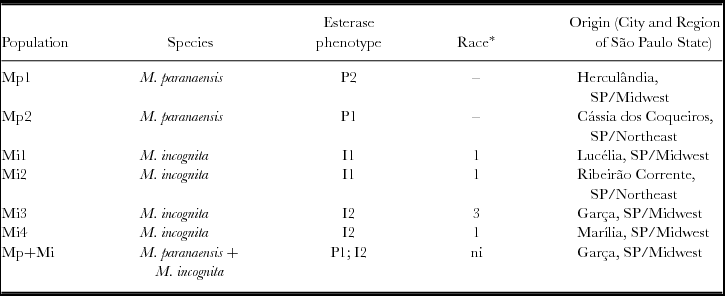
Coffea canephora plants were evaluated against two populations of M. paranaensis, four populations of M. incognita, and a mixed population of these two species (Table 1). Nematode populations were collected from coffee plantations of different Regions of São Paulo State. The population Mp1 of M. paranaensis was collected from the trial where mother plants were selected.
Description of Meloidogyne paranaensis and M. incognita populations.

* Physiological races of M. incognita. ni – race of M. incognita not identified.
The identification of M. paranaensis and M. incognita populations was performed through biochemical analysis of esterase patterns according to Carneiro and Almeida (Reference Carneiro and Almeida2001) and molecular markers SCAR-PCR (Randig et al., Reference Randig, Bongiovani, Carneiro and Castagnone-Sereno2002). Physiological races of M. incognita were characterized according to the North Carolina differential host-range test (Hartman and Sasser, Reference Hartman, Sasser, Barker and Carter1985). Nematodes were multiplied in pots containing susceptible C. arabica cultivar Mundo Novo IAC 515–20, to ensure the infectivity of nematodes in coffee, and susceptible tomato cultivar Santa Cruz, that allow higher multiplication rates. Inoculum was a mixture of J2 and eggs from coffee and tomato extracted following Bonetti and Ferraz (Reference Bonetti and Ferraz1981) method. Coffee plants of 18 months of age, about 50 cm in height, were inoculated with approximately 25 000 eggs+J2 by the deposition of nematode suspension in holes made in the substrate around the plants. Plants were cultivated in a greenhouse without control of temperature and watered and fertilized as needed.
The reaction of clones to the seven nematode populations was evaluated in seven separate experiments. The experimental design for all experiments was completely randomized with four replicates per treatment and single-plant plots. Non-inoculated plants of C. canephora clones and susceptible control were also evaluated in order to compare their vegetative growth with plants subjected to nematodes parasitism.
Evaluation and data analysis
The number of eggs+J2 per gram of roots (NEg−1) was evaluated at 9 and 18 months after inoculation (MAI). At 9 MAI, root samples were collected randomly from root systems of inoculated plants with a soil auger and 5 g were separated for analyses. At 18 MAI, the entire root system was assessed. Nematodes were extracted through the method previously described to prepare the inoculum. Data of NEg−1 were log transformed (log10 (x+1)), subjected to analysis of variance (ANOVA) and the means were compared by Scott–Knott's test (p < 0.05).
Since M. paranaensis and M. incognita do not cause the formation of typical galls in coffee, the damage on root system was evaluated at 18 MAI through the damage index (DI), according to Bertrand et al. (Reference Bertrand, Peña Durán, Anzueto, Cilas, Etienne, Anthony and Eskes2000). DI is scored on a 0 to 5 point scale, where 0 = totally intact roots systems without egg masses; 1 = healthy roots without necrosis and existence of a few egg masses; 2 = secondary roots showing necrosis (< 25%) and presence of few egg masses; 3 = egg masses and early necrosis in 25–50% of roots; 4 = egg masses and loss of secondary roots due to necrosis observed in 51–75% of the root system; and 5 = severe loss of secondary roots greater than 75% and necrosis in taproots. Plants were considered resistant when DI ≤ 2, and susceptible when DI > 2.
The vegetative growth of inoculated and non-inoculated plants was evaluated measuring of shoot dry mass at 9 MAI (SDM9), when plants were pruned at 50 cm of height, and shoot dry mass (SDM18) and root fresh mass (RFM18) at 18 MAI, correspondent to plants regrowth after pruning.
Pruning was performed in order to simulate a management practice in renewal of coffee plantations, and because reduction of root systems and photosynthetic area of the plants may affect regrowth under high nematode densities.
Data analysis of variables related to vegetative growth was performed for each genotype, comparing plants non-inoculated and inoculated with the seven Meloidogyne populations. ANOVA was performed considering the completely randomized design with eight treatments. Means were compared by Scott–Knott's test (p < 0.05).
Gall index bioassay in tomato plants
The potential of clones in reducing nematode population in the soil was assessed by a bioassay using susceptible tomato plants grown in the same pots of coffee plants inoculated with the seven populations of Meloidogyne. The tomato plants were planted 12 MAI of coffee plants, and evaluated 60 days after according to a gall/egg masses index (GI) (Taylor and Sasser, Reference Taylor and Sasser1978).
RESULTS
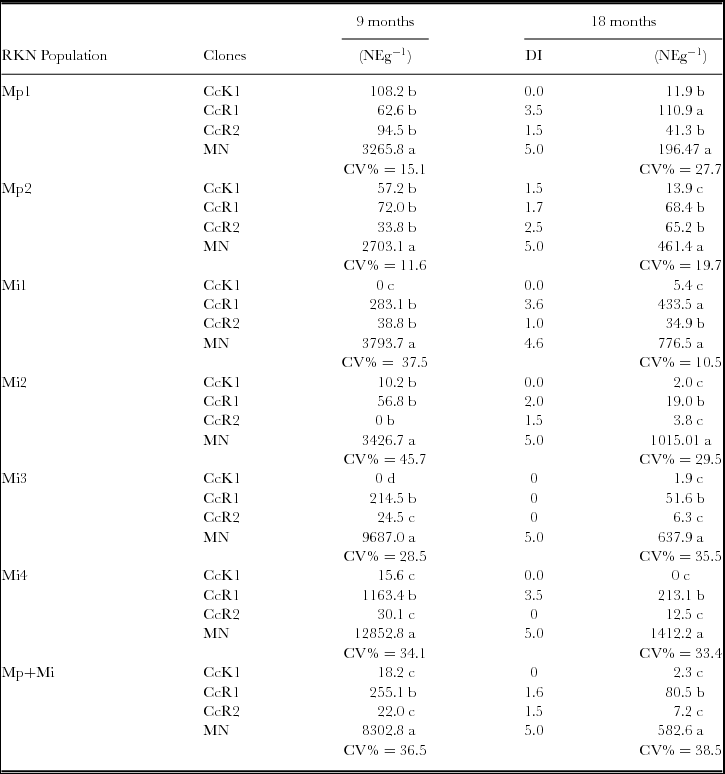
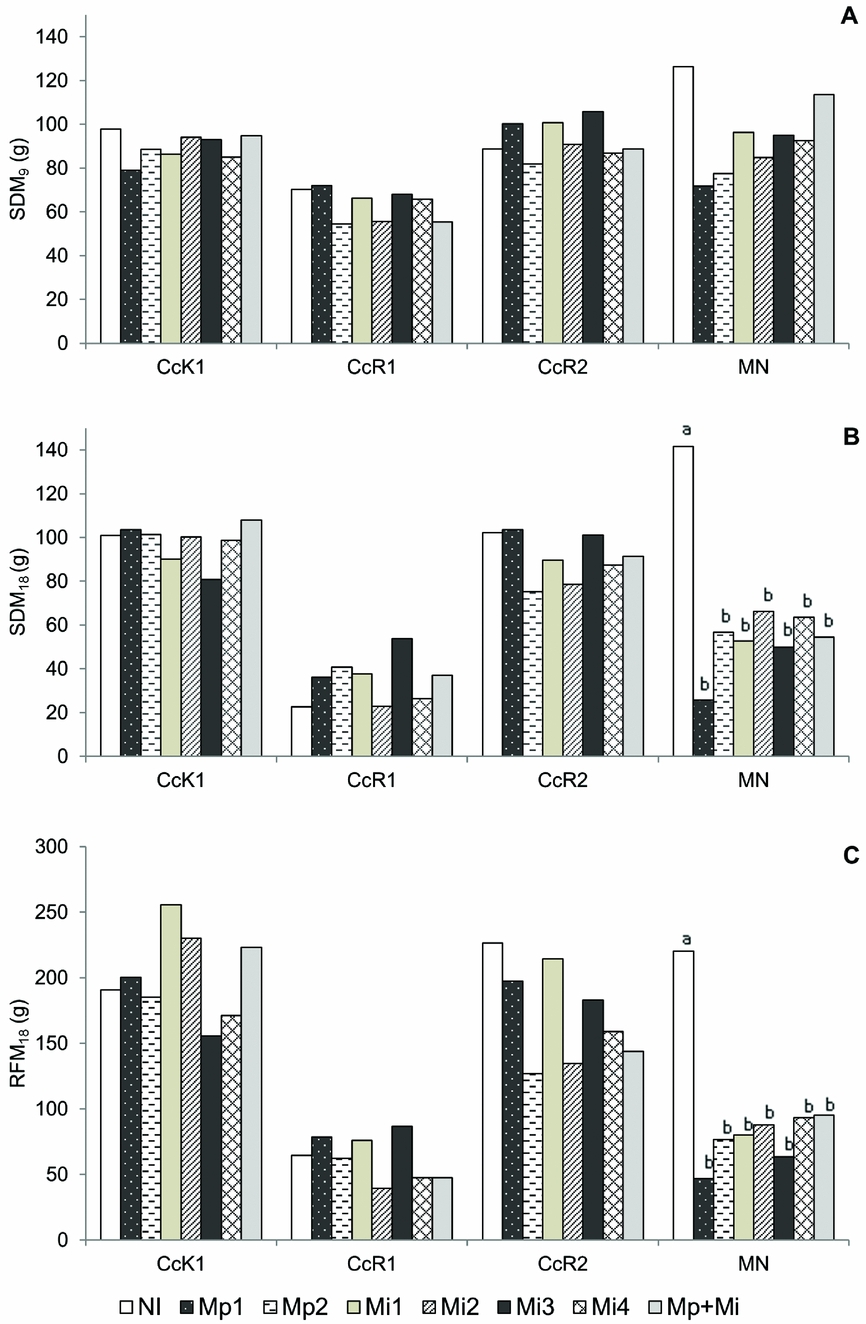
Cultivar Mundo Novo IAC 515–20 showed the highest means of NEg−1 at 9 MAI for all nematode populations, confirming its status as a susceptible control, as well as the viability of inoculum (Table 2). Susceptibility of cultivar Mundo Novo was also illustrated by reduction of SDM18 of plants inoculated with the seven nematode populations (Figure 1b), probably due to the influence of high nematode population densities on plants regrowth after pruning (p < 0.01). In addition, the root system was severely damaged, as demonstrated by maximum scores of DI (Table 2) and low RFM18 (Figure 1c). The NEg−1 was low in Mundo Novo at 18 MAI, especially for M. paranaensis populations, but statistically higher than CcK1 and CcR2 for all populations, and CcR1 for all populations except Mp1 and Mi1.
Reaction of Coffea canephora clones CcK1, CcR1 and CcR2 and susceptible control Mundo Novo IAC 515–20 (MN) to Meloidogyne paranaensis (Mp1 and Mp2), M. incognita (Mi1, Mi2, Mi3 and Mi4) and a mixed population of M. paranaensis and M. incognita (Mp+Mi) according to the variables number of eggs+J2 per gram of roots (NEg−1) at 9 and 18 months after inoculation and damage index (DI) at 18 months after inoculation.

Means within a column followed by the same letter are not significantly different according to Scott–Knott's test (p < 0.05). Log10(x+1) transformed data was used for analysis of number of eggs+J2 per gram of root.
Vegetative growth of Coffea canephora clones Cck1, CcR1 and CcR2 and susceptible control cultivar Mundo Novo IAC 515–20 (MN) of C. arabica. (a) Shoot dry mass at 9 months after inoculation (SDM9); (b) shoot dry mass (SDM18) and (c) root fresh mass (RFM18) at 18 months after inoculation with Meloidogyne paranaensis (Mp1 and Mp2), M. incognita (Mi1, Mi2, Mi3 and Mi4) and a mixed population of M. paranaensis and M. incognita (Mp+Mi). White bar is non-inoculated treatments. Lowercase letters indicate significant differences between non-inoculated and inoculated plants of susceptible control Mundo Novo IAC 515–20 to variables SDM18 and RFM18. Clones of C. canephora did not show differences in vegetative development according to the tree variables evaluated. Means of SDM9, SDM18 and RFM18 were compared by Scott–Knott's test (p < 0.05).

Clones CcK1 and CcR2 showed reduction of all nematode populations with reduced means of NEg−1 at 9 MAI (Table 2). Maintenance of low reproduction of populations was suggested by reduced NEg−1 and DI at 18 MAI, which indicates almost no damage in root systems. Vegetative growth of these clones was not impaired by nematodes at 9 and 18 MAI (Figure 1a and b, respectively), once there were no statistical differences between inoculated and non-inoculated plants.
Unlike CcK1 and CcR2, the reaction of CcR1 was variable when inoculated with different nematode populations. In general, the mean values of NEg−1 for CcR1 at 9 MAI were higher when inoculated with populations of M. incognita, especially Mi4, but still lower than susceptible control (Table 2). Similar response was observed at 18 MAI, when the highest NEg−1 and DI were observed in plants inoculated with Mp1, Mi1 and Mi4.
The vegetative growth of CcR1 was slightly lower than CcK1 and CcR2 at 9 MAI, but severe reduction of SDM18 and RFM18 was observed after pruning, also for the non-inoculated plants (Figure 1b, c). Hence, it was not possible to evaluate the influence of nematodes on plant growth.
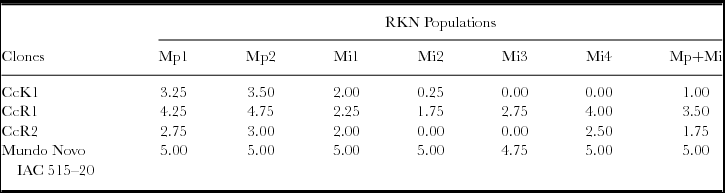
Tomato plants cultivated in pots of MN clones inoculated with M. incognita and M. paranaensis populations showed the maximum value of GI (Table 3). Populations of M. incognita and the mixed population of Mp+Mi were reduced in tomato plants cultivated in pots of CcK1 and CcR2. Tomato plants grown in pots of these clones inoculated with M. paranaensis populations had average GI of 2.8–3.5, lower scores considering that tomato is a good host for this nematode species. Tomato plants grown in pots of clone CcR1 had lower GI when inoculated with Mi1, Mi2 and Mi3 (Table 3).
Gall index evaluated in tomato plants cultivated in pots of Coffea canephora clones CcK1, CcR1 and CcR2 and in pots of susceptible control cultivar Mundo Novo IAC 515–20 of C. arabica inoculated with Meloidogyne paranaensis (Mp1 and Mp2), M. incognita (Mi1, Mi2, Mi3 and Mi4) and a mixed population of M. paranaensis and M. incognita (Mp+Mi).

Gall and/or egg masses index according Taylor and Sasser (Reference Taylor and Sasser1978).
DISCUSSION
The three C. canephora clones were considered highly resistant to M. paranaensis and to M. incognita, once nematode reproduction at 9 MAI was less than 10% of the susceptible control (Hussey and Jansen, Reference Hussey, Janssen, Starr, Cook and Bridge2002). These clones were previously characterized as resistant to M. exigua (data not shown), similar to what was observed with coffee trees of the Kouilou and Robusta germplasms (Bertrand et al., Reference Bertrand, Peña Durán, Anzueto, Cilas, Etienne, Anthony and Eskes2000, Fazuoli and Lordello, Reference Fazuoli and Lordello1978; Lima et al., Reference Lima, Furlanetto, Nicole, Gomes, Almeida, Jorge-Junior, Correa, Salgado, Ferrão and Carneiro2015). As breeding and pyramiding of resistance genes is a laborious and time consuming process, these plants, selected from the natural genetic variability present in C. canephora, may be important sources of resistance for developing multi-resistant cultivars.
Clones CcK1 and CcR2 were the most promising in relation to reduction of nematode population at 9 MAI, and maintenance of low number at 18 MAI. The vegetative growth of both clones was unaffected by different Meloidogyne populations. The low nematode density in root systems suggests that the maintenance of vigour of mother plants in infested fields is associated with a resistance response. Conclusions cannot be drawn about CcR1 reaction. According to the variables related to nematodes reproduction, this clone was classified as resistant to M. incognita and M. paranaensis, but the pruning affected negatively both inoculated and non-inoculated plants.
Few works evaluated multiple resistance to RKN in C. canephora germplasm (Bertrand et al., Reference Bertrand, Peña Durán, Anzueto, Cilas, Etienne, Anthony and Eskes2000; Lima et al., Reference Lima, Furlanetto, Nicole, Gomes, Almeida, Jorge-Junior, Correa, Salgado, Ferrão and Carneiro2015). According to our results the CcR2 and CcK1 genotypes, both resistant to M. paranaensis, M. incognita and M. exigua, could be immediately used in crosses to obtain hybrids with high frequency of multiple resistant plants to be used like rootstock for susceptible Arabica cultivars or to the Robusta green coffee production. For both purpose, several traits need to be taken into consideration besides RKN resistance, like simultaneous flowering and genetic compatibility in crossing between clones, that are essential to yield. CcK1 and CcR2 exhibited flowering at the same time and previous observations showed that they are cross-compatible, being the fruit set next to 50% in the CcK1 x CcR2 or CcR2 x CcK1 crosses (unpublished data).
As coffee is a perennial crop, remaining in the field for several years while subjected to nematode parasitism (Campos and Silva, Reference Campos, Silva and Souza2008), in this work we accomplished a late evaluation at 18 MAI, period sufficient to observe the nematodes damage potential on susceptible plants and the maintenance of normal vegetative growth of resistant clones. In these conditions, DI proved to be effective to select resistant plants, because susceptible control shows pronounced destruction of root system while resistant clones CcK1 and CcR2 remained intact.
In this work, we evaluated plant responses to two populations of M. paranaensis, two populations of M. incognita and a mixed population of these species. We believe these populations were distinct because they present different aggressiveness in field conditions and came from distinct edaphoclimatic coffee growing areas of São Paulo State. Mp1 and Mi1 were collected in Alta Paulista Region, a warm and dry area of São Paulo, with predominantly sandy soils; while Mp2 and Mi2 were collected in the Mogiana Region, a higher altitude area more humid than Alta Paulista and with clayey soils. Besides low genetic variability, some populations present higher aggressiveness to susceptible coffee genotypes (Santos et al., 2018).
Further work is required to understand the genetic basis of resistance to M. incognita and M. paranaensis and determine if resistance is due to the same or to different genes. This information would underpin the development of resistant rootstocks and ungrafted cultivars of C. canephora, as well the introgression of resistance genes in C. arabica cultivars.
Acknowledgements
The authors are grateful to the Consórcio Pesquisa Café (WG 002.06.10.014.00.03); National Council for Scientific and Technological Development (CNPq) for a research fellowship (OGF CNPq DT 308.634/2016-0); São Paulo Research Foundation (FAPESP) for a scholarship (BJRF FAPESP 2010/15416-0); Coordination for the Improvement of Higher Education Personnel for a scholarship (VTA) and Dr. Abertus B. Eskes for helpful comments and suggestions.