Introduction
Determining and taking into account the environmental impacts caused by small and medium enterprises (SMEs) is a major challenge. The traditional environmental assessment used when implementing an eco-innovation process is long and arduous, and furthermore, does not provide designers with direct solutions. In addition, SME employees responsible for innovation face a dearth of data, and even where data are available, it is most often hard to collect, and ultimately, the time needed to evaluate it is very long (Cherifi et al., Reference Cherifi, Gardoni and Dubois2015).
Designers are also confronted with constraints such as the choice of eco-innovation tools to adapt to the context of the company, the interconnection of these tools with those usually used in the design process, and the acquisition of skills in order to be able to use the tool adapted at the right time (Tatiana, Reference Tatiana2007).
For all these reasons, companies quickly become paralyzed when faced with the need to use eco-design tools (Rennings, Reference Rennings2000). With this reality in mind, we propose a methodological framework dedicated to designers with no eco-innovation tools expertise.
Starting from a methodological problem solving approach based on TRIZ (Teorija Reshenija Izobretateliskih Zadatch) (Altshuller, Reference Altshuller and Williams1984), and associated with the use of knowledge already available within SMEs, we propose a framework that may enable these entities to develop eco-innovation practices. The Ecatriz (ecological approach TRIZ) tool proposed is user-friendly, and can be used by non-experts in eco-innovation.
In the first, we present the background and the need of eco-innovation in SMEs.
The need for eco-innovation in SMEs: challenges and problems
SMEs must consider innovation constraints both in their strategic and functional practices. These entities are characterized by specific aspects that make them vulnerable, due to their market, their context, their environment, their customers and their competitors. Most often, they follow intuitive strategies proposed by the founding manager. However ideally, climate and conditions conducive to successful innovation should be promoted. The key factors that generally determine the success of innovation projects include:
(a) the contractor's capabilities and their involvement;
(b) the presence of adequate human and financial resources;
(c) the control of tacit and explicit knowledge needed to create new knowledge that must materialize innovation
Eco-innovation allows environmental constraints (e.g., limiting the emission of CO2 or other products, prioritizing the use of recycled materials, etc.) to be taken into account, which enables a connection with the objectives that promote sustainable development. The applied dimension of eco-innovation goes hand in hand with the product or service life cycle analysis model. Eco-innovation solutions must therefore integrate environmental compliance parameters, as stipulated by the ISO 14062 standard, based on the development and support optimization of the eco-efficiency ratio.
State of the art
Eco-innovation calls upon a set of strategy and perception approaches with prevention and thinking in terms of life cycle, as the focus of eco-innovation (Falk and Ryan, Reference Falk and Ryan2001).
It is therefore a response to the current practice of eco-design, which allows only one approach to reducing environmental impacts and optimizing current economic practices, whereas sustainable development requires more radical changes in products and services (Tyl, Reference Tyl2011). Eco-innovation therefore proposes a vision comprising a new environmental approach and business strategy.
Moreover, from an economic perspective, eco-innovation facilitates many opportunities, such as a new goal or benefit secured thanks to a new vision to open new markets for desirable goods (Baroulaki and Veshagh, Reference Baroulaki and Veshagh2007).
It is therefore important to have a twofold understanding of the term ‘eco-innovation’ (Tyl, Reference Tyl2011):
• The first one, through a horizontal reading, allows us to see the variety of definitions which have evolved in a recent past (Klemmer et al., Reference Klemmer, Lehr and Lobbe1999).
• The second one, through a vertical reading, allows us to put eco-innovation in its appropriate context (Matthieu, Reference Matthieu2008).
The two studies conducted by Carrillo-Hermosilla et al. (Reference Carrillo-Hermosilla, Del Río and Könnölä2010) and Matthieu (Reference Matthieu2008) provide a comprehensive view of both these perspectives.
Dangelico and Pontrandolfo (Reference Dangelico and Pontrandolfo2010) worked on eco-design tools that can help engineers in the ecological design of products. Other studies describe a new model to accelerate the preliminary design of an eco-innovative product incorporating the concepts of the TRIZ method (Cheng and Jahau, Reference Cheng and Jahau2011). Several examples of eco-design are given to illustrate the capabilities of such process in the work of Jahau Lewis and Chih Chen (Reference Jahau Lewis and Chih Chen2001).
Russo et al. (Reference Russo, Regazzoni and Montecchi2009) describe a way to use TRIZ concepts and tools to analyze, evaluate, and innovate a technical sustainability system that can be easily incorporated into design practice in daily life. Other studies compare the trends in the evolution of TRIZ with the eco-design strategies presented in the framework of the LiDS wheel (Lifecycle Design Strategies) to analyze its effects on environmental parameters (Chulvi and Vidal, Reference Chulvi and Vidal2009).
Some authors present a new forecasting model to acquire new ideas and to help design environmentally friendly products, while following new design assessments to see if it is more effective than those currently available (Houssin and Coulibaly, Reference Houssin and Coulibaly2010).
Based on the Mal'IN (Méthode d'aide à l'innovation) and Eco-Mal'IN methods, a new eco-innovation tool based on the matrix invention was developed by Kallel (Reference Kallel2010). Other authors have proposed the “Ecological Advanced Systematic Inventive Thinking” (Eco-Asit) tool for promoting the eco-ideation of sustainable systems (Tyl, Reference Tyl2011).
In spite of that Chechurin and Borgianni (Reference Chechurin and Borgianni2016) stated that actual scope of TRIZ goes well beyond technical problem solving, some other studies are already published applying TRIZ on ecologic problems. Since Russo et al. (Reference Russo, Rizzi and Montelisciani2014) presented a method based on a set of eco-design guidelines specifically conceived to support designers in developing new greener products. They proposed TRIZ Eco-guidelines to support ECO-innovation in SMEs. Over 300 TRIZ based eco-design guidelines (Russo et al., Reference Russo, Regazzoni and Montecchi2009) are selectively introduced to develop design variants with the aim of providing a lower global environmental impact (Russo et al., Reference Russo, Schöfer and Bersano2015). Vidal et al. (Reference Vidal, Salmeron, Mena and Chulvi2015) identified and prioritized TRIZ evolution trends that improve the environment.
The proposed innovative methodology helps designers to predict technological evolutions for more environmentally friendly products. TRIZ also used to improve the building environment (Wang et al., Reference Wang, Zhang and Zhang2015) where the enterprise environmental parameters are used to solve the management conflict matrix. Filippi and Barattin (Reference Filippi and Barattin2015) developed a new design method where systematic approach to innovation of TRIZ compensates for some lacks of the user centered interaction design process. Hede et al. (Reference Hede, Ferreira, Lopes and Rocha2015) proposed a conceptual multifaceted framework to address the issue of social sustainability in product development. They used evaluation technique is utilized for assigning numerical values to the pertinent sustainability related criteria of the multilayered decision model.
Diego et al. (Reference Diego A. de, ten Caten, Navas, Jung, Cruz-Machado and Lopes2016) proposed an integrated model focused on the systematic generation of eco-innovations in Lean PSS environments. The proposed model enables an analysis of the existence of a waste or contradictions in the system, that is, the existence of a problem. They proposed TRIZ tools to analyze, to model, and to solve the eco-innovation problems.
Ben Moussa et al. (Reference Ben Moussa, Rasovska, Dubois, De Guio and Benmoussa2017) showed how to evolve TRIZ to address green supply chain problems and the use of ARIZ to solve an operation management problem. Ben Moussa showed also the limits of using the classical TRIZ model for green supply chain problem solving. Also, Mansoor et al. (Reference Mansoor, Mariun and AbdulWahab2017) used TRIZ for innovating problem solving for sustainable green roofs recognized as worthy strategy for making buildings more environmental friendly and sustainable. Therefore, we developed and tested Ecatriz, based on TRIZ, to find a solution avoiding compromise when integrating environment constraints in innovative product design. This approach allows us to move from a matrix of engineering parameters (EP) to a reduced matrix with eco-efficiency parameters.
It will be used for decision support in the case of contradictory ecodesign situations. The methodology is given in the following section.
From the TRIZ matrix of EP to eco-efficiency parameters for innovation
The environmental impact evaluation results of each assessment must therefore be translated into design axes, for practical purposes. However, the proposed axes are generally inconsistent or contradictory; hence, a compromise solution must be sought. However, a problem solved by compromise in the context of the industrial reality often results in an insufficient long-term solution.
Initially, we built a matrix to determine the general environmental profile of the potential product from a series of questions related to its life cycle. The impact assessment is done at each stage of the product's life cycle.
The advantages of such a matrix are:
• Ease of use and ownership.
• Consideration of all environmental concerns (multi-criteria) throughout the (global) product life cycle.
• Does not require data figures since the assessment is qualitative.
• Introduction of new eco-efficiency factors, including consideration of the product from the user's point of view and the level of ownership of eco-design at the company level.
TRIZ is based on the similarity that may exist between an inventive problem and a solved similar problem in another context or field. The TRIZ matrix is a solution principles database that can overcome some contradictions.
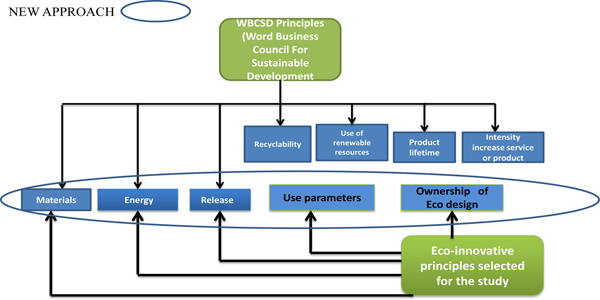
To apply TRIZ in the field of eco-innovation, we built a simpler eco-innovative matrix from 39 EP. These EP are classified and grouped under five types of eco-efficiency parameters selected from the World Business Council for Sustainable Development, considering materials, energy, and waste (liquid, gaseous, and solid).
We introduced two other new settings, which was the first time this had ever been done: parameters used by the designer or user of the final product in general (shape, stability, strength, etc.) and the degree of ownership of ecodesign (culture, the degree of involvement in eco-design within SMEs, etc.).
The importance of introducing the use parameters that needs to take care of, in addition to environmental factors, social needs of the user in the context of an eco-innovative approach.
The second criterion introduced for the first time, which is a priority in our opinion, is the degree of ownership of the designer of the company or service provider ecodesign.
In order to exploit the matrix of EP and adapt it to eco-innovation chosen parameters, it was necessary to combine EP by category eco-innovation parameters considered.
We considered the introduction of these two parameters important in the case of innovative design, for the first case, and for the appropriation of eco-design by the company's designer in the second case.
The eco-efficiency factors retained for this study are presented in Figure 1 (Cherifi et al., Reference Cherifi, M'Bassègue, Gardoni, Renaud and Houssin2017). These choices are justified by the fact that recyclability, renewable resource use, product lifetime, as increased product or service intensity can be incorporated into materials or discharges. Inventive principles were selected and grouped from the initial matrix according to their frequency of occurrence.
Choice of ecoefficiency parameters.

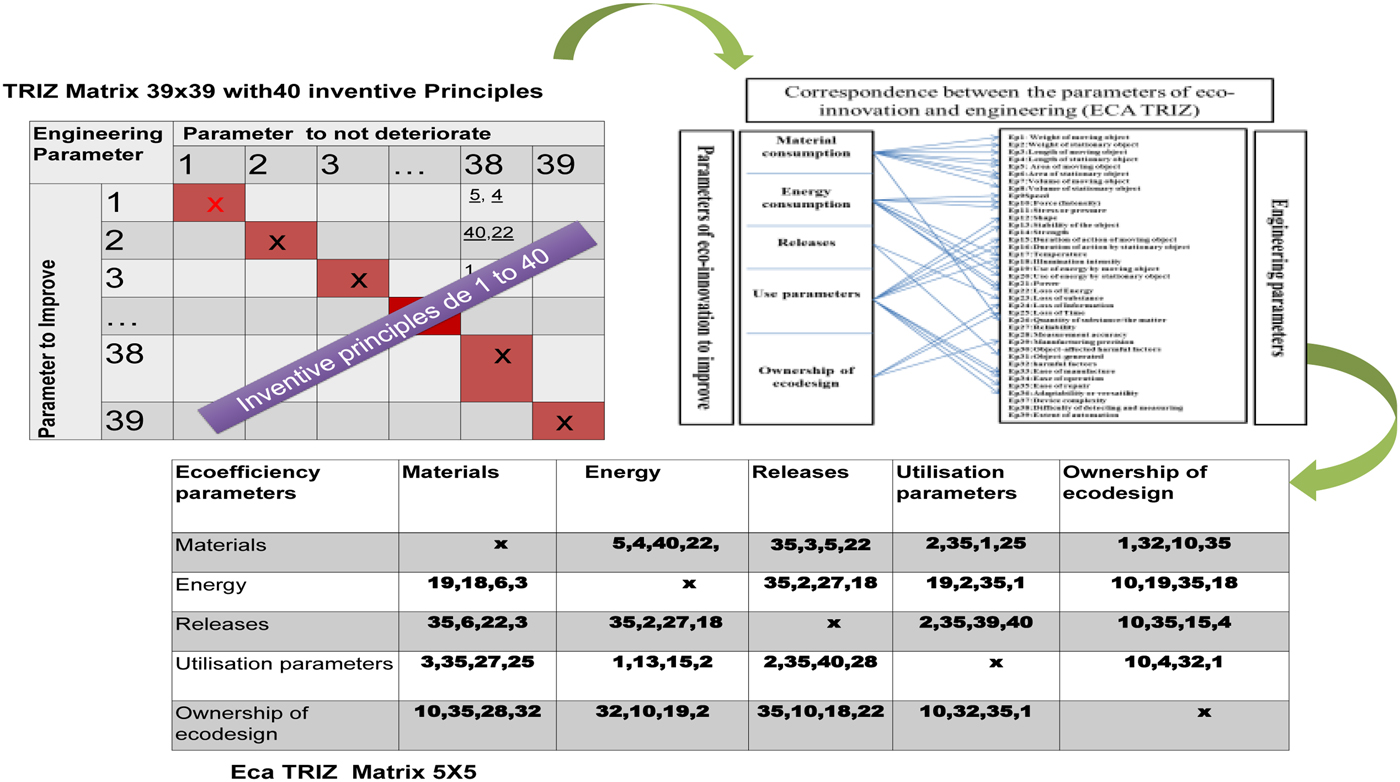
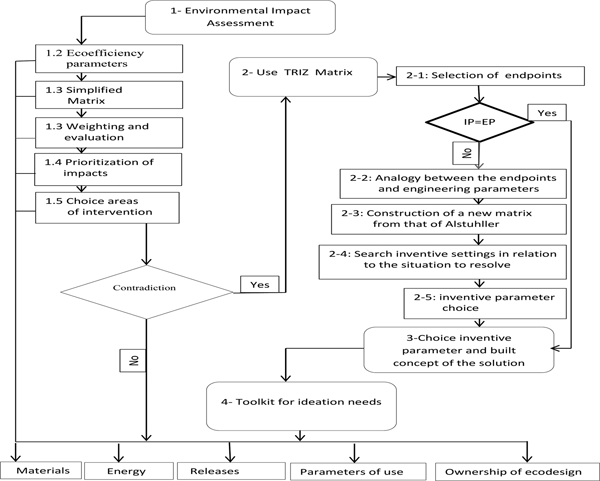
To maximize the probability of occurrence of each parameter in the eco-efficiency parameter, we established a maximum number of settings. We obtained a new matrix, 5 × 5, composed of eco-efficiency parameters, and an x- and a y-axis, with new inventive numbers. Figure 2 presents the TRIZ matrix to the new matrix called Ecatriz (ecological TRIZ). The overall methodological approach is given in Figure 3. A set of rules to improve a particular aspect in the life cycle must be given. This constitutes the core of a state-of-the-art exploration approach used to achieve eco-design products. In this approach, we could use technical troubleshooting tools that have proven themselves in other areas, such as the generation of new concepts that may be tested in eco-innovation.
The approach to obtaining the Ecatriz matrix.

Eco-innovating Ecatriz process.

The matrix is composed of the same EP (horizontal to be improved and vertical not to deteriorate). Each situation of pairs of contradictory parameters chosen will correspond to numbers of inventive principles (cross in the matrix) that may be possible solutions to the problem.
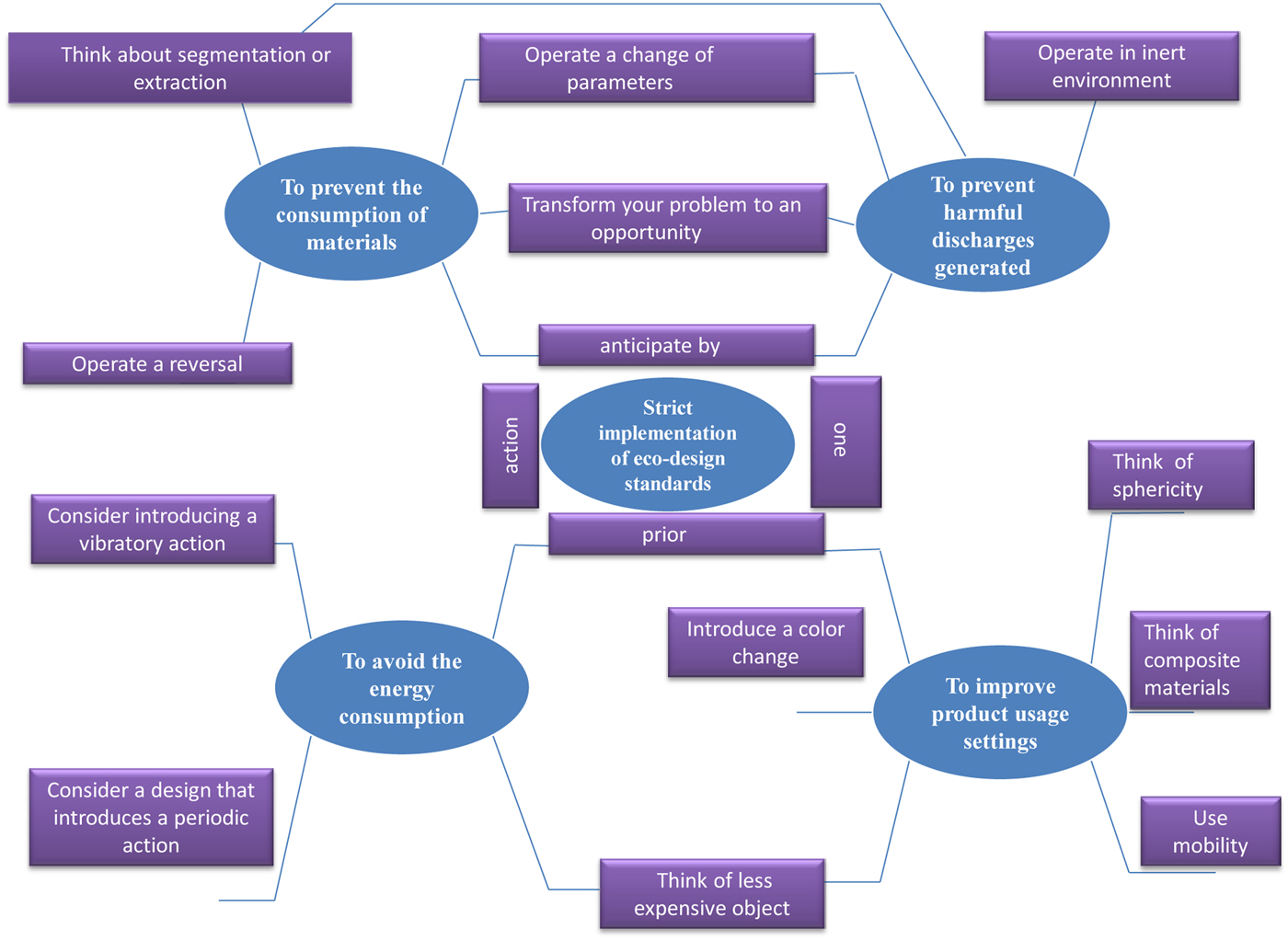
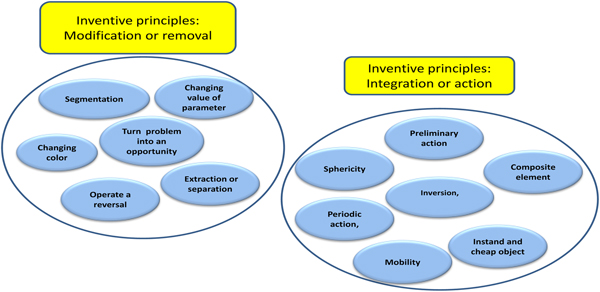
Thirteen principles motivated by the frequency of occurrence of these tracks of solution in the new matrix called levers for eco-innovation (segmentation, extraction, inversion, sphericity, periodic action, prior action, mobility, color change, vibratory action, composite material, and cheaper object) are chosen.
The designer will choose the best-suited of these selected inventive principles to solve the problem in accordance with the given situation (Fig. 4).
Summary of the main possible actions for eco-design innovation based on the Ecatriz method.

The levers or actions developed in Figure 4 allow the Ecatriz matrix to be more user-friendly for designers, who find the principles to solve it need in the rectangle. The matrix aims to improve the product development process or establish environmentally friendly procedures in an innovative approach and uncompromised solution. It can be applied to the launching of a new product or used to improve an existing one.
Looking more for creative ideas with Ecatriz
The inventive principles obtained, which are potential levers which assist the designer in the ideation phase, are divided into two categories, as shown in Figure 5. At this stage, we can choose strategies (deconstruction of the problem) that have been adapted to eco-innovation.
Categorization of the inventive principles obtained.

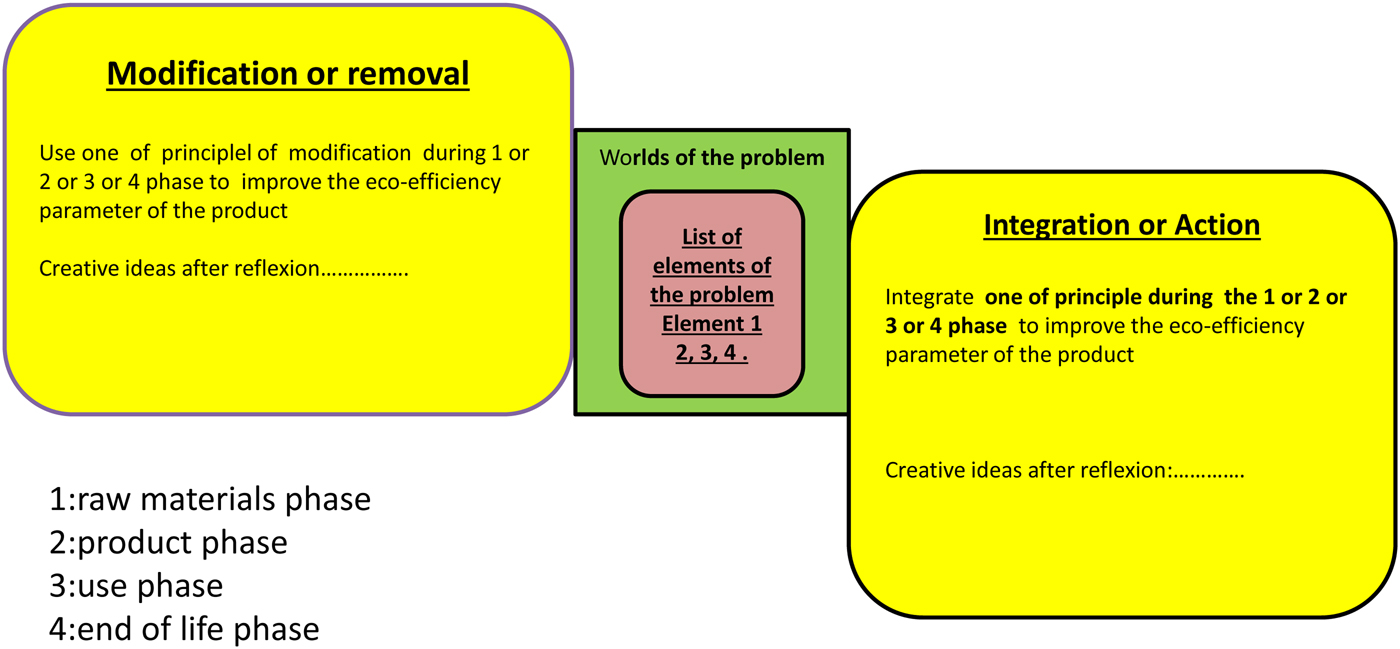
The idea generation phase consists in building stimulating sentences from four product phases (words of the problem):
1. raw materials
2. product phase
3. use phase
4. end of life phase
and two actions promoting life cycle thinking:
1. modification or removal (six inventive principles)
2. integration or action (seven inventive principles).
A summary of 52 sentence possibilities (6 × 4 + 7 × 4) is given in Figure 6. To generate creative ideas, the Ecatriz eco-innovation approach can be made operational and enriched by knowledge management elements developed in the following section.
Stimulating sentences from words of life cycle and tools composed by inventive principles.

Knowledge management elements to complete Ecatriz
Given the situation of SMEs (scarcity of resources, limited staff, etc.), designers can rely on the tacit and explicit knowledge the company possesses. This knowledge will help find new solutions to improve the analysis of the life cycle as well as the eco-efficiency ratio (Nagano et al., Reference Nagano, Vick and Moura Madrika2017). Eco-innovation initiatives should ideally be structured according to the knowledge creation model of Nonaka and Takeuchi (Reference Nonaka and Takeuchi1995), see Table 1.
Matrix of Nonaka and Takeuchi

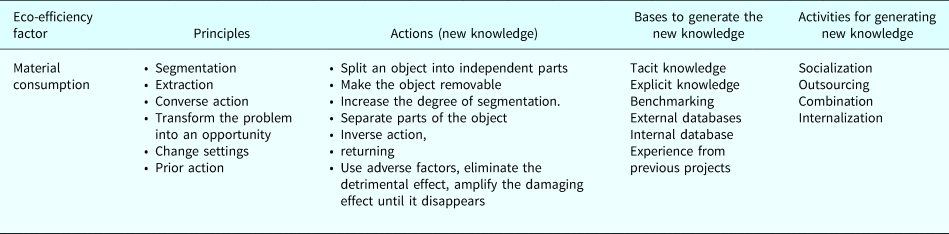
An example is given in Table 2 in the case of the consumption of materials. Through socialization characterized by situations of direct contact or observation, everyone can give an account of the tacit knowledge they possess (Dalmanco et al. Reference Dalmanco, Maehler, Trevisan and Schiavini2017). Similarly, outsourcing activities, based on explicit knowledge, allow encoding the eco-innovation solutions already used in other contexts of the project (Albers and Brewers, Reference Albers and Brewer2003); thus, inducting concrete solutions to reduce the consumption of resources and energy. Finally, internalization, characterized by the appropriation of explicit knowledge that is held individually contributes to the management of existing knowledge and to the production of new knowledge, which increasingly affects the eco-efficiency ratio.
Example of an application of the knowledge base

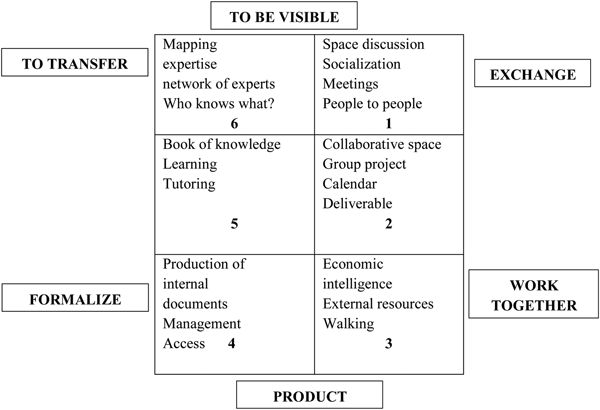
Nonaka's and Takeuchi's production-of-knowledge model (generic framework already associated in the methodological guide) – in operational terms – is necessary to integrate the functional rosette of communities of practice (Nonaka and Takeuchi, Reference Nonaka and Takeuchi1995). It characterizes all the knowledge management activities that contribute to the creation, sharing and dissemination, and valorization of knowledge needed to rationalize and optimize the eco-innovation process (Albers and Brewers, Reference Albers and Brewer2003; Nagano et al., Reference Nagano, Vick and Moura Madrika2017). Figure 7 shows how the community of practice proposed by the Prax (Reference Prax2003) model may be a useful aid in the proposed Ecatriz approach, especially in terms of solutions to be found regarding the specification of the problem to be solved, the choice of adequate materials, the identification of suitable energy solutions, etc.
All knowledge-management activities.

The combination above illustrates the application of basic knowledge to the eco-efficiency factor improvement process. It is very obvious that the knowledge base serves as much for the consumption of materials as for energy choice, or for the product settings as well, with all these elements being dimensions that are included in the eco-innovation model. These factors are well fed by an internal as well as external knowledge base (Albers and Brewers, Reference Albers and Brewer2003; Nagano et al., Reference Nagano, Vick and Moura Madrika2017). This combination therefore offers a more robust eco-innovation model because it is practical and based on knowledge available to and easily appropriated by non-experts.
Application of the Ecatriz method
Challenges of 24 h of innovation competition
We applied the Ecatriz method to assess the solutions proposed by the student teams to meet the challenges of the “24 h of innovation” competition. As part of the 24 h of innovation, a marathon during which students must answer problems created businesses, we established a simplified evaluation grid which helps participants conduct an ecological evaluation of a suggested design. The idea here is to take into account the environmental aspects of the product, employing a simple, easy-to-use tool, which can be applied rapidly, and does not rely on a database, thus making the application quantitative.
The other advantage that this tool presents is that it allows a multi-criterion analysis throughout the life cycle of the product.
This simple and rigorous application can be used by the designer.
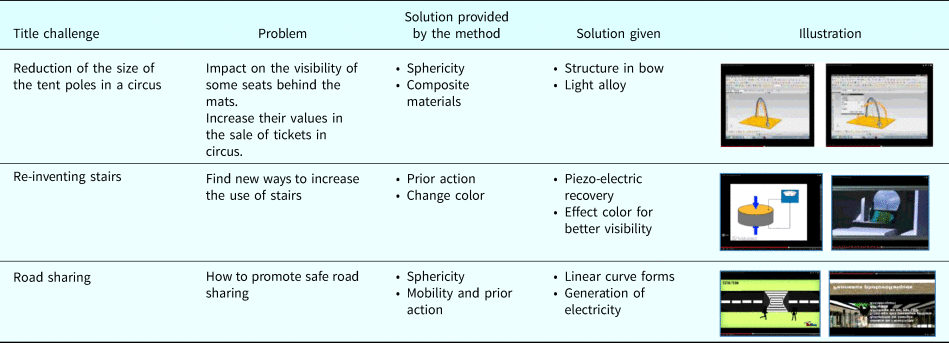
The best concept of solutions provided by participants generally agreed with all the Ecatriz principles. Table 3 provides an overview of the best eco-innovative solutions proposed to cope with some of the challenges.

Patents published in the area of eco-innovation
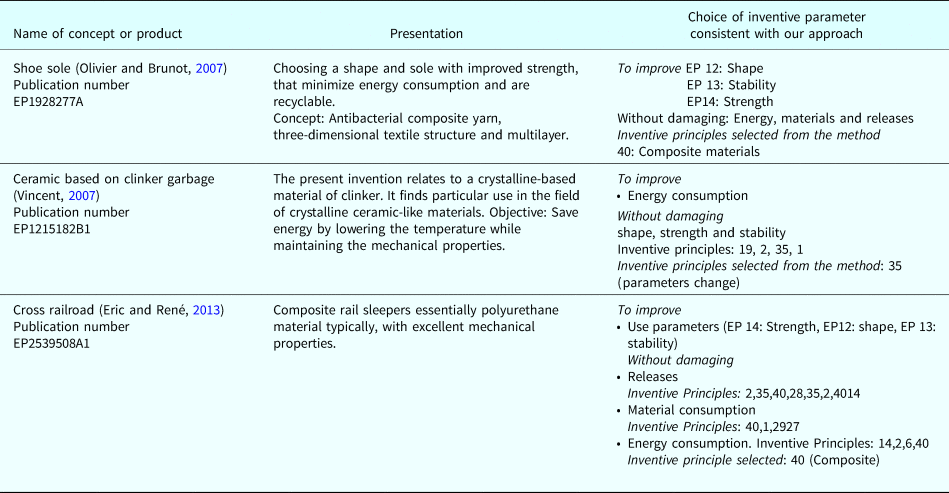
Another interesting application we considered was the use of Ecatriz to assess the published patents for products designed with the eco-innovative method (Table 4).
The methodological tool applied to examples of published patent

Conclusion
The idea of replacing the EP for the parameters of eco-efficiency is an approach justified by the existing of many contradictions of environmental factors and to adapt our approach to the situation.
Our main contribution is the creation of a simplified matrix which takes into account the life cycle of the product with a multi-criteria approach and the resolution of eco-contradictions using a suitable TRIZ principles selection. This leads us to obtain potential inventive principles (some of these principles may not be applied to all design configurations). However, the matrix may help the designer focus on helpful creative innovations.
The results obtained with the Ecatriz method were compared with the solutions given by students during the “24 h of innovation” competition as well as with the published patents relating to resolutions of environmental issues. This comparison showed that our methodological approach can be applied to different situations, with a high level of consistency regarding the proposed principles. Ecatriz could also be used as a referential kit to obtain environmental objectives without transfer of pollution. To sum up, the results obtained by the Ecatriz method will guide designers along potential eco-innovative tracks.
Acknowledgments
We presented some of this work at the ICED conference held in August 2017 in Vancouver. Results from a PhD thesis completed in 2015 enriched this article. The participation of all co-authors is noteworthy, I thank them for their valuable contribution.
Ahmed Cherifi, Lecturer, Research Associate and Post-Doc Student at École de technologie supérieure in Montreal. Holds an engineering degree in Process Engineering, a Master's degree in Engineering and a PhD in Engineering option applied research in the field of eco innovation.
Patrick M’Bassègue, Lecturer, National Polytechnic School, Montreal.
Mickael Gardoni, Professor at the École de technologie supérieure. Engineering degree (Metz, France), D.E.A. (INPL,Nancy), PhD (Metz, France). Research laboratory on the engineering of organizations in a digital enterprise context.
Rémy Houssin, MCF-HDR Teacher-Researcher at Strasbourg University Studies / research, Current position: INSA Strasbourg, University Previous posts: ENSAM of METZ, CRAN. Training: CRAN Nancy.
Jean Renaud, I.Cube Laboratory, UMR 7357, Strasbourg, FRANCE. Associate Professor in the Department of Automated Production Engineering, ETS, Montreal, Canada.