

INTRODUCTION
Ninth-century England witnessed the reintroduction of the potters’ wheel, a form of technology that had been absent from Britain for c 500 years, since the collapse of Roman rule. The first centres to use this reintroduced technology were located in eastern England, in an area controlled by Scandinavian elites – the Danelaw. After reintroduction, the technology spread, so that by the late eleventh century there were approximately thirty potteries producing wheel-thrown, kiln-fired wares.Footnote 1 Research into this technological revolution has focused on dating and chronology,Footnote 2 and whether the wheel appeared before or at the time of the Scandinavian settlement of England.Footnote 3 Yet, little attention has been paid to the mechanisms that allowed the wheel to spread once it had arrived. This gap in knowledge provides a major obstacle to our understanding of the period’s economy and development of new identities in the wake of Scandinavian settlement.Footnote 4 By examining the relationship between one of the earliest industries to use this technology – in Torksey, Lincolnshire – and one that was founded a century later – in Newark, Nottinghamshire – this paper sheds important light upon the systems and processes that enabled this technology to spread and flourish.
It is now recognised that the wheel was introduced by immigrant potters from the Continent in the latter decades of the ninth century and that their passage to England is likely to have been provided by Scandinavian groups that settled here in this period.Footnote 5 As the wheel spread, a series of ‘regional traditions’ developed whereby potteries operating in close proximity to one another shared particular production practices – for instance, in the use of specific clay-types or firing according to particular regimes.Footnote 6 This phenomenon, Alan Vince suggested, arose out of a process of acculturation and direct movement of potters – important insight into the means by which this technology was disseminated.Footnote 7 Why potters might choose to relocate or adopt the production techniques used by their neighbours, however, has not hitherto been considered.
The idea that production practice could shed light upon the mechanisms that enabled the wheel to spread through eastern England was advanced in the author’s recent analysis of so-called Torksey ware.Footnote 8 Here it was argued that in order to comprehend this technological revolution, one must focus upon the less visible aspects of production – the choices made by potters at each stage in the manufacturing process, for example, clay selection, forming operations and firing regime – and that these choices must be considered in context of the social, political and economic climate in which they were made. Such an approach allows us to explore how individual industries relate to one another, providing insight into the organisation of production, transfer of knowledge between potters, development of regional traditions and how new techniques were absorbed into existing repertoires.Footnote 9 Accordingly, a range of analytical techniques were employed to reconstruct the production sequence followed by potters working in Torksey, allowing their production sequence to be compared with that followed by potters working at other potteries. This revealed that changes to the way in which pottery was made and fired in tenth-century Lincoln were in response to large amounts of Torksey ware entering the town, and an attempt by Lincoln’s potters to imitate this extremely successful productFootnote 10 – a clear demonstration of the acculturation proposed by Vince.
This paper examines Vince’s other means of dissemination: the direct movement of potters. It focuses on the pottery industry in Newark – the pottery from this area is so similar to that produced at Torksey, it has been suggested that this industry was founded by a relocated Torksey potter.Footnote 11 This similarity will be explored by examining the context of pottery production in Newark and analysing its pottery by thin section petrology, scanning electron microscopy (SEM) and geological sampling to determine fabrics and provide insight into the Newark potter’s production sequence, allowing it to be compared with that followed in Torksey, which has been published elsewhere.Footnote 12 Drawing on evidence from archaeological excavation, numismatics, historical documents and patterns of pottery distribution, the foundation of the Newark pottery industry is placed in the context of the birth and development of late Saxon Newark, shedding light upon the mechanisms that enabled the potters’ wheel to spread throughout eastern England.
NEWARK: CONTEXT AND PRODUCTS
Background
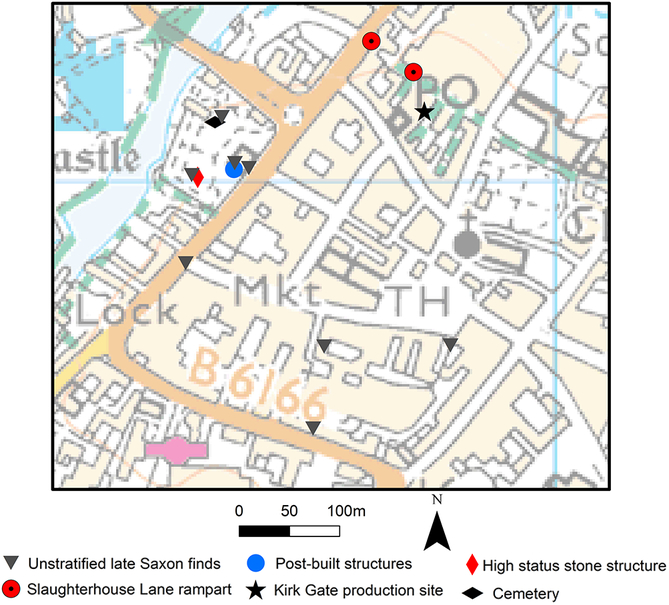
Newark and Torksey lie 23km apart on the banks of the River Trent (fig 1). Like other late Saxon pottery industries located in the Trent Valley, both centres produced pottery with grey-black surfaces, in a sandy fabric, fired according to a two-stage regime – oxidation followed by reduction.Footnote 13 Production began in Torksey c 870 s and continued until the late eleventh century. Torksey was an extremely successful industry, trading its wares widely and providing Anglo-Scandinavian York with much of its pottery. To date, nine definite kilns have been uncovered in the village, in addition to a further six potential production sites whose levels of preservation preclude their positive identification as kilns.Footnote 14 Newark’s industry was founded a century after Torksey’s, in the late tenth century. It was considerably smaller than Torksey’s, with the remains of just a single production site being identified during the course of a watching brief on Kirk Gate in the town centre (fig 2). The similarity between this pottery and that which was produced at Torksey has led ceramicists to term it a Torksey-type ware, thus pottery produced in Newark is hereafter referred to as Newark Torksey-type ware (or NT-ware). Little remains of the excavation archive, and information about this intervention has been obtained from draft reports produced by Trent and Peak Archaeological Trust.Footnote 15
Places mentioned in the text. Drawing: the author.

Location of the Newark Kirk Gate production site and other late Saxon activity on the town. Map image: © Crown Copyright and Database Right [2018] Ordnance Survey (Digimap Licence).

The Kirk Gate kiln yard
The kiln yard seems to have been bounded by a gullied enclosure, within which lay a shallow depression, cut into the natural sand. This feature, c 0.1m deep, roughly oval in shape, c 2m long and c 1m wide, comprised ‘clean’, ‘heat affected sand’ (1005), which was ‘dark red-brown’ in colour, merging to black at its centre; it did not contain charcoal or pottery.Footnote 16 Charcoal and 370 sherds of pottery were recovered from ‘two small areas of ashy sand’ (1004) that partly overlaid (1005). According to the excavation report, the larger of the two areas was located to the east of (1005) (fig 3), however plans in the site archive show it to the north. These deposits were interpreted as the remains of a kiln, with the ‘heat affected sand’ representing the area under the firing chamber and the eastern deposit of ashy sand as the stoke hole. Both (1004) and (1005) were sealed below layers of gravel (1003, not shown) and silty loam (1002, not shown) (see fig 3).Footnote 17
Plan of the Kirk Gate production site. Drawing: the author (adapted from plans in Trent and Peak Archaeology’s archive).

In the absence of evidence for an internal structure, the excavators concluded that the kiln had been a typical ‘Type 1a’ in John Musty’sFootnote 18 taxonomy of medieval kilns.Footnote 19 In these kilns, the pots were placed directly onto the firing chamber floor, on the same level as the stoke hole, with heat supplied through a single flue.Footnote 20 However, this interpretation is problematic. Other excavations of more complete Type 1a kilns elsewhere demonstrate that the firing chambers are typically clay-lined and/or their fills, along with those of their stoke holes and flues, contain substantial amounts of fired-clay superstructure (for example, Torksey (kiln 2), Lincolnshire;Footnote 21 Cassington, Oxfordshire;Footnote 22 Ipswich, Suffolk;Footnote 23 Grimston, Norfolk;Footnote 24 and Michelmersh, Hampshire).Footnote 25 No evidence of a kiln superstructure was found at Newark, either in the fills of the feature or in surrounding and overlaying deposits. Therefore, it seems more likely that this feature represents a shallow pit in which potters disposed of waster pottery, refuse (sherds of Stamford ware were also found in 1004) and embers raked from the stoke hole of a nearby kiln, rather than the kiln itself. Thus, the form of the Newark kiln remains unknown.
The pottery
A total of 495 post-Roman sherds were recovered from Kirk Gate, of which 471 are NT-ware. Of these, 370 sherds were excavated from the area of ashy sand interpreted as the stoke hole of the kiln (1004). Three near-complete NT-ware pots were reconstructed from this assemblage. Almost all vessels suffered from faults such as bloating, warping and fire-cracking, Footnote 26 which are all indicative of imperfect control of temperature during firing.Footnote 27 As such, these vessels must be regarded as wasters – vessels that failed during firing.
Forms
Small- to medium-sized jars, with rim diameters from 9cm to 16cm (mode 13cm) and sagging bases, account for c 75 per cent of the assemblage. Bowls, including a socketed bowl and one with a thumb-impressed rim, comprise c 13 per cent, with large jars and pitchers providing the remainder. Thumb impressions decorate the rims and bodies of large jars/pitchers, while the rims of small jars are plain-everted, and medium jars hollow-everted (fig 4).Footnote 28 The range of vessel forms, rim types and the types of decoration applied to them are directly paralleled in the assemblages from kilns 5 and 7 at Torksey.Footnote 29
Pottery from the Kirk Gate production site. Drawing: Jerneya Willmott.

Fabric
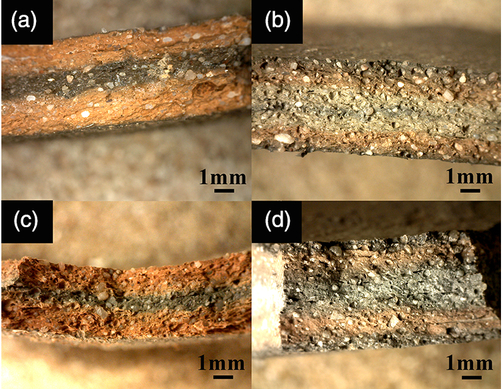
The fabric of NT-ware is very similar to Torksey ware.Footnote 30 It is characterised by relatively well sorted sub-rounded to sub-angular grains of sand, generally <1 mm in diameter (mode 0.25mm), in a grey/brown/black matrix, with orange to red-brown margins and grey-black surfaces, which give a ‘sandwich’ effect in the fracture (fig 5). When viewed at ×20 magnification, significant differences from Torksey ware emerge, which allow the two fabrics to be distinguished. For example, there is a dense scattering of silt-sized grains in the background of NT-ware, which is absent from Torksey ware,Footnote 31 while calcareous clasts are occasionally found in Torksey ware but are absent from NT-ware. Notably, petrographic analysis undertaken by Vince revealed that these distinctions were lost at higher magnification (but see section, ‘Results: petrographic analysis and microstructural analysis using SEM’.);Footnote 32 however, analysis using inductively coupled plasma mass spectrometry demonstrated that NT-ware was distinguishable chemically from Torksey ware.Footnote 33
The fabric Torksey ware (a) and (b) and Newark Torksey-type ware (c) and (d); note the similarity between the two. Photographs: the author 2015 (a) & (b) and 2016 (c) & (d).

Dating
No independent dating evidence was recovered from the waste deposit and therefore dating is based entirely upon the stylistic characteristics of NT-ware and associated non-kiln pottery. In this respect, the absence of roller-stamped (rouletted) decoration and the presence of thumb-impressed rims are key to dating. Rouletting was the most common form of decoration on pottery in the East Midlands from the late ninth to the late tenth century, while thumb impressions are common from the later tenth century.Footnote 34 For example, both the Lincoln Gritty ware and Lincoln kiln-type shelly ware industries employed roulette decoration and both had ceased production by c 1000,Footnote 35 while roulette decoration was not found on Saxo-Norman Lincoln Sandy ware, a type produced in Lincoln from the late tenth to late eleventh century.Footnote 36 At Torksey, rouletting was replaced by decorative thumbing in the later tenth century.Footnote 37 It is only at Stamford that rouletting continued into the twelfth century.Footnote 38 The stylistic evidence suggests that Newark’s industry ran from the late tenth to late eleventh century and this date is supported by pottery from contexts overlaying the waster deposit, which reveal that production had ended by the late eleventh/early twelfth century.Footnote 39
Summary
The forms, fabric and decoration of pottery produced at Newark are directly paralleled by pottery produced in Torksey from the late tenth to late eleventh century, particularly that from kilns 5 and 7, and it is these similarities that have led to the suggestion that this industry was founded by a relocated Torksey potter.Footnote 40 Although no kiln has been found in Newark, it is likely that this lay a few metres from the waste heap, within the bounds of the potter’s kiln yard. With a background to the Newark pottery and production site we can begin to investigate the less visible aspects of production, for example, clay choice and processing activities, firing regime, and forming and finishing procedures, and examine the similarities of the pottery production sequences between the two industries, thus allowing us to assess how likely it is that a potter did relocate from Torksey to set up the Newark industry.
MATERIALS, METHODS AND RESULTS
Materials and methods
A range of techniques were employed to investigate and reconstruct the Newark potter’s production sequence, including geological sampling, petrographic analysis and microstructural analysis using SEM.Footnote 41
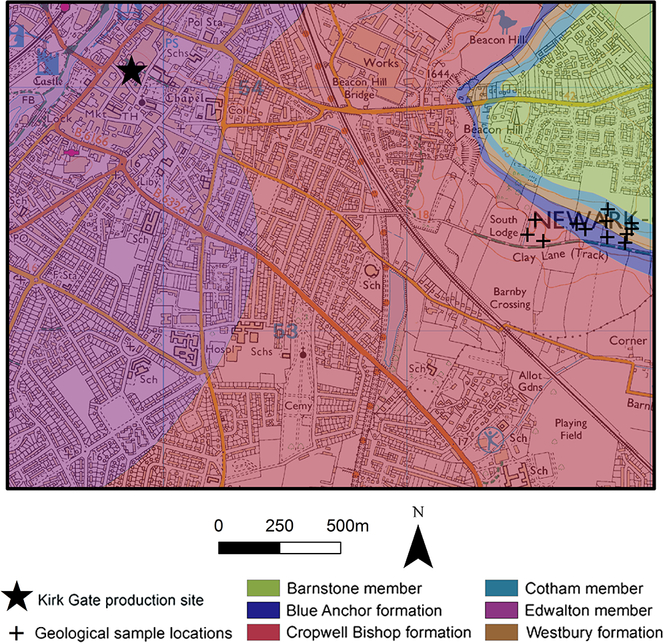
Results: geological sampling
Six clays crop out within 2km of the Kirk Gate production site: the Edwalton, Cropwell Bishop, Blue Anchor and Westbury Formations, and the Cotham and Barnstone Members. The Kirk Gate production site, and Newark itself, is situated on the Edwalton Formation. Being in an urban centre, it was not possible to sample this clay. Fortunately, the remaining five clays crop out on a slope c 1.5km east of the site (fig 6). These clays were sampled to assess their suitability for pottery production and to understand potters’ choices. Clays were formed into briquettes and dried at room temperature before firing in an electric kiln. Thin section and SEM analysis (see section, ‘Results: petrographic analysis and microstructural analysis using SEM’) revealed that NT-ware waster pottery was primarily fired in an oxidising atmosphere, with kilns achieving equivalent firing temperatures ≥800–850°C. In contrast, (non-waster) pottery that was fired successfully and traded was fired to temperatures ≤800–850°C. Thus, to enable comparison with both waster and successfully fired pottery, the clay was fired in an oxidising atmosphere at rate of 250°C/hr and held at 800°C for one hour.
Geology around Newark. Map image: © Crown Copyright and Database Right [2018] Ordnance Survey (Digimap Licence) and Geology Map Data © NERC 2018.

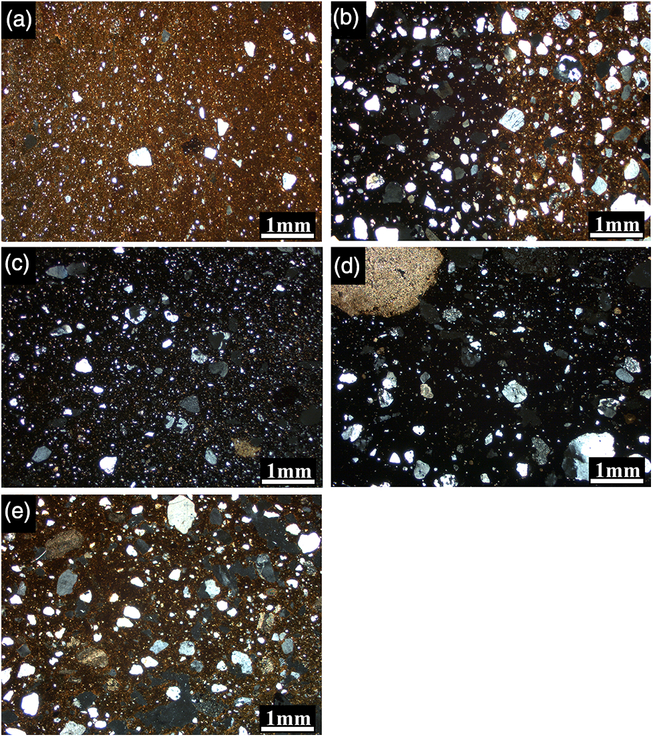
Each of the sampled clays has very different properties, with some more suitable for pottery production than others (table 1). Being devoid of inclusions, the Cropwell Bishop clay (fig 7) is likely to have required tempering – the addition of non-plastics – in order to provide support throughout forming and drying and to provide resistance to thermal shock during firing and use.Footnote 42 All other clays contained naturally occurring sand inclusions, derived from sands and gravels that surround Newark (see fig 7). The Westbury, Cotham and Barnstone clays all contained calcareous clasts and fine-grained calcite in their matrices. These inclusions caused the fired briquettes to lime spall – a problem associated with the thermal decomposition of calcium carbonate.Footnote 43 In some instances the spalling developed to such an extent that entire briquettes crumbled, and it was impossible to thin section them; clearly, these clays were not suitable for pottery production. The most suitable potting clay is that deriving from the Blue Anchor Formation. Intrinsic sand inclusions mean that it would not require tempering and, being non-calcareous, it would not suffer from the problems posed by the Westbury, Cotham or Barnstone clays. In its ‘as-dug’ form, it is a ready-made potting clay.
Properties of the clays that were available to Newark’s potters (see Howard et al 2009, 118–42; Waters 1992, 9–16)

Photomicrographs of geological samples: (a) Cropwell Bishop; (b) Blue Anchor; (c) Westbury; (d) Cotham; (e) Barnstone. Photomicrograph images: the author 2017.

Results: petrographic analysis and microstructural analysis using SEM
Twenty sherds of pottery from the waste deposit were thin sectioned, representing a range of vessel parts and forms (five rims, five basal angles and ten body sherds). Of these, ten were subject to microstructural analysis, using SEM. The waster samples were compared with thin sections of pottery from the kilns in Torksey and thirty-eight thin sections of NT-ware/Torksey ware from stratified consumption deposits in Newark (see below for details of sites and note that many excavations were undertaken before the discovery of the Kirk Gate production site, and, therefore, much NT-ware has been erroneously identified as Torksey ware). All thin sections were taken vertically through vessel walls, with the exception of one sample of NT-ware that was taken tangentially, in order to provide further insight into forming procedures.Footnote 44
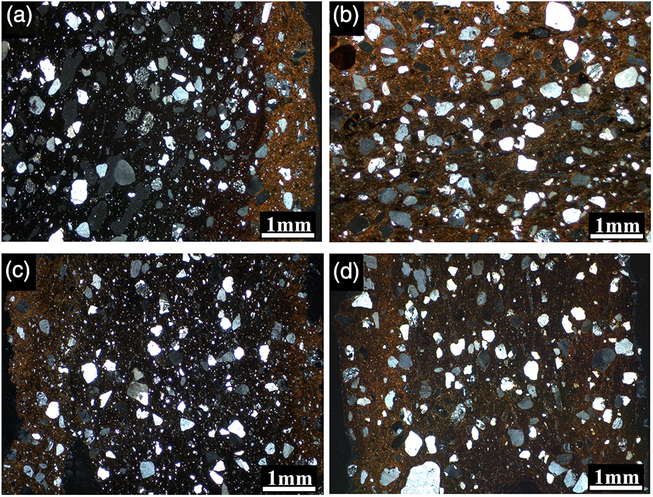
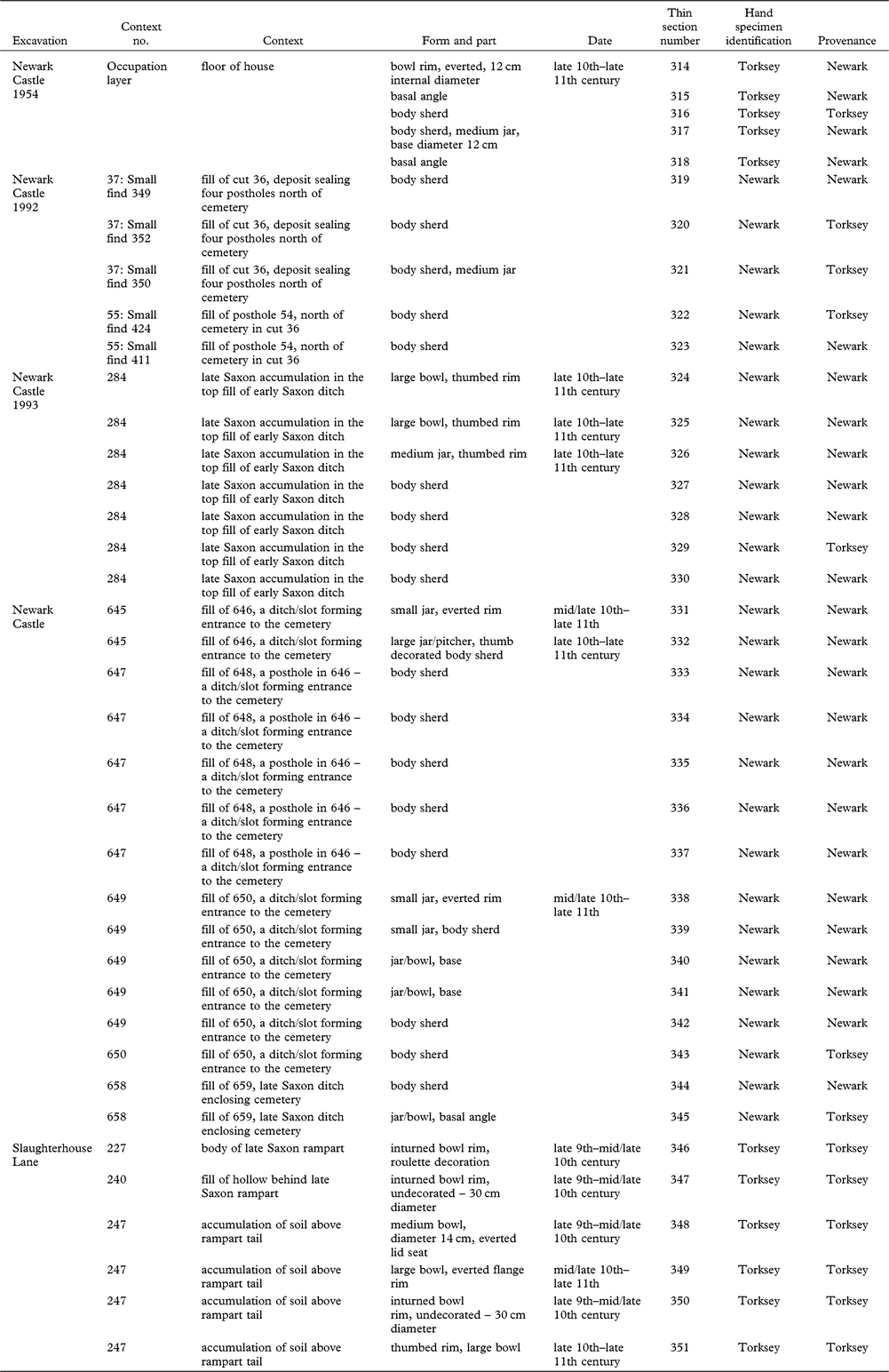
Petrographic analysis confirmed the differences identified in hand specimen between NT-ware and Torksey ware (see ‘Fabric’ section) – the matrices of NT-ware is considerably siltier than Torksey ware and devoid of calcareous clasts (fig 8a and b). The fabric of thirteen of the samples of pottery from consumption deposits in Newark identified them as products of the kilns in Torksey (fig 8d). The remaining twenty-five were attributable to the Newark industry (fig 8c; table 3). These samples form a homogeneous group with the twenty from the waste deposit at Kirk Gate, supporting the proposition that Newark was producing its own Torksey-type ware.
Photomicrographs of the fabric of: (a) Newark Torksey-type ware from the Kirk Gate production site (compare with fig 7(b), the clay of the Blue Anchor Formation); (b) Torksey ware from kiln 8, Torksey (note the similarity between the two, but also note the calcareous clasts in Torksey ware and silty matrices of Newark Torksey-type ware); (c) Newark Torksey-type ware found at Newark Castle; and (d) Torksey ware found at Newark Castle. Photomicrograph images: the author 2017.

NT-ware has a non-calcareous, ferruginous fabric with a bimodal grain-size distribution (that is, there are two modal grain sizes, representing coarse and fine fractions). This fabric is mineralogically identical to the Blue Anchor Formation clay (see figs 7b, 8a and c), demonstrating that potters utilised naturally sandy clay in an essentially unprocessed state. The preferred orientation of voids, clay domains and elongated grains indicate that NT-ware was wheel-thrown.
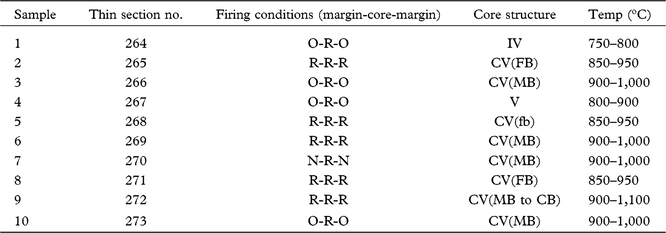
Just seven waster samples (35 per cent) have optically active to slightly active matrices (that is, the matrix changes from light to dark when rotated on the microscope stage), indicating firing temperatures ≤c 800–850°C. The majority (65 per cent) possess optically inactive matrices, indicating equivalent firing temperatures ≥c 800–850°C. These firing temperatures are corroborated by the microstructures observed under SEM, which reveal that the kiln reached equivalent firing temperatures in the range c 750–1100°C (fig 9; table 2). Importantly, 84 per cent (twenty-one) of the NT-ware from consumption deposits possess optically active to slightly active matrices, indicating that the majority of successfully fired pottery was fired at the lower end of this range, ≤c 800–850°C. Clearly, the waster pottery was fired to higher temperatures than that which was successfully fired and consumed within the town.
Vitrification structures viewed by SEM: (a) sample 264, initial vitrification IV, c 750–800°C; (b) sample 272, continuous vitrification with medium to coarse bloating pores CVMB to CB, c 900–1100°C, see table 2. SEM images: the author 2014.

Equivalent firing temperatures of samples studied by SEM

Note: (R) Reduction; (O) Oxidation; (NV) No Vitrification; (IV) Initial Vitrification; (V) Vitrification; (CV) Continuous Vitrification; FB(fb) High (low) concentration of fine bloating pores.
All NT-ware samples had grey-black to brown-black surfaces, revealing that the final stages of firing were carried out in a reducing (oxygen poor) atmosphere. However, half of the waster pottery had red-brown to orange margins and grey/brown/black cores, demonstrating that these vessels were initially fired in an oxidising (oxygen rich) atmosphere, and, as thin- and thick-walled vessels alike exhibit this sandwich effect, we must conclude that the oxidising atmosphere was maintained for a short period of time, insufficient for oxygen to fully penetrate and oxidise the core. The other half of the waster pottery possessed brown-black to grey-black margins and cores, indicating that they were subject to a reducing atmosphere throughout the firing. It must be borne in mind that this waster assemblage was badly affected by firing faults and therefore these characteristics may not be typical of pottery that was successfully fired and consumed in the town. Accordingly, the twenty-five samples of NT-ware from domestic consumption deposits offer an important counterpoint to these wasters. Of these, 64 per cent had oxidised margins and reduced cores, with the remaining 36 per cent being reduced throughout the margin and core. As there is no correlation between the firing atmosphere and vessel form or wall thickness, we must conclude that the normal firing regime comprised an initial period of oxidation, with a reducing atmosphere being introduced in the latter stages to blacken the surfaces. Vessels that were subject to reducing atmospheres throughout firing are likely to result from a differential oxygen supply, depending on their position in the kiln, with some vessels being afforded more oxygen than others. The higher proportion of reduced pottery in the waster assemblage must be seen as a consequence of unsuccessful firing.
Results: reconstructing and comparing the production sequence
The production site occupied seems to have been bounded by a ditch/gulley, c 200m from the River Trent. Potters travelled c 1.5km east to obtain their potting clay from the Blue Anchor Formation (see fig 6). This clay is green in colour, naturally sandy, did not require tempering and was used in an essentially ‘as-dug’ state. The same type and colour of clay was used by potters working in Torksey and here, too, the potting clay cropped out on a slope c 1.5km east of the production site. Although we cannot be certain what clay the Kirk Gate kiln was constructed from – given that no kiln structure has been found – it is notable that the production site is situated on the Edwalton Formation, which produces reddish, stiff, silty clay.Footnote 45 These properties make it suitable for building superstructures and it seems more than coincidental that Torksey’s kilns were located on – and built from – clay with the same suite of material properties.Footnote 46
Thin section analysis, along with rilling marks on interior surfaces of the Kirk Gate pottery, reveals that NT-ware was fully wheel-thrown, with the wheel rotating anticlockwise. The absence of rilling marks on exterior surfaces demonstrates that potters used forming tools such as ‘ribs’ to assist in forming and finishing, while parallel surface striations indicate that the pots were wiped after forming. All of these features are consistent with the production sequence followed at Torksey.Footnote 47
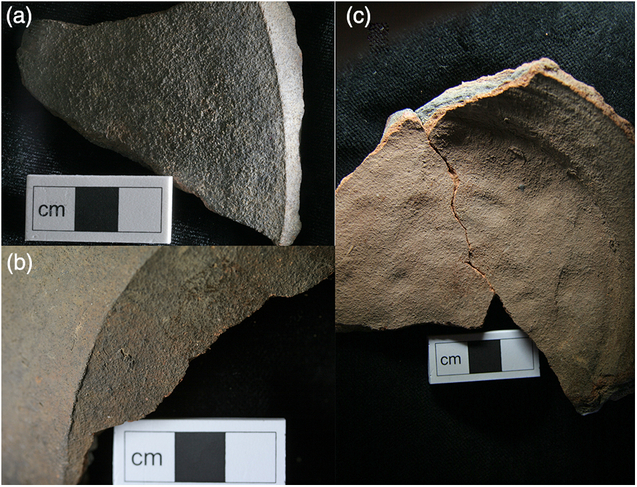
Newark’s potters produced the same range of forms as those produced at Torksey, with the medium jar with hollow-everted rim being the most common form (fig 10). The sagging bases of these jars were produced by pushing the base out from the inside, smoothing the base exterior with a forming tool, then placing this tool against the vessel’s lower wall. This process resulted in a small lip on the basal angle, a characteristic also present on Torksey ware (fig 11). In order for vessels to maintain their sagging bases, the final drying stage must have been undertaken while vessels were inverted, standing on their rims.
Torksey ware forms (note the similarity with those produced at Newark, see fig 4). Drawings: redrawn from Barley 1981 and Perry 2016.

Sagging bases on Newark Torksey-type ware and Torksey ware jars. Note the finger impressions and the small lips on the basal angle; (a) Torksey ware, (b) and (c) Newark Torksey-type ware. Photographs: the author 2015.

Once dried, the pottery was fired. The combination of atmosphere and firing temperature (oxidation followed by reduction, c 750–850°C) replicate the ‘typical regime’ followed by potters working in Torksey (fig 12).Footnote 48 Clearly, all stages of production of NT-ware were the same as those followed by potters working in Torksey, even down to their understanding of the landscape as a source of raw material, demonstrating that Newark and Torksey potters belonged to the same learning network, and strongly supporting the hypothesis that the Newark industry was founded by a Torksey potter.
Production sequences of Newark Torksey-type ware and Torksey ware sequence adapted from (Perry 2016). Diagram: the author

In order to understand why a potter relocated from Torksey to Newark, we must consider the birth of this industry in the context of the foundation and development of the late Saxon town of Newark and the supply of pottery to it. Therefore, the following section examines the archaeological and historical evidence for late Saxon Newark. Particular attention is given to sites that have produced secure dating evidence and well-stratified late Saxon pottery assemblages, illuminating the relationship between the burh’s own pottery industry and supply of wares from regional centres such as Lincoln, Torksey and Stamford.
THE NEWARK POTTERY INDUSTRY IN CONTEXT OF THE LATE SAXON TOWN
Numerous excavations in the town have recovered assemblages containing late tenth-century pottery and it seems that kilns emerged among a flurry of activity in the latter half of the century. The focus of tenth-century activity lies within the walls of the medieval town, which excavation suggests ran from Lombard Street, along Appleton Gate, turning onto Slaughterhouse Lane.Footnote 49 While the majority of late Saxon finds from Newark are residual, two sites have yielded well-stratified evidence of late Saxon activity (see fig 2), Slaughterhouse Lane and Newark Castle.
Slaughterhouse Lane
Excavations along Slaughterhouse Lane (see fig 2) have revealed a rampart and ditch, an oven and a range of gullies and post-holes aligned parallel and perpendicular to the rear of the rampart.Footnote 50 These features, and the rampart’s tail, were sealed below a layer of soil (0247) thought to have accumulated between the late tenth century and c 1100.Footnote 51 The rampart and ditch ran parallel to Slaughterhouse Lane. Although the ditch has not been fully excavated, nor has a construction date been determined, a single fragment of pottery recovered from the rampart – a Torksey ware bowl rim, decorated with roulette impressions – suggests that the rampart was constructed before the later tenth century, when this form of decoration fell out of use (see ‘Dating’ section). This sherd could be residual, yet the late tenth- to early twelfth-century date of the layer sealing the rampart tail suggests that a pre-late tenth-century construction date is realistic. Two other early Torksey ware rims were found at Slaughterhouse Lane, both belonging to inturned bowls (one of which was stratified in the fill of a hollow (0240), broadly contemporary with and behind the rampart), a form typical of the early phases of Torksey ware production.Footnote 52 These sherds, allied with two residual Lincoln kiln-type shelly ware inturned bowl rims of mid-tenth-century date, represent the earliest late Saxon finds from the town.Footnote 53 Other finds from the site, such as thumb-decorated Torksey ware rims, are typical of a late tenth- to late eleventh-century date.
At 60 per cent by sherd count, Torksey ware/NT-ware (note that Slaughterhouse Lane was excavated before the Kirk Gate, and all Torksey-type pottery found on this site was identified as Torksey ware) dominates the pottery assemblage from Slaughterhouse Lane, with regional types such as Stamford ware and Lincoln kiln type shelly ware contributing just 8 per cent and 18 per cent, respectively.Footnote 54 Six sherds of Torksey ware/NT-ware were subject to thin section analysis as part of the current project. These were taken from the rampart, the hollow behind the rampart and the accumulation of soil sealing its tail, and included the typologically early roulette-decorated and inturned bowl rims (table 3). All six sherds were attributable to the kilns at Torksey. The absence of NT-ware in these early deposits suggests that Slaughterhouse Lane was a focus for tenth-century activity in Newark, before the town’s pottery industry was founded, with pottery being obtained from Torksey and Lincoln. Given the small quantity of this early pottery, and the predominance of late tenth to late eleventh-century forms within the assemblage, it is likely that this early phase of occupation was short-lived and spanned the transitional phase between the early and later rim forms, in the mid- to late tenth century.
Provenance of Torksey-type wares from consumption deposits in Newark

Newark Castle
Excavations at the castle (see fig 2) have uncovered two late Saxon buildings – one of which was of ‘gully or sleeper trench’ construction,Footnote 55 a cemetery, a high-status stone building and a series of post-holes, ditches, gullies and an enclosure.Footnote 56 Radiocarbon dates obtained from three skeletons suggests that burial began in the late tenth century, while the palisade trench and rampart of the first Norman castle cut through and sealed the cemetery, demonstrating that burial had ceased by the late eleventh century.Footnote 57
All pottery found in the castle’s late Saxon features was late tenth- to late eleventh-century in date. This assemblage was dominated by Torksey ware/NT-ware – 64 per cent by sherd count – with regional imports such as Stamford ware and Lincoln kiln-type shelly ware contributing very little, 7 per cent and 3 per cent respectively.Footnote 58 Thirty-two sherds of Torksey ware/NT-ware were sampled from the castle site and subjected to thin section analysis (see section ‘Results: petrographic analysis and microsctructural analysis using SEM’). These were taken from a range of stratified contexts, including the floor of the sleeper-trench building and the cemetery’s boundary ditch (see table 3). Twenty-five of these sherds were shown to be products of the Newark kiln; the remaining seven were attributable to those in Torksey. As no feature contained purely Torksey ware or NT-ware, we must conclude that activity began here in the late tenth century and that both types were contemporary, with small amounts of pottery from Torksey continuing to enter the burh throughout the life of the Newark industry.
The foundation of the town
The absence of documentary evidence for the origins of Newark has led scholars to propose a number of dates for its foundation. Barley suggested that it was established between the Scandinavian settlement of Mercia in ad 878 and the English re-conquest of the Danelaw in ad 917–18,Footnote 59 while Kinsley saw it as part of Edward the Elder’s attempt to consolidate the gains (the taking of Derby and Leicester, the promise of allegiance from the men of York, and fortifications installed in Stamford and Nottingham) made during the 918 campaign;Footnote 60 neither author provided evidence to support these dates. Sawyer placed its foundation in the mid-tenth century, under the reign of Eadred (946–55), as part of an attempt by the king to strengthen his position in the region in a chaotic political climate.Footnote 61
Eadred’s brother, Edmund, had recovered the Five Boroughs of Derby, Leicester, Stamford, Nottingham and Lincoln from the Northumbrians in 942. Edmund was recognised as king of Northumbria in 944, but died two years later. The crown passed to Eadred, who, in 948, faced a Northumbrian rebellion that saw Olaf Sihtricson and then Erik Bloodaxe take the Northumbrian throne. Eric was expelled in 952/4; his subsequent death marked the end of Northumbrian independence and the throne was returned to Eadred. The name Newark means ‘new work’ or ‘new fort’, and its location at the junction of the River Trent and the Roman Fosse Way was strategic, providing protection from attacks from the north.Footnote 62 Sawyer’s suggestion accords with documentary evidence detailing grants of land at Southwell and Sutton (Nottinghamshire) to Bishop Oscytel of Dorchester by Eadred’s successors, Eadwig and Edgar, in 956 and 958 respectively, which Dawn Hadley interprets as part of an attempt by southern kings to secure control in the north.Footnote 63 Notably, Southwell is but a few kilometres from Newark, on the western bank of the River Trent.
As we have seen, the excavated evidence from Newark supports Sawyer’s suggestion of a mid-tenth-century foundation: the pottery sequence from Slaughterhouse Lane reveals a short period of occupation followed by the raising of the rampart in the mid to late tenth century, while interment in the castle’s cemetery began in the late tenth century (see Newark Castle section). To this we can add numismatic evidence, which demonstrates that Edgar’s reform coinage was minted in Newark from 973–75, by the moneyer Ingolf. A small number of Edgar’s pre-reform coins by the same moneyer has also been attributed to this mint and coins may therefore have been struck in Newark as early as 959 when Edgar took the English throne (a small number of coins of Eadwig (955–9) have previously been attributed to the Newark mint, but they are now accepted as coins from Newport).Footnote 64
In summary, all available evidence points towards a foundation in the mid-tenth century – perhaps as early as the 950 s, and certainly before the minting of reform coinage in 972–3. When the town was first founded, pottery was supplied by external production centres such as Lincoln and Torksey. The latter half of the century witnessed the growth of the burh and the foundation of the Newark pottery. Although pottery still entered Newark from external centres, much of the town’s need was satisfied by this resident potter. What was the stimulus, then, for the relocation of this potter and the foundation of this new industry?
A relocated potter
The distribution of pottery throughout tenth-century Lincolnshire and eastern Nottinghamshire has been researched by Leigh Symonds.Footnote 65 She revealed that pottery produced at the major production centres of Torksey and Lincoln was primarily traded to settlements in the north of Lincolnshire, while pottery produced in Stamford was primarily traded to settlements in the south of the county and westwards into Nottinghamshire.Footnote 66 These distributions broadly coincide with the Anglo-Saxon territories of Lindsey and Kesteven – in the north and south of Lincolnshire, respectively – with the River Witham and Fosse Dyke canal marking the boundary between the two. The geographical distribution of this pottery demonstrates that Lincoln and Torksey were participating in the same trade network and that this network was orientated northwards into the heart of Lindsey,Footnote 67 and therefore away from Newark. Indeed, both centres lie on Lindsey’s southern boundary – the Fosse Dyke canal.Footnote 68
Despite being c 25 km from both Torksey and Lincoln, with direct routes to these centres provided by the River Trent and the Roman Fosse Way respectively, Newark was south of the Lindsey–Kesteven border and thus outside the main distribution network for Lincoln (for example, Lincoln kiln-type shelly ware and Lincoln Late Saxon shelly ware) and Torksey-made pottery. This location placed Newark within the main Stamford ware distribution area. Yet, excavation demonstrates that little Stamford ware arrived in the town; just twenty-four sherds were recovered from the 1992–4 castle excavations, and the majority of these sherds derive from eleventh- to twelfth-century glazed jugs and pitchers.Footnote 69 Such a composition is typical of assemblages from locations beyond the primary Stamford ware distribution areaFootnote 70 and is not unexpected given that Newark is c 50 km northwest of Stamford, without a direct route between the towns. Thus, Newark appears to have occupied an isolated position on the edge of the Stamford ware distribution area, and outside the primary distribution network bringing pottery from Torksey and Lincoln. Although small amounts of Torksey- and Lincoln-made pottery did make it across the Lindsey–Kesteven border into Newark, the limited supply would have been problematic for the occupants of this growing town and would therefore have provided a clear incentive for a potter to relocate from Torksey to Newark. It is important to consider the source of this restriction as it provides further insight into the reasons behind the relocation of this potter.
Symonds drew attention to the fact that these ceramic distribution patterns reflected the styles, sources and distribution patterns of Lincolnshire’s and Nottinghamshire’s contemporary memorial stones, with elites in Lindsey using so-called Borre-style and Carrick-bend decorated sculpture and those in Kesteven, Nottingham and Derbyshire employing so-called Trent Valley Hogbacks and Mid-Kesteven grave covers.Footnote 71 She argued that these politically charged forms of material culture not only articulated local landholding practices, they also expressed territorial units and distinct regional identities, which the pottery trade-networks respected.Footnote 72
Documentary evidence demonstrates that boundaries between late Saxon land units and territories were clearly defined, with features such as roads and rivers being integral to establishing their limits with the movement of people and goods through and between these territories being governed by law.Footnote 73 For instance, as Symonds notes,Footnote 74 in the late ninth century Alfred required traders to declare how many men would accompany them on their travels.Footnote 75 His desire to regulate movement is emphasised in a late ninth-century law imposing fines on those who left the governance and territory of one lord for that of another without first having consulted the ealdorman; while the Alfred–Guthrum Treaty of the 880s records control over movement of people and goods between areas under English and Danish jurisdiction.Footnote 76
Laws governing movement were augmented by a requirement to pay tolls, with boundaries representing an important place for collecting payments. Domesday Book, for example, records that the inhabitants of Torksey were exempt from paying Lincoln’s entrance and exit tolls.Footnote 77 In the eighth century, the bishop of St Andrew’s (Rochester) received a toll-waiver from King Æthelbald of Mercia on a ship entering the port of London. This exemption was ratified by Mercian kings in the ninth and tenth centuries.Footnote 78 Other places where tolls might have been collected include bridges, bars in the road, field boundaries and mooring-places.Footnote 79 It is likely that there was a direct correlation between the payment of tolls and the cost of goods. The Domesday survey of Cheshire, for instance, records that those who lived outside the hundred in which salt was produced paid at least twice the amount as those living within.Footnote 80
Not only were the movements of goods and people restricted by law and toll, so were the places in which transactions could take place. Both Edward the Elder (870–924) and Ælthelstan (893–939) required that goods be bought inside towns, while Edgar (944–75) prescribed that trade should take place in front of witnesses assigned to the town or wapentake.Footnote 81 There were clear economic incentives for elites to restrict transactions in this way. Indeed, in the late ninth century, Alfred granted Bishop Wæfreth of Worcester half the rights to the market and the street, both inside and outside the town defences. The grant also entitled Wæfreth to half of the revenue raised from land-rents and the fines from dishonest trading.Footnote 82 With financial incentives such as these, we might consider that an elite saw the potential for profit and enticed a potter to relocate to Newark, rather than a potter moving of their own volition. Indeed, there is now a growing body of evidence which suggests that elite groups may have involved themselves in the production and trade of pottery.
In the decades around ad 1000, Torksey provided York with much of its pottery.Footnote 83 This large-scale movement of goods is indicative of a well-organised commercial enterprise, and it has been argued that it was supported by trading elites whose graves are marked by stone sculptures at Marton church, c 1.5km north of Torksey.Footnote 84 Hinton has suggested a similar level of organisation in the supply of lead used to make glazes at the potteries in Stamford. He argued that the quantity needed is unlikely to have been met by tinkers supplying potters with scraps. Instead, lead may have been obtained from mines in Derbyshire, and its arrival in Stamford was the result of ‘commercial arrangements of some complexity, perhaps arranged by a kiln-owner employing potters, rather than the producers themselves’.Footnote 85
The regular layout of plots in late Saxon urban areas, along with evidence from laws and land grants, indicates that urban land was arranged and distributed by elite groups.Footnote 86 The locations of pottery production sites inside these towns – within areas of industrial activity and bounded by ditches/gullies, for example ThetfordFootnote 87 and TorkseyFootnote 88 – suggests that their siting was also subject to elite control.Footnote 89 Being in close proximity to the oven on Slaughterhouse Lane, and contained within a gullied plot, Newark’s pottery industry fits this general trend. The land-rents from these urban plots and the revenue raised from urban markets were paid to elite groups, as Alfred’s grant to Bishop Wæfreth demonstrates. It is significant that this grant was part of the arrangement for building the fortifications that bounded and protected the burh of Worcester.Footnote 90 Similar grants and legislation may have been passed upon the foundation of Newark, which provided an incentive for the church or town’s lord to draw in a potter from Torksey. Thus, although it is unclear whether secular or ecclesiastical influence was responsible for bringing a potter to Newark, they likely received rent from the potter’s occupancy of a plot within the defences, and profited from the sale of pottery in the town’s market.
CONCLUSIONS
This paper has reconstructed the production sequence followed by Newark’s late Saxon potters. Comparison with the Torksey ware production sequence demonstrates that Newark’s potters were making exactly the same manufacturing choices as those working in Torksey, revealing that they belonged to the same learning network, and supporting the hypothesis that a potter or group of potters relocated from Torksey to found the Newark industry. Despite this direct link between the two industries, the confirmation that NT-ware can be distinguished from Torksey ware in hand specimen and thin section will enable future studies to differentiate between the products of these industries and facilitate a better understanding of pottery distribution and trade in the East Midlands.
The late Saxon burh of Newark was established in the period c 950s to 972/73 as part of southern kings’ attempts to strengthen their position in the north. The pottery industry was founded around this time, after the raising of the rampart and as part of a flurry of activity that saw the opening of a cemetery and mint. In the mid to late tenth century, pottery was obtained from regional production centres such as Torksey and Lincoln, but by the end of the tenth century, much of the burh’s pottery needs were met by its resident potter. Key to understanding the foundation of the Newark industry are the geographical distribution patterns of individual ware-types throughout Lincolnshire and Nottinghamshire. Newark occupied a marginal location, on the edge of the main area of Stamford ware distribution and beyond the core distribution network for Lincoln- and Torksey-made pottery. These patterns reflected territorial boundaries, the movement of people and goods across which were governed by law and subject to tax and toll. The emphasis on intra-territorial movement and trade meant that the supply of pottery to Newark was restricted and thus insufficient to meet the demands of the growing town. This gap in the market provided a clear incentive for a potter to relocate from Torksey to Newark. The potter may have moved of their own volition, but perhaps it was more likely that they were encouraged by an entrepreneurial elite seeking to make profit by filling this gap. Paradoxically then, limitations on the movement of goods and people actually encouraged the spread of the potters’ wheel throughout eastern England and the development of the Trent Valley pottery tradition. By focusing on the technological practices of a small number of potters, we have been provided with a window upon the movements of an individual(s) within and across territorial and political boundaries. In doing so, we are presented with a greater understanding of the mechanisms that transformed pottery making in the wake of the Scandinavian settlement.
Finally, this paper has drawn on a range of analytical techniques, archaeological and documentary evidence, to provide insight into all aspects of pottery production in late Saxon Newark. The merits of each technique have been discussed elsewhere,Footnote 91 but it is worth noting here that each contributes to further our understanding of the technological choices made at every stage of manufacture – the analysis of geological samples, for instance, enables the identification of raw material sources but also permits their suitability for pottery production to be assessed, while petrographic and SEM analysis allows observation of microscopic and microstructural evidence of manufacturing practices undiscernible in hand specimens (for example, preferred orientations indicative of coiling or wheel throwing and determination of firing temperatures). Such fine-grained detail may not be necessary when answering questions of provenance, but it is crucial when comparing nuances in production practices between industries in order to understand the spread of technology and development of regional potting traditions. Combining this evidence with documentary records and distribution patterns of other forms of material culture serves as a powerful tool for placing the foundation of a pottery in context of contemporary political, social and economic climates, revealing the mechanisms that allow technologies to prosper and spread.
ACKNOWLEDGEMENTS
This research was funded by a grant from the Society for Medieval Archaeology. Jane Young provided access to pottery reports and catalogues and many insightful discussions concerning the early medieval pottery of the East Midlands. Kevin Winter (Newark Museum) and Alison Wilson (Trent and Peak Archaeology) provided access to excavation archives and pottery. Harriet White assisted with the SEM analysis. Thanks also to Jerneya Willmott. Gavin Kinsley discussed the development of Newark, and Dawn Hadley, Caroline Jackson and Vicky Crewe read and commented on earlier drafts of this paper; their comments and critique are gratefully acknowledged. All errors and omissions remain the responsibility of the author.