Introduction
Defining public and private spheres has always been a historically constructed project that mutates according to circumstance. Yet, one conceptual distinction has remained constant within changing historical circumstances: what is defined as the public is ‘open and revealed’ while the private is ‘hidden or withdrawn’.Footnote 1 Urban female prostitutes were labelled ‘public’ women, or streetwalkers, because they were open and revealed. Such a label signalled societal disapproval of female prostitution, but also of women generally in the open and public spaces of the city.Footnote 2 By the 1870s, the social, political and economic dislocations produced by industrialization threatened this distinction. Women were flooding into the public spaces of cities, shopping, dining, street-selling, working in shops and offices, commuting to and from work outside the home, walking the streets seeking employment and housing.Footnote 3 One magazine article warned the city of London was becoming the place of ‘glorified spinsters’, who ‘remapped the city as “like meteors [they] wander free in interfamiliar space obeying laws and conventions of their own”’.Footnote 4
Women's intrusion into the public spaces of London, Dublin, Toronto and Chicago coincided with growing pressures on each city to reconstruct its built environment.Footnote 5 Industrial workers, new public servants such as police and fire fighters, the denizens of office buildings, politicians and political appointees, the managers and financiers of the industrial economy, all needed new buildings and spaces in which to function. Upgraded infrastructures such as improved streets and transportation networks, new housing, other public accommodations were needed to enhance comfort and safety.
As the public and private spaces of the urban built environment structure daily life, the social relations of a city's residents structure those spaces to privilege some residents and ignore or constrain the lives of other residents.Footnote 6 This article applies the social and cultural construction of gender to examine decisions over providing a new type of public accommodation – the toilet – in London, Dublin, Toronto and Chicago. It examines how male-controlled municipal authorities worked to preserve the city for men's benefit by denying women's claim for more access to public space. It demonstrates that decisions over how, where or whether to provide public toilets reflected two gendered notions of the purpose of the city. And it depicts how men intended, as much as possible, to restrict women's access to and influence over public space and thereby preserve the patriarchal city.
Of course, not all men would benefit equally, or have equal control, but in all four cities men controlled the political and economic institutions and thus the power to make decisions about the built environment. New male-dominated urban organizations and male-only municipal offices that proliferated in each of these cities in the late nineteenth century gave these primarily middle-class and professional men vehicles through which to direct urban development. While across the spectrum of new organizations, the men belonging to them might disagree on specifics of their agendas, they largely agreed that fostering male economic desires was the foremost purpose of the city's built environment. Moreover, each of these cities by the 1890s possessed a governing body that, while in different degrees was subject to national legislation, made policy for the city.Footnote 7
Each of these four cities was organized within the legally gendered, historically patriarchal nature of the British model of the city as a legal corporation.Footnote 8 Corporate status conferred self-rule on British towns and cities, recognizing them as ‘autonomous public spaces’ ruled by a ‘civic community’ composed of property owners and master craftsmen.Footnote 9 Since few women owned property or belonged to guilds, they did not have rights of access to the civic community. Propertied men considered it their right to exercise all political and economic regulation granted by the charter.Footnote 10 The Anglo-Norman ascendancy extended the practice to Ireland, and English colonists carried it into British North America.Footnote 11 Ultimately, this model's idea of a civic community evolved into a broader notion of a democratic civil society in which ‘public opinion, public interest, and public policy coincided’ as cities assumed responsibility for providing a broad range of municipal services.Footnote 12 These four cities provide a context for comparing how ideas about the public and the private intersected with the corporate nature of Anglo-American cities to reproduce the patriarchal city.
Further, although the pre-twentieth-century trajectories of these cities differed in various regards, they possessed several similarities. Important urban technological developments were shared across the Atlantic.Footnote 13 The leading figures of the nascent urban planning movement worked, lectured and attended conferences in all four countries, sharing notions of a good built environment, who should benefit, and how and why it should be produced.Footnote 14 These men imprinted their ideas of appropriate gender relations through their conceptions of what made a good city and thus how its built environment should be reshaped. If women were perceived as free wanderers, these men thought of themselves as the disciplined professionals – architects, engineers, surveyors, scientists – who would bring order and growth to the city through planning. Surveying the intersection of planning theory and women's roles therein, planning historian Helen Meller concluded that ‘Of all the pressures which [had] dictated the form of nineteenth-century cities, there was not one related to finding new ways for women to live in modern cities outside a rigid interpretation of the two spheres.’ By the twentieth century, reforms to the built environment of Anglo-American cities were reflecting, in the words of another study, ‘a supremely masculinised belief system that place[d] a heavy emphasis on the male-dominated economic sectors’. Or, as feminist political philosopher Carole Patemen put it: ‘separation of the two worlds [public and private] located within civil society’, means that ‘public life is implicitly conceptualized as the sphere of men’.Footnote 15
As men sought to consolidate their control of urban development from the 1870s, however, new women's organizations arose to challenge male domination and demand a built environment more congenial to women's needs and ideas. These women seized upon the idea of the civic community to claim rights to urban citizenship and decision-making denied them over the previous centuries.Footnote 16 Significant work has appeared recently that emphasizes what women did indeed accomplish in carving out spaces and opportunities for themselves in cities. They built private spaces, such as women's clubs, women's residences and mother and baby clinics. They convinced male public officials to construct public baths, parks and playgrounds. They founded female-run settlement houses. They claimed the right to organize public demonstrations. Yet, gender determined the major decisions on the urban built environment. As Daphne Spain said of Chicago: ‘Men Build Chicago's Skyline, Women Redeem the City.’Footnote 17
This article asks ‘who gets what, where, why, and how’ as the urban built environment is produced and reproduced.Footnote 18 By forefronting this question, this article differs from work that focuses first on women and their achievements. The struggle over who wins and loses and why on issues of public space turns attention to ideas about the city, not solely on what women tried to do and whether or not they succeeded. Moreover, examining the activities and rhetoric over public toilets presents an opportunity to see how men and women experienced the city, its built environment, and its concept of private/public spaces, differently. Such different experiences in turn produced different ideas about how a city should function and for whom.Footnote 19 These four cities, on opposite sides of the Atlantic and in four different countries, provide context for exploring the intersection of ideas about public and private space that transcend place, but are deeply rooted in conceptions of the city. By the late nineteenth century, the Victorian gendered ideals about proper femininity and masculinity reinforced the deeply embedded patriarchy of a public/private divide and competed with the ideal of a civic community. Arguments to the civic good, or the public welfare, as women would express it, could never trump centuries of male economic priorities in determining the overall shape of the built environment. Women were too often perceived as the ‘meteors’ obeying ‘laws and conventions of their own’ and not the laws and conventions of the men controlling the cities.Footnote 20
The movement for public toilets in the four cities between 1890 and 1920 was gendered. It coincided with the appearance of private toilets for women in department stores.Footnote 21 Men had traditionally availed themselves of such private spaces as pubs, saloons and men's clubs. Despite the much larger number of male toilet accommodations, city leaders were not averse to continually furnishing men of all classes with public toilets while resisting the building of public toilets for women. Reluctance to build public conveniences for women derived, as this article will demonstrate, from male desires to regulate women's presence in the public spaces of the industrial city. The public/private gender divide that characterized this issue fits precisely into Elizabeth Wilson's argument that this ‘particular division [public/private] became inscribed on urban life and determined the development and planning of cities to a surprising degree and in an extraordinarily unremarked way’.Footnote 22 Refusal to provide public toilets for women fits into both parts of Wilson's argument. Such conveniences could allow women to claim use of public space and the right to public accommodations; responding to women's demands would have also acknowledged their legitimacy in determining the public spaces of the built environment, thereby threatening to overturn the gender division of the public/private urban order. The fact that so little scholarly investigation has been done on this aspect of the late nineteenth- to early twentieth-century reconstruction of the built environment demonstrates the truth of how ‘unremarked’ this gender divide has been in urban history.
Toilets and public space in four cities
London
Public toilets for men became a desirable urban amenity in London in the 1880s. The Surveyor and Municipal and County Engineer declared that ‘Public urinals ought to be erected by the urban authority as a matter of convenience to the peripatetic portion of any community, and also to prevent nuisances being committed in improper places.’Footnote 23 Urinals obviously refers to men, for ‘respectable’ women were not imagined among the peripatetic on the city streets; nuisances clearly meant men urinating in public.
Public health acts and amendments gave various London municipal authorities the power to provide public toilets in or under streets. Until 1899, vestries and districts controlled provision of public services, after which such powers devolved to 28 metropolitan boroughs. Vestry minutes and the local newspaper indicate that St Pancras, for example, provided public toilets for men on High Street, Tottenham Court, Kentish Town Roads and other streets. The vestry spent £2,000 alone on the Fortress Road toilets. Two accommodations for women did exist on Pancras Road and Kentish Town Road. Ratepayers who had protested against building the latter had argued that this was not necessary because there were already several urinals nearby!Footnote 24 A few architects and district medical officers proposed women's public toilets, but few were erected.Footnote 25 When the private voluntary Ladies Sanitary Association asked vestries to build women's public toilets, the Paddington vestry board rejected its medical health officer's supporting recommendation. By the 1890s, the Union of Women's Liberal and Radical Associations of the Metropolitan Counties, claiming to represent ‘four thousand working-class women in and around London’, requested every vestry to provide one free facility for women.Footnote 26 A few vestries where women served on vestry boards built women's toilets, but overall men resisted women's pleas. Gender was key in these deliberations over women's public toilets,Footnote 27 although men injected class into their protests. Men, and not women, articulated their gendered ideas of women's appropriate public presence even when they divided women into classes. For the men arguing against women's public toilets, middle-class women would violate gender strictures by entering such facilities; the idea that these facilities might attract working-class or poor women was another male shibboleth. London's middle-class female advocates of female public toilets did not make such distinctions. The Ladies’ Sanitary Association (LSA) wanted public toilets for all women regardless of class. It was men who objected that ‘Ladies’ would not wish to pass by such an ‘objectionable place’, while sexual disorder would increase because prostitutes and low-class flower sellers would use the facilities.Footnote 28 Class was important, but it was referenced through gender and then applied by men to notions of appropriate female public presence.
An incident in the vestry of St Pancras in 1900 illustrates the gendered ideals behind men's hostility to women's public toilets. This so-called progressive vestry not only had women serving on the board but had built two women's public toilets, as mentioned before. The building of a temporary wooden prototype of a women's public toilet on Park Street almost directly opposite the existing men's toilet on Camden High Street by the vestry in 1900 brought out the gendered and class-based arguments against the temporary toilet in particular and women's toilets in general. Businessmen, tradesmen and male residents protested with a variety of economic arguments. Not only would its location be a nuisance to traffic and trade, but a women's toilet would also ‘spoil a most important thoroughfare and seriously depreciate the character and value of property in the immediate vicinity’.Footnote 29 Since public urinals already existed in similar cross-streets and major roads throughout the city,Footnote 30 further remarks expose the deep hostility of these men to women's public presence on the streets. One claimed that 90 per cent of the women passing through the spot lived in the area and thus would use facilities at home. In response, one councillor quipped, reportedly to much laughter, that a ‘suitable house’ could be found for the ‘use of [other] ladies’. Another protester decreed that ‘ladies’ out shopping would not be able to endure the sight of this toilet, ignoring the point that women had been passing the men's toilet for several years, while others declared a woman's public toilet to be an ‘abomination’ and that any women supporting such a structure ‘so far “forgot their sex” [they] should not have anything provided for them at all’.Footnote 31 The sexual import of such statements was clear. Using public toilets would make women public women, akin to prostitutes. The reference to a ‘suitable house’ clearly associated a women's public toilet with a brothel.
These men were not content with mere verbal assault. On a given day, as recounted by vestryman George Bernard Shaw:
every omnibus on the Camden Town route, every tradesman's cart owned within a radius of two miles, and most of the rest of the passing vehicles, including private carriages driven to the spot on purpose crashed into that obstruction with just violence enough to produce an accident without damage . . . the joke soon caught on, and was kept up for fun by all and sundry.
The result was that the structure had been hit an ‘incredible forty-five times’.Footnote 32
Former vestry board member, Mrs Miall Smith, finally convinced the borough in 1905 to build a permanent public toilet at that intersection – where it still exists. Despite a few such victories, London authorities did little to provide public toilets for women. Even when public toilets were built for both sexes, women's facilities were always far fewer than were men's.Footnote 33 In 1928, the medical officer of health found that London had built 233 public toilets for men against only 84 for women, 30 of which were in central London. Many boroughs provided few public toilets for women. The medical officer admitted that the situation was ‘quite inadequate’ and underscored the inequity pointing out that women had to pay to enter existing facilities – men did not have to pay to use urinals. Yet, he did not see that public provision of free women's toilets designed to meet women's physical anatomy was in the public interest. He urged that some engineer ‘design a female equivalent to the male urinal’.Footnote 34 Women wanting ‘greater privacy’ would pay. One is reminded of Lerner and Loewe's Professor Henry Higgins complaining, ‘Why can't a woman be more like a man’!Footnote 35
Dublin
Little was different in Dublin. By the late 1890s, the Dublin Corporation began erecting public toilets in the city centre and along the Liffey River, ‘for the use of the workmen and others engaged along the quays’.Footnote 36 Between 1898 and 1901, it then approved sums from £300 to £1,820 for new works throughout the city. It directed the Public Health Committee to erect a men's underground convenience in each city ward, build 10 new urinals and two water closets on Bachelor's Walk at O'Connell Bridge and erect a urinal for Mountjoy Street with ‘ribbed glass roofing’.Footnote 37 At the same time, the council rebuffed the high sheriff's suggestion for a comprehensive plan for public toilets for ‘both sexes’. In rejecting support for the ‘desirability and the necessity of providing proper sanitary conveniences for females in or near certain populous thoroughfares in the city’, the Improvements Committee declared ‘that the necessity for such conveniences is not of such a character as to render the building of them a work of urgent importance’. Besides, the committee continued, the corporation was ‘committed to a large number of other Civic schemes, which are of paramount importance’.Footnote 38
Over the following years, the situation remained unchanged. In 1906, Dublin Medical Officer Charles Cameron pronounced his opinion that ‘women would not use underground lavatories, or even Kiosks, placed in prominent positions’. ‘Ladies’, he insisted, could ‘use the lavatory accommodation provided in the confectionary establishments through the city.’ Cameron acknowledged that since not all women could frequent such shops, the council might erect a few small shops with a women's toilet at the back, with a female proprietor, who ‘might sell papers or other small articles, which would be the excuse some women might like for entering the place’.Footnote 39
Despite the corporation's attempt to downplay the need, the pressure for building a women's public toilet continued. Finally, realizing that it would cost less to erect a women's public toilet than to rent a small shop, the council decided in 1907 to build one on Sackville Street adjacent to Nelson's Pillar just north of the Liffey River.Footnote 40 As happened in London St Pancras, business and property owners near the proposed site objected. Once again, the gendered politics of toilet provision was intertwined with economic arguments. They sued the council claiming that to erect ‘in close proximity to the respective plaintiffs’ premises, a building, placed overground, to contain water closets lavatories, etc., for use by the female public [would] constitute the same a nuisance to the plaintiffs and their tenants, and an injury to the property and business of the respective plaintiffs and their tenants’. They further claimed that a women's toilet would obstruct pedestrian and vehicular traffic, ‘prevent respectable inhabitants and visitors’ from crossing the street, and that ‘the existence of such would attract a different class of women’, which in turn would ‘divert ladies and others from the plaintiffs’ premises’. When Dublin's medical officer rebutted such claims, saying that the toilet entrance would face the Pillar and be ‘effectively screened from public view’, the plaintiffs’ counsel raised a hearty laughter wondering at this ‘latter day use to which Nelson's Pillar is to be put – to act as a shield for a Corporation lavatory’. The court granted an injunction and the council dropped its plan.Footnote 41
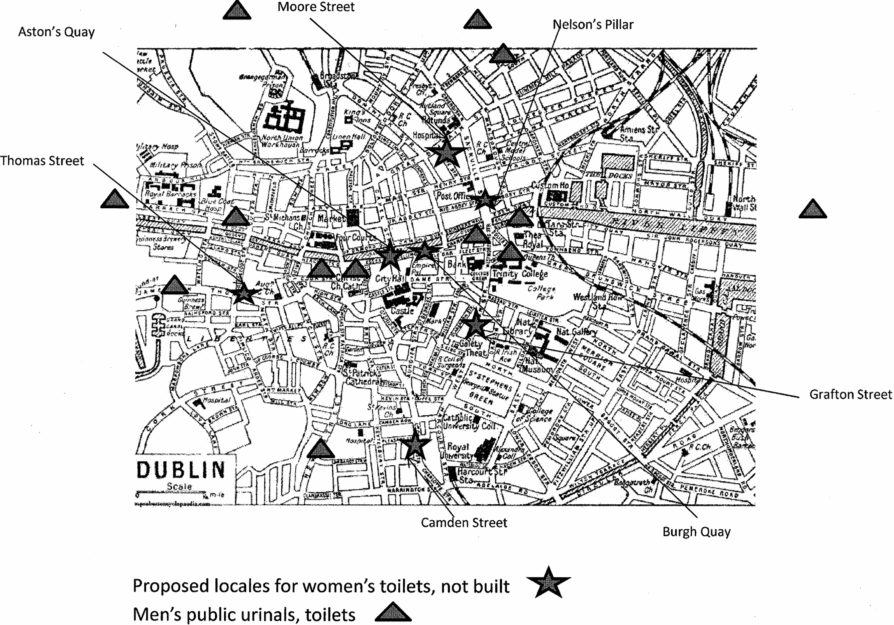
Four years later, prompted by ‘several Associations interested in public health’ including the Women's National Health Association (WNHA) asking for women's toilets on Moore, Thomas and Camden Streets – all in working-class areas – and ‘in such busy thoroughfares’ (Figure 1) the council asked the corporation for a loan to build a women's toilet. This request was half-hearted, asking only that a small sum be taken from appropriations for men's public toilets. Charles Cameron again objected and proposed that lavatories be constructed in the back of small shops. The lord mayor ruled the entire question out of order.Footnote 42
Map of Dublin men's toilets and women's proposed toilets (map drawn by author)

In 1912, the council authorized expenses for a urinal at The Slip, East Wall, claiming it was needed because this was a bathing place ‘frequented by close on 20,000 bathers during the summer months, and is adjacent to one of the principal thoroughfares of the city’. Erecting only a urinal reinforced the idea that the public spaces of the city were to be convenient for men.Footnote 43 It was only in 1914 and 1915 that the council got around to building a public toilet for women. Again, as in St Pancras, the men erected a temporary women's toilet at the southern foot of O'Connell Street bridge on Aston Quay.Footnote 44 Dublin businessmen and property owners along the Quay protested, claiming that ‘a structure of this class . . . in such an exposed position . . . would largely reduce our business’. As ratepayers, they protested that such a structure would be ‘highly injurious to our interests’: it would be both ‘objectionable and an obstruction’. These men disingenuously voiced their objections behind concern for women's sensibilities, suggesting that some shop furnish a ‘ladies cloakroom . . . [with] the lavatory placed at the rere – . . . where ladies would not be observed passing in and out of same’.Footnote 45 The council chose not to build a permanent structure. In 1921, the council authorized £5,000 for a women's toilet on Burgh Quay, but agreed to stop work if it caused any weakness in the river wall.Footnote 46 As in London, the use of public spaces for women's toilets in Dublin was considered obstructive, objectionable, a nuisance, an inconvenience, an injury to the property and business of the city's business men.
Toronto
As well-established, long-settled, crowded and, in the case of Dublin, struggling to reclaim importance, London and Dublin saw public toilets for men, including semi-private pub facilities, as necessary amenities. For their parts, Chicago and Toronto were new cities just coming to terms with exploding populations and new wealth. Both cities wished to project the image of a new, modern city, the most beautiful city in its country. Both cities minimized building public toilets on the streets of the central business districts. As they were new cities unencumbered with centuries of haphazard growth, the men of Toronto and Chicago believed they were in a position to ensure that their built environments could reflect beauty and economic vibrancy if directed toward that end rather than public convenience. When public toilets were erected, they would be predominantly for men as in London and Dublin.
Toronto possessed a great harbour, was the railroad centre of the country and by the late nineteenth century was becoming a magnet for immigration for both labourers and middle-class men-on-the-make. Between 1901 and 1911, property values increased by more than $20 million, over 100 new factories and 77 new warehouses were erected, while the population almost doubled between 1905 and 1911 to 425,407. Explosive growth produced inevitable problems for health, sanitation and infrastructure development. But economic advancement, pursued by luring new business to a ‘City of Opportunity’, remained first priority of the city's leaders.Footnote 47
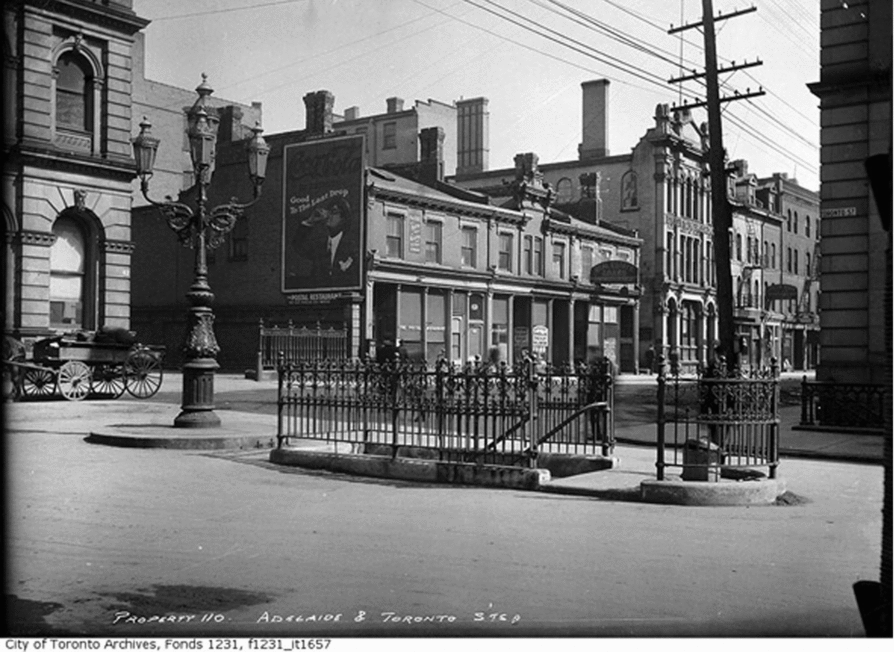
Toronto moved slowly in building public toilets, with its first men's public toilet erected in 1897 in the middle of Adelaide Street at Toronto Street opposite the main post office (Figure 2). In 1904, the medical health officer, Dr Charles Sheard, urged the city to supply more such amenities.Footnote 48 Mayor Thomas Urquhart responded that the Board of Control was considering more public toilets, and a men's toilet opened the following year at the busy downtown intersection of Spadina and Queen Streets.
Men's public toilet, Adelaide and Toronto Streets, 1912 (Fonds 1231, Item 1657, Toronto City Archives, by permission)
Complicating an investigation of the gendered nature of Toronto's built environment by looking at public toilet provision is the relative lack of information on Toronto's organized middle-class women who left few documents and whose work was sparingly documented in public venues such as newspapers or Toronto city council proceedings. Much of what we know comes from the Local Council of Women of Toronto (LCWT), the Toronto affiliate of Canada's National Council of Women. The LCWT left few written sources. A run of its Annual Reports contains brief reports from its standing committees and more than 30 affiliated women's organizations, and there is a small archival collection at the Archives of Ontario.Footnote 49 City council minutes and reports briefly mention communiques received from the LCWT, but rarely give details.Footnote 50 In his 1907 inaugural address, for example, the mayor thanked the ‘representatives of public spirited organizations for interest in municipal improvements’ – all male – and thanked women for attending the inauguration, as their ‘presence at all times lends a charm and casts a refining influence over an assemblage which nothing else can replace’.Footnote 51 Newspapers mentioned the LCWT sporadically, often only announcing its meetings.
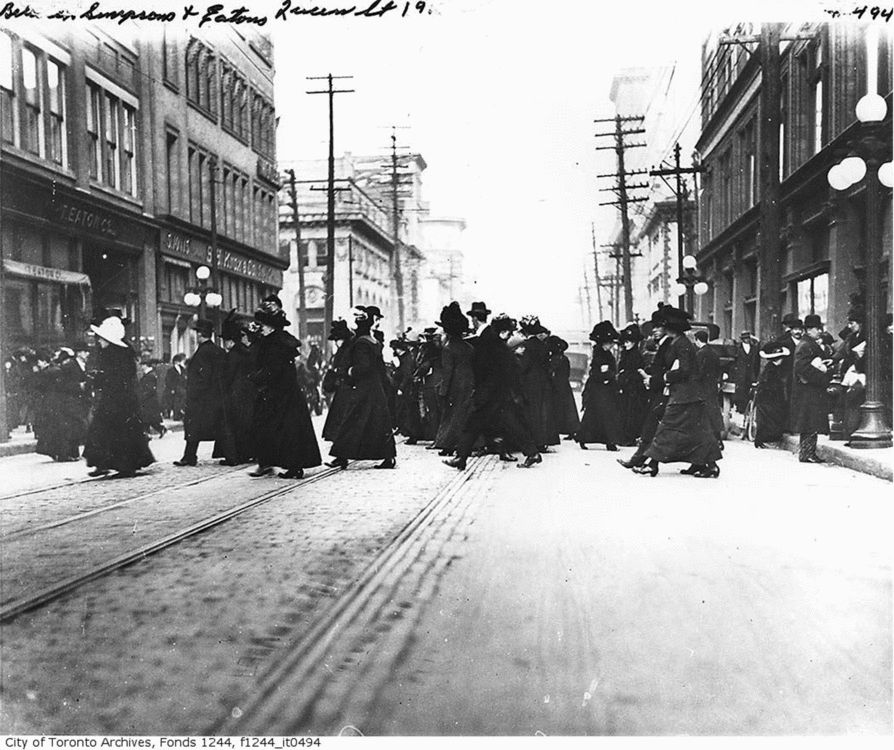
Nevertheless, we do know that the city council ignored LCWT's Public Health Committee's request in 1908 that Toronto build public lavatories for women who were in the downtown area as shoppers, workers and spectators (Figure 3). As early as 1901, a higher percentage of employed women than employed men worked in that area: 56 per cent of Toronto's employed women worked in the downtown against 47 per cent of the city's employed men, yet they found no public toilets coming to and going from work.Footnote 52 In 1909, the council assured women that it would erect women's public lavatories in the ‘downtown’ area as ‘land became available’ for such sites. In 1912, the women reported that the promise was unfulfilled.Footnote 53
Downtown pedestrians, Queen Street, Toronto, 1910 (Fonds 1244, Item 494, Toronto City Archives, by permission)
At various times, the council debated building public toilets, but generally focused on drawing comprehensive plans to foster economic development. In 1911, rather than spending the estimated $30,000 to build public lavatories at the intersections of College Street and Spadina Avenue and of King and Queen Streets with Roncesvalles Avenue, Controller J.J. Ward proposed that the city make money by buying some lots, building shops for which rental would be charged and putting toilets in the basements.Footnote 54 Another alderman objected that the Spadina and College public toilet would disturb the young people entering the nearby Broadway Tabernacle. Even the public library board objected to the city constructing a lavatory in its building at Broadview and Gerrard Streets.Footnote 55 In 1914, the Board of Control eliminated $36,500 earmarked by the Property Commission for site purchase and construction of public toilets and in 1919 the commission itself eliminated another $34,000.Footnote 56 Almost none of the proposed sites was in the city centre where the LCWT was requesting women's lavatories. Instead, they were to the east, west and north of the crowded downtown area.Footnote 57
This lack of interest in providing public toilets, combined with these suggested decentralized locations, reflected the desire of many men in Toronto (as elsewhere) to focus on creating a city of economic growth and opportunity (as will be explained below). In contrast, the women of the LCWT viewed public toilets, especially for women, as a social necessity. Despite the limits of women's voices in this issue, if the issue is examined within the context of who controls the city and to what end, the gendered perspectives become clear. First, the city's political institutions controlled all decision-making. Not only did they deflect the calls of the LCWT for public toilets, they were determined to exert control over all social issues, and most emphatically not give any of the control to women.Footnote 58
Second, male civic organizations seized upon and controlled the idea of city planning as the top priority of reconstructing the built environment to enhance economic development. Thus, the Toronto Guild of Civic Art (GCA) claimed its interest was in making Toronto beautiful, and produced plans for the city along these lines. By 1911, it had released a comprehensive plan for the city and had convinced the council to appoint a Civic Improvement Committee. The plan focused on redeveloping public spaces to increase economic growth: widening streets, building faster modes of transportation, erecting new public buildings and redeveloping the harbour. The GCA reduced social necessities to transportation: ‘Numerous and intricate as are the questions involved in a comprehensive plan . . . the basic problem is transportation. This is equally true in relation to the industrial, the commercial and the social needs of the City.’Footnote 59 The city appropriated millions to widen and extend commercial streets, create new transit routes, purchase land and compensate property owners at considerable public expense.Footnote 60 It completed the Bloor Street viaduct in 1918 – a modern marvel ‘centered on five steel-framed arches encased in concrete’ to stimulate trade along the eastward extension of Danforth Street.Footnote 61 Toronto ratepayers pursued developments that enhanced their property values and the city's overall economic growth. One such group claimed that widening Yonge Street was ‘a matter of utmost importance to every loyal citizen having the welfare of our city at heart’.Footnote 62
The grip of male politicians and men organized into civic groups on the city's political institutions and the focus on city planning schemes to promote economic standing and increase property value had serious implications for small-scale, socially oriented schemes. Despite the efforts of a few men and the women of the LCWT, the question of public toilets that were intended to enhance the daily experiences of ordinary residents rarely received priority or money. Toronto's male leaders, like those in London and Dublin, preferred to spend money on major improvements to the built environment. Unlike the two latter cities, in Toronto there was not even much public consideration given to providing public toilets for women.
Chicago
Unlike Toronto women, Chicago women were highly organized and engaged early in municipal affairs. The Woman's City Club (WCC), for example, organized in 1910, had 1,252 members that year; 2,789 five years later; and 4,031 by 1920. While these members were largely white middle-class, working-women's leaders such as Agnes Nestor also belonged and were quite active. The WCC, along with the Chicago Woman's Club (CWC) and the Chicago Woman's Aid (CWA) and then the female-headed department of public welfare, made the issue of public toilets a very public one, so that the Chicago struggle over public toilets provides significant evidence of the gendered ideas about the purposes and uses of public space. Before examining the Chicago context, however, it is important to refer again to the idea of experience. According to feminist scholarship on gender and the city, how one experienced the city was a most important determinant in how its residents viewed the city. For men, the public spaces were to be the physical representation of their economic and financial expertise and power. For women, on the other hand, private needs could no longer be separated from public spaces; public toilets in public spaces for private needs were necessary amenities for all residents.Footnote 63 An early example of this idea, along with differences in interpretation, can be seen in the developments at the Hull House settlement of Jane Addams and Ellen Gates Starr and in perceptions of the LCWT. According to a feminist interpretation, the women of Hull House were reformulating the boundaries between public and private. They opened ‘the domestic to the space of the city’ in the belief that ‘the civic realm was the home in public’. As such, they are perceived in feminist literature of the urban context as contesting over the ‘infrastructure of everyday life’. That is, seeking a practical rearrangement of ‘all that it takes in a practical sense for individuals and households to “go on” from one day to the next’. In her study of regency London, for another example, Jane Rendell argues that the women's Lyceum Club ‘pushed the domestic toward the public’, to collapse the distinction between ‘the male public city and the female public home’.Footnote 64 Such interpretations of women's public activities on the built environment suggest that something more radical was at work among urban women than wishing to create the bourgeois ‘city as parlour’ as one analysis of the work of the LCWT would have it. In each of these four cities, women were struggling over use of and accessibility to public spaces.Footnote 65 The difference in interpretation is significant. The latter interpretation suggests that women sought a ‘feminine’ city, not a ‘feminized’ city. It also negates recognizing that the city is a place in which women were actively struggling with men over gender appropriate public order and behaviour. This was not a struggle of a binary dichotomy of essentialist gender nature. The struggle resulted from different lived experiences in cities that for centuries had been shaped by men who viewed the city as economic space and women who had come to see it as home for all its residents. Any analysis of women's activities that emphasizes domesticating urban space fails to appreciate the fear that so many urban men had of women's disorder, as Elizabeth Wilson, Doreen Massey, Clara Greed and other feminist scholars have argued.
In Chicago, there is definitive evidence of how middle-class women perceived the city differently from their male counterparts. The women of the Municipal Order League (MOL), led by president Dr Sarah Hackett Stevenson, first promoted public toilets in 1892, labelling them a necessity to keep men and boys out of saloons.Footnote 66 Yet, for Stevenson and the MOL, public toilets were just one aspect of their struggle to make the city provide socially needed facilities for all its residents, including public baths – none of which existed in Chicago – and public drinking fountains, and to rescind its ban on public bathing in Lake Michigan. The next year, the MOL demanded that public toilets be provided for all the people coming to the Columbian Exposition.Footnote 67
The city council deflected the pleas for public toilets until 1907 when 35th ward Alderman Frank Race proposed that the city architect recommend locations for public comfort stations in the downtown district. According to Race, these amenities could prove an economic boon to the city because they could be used to lure the 1908 Democratic and Republican conventions to the city.Footnote 68 Later that year, several men's civic clubs organized a committee to study whether providing public toilets was an appropriate municipal responsibility (Figure 4).
Agenda for meeting organized by the Rotary Club of Chicago to discuss public toilets, 1907 (Rotary International website, under the heading Rotary Timeline, by permission of Rotary International)
The city council had previously appropriated $5,000 for an experimental one but then diverted the money to the sewer department.Footnote 69 The following year, the city's assistant engineer proposed 15 suitable locations in downtown, and Alderman Race again requested an appropriation for such facilities. The council stalled, and only in 1911 were two municipally furnished public toilets built in the basement of the new city hall at the corner of LaSalle and Washington Streets. Despite one of these facilities being for women, city hall was an overall male space that many women might feel uncomfortable entering.Footnote 70
Chicago leaders gave various reasons for their reluctance to build public toilets. One city official claimed they were ‘unAmerican’.Footnote 71 This argument was easy to reject. A more significant source of this reluctance was money: even when they conceded that public comfort stations might be positive features of city life men asked ‘have we the money to install this service’?Footnote 72 Yet, a perusal of the city council proceedings shows that the city had money to fund what it wanted, so the underlying meaning really was, ‘do we want to spend the money on this improvement’? Moreover, Chicago's segmented governing system with its three separately funded park districts, accompanied by the lack of any national public health acts, enabled the council to focus spending on its preferred built environment improvements and wait for the park districts to provide public comfort stations out of their appropriations.Footnote 73
Chicago women were the main advocates of public toilets, yet their social and political marginalization in the public arena of decision-making muted their voices. Representatives from the CWC and State Federation of Women's Clubs attended meetings of the male organization mentioned above, but newspapers never recorded what they may have said. No women were invited to contribute their voices at these discussions.Footnote 74 When men did advocate public toilets, they always requested more provision for men than for women, claiming that this derived from a ‘proportion . . . indicated by statistics of use’.Footnote 75 Such pronouncements raise three questions: if few public toilets were provided for women in areas where they might most need them, how could they know what women might want and need; what about women's differing biological and social conditions; and, finally, what about the needs of women with children?Footnote 76 Chicago women raised such questions; Chicago's political and business leaders rarely addressed such questions.
Chicago women countered the masculinized vision of the city with what one could label a feminized (not feminine) one that promoted public comfort stations all around the city as crucial to a good urban environment. Unlike London and Dublin, Chicago was a new city with myriad possibilities for its built environment. Yet, the gender dynamic of dividing public and private spaces held fast. By diverting calls for public toilets to parks, for example, and placing the first women's toilet in the basement of City Hall, the city's downtown commercial and political districts could remain ‘safe’ from the sexual disorder of women's presence.
Chicago women continued the struggle despite opposition. The WCC, the CWC and the CWA replaced the demised Municipal Order League in demanding public toilets. In 1913, the downtown public library offered the city space under the sidewalk at Randolph Street and Michigan Avenue to build public toilets and agreed to furnish a women's public comfort station inside the library. The CWA prepared and circulated a pamphlet urging city support for public toilets. The women demanded that they be ‘open day and night, holidays and Sundays for all classes . . . Women and children who spend the day in town, workingmen, letter carriers, street cleaners.’Footnote 77
Yet, the city still did not act. In late 1914, the mayor promised that work on the toilets inside the library would proceed quickly; a year later the WCC noted that they were still ‘under construction’ and again protested the lack of facilities in the downtown district.Footnote 78 With few exceptions,Footnote 79 women remained the principal proponents of public toilets for Chicago. The newly created Department of Public Welfare – staffed largely by women – surveyed the city's public comfort station situation and recommended a ‘thorough-going plan’ to locate comfort stations in all 35 wards in the city (not just in the parks). The WCC directed its members to locate suitable places in their wards. The welfare department asked the city council for a plan to purchase sites for two new large and six small comfort stations in the downtown district. The department further noted that existing public comfort stations in the parks generally contained more facilities for men than for women; only the public library's facility, which had resulted from women's pressure, contained more provisions for women.Footnote 80
With sustained calls for public toilets from women's organizations whose members numbered in the thousands, one might have imagined that the city would have listened to this public interest. Women did succeed in May 1917 in putting a bond proposal for $150,000 for public comfort stations to the voters. When it passed, the WCC proclaimed it a ‘signal victory’ coming after ‘four years’ cooperation with the CWA’.Footnote 81 By summer 1918, however, no money had been spent. That summer, the WCC dramatized this situation in the form of a written movie script, wherein Jennie Purvin, chair of its committee on bathing beaches and public comfort stations, and former president of the CWA, trudges from floor to floor in city hall inquiring about the lack of progress in spending the $150,000. She shuttles among the public works, health and sanitary departments, the city architect's office; each office sends her elsewhere. She leaves the building counting ‘how many months have elapsed since the city council began to spend money on paper, for comfort stations; she reaches sixteen, heaves a sigh of regret, and proceeds on her way’. The script's second episode ended with Purvin musing about how long it will be ‘before her committee may rest from its efforts. She decides that it would be easier to guess when the war will end.’ In 1925, her committee informed women that few public comfort stations had been built.Footnote 82
The club women had been especially discouraged that Daniel Burnham's Chicago Plan failed to include public comfort stations along streets being widened such as 12th Street. Like those plans proposed for London, Dublin and Toronto, Chicago's Plan was deeply embedded in the idea of the masculinized city. Chicago spent millions of dollars widening business district streets, improving railroad transportation, completing the new Union Station, constructing the Wacker Drive underground thoroughfare, straightening the south branch of the Chicago River and building a new bridge across the river along Michigan Avenue. City leaders boasted that the new bridge would carry ‘seven times the traffic of the old’ bridge, and that ‘the $16 million spent on Michigan Avenue had already paid for itself six times over in increased property values’.Footnote 83 Every element of the Chicago Plan assumed that spending millions on improving the economic infrastructure of the city would create a good city. In such an atmosphere, women's pleas for including public comfort stations in all street improvement plans and in all parts of Chicago could hardly compete. Public comfort stations were for the health and well being of all city residents; the plan and its proponents viewed the city as an economic growth machine. The council's decision in 1918 that no public comfort stations would be built unless they could be financially self-supporting reflected such thinking.Footnote 84
Despite setbacks and discouraging pronouncements, Chicago club women continued to agitate for public toilets. When they persuaded the council in early 1923 to solicit bids for two public comfort stations on the city's near north-west and far south sides, they hoped that ‘possibly before another season passes we may therefore mark some small progress in the scheme to cover Chicago with needed public convenience stations’. Two years later, they admitted little more had been done.Footnote 85
Conclusion
Whether cities provided public toilets for men but not for women, or whether they virtually ignored the issue, a patriarchal gender dynamic undergirded the decisions. A gender dynamic is more subtle and often invisible in the standard sources consulted by most urban scholars. Understanding its influence over the use of public space requires realizing that the city has been a masculinized place in which the economic desires of men determined the shape of the built environment. In contrast, the LCWT women were concerned with the everyday experiences of Toronto's people. They wished to extend women's ‘special maternal concern for the home and family . . . outside their own domestic sphere to embrace the community’.Footnote 86 The LSA in London worked to shift the male discourse about public toilets from one about sewers and disease to emphasize public toilets as amenities that would bring both individual and social health.Footnote 87 The leaders of Ireland's WNHA charged its local branches to ‘develop a sense of responsibility regarding public health’ by organizing branches everywhere: we ‘do not want branches which represented only one or two sections of the community’. We want to ‘have all sections, all parties, all creeds, working together’.Footnote 88 As feminist planning historians have emphasized, urban men consistently thought in terms of major public infrastructure projects, applying new technology and engineering to the city. Helen Meller has argued that male professionals focused on ‘drains and sewers’ as the means to eliminate disease from the city, and then declared these infrastructures as a public good.Footnote 89 Public toilets could thus be easily dismissed as social amenities and of secondary importance. Moreover, if public toilets were provided for women, these same men feared the potential disorder that might accompany women's easy access to all public spaces. Women for their part did not reject drains and sewers, but their arguments expose their belief that these were not enough. Activist, middle-class women in all four cities focused on the ‘infrastructure of everyday life’ that would enable the city's residents to move around and through the public spaces of the city in comfort and security as they went about their daily lives.Footnote 90
Recognizing the city as a place in which people live, composed of both public and private spaces that structure their lives, illuminates struggles over public toilets as an aspect of the gendered contestation over the built environment and an attempt to restrict women's access to those spaces. When London and Dublin refused to provide equal public toilet facilities, when Chicago refused for six years even to erect signs directing women to the public library toilet, and when Toronto refused to build downtown toilets for women, the male decision-makers either implicitly or explicitly signalled that the built environment was for men. Women's place in urban public spaces and their demands for alternate public structures threatened male prerogatives to control and shape the city. Women's vision of the city as a public place shared by all its residents, all of whose needs should be met, directly challenged men's ideas about the city as foremost the site of male economic endeavour. Men contested among themselves about whose economic endeavours should be rewarded and how broadly to distribute those rewards, but they assumed that control of the public spaces was the male prerogative. If urban scholars privilege male authority when examining the city, as is too often the case, the public/private divide is constantly recapitulated. Differing gender experiences led to different ideas about the city.Footnote 91
Investigating competing gender ideas about the built environment will also allow urban scholars to stop labelling women's urban reform activities as maternalist. Understanding the attention that these women were giving to the ‘infrastructure of daily life’ distinguishes them from a male focus on the infrastructures of business and trade as the purpose of the city. Even if women themselves used such terminology that stemmed from their gender experiences, it was a strategy for inserting themselves into public discussion and action. Disagreements over if, where, how many and at what cost public toilets should be built and maintained by the city demonstrate that the goal of women's activities in these four cities was to construct a different type of city. They sought to break down the public/private, the productive/reproductive dichotomy to make the city more livable for all its residents. In doing so, women also sought to integrate women and their concerns into the public civic community of a democratic city from which they had been banished for centuries. If the civic realm were reconceptualized as the home in public, then women would be positioned to reorganize the city and reconstruct its built environment. Women's private needs would become part of the city's public spaces.