INTRODUCTION
Many children around the world grow up in multilingual environments. In fact, it has been speculated that the number of children exposed to more than one language from birth is similar, if not larger, than the number of those who speak only one language (Tucker, Reference Tucker, Cenoz and Genesee1998). Although governments in many countries deliberately depict monolingualism as the norm, multilinguals are predominant not only in Asia and Africa but also in Europe and North America. For instance, according to figures reported by the US 2000 Census Bureau (http://www.census.gov), almost twenty percent of the US population speaks a language other than English, and over forty percent of California residents are multilingual. In southern California cities like Los Angeles or Santa Ana, the percentage of children growing up with more than one language oscillates between sixty and eighty percent. Multilingual exposure is, therefore, not so uncommon as the general literature on children's language acquisition might suggest.
Nevertheless, little is known about the acquisition of multiple languages within the same individual. This lack of knowledge has produced contradicting beliefs about the advantages and disadvantages of early multilingualism. On the one hand, it has been argued that young children can effortlessly acquire two or more languages if exposed to them in early life, because the ability for multilingual acquisition ‘is an essential’ but not ‘a contingent property of the human language making capacity’ (Meisel, Reference Meisel, Cenoz and Genesee2001: 12). On the other hand, the view that multilingualism might cause developmental language delays seems to prevail among the public at large and some evidence suggesting that multilinguals develop some aspects of language more slowly than monolinguals exists (Gathercole, Reference Gathercole, Oller and Eilers2002; Silva-Corvalán & Montanari, Reference Silva-Corvalán and Montanari2008).
Echoes of these views can also be found in contemporary research on childhood bilingualism. Starting from the 1980s, an increasingly large number of investigators have indeed turned to the study of bilingual first language acquisition, focusing on whether bilingual children can differentiate their languages in production early on and whether they acquire language-specific constraints at the same age as monolinguals. At least two opposing theories have been proposed. Early findings from studies on bilingual acquisition were interpreted as evidence that, although children are exposed to distinct sets of input, they go through an initial stage in which their two languages are represented in a unitary or fused system (unitary language system hypothesis, Genesee, Reference Genesee1989), at the phonological (Schnitzer & Krasinski, Reference Schnitzer and Krasinski1994; Vogel, Reference Vogel1975), lexical (Clark, Reference Clark and MacWhinney1987; Volterra & Taeschner, Reference Volterra and Taeschner1978) and syntactic level (Murrell, Reference Murrell1966; Redlinger & Park, Reference Redlinger and Park1980; Volterra & Taeschner, Reference Volterra and Taeschner1978). Although these researchers never openly argued that developing bilinguals are ‘slower’ than monolinguals when it comes to language learning, the proposal of an initial unitary language system does imply that young multilinguals go through prolonged language development as they differentiate their languages early on, an idea in line with the public perception of language delay in young bilinguals (Petitto, Katerelos, Levy, Gauna, Tétreault & Ferraro, Reference Petitto, Katerelos, Levy, Gauna, Tétreault and Ferraro2001).
In correcting the methodological problems of these earlier studies, however, researchers holding views under the differentiated language system hypothesis (Genesee, Reference Genesee1989) have recently shown that by the time bilingual-to-be children begin talking, they show signs of language differentiation, both in their phonology (Deuchar & Quay, Reference Deuchar and Quay2000; Paradis, Reference Paradis2001), and in their lexicon (Deuchar & Quay, Reference Deuchar and Quay2000; Pearson, Fernández & Oller, Reference Pearson, Fernández and Oller1995). Likewise, as soon as there is evidence for syntax, they use their two syntactic systems differentially (Meisel, Reference Meisel, Cenoz and Genesee2001; Paradis & Genesee, Reference Paradis and Genesee1996).
A related issue that has received less attention, and that is addressed in this paper, is whether multilingual children can differentiate their languages pragmatically following their interlocutors' patterns of language use. Early theorists, the proponents of the unitary language system hypothesis, never examined, systematically, whether bilingual children could actually show evidence for language differentiation by selecting language A rather than language B when addressing a speaker of language A. Rather, they interpreted any form of language mixing (be it the use of elements of two or more languages in the same utterance – intra-utterance mixing – or the use of a language in a context where the use of another language would be appropriate – inter-utterance mixing) as anecdotal evidence that children could not differentiate languages.
Recent studies of language choice among developing bilinguals have shown, however, that they can choose language appropriately according to the language of the context or interlocutor around age two, suggesting that pragmatic differentiation occurs relatively early from their first steps into the acquisition process (Comeau, Genesee & Lapaquette, Reference Comeau, Genesee and Lapaquette2003; Deuchar & Quay, Reference Deuchar and Quay2000; Nicoladis & Genesee, Reference Nicoladis and Genesee1996; Nicoladis & Secco, Reference Nicoladis, Secco, Greenhill, Hughes, Littlefield and Walsh1998). In particular, Nicoladis and Genesee (Reference Nicoladis and Genesee1996), who examined pragmatic differentiation in French–English bilingual children aged between 1 ; 7 and 3 ; 0, found, for each child, that there was an initial period in which children did not choose language appropriately, but this ability emerged in all of them sometime between 1 ; 9 and 2 ; 4. The authors suggested that lack of vocabulary might have been responsible for the children's early inability to differentiate languages. Yet, detailed information on the children's lexical development was not available and this hypothesis could not be confirmed. On the other hand, Nicoladis & Secco (Reference Nicoladis, Secco, Greenhill, Hughes, Littlefield and Walsh1998), who used parental reports on vocabulary development to examine lexical and pragmatic differentiation in a Portuguese–English bilingual child aged between 1 ; 0 and 1 ; 6, demonstrated that lexical gaps are often responsible for inappropriate language choices. Similarly, Deuchar & Quay (Reference Deuchar and Quay2000), in their thorough analysis of language choice and mixing in a developing Spanish–English child, found that the child showed interlocutor sensitivity from approximately 1 ; 8. Yet, they observed that lexical gaps, the location of the interaction and the interlocutors' responses to mixing also played a crucial role in determining the child's choice of one language over another. Finally, Comeau et al. (Reference Comeau, Genesee and Lapaquette2003), who examined the ability of two- to three-year-old French–English bilinguals to identify and adjust to the language choice preferences of unfamiliar interlocutors, reported that their subjects were capable of varying their patterns of language choice following the lead of their interlocutor across three sessions. This finding was interpreted as evidence that children can not only show signs of pragmatic differentiation with interlocutors whom they have long associated with a specific language but they can also monitor language input on-line and adjust their language use accordingly.
Despite this recent effort towards the study of bilingual acquisition, relatively little work has been done on early trilingualism and research on pragmatic differentiation in developing trilingual children is literally in its infancy. Barnes (Reference Barnes2006) and Cruz-Ferreira (Reference Cruz-Ferreira2006) are two recent book-length studies of children learning three languages, but while Barnes' work focuses exclusively on the acquisition of questions in English in a simultaneous trilingual child, Cruz-Ferreira looks at the strategies that three sequential trilingual children employ in acquiring language(s). The only researcher who has systematically examined language choice in trilingual-to-be children is Quay (Reference Quay, Cenoz and Genesee2001; Reference Quay2008), although her results are strikingly different from study to study. In particular, the child in her first investigation (Quay, Reference Quay, Cenoz and Genesee2001), a developing Japanese–English–German trilingual boy growing up in Japan, failed to address his parents in their respective native language, but managed ‘to function within the realms of all three by choosing the language that works in the most cases’ (2001: 194), that is, the language spoken by the community and his trilingual parents. On the other hand, the trilingual two-year-old girl in Quay's second study (Reference Quay2008), when faced with multiple language users during dinner conversations, did modify her patterns of language choice following her interlocutors' language preferences, their proficiency in each language and their expectations as to appropriate language use. In either case, given the increased complexity that arises out of hearing, interacting in and choosing from three different languages, Quay concludes that trilingual development differs considerably from bilingual development and calls for more research on early trilingualism.
It is the aim of this study to further investigate the issue of pragmatic differentiation in early trilingual development through a longitudinal examination of language choice in a developing Tagalog–Spanish–English trilingual child. Because inappropriate language choices have been shown to originate both from external (parental language mixing) and internal (lack of proficiency) factors, the child's patterns of language choice with different language users are analyzed at age 1 ; 10 and 2 ; 4 to examine: (1) whether evidence for pragmatic differentiation can be found even before age two and within a ‘mixed’ language context where the child is simultaneously confronted by distinct language users; (2) whether lack of proficiency is responsible for her choice of one language over another; (3) whether the child's language choice is affected by the interlocutors' language preferences and their responses to language mixing.
While most researchers working on pragmatic differentiation have intentionally collected their data in separate language contexts, the child in this study was not recorded exclusively in the presence of one language user; rather, speakers of each language participated during the recording sessions, each taking turns addressing the child in their own language (as in Quay, Reference Quay2008). In this way, her ability to select a language when confronted by different language users could be observed directly within a mixed language context, a situation that reproduced more faithfully her natural language environment. Although it has been argued that such situations do not favor language separation because multiple languages are being simultaneously activated (Grosjean, Reference Grosjean and Nicol2001), mixed language contexts, which require the child to differentiate and switch between his/her languages on-line, reproduce more accurately multilingual environments, and are a more valid test of the ability to differentiate languages pragmatically.
Also, while parental language use and response to inappropriate language choices have been shown to affect children's selection of one language over another (Juan-Garau & Pérez-Vidal, Reference Juan-Garau and Pérez-Vidal2001; Lanza, Reference Lanza1997), fewer investigators have actually examined whether the children studied had sufficient lexical resources to demonstrate pragmatic differentiation. Lexical gaps have been widely acknowledged as one of the reasons for language mixing in young bilinguals; yet, most experimental studies, which involve a large number of children and focus on limited speech samples collected in a laboratory, have not been able to ascertain whether their subjects possessed distinct lexical items at different points in development. Nonetheless, if one wants to use language choice to address the issue of pragmatic differentiation, it is necessary to know what lexical resources the multilingual child has at his/her disposal. As Quay (Reference Quay1995: 386) puts it, ‘only by having such a firm base to start from can language choice be used as an indication of young bilingual children's emerging communicative competence’.
The prediction is that the child in this study will modify, from the earliest sessions, the amount that she uses each language to match the specific language of the addressee. Yet, switches to inappropriate languages are expected to be common both for input- and proficiency-related reasons. In particular, the child should vary her patterns of language choice following her interlocutors' degree and acceptance of language mixing and she should favor the majority over the minority languages, as the trilingual children in Quay's studies (Reference Quay, Cenoz and Genesee2001, Reference Quay2008). Lexical gaps as well as changes in language exposure patterns are also expected to be crucial determinants of the child's selection of one language over another.
METHOD
The child and her family
The data in this study come from a longitudinal investigation of first trilingual language acquisition in a girl, Kathryn, born in Los Angeles to a Filipino–American mother and a Chilean–American father. The child's mother, a clinical lab scientist in her late thirties, came to the United States from the Philippines at age nine; her father, also a clinical lab scientist in his late thirties, moved to Los Angeles from Chile at age twelve. From birth, Kathryn was addressed primarily in Tagalog by her mother, in Spanish by her father, and in English by her sister, nine years older than herself. English is the main medium of communication in and outside the home, although both parents usually switch to their native language when interacting with Tagalog or Spanish speakers. Kathryn's sister is a passive trilingual: she understands Spanish and Tagalog, but addresses her parents, and is primarily addressed by them, in English.
During her first two years of life, Kathryn was exposed to Tagalog through her mother and her Filipino–American grandparents, who took care of the child three days a week. At the same time, Kathryn heard Spanish from her father, with whom she spent two days a week when her mother was working, and from her Spanish-speaking grandmother, who visited her on a weekly basis and took care of her on some weekends. Finally, the child was exposed to English through her sister, and, more indirectly, through family conversations. From age 2 ; 2, Kathryn started attending a daycare three days a week (for eight hours a day); most of the daycare staff and children spoke primarily English. During the remaining days of the week, the child was taken care of by her Tagalog-speaking grandparents and, on weekends, by her mother, her father and her Spanish-speaking grandmother.
Table 1 shows the percentage of Tagalog, Spanish and English heard by Kathryn between birth and age 3 ; 6. These percentages, based on the child's general language exposure in typical daily life, were calculated on the basis of twelve waking hours per day, seven days a week. As can be seen, it was estimated that, until age 2 ; 2, Kathryn's direct exposure to Tagalog was higher than her exposure to Spanish and English. Starting from age 2 ; 2, however, Kathryn's exposure patterns reversed and English became the language the child heard the most. Since it has been suggested that children need interaction to develop language (Ervin-Tripp, Reference Ervin-Tripp and Slobin1971), i.e. observing people speak is not enough for language learning, Kathryn's language exposure patterns were calculated in terms of the number of hours spent with each interlocutor. The reader should keep in mind, however, that English was the main medium of communication in the home, and thus it might have been heard more often than estimated.
Kathryn's exposure patterns from birth to age 3 ; 6

Procedure: data collection
The data analyzed in this study are part of a larger database consisting of diary records and audio-recordings of Kathryn's spontaneous speech while interacting with different language users. Seven 90-minute sessions were used for the present analysis. The first four recordings, each separated by a one-week interval, were made by the author between Kathryn's age of 1 ; 9·23 and 1 ; 10·12 and constituted the data at Time I. The last three recordings, which formed the Time II dataset, were made approximately biweekly between the child's age of 2 ; 3·23 and 2 ; 4·27.
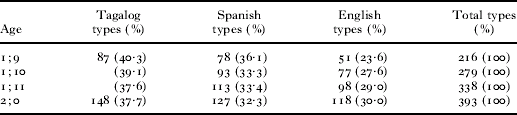
At Time I, the child's dominant language was Tagalog, the language in which she had the largest vocabulary. This can be seen in Table 2, which shows Kathryn's total number of word types in each language from age 1 ; 9 to 2 ; 0. These values were derived from the child's reconstructed trilingual lexicon, a chronological list of the first 400 words spontaneously produced by the child from age 1 ; 3·24. The trilingual lexicon, which includes information about the child's age when a word first appeared, its pronunciation, and the context in which it was produced, was reconstructed on the basis of words that appeared in weekly reports and audio recordings (including those used for the language choice analysis) made by the child's grandmother (a linguist) and the author (see Montanari, Reference Montanari2006, for more details).
Kathryn's total number of word types in each language from 1 ; 9–2 ; 0 (percentages in parentheses)

Table 3 presents the child's MLUwords (MLUw) in Tagalog, English and Spanish at Time I and Time II. MLU values, given in words rather than morphemes because the three languages are characterized by distinct morphological patterns, were calculated over the same number of utterances (‘base’) produced by the child in each language during a two-week period. As shown by the table, Kathryn was predominantly at the one-word stage of production in all her languages at Time I. By the time the child was almost 2 ; 5, however (Time II), English had become the language in which she had more proficiency.
Kathryn's MLUwords in her three languages at Time I and Time II

* ‘Base’ refers to the number of utterances in each language over which MLUw values were calculated.
The recordings used for the language choice analysis were made by the author at the child's home during four main activities: drawing, book-reading, eating meals and free play. Because one of the goals of this study was to examine the child's ability to select a language when confronted by different language users, all adults participated during the recording sessions, each taking turns addressing her in their own language. Given that all interlocutors were found to use primarily one language when addressing Kathryn (see ‘Results and discussion’ section below), interactions in which Kathryn was addressed by her mother defined the Tagalog context, interactions between the child and her father or grandmother the Spanish context, and conversations between Kathryn and the author were taken to represent the English context.
The sessions used for the present analysis were selected for several reasons. As to the sessions at Time I, earlier recordings did not contain sufficient data in which the child was interacting, alone, with a speaker of each language, and her words did not satisfy the criteria for language/word identification outlined in the section ‘Procedure: transcription’ below. Also, it has been shown that analyses of appropriate language choice can only be made when children have over 100 words in their vocabulary, that is when they have sufficient lexical resources from which to choose (Deuchar & Quay, Reference Deuchar and Quay2000). As to the recordings at Time II, the data collected at 2 ; 4 were deemed appropriate to examine the relation between language choice and proficiency/language exposure patterns because, starting from age 2 ; 2, the child was enrolled in an English daycare center. Before this age, she was primarily taken care of by her Tagalog-speaking grandparents, thus the question was whether changes in the frequency of exposure to each language, and thus proficiency changes, would have an effect on her language choices.
Procedure: transcription
The recording sessions were transcribed on the day following the session to maintain the most faithful record of the non-verbal context. Passages in which the adults were talking to each other, and Kathryn did not participate in the conversation, were omitted from the transcriptions. The recordings were initially transcribed in regular orthography, together with an identification of unintelligible and unclear passages, English translations, and information about non-verbal events that became relevant to the interaction and clarified the discourse (such as Kathryn's hurting herself or running away). The transcriptions were further checked by Kathryn's mother, by a Tagalog-speaking assistant and by a Spanish–English bilingual. Disagreements on utterances/passages were discussed by listening several more times to the recordings. When agreement was reached, the affected utterances/passages were transcribed a second time adopting the consensus.
The child's utterances were transcribed in regular orthography if they were clearly comprehensible as words of a specific language; when this was not the case, narrow phonetic transcription was used. Because transcripts in the CHAT format of CHILDES (MacWhinney, Reference MacWhinney2000) are now being made for all recording sessions, examples will be given in this format with a few exceptions: (a) phonetic transcriptions (in IPA) are provided on the main tier rather than on a separate one; (b) the language of each utterance is not indicated in a separate tier but rather in the English translation tier (‘%eng: dog in Spanish’ or ‘%eng: bird in Tagalog’); (c) inter-utterance language switches are indicated in bold; (d) the addressee of each utterance is indicated, only when relevant, in the comment tier (%com); (e) the accents and apostrophes of Tagalog and Spanish words are preserved in the examples; (f) for space limitations, multiple utterances produced by the same adult might be reproduced on the same tier. These deviations from the CHAT format were meant to free the examples from excessive information and make them easily readable, even by those not familiar with CHAT.
Three specific criteria were employed for word – and hence language – identification. The child's words were transcribed as Tagalog, English or Spanish (or Tagalog/Spanish, Tagalog/English and Tagalog/English/Spanish words if they were common to two or three languages) only if: (1) the same sequence of sounds was consistently employed in relation to the same set of referents (e.g. [ˈ tatas] consistently used to refer to Kathryn's bottle of milk was coded as gatas, ‘milk’ in Tagalog); (2) the child's form exhibited at least two phonetic units in common with the adult form of the word or utterance (e.g. [ˈ ta] produced to refer to a bike was coded as the Spanish/Tagalog word /bisiˈ kleta/ ‘bike’); (3) the child's verbal production displayed a similar pattern of syllabification and stress to the adult's form (e.g. [ˈ papa] for ‘daddy’ was considered as having a Tagalog source, /ˈ papa/, because ‘daddy’ in Spanish has opposite stress /paˈ pa/). This third criterion was justified by the finding that children tend to replicate adult stress from their earliest productions (Cruz-Ferreira, Reference Cruz-Ferreira2006; Petitto et al., Reference Petitto, Katerelos, Levy, Gauna, Tétreault and Ferraro2001). Notice that in the text, Tagalog words are indicated in italics, English words are in bold italics, and Spanish items are in underlined italics.
For reliability measures, a native speaker of Tagalog, a native speaker of Spanish and a native speaker of English were asked to examine the transcriptions, and code each of the child's utterances as: (1) ‘belonging to their native language’; (2) ‘not belonging to their native language’. Inter-rater agreement ranged from 98·5% for English to 99·4% for Spanish and 99·8% for Tagalog.
Procedure: coding and analyses
In order to analyze whether Kathryn could use her languages differentially and appropriately in different language contexts, i.e. with distinct interlocutors, the utterance was chosen as the unit of analysis. An utterance was defined as ‘the expression of a thought (or thoughts), marked off by pauses (including intonation, stress) or conversational turns, which the child produced with some apparent intent to communicate’ (Petitto et al., Reference Petitto, Katerelos, Levy, Gauna, Tétreault and Ferraro2001: 466). The language of each utterance addressed by the child to each speaker was examined and the distribution of Tagalog, Spanish, English and mixed utterances per language context was calculated. Mixed utterances, although rare, consisted of a co-occurrence of words from two or three languages (sa mine, literally ‘to/for mine’, i.e. ‘for me’).
Not all of Kathryn's utterances were counted for the purpose of the language choice analysis. For instance, only her spontaneous productions were included, i.e. both repetitions of adult utterances and productions prompted by an adult through the use of an explicit word (e.g. ‘say …’ ) were omitted from the count. Kathryn's self-repetitions within the same conversational turn were also excluded from the analysis. Proper names, cross-language onomatopoeia, words common to all three languages and unintelligible utterances were also omitted since these items could not necessarily provide evidence for appropriate language choice.
Words common to two of the child's three languages (such as lapis/lápiz, ‘pencil, pen’ in Tagalog and Spanish) were included for two reasons. First, unlike words common to all three languages, this type of neutrals could give some insights into appropriate language choice. For instance, when Kathryn produced lapis, rather than pen, while addressing her mother, she showed sensitivity to the language of her interlocutor; therefore her utterance had to be counted as a token of the context language. Second, over thirty percent of Tagalog lexical items have been estimated to be Spanish loan words, and almost ten percent of Tagalog words are said to have an English source (Rau, Reference Rau1992), thus, omitting such items from the analysis would considerably lower the number of usable tokens, making statistical analyses impossible.
As far as assigning every utterance produced by the child to a specific language context, i.e. as addressed to a specific interlocutor, the structure of the recording sessions itself made quite clear who was being addressed in each utterance, since the child was more often engaged in dyadic rather than in group conversations. There were a few cases, however, in which an utterance was addressed to more than one interlocutor, and there were instances in which Kathryn was addressing herself rather than anybody else. Such utterances, although excluded from the language choice analysis, were used qualitatively to examine the child's vocabulary knowledge at specific points in development.
The language choice analysis was followed by a second analysis aimed at examining whether there was a relationship between the child's language choice and her proficiency levels in each language. Proficiency was assessed in terms of total vocabulary at Time I and in terms of MLUw at Time II. In addition, in order to assess whether the choice of a specific lexical item was indeed available at a particular age, the child's instances of language mixing at Time I, which mainly consisted of one-word utterances in a language other than the addressee's, were analyzed in terms of the child's reconstructed trilingual lexicon, the chronological list of the first 400 words she produced from age 1 ; 3·24 used to compile Table 2. Percentages of code-mixed words that lacked translation equivalents were calculated and they were then compared across language contexts. The expectation was that Kathryn would mix languages, in part if not wholly, in order to fill in lexical gaps in each language, and that lexical gaps, and hence mixing, would be more frequent in the child's weakest language, i.e. the language in which she had the most limited vocabulary. Although it cannot be claimed, with certainty, that an item not recorded in the lexicon was indeed not available to the child, an analysis of Kathryn's inappropriate language choices in terms of her lexical gaps was deemed to provide a good starting point to examine the relationship between proficiency and language mixing.
The final step was to assess whether there was a relationship between the child's language choice and the interlocutors' patterns of language use. For this part of the study, the distribution of the language(s) that the adult interlocutors used when addressing the child was calculated. In particular, both the patterns of inter-utterance language use, i.e. the percentage of Tagalog, English and Spanish utterances, as well as the patterns of intra-utterance language use, i.e. the percentage of mixed utterances, were calculated. The adults' communicative strategies, that is their responses to Kathryn's language mixing, were further examined qualitatively in terms of Lanza's (Reference Lanza1997) parental discourse strategies towards child language mixing to see whether the interlocutors tended to negotiate a monolingual, a bilingual or a trilingual context. Although Nicoladis & Genesee (Reference Nicoladis and Genesee1998) failed to find a correlation between parental discourse strategies and the code-mixing patterns of children growing up in a bilingual community, other studies of multilingual children growing up in monolingual communities have indicated that parents' responses to child mixing are an important determinant of language choice (Döpke, Reference Döpke1998; Juan-Garau & Pérez-Vidal, Reference Juan-Garau and Pérez-Vidal2001; Mishina, Reference Mishina1999; Quay, Reference Quay, Cenoz and Genesee2001, Reference Quay2008).
RESULTS AND DISCUSSION
Kathryn's patterns of language choice at Time I and Time II
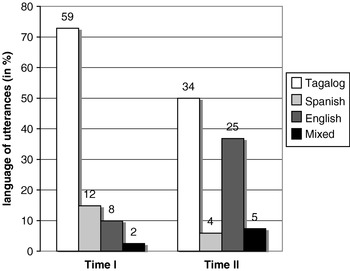
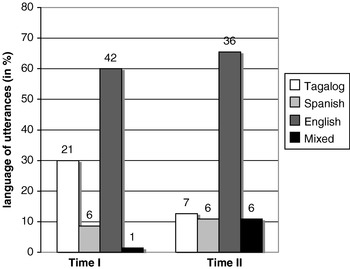
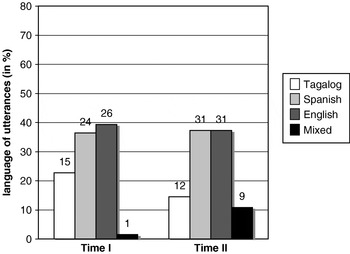
Figure 1 shows Kathryn's patterns of language choice in the Tagalog context, Figure 2 reports the results in the English context, and Figure 3 in the Spanish context. As can be seen in the figures, the child differentiated languages from the earliest sessions: she used more Tagalog with her Tagalog-speaking mother, she increased her use of English with the English-speaking interlocutor, and resorted to more Spanish in the Spanish context, even when simultaneously confronted by multiple language users. The results of chi-square tests applied to the Tagalog, English, Spanish and mixed utterances addressed by the child to each interlocutor at each time further indicate that the association between the child's patterns of language choice and the language of the interlocutors was significant both at Time I (χ2 (6, N=217)=68·005, p<0·001) and at Time II (χ2 (6, N=206)=52·775, p<0·001).
Kathryn's patterns of language choice in the Tagalog context at Time I and Time II (tokens given on top of columns).

Kathryn's patterns of language choice in the English context at Time I and Time II (tokens given on top of columns).

Kathryn's patterns of language choice in the Spanish context at Time I and Time II (tokens given on top of columns).

Notice that although Kathryn increased her use of Spanish and decreased her use of other languages to match the language of the Spanish-speaking interlocutors (Figure 3), approximately only 35 percent of her utterances were in Spanish both at Time I and II, suggesting that the child was still far from adult-like language separation. In the following excerpt (1), for example, Kathryn (KAT) insists in addressing her Spanish-speaking father (DAD) and grandmother (GRA) in English and in Tagalog, clearly indicating a failure to adjust her language use to the ongoing interactional demands of her addressees:
(1) Excerpt from 1 ; 9·29
%sit: KAT, GRA and DAD are engaged in book reading *DAD: Kathryn, ¿dónde está la niña? %eng: Kathryn, where is the little girl? %act: points at the picture of a girl in the book *KAT: [oˈ tei]. %gls: okay *KAT: look! %act: points at the same picture *DAD: uhm? *KAT: this. %act: points at the picture of the girl *DAD: sí, esa es la niña. %eng: yes, that's the little girl *DAD: ¿pero dónde está? %eng: but where is she? *KAT: aso. %eng: dog in Tagalog %act: points at the same picture of the girl sleeping next to her dog *GRA: tiene un perro la niña, sí. %eng: the little girl has a dog, yes *DAD: Kathryn, ¿la niña está durmiendo? %eng: Kathryn is the little girl sleeping? *DAD: ¿en su cama? %eng: in her bed? *KAT: unan. %eng: pillow in Tagalog
In addition, the association between the adults' and the child's patterns of language choice did not always gain strength over time. While Kathryn's patterns of language use in the English context were statistically different between Time I and Time II (χ2 (3, N=125)=9·368, p<0·025), no significant association was found between her differential use of her languages and time in the Spanish context (χ2 (3, N=149)=6·204, p<0·102). In the Tagalog context, on the other hand, Kathryn's patterns of language use changed significantly with age (χ2 (3, N=149)=19·780, p<0·001), but this change involved a dramatic increase of English at the expense of Tagalog. In other words, Kathryn became more sophisticated in selecting the appropriate language in the English context but her ability to do so remained the same in the Spanish context or even decreased in the Tagalog context.
The child's inability to strictly adhere to her interlocutors' language is not surprising. After all, she was interacting simultaneously with different language users and, as found in Quay (Reference Quay2008), mixed language contexts are more conducive to the use of multiple languages than conversations with a single language user. In addition, as the literature repeatedly reports, not even developing bilinguals recorded in separate language contexts show strict language separation by context, or even the use of primarily one language with one speaker, until three years of age. They also do so only if their parents do not mix languages and if the children ‘are relatively balanced in their proficiency in their two languages’ (Nicoladis, Reference Nicoladis1998: 111). Clearly, Kathryn was younger than three, and her competence in each of her languages was far from balanced. The issue at stake, then, is whether Kathryn's inappropriate language choices were dependent upon the adults' patterns of language use and her proficiency in each language.
Adults' patterns of language use
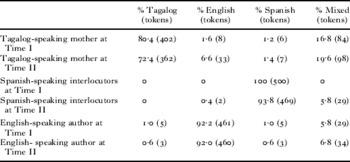
Table 4 shows the adults' patterns of language use at Time I and Time II. The percentages of Tagalog, English, Spanish and mixed utterances were calculated on the basis of the first 500 utterances produced by each interlocutor while addressing the child. These spanned over three of the four recordings at Time I and two of the three sessions at Time II.
Distribution of interlocutors' Tagalog, English, Spanish and mixed utterances at Time I and Time II

All four interlocutors used only one language most of the time when addressing Kathryn. This was especially true in the case of the Spanish-speaking adults who never code-mixed within or across utterances (Time I) or did so only to a limited extent (Time II). The author's use of English with Kathryn was also predominant and remained roughly the same over time. Finally, Kathryn's mother addressed the child in Tagalog on most occasions; yet, she code-mixed the most and substantially increased the amount of mixed, English and Spanish utterances over time.
Kathryn's inappropriate language choices thus appear to be only in part related to her addressees' patterns of language use. While her extensive use of English in the Tagalog context at Time II might have been correlated with the type of code-mixed input provided by her mother, the limited number of English, Spanish and mixed utterances produced by the child in the same context at Time I did not mirror her mother's patterns of language use. Similarly, Kathryn's amount of English in the Spanish context surpassed, to a great extent, her father's and grandmother's mixing rate.
Inappropriate language choices and proficiency
An examination of Kathryn's patterns of language use with respect to proficiency suggests that the child's command of Tagalog, English and Spanish might have been a more important determinant of language choice than the interlocutors' language preferences. Recall that, at Time I, the child's dominant language was Tagalog (as shown by her Tagalog vocabulary in Table 2), a language that she used a great deal while interacting in non-Tagalog contexts (Figures 2 and 3). However, at Time II, following two months of schooling in English, English had become her strongest language (as shown by her MLUw in Table 3), a language that she chose extensively while addressing the Spanish- and Tagalog-speaking interlocutors (Figures 1 and 3).
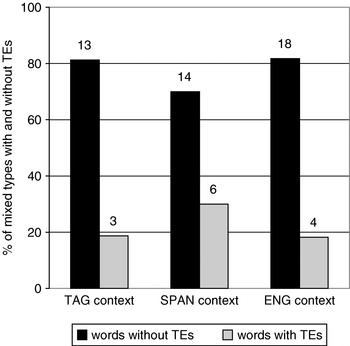
The analysis of Kathryn's inappropriate instances of language choice at age 1 ; 10 with respect to the reconstructed vocabulary further supports the claim that lexical gaps were responsible for utterances in a language other than the interlocutor's. Figure 4 shows the percentage of code-mixed types with and without translation equivalents over the total number of code-mixed types produced by Kathryn in the Tagalog, Spanish and English context at Time I. As can be seen, the majority of Kathryn's mixes were due to vocabulary gaps. Over 80 percent of code-mixed types in the Tagalog and in the English context lacked indeed a translation equivalent; likewise, 14 out of 20 code-mixed types in the Spanish context were due to vocabulary gaps.
Percentage of code-mixed types with and without translation equivalents over total number of code-mixed types produced by Kathryn in the Tagalog, Spanish and English context at Time I (raw numbers given on top of columns).

Notice, however, that although lexical gaps did account for most of Kathryn's mixed utterances, there were items, in all contexts, that Kathryn code-mixed despite having equivalents. In the Tagalog context, for example, Kathryn consistently employed book, arbol, ‘tree’, and llaves, ‘keys’, despite having Tagalog equivalents. Book appeared on the same day as the session in which it was recorded for the purpose of the present analysis, whereas its Tagalog/Spanish translation equivalent libro/libro was first recorded a week earlier, when Kathryn was 1 ; 9·23. Both items were recent acquisitions, and neither of them might have been sufficiently well-established to allow strict word separation by language context. Arbol, ‘tree’, first appeared when Kathryn was 1 ; 6·23, while its Tagalog equivalent puno was first recorded a month-and-a-half earlier, when the child was 1 ; 5·09. Since arbol was the only item employed at Time I irrespective of the context, it could be speculated that puno was by this time no longer active in the child's productive vocabulary. After all, children's early words have been shown to have a high mortality rate (Bloom, Reference Bloom1973; Leopold, Reference Leopold1939). No information is available as to whether a specific lexical item entered in the lexicon was subsequently used, therefore it is not possible to ascertain whether the child no longer had puno in her productive vocabulary or whether she simply failed to retrieve this word. Finally, llaves, ‘keys’, was first recorded on the same day as its Tagalog synonym susi, when Kathryn was 1 ; 5·19. Neither item appeared in other language contexts or in group conversations, thus no evidence is available as to whether the Spanish item was more active than the Tagalog one or whether the former was preferred over the latter.
In the English context, there were four code-mixed types that had English equivalents: bola, ‘ball’, gatas, ‘milk’, isda, ‘fish’, grande, ‘big’. The first three words were acquired an average of three months earlier than their corresponding English equivalents, and they were observed to be among the most active words in Kathryn's productive vocabulary. Thus, Kathryn might have opted for the Tagalog items because they were more established than their corresponding English synonyms. Notice, however, that this was not true at all times: in one session, for instance, Kathryn referred to a stuffed dolphin as fish while addressing the English-speaking interlocutor, but in the next session, she employed the Tagalog item isda to talk about the same referent with the same speaker. Likewise, the use of the code-mixed adjective grande, ‘big’, first recorded when Kathryn was 1 ; 10·01, alternated with the use of its English equivalent big, which appeared in the data when she was 1 ; 9·30. Therefore, although fish and big might not have been sufficiently well-established to allow strict word separation by language context, it is also possible that momentary memory lapses, which are common even among adult bilinguals (Green, Reference Green1998), were responsible, in certain cases, for Kathryn's failure to retrieve a contextually appropriate word.
Finally, in the Spanish context, there were six items that Kathryn code-mixed despite having translation equivalents: pen, bola, ‘ball’, look, this, ilaw, ‘light’, and that. While pen, bola, this, and that appeared relatively earlier than their corresponding Spanish equivalents, which thus could be argued not to have been sufficiently well-established by the time they were recorded for the language choice analysis, look and ilaw are more difficult to explain since both were recorded later than their Spanish equivalents. In particular, look appeared when Kathryn was 1 ; 9·23 while mira was first recorded when she was 1 ; 9·09; ilaw, on the other hand, appeared when she was 1 ; 8·24 while luz was first recorded when she was 1 ; 4·05. Preference could be invoked to account for Kathryn's use of look rather than mira since look was the term she employed not only in the Spanish context but also in English and in group conversations. Decay of early acquisitions, on the other hand, could explain Kathryn's use of ilaw rather than luz given that the latter appeared so much earlier than the former and it was never encountered in the data between 1 ; 9·23 and 1 ; 10·12.
Although age of acquisition, preference, decay of early acquisitions, and momentary memory lapses can all be invoked to explain why certain words with cross-language synonyms were not used appropriately in their specific language context, it must be kept in mind that code-mixed utterances can serve other purposes than filling in vocabulary gaps and, although important, there might be variables other than proficiency affecting the amount and direction of language mixing. Table 5 shows the child's overall mixing rate at Time I, that is, the percentage of code-mixed tokens and types over the total number of tokens and types produced in each language context. As can be seen, the child's patterns of language choice in the Spanish context were quantitatively and qualitatively different from her language use in other contexts: Spanish was the language in which inappropriate language choices occurred more often, a result that was statistically significant both for tokens (χ2 (2, N=217)=20·056, p<0·001) and types (χ2 (2, N=145)=7·879, p<0·02). This finding contradicts the prediction that language mixing should be more frequent in the child's weaker language (i.e. English, as shown in Table 2).
Percentage of code-mixed tokens and types over total number of tokens and types produced by Kathryn in the Tagalog, Spanish and English context at Time I (raw numbers in parentheses)

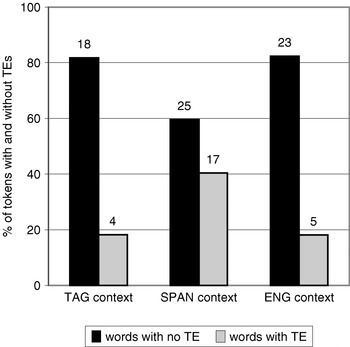
Moreover, when code-mixed tokens alone were considered, it was found that while over 80 percent of switches to the inappropriate languages in the Tagalog and English context at Time I lacked a translation equivalent, only 60 percent of mixed utterances in the Spanish context were due to vocabulary gaps. Figure 5 shows the percentage of code-mixed tokens with and without translation equivalents over the total number of code-mixed tokens produced by Kathryn in each context at Time I.
Percentage of code-mixed tokens with and without translation equivalents over total number of code-mixed tokens produced by Kathryn in the Tagalog, Spanish and English context at Time I (tokens given on top of columns).

Therefore, although there were only six lexical types that Kathryn code-mixed at Time I despite having Spanish equivalents, these items were repeatedly used, increasing the overall rate of the child's mixing. As shown in the excerpt in (3), Kathryn often insisted on addressing the Spanish-speaking adults in English, even when a Spanish equivalent was clearly available (2). In particular, in (2), the child, who is playing with a watch, produces the word [‘ete], este, ‘this’ in Spanish, in a mixed utterance while addressing her Spanish-speaking grandmother and the author (AUT). However, only a few minutes later (3), she insists on describing the watch to her father as this, despite his requests for clarification:
(2) Excerpt from 1 ; 9·29
%sit: a watch has been strapped on KAT's ankle. GRA and AUT are present *AUT: what time is it? *KAT: [ˈ ete ˈ mai ləˈ lo]. %gls: este my reloj/reló %eng: this (Spanish) my (English) watch (Spanish/Tagalog) %act: shows the watch to both interlocutors *GRA: el reloj de Catarina. %eng: Kathryn's watch
(3) Excerpt from 1 ; 9·29
%sit: a few minutes later Kathryn takes off her watch. DAD is now present *KAT: oh oh. %act: holds the watch and looks at it *GRA: oh oh ¿te lo sacaste? %eng: oh oh, did you take it off? *DAD: ¿qué es eso? %eng: what is that? %act: points at the watch *KAT: this. *DAD: ¿uh? *KAT: this. *DAD: 0. *GRA: ¿el reloj de Catarina? %eng: Kathryn's watch? *KAT: 0 [=! runs away].
In sum, proficiency, although important, might not have been the only variable determining Kathryn's patterns of language choice, at least in the Spanish context. The next question, then, is whether the child's inappropriate language choices were determined, or at least encouraged, by the interlocutors' responses to mixing and the overall social context in which the interactions occurred.
Inappropriate language choices in a multilingual context
The location of the interaction, the societal status of the languages being acquired, the child's awareness of the interlocutors' bi- or multilingualism and the interlocutors' reactions to language mixing have all been argued to affect multilingual children's patterns of language choice. In particular, bilingual children have been found to be more likely to mix languages while interacting in the minority language (Paradis & Nicoladis, Reference Paradis and Nicoladis2007), or while addressing speakers whom they know to be proficient in two or three languages (Quay, Reference Quay2008). Also, it has been shown that bilingual children's language choices are affected by the extent to which an interlocutor negotiates a monolingual or a bilingual context, that is how willing he/she is to accept utterances by the child in an inappropriate language (Lanza, Reference Lanza1997). Analyses of the adults' reactions to mixing indicate that the child's language choices were not at odds with the interlocutors' attitudes and expectations concerning appropriate language use. While the author (and the mother at least at Time I) had a tendency to provide negative sanctioning to the child's mixing, that is, correct her as to appropriate language choice (excerpt 4), the Spanish-speaking interlocutors repeatedly showed comprehension and appreciation of the child's English utterances, involuntarily suggesting to her that her mixes were not only being understood but they were appropriate (excerpts 5 and 6).
(4) Excerpt from 2 ; 4·19
%sit: KAT and AUT are playing with paint *AUT: it's to paint, uh? %act: points at a tube of paint *AUT: what is this shape of? *KAT: [ˈ asen]. %gls: alisin %eng: remove in Tagalog %act: points at the cap of the tube of paint *AUT: uh? *KAT: [aˈ sen]. %gls: alisin %eng: remove in Tagalog *AUT: <okay you have to say> [/-] yes I open it up. *KAT: open. *AUT: open say open. *KAT: open. *AUT: very good! *AUT: say it here now, open. %act: brings microphone closer *KAT: open. *AUT: ah very good! *AUT: so to mommy you say alisin. *AUT: and to Simona you say open. *KAT: open.
(5) Excerpt from 1 ; 9·29
%sit: GRA and KAT are playing *GRA: Catarina, oye Catarina. %eng: Kathryn, listen Kathryn *GRA: ¿cómo te llamas tú? %eng: what's your name? *KAT: pen. %act: shows a pen to GRA *GRA: sí este es el lápiz de la Bibi. %eng: yes this is Bibi's pencil
(6) Excerpt from 1 ; 9·29
%sit: DAD and KAT are engaged in book reading *DAD: a ver busquemos +/. %eng: let's see let's look for *KAT: [wos ˈ dIs]? %gls: what's this %act: points at a picture of a pinecone *DAD: esa es una piña, una piña. %eng: that's a pinecone, a pinecone *DAD: ¿y esto qué es? %eng: and what is this? %act: points at a picture of a tree *KAT: [wos ˈ dIs]? %act: addresses the question to DAD but points at author's nose ring *DAD: ese es un anillo, anillo. %eng: that's a nose ring, nose ring
The interaction in (4) bears all the flavor of a language-teaching episode: the author first responds to Kathryn's use of the Tagalog word alisin by instructing the child, in up to three turns, to employ the corresponding English equivalent; then, she praises Kathryn twice for her immediate English response; and finally, she explicitly attempts to establish language separation by interlocutor by highlighting the lexical item from the respective languages according to addressee (‘to mommy you say alisin and to Simona you say open’). In (5) and (6), on the other hand, both Spanish-speaking adults respond to Kathryn's use of English by merely continuing the conversation, and by paying attention to the content and not to the form of her utterances. In particular, in (5), the grandmother replies to the child's use of the English word pen by indicating agreement and translating her mix into Spanish; in (6), the father does not even provide a translation equivalent for Kathryn's English utterance, but continues the conversation, exhibiting comprehension of his daughter's use of English.
In her first response to the child's language mixing, the author is employing a minimal grasp strategy (Lanza, Reference Lanza1997), that is, a request for clarification in the form of a question or a statement. By failing (or pretending not) to understand the child's utterance and asking for clarification, the adult highlights her monolingual role and requests that a reformulation be provided in the same language she is using. In her next utterances, the author instructs the child as to the appropriate language, explicitly informing her what the expectations are when it comes to language choice and use (instruction strategy, according to Kasuya, Reference Kasuya1998). These two strategies socialize the child into language separation because they indicate that mixed utterances are not accepted and that the form and not only the content of the child's utterances is important. On the other hand, Kathryn's father and grandmother are employing, respectively, a repetition and a move on strategy towards mixing (Lanza, Reference Lanza1997). A repetition strategy involves the adult's repetition of the content of the child's mixed utterance ‘using the other language in a non-question form’ (1997: 264). A move on strategy consists of a topic-continuing utterance in which the adult indicates comprehension of the child's mix. As opposed to minimal grasps and direct instruction, the move-on and repetition strategies reveal a bilingual identity because, by repeating or continuing the conversation after a child's mix, the adult indicates that he/she understands, that the language of the child's utterance is not important, and therefore that the use of another language is permissible.
As put by Lanza (Reference Lanza1997: 269), ‘a child is socialized into language mixing or language separation in so far as the parents' use of these contextualization cues … becomes habitual’. For example, if the adult normally provides negative sanctioning when the child mixes languages, he/she will negotiate a monolingual context and socialize the child into language separation. If, however, the adult shows comprehension, and thus acceptance, of the child's mixes, he/she will negotiate a bilingual context and socialize the child into language mixing. Since it is ‘the accumulation of the type of response to mixing that contributes to the language socialization for the child’ (Lanza, Reference Lanza1997: 269), Kathryn's father and grandmother involuntarily socialized the child into mixing languages, especially those languages that they themselves spoke and understood.
The Spanish-speaking adults were not the only ones signaling to the child that multilingual conversations were appropriate: Kathryn's immediate social context provided many clues as to which language contexts were bilingual (and hence accepted mixing) and which were monolingual. Recall that during the period of study Kathryn's life revolved around her immediate caregivers: her Filipino–American grandparents, the daycare staff, and her mother, father and sister. The grandparents spoke little English, and communicated exclusively in Tagalog, both with each other and with the child; the daycare staff and children were for the most part monolingual English speakers; Kathryn's mother, father and sister used English both to interact with each other and with people outside the family. It was very common for Kathryn to spend entire days with her Tagalog-speaking grandparents and rarely hear a word of English, or be at the daycare center for eight hours a day and hear no Tagalog or Spanish at all. Likewise, it was not unusual for her to sit at home for hours while mommy and daddy were discussing lengthy topics, or perhaps explaining homework to her sister, in English. Kathryn's own sister, an undoubtedly important model when it came to language choice (see Stevens & Hishizawa, Reference Stevens and Hishizawa2007, for a discussion of the importance of siblings in bilingual development), had chosen English at the expense of Tagalog and Spanish (she was a passive trilingual at the time of the study). On the other hand, Kathryn's father and paternal grandmother, the only speakers Kathryn could hear Spanish from, were observed to switch to English not only to address other family members, including their own spouses, but also to interact with each other. It is thus possible that, for Kathryn, Spanish was perceived as the ‘most’ minority language, and that the use of English in interactions with the Spanish-speaking interlocutors was viewed as appropriate, even in the context of sufficient lexical resources.
While the adults' responses to mixing, the child's awareness of the interlocutors' multilingualism, and the societal status of the languages being acquired can all be invoked to explain children's patterns of language mixing, a final and crucial point must be made: multilingual children's code-mixed utterances rarely result in communication breakdowns; rather, they serve as the means by which children make themselves understood, providing insights into the richness rather than deficiencies of young multilinguals' language repertoire. For example, in the excerpt below (7), which depicts a conversation between Kathryn and her father at age 1 ; 9·23, the child clarifies her Spanish utterance [‘papis], lápiz, by employing its corresponding English equivalent pen, indicating an ability to use all her lexical resources functionally for the purpose of communication:
(7) Excerpt from 1 ; 9·23
%sit: KAT and DAD are engaged in book reading *DAD: ¿qué es eso? %eng: what's that? %act: points at a picture of a pillow. *KAT: unan. %eng: pillow in Tagalog. *DAD: sí, muy bien. %eng: yes, very good. *KAT: [ˈ papis]. %gls: lápiz/lapis %eng: pencil in Spanish and Tagalog %act: points at a pen on the floor. *DAD: 0. %com: does not hear *KAT: [ˈ awa]. %gls: agua %eng: water. %act: points at a picture of a glass of water. *DAD: muy bien ¿y esto qué es ahí? %eng: very good and what's that there? %act: points at a picture of a book. *KAT: [ˈ bibo]. %gls: libro %eng: book in Spanish and Tagalog *DAD: un libro, muy bien. %eng: a book, very good. *DAD: a ver otra +/. %eng: let's see another. *KAT: this pen. %act: points at the pen she was previously referring to *DAD: y eso es un lápiz. %eng: and that's a pencil.
Likewise, in the excerpt in (8), Kathryn's switch to Tagalog helps her Spanish-speaking grandmother understand the content of the child's previous Spanish utterance, suggesting the undeniable importance of multiple language knowledge in a trilingual environment:
(8) Excerpt from 1 ; 9·23
%sit: KAT and GRA are engaged in book reading *GRA: oh la niña tiene pena está llorando ¡mira! %eng: oh the little girl is sad she's crying look! %act: points at the picture of a girl in the book. *KAT: oso. %eng: bear in Spanish and Tagalog %act: points at the picture of a bear in the book *GRA: un oso, sí. %eng: a bear, yes. *KAT: [ˈ ota]. %gls: pelota %eng: ball in Spanish *GRA: ¿botas? zapatos? zapatos. %eng: boots? shoes? shoes. *KAT: bola bola! %eng: ball in Tagalog *GRA: ah la pelota ahí detrás, ahí está la pelota. %eng: ah the ball right behind, there is the ball.
In sum, language mixing may not only be ‘a pragmatic strategy bilingual children use to communicate in language contexts where they lack proficiency’, as argued by Nicoladis & Genesee (Reference Nicoladis and Genesee1996: 443), but also a conscious choice determined by the existence of multiple lexical resources and multiple language users. Although most of Kathryn's inappropriate language choices were caused by internal factors, that is by lexical gaps in her knowledge of each language, Kathryn was also found to be extremely sensitive to external factors, such as the possibility to express the same content in different forms, and the possibility to interact in more than one language with the same speaker. Given the diversity of her early linguistic experience, it is therefore not surprising that the trilingual child in this study displayed flexibility in her lexical choices and an early awareness of the arbitrary nature of word–meaning pairings.
GENERAL DISCUSSION
The first goal of this study was to investigate whether a developing trilingual child could modify, from the earliest months of production, the amount that she used each language to match the language of the addressee, providing evidence for pragmatic differentiation. This question is important because it provides insights into how early young multilinguals can differentiate their languages in use and possess the pragmatic skills necessary for effective communication in a multilingual context. Children who grow up learning more than one language, for instance, need not only acquire distinct linguistic codes but they must also learn to make decisions about which language(s) to use with their interlocutors.
A second question that was addressed in this paper was whether the child's inappropriate language choices were brought about by lexical gaps in her vocabulary and by the overall social context in which the interactions occurred. These are also important issues: a child's capacity to use his/her languages differentially and appropriately with different language users rests upon the existence of sufficient lexical resources. Without sufficient lexical resources, a child cannot communicate, let alone adhere to a single language. Likewise, if a child is socialized into using multiple languages with the same interlocutor, language mixing will not be a sign of language confusion or lack of differentiation but rather of an ability to comply with his/her speech community's socio-linguistic norms.
Overall, the results of this study indicate that evidence for pragmatic differentiation can be found not only before age two but also in the context of multiple languages. Kathryn was observed to modify the amount that she used each language to match the language of her interlocutors at both times, suggesting that she could differentiate her languages pragmatically from the earliest sessions, and hence could function appropriately in the context of her trilingual family. Notice that pragmatic differentiation was evident even if the data were collected in a mixed language context, that is while the child was simultaneously confronted by multiple language users. This finding is important because it suggests that the developing multilingual child is capable of coordinating his/her languages during on-line production not only in a non-competition situation (i.e. a single language context) but also when all languages are simultaneously activated, as in the child's natural language environment. Although previous studies intentionally avoided collecting the data in mixed language contexts, arguing that this method would not guarantee language separation, the results of this study show that this is not necessarily the case, even with a child younger than two.
At the same time, Kathryn did not always address an adult exclusively in the adult language. An analysis of her inappropriate language choices in terms of her reconstructed cumulative lexicon indicated that most mixed utterances could be attributed to the lack of a contextually appropriate item in her vocabulary. In particular, Kathryn employed items that matched the language of the addressee when she could; yet, she switched to inappropriate languages when she needed to fill in lexical gaps. As Deuchar & Quay (Reference Deuchar and Quay2000: 75) put it, ‘mixed utterances … are evidence for a prioritizing of the contextually appropriate item, supplemented by a last resort strategy that allows the child to select whatever lexical item is available, whether or not it is contextually appropriate’.
In Kathryn's case, mixed utterances were rarely inappropriate: the child was well aware of her interlocutors' multilingualism, and of the possibilities determined by the existence of multiple lexical resources and multiple language users. As a matter of fact, her inappropriate language choices were determined not only by proficiency but also by the extent to which the immediate social context accepted language mixing, as indicated by the adults' degree of bilingualism, their responses to mixing, and the family's overall patterns of language use. In sum, it can be argued that Kathryn's inappropriate language choices were never brought about by confusion about the appropriate language or by a fusion of her language systems; rather, they were a highly constrained phenomenon originating from a variety of internal and external factors.
The findings of this study have important implications for theories of language acquisition – be it monolingual or multilingual. First of all, this study has shown how important it is to examine the acquisition of language in its social context because it is the context that determines whether, when and how children will use language(s). When it comes to young multilinguals, one might expect language differentiation by language context; however, it is the needs or preferences of the social situation that will eventually determine whether languages should be kept separate or mixed. As a matter of fact, language separation might be appropriate in one context, but it might be deemed inappropriate in another where mixing is the norm.
By showing that children are extremely sensitive to subtle details of the linguistic input to which they are exposed, the results of this study also make a contribution to the debate within language acquisition theories as to the role of the input in early language development. Recall that Kathryn's interlocutors addressed the child exclusively in one language on most occasions; yet, she was shown to make more or less use of other languages in interactions with them following their degree of acceptance of these other languages and their degree of bilingualism. As Juan-Garau & Pérez-Vidal (Reference Juan-Garau and Pérez-Vidal2001: 84) put it: ‘the single adherence to the one person-one language norm … is not sufficient to achieve productive bilingualism’. Rather, it is ‘negative evidence [i.e. the way that the adult reacts to the child's mixing] that provides the child with a unique discourse structure that signals the disparity between the child's choice of language and the adult's, thus encouraging the child to reject his mixing’ (2001: 83). Kathryn's Spanish-speaking interlocutors never provided negative sanctioning to the child's use of English; rather, they showed comprehension and appreciation of her English utterances, involuntarily suggesting to her that her mixes were not only being understood but that they were perfectly appropriate. This finding suggests that, in order to assess the role of the input in the child's early language development, one should look beyond the linguistic input itself and explore more in detail the adults' attitudes and expectations concerning appropriate language use.
Finally, the present research points to the importance of including children's proficiency as a variable when assessing language differentiation. As a matter of fact, it does not make sense to ask whether a child can differentiate languages on pragmatic grounds without first examining whether sufficient exposure to and adequate resources in one or more languages are present: proficiency can indeed dramatically affect children's ability to show pragmatic differentiation. After all, a monolingual child younger than two is never expected to know all the words of his/her language or to switch swiftly and naturally from an informal to a formal speech style. From this perspective, then, a multilingual child who is capable of coordinating his/her languages during on-line production following his/her interlocutors' language choice preferences can be seen as possessing additional processing capacities and earlier communicative competence than his/her monolingual peers.
In sum, despite Kathryn's limited knowledge of each language and the presence of distinct language users, her flexibility in her early lexical choices reveals that she was not confused as to the appropriate language but was rather a competent speaker, both linguistically and socially, within the context of her trilingual family. It remains to be seen whether Kathryn will become a proficient trilingual in the years to come. This study has shown that pragmatic differentiation is a natural step in the course of becoming trilingual; yet, it is not a sufficient condition to develop productive competence in three languages. Only consistent exposure to these languages and a social context that strongly supports trilingualism will allow the child to maintain her multilingual abilities and become a successful member of three language communities.