In liberal democracies, social policy formulation is a long, messy and often convoluted process that takes place in a number of arenas and in which diverse policy actors participate (Kingdon, Reference Kingdon2003; Birkland, Reference Birkland2005; Cochran et al., Reference Cochran, Mayer, Carr and Cayer2009). In the case of social policy at the national level, legislative bodies will tend to be a crucial arena along the route to the formulation (or re-formulation) of policies. The focus of this article will be upon a crucial policy juncture within this arena, that of parliamentary committees (Hazan, Reference Hazan and Hazan2001a). It will offer an empirical analysis of one type of policy actor engaged in the policy process at this juncture – social workers.
While members of different professional groups are involved in the social policy process, the involvement of social workers is of particular interest. Social workers are members of a profession most associated with the welfare state and its social policies. In recent years, there has been growing emphasis on a better understanding of what has been termed the ‘policy practice’ of social workers. This term refers to activities undertaken by social workers, as an integral part of their professional activity in diverse fields and types of practice, that focus on the formulation and implementation of new policies, as well as on existing policies and suggested changes in them (Gal and Weiss-Gal, Reference Gal and Weiss-Gal2013). The policy-related activities of social workers within the parliamentary arena have been the subject of some discussion within the literature, particularly in the United States (e.g., Figueira-McDonough, Reference Figueira-McDonough1993; Jansson et al., Reference Jansson, Dempsey, McCroskey, Schneider and Weil2005; Richan, Reference Richan2006; Haynes and Mickelson, Reference Haynes and Mickelson2009; Cummins et al., Reference Cummins, Byers and Pedrick2011). However discourse has seldom been based on a systematic analysis of empirical data but rather has tended to offer normative support for policy practice in the legislative arena and practical advice on how to engage in this. The current study seeks to offer a more solid empirical basis for a better understanding of the role of social workers as policy actors.
Parliamentary committees play two major roles in the policy formulation process in most democracies. First, they are an essential and integral component in the legislative process (Wehner, Reference Wehner2006; McAllister and Stirbu, Reference McAllister and Stirbu2007). The second role is that of oversight, which consists of the examination, review and scrutiny of the policies of the executive branch and of the parliament and the challenging of these policies (Mattson and Strøm, Reference Mattson, Strøm and Doring1995; Longley and Davidson, Reference Longley, Davidson, Longley and Davidson1998). These deliberations can, and often do, lead to policy change.
The term ‘policy actor’ is commonly used in public policy literature (Hill et al., Reference Hill, Gonzales and Pelletier2011; Montpetit, Reference Montpetit2012). It generally refers to those individuals, organisations and institutions that have a direct or indirect interest in a specific policy and are involved in the policy process concerning this policy in one way or another (Kraft and Furlong, Reference Kraft and Furlong2007). Social workers have also been recently defined as policy actors (Marston and McDonald, Reference Marston and McDonald2012). Here social workers, regardless of whether they are state employees or advocates representing not-for-profit organisations, are defined as policy actors if they conform to these criteria and actively play a role in the policy process by participating in a discussion in a parliamentary committee.
This article presents findings from a study that examined the engagement of Israeli social workers in the policy process within the context of the Knesset, Israel's parliament. Based on the minutes of the meetings of parliamentary committees in the Knesset over a long time period, initial findings from the study revealed that in 14 per cent of a total of 7,548 meetings held by twenty of the twenty-four parliamentary committeesFootnote 1 active in the period studied (1999–2006), there was one or more social worker in attendance, and that in 839 of them at least one social worker spoke, that is, participated actively (Gal and Weiss-Gal, Reference Gal and Weiss-Gal2011). The study also showed that the social workers participating in the parliamentary committee deliberations were almost all affiliated with one of the three welfare sectors, they were either central government employees (typically officials in the Ministry of Welfare), local government employees (generally social workers employed by municipal social services), or social workers employed by not-for-profits – either advocacy organisations or service providers.
A further qualitative analysis of minutes from committee meetings enabled us to identify five main inputs (and twenty-three sub-inputs) by social workers who participated in these meetings (Weiss-Gal, forthcoming). The main inputs identified were: placing matters on the agenda (such as social problems or deficiencies in social policies and their implementation), providing information (with regard, for example, to features of social problems or the implementation of current or planned social policies), providing explanations (for example, on the causes of social problems or behaviour), expressing opinions and making suggestions (such as recommendations for dealing with social or policy problems or praise for effective interventions on the part of institutions), and commenting on the manner of the discussion (reflection on the discussion and suggestions as to how to conduct it more productively, for example). Through their inputs, social workers participated in both the legislative and oversight roles of parliamentary committees.
This article seeks to build on these initial analyses in order to further our knowledge about social workers as policy actors in parliamentary committees. It does so by examining the degree to which each of these inputs was identifiable in the activities of the social workers in the committees, and by discussing the factors that were of influence.
Factors influencing social-worker policy actors
There are, at least, three types of factors that can be assumed to influence the inputs of social-worker policy actors within the context of parliamentary committees.
Profession
The affiliation of social workers to the social work profession can conceivably influence social workers’ inputs into the policy formulation process in two opposing ways: either enhance their impact as policy challengers or undermine it. The social work professional culture, which comprises both its historical legacy and the discourse, implies that the most frequent inputs of social workers in the policy process will be placing matters on the agenda: either new social problems or highlighting the limitations of existing social policies and their implementation. Social work history provides ample examples of social workers who engaged in challenging policies by directing the attention of the public and of policy makers towards social injustice in the United Kingdom (Lyons, Reference Lyons2003), United States (Reisch and Andrews, Reference Reisch and Andrews2001), Australia (Mendes, Reference Mendes2003) and Israel (Gal and Weiss-Gal, Reference Gal and Weiss-Gal2011). Both the international and national discourse of the social work profession emphasise social change as an important role and mission of social workers (Hare, Reference Hare2004), as do codes of ethics, professional organisations and the social work literature (e.g., Jansson, Reference Jansson2008; Ferguson and Woodward, Reference Ferguson and Woodward2009). Thus, despite the clear gap between this discourse and practice in social work in different countries (Koeske et al., Reference Koeske, Lichtenwalter and Koeske2005; Weiss-Gal and Gal, Reference Weiss-Gal and Gal2008; Gal and Weiss-Gal, Reference Gal and Weiss-Gal2013), it can be assumed that the social work professional culture will be manifested in a policy challenging role and, more specifically, in a high frequency of inputs such as placing matters on the agenda.
However professionalisation processes in social work weaken its social activist role and enhance more compliant behaviour among professionals. Social work in different countries has been the subject of ongoing professionalisation processes that include the search for public recognition by laws, seeking higher professional stature and increasing specialisation (Weiss and Welbourne, Reference Weiss and Welbourne2007). It is often argued that professionalisation implies an acceptance of the social and political status quo. Scholars claim that this process moves social work away from its tradition of social reform and weakens its concern with social action because it strengthens conservative, system-conserving assumptions about individuals, society and social change (Karger, Reference Karger2004; Haynes and Mickelson, Reference Haynes and Mickelson2009). Four decades ago, Bisno (Reference Bisno and Weinberger1969) warned that the professionalisation process of social work will result in the further acceptance of the role of the technician implementer and lessen the gap between social work's system of ideas and that of the dominant groups in society.
Moreover, the emphasis on direct practice and more clinical strategies both in education and practice in different countries may reduce social workers’ macro perspective, which is conducive to their agenda-setting role and also the role of challenging that they play. This clinical trend in social work practice and education emphasises methods and techniques to deal with ‘individualistic or intra-psychic problems’ instead of the broader critical social perspective that can serve as the foundation for a critical stance in the policy process (Haynes and Mickelson, Reference Haynes and Mickelson2009). As a consequence, the role of policy challenges will be less prominent. These theoretical claims can serve as a basis for the hypothesis that the more consensual tasks of facilitation and enhancing policy will be the most frequent role of social workers in the legislative process. Thus, we will expect that, when social workers participate in discussion in parliamentary committees, they will be more likely to offer inputs that facilitate and enrich the policy making process, such as providing information, and less likely to place matters on the agenda and challenge this process.
Institutional environment
The policy practice activities of social-worker policy actors will also be presumably affected by the arena in which these take place. This is an insight drawn from the institutionalist literature within political science (March and Olsen, Reference March, Olsen, Rhodes, Binder and Rockman2006). Put simply, this broad school of thought posits that political behaviour is structured by formal and informal rules and existing structures that dictate how policy formulation takes place, who is party to this process and when, and to what degree, they are likely to influence the process (Skocpol, Reference Skocpol1994). Institutionalists will tend to underscore the independent role of institutions as a factor in explaining otherwise inexplicable divergences in the form that the policy process takes in different countries and its outcomes. In other words, the modes of policy engagement adopted by social-worker policy actors will reflect the institutional environment in which they practice.
This is, of course, very much the case for organs of legislative bodies which operate on the basis of formal rules and norms and which have specific functions in the policy formulation process. Thus, the workings of the parliamentary committees within which social-worker policy actors are active and the specific features of each of the committees will determine the types of policy practice that social workers can engage in.
Organisation
It can be assumed that the organisational affiliation of social workers will also have an impact on the roles that they play in the policy formulation process within parliamentary committees.
Social workers employed by the state, at the national or local level, will be very reluctant to engage in policy practice that openly challenges the state or its institutions. As public employees, the policy role of these social workers is often formally limited by regulations and by the norms prevalent in the bureaucracies in which they serve (Rayner et al., Reference Rayner, Williams, Lawton and Allinson2010). The impact of New Public Management in the last two decades, with its increased regulation and control of social workers, has further narrowed the space for social worker engagement in policy debates that are critical of state policies (Jones, Reference Jones2001; Simpson, Reference Simpson, Gal and Weiss-Gal2013). As such, it is to be expected that the policy practice activities of these social workers in parliamentary committees will be limited and that, when they do take place, they will either be in an official capacity or in response to specific requests by decision makers.
In contrast to agencies under the aegis of the state, a not-for-profit organisation is perceived to be ‘most concerned with the articulation and actualization of particular social visions, does so through the shared normative values of its patrons, members and clients; represents the interests of the those who consider their interests marginalized; and operates in the realm of civil society’ (Najam, Reference Najam and Lewis1999: 146). As these organisations are not limited in their activities by their allegiance to the state and its interests, they are more likely to be actively critical of existing policies, institutions and structures. The engagement of not-for-profits in advocacy in the policy arena on behalf of the groups which they serve or seek to represent is an obvious consequence of this perception.
While there is much diversity within the voluntary and community sector (Hogg and Baines, Reference Hogg and Baines2011) and there is disagreement among scholars over the impact of state funding or the need to compete with for-profit agencies upon the degree to which organisations within this sector are actually able to engage in advocacy (Kimberlin, Reference Kimberlin2010; Mosley, Reference Mosley2010; Hasenfeld and Garrow, Reference Hasenfeld and Garrow2012; Smith and Pekkanen, Reference Smith and Pekkanen2012), little disagreement exists as to the assumption that advocacy is certainly more prevalent among organisations within this sector than those in the state or market sectors. Indeed, much importance is attributed to the role that not-for-profits, and particularly those that engage specifically in advocacy, play in agenda-setting, policy enactment and implementation (Andrews and Edwards, Reference Andrews and Edwards2004).
The realm of social welfare is a major field of activity for advocacy organisations, and in many countries social workers are frequently employed by advocacy organisations active in this field and by not-for-profit service-provider agencies that also undertake advocacy roles (Mellinger and Kolomer, Reference Melinger and Kolomer2013). As such, social workers affiliated with not-for-profits will be more likely to challenge policies than those affiliated with the state, on a national or a local level.
The current study
In order to examine the frequency of the different inputs of social workers in parliamentary committees and to identify the links between organisational and committee type and the inputs, the current study offers a close analysis of the recorded minutes of three different committees in the Knesset. Parliamentary activity in the Knesset, the Israeli parliament, takes place both in plenary sessions and in its committees (Sager, Reference Sager1985). Four types of parliamentary committees exist: permanent committees (twelve in all); temporary committees established to deal with specific issues; two ‘housekeeping’ committees; and parliamentary committees of inquiry that are formed occasionally. In addition, the permanent committees can, and frequently do, delegate authority to sub-committees (Hazan, Reference Hazan and Hazan2001a).
According to Knesset by-laws, committees invite ministers and state officials to testify before them in deliberations touching upon their fields of activity and jurisdiction. While not required specifically by law, the participation of experts and other interested parties in the deliberations of Knesset committees is also the norm. These include professionals, representatives of diverse organisations, interest groups and citizens. Social workers are among those professionals often invited to participate in these deliberations.
The data for this analysis were extracted from the larger database compiled for the study in order to undertake a more focussed and richer quantitative analysis. The three committees selected for analysis were the Labor, Welfare and Health Committee (LWH), the Immigrant Absorption and Diaspora Affairs Committee (IADA) and the Committee on the Trafficking of Women (TW). These committees were chosen due to the fact that the frequency of appearance of social workers in them was the highest among all the committees (Gal and Weiss-Gal, Reference Gal and Weiss-Gal2011), and that they represent diverse types of parliamentary committees in the Israeli parliament. Both IADA and LWH are permanent committees. However they differ in the focus of their activity. LWH is a policy arena in which policies covering a wide range of issues are debated on social welfare, social security, labour and health. Much of the activity of the LWH committee is devoted to legislation due to the fact that any tentative legislation dealing with these issues is referred to this committee and additions and changes in laws on this subject generally require the committee's approval. By contrast, due to the very limited legislative activity regarding immigration and the relatively low level of new immigration, most of the activity of the IADA committee is directed towards oversight of existing immigrant absorption policy. TW is a committee of inquiry that was originally established in 2000 to address the issue of trafficking of women for the purposes of prostitution and which later became a sub-committee of the Committee for the Status of Women. Lacking any significant legislative role, oversight concerning the criminal, juridical and social aspects of the trafficking of women and policies towards these is the focus of the deliberations of this committee.
The specific research questions in the current study were: 1. What is the frequency of each of the inputs (placing matters on the agenda, providing information, providing explanations, expressing opinions and making suggestions, and commenting on the manner of the discussion) in the social workers’ policy practice in the parliamentary committees? 2. Are there differences between social workers’ inputs in the various committees? 3. Are there differences in the inputs of social workers with distinctive organisational affiliations?
Method
The analysed minutes
Quantitative content analysis was performed on 284 minutes. These were all the minutes of the three selected parliamentary committees in which at least one social worker spoke. Minutes of meetings attended by social workers in which they did not speak are not included. The minutes surveyed are from the meetings held during the 15th and 16th Knesset (1999–2006) sessions. They consisted of 124 IADA minutes, which constituted 12 per cent of all the IADA committee meetings during this period, and of eighty-two LWH minutes, which constituted 7 per cent of all the LWH committee meetings. The third committee, Trafficking of Women (TW), was established as a committee of inquiry but in 2009 became a sub-committee. In order to ensure sufficient data, the surveyed minutes of this committee are from its meetings in the 15th through 18th Knesset (2000–2012). Seventy-eight TW minutes, which constituted 59 per cent of all the committee meetings during the stated years, were analysed.
The sample
The unit of analysis was social worker appearances. An appearance was defined as each committee session in which a social worker spoke. Where more than one social worker spoke during that session, the number of appearances was recorded as the number of social workers who spoke. When the same social worker spoke at more than one committee meeting, each appearance was recorded separately. On the basis of these calculations, the study sample consists of 557 social worker appearances. Of these, 251 were appearances in IADA, 146 in LWH and 159 in TW. We also counted the number of social workers who spoke, regardless of how many times they did so. Two hundred and six social workers spoke in all. Of these, seventy-nine spoke in IADA, eighty-four in LWH and forty-two in TW.
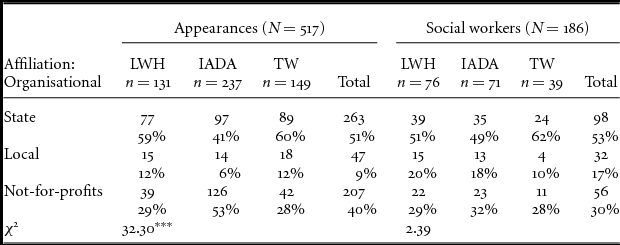
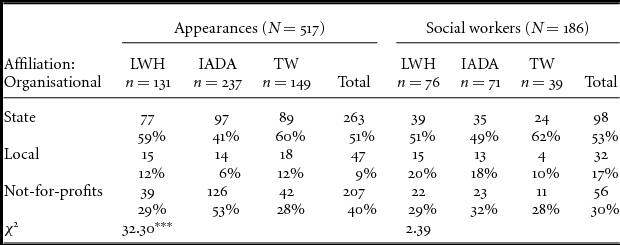
Table 1 presents the social workers’ organisational affiliation. The left-hand column presents the numbers and percentages of social worker appearances in each committee, the right-hand column the number and percentages of social workers who spoke at each committee.
Organisational affiliation, by appearances (N = 517), and by social workers (N = 186)
Notes: ***p<0.001.
Due to missing data regarding the organizational affiliation of some of the social workers, the totals in this table are not equal to the total number of appearances and of social workers in the study sample.
As can be seen, significant difference in organisational affiliation emerged in social worker appearances between the committees. The differences were between IADA and LHW (χ2= 19.27; p<0.05), and between IADA and TW (χ2= 24.03; p<0.001). More appearances by social workers from not-for-profits were made in IADA than in LWH and TW. In all three committees, the lowest percentage of appearances was by local social workers. There was no significant difference in the organisational affiliation of the social workers within each of the three committees. In each, government social workers made up the highest percentage, followed by social workers from not-for-profits, and, lastly, by local social workers. The discrepancy between the organisational distribution of the social worker appearances and the number of social workers means that social workers from not-for-profits tended to participate more often in IADA than in the other two committees.
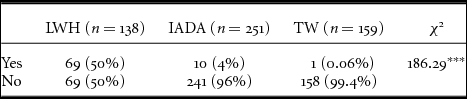
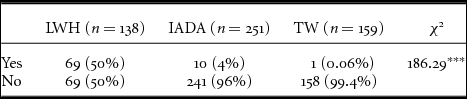
The committees chosen for analysis in this study differ in various ways, in particular with regard to the degree to which they focus on legislative issues. Table 2 provides data on the degree to which social workers’ appearances in the different committees related to legislation.
Discussion of legislation, by committee (N = 548)
Note: ***p<0.001.
The total numbers are not equal to the sample number due to missing data.
As can be seen in the table, in IADA and TW very few of the discussions in which social workers participated were devoted to legislation (4 per cent and 0.06 per cent, respectively). In sharp contrast, half of all the appearances by social workers in LWH were in meetings devoted to legislation.
Analysis
As stated above, the contents of the social workers’ inputs into Knesset committees were identified in a previous stage of the study (Weiss-Gal, forthcoming). For this part of the study, three research assistants who had helped to classify the contents coded the inputs into the three committees in accord with that classification. To perform the coding, they received training over the same ten month period during which they classified the inputs. During this period, they practiced coding the inputs into the committees whose contents were not coded to the present study. All three assistants read the same minutes, coded them separately, and then met with one of the authors of this article and each other in a group every two weeks to discuss their coding. This process continued until we reached an inter-rater agreement of 90 per cent.
At the end of the training period, each research assistant received the minutes of one of the three committees and proceeded to code the inputs in accord with the five main and twenty-three sub-inputs previously identified. As they read the minutes, they wrote down the type of input of each utterance. After completing the reading, they answered the question: What types of input are found in this minute? For the purpose of this study, reiterations of the same type of input by the same social worker were not counted. For example, if a social worker made several utterances in a minute that fell under the category of ‘providing information’, they were all coded as one ‘providing information’ input. If other social workers provided information in the same minute, another point was added for each worker's utterances in this category. If the same social worker provided information in different minutes, the provision in each was counted separately.
To ensure consistency, the authors of this article read about 15 per cent of the minutes of each committee and compared their coding with that of the research assistant. Agreement between us ranged from 85 per cent to 100 per cent per minute. Disagreements were discussed until consensus was reached. In addition, the authors made themselves available to discuss any uncertainties that the assistants raised.
Results
Frequencies of inputs
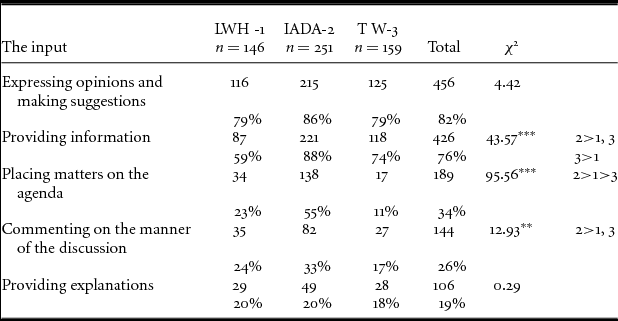
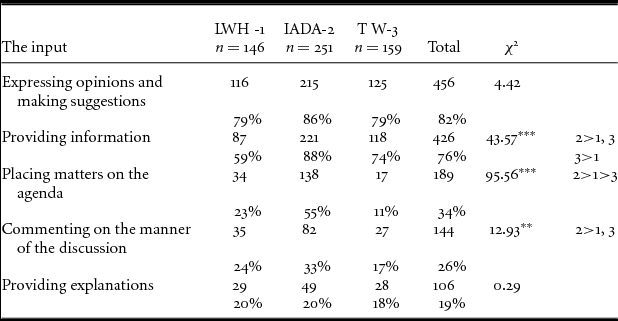
Table 3 presents the frequencies of the five main inputs in each committee. Since a single social worker could contribute more than one type of input per committee meeting, the total percentages exceed 100 per cent.
Distribution of inputs, by committee (N = 556)
Note: ** p<0.01, ***p<0.001.
As can be seen in the fourth column (Total), in all three committees the two most common inputs were (a) expressing opinions and making suggestions and (b) providing information. With total frequencies of respectively 82 per cent and 76 per cent, they were substantially more frequent than the other three inputs, whose order of frequency differs from committee to committee. Significant differences between the committees were found in the frequencies of providing information, placing matters on the agenda and commenting on the manner of the discussion. All three inputs were significantly more frequent in IADA than in the other two committees. Of all the differences, the largest by far was ‘placing matters on the agenda’, which was the third most frequent input in IADA and the least frequent in TW.
Associations of inputs with organisational affiliation
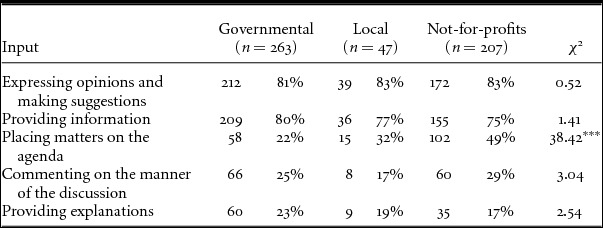
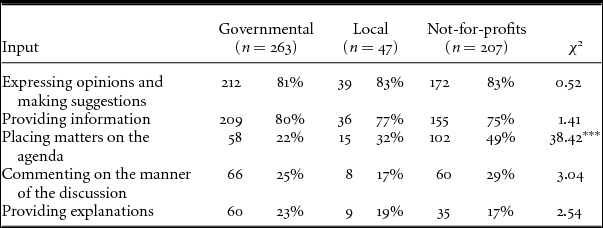
Table 4 presents the social workers’ inputs by organisational affiliation.
Distribution of inputs, by organisational affiliation (n = 517)
Note: ***p<0.001.
The total numbers are not equal to the sample number due to missing data.
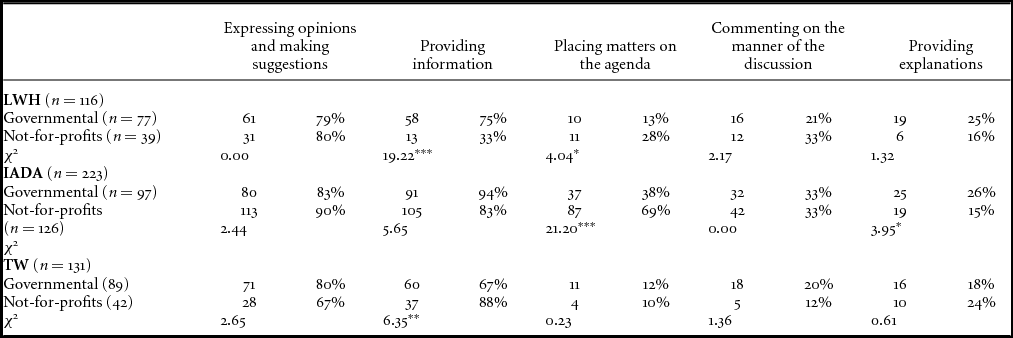
As can be seen social workers from the governmental, local and not-for-profit sectors were most inclined to express opinions and provide information, which they did at considerably higher frequencies than the frequencies with which they made the other inputs. They differed, however, in the frequencies with which they placed matters on the agenda, with not-for-profit social workers significantly more inclined to place matters on the agenda than the social workers in the other two groups, and the local social workers significantly more inclined to do so than social workers employed by the central government.
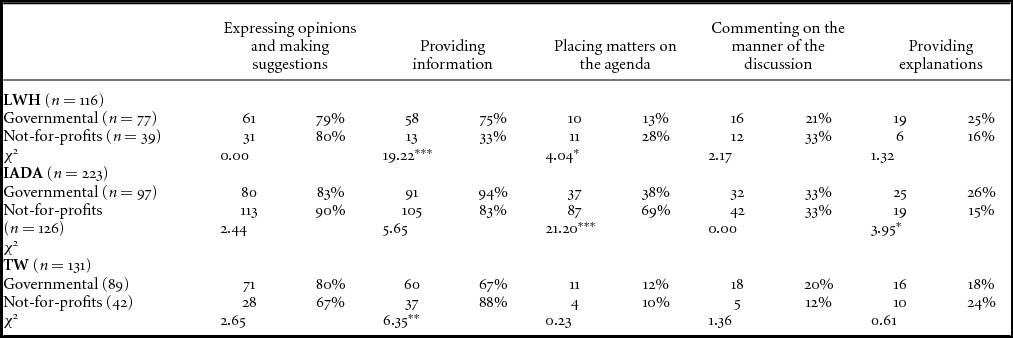
Table 5 presents the association of inputs with organisational affiliation within each committee in order to ascertain whether these differences exist within each of the committees. Due to the limited number of appearances by local social workers, we have focused here only on two, rather than three, groups – governmental and not-for-profits.
Distribution of inputs by committee and affiliation (N = 470)
Note: * p<0.05, ** p<0.01, ***p<0.001.
The findings reinforce the conclusion that, in all the committees, both governmental and not-for-profit social workers engaged more in expressing opinions and providing information. Similarly, the difference between the two sectors remained with regard to placing matters on the agenda. In two of the committees, LWH and IADA, social workers employed by not-for-profits were significantly more inclined to place matters on the agenda than those employed by government. In TW, in which this input was particularly infrequent, the difference was not significant.
The focus on the committees reveals a finding that did not appear in the previous analysis. In LWH, in their appearances, governmental social workers engaged significantly more in providing information than social workers employed by not-for-profits. In contrast to LWH, in TW the frequency of providing information by not-for-profit social workers was significantly greater than by their governmental counterparts. In IADA, there was no significant difference.
Discussion
This article seeks to elucidate the role of social workers as policy actors in parliamentary committees through a quantitative analysis of their inputs in the meetings of three parliamentary committees in the Israeli parliament over a relatively long period of time. Drawing upon a unique dataset that documents the participation of social workers in the policy process at this legislative juncture, it offers a rare empirically based perspective on the role of social workers in the social policy process and contributes to a better-informed discourse concerning the role of professionals in the formulation of social policy (Malin, Reference Malin and Malin2000; Farrell and Morris, Reference Farrell and Morris2003; Kingdon, Reference Kingdon2003).
The results revealed that, although five types of inputs were observed in the policy practice of the social workers in these committees, the two most common types of inputs were ‘expressing opinions and making suggestions’, and ‘providing information’. ‘Placing matters on the agenda’ was the third most common input though it lagged far behind the first two. ‘Commenting on the manner of the discussion’ and ‘providing explanations’ were the least frequent, although they were not marginal.
On the basis of these findings, the prime role of social workers in the parliamentary committees is that of facilitating and enriching the social policy formulation process. In other words, in the policy arena studied here, social workers were more likely to offer their opinions or provide information in order to enable policy makers to better understand social problems, existing policies or legislation, or to facilitate the creation of new policies. Social workers played a role in both the oversight and legislative functions of parliamentary committees by providing policy makers with information that apparently offered a useful contribution to the policy debate, and with informed opinions that provided a professional perspective to the policy process.
However, social workers also played a challenging role in the committees. Although placing matters on the agenda was less common among social worker policy actors than offering opinions or providing information, social workers did often endeavor to intervene in the policy process by bringing new issues to the table. Rather than only responding to requests by policy makers, they initiated debates within the committees by raising new social problems or by bringing lacunae in existing policies to the committee members’ attention. In doing so, social workers undertook a challenging role in the policy formulation process, reflecting a position advocating a more activist social work mission that can be found in professional codes of ethics (BASW, 2002; NASW, 2008) and in the critical social work discourse (e.g., Allan et al., Reference Allan, Pease and Briskman2003).
Alongside these findings, the study also shows variation in the policy practice of social workers that appears to reflect the impact of two additional factors – the organisational affiliation of social workers and the features of the institutional environment, in this case the specific legislative committee, in which they operated in as policy actors. Though the inputs most common to social worker policy actors from the different sectors in the various committees were indeed expressing opinions and making suggestions and providing information, the analysis did find variation between the sectors. The frequency by which social workers employed by not-for-profit organisations sought to place matters on the agenda in the committee meetings was significantly higher than that of state employed social workers, at the national or local levels. Yet institutions matter as much as organisations. This is clear from the variation in the types of inputs found in the various committees. Though expressing opinions and providing information were the most frequent inputs in all three committees, in IADA placing matters on the agenda was significantly more common than in the other two committees.
The central conclusion of this study, the tendency on the part of social worker policy actors (at least in the legislative arena) to play a more accommodating, rather than challenging, role in the policy process, may be a reflection of the fact that in Israel most social workers are engaged in the provision of social welfare services and are perceived by policy makers in the parliamentary committees primarily as a source of information on these services and the needs of the population groups served by them. Social workers and other professionals are typically invited to the deliberations to assist committee members to better understand diverse aspects of the legislation being discussed, the implementation of existing policies or new needs that have arisen (Hazan, Reference Hazan and Hazan2001b) and on which, it is assumed, social workers have first-hand knowledge. More broadly, the role played by social workers in parliamentary committees would also appear to reflect deeper trends within the profession. Linked to the impact of the professionalisation process, these trends enhance the tendency of social workers to accept the status quo rather than challenge it and to seek to facilitate the smooth implementation of existing policies and to shy away from critiquing them (Dominelli, Reference Dominelli1996; Hugman, Reference Hugman, Abbott and Mirabeau1998; Olson, Reference Olson2007).
However, these trends are not universal. Not surprisingly they are strongest amongst social workers embedded within the institutions of the state and less dominant among social worker policy actors employed by not-for-profit organisations. The greater tendency among social workers from not-for-profits to challenge policy makers by placing matters on the agenda would appear to reflect the claims that these social workers enjoy greater autonomy in the policy arena, are committed to advocating on behalf of their constituents and tend to challenge existing policies (Mellinger and Kolomer, Reference Melinger and Kolomer2013).
These trends are also mitigated by the institutional context within which policy practice is carried out. The finding that in IADA placing issues on the agenda was much more prevalent than in other committees reflects the fact that this committee devoted much of its deliberations to an overview function. In responding to initiatives for debate, the committee provided much more leeway for social workers, primarily from not-for-profit agencies engaged in the provision of services for immigrants or advocacy on their behalf, to challenge existing policies or to underscore social problems faced by immigrants. By way of contrast, the volume of legislative activity in LWH inevitably led to social worker participants in the committee's discussions being more likely to respond to specific issues that emerged from this legislative process rather than placing new issues on the agenda. Finally, the unique role of TW as a committee established to reflect growing pressure to address a new issue on the agenda of Israeli society, that of the trafficking of women, meant that the committee's deliberations focussed on how best to deal with this issue. As such, the social worker policy actors in this committee, even those from not-for-profit advocacy organisations, devoted their efforts to providing information on the phenomena or offering advice on how to best deal with it instead of placing matters on the agenda.
This study depicts a portrait of the social worker as policy actor that challenges the accepted wisdom of much of the discourse concerning members of this profession. Social workers here are neither obedient and passive implementers of policies, over which they have no control or input, nor are they radical critics of the social structure and the policies that maintain its stability and its unequal distribution of power and resources. Rather social workers emerge from this study as policy actors who offer diverse inputs into a complex policy formulation process. At times, they facilitate the process by providing expert opinions or information, at others they enrich the debate by drawing upon their experience at the forefront of social care provision, and frequently they bring to the process a demand to address emergent social problems or to rectify the limitations of existing policies and institutions.
While generalisation from this study is clearly limited in that it focusses upon social workers in a specific arena in the context of policy making in Israel, the findings offer empirical data in a field which lacks it. Hopefully, it will lead to additional research on policy involvement by social workers in other national settings. Much more work is required in order to study the actual impact of the policy practice of social worker policy actors in this, and other, arenas of policy formulation. The fact that other professionals, such as lawyers, physicians and psychologists, participate in legislative committee meetings suggests that a comparison of the policy involvement of various professions may also be an interesting avenue for future research.
Acknowledgement
This research was supported by The Israel Science Foundation (grant No. 3/08).