Introduction
Globally, bread wheat (Triticum aestivum L.) ranks second amongst important cereal crops after rice (Oryza sativa L.), ensuring food security to the world. It contributes approximately 20% of daily calories and protein to 4.5 billion people (Shiferaw et al., Reference Shiferaw, Smale, Braun, Duveiller, Reynolds and Muricho2013). With nearly 85% contribution to global bread wheat production, India remains the second-largest producer in the world after China with the production level of 98.30 Mt (FAOSTAT 2019). To meet future demands, current growth in wheat production (1% annually) need to be doubled. This increase has to happen while addressing the current and upcoming challenges including reduced land, reduced water availability and increased temperature due to global warming under climatic shift. Since the yield of wheat is decreased by approximately 6% with every 1°C increase above the optimum temperature of 28°C (Asseng et al., Reference Asseng, Ewert, Martre, Rotter, Lobell, Cammarano, Kimball, Ottman, Wall, White, Reynolds, Alderman, Prasad, Aggarwal, Anothai, Basso, Biernath, Challinor, Sanctis, Doltra, Fereres, Garcia-Vila, Gayler, Hoogenboom, Hunt, Izaurralde, Jabloun, Jones, Kersebaum, Koehler, Müller, Kumar, Nendel, O'Leary, Olesen, Palosuo, Priesack, Rezaei, Ruane, Semenov, Shcherbak, Stöckle, Stratonovitch, Streck, Supit, Tao, Thorburn, Waha, Wang, Wallach, Wolf, Zhao and Zhu2014), doubling the current wheat production is challenging under these circumstances.
Wheat crop is less exposed to high-temperature stress during seed germination as compared to the grain filling stage. The progress of stages of wheat anthesis up to grain filling takes place between the optimal temperature range of 12–28°C and temperature outside this range results in significant yield loss. Nagarajan (Reference Nagarajan2005) indicated heat stress (HS) at the terminal stage, to be the key reason for the decreased production of wheat in India.
Reynolds (Reference Reynolds, Reynolds, Ortiz Monasterio and McNab2001) suggested that exotic germplasm resources of bread wheat usually possess improved adaptation in HS conditions, containing additional genes responsible for stress tolerance. In this respect, information about the genetic diversity available in the gene pool for terminal HS can facilitate in widening the genetic basis of bread wheat and assists in accelerating the genetic gains to the crop. Efforts were made by various researchers to investigate the genetic diversity in bread wheat for terminal heat tolerance using diverse DNA marker systems such as inter-simple sequence repeat (Maqsood et al., Reference Maqsood, Amjid, Saleem, Shabbir and Khaliq2017), simple sequence repeats (SSRs) (Raj et al., Reference Raj, Vyas, Baranda, Joshi, Tyagi and Bagatharia2017) and single nucleotide polymorphism (SNP) (Garg et al., Reference Garg, Sareen, Dalal, Tiwari and Singh2012). Since SSRs are highly diverse and codominant, these are the widely preferred DNA markers for diversity analysis, high reproducibility and greater abundance across the genome (Gupta and Varshney, Reference Gupta and Varshney2000).
Instantly, canopy temperature depression (CTD), normalized difference vegetation index (NDVI), membrane thermostability index (MSI) and heat susceptibility index (HSI) are the major parameters that are suggestive of tolerant to HS in wheat. Genomic regions are associated with various physiological parameters for terminal HS tolerance mapped through quantitative trait loci (QTL) analysis for thousand-grain weight, CTD and MSI (Paliwal et al., Reference Paliwal, Röder, Kumar, Srivastava and Joshi2012; Talukder et al., Reference Talukder, Babar, Vijayalakshmi, Poland, Prasad, Bowden and Fritz2014; Shirdelmoghanloo et al., Reference Shirdelmoghanloo, Taylor, Lohraseb, Rabie, Brien, Timmins, Martin, Mather, Emebiri and Collins2016). Additionally, once a candidate gene identified for a particular trait and validated in a stress environment, it becomes a powerful marker system for genomic-assisted breeding.
The present study was therefore aimed to (i) characterize the diverse bread wheat genotypes using microsatellite markers, (ii) determine the marker-trait association (MTA) for terminal HS tolerance, and (iii) identify potential candidate genes of significantly associated markers using in-silico approach.
Materials and methods
Planting material
A set of 40 bread wheat genotypes comprising tolerant and sensitive exotic and indigenous genotypes including lines from Washington State University, Pullman, USA and landraces was used in the present investigation (online Supplementary Table S1). Importantly, the panel involved heat tolerant and sensitive genotypes as reported by Sharma et al. (Reference Sharma, Jaiswal, Singh, Chauhan and Gahtyari2018). The genotypes were subjected to delayed planting to expose terminal growth stage to HS conditions (online Supplementary Fig. S1)
Genomic DNA extraction
Genomic DNA was isolated from the leaves of selected wheat genotypes following the standard cetyl trimethyl ammonium bromide with some modifications. DNA concentration was determined by Eppendorf™ UV Biophotometer, where blank was set against the TE buffer. The final concentration of extracted DNA was diluted to 10 ng/μl for polymerase chain reactions (PCR).
SSR markers and PCR
A total of 180 SSR markers linked to four selected physiological parameters of CTD, NDVI, MSI and HSI, distributed throughout the genome, were employed for the present study. PCR was carried out in a 20 μl reaction cocktail comprising 50–100 ng of template DNA, 1X Taq buffer (10 mM Tris–HCl, 50 mM KCl, pH 8.3), 1.5 μM MgCl2, 0.5 μM dNTP, 0.4 μM of both the primers (forward and reverse) and 0.2 U of Taq polymerase (Thermo Fisher Scientific Mumbai, India, Pvt. Ltd.) using G-40402 thermal cycler (G-STORM, Somerset, UK). The PCR profile used for amplification was as follows: initial denaturation for 5 min at 94°C, 30 cycles of 30 s at 94°C, annealing for 30 s at 61°C and extension for 30 s at 72°C and 8 min of final extension at 72°C. Amplified fragments were resolved in 4% agarose gel and images were analysed with a gel documentation system (AlphaImager®; M/s Alpha Innotech, San Leandro, CA).
Genetic divergence and population structure analyses
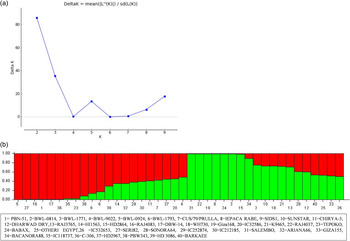
The amplified DNA of 40 wheat genotypes generated through SSR marker profiles was used for the genetic divergence and population structure analysis. The similarity matrix was generated with binary data of SSR markers using Jaccard's coefficient, which was further used to construct a dendrogram employing unweighted pair group method with arithmetical averages (UPGMA) in NTSYS-PC software (version 2.02). The estimate of discriminatory power of locus/loci is provided by values of polymorphic information content (PIC) by considering two parameters, viz. the number of expressed alleles and their relative frequency. Exploiting SSR data, a neighbour-joining (NJ) tree was constructed using DARwin software version 5.0.158, with 10,000 bootstraps. The patterns of genetic relationship contained in the matrix were visualized by PCoA (Principal Coordinates Analysis) in GenALEx 6.5. To determine population structure (Q matrix) and the subpopulation (K) in the given set, a model-based analysis was conducted with STRUCTURE. By applying the admixture model, five independent runs were conducted with 200,000 Markov Chain Monte Carlo iterations for each K value, which ranges from 1 to 10 with a burn-in length of 200. In parallel, the finest K value was obtained according to the ΔK method of Evanno et al. (Reference Evanno, Regnaut and Goudet2005) by processing the results of STRUCTURE HARVESTER.
Analysis of CTD, NDVI, HSI and MSI
The ambient and canopy temperatures for the whole plant were recorded in between 1200 and 1400 h at heading phase of the crop. CTD, abbreviated as CTD, which shows the difference between ambient temperature and canopy temperature, was measured at three different stages of crop using Infra-red thermometer, viz. CTD 1: 50% flowering, CTD II: 10 days after 50% flowering and CTD III: 20 days after 50% flowering. Normalized vegetation index (NDVI) was also observed at the same stages (NDVI I to NDVI III) as in case of CTD in each genotype, using ‘GreenSeeker’ (Trimble® GreenSeeker®) instrument.
For MSI, approximately 5 cm long segments of fully expanded uppermost leaves were excised from 10 healthy seedlings in each replication per genotype. The samples were washed twice with deionized water to remove any adherent and transferred in test tubes with 10 ml of double-distilled water. The test tubes were covered with aluminium foil. Test tubes were submerged to a height of 4 cm in the water bath at 49°C for 30 min to give high HS and then held overnight at room temperature. On the next day, electrical conductivity was measured using electrical conductivity meter followed by autoclaving the leaf tissues in test tubes and measurement of their conductance as an indication of the maximum potential leakage from a given sample. Membrane thermostability was computed by the formula: MTS = (1 − T1/T2) × 100, where, T1: conductivity before autoclaving and T2: conductivity after autoclaving (Sullivan, Reference Sullivan1972). To better characterize the HS effect, HSI was calculated as HSI = [1 − (Ys/Yt)/(1 − Xs/Xt)], where Ys: grain yield under stress, Yt: grain yield under non-stress, Xs and Xt being the mean of grain yields under stress and non-stress conditions, respectively (Fischer and Maurer, Reference Fischer and Maurer1978).
Statistical analysis
Analysis of variance (ANOVA) was performed separately for year-wise data for four selected traits using Windostat v.9.2. A combined analysis of variance was carried out for partitioning the total variance into the year, genotype and error variances. Various descriptive statistics including mean, median, standard deviation (SD), standard error, coefficient of variation, genetic advance and broad-sense heritability was computed based on four morpho-physiological traits in the genotypes. Heritability and the genetic advance were estimated following the method suggested by Johnson et al. (Reference Johnson, Robinson and Comstock1955).
Association mapping to uncover significant MTAs
The phenotypic data on CTD, NDVI, HSI and MSI traits and the genotypic data were analysed to discover significant MTAs. Two models, viz. general linear model (GLM) and mixed linear model (MLM) employed in the analysis based upon Q and Q + K matrix, respectively. TASSEL v. 3.0 was used to detect MTAs and P = 0.05 was considered as a significance threshold.
Candidate gene identification
Significantly associated SSR markers were BLAST against Triticum aestivum and Aegilops tauschii genome database employing Ensembl Plants tool, GrainGene database, PrimerBLAST (NCBI) to find the location of SSR markers and searched for gene models and encoded proteins by those regions using in Ensembls' Plant database and NCBI. The domains were identified by InterPro Scan, PROSITE and Pfam proteomic tools.
Results
SSR analysis
In the current study, 180 SSRs markers were screened for genotyping of 40 genotypes. Out of 180 SSRs, 52 markers showed polymorphism. A total of 182 amplicons (size varying between 75 and 400 bp) were produced and each marker exhibited polymorphism having an average of 2.58 polymorphic fragments per marker (online Supplementary Table S2). PIC ranged from 0.33 (barc137) to 0.51 (barc124) with a mean of 0.46 per marker. Since the plant material used for the investigation was fixed lines, hence the observed heterozygosity was zero.
Genetic divergence analysis and relationships between bread wheat genotypes
Based upon polymorphism exhibited by SSR markers, cluster analysis was performed using the unweighted NJ method. The 40 genotypes were clustered into two main groups (Fig. 1(a)) with a genetic similarity of 35%. Two clusters separated tolerant, intermediate and sensitive genotypes. Cluster I comprised a maximum of 37 genotypes, while cluster II had only three genotypes. Further, examination at the sub-cluster level suggested that most of the genotypes harboured within the same sub-cluster (A) comprising, viz. PBN51, DBW14, BWL0924 and RAJ4083 which were highly tolerant to heat and adapted to various agro-climatic zones in India. The majority of varieties, which were having a high and intermediate tolerant response to HS, belonged to sub-cluster (B). Likewise, IC252874 and BACANORA existing in sub-cluster (C) were sensitive to HS. Importantly, CUS/79/PRULLA and CHIRYA 3 from sub-cluster (D) were tolerant to HS. While sub-cluster (E) comprising cultivars, viz. HD 2967 and HD 3086 were having an adaptive mechanism for HS and are under wide cultivation in different agro-climatic zones of India, particularly HD3086 cultivar, was mainly released for late sowing. This generally coincides with HS conditions. Although, there was no distinct pattern of a phylogenetic relationship with HS response because the genotypes used in the current study belong to different genetic backgrounds and their reaction towards HS varies. Therefore, tolerant and sensitive genotypes tend to fall in the same cluster.
(a) Neighbour-joining (NJ) phylogenetic tree using SSR marker data in 40 wheat genotypes. (b) Factorial analysis of wheat genotypes based on SSR markers.

Population structure analysis
The population structure dissected in the panel containing 40 wheat genotypes was calculated using 52 SSRs and a model-based approach of STRUCTURE. For estimation of the exact population substructure (K), ten independent Ks were estimated (from K = 2 to K = 10 where K is kinship matrix). The Bayesian-based clustering analysis divided the population into two main groups (Fig. 2(a)), but the differentiation at K equals to 2, were almost consistent with pedigree knowledge with few exceptions. The first subpopulation mainly comprised of the exotic cultivars and two Indian tolerant cultivars, whereas the rest of the genotypes remained in the second subpopulation representing predominantly the released cultivars and germplasm accessions.
(a) K and ΔΚ relationship based on STRUCTURE analysis of wheat genotypes and (b) Gene pool introgression based on the population structure analysis at K = 2.

The clustering pattern inferred by factorial analysis was further validated by STRUCTURE analysis. The kinship analysis indicated most lines had no or weak relationship with the other lines in this wheat panel, which is in agreement with various sources of the collected lines. However, exploiting Structure bar plot (Fig. 2(b)), the entire population was sectioned into 2 sub-populations where each genotype had its estimated membership in the respective subgroup ranging from 52% to 99%. Thus, the knowledge of introgression in the genotypes helped to group the genotypes better than a dendrogram. The genotypes existing in a subpopulation of STRUCTURE are distributed in all the four quadrants. But the genotypes of the subpopulation 1 of STRUCTURE are mainly present in quadrants I and IV of factorial analysis (Fig. 1(b)). In contrast, the genotypes of II subpopulation of STRUCTURE are primarily characterized by quadrants II and III.
Analysis of CTD, NDVI, MSI and HSI
Combined ANOVA of the physiological traits recorded over 2 years suggested significant genetic difference among the genotypes (Table 1). For these four traits, values for the range, median, standard error, and coefficient of variation are given in online Supplementary Table S3. Additionally, the frequency distributions for the four selected traits are shown in online Supplementary Fig. S2. The HSI on grain yield classified whole genotypes into tolerant, intermediate and sensitive classes. The HSI value varied from 0.25 to 1.24 for tolerant to sensitive types. Of 40 genotypes 19 were heat-tolerant (HSI, <0.05), 8 were intermediate (HSI, 0.05–1.00) and 13 were heat-sensitive genotypes (HSI, >1.00). The high heritability (h2) estimates were observed for all the physiological traits and ranged from 0.64 (HSI) to 0.89 (NDVI). The higher estimates of heritability were recorded for NDVI (89%), MSI (82%) and CTD (70%) in comparison to HSI (64%). The genetic advance estimates varied from 11.67 (NDVI I) to 77.62 (CTD III). High heritability, coupled with high genetic advance, was observed for CTD II, CTD III, NDVI III, MSI and HSI. This indicates that selection for these physiological traits would help in the improvement of stress-tolerant cultivars.
Combined ANOVA for CTD, NDVI, MSI and HSI traits (2017 and 2018).

Note: **Significant at p<0.01.
Association analysis
We attempted to discover MTAs through analysing the genotyping data of 52 SSRs and four traits with GLM and MLM approaches. Concerning the analysis of CTD I, II, III (year 2017) with GLM, the markers wmc89, wmc408, barc124, cfd58 and barc183 showed significant associations, with phenotypic variation (PV) ranging from 9.83 to 22.19% (Table 2). On the other hand, analysis with MLM approach for CTD (year 2017) exposed noteworthy association of four SSR markers (wmc491, barc124, wmc89 and barc183) with the trait accounting for PVs in the range of 9.63 and 5.34% (Table 3). Importantly, the association of one SSR marker barc183 with CTD trait was evident by both GLM and MLM in 2 years (2017 and 2018). Likewise, for NDVI I, II, III data (2017), GLM revealed that the SSRs gwm75, gwm484, cfd7, barc8, barc229, cfd3 and cfd7 had a significant association with the trait. In the case of MLM, the association of two SSR markers gwm75 and cfd7 with the NDVI could be established. For MSI data (2017), both the models revealed that two SSRs gwm34 and wmc222 had a significant association with the trait. Likewise, for HSI data (2017), GLM revealed that the SSRs wmc474 and barc49 had a significant association with the trait. In the case of MLM, the association of one SSR marker, i.e. cfd43 with the NDVI value could be established.
Significant MTA and per cent phenotypic variation of CTD, NDVI, MSI and HSI traits by Q GLM approach

Significant MTA and per cent phenotypic variation of physiological traits by Q + K MLM approach

In 2017–18, GLM analysis suggested that wmc89, wmc818, barc124, cfd21, cfd58 and barc183 markers had a noteworthy association with CTD. In the case of MLM, the association of three SSR markers wmc818, cfd58 and barc183 with CTD could be established. The momentous association of the SSR marker in GLM approach (gwm75, wmc222, barc49, cfd398, gwm484, cfd7, barc8, barc229, cfd3 and cfd7) and MLM approach (gwm75 and cfd7) with NDVI value was obtained. GLM and MLM analyses showed a noteworthy association with two SSR markers gwm34 and wmc222 (P < 0.05) with MSI. For HSI, GLM analysis in 2017 showed significant association with three SSR markers gwm11, gwm75 and wmc73. In the case of MLM analysis, two SSR markers gwm11and gwm75 showed significant association with HSI (P < 0.05). Two important pair of markers, viz. gwm75 and cfd7 for NDVI trait and wmc222 and gwm34 for MSI trait showed consistently significant MTA over the years (2016–17 & 2017–18) for analysis of both the models. These results were consistent in both the years and in both GLM and MLM models, which represent the strong MTAs in both the years and could be utilized in the marker-assisted selection programmes.
Candidate gene identification
The genomic regions of significantly associated 21 SSR markers (Table 4), when searched for candidate genes using in-silico tools, eight were identified as a part of gene models. For CTD-linked two SSRs, viz. cfd21 and barc124, two proteins including wall-associated receptor kinase 3 and TaAP2-B, respectively, were predicted in their genomic regions. Four proteins viz. an unplaced scaffold of potassium/sodium hyperpolarization-activated cyclic nucleotide-gated channel-4-like protein, COP-1-interacting protein (CIP), vacuolar protein sorting associated protein 13 (VPS 13) and membrane transport protein consisting of PIN-LIKE protein domain were predicted for NVDI linked SSRs, i.e. barc8, barc49, barc229 and cfd7. Similarly for 3 HSI-linked SSRs, four proteins viz. COP1-interacting protein (CIP) -related family of proteins and vacuolar protein sorting associated protein 13 (VPS 13), a protein having the MATH/TRAF (Meprin and TRAF homology) and BTB/POZ (Broad complex tramtrack/POX virus and zinc finger) domains for barc49, phospholipid hydroperoxide glutathione peroxidase for cfd43 and uncharacterized protein carrying PAZ (Piwi Argonaute and Zwille) and argonaute were predicted for wmc474 (Table 4).
Potential candidate gene for the significant MTAs and their functions

Discussion
To improve the genetic gain for any trait in the crop, understanding of the genetic diversity is an essential criterion. Identification of novel alleles and their introduction to the presently cultivated gene pool provide potential to break yield plateau and imparting terminal HS (Tadesse et al., Reference Tadesse, Rajaram, Ogbonnaya, Sanchez-Garcia, Sohail, Baum, Singh and Kumar2016). In this regard, a molecular marker such as SSR acts as a promising tool for revealing the genetic diversity at the DNA level. Also, markers systems have been beneficially recruited to access MTA to accelerate trait improvement in wheat. The present study identified 182 alleles with a mean of 2.58 alleles per locus were recovered from 40 bread wheat genotypes assayed with 52 polymorphic SSRs. The results suggested a moderate level of genetic diversity present in the studied panel. These findings were in agreement with the earlier reports (Kumar et al., Reference Kumar, Talukdar, Bala, Verma, Lal, Sapra, Namita, Chander and Tiwar2014; Raj et al., Reference Raj, Vyas, Baranda, Joshi, Tyagi and Bagatharia2017), which suggested adequate genetic diversity among cultivated bread wheat genotypes. The PIC ranged from 0.33 to 0.51. Such considerable differences in the less number of alleles detected and moderate PIC value may be explained because of the difference in the diversity of the lines used, the number of lines examined, and the genotyping method used (Gupta and Varshney, Reference Gupta and Varshney2000). Inclusion of wild species, landraces and advanced breeding lines could have resulted in a greater number of alleles per locus and higher PIC values as suggested by Tadesse et al. (Reference Tadesse, Rajaram, Ogbonnaya, Sanchez-Garcia, Sohail, Baum, Singh and Kumar2016). The PIC values and an average number of alleles per locus have shown a strong positive association with each other, which is following the earlier studies.
Trends of increasing genetic diversity based on higher PIC values were also reported by earlier researchers (Ramya et al., Reference Ramya, Jain, Singh, Singh and Prabhu2015; Chander et al., Reference Chander, Bhat, Kumari, Sen, Gaikwad, Gowda and Dikshit2017). The selected genotypes were grouped into two major clusters collected from different regions having tolerant, intermediate and sensitive response towards HS. Clustering of the population into two distinct groups represents the difference between population diversity and indicates a significant influence of the environment on genetic diversity. The sensitive genotypes were grouped in the second cluster, while the first cluster harboured mainly tolerant and intermediate cultivars for HS. The sub-clusters (A-E) contained a different set of tolerant genotypes. The grouping of tolerant, sensitive and intermediate genotypes into separate clusters reflected in our study was similar to the results demonstrated by Nagar et al. (Reference Nagar, Singh, Arora, Dhakar and Ramakrishnan2015). Additionally, Ramya et al. (Reference Ramya, Jain, Singh, Singh and Prabhu2015) also evidenced grouping of 92 bread wheat genotypes into different clusters based on tolerance reaction towards HS. Importantly, the crossing of tolerant genotypes from the different cluster will be useful for improving HS tolerance trait in bread wheat cultivars. Moreover, results of UPGMA and sub-cluster analysis indicated an ample amount of genetic diversity amongst the cultivars released for the different agro-climatic zone.
Population structure analysis deciphers the prevailing genetic diversity over the collection. In recent years, previous studies have shed light on the genetic structure of bread wheat using SSR and SNP markers (Kamil et al., Reference Kamil, AL-Jobori and AL-Tamemy2018). In our analysis, the patterns arising from STRUCTURE were consistent with those obtained from distance-based clustering methods (NJ and PCoA analyses). Of the two major clusters, tolerant and intermediate cultivars grouped within one cluster, while the other group retained the sensitive cultivars. Explaining the genetic construction of complex traits in crops is indispensable for accelerated trait improvement and association mapping has emerged as a rapid technique in this respect. In bread wheat, genome-wide genetic variants showing association with a range of agriculturally important traits including drought, HS, leaf rust, 100 seed weight, thousand-grain weight, seed protein content were discovered by employing association genetics (Qaseem et al., Reference Qaseem, Qureshi, Muqaddasi, Shaheen, Kousar and Röder2018). In the cultivated gene pool of bread wheat, very less variability is available mainly for HS tolerance due to the similar genetic background of reduced height (rht) genes. The replacement of available rht background with other reduced height genes could enhance the genetic diversity for the particular trait which would help to break the yield plateau (Tadesse et al., Reference Tadesse, Rajaram, Ogbonnaya, Sanchez-Garcia, Sohail, Baum, Singh and Kumar2016). Many physiological factors which are mainly involved in the photosynthesis, translocation of photosynthates and sugar starch inter-conversion affect the complex trait of HS. In this context, the identification of DNA-based markers that could help rapid selection of traits under HS tolerance is of great significance. The CTD, NDVI, MSI and HSI traits have been extensively studied for the improvement of tolerance to HS in several crops such as sorghum (Sullivan, Reference Sullivan1972) and rice (Anantha et al., Reference Anantha, Patel, Quintana, Swain, Dwivedi, Torres, Verulkar, Variar, Mandal, Kumar and Henry2016). Significant genetic variation for these physiological traits is in line with the earlier observations documented in wheat for CTD, NDVI, MSI and HSI under HS (Sharma et al., Reference Sharma, Jaiswal, Singh, Chauhan and Gahtyari2018). High heritability was recorded for NDV (89%), MSI (82%) and CTD (70%) in comparison to HSI (64%). To the best of our information, the present study is the first report of MTAs for four important physiological traits associated with HS tolerance, viz. CTD, NDVI, MSI and HSI in bread wheat.
Importantly, we found two SSR markers gwm75 and cfd7 for NDVI trait and two markers wmc222 and gwm34 for MSI trait showing consistently significant MTA. SSR markers viz. barc183, gwm75, gwm11, cfd7, wmc222 and gwm34 showed stable MTAs with CTD, NDVI, MSI and HSI traits. Considering membrane injury, CTD, HSI and chlorophyll content as important physiological traits for drought tolerance in wheat, Elshafei et al. (Reference Elshafei, Saleh, Al-Doss, Moustafa, Al-Qurainy and Barakat2013) identified five SRAP (sequence-related amplified polymorphism) markers linked to chlorophyll content as major QTL with PV up to 53%. Kuchel et al. (Reference Kuchel, Fox, Reinheimer, Mosionek, Willey, Bariana and Jefferies2007) reported the association of gwm11 with yield under high-temperature stress. In a report, five stable QTLs associated with HSI were present on single grain weight (1A and 2A), grain number (2B and 3B) and grain weight (3B) with 22% of PV (Mason et al., Reference Mason, Hays, Mondal, Ibrahim and Basnet2013). The QTLs for CTD was reported on chromosome 4A, 3B with 22% PV, 2B, 7B and 7D with 15% PV (Paliwal et al., Reference Paliwal, Röder, Kumar, Srivastava and Joshi2012). Recently, five QTLs associated with plasma membrane damage, chlorophyll content and damage of thylakoid membrane were reported on chromosome number 1B, 1D, 2B, 6A and 7A explained up to 33.5% of the PV (Talukder et al., Reference Talukder, Babar, Vijayalakshmi, Poland, Prasad, Bowden and Fritz2014).
Limited investigations have been carried out that describe the candidate genes and their corresponding function for CTD, NDVI, membrane stability and heat susceptibility-related traits regarding HS tolerance in plants. HS results in an oxidative burst in the cell, which is followed by a rise in the expression of several proteins like antioxidant enzymes, HSPs and protein kinases. These proteins protect the denaturation and aggregation of nascent proteins which are involved in various biochemical reactions, thus modulate the defensive actions of wheat. In our current study, the candidate genes AET7Gv20347000 and AB749309 underlying CTD associated cfd21 and barc124 markers' region were predicted to encode wall-associated receptor kinase 3-like protein and TaAP2-B, respectively. This protein product was reported to be involved in abiotic stress tolerance in the plant (Xia et al., Reference Xia, Yin, Zhang, Shi, Lian, Zhang, Hu and Shen2018). The TaAP2-B gene encodes the protein possessing DNA-binding motif found in some transcription regulators of plants viz. APETALA2 (AP2) and EREBP (ethylene-responsive element-binding protein). These factors play a pivotal role in adaptation to biotic and abiotic stresses, such as those caused by pathogens, wounding, cold and HS, UV light, drought, and salinity. The markers barc8 and barc49 associated with NDVI and HSI were found to reside within the genomic region that encodes potassium/sodium hyperpolarization-activated cyclic nucleotide-gated channel-4-like protein, COP-1-Interacting protein (CIP) and vacuolar protein sorting associated protein 13. Wang et al. (Reference Wang, Munemasa, Nishimura, Ren, Robert, Han, Puzõrjova, Kollist, Lee, Mori and Schroeder2013) reported the role of cyclic nucleotide-gated channels (CNGC) in stress management of various plants. Acquired thermotolerance in plants furnished by Arabidopsis CNGC6 through mediating heat-induced Ca2+ influx and thereby triggers expression of heat HSP genes. CIP exhibits function for transcriptional activation, thus controlling light-regulated genes positively (Yamamoto et al., Reference Yamamoto, Matsui, Ang and Deng1998).
The plasma membrane is the primary sensor of heat in plants (Hofmann, Reference Hofmann2009). Any adjustment in cell membrane fluidity can be detected through integral membrane proteins, viz. ion channels and transporters, membrane-anchored receptor-like kinases, and we observed NDVI-associated marker cfd7 coincided with genomic region encoding membrane transport protein consisting of PIN-LIKE protein domain. NDVI associated SSR marker barc229 was predicted in the region of a gene containing NFACT-RNA binding domains (RBPs). Recent reports supported the important role of these proteins in the attainment of heat tolerance (Zhu et al., Reference Zhu, Zhu, Guo, Zhu, Wang and Liu2013). Likewise, HSI-associated cfd43 marker region was predicted to encode phospholipid hydroperoxide glutathione peroxidase, which are involved in imparting abiotic stress tolerance as elucidated from its higher expression in Arabidopsis (Chiang et al., Reference Chiang, Chien, Chen, Hsiung, Chiang, Chen and Lin2015). However, further confirmation of the MTAs established in the present study will be required to further confirm in other genetic backgrounds before deploying these DNA markers in breeding bread wheat for HS tolerance.
Conclusions
We concluded that the genetic diversity for HS among indigenous and exotic cultivars could be exploited for widening the genetic base of bread wheat and breeding superior bread wheat cultivars tolerant to HS. After validation of the preliminary results of association mapping for CTD, NDVI, MSI and HSI might be helpful in the future for the screening of HS tolerance genotype. The candidate genes which were identified in the present investigation may be explored in greater detail and other genetic backgrounds for better understanding of HS tolerance in bread wheat. The predicted candidate genes for HS tolerance can be further investigated in various sequencing platforms for developing DNA-based markers which can be utilized for developing heat-tolerant wheat varieties.
Supplementary material
The supplementary material for this article can be found at https://doi.org/10.1017/S1479262120000131.
Acknowledgements
Financial help received from Department of Biotechnology (DBT), Government of India under the project entitled ‘Genetic dissection of heat tolerance in wheat using multiple bi-parental RIL mapping populations’ [Sanction No. BT/PR10957/AGII/106/970/2014] is thankfully acknowledged. Authors are thankful to Director Research, G. B. Pant University of Agriculture and Technology, Pantnagar-263 145 (Uttaranchal, India) for providing research facilities and Washington State University, Pullman, USA for sharing the research material. The lab facility provided by Dr N. K Singh and Dr Poonam is duly acknowledged.
Conflict of interest
The authors declare that they have no conflicts of interest