There is accumulating evidence on the association between spirituality and mental health during adolescence (James & Miller, Reference James and Miller2017; Yonker et al., Reference Yonker, Schnabelrauch and DeHaan2012). However, empirical knowledge on what specific aspects of mental health are associated with spirituality is limited, and theoretical explanations for the mechanisms underlying this association is scarce. Furthermore, the existing literature primarily focuses on Christian participants in Western societies (Hood et al., Reference Hood, Hill and Spilka2009; Yonker et al., Reference Yonker, Schnabelrauch and DeHaan2012). Empirical knowledge about how spirituality is related to health outcomes among individuals from other religious backgrounds is needed. The present study aimed to address this gap by examining associations between spirituality and three aspects of self-perceived mental health, including life satisfaction, externalizing problems (expressing distress outwards, such as aggressive behaviors, attention problems, and hyperactivity; Kelly et al., Reference Kelly, Newton, Stapinski, Slade, Barrett, Conrod and Teesson2015), internalizing problems (turning distress inwards, such as anxiety, depression, and withdrawal; Kelly et al., Reference Kelly, Newton, Stapinski, Slade, Barrett, Conrod and Teesson2015), in adolescents from diverse religious backgrounds in two non-Western countries, India and the United Arab Emirates (UAE). Additionally, in an attempt to gain a better understanding of the spirituality–mental health association in adolescents, we examined mediating and moderating factors (self-control, country, gender). Given the crucial role that self-control plays in adolescents’ well-being (Burnette et al., Reference Burnette, O’boyle, VanEpps, Pollack and Finkel2013), coupled with evidence on the influential role of spirituality on self-control (Aldwin et al., Reference Aldwin, Park, Jeong and Nath2014; McCullough & Willoughby, Reference McCullough and Willoughby2009), we hypothesized that self-control would mediate the spirituality–mental health association. Finally, this study examined the moderating role of country and gender to explore the universality and applicability of this association to different adolescent populations. This study will enhance our theoretical understanding of the complex relations between spirituality and mental health in adolescence and could have meaningful implications for how parents, school administrators, and mental health practitioners view spirituality in relation to adolescents’ mental health outcomes.
Spirituality and mental health
Spirituality can be defined as the internal, personal, and emotional expression of the sacred, and as an inner sense of one’s relationship to a higher power, which might be God, the universe, nature, or anything that represents a divine presence, which may or may not include religion (Cotton et al., Reference Cotton, Zebracki, Rosenthal, Tsevat and Drotar2006). Miller (Reference Miller2016) argued that spirituality refers to the fact that a person has faith in a higher source that has an active and guiding place in the individual’s daily life. The present study focused on spirituality and its effect on mental health, rather than other aspects of religiousness such as religious affiliation, as increasing evidence points to the positive effects of spirituality on mental health (Koenig, Reference Koenig2010; Yonker et al., Reference Yonker, Schnabelrauch and DeHaan2012).
With regards to mental health outcomes in adolescence, we focused on the aspects of life satisfaction, internalizing problems, and externalizing problems, as developmental psychology research has identified these as key domains of functioning among youth. One important aspect is positive mental health in youth or subjective well-being and many studies have associated this aspect with markers of developmental success (Busseri et al., Reference Busseri, Choma and Sadava2012; Keyes, Reference Keyes2006; Ronen et al., Reference Ronen, Hamama, Rosenbaum and Mishely-Yarlap2016). Subjective wellbeing has been defined as the evaluation that individuals make on the quality of their own lives (Keyes, Reference Keyes2006). Internalizing problems include anxious and depressive symptoms, while externalizing problems include hyperactivity and aggression, both of which are prevalent among adolescents and associated with psychological impairment (Kuhn, Reference Kuhn2019).
A recent meta-analysis of research on spirituality and mental health outcomes in adults, including 48 longitudinal studies, showed that spirituality was significantly associated with positive mental health outcomes (see Garssen et al., Reference Garssen, Visser and Pool2021 for a review; effect size: .06–.10), including better life satisfaction, well-being, and quality of life. Other reviews have shown associations of spirituality with lower levels of distress, internalizing problems, and externalizing problems (see Kao et al., Reference Kao, Peteet and Cook2020 for a review; Kim et al., Reference Kim, Miles-Mason, Kim and Esquivel2013; Marques et al., Reference Marques, Lopez and Mitchell2013). Such positive outcomes were also found for adolescents, with a recent review showing that spirituality promoted youth’s psychosocial health (James & Miller, Reference James and Miller2017). A meta-analytic review of 75 independent studies encompassing 66,273 adolescents and young adults showed significant main effects of spirituality on mental health outcomes, such as depression, wellbeing, and self-esteem (Yonker et al., Reference Yonker, Schnabelrauch and DeHaan2012). Overall, for adolescents, the findings support small to moderate yet significant relations between spirituality and better mental health outcomes (James & Miller, Reference James and Miller2017; Yonker et al., Reference Yonker, Schnabelrauch and DeHaan2012).
To better understand the mechanisms underlying the spirituality–mental health link, the current study investigated direct and indirect associations. Among potential mechanisms that have been hypothesized to explain the positive effects of spirituality on mental health outcomes in adolescents, health-related practices, such as eating habits, alcohol and substance use, and cognitive processes such as self-regulation, have received much empirical attention (e.g., McCullough & Willoughby, Reference McCullough and Willoughby2009; Salas-Wright et al., Reference Salas-Wright, Olate and Vaughn2013; Yoo et al., Reference Yoo, Slack and Holl2009). The present study focused on investigating the mediating influence of self-control, since this construct has been identified as a transdiagnostic risk factor for internalizing and externalizing psychopathology (Karoly, Reference Karoly2010; Strauman, Reference Strauman2017). Importantly, self-control has been strongly correlated with spirituality and mental health outcomes independently (Boals et al., Reference Boals, vanDellen and Banks2011; Desmond et al., Reference Desmond, Ulmer and Bader2013; Duckworth et al., Reference Duckworth, Taxer, Eskreis-Winkler, Galla and Gross2019; Fergusson et al., Reference Fergusson, Boden and Horwood2013; Moffitt et al., Reference Moffitt, Arseneault, Belsky, Dickson, Hancox, Harrington, Houts, Poulton, Roberts, Rodd, Sears, Thomson and Caspi2011; Rounding et al., Reference Rounding, Lee, Jacobson and Ji2012). Moreover, self-control is developing and maturing during the adolescent developmental period (Backes & Bonnie, Reference Backes and Bonnie2019; Burnette et al., Reference Burnette, O’boyle, VanEpps, Pollack and Finkel2013).
The importance of self-control
Self-control refers to the capacity to initiate and control one’s emotions, thoughts, and behaviors to support a desired outcome or prevent an undesired outcome (Karoly, Reference Karoly1993). In other words, the exertion of self-control involves modification of response tendencies to achieve a highly valued short-term or long-term goal. Consequently, this cognitive process supports a number of adaptive, and prevents a number of maladaptive, psychological and behavioral tendencies. It is no surprise that self-control has been linked to a myriad of positive mental health outcomes. For example, results from a 30-year longitudinal study with 1,142 individuals demonstrated that childhood self-control had significant positive associations with better mental health outcomes and educational and career success in adulthood, and had significant negative associations with substance use, criminal offending, and internalizing problems (Fergusson et al., Reference Fergusson, Boden and Horwood2013). Other studies in the field have shown similar results – higher self-control has been associated with lower rates of alcohol use, substance abuse, depression, and perceived stress and with higher/better self-esteem, life satisfaction, interpersonal relationships, and academic achievement (Boals et al., Reference Boals, vanDellen and Banks2011; Duckworth et al., Reference Duckworth, Taxer, Eskreis-Winkler, Galla and Gross2019; Moffitt et al., Reference Moffitt, Arseneault, Belsky, Dickson, Hancox, Harrington, Houts, Poulton, Roberts, Rodd, Sears, Thomson and Caspi2011; Rawn & Vohs, Reference Rawn, Vohs, Vohs and Finkel2006).
Given the strong evidence for self-control promoting mental health outcomes, we hypothesized that the association between spirituality and mental health may be through one’s self-control. This hypothesis was based on the proposed theory that the evolution of religion is related to the cultural adaptation to promote self-control through many possible explanations, such as spiritual individuals may self-monitor in the fear of a higher power. Therefore, we speculated that spirituality fosters the exercise of self-control, which leads to beneficial outcomes in a variety of behavioral and psychological domains. Prior research also supports this theorizing, with evidence that spirituality promotes self-regulatory behaviors (Aldwin et al., Reference Aldwin, Park, Jeong and Nath2014; McCullough & Willoughby, Reference McCullough and Willoughby2009), including self-control (Desmond et al., Reference Desmond, Ulmer and Bader2013; Rounding et al., Reference Rounding, Lee, Jacobson and Ji2012).
The relation between spirituality and self-control, and between self-control and mental health outcomes, is especially salient during adolescence, a period of intensive development in the physical, psychological, and behavioral domains (Backes & Bonnie, Reference Backes and Bonnie2019). The transition to adolescence is followed by a demand for higher self-control in several domains (e.g., academics, social; Burnette et al., Reference Burnette, O’boyle, VanEpps, Pollack and Finkel2013). Accordingly, adolescence is a developmental period when cognitive self-control abilities not only mature, but there is also an increased demand for their use (Choudhury et al., Reference Choudhury, Blakemore and Charman2006). Additionally, adolescence is a period of increased autonomy for making decisions and a time of identity formation (e.g., Becht et al., Reference Becht, Nelemans, Branje, Vollebergh, Koot, Denissen and Meeus2016; Klimstra et al., Reference Klimstra, Hale, Raaijmakers, Branje and Meeus2010; Meeus et al., Reference Meeus, Iedema, Helsen and Vollebergh1999), where adolescents explore and engage in different activities and contemplation of different constructs including spirituality.
Importance of examining the role of spirituality in mental health outcomes in non-Western societies
Despite the importance of examining the role of spirituality and self-control in predicting better mental health outcomes among adolescents, a major limitation of the current literature is its dominance by studies with Christian participants in Western countries (e.g., Hood et al., Reference Hood, Hill and Spilka2009; Yonker et al., Reference Yonker, Schnabelrauch and DeHaan2012). Reviews of the literature on the association between spirituality and mental health demonstrated that Christian participants were the sole focus in 38% of the studies (Yonkers et al., Reference Yonker, Schnabelrauch and DeHaan2012) and that majority of the studies (92%) were carried out in samples from Western countries (Garssen et al., Reference Garssen, Visser and Pool2021). Empirical knowledge about how spirituality is related to self-control, and in turn mental health outcomes among adolescents from other religious backgrounds, such as Islam and Hinduism, and from non-Western countries is scarce. This study extends existing literature on the outcomes of spirituality for mental health to adolescents from diverse religious backgrounds and two non-Western countries, namely India and the UAE. Even though India and the UAE are representative of Eastern countries, participants in our sample from these two countries are different in a few ways that are important when discussing this topic.
Both India and the UAE are culturally very similar in that they are both collectivistic Eastern cultures with similar societal laws and customs that place the needs of the group above that of the individual (Hofstede, Reference Hofstede2011). As a result, the primary analyses in this study involves the entire sample including participants from both countries, thereby extending our empirical knowledge of the spirituality–mental health link beyond Western societies. However, these two countries differ in a few important characteristics that warrants examination of country as a moderator of this association. The UAE government is a federal absolute monarchy, while India is a federal parliamentary constitutional republic. Secondly, although both countries have high levels of religious diversity, the official religion in UAE is Islam, while India has no official state religion. Another important and relevant distinction is that the UAE is less populous and more economically stable than India. In terms of socioeconomic status (SES), the median annual household income in United States Dollars is $2,130 in India and $43,470 in the UAE (World Bank, 2019). Similarly, the average years of education is 5.1 years in India and 12 years in the UAE. The risk for child malnutrition is considerably higher in India compared to the UAE, with India being home to 46.6 million stunted children (World Bank, 2019). Finally, India has been reported to have three times more crime than the UAE, with the UAE having very low crime rates overall. All of these factors could play a crucial role in influencing associations between spirituality, self-control, and mental health in an adolescent’s life.
Potential moderators of the relation between spirituality and mental health
SES has been associated with the adoption and role of spirituality in an individual’s life, although the current literature on this topic is mixed. Whereas some researchers have shown that individuals with high SES report significantly lower levels of spirituality (Schieman, Reference Schieman2010), other researchers have found positive associations between SES and spirituality (Krause et al., Reference Krause, Pargament and Ironson2017). Secondly, even though there is a large literature on self-control as a protective factor for positive mental health outcomes (Fergusson et al., Reference Fergusson, Boden and Horwood2013), it is important to examine the utility of this protective factor in different environmental contexts and how it changes according to associations between the adolescent and their immediate environment. Considering this, the present study examined the moderating influence of country on the spirituality–mental health association, in the context of non-Western societies and cultures.
It is also important to examine the moderating role of gender in this association as current research is mixed on this topic. With empirical evidence showing that women are more spiritually inclined than men, it is no surprise that several studies have found that the relations between spirituality and psychological wellbeing were generally stronger for females compared to males (Buchko, Reference Buchko2004; Smith & Denton, 2005; Vosloo Reference Vosloo2009). However, some studies that examined the association between spirituality and mental health outcomes did not find a moderating influence of gender (Reid-Arndt et al., Reference Reid-Arndt, Smith, Yoon and Johnstone2011; Rohyatin et al., Reference Rohyatin, Merlyn, Latipun and Iswinarti2020). As a result, the present study also explored the moderating role of gender in the association between spirituality and mental health outcomes in two non-Western countries.
The present study
The present study aimed to examine direct and indirect associations between spirituality and mental health in adolescents from diverse religious backgrounds, residing in two non-Western countries. Extending upon prior research using predominantly Christian groups and Western populations (Hood et al., Reference Hood, Hill and Spilka2009; Yonker et al., Reference Yonker, Schnabelrauch and DeHaan2012), we explored direct relations between spirituality and three different aspects of mental health (life satisfaction, internalizing problems, and externalizing problems), and hypothesized that higher levels of spirituality would be associated with higher levels of life satisfaction and lower levels of internalizing and externalizing problems. Based on theoretical and empirical evidence for associations between spirituality and self-control, and between self-control and mental health outcomes, we tested the mediating influence of self-control on this relation and hypothesized that higher levels of spirituality would be associated with increased self-control abilities which, in turn, would relate to better mental health outcomes. Finally, we investigated the moderating influence of gender and country on this association and expected that this association would be stronger for females and individuals from the UAE given various country variables, based on existing literature.
Method
Participants
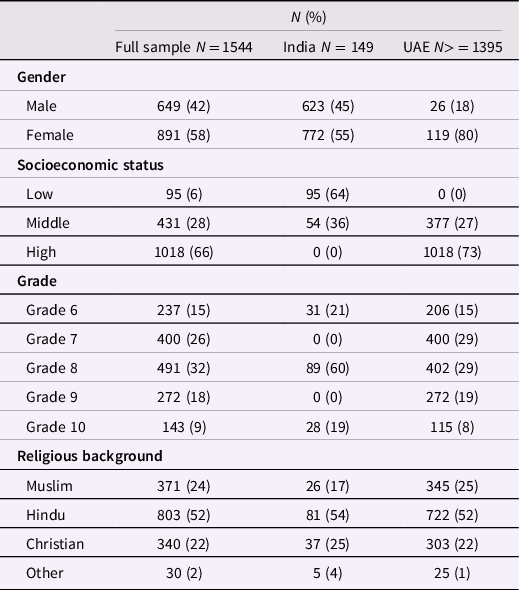
Participants were 1,544 adolescents recruited from 16 different schools in Abu Dhabi, UAE (9 private schools; 4 public schools) and in Chennai, India (3 private schools). Students were between 11 and 15 years of age (M = 13.21 years, SD = 1.15). The sample consisted of 58% girls and 42% boys. The schools in Chennai and Abu Dhabi had a population of students from different religious and socioeconomic backgrounds. Among adolescents from India, 64% of students came from low family affluence backgrounds and 36% of students came from moderate family affluence backgrounds; among adolescents from the UAE, 27% of students came from moderate family affluence backgrounds and 73% from high family affluence backgroundsFootnote 1 . Additional student demographic information can be found in Table 1.
Student demographic statistics

Procedure
The study protocol was approved by the university’s Institutional Review Board, the Abu Dhabi Education Council and by the psychology department at a local university in Chennai, India. Following this, principals of schools were contacted and detailed information about the study was provided. Once principals approved participation of their schools, classes in the targeted age range (grades 6–9) were invited to participate. Parents’ written consent was waived for this study because the survey was evaluated as being similar to other evaluations at the school level. The response rate of students within schools was high (96%), indicating that the sample was representative of the targeted student population within the participating schools. The data was collected in the school auditorium or classrooms, with two undergraduate research assistants and at least one teacher being present. Students were introduced to the study following a standardized protocol and then completed a self-report questionnaire independently. The time of completion ranged between 40 and 60 minutes. After a debriefing, students received a chocolate bar for participation.
Measures
Spirituality
Spirituality was measured using the Santa Clara Strength of Religious Faith Questionnaire (Plante & Boccaccini, Reference Plante and Boccaccini1997), a measure of the strength of a person’s religious faith irrespective of their religious affiliation. Ten items assess different aspects of spirituality. Sample items include statements such as “I look to my faith as a source of inspiration”. Students rated their agreement with each item on a 4-point scale (1 = strongly disagree to 4 = strongly agree); these items were then summed, with higher scores (range = 10–40) reflecting higher levels of spirituality. Internal consistency was high in the present data (α = .97).
Mental health outcomes
Different scales were used to measure the various aspects of mental health. Adolescents’ self-perceived life satisfaction was measured using a single item (“Where do you feel your life stands at the moment?”) from the World Health Organization’s Health Behaviors in School-Aged Children Survey (Griebler et al., Reference Griebler, Molcho, Samdal, Inchley, Dür and Currie2010). The item was rated on a 10-point scale (1 = worst possible life to 10 = best possible life), with higher scores indicating more life satisfaction.
Internalizing (10 items) and externalizing (10 items) problems were measured using the Strength and Difficulties Questionnaire (SDQ; Goodman, Reference Goodman1997), a questionnaire used to assess behavioral and emotional problems in children and adolescents. Prior research has successfully utilized the SDQ with diverse international adolescent samples and for the present study, we used self-report versions of the scale in English, Arabic, and Tamil that are available at the SDQ website (Alyahri & Goodman, Reference Alyahri and Goodman2006; Lukumar et al., Reference Lukumar, Wijewardana, Hermansson and Lindmark2008; Woerner et al., Reference Woerner, Becker and Rothenberger2004). Sample items for internalizing problems include “I am often unhappy, depressed, or tearful” and for externalizing problems include “I am restless, I cannot stay still for long.” The items were rated on a three-point scale (0 = not true, 1 = somewhat true, or 2 = certainly true). Sum scores for internalizing problems (range = 4–15) and externalizing problems (range = 5–17) were created by adding responses from relevant items, with higher scores indicating higher levels of problematic behaviors. Internal consistency was acceptable for the internalizing (α = .60) and externalizing (α = .63) problems subscales. However, prior research using the SDQ report similar numbers and therefore we used this scale in our current study (Lukumar et al., Reference Lukumar, Wijewardana, Hermansson and Lindmark2008; Di Riso et al., Reference Di Riso, Salcuni, Chessa, Raudino, Lis and Altoè2010; Richter et al., Reference Richter, Sagatun, Heyerdahl, Oppedal and Røysamb2011).
Self-control
Self-control was measured using the 10-item Brief Self-Control Scale (Tangney et al., Reference Tangney, Baumeister and Boone2004), a measure of dispositional self-control. Sample items include “I’m good at resisting temptation.” The items were rated on a 5-point scale (1 = Very much like me to 5 = Not at all like me). Following the protocol by Tangney et al. (Reference Tangney, Baumeister and Boone2004), a single variable for self-control was created by averaging scores on all ten items. Internal consistency was acceptable in the present data (α = .76).
Analytic plan
All statistical analyses were run with SPSS 26 (IBM Corp, 2019). Intraclass correlations were first examined for all variables to test whether the structure of students being nested in classrooms and in schools needs to be taken into account. The average measure Intraclass Correlation Coefficients at the classroom and school level were <0.1 and therefore, it was determined that a multi-level model structure was not warranted. Linear regression analyses were run to examine associations between spirituality and three different aspects of mental health (life satisfaction, internalizing problems, and externalizing problems), controlling for age, gender, and SES (measured using the FAS scale). For the aspects of mental health that were significantly associated with spirituality, mediation models were run using the PROCESS macro version 3 (Hayes, Reference Hayes2017) to analyze whether self-control mediated the spirituality–mental health association. Finally, moderated mediation models were run using the PROCESS macro version 3 (Hayes, Reference Hayes2017) to examine potential indirect effects at differing levels of the moderators of Country (Figure 3) and Gender (Figure 4). We used PROCESS macro model number 8 in which the moderator influences the first (X → Y) and second stage (X → M) of the mediating relation (X → M → Y). Bootstrapping with 5,000 replications was used in the present study, as bootstrapping tests of mediation are preferred compared to other tests of mediation (Baron & Kenny, Reference Baron and Kenny1986). For these analyses, results were considered significant if the 95% confidence intervals (CI) did not encapsulate zero.
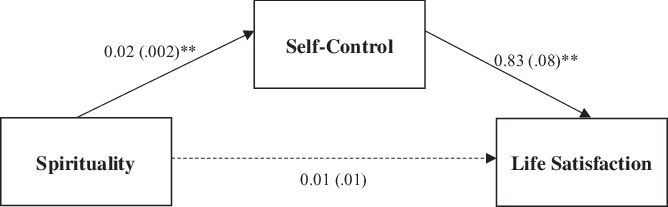
Indirect effects model of spirituality on life satisfaction through self-control.
Note. Unstandardized coefficients shown outside parentheses; standard errors are shown inside parentheses. Dashed path is non-significant (p > .05). **p < .01. Analyses controlled for Age, Gender, and SES (measures using the FAS scale).

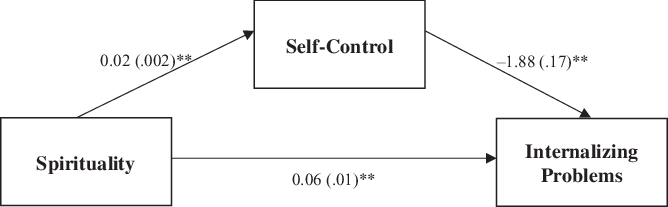
Indirect effects model of spirituality on internalizing problems through self-control.
Note. Unstandardized coefficients shown outside parentheses; standard errors are shown inside parentheses. **p < .01. Analyses controlled for Age, Gender, and SES (measured using the FAS scale).

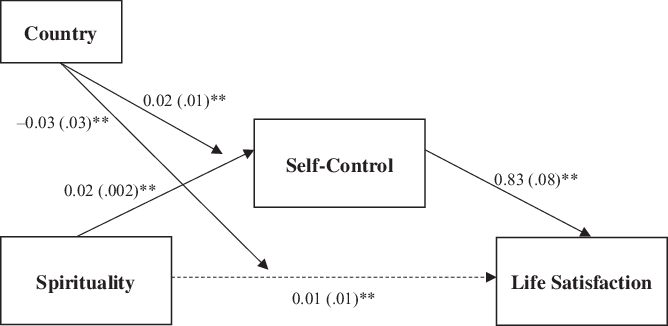
Conditional indirect effects model of spirituality on life satisfaction through self-control moderated by Country.
Note. Unstandardized coefficients shown outside parentheses; standard errors are shown inside parentheses. Dashed path is non-significant (p > .05).

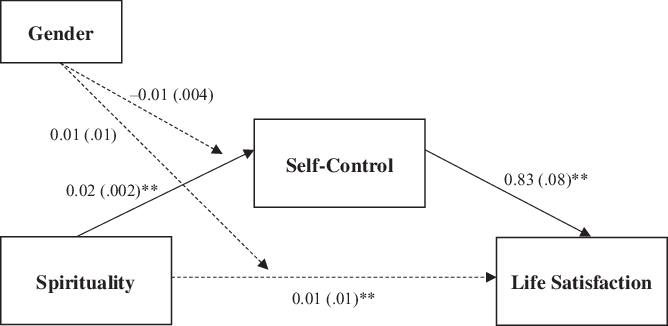
Conditional indirect effects model of spirituality on life satisfaction through self-control moderated by Gender
Note. Unstandardized coefficients shown outside parentheses; standard errors are shown inside parentheses. Dashed path is non-significant (p > .05).

Results
Descriptive statistics
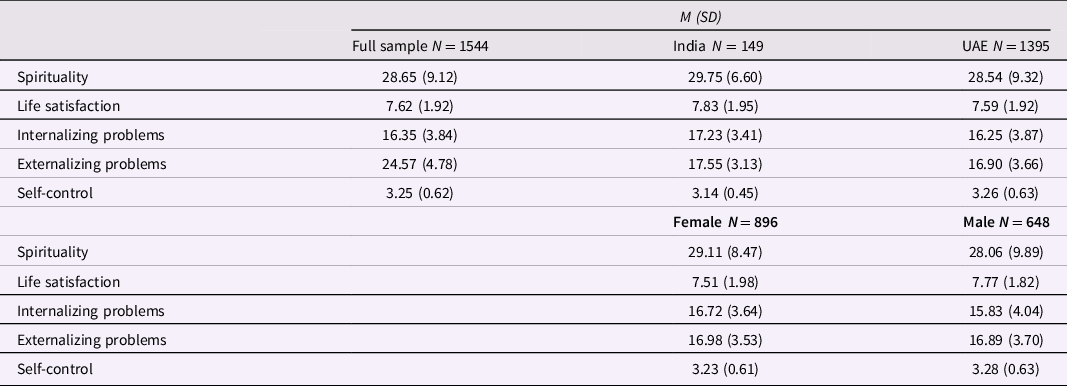
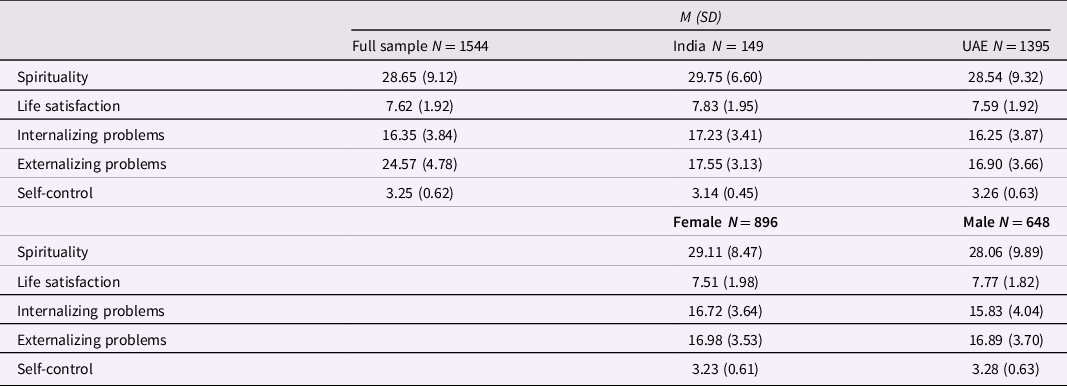
Table 2 presents means and standard deviations of all independent, dependent, and mediator variables based on country and gender. For the entire sample, the mean indicated a high level of spirituality on average (M = 28.65, SD = 9.12). The mean for self-control indicated moderate levels of self-control abilities (M = 3.14, SD = 0.45). With regards to mental health, adolescents reported high levels of life satisfaction (M = 7.62, SD = 1.92), internalizing problems (M = 16.35, SD = 3.84), and externalizing problems (M = 16.96, SD = 3.81).
Means and Standard Deviations of independent, dependent, and mediator variables for the full sample and based on country and gender
The correlation matrix in Table 3 shows bivariate correlations between dependent, independent, and mediator variables. The correlations of spirituality with the three mental health outcomes were significant, such that higher spirituality was correlated with greater life satisfaction, and with fewer internalizing problems and externalizing problems. Self-control was significantly positively correlated with spirituality. As expected, self-control was significantly positively correlated with life satisfaction and significantly negatively correlated with internalizing problems and externalizing problems.
Correlations and Cronbach’s alphas of all independent variables, dependent variables, and mediator variables

Note. **p < .01.
Associations between spirituality and mental health
Multiple regression analyses controlling for the effects of gender, age, and SES (measured using the FAS scale) showed that spirituality was significantly positively associated with life satisfaction, F(4,1351) = 14.48, p = .007, R 2 = 0.03, and was significantly negatively associated with internalizing problems, F(4,1534) = 11.88, p < .001, R 2 = 0.03. Spirituality was not significantly associated with externalizing problems, F(4,1535) = 3.77, p = .392, R 2 = 0.01. As a result of this non-significant relation, no further analyses were run for externalizing problems.
Mediation analyses
Mediation analysis results support our mediational hypothesis for life satisfaction, with self-control completely mediating the relation between spirituality and life satisfaction, as seen in Figure 1. Spirituality was a significant predictor of self-control, B = .02, SE = .00, p < .001, 95% CI [.01, .02], and self-control was a significant predictor of life satisfaction, B = .83, SE = .08, p < .001, 95% CI [.67, .99]. Spirituality was no longer a significant predictor of life satisfaction after controlling for the mediator, self-control, B = .01, SE = .01, p = .283, 95% CI [−.01, .02], consistent with full mediation assumptions. Approximately 8% of the variance in life satisfaction was accounted for by the predictors (R2 = .08). The indirect effect indicated that higher levels of spirituality were associated with higher levels of life satisfaction through increased self-control abilities, B = .01, SE = .002, 95% CI [.01, .02].
Mediation analysis for internalizing symptoms also support our mediational hypothesis, and showed that self-control partially mediated the relation between spirituality and internalizing problems, as seen in Figure 2. Spirituality was a significant predictor of self-control, B = .02, SE = .002, p < .001, 95% CI [.01, .02], and self-control was a significant predictor of internalizing problems, B = −1.88, SE = .17, p < .001, 95% CI [−2.21, −1.56]. However, spirituality was still a significant predictor of internalizing problems after controlling for self-control, B = .06, SE = .01, p < .001, 95% CI [.04, .09], indicating partial mediation. Approximately 9% of the variance in internalizing problems was accounted for by the predictors (R2 = .09). The indirect effect indicated that higher levels of spirituality were associated with lower levels of internalizing problems, with this association being partially mediated by self-control abilities, B = −.03, SE = .01, 95% CI [−.04, −.02].
Moderated mediation analyses
Country of origin was found to moderate the effect of spirituality on life satisfaction (B = −.03, SE = .03, t = −1.13, p = .256) and the effect of spirituality on self-control (B = .02, SE = .01, t = 2.46, p = .011). The overall moderated mediation model was supported with the index of moderated mediation (Figure 3); index = .02, SE = .01, CI [.01, .03]. As zero is not within the CI, this indicates a significant moderating effect of country on the indirect relation of spirituality and mental health via self-control (Hayes, 2015). The conditional indirect effect was significant for adolescents from the UAE, effect = .01, SE = .00, CI [.01, .02], but non-significant for adolescents from India, effect = −.003, SE = .01, CI [−.01, .01]. In summary, self-control mediated the association between spirituality and life satisfaction among adolescents in the UAE, but not among adolescents in India.
Gender was not found to moderate the effect of spirituality on life satisfaction (B = −.01, SE = .01, t = −.81, p = .406) or the effect of spirituality on self-control (B = −.01, SE = .00, t = −1.25, p = .212). The overall moderated mediation model was not supported based on the index of moderated mediation (Figure 4; index = −.004, SE = .00, CI [−.01, .002]). The conditional indirect effect was significant for both male (effect = .01, SE = .00, CI [.01, .02]), and female adolescents (effect = −.02, SE = .00, CI [.01, .02]).
Discussion
This study contributes to the current literature in three ways: 1) it confirms positive associations between spirituality and different aspects of mental health, and extends these findings to adolescents from diverse religious backgrounds and from two non-Western countries, 2) it delineates the importance of self-control in this association, and 3) it identifies groups for which this association is stronger. The findings of the present study demonstrate that spirituality might be related to life satisfaction and to internalizing problems in adolescents from Eastern cultures. Specifically, adolescents who report higher levels of spirituality also reported higher levels of life satisfaction and lower levels of internalizing problems. Furthermore, the association between spirituality and life satisfaction was mediated by self-control, such that spirituality was positively associated with life satisfaction through increased self-control abilities. The association between spirituality and internalizing symptoms was only partially mediated by self-control. Finally, country of origin moderated this mediated association demonstrating that this association was only present for adolescents from the UAE, which is representative of a non-Western, high SES sample. Given that a percentage of adolescents living in the UAE are from Western backgrounds, a robustness check of the findings was conducted by excluding this subsample, which further confirmed our findings and interpretation.
Our findings were largely consistent with the existing literature on the positive associations between spirituality and mental health outcomes in adolescence (Kim et al., Reference Kim, Miles-Mason, Kim and Esquivel2013; Marques et al., Reference Marques, Lopez and Mitchell2013; Yonker et al., Reference Yonker, Schnabelrauch and DeHaan2012). Specifically, we found that spirituality predicted higher life satisfaction and less internalizing problems, but was unrelated to externalizing problems. These differential relations indicate that spirituality might be associated with mental health outcomes through cognitive function specifically. This suggests that spirituality influences how an adolescent might be thinking about their problems or framing their situations, through positive thought, rather than eliminating problematic behaviors altogether. This finding might also serve to explain current literature on associations between spirituality/religiosity and externalizing behaviors (Holmes & Kim-Spoon, 2017). A literature review on this topic concluded that while the majority of studies have found that spirituality or religiosity has been associated with lower externalizing problems, other studies find no effect or sometimes a negative effect as well. The studies that have found significant associations have displayed that only the religious identity or religious affiliation (e.g., commitment, in-depth exploration) aspect was associated with externalizing behaviors, rather than spirituality (Holmes & Kim-Spoon, 2017). Since our study does not include a measure of religious identity, but rather analyzes the effects of spirituality specifically, this might serve to explain the non-significant associations between spirituality and externalizing problems in our sample.
Moreover, the present study showed that self-control can serve as a mediator in the spirituality–mental health link in adolescence. This finding is an important contribution to the current literature as it delineates a means by which spirituality could be positively related to mental health outcomes. It is well established that regulatory processes are critical for healthy developmental trajectories (e.g., Duckworth et al., Reference Duckworth, Taxer, Eskreis-Winkler, Galla and Gross2019; Moffitt et al., Reference Moffitt, Arseneault, Belsky, Dickson, Hancox, Harrington, Houts, Poulton, Roberts, Rodd, Sears, Thomson and Caspi2011; Rawn & Vohs, Reference Rawn, Vohs, Vohs and Finkel2006). Therefore, if spirituality promotes healthy self-control as was found in this and prior research (Aldwin et al., Reference Aldwin, Park, Jeong and Nath2014; McCullough & Willoughby, Reference McCullough and Willoughby2009), this would explain why spirituality could lead to better mental health outcomes. A relevant question is how spirituality improves self-control (e.g., promotes high self-control, reduces impulsive behaviors). Most spiritual disciplines require self-control resources such as focusing on maintaining stable relationships, displaying regular acts of compassion, and time commitment to focus on physical and mental health that strengthen self-control abilities that may eventually be used in other domains (Holmes & Kim-Spoon, Reference Holmes and Kim-Spoon2016). The muscle model for self-regulation implies that self-regulation applied in a particular area of life can be extended to behaviors or thoughts in other areas of life as well (Baumeister et al., Reference Baumeister, Vohs and Tice2007). Involvement in spiritual settings is characterized by a level of constraint where one receives social incentives for better self-control and is penalized for impulsive behaviors (McCullough & Willoughby, Reference McCullough and Willoughby2009). Additionally, spirituality encompasses a level of self-monitoring, a characteristic that can facilitate higher self-control (McCullough & Willoughby, Reference McCullough and Willoughby2009). Studies have found that spirituality was positively correlated with public self-consciousness, and promotes goal-directed self-monitoring (Watson et al., Reference Watson, Ghorbani, Davison, Bing, Hood and Ghramaleki2002). Therefore, since spiritual involvement comprises higher self-control, a person who is spiritually involved can possess high self-control simply due to increased self-control practice in spiritual settings and thus daily life.
Finally, the findings showed that the medicated association between spirituality and life satisfaction through self-control was significant only for adolescents from the UAE, and not for adolescents from India. This finding preliminarily suggests that specific environmental characteristics, such as SES, play a role in whether and how spirituality influences mental health outcomes. Specifically, this finding suggests that a protective factor in one context might not be a protective factor in another context (Aisenberg & Herenkohl, 2008). Specifically, adolescents from disadvantaged groups, such as low SES, might be more likely to experience a wide array of stressors and large amounts of adversity that might be too great to be overcome by self-control alone. Additionally, people from more advantaged groups such as high SES might have other types of stimulations in their environment (such as familial relationships) that might influence the relation between self-control and mental health outcomes (McDermott et al., Reference McDermott, Donlan, Anderson and Zaff2017). Furthermore, in our sample, adolescents form the UAE reported significantly higher levels of self-control abilities compared to adolescents from India. This greater variability in self-control could serve as another possible explanation for why self-control mediated the association between spirituality and life satisfaction only for adolescents from the UAE, and not for adolescents from India. Therefore, this finding suggests that preventive strategies and clinical interventions should consider the specific environmental factors of adolescents to understand the best way to support them. Given our smaller sample size for participants in India, future research with a larger sample is needed to explore what factors may predict mental health outcomes in this population.
These findings and the increasing empirical evidence of the beneficial influence of spirituality and mental health outcomes have important implications for parents, school counselors, and mental health professionals. Specifically, parents, health care providers, and school staff should be open to supporting adolescents’ existing spiritual thoughts and beliefs given its role in improved self-control and well-being, and promote its protective role as a coping strategy to protect against mental health problems. For many decades, literature has shed light on the positive effects of self-control on mental health outcomes (e.g., Auerbach et al., Reference Auerbach, Stewart and Johnson2017; Duckworth et al., Reference Duckworth, Taxer, Eskreis-Winkler, Galla and Gross2019; Moffitt et al., Reference Moffitt, Arseneault, Belsky, Dickson, Hancox, Harrington, Houts, Poulton, Roberts, Rodd, Sears, Thomson and Caspi2011; Rawn & Vohs, Reference Rawn, Vohs, Vohs and Finkel2006; Oquendo & Mann, Reference Oquendo and Mann2000). When working with youth for whom a wide variety of at-risk behaviors are a concern, spirituality should be allowed more space to work as a protective factor against these risky behaviors (Donahue & Benson, Reference Donahue and Benson1995). In addition to serving as a protective factor, for adolescents with existing mental health issues, particularly internalizing problems, clinicians should be more open to encouraging and promoting spiritual resources as a coping mechanism (Mueller & Johnson Reference Mueller and Johnson1975). For example, clinicians can discuss how spirituality may tie into mindfulness and other evidence-based cognitive interventions. However, while supporting spirituality as a protective factor or coping mechanism, one should take caution to identify the right coping styles, locus of control, social support, and social networks that contribute to the adolescent’s spiritual life, to ensure an implementation of the advantages of spirituality rather than the disadvantages (Larson et al., Reference Larson, Sherrill, Lyons, Craigie, Thielman, Greenwold and Larson1992). Unfortunately, in the present study we examined spirituality as a single construct, so the current findings cannot shed light on which aspects of spirituality may particularly promote self-control and well-being. Future research should explore specific aspects of spirituality (e.g., altruism, contemplative practice) that may be linked to self-control and/or mental health outcomes, particularly among individuals from diverse backgrounds.
These findings and implications should be considered within the context of the study’s limitations. First, this study involved cross-sectional data and only used self-report measures, limiting causal conclusions from being drawn, and raising both the possibility of shared method variance and possible reporter biases. Self-report is commonly used in this field and with this population (Yonker et al., Reference Yonker, Schnabelrauch and DeHaan2012); however, future research should include other sources of data, such as parent or teacher ratings, ecological momentary assessment, and behavioral observations to provide a more complete picture of spirituality, self-control, and mental health. Related to data collection, our disproportionate sample sizes for India and the UAE may have contributed to our lack of findings for the India sample. It will be important for future research with larger samples from multiple Eastern cultures to be conducted to continue examining these relations. Additionally, although these two countries on average have different representations of SES, our samples only included low to moderate affluent families from India and moderate to high affluent families from the UAE. As a result, SES and country were highly intertwined in the present study. Additionally, it is important to note that Chennai is not representative of the Indian population, given the vast cultural diversity across India and therefore our results can only be generalized to South Indian urban populations. Furthermore, the participating sample from Chennai only attended private schools and as a result, this study might not capture findings that pertain to adolescents attending public schools. Finally, the small effect sizes in our model indicate that our predictor variables only account for a small variance in adolescents’ mental health outcomes, stressing the importance of including other predictor variables such as familial and peer relationships in future studies. Longitudinal research examining potential causal relations between spirituality and mental health in adolescence and adulthood using diverse methodologies among large, religiously, geographically, and socioeconomically diverse populations is needed. Future studies could also explore a wide range of other mediators, such as health-related behaviors like smoking, exercise, and alcohol consumption that may be relevant for diverse populations, as prior work suggests that spirituality has a stronger impact on improving poor health behaviors rather than maintaining good behaviors (Strawbridge et al., Reference Strawbridge, Shema, Cohen and Kaplan2001).
Despite these limitations, we were able to show a positive association between spirituality and mental health in adolescents from various religious backgrounds and non-Western countries. We were also able to demonstrate the mediating effects of self-control on the spirituality–mental health relation. This study is a first step in expanding the literature on the spirituality–mental health link to understudied populations from non-Western backgrounds and a wider range of religious backgrounds. The results of this study might help to generate new hypotheses for future studies that may eventually lead to a more comprehensive theoretical understanding of the complex relations between spirituality and mental health outcomes, and have meaningful implications for mental health professionals and individuals that support the positive development of adolescents.
Acknowledgements
This study was funded by Dr. Antje von Suchodoletz’s Faculty Research Fund at New York University Abu Dhabi. We wish to thank all principals and teachers for allowing us to collect the data during school hours and all students for their participation.
Conflicts of interest
None.