Introduction
Wallich (Reference Wallich1832) described Rhododendron formosum Wall. based on specimens collected by Smith from the Khasia Hills, Meghalaya, in 1815. Subsequently, Clarke added two varieties of Rhododendron formosum, namely var. salicifolium C.B.Clarke and var. inaequale C.B.Clarke, also from the Khasia Hills (Hooker, Reference Hooker1882). Later, Hutchinson (Reference Hutchinson1919–1921) treated both these varieties as distinct species and named Rhododendron iteophyllum Hutch. for R. formosum var. salicifolium and Rhododendron inaequale Hutch. for R. formosum var. inaequale. He also stated that both taxa deserved closer study and that future collectors in the Khasia Hills would be able to throw further light on their taxonomic status. However, subsequent workers such as Cullen (Reference Cullen1980, Reference Cullen2005), Chamberlain et al. (Reference Chamberlain, Hyam, Argent, Fairweather and Walter1996), Sastry & Hajra (Reference Sastry and Hajra2010) and Bhattacharyya & Sanjappa (Reference Bhattacharyya, Sanjappa, Sanjappa and Sastry2014) treated var. salicifolium as conspecific with Rhododendron formosum and var. inaequale as a distinct variety, while keeping R. iteophyllum as a synonym under it (in the absence of a full taxonomic treatment and basing their diagnosis on the width of leaves alone). These various changes have created misconceptions and confusion regarding the identification as well as the numerical diversity of species in the genus Rhododendron L.
When Wallich (Reference Wallich1832) described Rhododendron formosum, he did not mention the presence of hairs on the leaf margins and petioles of the species, but on the specimens collected by Griffith (3506, KEW) from Moflong–Myrung road, Khasi Hills, such hairs are a characteristic feature of young leaves (Hutchinson, Reference Hutchinson1919–1921). Another species, Rhododendron gibsonii Paxton, was described based on the collections made in 1837 by J. Gibson from the Summit area of the Khasi Hills (Paxton, Reference Paxton1841). The specimens at Kew show clear gradation in the ciliation of the mature leaves from entirely glabrous to long ciliate, although the young leaves are densely ciliate (Hutchinson, Reference Hutchinson1919–1921). Later, Hutchinson (Reference Hutchinson1919–1921) placed Rhododendron gibsonii under R. formosum as conspecific and revised the taxonomic description of R. formosum, in which he clearly mentioned the presence of hairs on the leaves.
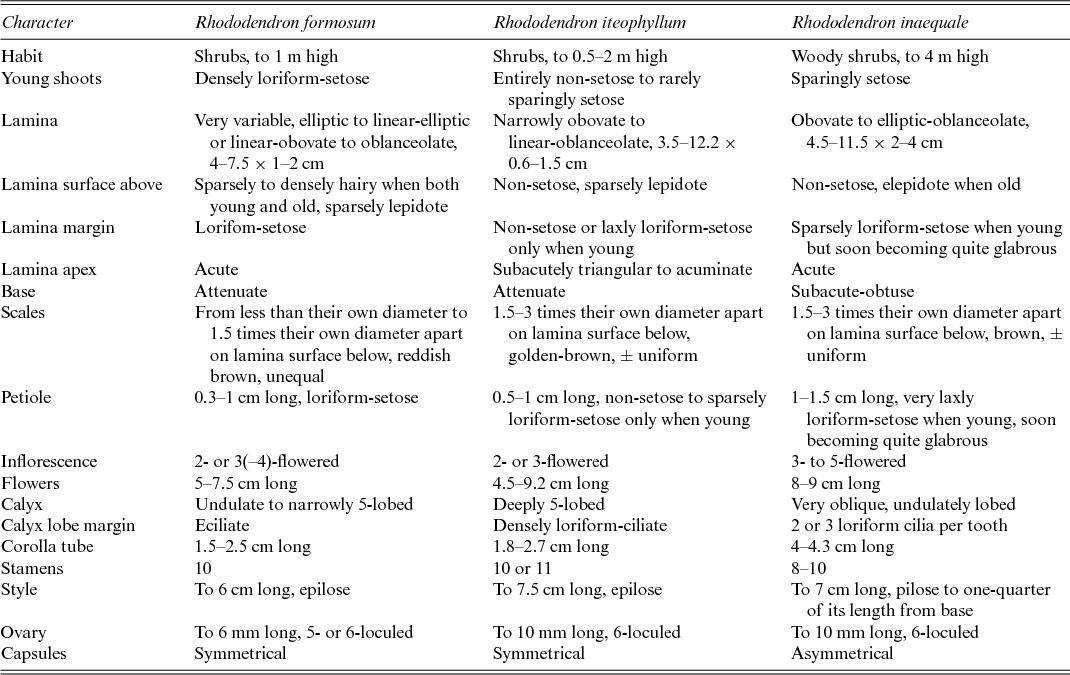
Most of the above-mentioned works are based on herbarium material, from which the gradation in ciliation cannot be ascertained properly. Moreover, all these taxa were first described from Northeast India. Therefore, an attempt was made to study the Rhododendron formosum complex in Northeast India to resolve this taxonomic complexity. The authors conducted an intensive observation of living plants of the Rhododendron formosum complex in the Garden of the Botanical Survey of India, the Eastern Regional Centre, Shillong, Summit, Pynursula and Mophlong areas of the Khasi Hills, and in the Umphang area of Jaintia Hills, Meghalaya, over three years. The observations revealed high variability within the complex in the gradation of ciliation of branchlets, petioles, leaf margins and even calyx lobe margins, along with other good taxonomic characters relating to habit, size and shape of leaves, density of scales on corolla and lamina surfaces, and length of flowers, styles and filaments. Therefore, we conclude that Hutchinson was correct to give distinct species rank to both var. salicifoliaum and var. inaequale. Rhododendron iteophyllum is characterised by narrowly obovate to linear-oblanceolate leaves 0.6–1.5 cm broad, sparsely loriform-setose to entirely glabrous (eciliate) young shoots and leaves, a deeply lobed calyx with loriform ciliate margins and an epilose style, whereas R. inaequale is characterised by eciliate, obovate to elliptic-oblanceolate leaves (laxly ciliate when young), a broader lamina to 4 cm wide that is not decurrent onto the petiole, style pilose at the base and more or less asymmetrical, larger capsules, to 3 cm long (Table 1).
Morphological comparisons between Rhododendron formosum, Rhododendron iteophyllum and Rhododendron inaequale

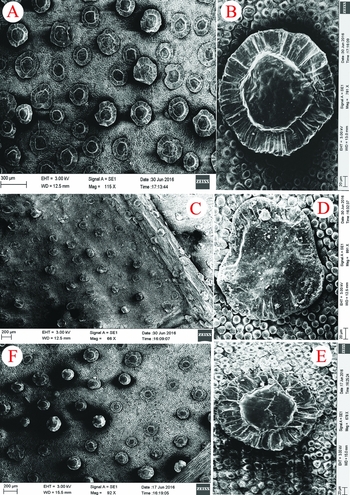
Here, Rhododendron iteophyllum is resurrected and R. inaequale is reinstated as a distinct species on the taxonomic evidence. Detailed taxonomic accounts of Rhododendron formosum, R. iteophyllum and R. inaequale are provided, along with photographic illustrations. Scanning electron microscopic images of the scales on the lower lamina surfaces of all three taxa are provided, showing their shape, size and density, these having taxonomic significance.
Materials and Methods
Collection, pressing and preparation of herbarium specimens were done according to conventional herbarium techniques (Jain & Rao, Reference Jain and Rao1976). Flowers were preserved in formaldehyde–acetic acid–ethanol solution. Taxonomic measurements and descriptions of each plant part are based on living material. Microscopic details were observed using an Olympus SZ2-ILST stereo-zoom microscope (Olympus, Tokyo, Japan) and a Carl Zeiss EVO 18 (special edition) scanning electron microscope (Zeiss, Oberkochen, Germany), and photographed with a Nikon Coolpix P520 (Nikon, Tokyo, Japan). Air-dried specimens (not subjected to critical point drying) were prepared for scanning electron microscopy by gold sputter coating. Voucher specimens have been deposited in the Herbarium of the Botanical Survey of India, Eastern Regional Centre, Shillong (ASSAM).
Taxonomic Treatment
Key to species
-
1a. Lamina 2–4 cm broad, not decurrent onto petiole; inflorescence 3- to 5-flowered; corolla throughout lepidote outside; style pilose to one-quarter of its length from base; capsules ± asymmetrical, to 3 cm long __________________________________________________ 2. R. inaequale
-
1b. Lamina 0.6–2 cm broad, more or less decurrent onto petiole; inflorescence 2- or 3(–4)-flowered; corolla lepidote only in tube outside and/or sparsely lepidote towards the middle of lobes outside; style epilose; capsules symmetrical, to 2 cm long _____________________________________________________________ 2
-
2a. Plants densely setose on branchlets and leaves; leaves 4.5–7.5 cm long, 1–2 cm broad with acute apex; scales about less than their own diameter to 1.5 times their own diameter apart on lamina surface below; calyx undulate to inconspicuously lobed with eciliate margin _________________ 1. R. formosum
-
2b. Plants entirely non-setose on branchlets and leaves (rarely sparsely ciliate only when young); leaves 3.5–12.2 cm long, 0.6–1.5 cm broad with subacutely triangular to acuminate apex; scales 1.5–3 times their own diameter apart on lamina surface below; calyx deeply lobed with densely loriform ciliate margin ______________________________________________ 3. R. iteophyllum
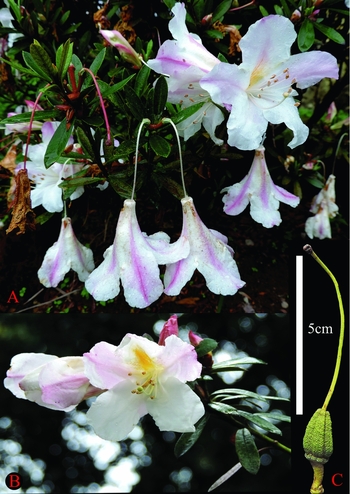
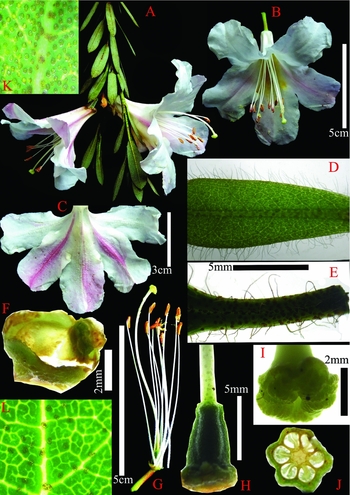
1. Rhododendron formosum Wall., Pl. Asiat. Rar. 3: t. 207 (1832); G.Don, Gen. Syst. 3: 845 (1834); DC., Prodr. 7: 721 (1839); Bot. Mag.: t. 4457 (1849); C.B.Clarke in Hook. f., Fl. Brit. Ind. 3: 473 (1882). – Type: India. Assam: Khasi Hills, Moflong–Myrung road, 9 xi 1835, Griffith 3506 (topo K). Figs 1 , 2 , 7 A,B.
Rhododendron formosum Wall. A and B, habit; C, capsule with persistent style.

Rhododendron formosum Wall. A, flowering twig; B, flower; C, corolla (dorsal view); D, portion of lamina, showing loriform-setose margins; E, setose petiole; F, calyx; G, stamens and carpel; H, ovary with lower portion of style; I, stigma; J, transverse section of ovary; K, scales on lamina surface below; L, scales on lamina surface above.

Rhododendron gibsonii Paxton, Paxton's Mag. Bot. 8: t. 217 (1841); Fl. des Series: 1, t. 18 (1845).
Erect shrub, 2–3 m high. Young shoots loriform-setose, lepidote. Leaves crowded. Lamina very variable, elliptic to linear-elliptic or linear-obovate to oblanceolate, 4–7.5 × 1–2 cm, sparsely to densely hairy and laxly lepidote above, glabrous and densely lepidote beneath, long tapering to the base, acute at apex, margin loriform-setose, dense when young; scales from less than their own diameter to 1.5 times their own diameter apart on lamina surface below, light brown to golden brown, circular, unequal, 169.4–276.7 μm across, rim entire, 55–57 μm broad, central part swollen, 134–185 μm in diameter; midrib impressed above, prominent beneath, rather sparingly lepidote. Petiole 0.3–1 cm long, grooved above, loriform-setose, lepidote. Inflorescence terminal, 2- or 3(–4)-flowered; peduncle 0.3–0.5 cm long, glabrous. Flower delicately scented, 5–7.5 cm long. Pedicel 0.5–1.2 cm long, glabrous, lepidote. Calyx disc-like, undulate to narrowly 5-lobed; lobes unequal, ovate-rounded to triangular, 1–1.5 × 1–1.5 mm, densely lepidote outside, apex acute-rounded, margin eciliate. Corolla 3.5–5.5 cm long, widely funnel-campanulate, 5-lobed, white with a yellow blotch at the base on lower petals inside and purplish flushed along 5 external stripes outside; tube 1.5–2.5 cm long, sparsely lepidote, glabrous inside, pilose at the base outside; lobes broadly elliptic, 2.5–3 × 1.8–3 cm, emarginated at apex, glabrous, elepidote. Stamens 10, unequal; filaments 2.8–4.8 cm long, slender, densely pubescent at base up to 3.5 cm from base; anthers linear-oblong, 4–5 mm long, dark purple-brown. Ovary cylindrical-ovate, 0.4–0.6 cm long, 5- or 6-loculed, densely lepidote; style impressed, 4.5–6 cm long, whitish, epilose, densely lepidote from base to middle; stigma lobulate, 2–3 mm across. Capsule straight, 1.5–2 cm long, about 8 mm thick, strongly ribbed, densely lepidote, with persistent style on central axis.
Phenology. Flowering in March to May and fruiting in May to July.
Distribution. India: Meghalaya.
Altitudinal range of distribution. 1400–2300 m a.s.l.
Specimens examined. India. Meghalaya: Khasi Hills, Shillong, Woodland campus, 1441 m, 25°34′46.34″N, 91°53′55.15″E, 21 iv 2015, A.A. Mao & D.K. Roy 110465 (ASSAM!); 1451 m, 25°34′45.99″N, 91°53′56.13″E, 21 iv 2015, A.A. Mao & D.K. Roy 110466 (ASSAM!); 1470 m, 25°34′44.13″N, 91°53′55.01″E, 21 iv 2015, A.A. Mao & D.K. Roy 110467 (ASSAM!); 1469 m, 25°34′44.59″N, 91°53′54.95″E, 21 iv 2015, A.A. Mao & D.K. Roy 110468 (ASSAM!).
Additional specimens examined. India. Meghalaya: Khasi & Jaintia Hills, Peak Forests, 6 iii 1932, S.R. Sarma 13522 (ASSAM!); Shillong, Lake garden, 5 v 1947, G.K. Deka 22354 (ASSAM!); Umsaw, G.K. Deka 21833 (ASSAM!); Shillong peak, H. Deka 18304 (ASSAM!); Mawphlong, 16 iv 1969, A.S. Rao 47408 (ASSAM!); Shillong, Woodland compound, 11 iv 1963, G.K. Deka 33062 (ASSAM!); Mawphlong, 4 x 1931, S.R. Sarma 9539 (ASSAM!); Shillong, Station Nursery, 30 iv 1947, G.K. Deka 23405 (ASSAM!); Elephant falls, 6000 ft, 24 v 1914, U. Kanjilal 3952 (ASSAM!); Shillong, Phudmari, 5000 ft, 4 vii 1913, U. Kanjilal 2245 (ASSAM!); Shillong, 5000 ft, iii 1886, G. Mann s.n. (16684, ASSAM!).
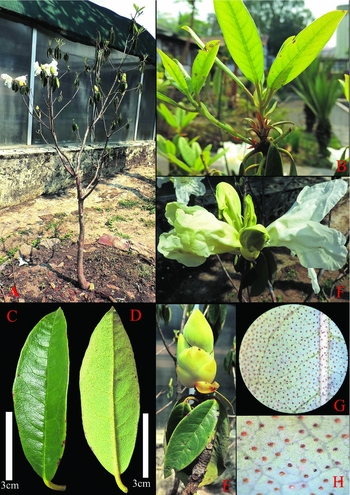
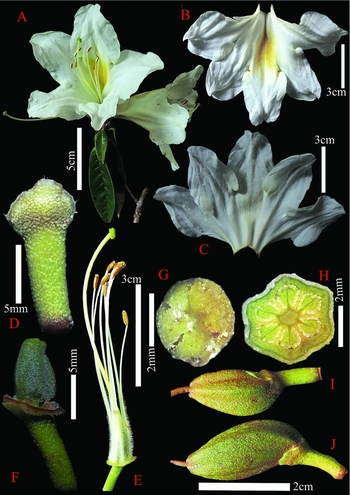
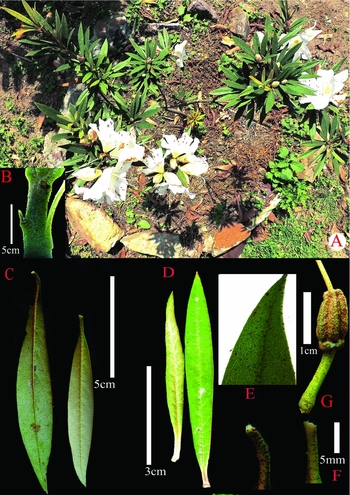
2. Rhododendron inaequale Hutch., Notes Roy. Bot. Gard. Edinburgh 12: 75–76 (1919). – Type: India. Meghalaya: Khasi Hills, Myrung, Kollong, 6000 ft, 23 viii 1885, Clarke 40025 (holo K). Figs 3 , 4 , 7 C,D.
Rhododendron inaequale Hutch. A, habit; B, vegetative twig; C, leaf (dorsal view); D, leaf (ventral view); E, flowering bud; F, flowering twig; G, scales on lamina surface below; H, scales on lamina surface below (close-up view).

Rhododendron inaequale Hutch. A, flowering twig; B, longitudinal section of corolla (ventral view); C, longitudinal section of corolla (dorsal view); D, pedicel; E, stamens and carpel; F, ovary; G, stigma; H, transverse section of ovary; I and J, capsules.

Rhododendron formosum var. inaequale (Hutch.) Cullen, Notes Roy. Bot. Gard. Edinburgh 36: 108 (1978).
Rhododendron formosum var. inaequale C.B.Clarke in Hook. f., Fl. Brit. Ind. 3: 473 (1882).
Erect woody shrubs, 2–4 m high; branches more or less umbellate. Young shoots lepidote, sparingly setose. Leaves apically crowded on the branches. Lamina obovate to elliptic-oblanceolate, 4.5–11.5 × 2–4 cm, acute at apex, subacute-obtuse at base, at first a little scaly on the upper surface, soon becoming quite glabrous and eciliate at margins when old, lepidote beneath; scales 1.5–3 times their own diameter apart, brown, circular, ± uniform, 212–254.2 μm across, rim entire to undulate, 36–70 μm broad, central part swollen, 110.8–130.8 μm in diameter; midrib impressed above, raised beneath, lepidote; lateral nerves about 6–8 on each side of the midrib. Petioles 1–1.5 cm, very laxly lorifom-setose when young, soon becoming quite glabrous, lepidote, deeply grooved on the upper side. Inflorescence terminal, 3- to 5-flowered. Flowers fragrant, 8–9 cm long. Pedicel 0.8–1.2 cm long, lepidote. Calyx very oblique, undulately lobed, densely lepidote outside, with 2 or 3 loriform cilia at margin of teeth. Corolla 7.5–8.5 cm long, 5-lobed, widely open campanulate, white with orange flushing on lower petals inside, laxly scaly all over the outside; tube 4–4.3 cm long, pilose at base outside; lobes broadly elliptic, 3.5–4.2 × 3.3–3.5 cm, emarginate at apex. Stamens 8–10, unequal; filaments 4–6 cm long, slender, densely pubescent in lower third; anthers linear-oblong, 4–5 mm long, purple-brown. Ovary 6-loculed, cylindrical-ovate, 0.8–1 cm long, densely lepidote; style impressed, 6–7.5 cm long, whitish, sparsely lepidote from base to middle, pilose to one-quarter of its length from base; stigma lobulate, 2–3 mm across, creamy white. Capsules ± asymmetrical, 6-valved, 2.5–3 × 1–1.4 cm, densely lepidote with persistent style on central axis.
Phenology
Flowering in March to April and fruiting in May to June.
Distribution
India: Arunachal Pradesh, Manipur, Meghalaya and Nagaland.
Altitudinal range of distribution
1400–2230 m a.s.l.
Specimens examined. India. Meghalaya: East Khasi Hills, Pynursla, 14 ii 2015, A.A. Mao 110461 (ASSAM!).
Additional specimens examined. India. Manipur: Esii Hills, 2200 m, 12 v 1997, A.A. Mao 102432 (ASSAM!); Meghalaya: Khasi & Jaintia Hills, Umsong bank, 5500 ft, 17 iv 1914, U. Kanjilal 389P (ASSAM!); Mauflong, 4 x 1931, S.R. Sarma 9539 (ASSAM!); Dumpep, 29 v 1932, S.R. Sarma 13523 (ASSAM!); Wah-Soh-Pho, 5500 ft, 23 ix 1913, U. Kanjilal 2631 (ASSAM!); Mawsmai, 26 iii 1960, D.C. Raju 21347 (ASSAM!); Shillong, Birla house, 2 vii 1963, G.K. Deka 35943 (ASSAM!); Riat Laban, 19 iv 1917, U. Kanjilal 7139 (ASSAM!); Peak forest, 19 iv 1931, S.R. Sarma 9095 (ASSAM!); Lai-Ling-Kot, 3 x 1930, S.R Sarma 9057 (ASSAM!); Shillong, Um-ja-sai, 5500 ft, 11 iv 1916, U. Kanjilal 6998 (ASSAM!); Nagaland: Naga Hills, vi 1935, N.L. Bor 21244 (ASSAM!); v 1936, N.L. Bor 20828 (ASSAM!).
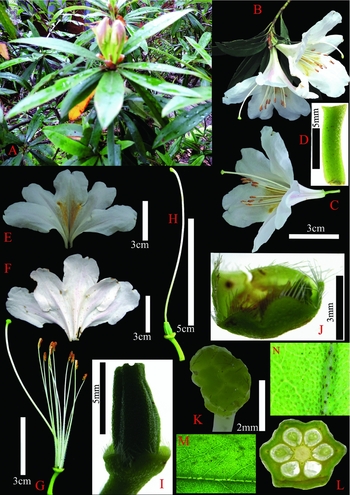
3. Rhododendron iteophyllum Hutch., Notes Roy. Bot. Gard. Edinburgh 12: 83–84 (1919). – Type: India. Meghalaya: Khasia Hills, rocks of Bor-Panee, 2000 ft, 24 vii 1850, Hooker & Thomson s.n. (syn K). Figs 5 , 6 , 7 E,F.
Rhododendron iteophyllum Hutch. A, habit; B, portion of branchlet; C, leaves (ventral view); D, leaves (dorsal view); E, leaf apex; F, petioles; G, capsule.

Rhododendron iteophyllum Hutch. A, flowering bud; B, inflorescence; C, flower; D, pedicel; E, longitudinal section of corolla (ventral view); F, longitudinal section of corolla (dorsal view); G, stamens and carpel; H, carpel; I, ovary; J, calyx; K, stigma; L, transverse section of ovary; M, scales on lamina surface above; N, scales on lamina surface below.

Scale(s) on lamina surface below. A and B, Rhododendron formosum Wall.; C and D, Rhododendron inaequale Hutch.; E and F, Rhododendron iteophyllum Hutch.

Rhododendron formosum var. salicifolium C.B.Clarke in Hook. f., Fl. Brit. Ind. 3: 473 (1882).
Erect shrub, 0.5–2 m high
Young shoots non-setose to sparingly setose, green, densely lepidote. Leaves narrowly obovate to linear-oblanceolate, non-setose or sparingly setose only when young, 3.5–12.2 × 0.6–1.5 cm, attenuate at base, subacutely triangular to acuminate at apex, sparsely lepidote above, densely lepidote beneath, margins non-setose; scales 1.5–3 times their own diameter apart on lamina surface below, circular, ± uniform, 150.5–225.5 μm across, golden-brown, rim entire, 65–100 μm broad, central part swollen, 85.5–125.5 μm in diameter; midrib deeply grooved above, raised beneath, lepidote. Petioles 0.5–1 cm, grooved, non-setose, lepidote. Inflorescences umbellate, terminal, 2- or 3-flowered; bracts golden-brown, glabrous inside, villous outside. Flowers strongly sweet-scented, 4.5–9.2 cm long. Pedicel 0.5–1.5 cm long, green, lepidote. Calyx reddish green, unequally and deeply 5-lobed; lobes oblong-rounded, 1–2.5 × 2–2.5 mm, glabrous and densely lepidote outside, densely loriform ciliate at the margin, apex acute-rounded. Corolla open funnel-campanulate, 4–7 cm long, 5-lobed, white with purplish flushing outside and with orange markings on lower petals inside; tube 1.8–2.7 cm long, glabrous inside, lepidote, minutely pilose at base outside; lobes broadly elliptic, 2.2–4 × 1.5–3.5 cm, emarginated at apex, glabrous, sparsely lepidote towards the middle outside, elepidote in inner surfaces. Stamens 10–11, unequal, slightly exerted from corolla-tube, shorter than style; filaments 3.5–6.5 cm long, slender, densely pubescent at base to up to 2–3 cm from base; anthers linear-oblong, 3–5 mm long, dark purple-brown. Ovary cylindrical-ovate, 5.5–1 cm long, 6-loculed, densely lepidote; style impressed, 4.5–7.5 cm long, whitish, epilose, densely lepidote from base to middle; stigma lobulate, c.3 mm across. Capsule symmetrical, 6-valved, 1–2 cm long, densely lepidote with persistent style on central axis.
Phenology
Flowers from April to May and fruit from June to July.
Distribution
India: Meghalaya.
Altitudinal range of distribution
890–1500 m a.s.l.
Specimens examined. India. Meghalaya: Jaintia Hills, Umphang, c.891 m, 18 iv 2015, A.A. Mao 110462 (ASSAM!); East Khasi Hills, Shillong, Woodland campus, 1466 m, 25°34′44.35″N, 91°53′55.82″E, 21 iv 2015, A.A. Mao & D.K. Roy 110464 (ASSAM!).
Additional specimens examined. India. Meghalaya: Khasi & Jaintia Hills, Peak forests, 26 xi 1949, G.K. Deka 22841 (ASSAM!); Myntang valley, 1000 ft, 19 i 1916, U. Kanjilal 6557, 6558 (ASSAM!); Sehra raim, 30 iii 1932, G.K. Deka 13512 (ASSAM!); Mahadew forest, 19 ii 1963, S. Choudhury 31844 (ASSAM!); Jaksem hot spring areas along the river bank, 2 v 1975, G.H. Bhaumik 61877 (ASSAM!).
Potential use
The species is suitable for home gardens, because it does not grow very high and is strongly sweet-scented.
Acknowledgements
The authors are grateful to Dr P. Singh, Director, Botanical Survey of India, Kolkata, India, for providing facilities and encouragement.