Introduction
In the setting of chronic maxillary sinusitis that is refractory to medical therapy, endoscopic maxillary antrostomy leads to disease resolution in about 90 per cent of cases.Reference Kennedy, Zinreich, Shaalan, Kuhn, Naclerio and Loch1 For recalcitrant chronic maxillary sinusitis after failed maxillary antrostomy, endoscopic medial maxillectomy, or endoscopic maxillary mega-antrostomy, has been shown to be effective in 70–80 per cent of cases.Reference Konstantinidis and Constantinidis2–Reference Woodworth, Parker and Schlosser6 In this clinical scenario, creating a wider maxillary sinus opening has been proposed to facilitate intra-operative removal of maxillary sinus disease,Reference Costa, Psaltis, Nayak and Hwang4 to improve sinus surveillance post-operatively and to improve sinus topical irrigation delivery.Reference Wang, Gullung and Schlosser5 However, each of the aforementioned factors has received minimal attention in the literature, especially with regard to the effects of endoscopic medial maxillectomy on maxillary sinus irrigation delivery.
Previous studies have assessed the impact of endoscopic sinus surgery, head position and delivery device on topical irrigation distribution to the maxillary sinus. Harvey et al. demonstrated improved total sinus irrigation after endoscopic medial maxillectomy compared to regular endoscopic sinus surgery. However, they also showed that after endoscopic medial maxillectomy, there was no difference in overall maxillary sinus irrigation when compared with maxillary antrostomy.Reference Harvey, Goddard, Wise and Schlosser7 Singhal et al. studied the impact of head position and degree of sinus surgery on sinonasal irrigation but did not assess the effects of endoscopic medial maxillectomy on maxillary sinus delivery.Reference Singhal, Weitzel, Lin, Feldt, Kriete and McMains8
Prior studies have analysed sinus irrigation distribution using various techniques such as colour-dyed irrigations,Reference Singhal, Weitzel, Lin, Feldt, Kriete and McMains8.9 iodinated contrast irrigations followed by computed tomography (CT) scans,Reference Harvey, Goddard, Wise and Schlosser7,Reference Snidvongs, Chaowanapanja, Aeumjaturapat, Chusakul and Praweswararat10 technetiumReference Wormald, Cain, Oates, Hawke and Wong11 and fluorescein-labelled irrigations.Reference Bleier, Preena, Schlosser and Harvey12 Such techniques are labour intensive and do not allow dynamic moment-to-moment irrigation flow analysis through the sinonasal cavities. Computational fluid dynamic modelling of sinonasal irrigations is a novel method for studying sinonasal irrigations in real-time and was validated for this use by Craig et al. in a cadaveric irrigation experiment.Reference Craig, Zhao, Doan, Khalili, Lee and Adappa13 The technique utilises CT sinus scans and proprietary computational fluid dynamic modelling software CFX® to model sinus irrigations. The purpose of the current study was to use computational fluid dynamic modelling to compare irrigation flow patterns to the maxillary sinus after maxillary antrostomy versus endoscopic medial maxillectomy.
Materials and methods
A 54-year-old female with left-sided chronic rhinosinusitis without nasal polyps underwent left side endoscopic sinus surgery, including wide endoscopic maxillary antrostomy, total ethmoidectomy, sphenoidotomy and Draf IIA frontal sinusotomy. The maxillary antrostomy involved an uncinectomy followed by removing the mucosa of the maxillary hiatus to create an antrostomy from the nasolacrimal duct anteriorly to the posterior wall of the maxillary sinus posteriorly, and from the orbital floor superiorly to the insertion of the inferior turbinate inferiorly.
Post-operatively she developed recurrent symptomatic maxillary sinusitis, so another CT scan was obtained, and she underwent an endoscopic medial maxillectomy. Endoscopic medial maxillectomy involved removing a majority of the inferior turbinate while leaving the turbinate's anterior head and posterior stump intact. The medial maxillary sinus wall was removed from the nasolacrimal duct anteriorly to the posterior wall of the maxillary sinus posteriorly, and inferiorly to the nasal floor. No contralateral endoscopic sinus surgery was performed. A post-operative CT scan was then obtained after the endoscopic medial maxillectomy.
Computational fluid dynamic models were then created based on the CT scans performed after each surgery. The method for creating the computational fluid dynamic models has been described in previously published studies.Reference Zhao, Scherer, Hajiloo and Dalton14–Reference Craig, Palmer and Zhao17 The interface between the sinonasal mucosa and air was established on the CT scans using AMIRA® imaging visualisation software. The sinonasal cavity was then filled with tetrahedral elements using proprietary ICEMCFD® computational fluid dynamic meshing software.
Subsequently, sinus irrigations were simulated through the left naris only, using the following parameters: 120 ml over four seconds (30 ml/second), head-down position and an irrigation trajectory of 30 degrees to the nasal floor. The contralateral naris was simulated to be an outlet through which air and fluid could exit while the nasopharyngeal opening was set to be blocked, as would be the case during normal sinus irrigations. The sinonasal mucosa was simulated to be immobile and smooth.
The simulations were then carried out using commercial computational fluid dynamic software CFX®, utilising the multiphase free surface method. This model allowed for the definition of different fluid phases (air and saline solutions in this case). Lower density air would rise, and the saline would fill the sinus in a gravity-dependent fashion. A turbulence model was utilised to simulate details of the air and saline fluid movement as well as to account for the initial saline fluid momentum. Videos of the computational fluid dynamic models were created in both axial and sagittal views (short videos are available on The Journal of Laryngology & Otology website; Appendix 1 and 2). Each of the maxillary antrostomy and endoscopic medial maxillectomy computational fluid dynamic simulations required seven days to complete, using a Dell PrecisionTM T7400 workstation with dual quadcore Intel® Xeon® X5472 central processing units in parallel mode. Video files and still images were created for each computational fluid dynamic simulation. Computational fluid dynamic videos were then analysed for the time taken to initial maxillary sinus penetration (seconds), the pattern of maxillary sinus irrigation filling and the times taken to reach 50 per cent and 100 per cent maxillary sinus filling (seconds).
Results
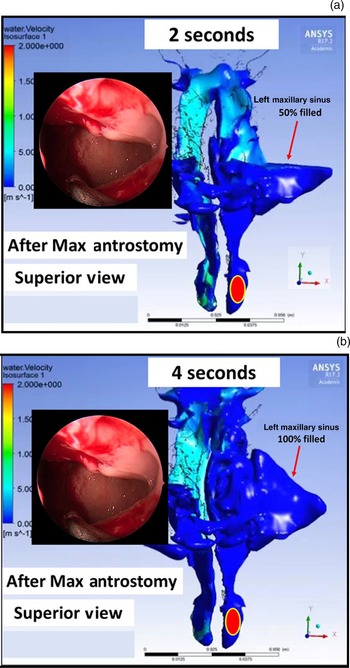
Figure 1 shows representative still frames of the computational fluid dynamic model created after left-sided endoscopic maxillary antrostomy. It highlights the filling pattern of the left maxillary sinus after irrigation was performed through the left naris. Irrigation first entered the left maxillary sinus after 0.5 seconds. Irrigation filled 50 per cent of the sinus by 2 seconds and completely filled the sinus by 4 seconds. Video 1 highlights how the irrigation filled the sinus in a moment-to-moment fashion. The irrigation filled the sinus gradually. Irrigation initially contacted the posterior wall, then flowed along the lateral and anterior walls before filling the sinus cavity anteriorly to posteriorly (against gravity, in the head-down position).
Computational fluid dynamic modelling of maxillary sinus irrigation ipsilateral to the side of a maxillary antrostomy. Irrigations first entered the left maxillary sinus after 0.5 seconds, filled it 50 per cent at 2 seconds (a), and completely filled it at 4 seconds (b). Irrigation filled the sinus gradually. It first contacted the posterior wall, then flowed along the lateral wall to the anterior wall, before filling the sinus from the anterior to the posterior (head-down position).

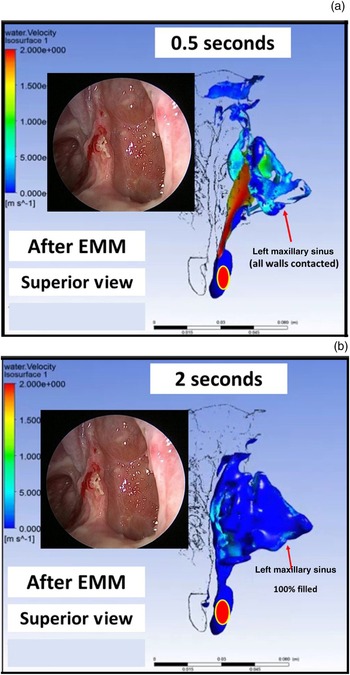
Figure 2 shows representative still frames of the computational fluid dynamic model created after the left endoscopic medial maxillectomy. It again highlights the filling pattern of the left maxillary sinus after irrigation was performed through the left naris, in the head-down position. Irrigation first entered the left maxillary sinus after 0.5 seconds. Irrigation filled 50 per cent of the sinus by 1.5 seconds and completely filled the sinus by 2 seconds. Video 2 highlights how the irrigation filled the sinus in a moment-to-moment fashion. The irrigation rapidly contacted all the walls of the sinus immediately after sinus penetration, rapidly filling the entire sinus.
Computational fluid dynamic modelling of maxillary sinus irrigation ipsilateral to the side of an endoscopic medial maxillectomy. Irrigations first entered the left maxillary sinus after 0.5 seconds (a), filled it 50 per cent at 1.5 seconds, and completely filled it by 2 seconds (b). Irrigation rapidly contacted all the walls of the sinus immediately after sinus penetration (a). EMM = Endoscopic medial maxillectomy

Discussion
In the minority of patients who fail primary endoscopic sinus surgery and subsequent medical management, revision endoscopic sinus surgery may be necessary. When recalcitrant chronic sinusitis affects the maxillary sinus, surgical revision of the maxillary antrostomy with endoscopic medial maxillectomy or endoscopic maxillary mega-antrostomy leads to excellent clinical outcomes.Reference Konstantinidis and Constantinidis2–Reference Woodworth, Parker and Schlosser6
Konstantinidis and Constantinidis conducted a systematic literature review and proposed the following indications for endoscopic medial maxillectomy to treat recalcitrant maxillary sinusitis: diseases with impaired mucociliary function, post-operative obstruction of the natural ostium or prior maxillary antrostomy, inadequate access to remove intramaxillary pathology intra-operatively, pathology that has destroyed the medial maxillary sinus wall, and facilitation of debridement and topical medication delivery.Reference Konstantinidis and Constantinidis2
Cho and Hwang showed that of 28 patients who underwent endoscopic maxillary mega-antrostomy for recalcitrant maxillary sinusitis, 74 per cent had complete symptom resolution, with 26 per cent having partial symptom resolution after a mean follow-up duration of 11 months.Reference Cho and Hwang3 Costa et al. reviewed endoscopic maxillary mega-antrostomy results in 122 patients who failed maxillary antrostomy for recalcitrant maxillary sinusitis, including the 28 patients from the Cho et al. study. They reported long-term maintenance of clinical improvements in the original 28 patient cohort (mean follow-up duration, 6.9 years), and statistically significant reductions in Sino-Nasal Outcome Test-22, endoscopy and Lund McKay scores in the additional 94 patient cohort (mean follow up, 2.2 years).Reference Costa, Psaltis, Nayak and Hwang4 Wang et al. reviewed 46 patients who underwent endoscopic medial maxillectomy for recalcitrant maxillary sinusitis and demonstrated that 80 per cent of patients had complete disease resolution based on symptoms and endoscopic exams.Reference Wang, Gullung and Schlosser5
While each of the aforementioned studies have shown clinical benefits from endoscopic medial maxillectomy or endoscopic maxillary mega-antrostomy in the setting of recalcitrant maxillary sinusitis, reasons for clinical improvement could only be hypothesised. While some studies have suggested that one benefit of endoscopic medial maxillectomy is to improve topical irrigation delivery to the maxillary sinus,Reference Konstantinidis and Constantinidis2,Reference Wang, Gullung and Schlosser5 other studies have shown that total irrigation to the maxillary sinus is no different between maxillary antrostomy and endoscopic medial maxillectomy.Reference Harvey, Goddard, Wise and Schlosser7 However, no study has assessed whether the benefits could be due to mechanical debridement by the irrigation rather than total irrigation delivery.
Prior studies analysing topical distribution to sinuses have relied on methods that measure total sinus filling, or presence or absence of sinus wall contact.Reference Harvey, Goddard, Wise and Schlosser7–Reference Bleier, Preena, Schlosser and Harvey12 The benefit of computational fluid dynamic modelling is that through moment-to-moment flow analysis, one can determine the time points at which the irrigation penetrates and fills a given sinus, which directly correlates with the irrigation velocity and force that the irrigation penetrates and debrides the sinus cavity. Additionally, computational fluid dynamic modelling allows analysis of the dynamic irrigation flow pattern through the whole sinus cavity.
In the current study, total maxillary sinus irrigation was the same between maxillary antrostomy and endoscopic medial maxillectomy, which were findings that were consistent with those by Harvey et al.Reference Harvey, Goddard, Wise and Schlosser7 However, there was a difference between maxillary antrostomy and endoscopic medial maxillectomy with regard to the speed and pattern of sinus filling by the irrigation. After endoscopic medial maxillectomy, not only was there more rapid complete filling of the maxillary sinus, but the irrigation also contacted all the sinus walls immediately after sinus penetration. These findings suggest that irrigations would mechanically debride all the maxillary sinus walls with greater force after endoscopic medial maxillectomy than the irrigation would after maxillary antrostomy.
• Studies have demonstrated clinical benefits from modified endoscopic medial maxillectomy in the setting of recalcitrant chronic maxillary sinusitis, for reasons that can only be hypothesised
• One proposed mechanism for improvement after this procedure has been improved topical therapy delivery
• Computational fluid dynamic modelling demonstrated that high volume sinus irrigations penetrated the maxillary sinus faster and with more force after endoscopic medial maxillectomy compared with maxillary antrostomy
Improved mechanical debridement of the maxillary sinus by irrigations would be one possible mechanism by which patients with mucociliary dysfunction derive clinical benefit from endoscopic medial maxillectomy, as shown in previous studies.Reference Konstantinidis and Constantinidis2–Reference Woodworth, Parker and Schlosser6 Patients with recalcitrant maxillary sinusitis often accumulate tenacious mucin and debris in the inferior, gravity-dependent aspect of the sinus. This material is a source of chronic mucosal inflammation and removal is essential to long-term maintenance of an inflammation-free sinus. If topical irrigations can rapidly penetrate and more forcefully debride the inferior aspect of the maxillary sinus, as was shown in the current study, this would portend a benefit compared with maxillary antrostomy. After maxillary antrostomy in patients with impaired mucociliary clearance, the more gradual sinus filling by irrigations demonstrated in the current study may be insufficient at debriding the gravity-dependent aspects of the sinus.
With regard to total irrigation delivery, the current study poses an interesting question that remains to be answered. Does endoscopic medial maxillectomy or maxillary antrostomy allow for better topical drug delivery? While total irrigation appeared to be equivalent between endoscopic medial maxillectomy and maxillary antrostomy, total mucosal contact time could not be determined since the computational fluid dynamic models were not carried out for time periods necessary to capture sinus emptying. However, based on the findings from Harvey et al.Reference Harvey, Goddard, Wise and Schlosser7 and the current study, the clinical benefits from endoscopic medial maxillectomy seem less likely to be related to topical medication delivery. In fact, topical drug delivery could actually be more effective after maxillary antrostomy compared with endoscopic medial maxillectomy if slower irrigation filling of the sinus leads to prolonged contact between the medication and the mucosa. Further studies are necessary to determine the effect of irrigation velocity on topical medication delivery.
A few limitations deserve mention, with the main limitation being the small sample size. One maxillary antrostomy and one endoscopic medial maxillectomy were modelled, limiting generalisability of the study. Additionally, various irrigation parameters were not assessed, which could affect maxillary sinus delivery. Different head positions, topical delivery angles, and irrigation volumes, pressures and flow rates were not analysed, and these could lead to different maxillary sinus irrigation patterns.
However, the irrigation parameters simulated in this study are commonly performed by patients, so the results do have clinical pertinence. Lastly, while endoscopic medial maxillectomy is very similar to endoscopic maxillary mega-antrostomy, they differ slightly in that more of the anterior portion of the inferior turbinate is kept intact during endoscopic maxillary mega-antrostomy. Leaving more inferior turbinate anteriorly during endoscopic maxillary mega-antrostomy could alter the trajectory of sinus irrigation post-operatively and potentially lessen the debridement effect of the irrigation. However, this cannot be determined by the current study.
Conclusion
Computational fluid dynamic modelling demonstrated that endoscopic medial maxillectomy allowed for faster, more forceful irrigation to all maxillary sinus walls compared with maxillary antrostomy. Endoscopic medial maxillectomy and maxillary antrostomy both ultimately resulted in complete maxillary sinus filling by the irrigation.
Acknowledgements
The authors would like to thank Natalie Craig for her assistance with formatting the digital still images of the computational fluid dynamic model and Kanghyun Kim for his assistance with computational fluid dynamic modelling. Kai Zhao has grant funding through the National Institutes of Health (NIDCD R01 DC013626).
Competing interests
None declared
Appendix 1. Supplementary video material
A short video demonstrates computational fluid dynamic model of 120 ml irrigation through the left naris, ipsilateral to the endoscopic sinus surgery, including maxillary antrostomy, that had been performed. This was simulated in a head-down position. Diagrams are included to outline the location of the maxillary sinus on axial and sagittal views during the video. Note the gradual filling of the left maxillary sinus from anterior to posterior (due to head-down position). Complete maxillary sinus filling occurred by 4 seconds. This video is available online at The Journal of Laryngology & Otology website, at https://doi.org/10.1017/S0022215121000013.
Appendix 2. Supplementary video material
A short video demonstrates computational fluid dynamic model of 120 ml irrigation through left naris, ipsilateral to the modified endoscopic medial maxillectomy that had been performed. This was simulated in a head-down position. Diagrams are included to outline the location of the maxillary sinus on axial and sagittal views during the video. Note the more rapid filling of the left maxillary sinus and that all walls were contacted immediately after sinus penetration. Complete maxillary sinus filling occurred by 2 seconds. This video is available online at The Journal of Laryngology & Otology website, at https://doi.org/10.1017/S0022215121000013.