


1. Introduction
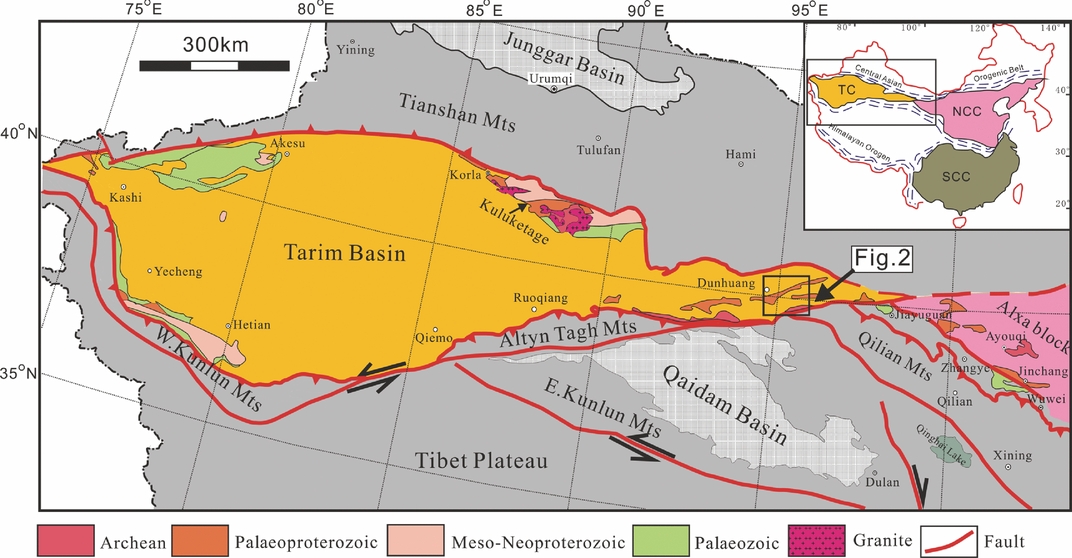
The Tarim Craton (TC) together with the North China Craton (NCC) and South China Craton (SCC) constitute the three major continental cratons in China. Major advancements in reconstructing the tectonic evolutionary history of the NCC and Yangtze Craton (YC) have been achieved in the past two decades with the development of petrology, geochemistry and geochronology (Song et al. Reference Song, Allen, Liu and Wu1996; Zheng et al. Reference Zheng, Griffin, O'reilly, Lu, Wang, Zhang, Wang and Li2004; Wilde & Zhao, Reference Wilde and Zhao2005; Zhao et al. Reference Zhao, Sun, Wilde and Li2005; Wan et al. Reference Wan, Liu, Song, Wu, Yang, Zhang and Geng2005; Zhang et al. Reference Zhang, Zheng, Wu, Zhao, Gao and Wu2006; Wan et al. Reference Wan, Liu, Xu, Zhuang, Song, Shi and Du2007; Zheng & Zhang, Reference Zheng and Zhang2007). It has been suggested that the NCC became a stable continental craton through amalgamation of small Archean blocks; however, there are disagreements on the amalgamation timing (Kusky et al. Reference Kusky, Li and Tucker2001, Reference Kusky, Li, Glass, Huang and Kusky2004, Reference Kusky, Li, Santosh, Zhai, Xiao and Santosh2007; Zhao et al. Reference Zhao, Wilde, Cawood and Sun2001, Reference Zhao, Sun, Wilde and Li2005, Reference Zhao, Sun, Wilde, Li, Liu and Zhang2006; Wilde et al. Reference Wilde, Zhao and Sun2002; Guo et al. Reference Guo, Sun, Chen and Zhai2005; Kroner et al. Reference Kroner, Wilde, Li and Wang2005, Reference Kroner, Wilde, Zhao, O'Brien, Sun, Liu, Wan, Liu and Guo2006; Wilde & Zhao, Reference Wilde and Zhao2005; Zhai et al. Reference Zhai, Ni, Oh, Guo and Cho2005, Reference Zhai, Li, Peng, Hu, Liu, Zhang, Guo, Kusky, Zhai and Xiao2010; Polat et al. Reference Polat, Li, Fryer, Kusky, Gagnon and Zhang2006; Wan et al. Reference Wan, Wilde, Liu, Yang, Song, Yin and Zhou2006, Reference Wan, Liu, Dong, Xu, Wang, Wilde, Yang, Liu, Zhou, Reddy, Mazumder, Evans and Collins2009, Reference Wan, Liu, Wang, Song, Kröner, Dong, Zhou and Yin2011; Faure et al. Reference Faure, Trap, Lin, Monie and Bruguier2007; Li & Kusky, Reference Li and Kusky2007; Santosh et al. Reference Santosh, Wilde and Li2007, Reference Santosh, Zhao and Kusky2010; Trap et al. Reference Trap, Faure, Lin and Monié2007, Reference Trap, Faure, Lin, Bruguier and Monie2008, Reference Trap, Faure, Lin, Monie, Meffre and Melleton2009; Santosh, Reference Santosh2010; Kusky Reference Kusky2011; Zhai & Santosh, Reference Zhai and Santosh2011). The South China Craton (SCC) had a different evolutionary history from the NCC (e.g. Zheng & Zhang, Reference Zheng and Zhang2007) before they collided with one another and amalgamated in the Late Triassic (Li et al. Reference Li, Xiao, Liu, Chen, Ge, Zhang, Sun, Cong, Zhang, Hart and Wang1993; Hacker & Wang, Reference Hacker and Wang1995; Rowley et al. Reference Rowley, Xue, Tucker, Peng, Baker and Davis1997; Zheng et al. Reference Zheng, Fu, Li, Xiao and Li1998). Compared to the NCC and SCC, the early evolutionary history of the TC remains poorly constrained however as its central part is broadly covered by desert with rare outcrops along its margins. The basement of the TC, formed through several tectonic periods, was dated as 2.65–2.45 Ga, 2.0–1.8 Ga, 1.6–1.5 Ga, 1.1–0.9 Ga and 0.83–0.63 Ga by Zhu et al. (Reference Zhu, Zhang, Shu, Lu, Sun and Yang2008), Lu et al. (Reference Lu, Li, Zhang and Niu2008), Shu et al. (Reference Shu, Deng, Zhu, Ma and Xiao2011), Zhang et al. (Reference Zhang, Yang, Wang, Takahashi and Ye2011) and Ma et al. (Reference Ma, Shu, Santosh and Li2012), respectively. Recently, Palaeoproterozoic detrital zircons (c. 2.0–1.8 Ga) from Neoproterozoic sediments, together with a sequence of 1.9 Ga tectono-magmatic and metamorphic events, were identified in the N and SW TC, which were suggested to have a close temporal relationship with the assembly of the supercontinent Columbia during the late Palaeoproterozoic (Zhang, Li et al. Reference Zhang, Li, Li and Ye2007; Long et al. Reference Long, Yuan, Sun, Kroner, Zhao, Wilde and Hu2011; Shu et al. Reference Shu, Deng, Zhu, Ma and Xiao2011; Zhai & Santosh, Reference Zhai and Santosh2011; Zhang et al. Reference Zhang, Yang, Wang, Takahashi and Ye2011). However, the TC is rarely the focus in studies related to the extensional and rifting events following the assembly of the Palaeoproterozoic supercontinent Columbia, limiting our understanding of the tectonic evolution of the TC and the reconstruction of the supercontinent Columbia.
The Dunhuang block is located on the SE margins of the TC with the metamorphic basement traditionally being assigned to the Archean, although the available isotopic data are scarce (BGMG, 1989). Mei et al. (Reference Mei, Yu and Lu1998) firstly reported c. 2.67 Ga trondhjemite, tonalite and granodiorite (TTG) gneiss by thermal ionization mass spectrometry (TIMS) U–Pb datings of zircons in the Dunhuang block. More precise zircon SHRIMP U–Pb dating has recently been carried out on gneiss and high-pressure (HP) granulite, and the results indicate that the Dunhuang block underwent a c. 2.5 Ga magmatic-metamorphic event and c. 1.85 HP granulite-facies metamorphism (Zhang, Gong & Yu, Reference Zhang, Li, Santosh, Li, Zou, Wang and Ye2012; Zhang et al. Reference Zhang, Yu, Gong, Hou and Li2013). In this paper, we present the first petrological, geochemical, Nd isotopic, zircon U–Pb dating and Hf isotopic data for the Dunhuang A-type granite in the SE Tarim Craton to: evaluate the processes involved in the geochemical evolution of these rocks; constrain the composition of their sources; determine their petrogenesis and tectonic settings; and provide important insights into the understanding of the late Palaeoproterozoic evolution of the TC. The late Palaeoproterozoic magmatic event recorded by this craton will provide insights into possible connections with the break-up of the Columbia supercontinent.
2. Geological background and sample description
Bounded by the Tianshan orogen to the north, the western Kunlun orogen to the south and the Altun Tagh orogen to the SE, the Tarim Craton (TC) is within the Xinjiang Uygur Autonomous Region of NW China and covers an area of more than 5600000 km2. Previous studies indicate that the TC is a typical doubly layered structure consisting of a Neoarchean–Palaeoproterozoic metamorphic basement overlaid unconformably by Mesoproterozoic–Palaeozoic marine to non-marine sedimentary rocks (Feng et al. Reference Feng, Zhou, Chi, Yang, Zhong and Ye1995; Shu et al. Reference Shu, Wang and Zhu2007, Reference Shu, Deng, Zhu, Ma and Xiao2011; Zhang, Li et al. Reference Zhang, Li, Santosh, Li, Zou, Wang and Ye2012). The basement of the TC (Fig. 1), which formed mainly through several episodes of igneous-metamorphic activities including the 2.8–2.5 Ga, 2.0–1.8 Ga, 1.6–1.5 Ga, 1.1–0.9 Ga and 0.83–0.63 Ga episodes (Zhu et al. Reference Zhu, Zhang, Shu, Lu, Sun and Yang2008; Lu et al. Reference Lu, Li, Zhang and Niu2008; Shu et al. Reference Shu, Deng, Zhu, Ma and Xiao2011; Zhang et al. Reference Zhang, Yang, Wang, Takahashi and Ye2011; Ma et al. Reference Ma, Shu, Santosh and Li2012; Zhang, Li et al. Reference Zhang, Gong and Yu2012), is exposed sporadically along the margins of the TC, including in the Hetian area in the SW margin, the Akesu area in the NW margin, the Kuluketage area in the NE margin and the north Altun Mountain and the Dunhuang area in the eastern margin. The Archaean – early Palaeoproterozoic rocks are well exposed in the Kuluketage and E Altun–Dunhuang regions, which are located on the N and SE margins of the TC, respectively (Hu et al. Reference Hu, Jahn, Zhang, Chen and Zhang2000, Reference Hu, Wei, Deng, Zhang and Deng2006; Guo et al. Reference Guo, Zhang, Liu and Li2003; Lu et al. Reference Lu, Li, Zhang and Niu2008; Long et al. Reference Long, Yuan, Sun, Zhao, Xiao, Wang, Yang and Hu2010, Reference Long, Yuan, Sun, Kroner, Zhao, Wilde and Hu2011). In the Kuluketage area, zircon U–Pb dating of TTGs yielded late Neoarchean and early Palaeoproterozoic ages (2.65–2.46 Ga), which were interpreted to be crystallization ages of these basement rocks (Long et al. Reference Long, Yuan, Sun, Zhao, Xiao, Wang, Yang and Hu2010, Reference Long, Yuan, Sun, Kroner, Zhao, Wilde and Hu2011; Zhang et al. Reference Zhang, Yang, Wang, Takahashi and Ye2011; Zhang, Li et al. Reference Zhang, Gong and Yu2012). In the north Altun Mountain, Lu & Yuan (Reference Lu and Yuan2003) previously reported the TIMS U–Pb zircon age of tonalitic gneisses as 2604±102 Ma, with 3.6 Ga residual zircon. Recently, Lu et al. (Reference Lu, Li, Zhang and Niu2008) gave a SHRIMP U–Pb zircon age of 2830±45 Ma for monzonitic gneisses. The late Palaeoproterozoic rocks (2.0–1.8 Ga) are mainly presented along the N, NW and SW margins of the TC, which record the tectonothermal events that are correlated with the assembly of the supercontinent Columbia (Zhang, Liu et al. Reference Zhang, Liu, Zhao, Yang, Song and Liu2007; Shu et al. Reference Shu, Deng, Zhu, Ma and Xiao2011; Long et al. Reference Long, Yuan, Sun, Kroner, Zhao, Wilde and Hu2011; Zhang et al. Reference Zhang, Yang, Wang, Takahashi and Ye2011; Zhu et al. Reference Zhu, Zheng, Shu, Ma, Wu, Li, Huang and Yu2011).
Sketch map showing the distribution of Precambrian basement in the Tarim Craton and adjacent western Alxa block of the North China Craton (modified after Zhang et al. Reference Zhang, Yu, Gong, Hou and Li2013)
The Dunhuang block in the SE Tarim Craton remains the least-studied area (Fig. 2); its Precambrian basement rocks (the Dunhuang Complex) are composed of orthogneisses (TTG gneisses), amphibolite (metamafic rocks) and metasedimentary rocks. The supracrustal rocks are defined as the Dunhuang ‘Group’ (BGMG, 1989) and are exposed along a SWW–NEE direction at the Sanweishan near the town of Dunhuang and the Hongliuhe–Shibaocheng near the Altyn Tagh fault.
Simplified geological map of the Dunhuang block, SE Tarim Craton.
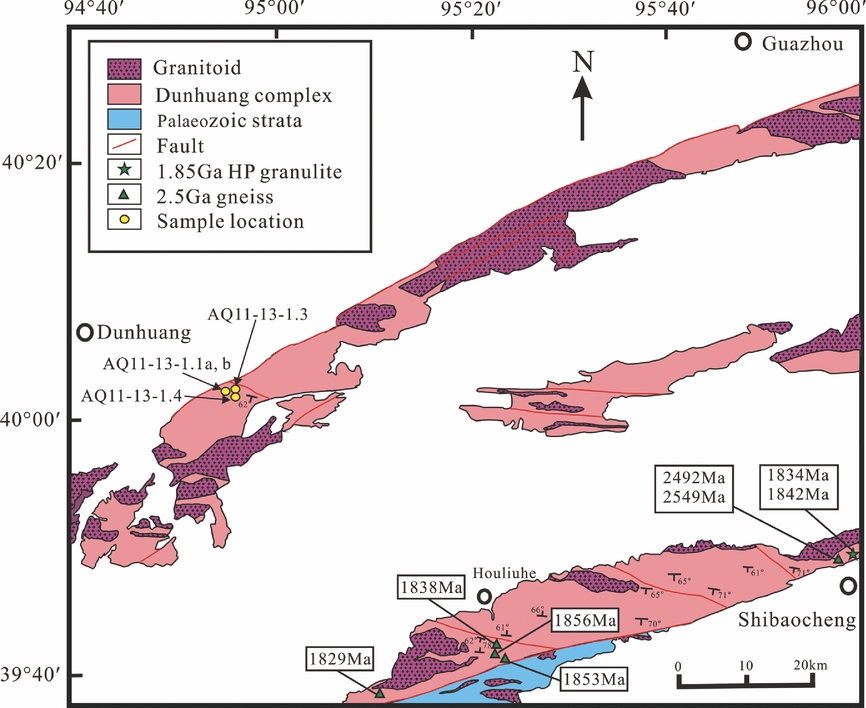
Very few isotopic data are available in the literature for the Dunhuang Complex. A tonalitic gneiss sample was previously dated at 2670±12 Ma using the zircon TIMS U–Pb method at Shibaocheng (Mei et al. Reference Mei, Yu and Lu1998). Recently, more precise SHRIMP zircon U–Pb dating results indicate that the tonalitic gneisses at Shibaocheng, Dunhuang block underwent a c. 2.5 Ga magmatic-metamorphic event (Zhang et al. Reference Zhang, Yu, Gong, Hou and Li2013). At the same location and nearby, Zhang, Gong & Yu (Reference Zhang, Gong and Yu2012) also recognized c. 1.85 Ga HP granulite metamorphism, which has been suggested to be related to the assembly of the Columbia supercontinent. Early Palaeozoic high-pressure granulites and magmatic rocks have also been recognized within the Dunhuang Block, suggesting that it may have been involved in a Palaeozoic orogeny (Meng et al. Reference Meng, Zhang, Xiang, Yu and Li2011; Zong et al. Reference Zong, Zhang, He, Hu, Santosh, Liu and Wang2012).
In this study, three representative granite samples (AQ11-13-1.1, AQ11-13-1.3 and AQ11-13-1.4) were collected from the Dunhuang block for zircon U–Pb dating and Lu–Hf isotopic analysis. In the field, the pink-red granitic plutons occur as dykes or patches intruding into the Precambrian basement, which mainly consists of biotite quartz-schist and plagioclase amphibole-schist (Fig. 3); locally, the plagioclase amphibole-schist has experienced anatexis and migmatization. Notably, the granitic plutons are cut by later dioritic or mafic dykes. The three granite samples show similar mineral assemblages, with compositions primarily of K-feldspar (30–40%), plagioclase (25–35%), quartz (15–25%) and sparse amphibole and sphene (Fig. 4); the amphibole is typically rimmed by fine-grained chlorite. The rocks show weakly deformed characteristics, and partly oriented K-feldspar, plagioclase and quartz define the foliation which is generally aligned with the regional tectonic lineament.
Simplified cross-section showing relationship between granitic pluton and other rocks.

Microtextures of A-type granites in the Dunhuang block, SE Tarim Craton: (a) the granite is composed of plagioclase, K-feldspar, quartz and titanite; (b) the sample mainly consists of perthite, plagioclase, amphibole and titanite.

3. Analytical methods
3.a. Major and trace element geochemistry
Bulk-rock major, trace and rare Earth element (REE) concentrations were obtained using X-ray fluorescence (XRF) and inductively coupled plasma mass spectrometry (ICP-MS) at the National Research Center for Geoanalysis (CAGS). Major elements were analysed by XRF with analytical uncertainties of <5%. Trace and rare earth elements were analysed by ICP-MS. REEs were separated using cation-exchange techniques. Analytical uncertainties are 10% for elements with abundances of <10 ppm and c. 5% for those with abundances of >10 ppm (Yu et al. Reference Yu, Zhang, Li, Hou, Mattinson and Gong2012).
3.b. Nd isotopes
Whole rock Sm–Nd isotopic ratios were obtained using a Finnigan Triton TIMS at the China University of Geosciences, Wuhan. The 147Sm/144Nd ratios of the samples were calculated using Sm and Nd concentrations measured by an Agilent 7500a ICP-MS with uncertainties of 0.3%, based on USGS standard analyses. The total analytical blanks were 5×10⁻¹¹ g for Sm and Nd. A detailed account of the analytical procedures for the Nd isotopic measurements is given by Ling et al. (Reference Ling, Duan, Xie, Zhang, Zhang, Cheng, Liu and Yang2009).
3.c. Zircon U–Pb geochronology and Hf isotopic composition
Zircon grains were mechanically separated from c. 5–10 kg of sample rock by crushing and sieving, followed by standard magnetic, heavy liquid and hand-picking methods. The zircon grains were mounted in epoxy resin and then ground to approximately half of their thicknesses. Cathodoluminescence (CL) imaging of the zircon crystals was performed using a FEI Philips XL30 SFEG instrument with a 2 min scanning time operating at 15 kV and 120 nA at the Beijing SHRIMP Center, Chinese Academy of Geological Sciences (CAGS).
3.c.1. Zircon U–Pb dating
The zircons were analysed for U, Th and Pb using the laser-ablation multi-collector inductively coupled plasma mass spectrometry (LA-MC- ICP-MS) facility at the Institute of Mineral Resources, CAGS. Laser sampling was performed using a Newwave UP213 laser ablation system. All analyses were performed with a beam diameter of 25 μm, a 10 Hz repetition rate and energy of 2.5 J cm−1. A Thermo Finnigan Neptune MC-ICP-MS instrument was used to acquire ion-signal intensities. Standards GJ1 and M127 were analysed twice every 5–10 analyses. The data were evaluated using ICPMSDataCal 3.4 (Liu et al. Reference Liu, Gao, Hu, Gao, Zong and Wang2010). Concordia diagrams and weighted mean calculations were made using Isoplot/Ex ver3. Detailed operating conditions for the laser ablation system and the MC-ICP-MS instrument and data reduction are the same as those described by Hou, Li & Tian. (Reference Hou, Santosh, Qian, Lister and Li2009).
3.c.2. Zircon Lu–Hf isotope analysis
The zircon grains from three samples (AQ11-13-1.1, AQ11-13-1.3 and AQ11-13-1.4) were separated for Lu–Hf isotopic analyses using LA-MC-ICP-MS. The analyses were performed on the same zircon domains for which U–Pb dating had been conducted (or nearby to). Zircon Hf isotope analysis was performed using a Newwave UP213 laser-ablation microprobe attached to a Neptune MC-ICP-MS at the Institute of Mineral Resources, Chinese Academy of Geological Sciences, Beijing. The instrumental conditions and data acquisition processes are comprehensively described in Hou et al. (Reference Hou, Li, Zou, Qu, Shi and Xie2007) and Wu et al. (Reference Wu, Yang, Xie, Yang and Xu2006). A stationary spot was used for the present analyses, with a beam diameter of either 40 μm or 55 μm depending on the size of the ablated domains. He was used as a carrier gas to transport the ablated sample from the laser-ablation cell to the ICP-MS torch via a mixing chamber with Ar. To correct the isobaric interferences of 176Lu and 176Yb on 176Hf, the ratios 176Lu/175Lu = 0.02658 and 176Yb/173Yb = 0.796218 were determined (Chu et al. Reference Chu, Taylor, Chavagnac, Nesbitt, Boella, Milton, German, Bayon and Burton2002). For instrumental mass bias correction, Yb isotope ratios were normalized to a 172Yb/173Yb ratio of 1.35274 (Chu et al. Reference Chu, Taylor, Chavagnac, Nesbitt, Boella, Milton, German, Bayon and Burton2002) and Hf isotope ratios to a 179Hf/177Hf ratio of 0.7325 using an exponential law. The mass bias behaviour of Lu was assumed to follow that of Yb; mass bias correction protocols are described by Wu et al. (Reference Wu, Yang, Xie, Yang and Xu2006) and Hou et al. (Reference Hou, Li, Zou, Qu, Shi and Xie2007). Zircon GJ1 was used as the reference standard, with a weighted mean 176Hf/177Hf ratio of 0.282008±27 (2σ) during our routine analyses. This ratio is not distinguishable from the weighted mean 176Hf/177Hf ratio of 0.282013±19 (2σ), according to in situ analysis by Elhlou et al. (Reference Elhlou, Belousova, Griffin, Pearson and O'Reilly2006).
Calculation of the Hf model age (single-stage model age, T DM) is based on a depleted-mantle source with present-day 176Hf/177Hf at 0.28325 using the 176Lu decay constant of 1.865×10⁻¹¹ year−1 (Schlerer et al. Reference Schlerer, Muenker and Klaus2001). Calculation of the ‘crust’ (two-stage) Hf model age (T DMC) is based on the assumption of a mean 176Hf/177Hf value of 0.015 for the average continental crust (Griffin et al. Reference Griffin, Wang, Jackson, Pearson, O'Reilly, Xu and Zhou2002). Calculation of εHf(t) values was based on the zircon U–Pb ages and the chondritic values (176Hf/177Hf = 0.282772 and 176Lu/177Hf = 0.0332; Blichert-Toft & Albarede, Reference Blichert-Toft and Albarede1997).
4. Results
4.a. Major and trace element geochemistry
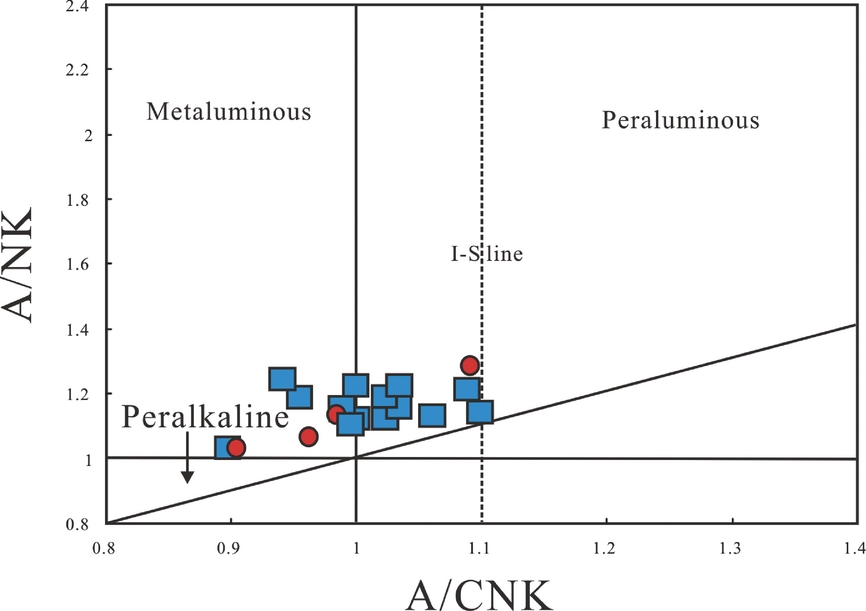
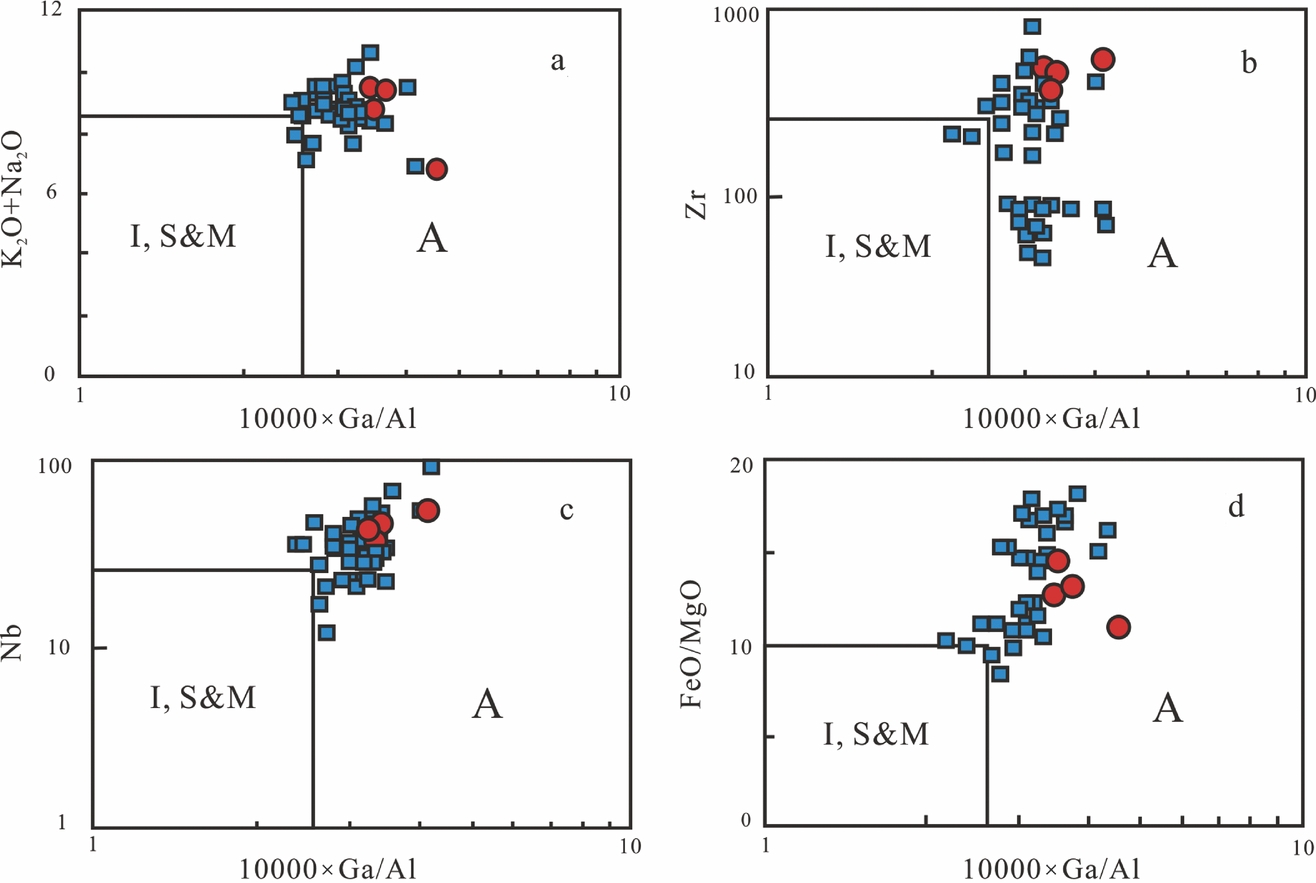
Major and trace element concentrations for the Dunhuang granites are listed in Table 1. The samples are rich in SiO2 (70.83–76.24 wt%) and K2O (4.35–5.13 wt%) and have high K2O/Na2O ratios greater than 1.0 (1.50–1.64), but are poor in MgO (0.17–0.27 wt%), TiO2 (0.32–0.35 wt%) and MnO (0.03–0.06 wt%). The rocks are metaluminous to weakly peraluminous, with A/CNK and A/NK ratios in the range 0.92–1.10 and 1.01–1.28 (Fig. 5), respectively. All Dunhuang granites have similar chondrite-normalized REE patterns, showing significant enrichment of light REE (LREE) relative to heavy REE (HREE), with high (La/Yb)N ratios (9–27) and large negative Eu anomalies (Eu/Eu* = 0.10–0.61; Fig. 6). In the primitive-mantle normalized trace element diagram, the granites show trace element features of A-type granites such as a strong depletion of Nb, Sr, P and Ti but enrichment in Rb, K, La, Ce, Zr, Hf, Nd and Sm (Collins et al. Reference Collins, Beams, White and Chappell1982; Whalen et al. Reference Whalen, Currie and Chappell1987; Wu et al. Reference Wu, Sun, Li, Jahn and Wilde2002). In the K2O + Na2O, FeOt/MgO, Zr and Nb vs. Ga/Al discrimination diagrams of Whalen et al. (Reference Whalen, Currie and Chappell1987), they fall in the A-type granite fields (Fig. 7).
Major and trace element compositions of granites from the Dunhuang block, SE Tarim Craton.

A/NK versus A/CNK plot showing the weak peraluminous nature of the Dunhuang granites. A = Al2O3, N = Na2O, K = K2O, C = CaO (all in molar proportion). The red diamonds and the blue circles represent samples from the Dunhuang area and the NCC, respectively (Zhang, Liu et al. Reference Zhang, Liu, Zhao, Yang, Song and Liu2007; Zhao & Zhou, Reference Zhao and Zhou2009; Jiang et al. Reference Jiang, Guo and Zhai2011).
(a) Chondrite-normalized REE patterns and (b) primitive mantle-normalized trace element spectra for the Dunhuang granites. Data for chondrite and primitive mantle–normalized values are from Sun & McDonough (Reference Sun, McDonough, Sauders and Norry1989). The NCC data are from Zhang, Li et al. (Reference Zhang, Liu, Zhao, Yang, Song and Liu2007), Zhao & Zhou (Reference Zhao and Zhou2009) and Jiang et al. (Reference Jiang, Guo and Zhai2011).

Major and trace element classification diagrams for the Dunhuang granites: (a) molecular (K2O+Na2O)/Al2O3 versus 10000Ga/Al diagram from Whalen et al. (Reference Whalen, Currie and Chappell1987); (b) Zr versus 10000Ga/Al diagram from Whalen et al. (Reference Whalen, Currie and Chappell1987); (c) Nb versus 10000Ga/Al diagram from Whalen et al. (Reference Whalen, Currie and Chappell1987); and (d) FeO/MgO versus 10000Ga/Al diagram from Whalen et al. (Reference Whalen, Currie and Chappell1987). The red diamonds and blue circles represent samples from the Dunhuang area and NCC, respectively (data from Zhang, Liu et al. Reference Zhang, Liu, Zhao, Yang, Song and Liu2007; Zhao & Zhou, Reference Zhao and Zhou2009; Jiang et al. Reference Jiang, Guo and Zhai2011).
4.b. Nd isotope
A value of t = 1770 Ma was assigned to calculate Nd radiogenic isotopic composition at the time of magma crystallization. The calculated initial εNd(t) values range from –6.2 to –2.5, giving depleted-mantle Nd model ages in the range 2.3–2.7 Ga. This indicates that the magma of the Dunhuang granites was most likely derived from the late Archean – early Palaeoproterozoic metamorphic basement of the Dunhuang Block.
4.c. Zircon U–Pb geochronology and Hf isotopic composition
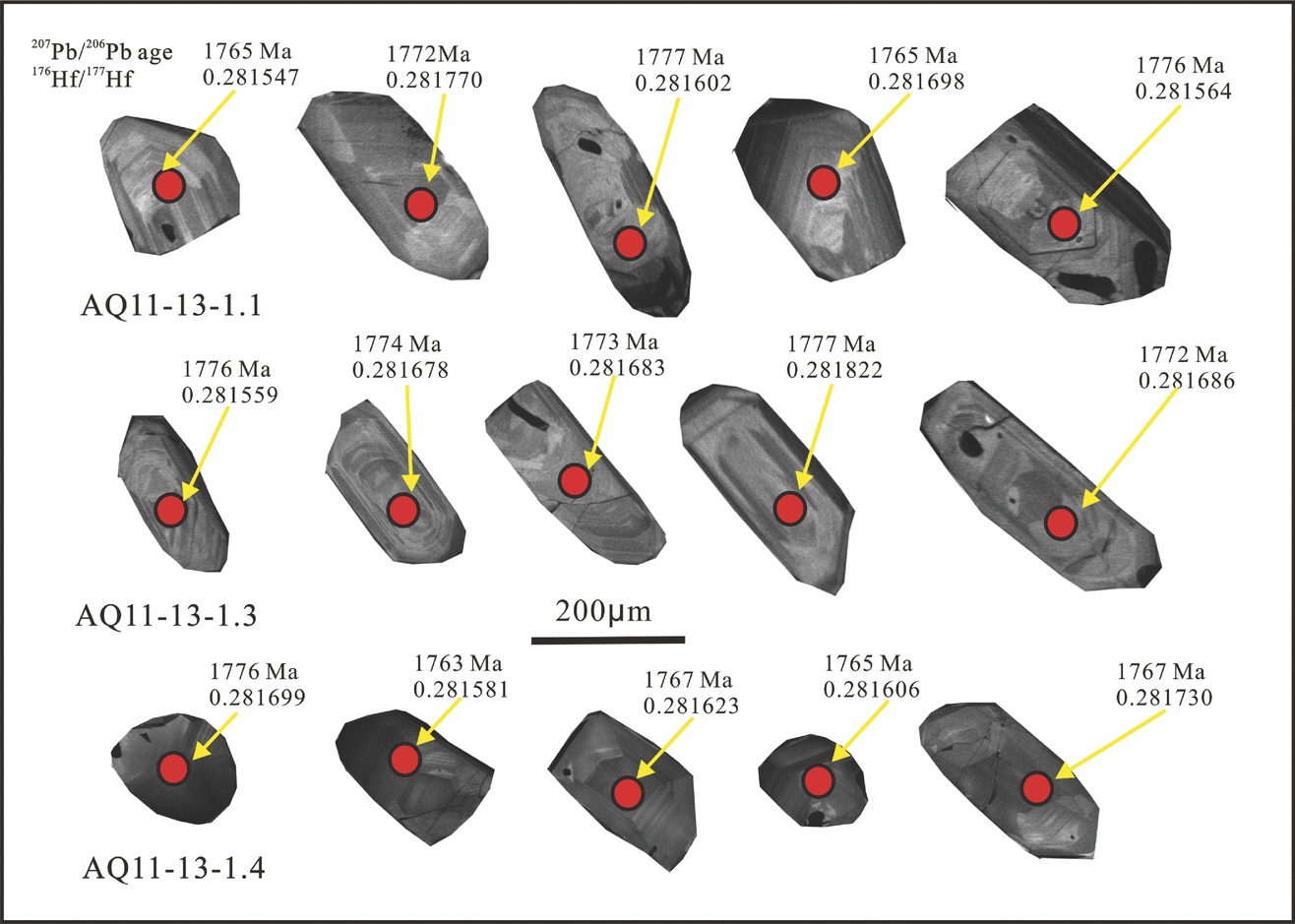
All of the zircons from the three granite samples AQ11-13-1.1, AQ11-13-1.3 and AQ11-13-1.4 show similar characteristics: transparent, euhedral crystals that are 200–300 μm in length. CL images mostly show oscillatory zonation with Th/U ratios greater than 0.1 (0.44–1.24), indicative of a magmatic origin (Fig. 8). Twenty-four spots from sample AQ11-13-1.1 were analysed for U–Pb dating (Fig. 9a; Table 2). Most zircon grains yielded discordant ages resulting from a marked loss of radiogenic Pb. All analyses yielded a weighted mean 207Pb/206Pb age of 1779±7 Ma (MSWD = 3.1), consistent with the upper concordia intercept at 1776±13 Ma (MSWD = 0.66). A total of 26 spots from sample AQ11-13-1.3 were analysed for U–Pb dating (Fig. 9b; Table 3), most of which are discordant (similar to sample AQ11-13-1.1). All analyses yielded a weighted mean 207Pb/206Pb age of 1777±5 Ma (MSWD = 0.30), consistent with the upper concordia intercept at 1777±12 Ma (MSWD = 0.21). A total of 29 spots from sample AQ11-13-1.4 were analysed for U–Pb dating (Fig. 9c; Table 4) which yielded a weighted mean 207Pb/206Pb age of 1770±4 Ma (MSWD = 3.3), consistent with the upper concordia intercept at 1759±12 Ma (MSWD = 0.21).
LA-ICP-MS U–Pb analytical data for zircons from granites AQ11-13-1.1 in the Dunhuang block, SE Tarim Craton.

LA-ICP-MS U-Pb analytical data for zircons from granites AQ11-13-1.3 in the Dunhuang block, SE Tarim Craton.

LA-ICP-MS U-Pb analytical data for zircons from granites AQ11-13-1.4 in the Dunhuang block, southeastern Tarim Craton

Representative cathodoluminescence images of dated zircons.
Zircon U–Pb concordia diagrams for granites from the Dunhuang block, SE Tarim Craton.

The Lu–Hf isotopes were analysed at the same zircon locations for which U–Pb dating had been conducted (or nearby to). The εHf(t) values of all the Hf isotopic analysis spots were calculated based on 1770 Ma. The Lu–Hf isotopic data on dated zircons from the three samples are given in Table 5 and Figure 10.
LA-MC-ICPMS Lu-Hf isotope data of zircon from Dunhuang granites, SE Tarim Craton.

Zircon U–Pb age versus εHf(t) diagram for zircons of samples from the Dunhuang block, SE Tarim Craton. The crustal evolution path assumes a crustal 176Lu/177Hf ratio of 0.015. The NCC data are from Zhang, Liu et al. (Reference Zhang, Li, Li and Ye2007), Zhao & Zhou (Reference Zhao and Zhou2009) and Jiang et al. (Reference Jiang, Guo and Zhai2011); the TC data of gneiss are after Zhang, Gong & Yu (Reference Zhang, Li, Santosh, Li, Zou, Wang and Ye2012).
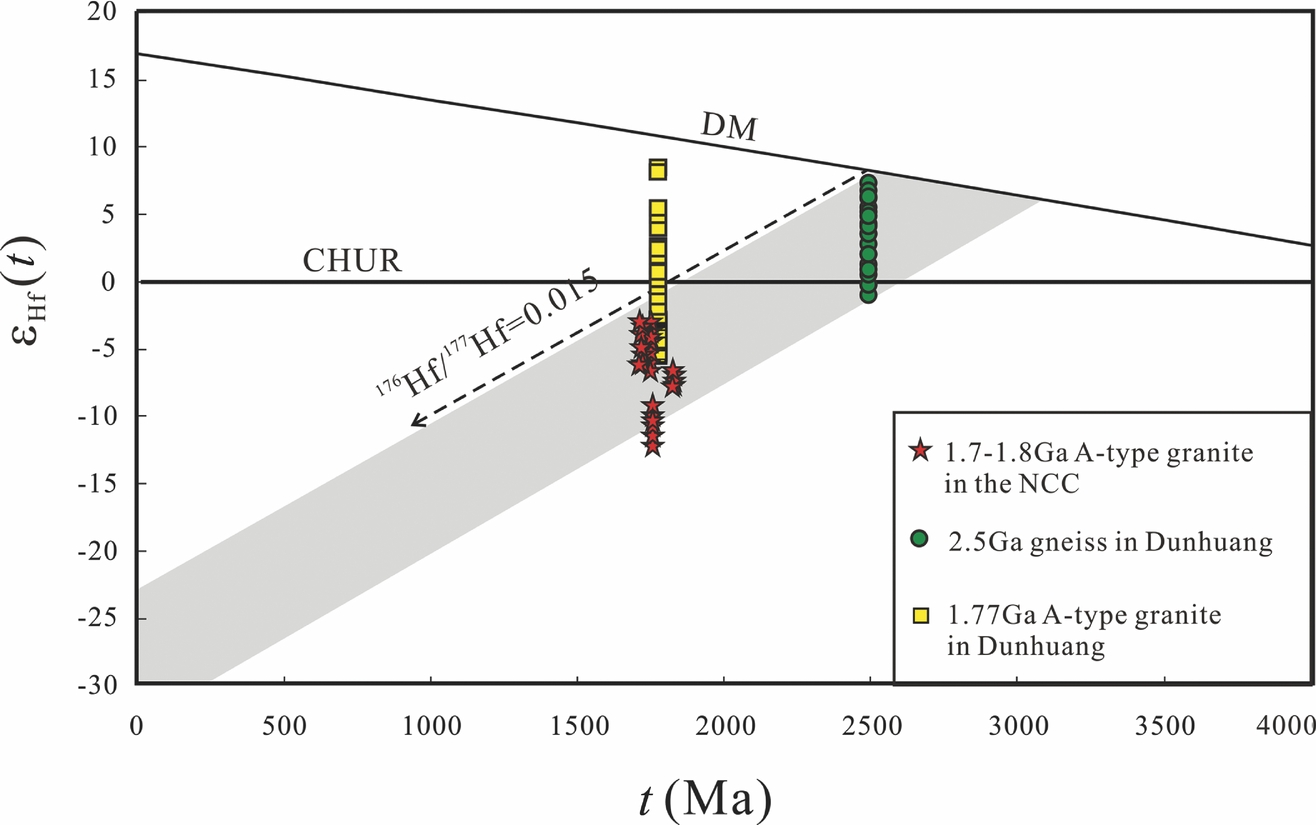
A total of 40 Hf isotopic spots were analysed on sample AQ11-13-1.1, which show 176Hf/177Hf ratios varying from 0.281529 to 0.281802. Their age-corrected εHf(t) values are between –5.2 and 4.6 at 1770 Ma. The two-stage zircon Hf model ages (T DMC) are within the range 2.2–2.8 Ga.
Thirty-two zircon Lu–Hf isotope analyses of sample AQ11-13-1.3 display variable 176Hf/177Hf ratios of 0.281512–0.281944, corresponding to εHf(t) values ranging from –5.9 to 8.7 and two-stage Hf model ages (T DMC) within the range 1.9–2.8 Ga.
Thirty-seven zircon Lu–Hf isotope analyses of sample AQ11-13-1.4 show 176Hf/177Hf ratios ranging from 0.281518 to 0.281730, corresponding to εHf(t) values varying from –5.6 to 1.8 and two-stage Hf model ages (T DMC) within the range 2.3–2.8 Ga.
5. Discussion
5.a. An A-type affinity of Dunhuang granite
A-type granites were originally defined as relatively alkali and incompatible element-rich anhydrous, reduced, anorogenic granites (Loiselle & Wones, Reference Loiselle and Wones1979). Later, more detailed petrographic and geochemical criteria as well as petrogenetic models were presented for A-type granites (Collins et al. Reference Collins, Beams, White and Chappell1982; Whalen et al. Reference Whalen, Currie and Chappell1987; Eby, Reference Eby1990, Reference Eby1992; Frost & Frost, Reference Frost and Frost1997; Frost et al. Reference Frost, Frost, Chamberlain and Edwards1999), which resulted in new classifications and terminology (such as A1-type and A2-type granites) based on trace element discrimination diagrams. The A1-type granites were suggested to occur in anorogenic settings such as continental rifts or intraplate environments. By contrast, A2-type granites can form in a wide range of tectonic settings (e.g. post-orogenic extension of collisional orogens; Eby, Reference Eby1992). A2-type magmas can be derived from continental crust or underplated crust that has experienced a cycle of continent–continent collision or island–arc magmatism. However, recent research indicates that no strict correspondence exists between A1 and A2 classifications and anorogenic post-collisional tectonic settings (Wang et al. Reference Wang, Wyman, Li, Bao, Zhao, Wang, Jian, Yang and Chen2010).
The Dunhuang granites exhibit the following petrologic geochemical characteristics that are typical of A-type granite: (a) high contents of SiO2 and alkalis (i.e. high K2O+Na2O with K2O/Na2O>1), enrichment in high-field-strength elements (HFSE) and REE (except for Eu), and extreme depletion in Ba, Sr, P, Ti and Eu; (b) 10000×Ga/Al ratios of 3.5–4.4, with an average value of 3.79 (Table 1), similar to the global average of 3.75 for A-type granites (Whalen et al. Reference Whalen, Currie and Chappell1987); (c) the presence of characteristic minerals such as amphibole, sphene and perthite; and (d) high-temperature magmas, from which it is generally accepted that A-type granites are derived. Zircon saturation thermometry (Watson & Harrison, Reference Watson and Harrison1983) provides a simple and robust means of estimating magma temperatures from bulk-rock compositions. Zirconium saturation temperature results indicate that the Dunhuang granites have high initial magmatic temperatures in the range 887–950°C, which is higher than typical I-type granite but similar to A-type granites (King et al. Reference King, White, Chappell and Allen1997, Reference King, Chappell, Allen and White2001; Miller et al. Reference Miller, McDowell and Mapes2003; Bonin, Reference Bonin2007). The high temperatures can also account for the absence of inherited zircons. In geochemical discrimination diagrams (Fig. 7), the Dunhuang granite samples therefore plot in the field of typical A-type granites regions.
5.b. Magma source
A-type granite magmas could be formed through a number of magmatic processes involving fractional crystallization of mantle-derived basaltic magmas (Turner et al. Reference Turner, Foden and Morrison1992; Smith et al. Reference Smith, Noblett, Wobus, Unruh, Douglass, Beane, Davis, Goldman, Kay, Gustavson, Saltoung and Stewart1999; Anderson et al. Reference Anderson, Frost and Frost2003), assimilation and fractional crystallization (AFC) processes, partial melting of mantle or crust and magma mixing between basaltic and crustal melts (Collins et al. Reference Collins, Beams, White and Chappell1982; Clements et al. Reference Clements, Holloway and White1986; Whalen et al. Reference Whalen, Currie and Chappell1987; Creaser et al. Reference Creaser, Price and Wormald1991; Frost & Frost, Reference Frost and Frost1997; King et al. Reference King, White, Chappell and Allen1997; Frost et al. Reference Frost, Frost, Chamberlain and Edwards1999; Wu et al. Reference Wu, Sun, Li, Jahn and Wilde2002; Yang et al. Reference Yang, Wu, Chung, Wilde and Chu2006; Bonin, Reference Bonin2007; Dall'Agnol & de Oliveira, Reference Dall'Agnol and de Oliveira2007). Based on petrological and geochemical characteristics, zircon U–Pb dating and the Lu–Hf isotope, three of the modes (fractional crystallization, AFC processes, partial melting of mantle or crust) do not appear to be able to account for the petrogenesis of the Dunhuang A-type granite, whereas the model with magma mixing between basaltic and crustal melts is more suitable for explaining the magmatic origin of the Dunhuang A-type granite.
Generally, magmas derived from fractional crystallization of mantle-derived basaltic magmas or AFC processes should exhibit a continuous compositional trend from mafic through intermediate to felsic rocks (Frost & Frost, Reference Frost and Frost1997; Bogaerts et al. Reference Bogaerts, Scaillet, Liegeois and Vander Auwera2003; Kim et al. Reference Kim, Oh, Ryu, Williams, Sajeev, Santosh and Rajesh2006; Wang et al. Reference Wang, Wyman, Li, Bao, Zhao, Wang, Jian, Yang and Chen2010). However, the Dunhuang granites show high SiO2 contents greater than 70 wt% without an obvious continuous compositional trend. In addition, no contemporary (1.75–1.8 Ga) coexisting large-volume mafic or intermediate rocks are closely associated with the Dunhuang A-type granites, which could be responsible for fractional crystallization or AFC processes in the region. Although some 1.85 Ga HP granulites occur in the Dunhuang area, they do not display a continuous compositional trend with A-type granite. Moreover, regarding the Nd and Hf isotope, the Dunhuang granites do not possess any features of mantle-derived magma; direct fractional crystallization of mantle-derived basaltic magmas or AFC processes is therefore not possible. The Dunhuang A-type granites exhibit a heterogeneous distribution of Hf isotopic compositions ranging from –5.9 to 8.7 and T DM2 ranging from 1.9 to 2.8 Ga, with a peak two-stage Hf model age (T DMC) of c. 2.5–2.6 Ga.
To explain the heterogeneous distribution of Hf isotopic compositions (εHf = –5.9 to 8.7) from the granites, we consider two possible scenarios: (1) a simple, common evolution by closed-system fractionation processes derived from the late Archean crustal source; and (2) the variation of c. 14 εHf units (e.g. –5.9 to 8.7) can be generated by mixing between two discrete magmas, one derived from pre-existing enriched crustal material (>2.8 Ga) and the other from a depleted mantle-derived component.
We favour model (1) to explain the source of the late Palaeoproterozoic granites in the Dunhuang area based on the following considerations. (a) For the same age interval, no coexisting mantle magma has been recognized in the Dunhuang area. (b) Most zircons have εHf(t) values lower than 0, with only rare analyses higher than 0 (about 10 analyses) and one sample (AQ11-13-1.3) having two analyses of about 8, which could not preclude the possibility of accidental experimental error. In the εHf(t)–t plot, most Hf isotopes of the late Palaeoproterozoic zircons are plotted within the evolution fields of the late Arhean zircons of the TTG gneiss, thus indicating that the late Palaeoproterozoic granites were derived primarily from the late Archean crust. (c) The granites have very low MgO, Cr and Ni contents, which preclude the possibility of mantle material being added. (d) The agreement between εNd values (–6.2 to –2.5) and T DM (2.3–2.7 Ga) also precludes a mixing regime. Thus, late Palaeoproterozoic granites in the Dunhuang area were most predominately derived from the late Archean crustal source.
5.c. Tectonic environments
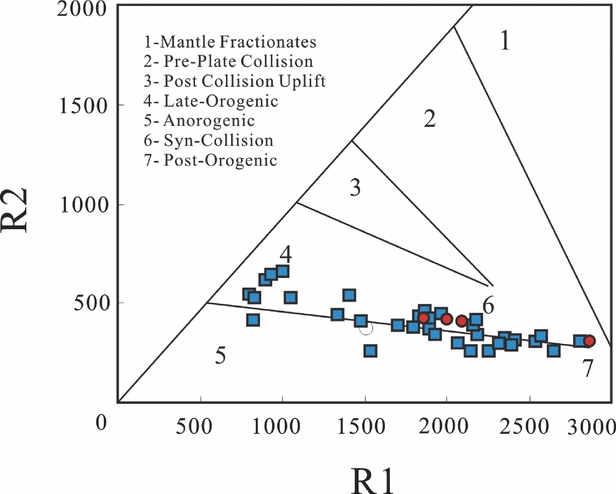
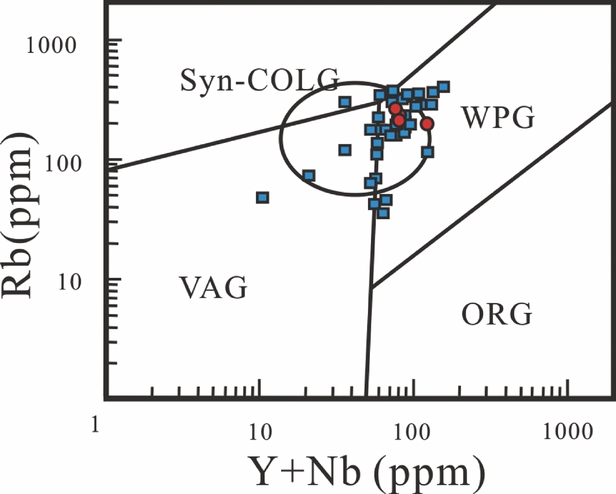
The A-type granites could occur in anorogenic settings or post-collisional/post-orogenic extensional tectonic environments (Eby, Reference Eby1992). By integrating regional geological and geochemical characteristics, we suggest that the late Palaeoproterozoic A-type granites in the TC were generated in a post-collisional/post-orogenic extensional tectonic environment based on the following considerations. (a) On the R2 versus R1 diagram of Batchelor & Bowden (Reference Batchelor and Bowden1985), most A-type granites fall into the late-orogenic or syn-collisional fields (Fig. 11). (b) In the tectonic discrimination diagrams of Pearce et al. (Reference Pearce, Harris and Tindle1984) and Pearce (Reference Pearce1996), most samples fall into the post-collisional fields (Fig. 12). (c) Newly recognized c. 1.85 Ga HP granulites in the Dunhuang area have a clockwise pressure–temperature (P–T) path involving isothermal decompression, implying continent–continent collisional environments in the late Palaeoproterozoic and that the emplacement of the A-type granites occurred just c. 80 Ma later.
Geochemical discrimination diagrams of R1/R2 after Batchelor & Bowden (Reference Batchelor and Bowden1985) for the Dunhuang granites. R2 = 6Ca+2Mg+Al; R1 = 4Si–11(Na +K)–2(Fe+Ti). The red diamonds and blue circles represent samples from the Dunhuang block and the NCC, respectively (data from Zhang, Liu et al. Reference Zhang, Liu, Zhao, Yang, Song and Liu2007; Zhao & Zhou, Reference Zhao and Zhou2009; Jiang et al. Reference Jiang, Guo and Zhai2011).
Geochemical discrimination diagrams of Rb–Y+Nb after Pearce et al. (Reference Pearce, Harris and Tindle1984) for the Dunhuang granites. VAG – volcanic arc granites; ORG – ocean ridge granites; WPG – within plate granites; syn-COLG and post-COLG – syn- and post-collision granites. The red diamonds and blue circles represent samples from the Dunhuang block and the NCC, respectively (data from Zhang, Liu et al. Reference Zhang, Liu, Zhao, Yang, Song and Liu2007; Zhao & Zhou, Reference Zhao and Zhou2009; Jiang et al. Reference Jiang, Guo and Zhai2011).
5.d. Tectonic implications
Similar to the TC, c. 1.7–1.8 Ga granitoid magmatism in extensional regimes has been well documented in many other cratons including in north China, India, North America and Greenland. Condie et al. Reference Condie, Belousova, Griffin and Sircombe2009 suggested that the period 1.7–1.8 Ga represents an important time of juvenile granitoid magmatism. In the NCC, the 1.7–1.75 A-type granites were recognized in the northern margin of the NCC, with εHf(t) values from –4.1 to –7.5 and T DM2 of 2.6–2.9 Ga (Zhang, Liu et al. Reference Zhang, Liu, Zhao, Yang, Song and Liu2007; Jiang et al. Reference Jiang, Guo and Zhai2011). The 1.7 Ga A-type granite was also recognized in the southern margin of the NCC, which was suggested to be derived from the late Archean basement complexes, with εHf(t) values from –4.1 to –7.5 and T DM2 of 2.7–2.9 Ga in post-orogenic extensional tectonic settings (Zhao & Zhou, Reference Zhao and Zhou2009). In India, 1.67–1.78 Ga A-type granites have been widely recognized in the Aravalli orogen, with εNd(t) values from –7.2 to –1.3 and T DM2 of 2.2–2.6 Ga in post-orogenic extensional tectonic settings (Sivaraman & Raval, Reference Sivaraman and Raval1995; Paudit & Khatatneh, Reference Paudit and Khatatneh1998; Biju-Sekhar et al. Reference Biju-Sekhar, Yokoyama, Pandit, Okudaira, Yoshida and Santosh2003; Chaudhri et al. Reference Chaudhri, Kaur, Okrusch and Schimrosczyk2003; Kaur et al. Reference Kaur, Chaudhri, Okrusch and Koepke2006, Reference Kaur, Chaudhri, Raczek, Kroner, Hofmann and Okrusch2011). In North America, rare 1720–1715 Ma post-orogenic A-type granites were recognized in the Makkovik province, Labrador, Canada (Kerr et al. Reference Kerr, Krogh, Corfu, Schärer, Gandhi and Kwok1992; Ketchum et al. Reference Ketchum, Barr, Culshaw and White2001). In addition, a c. 1755–1725 Ma extension-related rapakivi granite suite was found in the Ketilidian orogen, Greenland (Hutton et al. Reference Hutton, Dempster, Brown and Becker1990). From comparison with geochronologically, geochemically and tectonically similar rocks globally, 1.7–1.8 Ga was speculated to be an important extension-related phase related to dispersal of Columbia (Kaur et al. Reference Kaur, Chaudhri, Raczek, Kroner, Hofmann and Okrusch2011).
The supercontinent Columbia was first proposed in an abstract by Rogers (Reference Rogers2000). Purportedly, the supercontinent was mostly assembled by c. 2.0–1.8 Ga (Rogers & Santosh, Reference Rogers and Santosh2002, Reference Rogers and Santosh2009; Zhao et al. Reference Zhao, Sun and Wilde2002a , Reference Zhao, Wilde, Cawood and Sun b , Reference Zhao, Sun and Wilde2003a , Reference Zhao, Sun, Wilde and Li b , Reference Zhao, Sun, Wilde, Li, Liu and Zhang2006; Wilde et al. Reference Wilde, Zhao and Sun2002; Kroner et al. Reference Kroner, Wilde, Li and Wang2005, Reference Kroner, Wilde, Zhao, O'Brien, Sun, Liu, Wan, Liu and Guo2006; Hou et al. Reference Hou, Santosh, Qian, Lister and Li2008; Santosh et al. Reference Santosh, Sajeev, Li, Liu and Itaya2009; Yakubchuk, Reference Yakubchuk2010). Recent research indicates that the late Palaeoproterozoic tectono-magmatic and metamorphic (1.8–2.0 Ga) event was also recognized in the TC, demonstrating that the TC was part of Columbia (Zhang, Li et al. Reference Zhang, Liu, Zhao, Yang, Song and Liu2007, Reference Zhang, Gong and Yu2012; Zhang, Liu et al. Reference Zhang, Liu, Zhao, Yang, Song and Liu2007; Long et al. Reference Long, Yuan, Sun, Kroner, Zhao, Wilde and Hu2011; Shu et al. Reference Shu, Deng, Zhu, Ma and Xiao2011; Zhu et al. Reference Zhu, Zheng, Shu, Ma, Wu, Li, Huang and Yu2011; Zhang, Gong & Yu, Reference Zhang, Gong and Yu2012). However, the location of the TC in Columbia has not been studied extensively and is still controversial. Rogers & Santosh (Reference Rogers and Santosh2002) did not include the TC in their configuration of Columbia. Zhao et al. (Reference Zhao, Sun and Wilde2002a , Reference Zhao, Wilde, Cawood and Sun b , Reference Zhao, Sun, Wilde and Li2004) were the first authors to place the TC adjacent to the SCC and Australia. Later, Kusky et al. (Reference Kusky, Li, Santosh, Zhai, Xiao and Santosh2007) placed the TC adjacent to the NCC, which was further confirmed by Yakubchuk (Reference Yakubchuk2010). Recently, Long et al. (Reference Long, Yuan, Sun, Kroner, Zhao, Wilde and Hu2011) proposed that the TC was located between the South China and Australian blocks on the NW margin of the supercontinent. However, a sequence of 1.8–1.9 Ga tectono-magmatic and HP granulite-facies metamorphic evolution of the TC is remarkably similar to the N China and India cratons and the Canadian shield, which were purportedly united together as a landmass within the Columbia supercontinent before its extension and break-up (Hou et al. Reference Hou, Santosh, Qian, Lister and Li2008). Moreover, 1.7–1.8 Ga post-orogenic extensional A-type granite could also be correlated with those of the N China and India cratons and the Canadian shield, suggesting that these blocks were associated with extensional tectonics and the break-up of a possible supercontinent over the time interval 1.8– 1.7 Ga in contrast to the dominantly accretion and collision tectonics of the Laurentia and North Atlantic cratons during the same period (Kusky et al. Reference Kusky, Li, Santosh, Zhai, Xiao and Santosh2007).
The TC was previously regarded to be an individual block apart from the NCC in most accounts of geological history. However, recent zircon U–Pb ages and Hf isotopic composition data have indicated that the TC has a consistent early evolutionary history with the NCC during Neoarchean–Palaeoproterozoic time: (1) c. 2.7 Ga crust growth event as evidenced by Nd and zircon Hf isotopic data (Hu et al. Reference Hu, Jahn, Zhang, Chen and Zhang2000; Long et al. Reference Long, Yuan, Sun, Kroner, Zhao, Wilde and Hu2011; Zhang, Gong & Yu, Reference Zhang, Gong and Yu2012; Zhang et al. Reference Zhang, Yu, Gong, Hou and Li2013); (2) c. 2.5 Ga magmatic-metamorphic event occurred in both the TC and the NCC (Jiang et al. Reference Jiang, Guo, Zhai and Zhang2010; Geng et al. Reference Geng, Du and Ren2011; Wan et al. Reference Wan, Liu, Wang, Dong, Yang, Wang, Zhou, Du, Yin, Xie and Ma2010, Reference Wan, Liu, Wang, Song, Kröner, Dong, Zhou and Yin2011; Zhai & Santosh, Reference Zhai and Santosh2011; Zhang, Gong & Yu, Reference Zhang, Li, Santosh, Li, Zou, Wang and Ye2012; Zhang et al. Reference Zhang, Yu, Gong, Hou and Li2013; Zhao & Zhai, Reference Zhao and Zhai2012); and (3) c. 1.85 HP granulite metamorphism has been recognized in the Dunhuang area of the TC and in the NCC (Zhao et al. Reference Zhao, Wilde, Cawood and Sun2001, Reference Zhao, Sun, Wilde and Li2005; Kusky et al. Reference Kusky, Li, Santosh, Zhai, Xiao and Santosh2007; Kusky Reference Kusky2011), which is broadly coeval with the late Palaeoproterozoic global orogenic event correlated to the timing of the assembly of the Palaeoproterozoic supercontinent Columbia (Rogers & Santosh, Reference Rogers and Santosh2002; Zhao et al. Reference Zhao, Sun and Wilde2002a , Reference Zhao, Sun, Wilde and Li2004; Guo et al. Reference Guo, Sun, Chen and Zhai2005; Santosh et al. Reference Santosh, Sajeev, Li, Liu and Itaya2009; Santosh, Reference Santosh2010). In addition, following the amalgamation dated at c. 1.85 Ga, the NCC experienced a number of extensional and rifting events in the interior or along the margins of the craton between 1.8 and 1.6 Ga that were characterized by the emplacement of mafic dyke swarms, an anorthosite-gabbro-mangerite-rapakivi granite suite and A-type granite (Wang et al. Reference Wang, Fan, Zhang, Guo, Zhang and Peng2004; Peng et al. Reference Peng, Zhai, Zhang and Guo2005, Reference Peng, Zhai, Guo, Kusky and Zhao2007, Reference Peng, Zhai, Ernst, Guo, Liu and Hu2008; Zhang, Liu et al. Reference Zhang, Liu, Zhao, Yang, Song and Liu2007; He et al. Reference He, Zhao, Sun and Wilde2008, Reference He, Zhao, Sun and Xia2009, Reference He, Zhao, Sun and Han2010; Zhao & Zhou, Reference Zhao and Zhou2009; Zhao et al. Reference Zhao, He and Sun2009; Cui et al. Reference Cui, Zhang and Zhang2011; Jiang et al. Reference Jiang, Guo and Zhai2011).
Prior to this study, contemporary extensional and rifting events (1.8–1.6 Ga) have not been recognized in the TC. The c. 1.77 Ga A-type granites in the Dunhuang area are similar to those of the same age in the NCC, which provides more evidence to support the idea that the TC has an evolutionary history consistent with that of the NCC during Neoarchean–Palaeoproterozoic time.
6. Conclusions
The Dunhuang A-type granites in the SE Tarim block were emplaced at c. 1.77 Ga. Nd–Hf isotopic and whole-rock geochemical data indicate that these granites were most likely derived from the late Archean crustal source in a post-collisional/post-orogenic extensional tectonic environment. The late Palaeoproterozoic A-type granites in the TC could be correlated with those of the N China and India cratons and the Canadian shield, demonstrating extensional tectonics and break-up of the Columbia supercontinent.
Acknowledgments
This work was financially supported by the Geological Survey project of China (Grant No. 1212011120157 and 1212010918006), the National Natural Science foundation of China (Grant No. 41202037, 41072151, 40921001 and 41772138), and the Basic Foundation of the Institute of Geology, CAGS (Grant No. J1202).



