Family law is an essential dimension of women's citizenship in the modern state. The rights established in family law shape women's agency and autonomy; they also regulate access to basic resources—such as land, income, and education—that determine a citizen's ability to earn a living independently, among other life chances (Agarwal Reference Agarwal1994; Deere and León Reference Deere and León2001; Kabeer Reference Kabeer1994; Okin Reference Okin1989; World Bank 2012). Yet family law is a notorious site of sex inequality, historically and in the present. Equal rights enjoyed by women in national constitutions are often contradicted by family and civil codes that subordinate women to the decisions of their husbands and fathers. In the early 21st century, family law in a significant number of countries discriminated against women, denying them the rights held by men and contributing to their disadvantaged social positions.
Why do some countries have family laws that protect women's rights while others do not? This article analyzes an original dataset of family law provisions in 70 countries to provide some answers to this question. Though some scholars have analyzed variation in women's rights in family law in select groups of countries (see, e.g., Charrad Reference Charrad2001; Glendon Reference Glendon1987, Reference Glendon1989; Htun Reference Htun2003; Kang Reference Kang2010; Moghadam Reference Moghadam2003; Musawah 2009; WLUML 2006), little previous research has attempted a global analysis of the political, social, and historical conditions associated with more and less egalitarian family laws.Footnote 1
We show that the state's approach to religion is a major factor shaping the degree of sex equality in family law.Footnote 2 Though many other scholars of gender and politics have emphasized the role that religion plays in family law (and women's rights more generally) (see, e.g., Blofield Reference Blofield2006; Charrad Reference Charrad2001; Htun Reference Htun2003; Kang Reference Kang2010; Moghadam Reference Moghadam2003, Reference Moghadam2009; Razavi and Jenichen Reference Razavi and Jenichen2010; Williams Reference Williams2006), there is less consensus about what it is about religion that matters, and why and how it matters. Some scholars working with a broad cross-national perspective focus on particular religions, such as Islam or Catholicism (Alexander and Welzel Reference Alexander and Welzel2009; Castles Reference Castles1998; Cherif Reference Cherif2010, 1154; Donno and Russett Reference Donno and Russett2004; Fish Reference Fish2002); others connect gender equality to the degree of religiosity of a society (Inglehart and Norris Reference Inglehart and Norris2003). We emphasize the importance of the institutionalized relations between state and religion, which vary considerably across countries. Some states deny religion any official role while others institutionalize its public presence through constitutional establishment, funding, and enforcement of religious legislation, among other measures (Fox Reference Fox2008, Reference Fox2013).
Our analysis reveals a strong association between the political institutionalization of religious authority and sex equality in family law. In countries where political and ecclesiastical power are tightly linked, family law tends to discriminate against women. In the context of a separation of secular and religious institutions, family law tends to be more egalitarian. When religion is institutionalized, patriarchal interpretations—and interpreters—of family law gain greater authority and more immunity to contestation. They become increasingly insulated from external influences and more closely linked to the public status of religion. Challenges to particular versions of family law are seen as challenges to the entire church-state relationship. These findings affirm the importance of examining the relationship between religion and political institutions (e.g., Gill Reference Gill1998; Gryzmala-Busse Reference Gryzmala-Busse2012; Katznelson and Stedman Jones Reference Katznelson, Stedman Jones, Katznelson and Jones2010) and demonstrate that church-state relations help to shape key political outcomes such as party systems, the development of the welfare state, and the extent and nature of social provision (e.g., Castles Reference Castles1998; Esping-Andersen Reference Esping-Andersen1990; Kalyvas Reference Kalyvas1996; Kersbergen and Manow Reference Kersbergen and Manow2009; Lipset and Rokkan Reference Lipset, Rokkan, Lipset and Rokkan1967; Minkenberg Reference Minkenberg2002, Reference Minkenberg2003; Morgan Reference Morgan2006).
We do not argue that any and all religions are patriarchal. Religions are best understood as “multivocal” (Stepan Reference Stepan2001): doctrinal interpretations of women's rights vary within faiths and over time. For example, though state officials and conservative clerics often invoke Islam to defend patriarchal laws, most contemporary movements for egalitarian family law in the Muslim world also present their claims within a religious framework (Abu-Odeh Reference Abu-Odeh2004; Badran Reference Badran2009; Balchin Reference Balchin and Anwar2009; Mir-Hosseini Reference Mir-Hosseini1999, Reference Mir-Hosseini2006; Othman, Anwar, and Kasim Reference Othman, Anwar, Kasim and Othman2005; Singerman Reference Singerman and Hefner2005).Footnote 3 People have justified practices of sex discrimination and legitimized projects of gender equality in the name of religion. As this suggests, religious doctrine is not a thing; it is a site of struggle (Bayat Reference Bayat2007, 4; see also Hajjar Reference Hajjar2004; Mir-Hosseini Reference Mir-Hosseini2006). We show in this article that the political institutionalization of religious authority—not the hegemony of a particular religion, the strength of religious beliefs, or the assertion of spiritual values by a political party—is the key religious factor associated with differences in discriminatory outcomes across countries.
THEORETICAL FOUNDATIONS: FAMILY, THE STATE, AND FAMILY LAW
The family is foundational to politics. By families, we refer to “social units created by biological or affective ties among people who commonly contribute to one another's economic, moral, and psychological well being” (Minow Reference Minow1987, 959–60). The earliest political institutions grew out of family and kin networks (Adams Reference Adams2005; Weber Reference Weber, Roth and Wittich1978), and family relations historically supplied normative models of political authority (Cott Reference Cott2000).Footnote 4 At the same time, politics constitutes the family. Its definition and boundaries—not to mention the roles, relations, and identities of its members—are constituted by political processes and especially by the modern state (see, e.g., Nicholson 1998; Okin Reference Okin1989; Olsen Reference Olsen1985; Rhode Reference Rhode1989). Families do not exist prior to politics; rather, notions of the family as primordial and prepolitical are the result of politics.Footnote 5 Diverse political actors invoke the family to advance their political agendas, and it is the site of ideological and distributional battles (Minow Reference Minow1987; Mohamad Reference Mohamad2009; Strach Reference Strach2006; Thomas Reference Thomas2011).
Family law consists of legal norms governing the formation and internal relations of these social units. These include rules about marriage and its dissolution; the respective rights, obligations, and capacities of spouses; the relationship between parents and children; marital property; child custody or guardianship; and inheritance. These rules are usually—but not always—codified in national civil or family codes and expressed in judicial decisions. We exclude from consideration the myriad other ways that modern states affect women and families, including but not limited to the domain of “family policy.” Family policy—including paid maternity and parental leave, child care provision, and family allowances administered through the apparatus of the welfare state—has been the subject of considerable scholarship, particularly in the Organisation for Economic Co-operation and Development (OECD) countries (see, e.g., Esping-Andersen Reference Esping-Andersen2009; Gornick and Meyers Reference Gornick and Meyers2003; Morgan Reference Morgan2003; O'Connor, Orloff, and Shaver Reference O'Connor, Orloff and Shaver1999), but is conceptually and politically distinct from the family laws codified in civil codes and court decisions.Footnote 6
By the early twentieth century, family law in most places had come to uphold male dominance and enforce women's subordination and dependence. Official codification of social norms and practices tended to produce patriarchal homogeneity in contexts where a diversity of family forms and even women's freedoms had flourished (Ahmed Reference Ahmed1992; Dore Reference Dore, Dore and Molyneux2000; Glendon Reference Glendon1989; Tucker Reference Tucker2008). Even the liberal, democratic states that emerged after the U.S. War of Independence and the French Revolution explicitly placed women under the authority of their husbands through institutions such as coverture in the Anglo-American World and puissance maritale in the Napoleonic Code (Cott Reference Cott2000; Glendon Reference Glendon1989; Kerber Reference Kerber1998; Landes Reference Landes1988; Vogel Reference Vogel, Randall and Waylen1998). During the last third of the twentieth century, many states began to modify these old patriarchal models,Footnote 7 but the process has been uneven. In the first years of the 21st century, discriminatory provisions persisted in a significant number of countries. Why do some legal regimes disadvantage women across many areas while others treat women and men relatively equally across all, and still others uphold a mix of provisions?
ReligionFootnote 8
Understanding global variation in family law requires a close examination of the role of religion. Religious traditions and groups have long been invested in provisions on marriage, inheritance, and parenting. A central component of most ecclesiastical doctrines, these rules are used to demarcate the present and future membership of cultural communities. Sexuality in general, and women's sexuality in particular, features prominently. By regulating how, when, and with whom women and men bear children, family law determines who can become a member of the group and who is responsible for maintaining its values and ways of life (Shachar Reference Shachar2001). Family law connects the status of individual women to the construction and maintenance of group cultural identity (Okin 1999; Razavi and Jenichen Reference Razavi and Jenichen2010; Shachar Reference Shachar2001, Reference Shachar2008).
Religion has the potential to influence family law in myriad ways. Which aspects matter most? Our primary hypothesis is that state-religion relations are the most crucial, though we also test for factors identified in existing scholarship on religion and public policy, such as religiosity, confessional/denominational type, and religious parties (see, e.g., Castles Reference Castles1998; Esping-Andersen Reference Esping-Andersen1990; Hagopian Reference Hagopian and Hagopian2009; Kahl Reference Kahl2005; Manow Reference Manow2004; Manow and Kersbergen Reference Manow, van Kersbergen, Manow and Van Kersbergen2009; Minkenberg Reference Minkenberg2002, Reference Minkenberg2003; Scheve and Stasavage Reference Scheve and Stasavege2006a,Reference Scheve and Stasavegeb; Stadelmann-Steffen and Traunmüller Reference Stadelmann-Steffen and Traunmüller2011).
Religion-State Relations
Contemporary relations between the state and religion reflect historical patterns of state building. In many countries, new political authorities attempted to usurp or co-opt the social control exercised by religious organizations and other subnational groups. These struggles produced different outcomes. Some institutional arrangements centralized and imposed secular authority, marginalizing religious doctrines and leaders from public life. Other states did the opposite: they crafted a special role for religion, codified ecclesiastical law, and granted privileges to religious authorities. Still others chose an intermediate route by incorporating ecclesiastical principles into systems of otherwise secular governance (Charrad Reference Charrad2001; see also Glendon Reference Glendon1989; Joseph Reference Joseph and Kandiyoti1991; Kandiyoti Reference Kandiyoti and Kandiyoti1991b; Williams Reference Williams2006). The legacy of these institutionalized relations between state and religion continue to influence family law and are crucial to understanding why the degree of equality differs across countries.
Today, there is significant variation in the extent to which state power grants public status to religious doctrines, symbols, and ideas, with configurations ranging from virtual fusion (Saudi Arabia) to complete separation (United States).Footnote 9 Most states lie between these two extremes, producing variation in what we call the political institutionalization of religious authority. At one end of the spectrum, the state enforces religious education, holidays, and practices, provides funding for religious institutions, and names ecclesiastical officials, among other measures (Fox Reference Fox2008). The public legitimacy of religion in such contexts tends to promote “sacralization,” a process in which “the primary aspects of life from family to politics, are suffused with religious rhetoric, symbols, and rituals” (Stark and Iannaccone Reference Stark and Iannaccone1994, 234). Religious doctrine, rather than public or universal reasons, serves as the normative basis of lawmaking (cf. Weber Reference Weber, Roth and Wittich1978, 226). At the other, secularFootnote 10 end of the spectrum, the state maintains a normative basis that is at least formally independent of religious institutions and doctrine. Public reasons, not particular religious beliefs, supply the rationale for political decisions (Creppell Reference Creppell, Katznelson and Jones2010, 24–35; Rawls Reference Rawls1993).
Though religious doctrine is not necessarily patriarchal, it was historically so. Religions can and do change, but the state affects the timing and pace of this process. State institutionalization of ecclesiastical doctrine tends to freeze patriarchal interpretations and connect them to the public status of religion more generally. State intervention enhances the authority of certain religious interpretations—and interpreters, rendering them less liable to contestation and less exposed to broader societal influences. Political institutionalization reduces religious pluralism, suppressing currents of religious thought that are more supportive of sex equality.Footnote 11
It can be hard to reform family law in these contexts. Challenges to the religious interpretations supported by state law come to be seen as challenges to the entire institutional configuration whereby state power reinforces religious authority (and vice versa). Family law becomes a referendum on the role of religion in the polity and on the public and legitimizing character of religious doctrines. To uphold patriarchal family law is to defend religion's role; to favor egalitarian reforms is to challenge the historic bargain between church and state. As a result, critics of family law (and other elements of state power) are often branded as heretics. The greater the degree of political institutionalization of religion, the more likely it is that criticism will be suppressed and critics maligned.
For example, Egyptian women who protested sex discrimination in family law were branded as Western and immoral (Singerman Reference Singerman and Hefner2005). Opponents of legal divorce in Brazil in the 1970s criticized proposals for reform as sinful, and Roman Catholic bishops declared to legislators that “no good Catholic” could vote for the bill (Htun Reference Htun2003). In Israel, egalitarian reform to orthodox Jewish law has been deemed “inconceiveable” for its perceived challenge to the foundations of the polity and the construction of Jewish identity (Halperin-Kaddari Reference Halperin-Kaddari2003, 228). Malaysian feminists who defended women's rights in the name of Islam were called “traitors,” accused of insulting Islam, and deemed “not qualified enough” to discuss religious topics (Mohamad Reference Mohamad2009; Moustafa Reference Moustafa2013; Neo Reference Neo2003, 70). Zainah Anwar, founder of Sisters in Islam in Malaysia, claimed that the debate over family law is not so much about women's rights but “about the place of Islam in the public space and the place of Islam as a source of law and public policy.”Footnote 12
Since political institutionalization links patriarchal family law to the public status of religion more generally, reforms are difficult, and family law will remain discriminatory. We propose the following hypotheses:
H1:
In countries with official state religions, family law will be less egalitarian than in polities without official religions.
H2:
Family law will be less egalitarian in countries in which the government endorses religious practices and principles in law.
Institutionalized state-religion relations may not have the same effect across all contexts, as they are shaped by beliefs and practices in society. Since previous research has suggested that the degree of societal religiosity is related to support for women's rights, it is worth exploring its relationship to the degree of sex inequality in family law. Do religious beliefs of citizens play into the impact of institutionalized religion?
Religion-State Relations and Religiosity
Inglehart and Norris (Reference Inglehart and Norris2003) found a negative association between religiosity — measured by beliefs in God and attendance at religious services, among other factors— and beliefs about gender equality. This suggests that citizens and politicians may prefer laws that reflect conservative religious doctrines on women's family roles. It is not implausible that religiosity will have some effect on sex inequality in family law, namely, that
H3:
Countries with higher degrees of religiosity have less egalitarian family law.
However, we anticipate that on its own, religiosity will not be as consequential for women's rights as it is in the context of the fusion of church and state. The main impact of religiosity may come in the way that it conditions the effect of state-religion relations on women's rights. In countries where everyone is a believer, official religious institutions and doctrinal interpretations are widely perceived as legitimate (Hagopian Reference Hagopian and Hagopian2009; Htun Reference Htun and Hagopian2009). In societies where no one believes in God, institutionalized religion has less influence over public policy (Minkenberg Reference Minkenberg2002). This may be why some studies of family policy and abortion in Europe argue that religion-state relations have the opposite effect of the one we describe here. For example, Scandinavian countries with public, official religions but very low religiosity preside over Europe's most expansive family policies and most liberal abortion regimes and were early liberalizers of patriarchal family laws. In the Netherlands, where church and state are institutionally separated but religiosity is higher, family policies and abortion laws have historically been more conservative than in Nordic countries (Minkenberg Reference Minkenberg2002, Reference Minkenberg2003; Morgan Reference Morgan2006). This suggests that
H4:
High degrees of political institutionalization of religious authority interact with high degrees of religiosity to produce sex inequality in family law.
In our approach, church-state relations are the primary way that religion is associated with family law. Below, we explain why it is even more powerful than other avenues of influence charted by scholars, such as particular religious types and religious parties.
Confessional/Denominational Type
Several studies link particular religions to women's low status. For example, Muslim-majority countries, particularly in the Middle East and North African (MENA) region, have attitudes that are relatively unsupportive of gender equality, fewer women in positions of power, lower rates of female labor force participation, and discriminatory laws on citizenship and nationality (Alexander and Welzel Reference Alexander and Welzel2009; Cherif Reference Cherif2010; Donno and Russett Reference Donno and Russett2004; Fish Reference Fish2002; Inglehart and Norris Reference Inglehart and Norris2003, Reference Inglehart and Norris2004; Ross Reference Ross2008). Some scholarship has associated Catholic countries of Europe with less feminist policy outcomes in social welfare and abortion policy (Castles Reference Castles1998; Esping-Andersen Reference Esping-Andersen1990; Minkenberg Reference Minkenberg2003). Government officials seeking to defend sexist laws and practices have invoked Islam, Judaism, Hinduism, Catholicism, and indigenous African customs.Footnote 13
In light of the variation in the interpretation and use of religion, however, it is difficult to attribute causal power to the doctrines of “Islam,” “Catholicism,” or “Hinduism.” Once institutionalized and codified by state power, certain versions of religion may be patriarchal, but this owes to contingent historical factors, not the nature of religion. In fact, countries dominated by the same religion show varied patterns of family law. Consider the difference in timing in the legalization of divorce in Catholic countries in Europe [France (1884), and Ireland (2002)] and in Latin America, with Mexico legalizing in 1917 while Chile waited until 2004. Even in 2013, women in Chile lacked equal rights to marital property. Laws vary across Muslim-majority countries as well: though many countries remain conservative, Tunisia, Turkey, and Morocco have embraced egalitarian approaches while others, such as Iran and Indonesia, have become more discriminatory. We therefore propose the following:
H5:
The political institutionalization of religious authority is more powerfully associated with discriminatory family law than confessional/denominational type.
Religious Parties
The other factor to take into consideration is the presence of religious parties. They have been important actors in debates on family law in many countries, notably including Italy, Chile, Israel, and India (Clark, Hine, and Irving Reference Clark, Hine and Irving1974; Hagopian Reference Hagopian and Hagopian2009; Halperin-Kaddari Reference Halperin-Kaddari2003; Hasan Reference Hasan2010; Htun Reference Htun2003). Yet the presence of religious parties does not always correlate with the existence of religious cleavages or otherwise signal the importance of religious actors in political life (Kalyvas Reference Kalyvas1996; Minkenberg Reference Minkenberg2002). Due to the internal evolution of religious doctrine—especially among Christian churches—and the potentially moderating effects of political inclusion (e.g., Schwedler Reference Schwedler2011; Wickham Reference Wickham2004), religious parties do not always oppose family law reform. We therefore believe that the relationship between religious parties and family will be more ambiguous than state-religion relations.
H6:
The political institutionalization of religious authority will have a more powerful association with discriminatory family law than the presence of religious parties in government.
ANALYSIS
In this section, we test our theoretical propositions about the role of religion. Our analysis pools four cross-sections of data (1975, 1985, 1995, 2005) into a single dataset encompassing 70 countries.Footnote 14 Our dependent variable is measured using a new index of sex equality in family law. The index assesses formal legal equality in thirteen areas, including marriage, property, parenting, inheritance, and divorce. Values range from 0 to 13. The higher the value of the index, the more a country's legal regime can be judged to achieve formal equality. (For a detailed description of the components of the index, see the supplementary materials.) Since the observations in such a dataset are not independent (for example, the observed characteristics of Hungary in 2005 may be related to those in 1995), analysts prefer to use techniques designed to take the “panel-like” structure of the dataset into account, such as the Random Effects regression analysis we employ here.Footnote 15
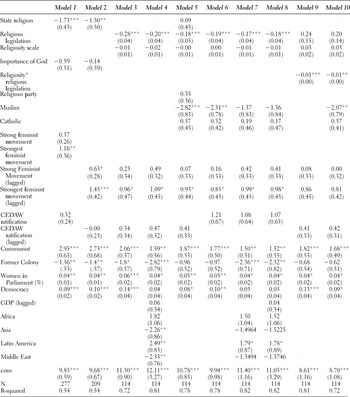
Our analysis reveals considerable support for hypotheses regarding variation in the degree of sex equality in family law (see Table 1). The GLS results, including both within-country and between-country effects, show that our model performs better at the latter than the former, but provides insight into both types of variation. Coefficients represent the average effect of the independent variables on the Family Law Index when the variable changes both across time and across countries by one unit. Negative coefficients indicate that a variable is associated with reduced sex equality (greater discrimination) while positive coefficients indicate an association with greater equality (less discrimination).
Panel regression analysis results

Note: Coefficients, standard errors in parentheses.
* p < .05, ** p < .01, and *** p < .001.
Religious Factors
Our theory expects to find a negative association between the political institutionalization of religious authority and sex equality in family law. We measured political institutionalization in two ways: through the presence of an official state religion and the degree to which the state upholds religious legislation. Footnote 16 Religious legislation was adapted from Jonathan Fox's Religion and the State database (Fox Reference Fox2008, especially 54–55).Footnote 17 Capturing the ways that political authority upholds religious principles across multiple spheres (education, diet, dress, political participation, etc.), it is a count of legislation on religious holidays, religious education, government funding for religion, blasphemy laws, religious requirements for public office, and others. The existence of religious laws in many areas evinces a significant fusion of ecclesiastical and political authority. The adapted measure covers 37 types of religious legislation, and our countries evince a wide range of variation, with Saudi Arabia scoring 31 and the United States scoring 1. The mean is 8 and the SD is 5.8. The establishment of an official state religion was measured as a dummy variable, available for all four time points (1975, 1985, 1995, and 2005). Religious legislation was available for only 1995 and 2005. In order to capitalize on the availability of a more refined measure and also to use our entire database, we used both of these measures in our analyses.Footnote 18
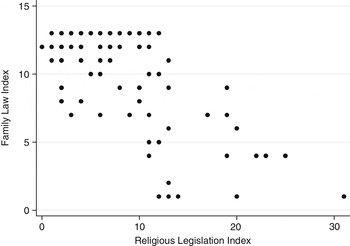
As Figure 1 shows, countries with lower scores on religious legislation (those where the government adopts fewer religious laws) tend to have higher scores on the Family Law Index (to be more egalitarian), and countries with higher scores on religious legislation (where the government adopts more religious laws) tend to be less egalitarian.
Family Law Index and religious legislation, 2005.

Turning to the generalized least squares (GLS) regression results in Table 1, the first thing to note is that all of the coefficients for both the state religion and religious legislation variables are negative (except for the state religion variable in Model 5, which includes all religious variables for comparison, where some multicollinearity accounts for the reversed sign). In and of itself, this is an important indicator of the strong relationship between the political institutionalization of religious authority and sex inequality in family law. When a country has a state religion, our models estimated that it will have one to two fewer areas of equality in family law (out of 13 possible areas), a statistically as well as substantively significant finding (Models 1 and 2).
Religious legislation, our more refined measure of the political institutionalization of religious authority, was employed in Models 3–10. (Since data for this variable were available only for 1995 and 2005, the N for these models is smaller.) Model 3 predicts that a one standard deviation change in the score for religious legislation will be associated with a change in the Family Law Index of 1.6 areas of inequality (5.8 × .28 = 1.6). This effect held up controlling for region (Model 4), religiosity (Models 3–10) and for those countries where Islam was the dominant religion (Models 5–8, 10).
What about the degree of religiosity? We measured societal religiosity with Inglehart and Norris's strength of religiosity scale. Looking at a scatterplot revealed that religiosity scale, on its own, was a poor predictor of sex inequality in family law at high levels of religiosity (not shown). As Table 1 shows, religiosity scale was not a significant predictor of inequality on its own in any model. However, since religiosity scale, a more refined measure, was available only for a subset of our dataset, we also used a simpler measure—the World Values Survey question about “importance of God”—to explore whether examining religiosity over a larger span of time and in more countries might better reveal its effects.Footnote 19 Our analysis revealed no statistically significant association between the importance of God and sex inequality in family law (Models 1 and 2).
We hypothesized that the effects of the political institutionalization of religious authority might vary with the degree of societal support for dominant religious institutions. To test this hypothesis, we examined the interaction between religiosity scale and religious legislation and found support for our argument (Models 9 and 10). Before examining marginal effects over the whole range of our independent variables, let us first examine what the coefficients of the constitutive terms tell us. Constitutive terms are the variables that are part of the interaction examined but that are also included separately in the model (as is necessary to explore interaction effects) (Brambor, Clark, and Golder Reference Brambor, Clark and Golder2005). The coefficient of the constitutive term religiosity in Models 9 and 10 is .03 and .03, respectively, but is not significant. This suggests that when religious legislation is zero, religiosity has no reliably predictive effect on sex equality in family law. Similarly, the coefficient of religious legislation in Models 9 and 10 is also positive but not significant (.24 and .20, respectively). This suggests that when religiosity is nonexistent (equal to zero), a fusion between church and state has little predictable effect on sex equality in family law.
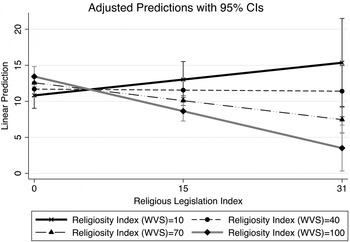
This is a prediction outside the range of actually existing observations, however, since no country has a complete absence of religious legislation and zero on the religiosity scale. To analyze the effects of the political institutionalization of religious authority at different levels of religiosity, we examined the adjusted predictions of increasing religious legislation at four different levels of religiosity: religiosity = 10, 40, 70, and 100 (Figure 2).
Adjusted predictions of equality in family law from religious legislation at varying levels of religiosity.

Our model estimates that at the lowest levels of religiosity, religion-state fusion could produce gains in sex equality in family law, though this is not a statistically significant relationship, probably because there are so few cases at the high end (see the dark black line in Figure 2, religiosity = 10). In these circumstances, such as Norway and the UK, it could be the case that the state, in response to democratic demands, may force reforms in religious doctrine and the ecclesiastical hierarchy. (Consider, for example, the UK House of Commons' approval in 2014 of the appointment of women as bishops to the Church of England.) Yet as the political institutionalization of religious authority increases in a context of high religiosity (religiosity = 100, the solid gray line), the effects on equality in family law are negative and dramatic. The steep decreases in the Family Law Index suggest that the combination of church-state fusion and a devout population is a potent mix that obstructs reform of family law to promote sex equality. Egypt, for example, has one of the highest scores on religious legislation and a 90 on the religiosity scale. Its score on the Family Law Index is 1, one of the three lowest (least egalitarian) in our entire sample. Even at more middling levels of religiosity (e.g., religiosity = 40, the narrowly spaced dashed line in Figure 2), or slightly higher religiosity (e.g., religiosity = 70, the more widely spaced dashed line), the effects of religious legislation are slightly, or even squarely, negative, though less dramatic than at the highest levels.
Other mechanisms of religious influence on law did not seem nearly as important as the religious legislation variable, especially in interaction with religiosity. The presence of a religious party was not significant (Model 5). Muslim accounts for a significant decrease in sex equality—the change associated with the entire range of the independent variable is at most 2.82 fewer areas of sex equality—but the coefficients in Models 5 and 6 may overstate the importance of being in a Muslim-majority country compared to other models. Yet it is important to note that the change associated with one SD of religious legislation (less than even the full range) is more than three times as large, accounting for almost 11 fewer areas of sex equality (as above).
Other Actors and Contextual Factors
Our model also assessed the association between family law and feminist movements, the ratification of CEDAW, historical experiences of communism and Western colonialism, and control variables such as level of democracy, GDP per capita, share of parliamentary seats held by women, and world region. Feminist movement strength, entered as a factor variable,Footnote 20 has a small but substantively significant effect in Model 1: a very strong feminist movement adds about one additional area of sex equality in family law. Our case studies suggested that feminist movements might produce change in family law over a longer period of time as they mobilized allies, raised awareness, and built on international conventions. In order to test this idea we employed a measure that lagged feminist movement strength by one time period (a decade). Even lagged, we still found that the strongest feminist movements added about one area of sex equality in law (Models 2–10), with stronger effects in earlier periods. This lagged indicator was significant in about half the analyses, but further analysis showed that these effects were stronger and more significant for earlier periods than later ones.
CEDAW ratification is not significantly associated with greater sex equality in family law, though it approaches significance (or might be considered significant by some) in later periods. We expected that communism, because it promoted an ideology of formal sex equality and marginalized religion, would create a legacy of sex equality in family law. In our analysis, the effect of communist is positively and significantly associated with sex equality in all 10 models. Former colony—a dummy variable indicating the experience of Western overseas colonialism—is associated with greater inequality in family law. The coefficient is negative across all ten models and statistically significant in more than half of them (Models 1, 3, 4, 6, 7, 8). We interpret this somewhat less robust finding as confirmation of the pervasiveness of efforts to build national identity around sexist family law in postcolonial societies, efforts which frequently—but not always—were inspired by the political institutionalization of religious authority (see, e.g., Charrad Reference Charrad2001; Kabeer Reference Kabeer and Kandiyoti1991; Najmabadi Reference Najmabadi and Kandiyoti1991; Razavi and Jenichen Reference Razavi and Jenichen2010; Tucker Reference Tucker1998; Williams Reference Williams2006).
We found that women in parliament had a statistically significant effect on sex equality in family law that was fairly consistent in size, if very small, regardless of specification and other model variations. While women in parliament might prevent rollbacks, they tend not to be major instigators of family law reform, a finding that has also been suggested by research in other areas of women's rights (cf. Weldon Reference Weldon2011). Democracy has a statistically significant relationship to family law when examined over three or four decades (Models 1 and 2), but this effect is less robust in the analysis focusing on 1995 and 2005 (Models 3–10). Regional dummy variables were inconsistently significant. While significant in some models (4), most faded from significance when we controlled for religion and national wealth (GDP) (Models 7 and 8). Unlike some other policy issue areas where regional activist networks were very influential, such as violence against women (Htun and Weldon Reference Htun and Weldon2012), we found little evidence of regional effects in either the qualitative or quantitative data.
CONCLUSION
This article demonstrated a powerful association between sex discrimination in family law and the political institutionalization of religious authority. When state power and religious power are fused, particularly in highly devout societies, it is difficult to reform family law toward greater equality, and patriarchal norms endure. Qualitative evidence suggests that, in these contexts, patriarchal family law becomes linked to the public status of religion. Feminist movements and secular activists have a hard time demanding reform without questioning the historical arrangements between church and state. Their challenges to patriarchal family law come to be seen as threats to the entire apparatus of state and religious authority, often reanimating older struggles over the boundaries and nature of the state-religion relationship. Ecclesiastical hierarchies defend discriminatory family law in order to protect their broader institutional privileges and normative legitimacy. Whereas international norms and transnational movements have helped compel progressive national policy making on gender issues such as violence against women, participation in decision making, and workplace equality, family law has a greater tendency to remain sealed off from political contestation and external influences.
Religion is important to understanding family law, but not in the ways often depicted in scholarly literature (especially cross-national statistical analysis). Previous work has a tendency to single out Muslim-majority countries and religious societies as environments conducive to legal sex discrimination. Instead, we focused on the institutionalized fusion of religious and political authority and the rigidities this introduces into both religious and state law. The key factor associated with discriminatory family law is not any particular religion, the degree of religiosity, or the presence of religious parties, but the institutional role states have crafted for religions and the frequent presence of these structures in Muslim-majority polities.
Religion is a field of contestation. Religious beliefs can be deployed for multiple causes, and religious actors have assumed conservative and progressive stances on social issues such as family law as well as human rights, poverty, social insurance, and democratic governance (see, e.g., Casanova Reference Casanova1994; Gutierrez Reference Gutierrez1973; Hagopian Reference Hagopian and Hagopian2009; Mainwaring Reference Mainwaring1986; Scheve and Stasavage Reference Scheve and Stasavege2006b). Depending on the institutional and political environment in which they are embedded, religious actors from the same denomination may behave in different ways. Braun's work on the role of religious rescue networks during the Holocaust in the Netherlands and Belgium shows that Catholic and Protestant churches behaved in opposite ways depending on whether they were the majority or minority religion. It was not Catholicism or Protestantism per se that shaped the behavior of religious communities toward Jews, but their institutionalized status as religious minorities (Braun, n.d.).
Religion can and has been repurposed as a force for sex equality in family law and other areas of social life, but this is harder to accomplish when the state props up particular religious interpretations and actors. Equality advocates should seek not to marginalize religion or erase its influence from the polity, but to de-link religious power from state power. Though religions in civil society are not always egalitarian or progressive, they are compelled to be responsive in order to remain relevant (Gill Reference Gill1998, Reference Gill2001). The state, not religion, thwarts advances in women's rights.
SUPPLEMENTARY MATERIAL
To view supplementary material for this article, please visit http://dx.doi.org/10.1017/S1743923X15000239