Introduction
Epidemiologic studies have shown that low birth weight is associated with increased risk of cardiovascular disease later in life.Reference Gluckman and Hanson 1 There is increasing evidence to support the ‘Developmental Origins of Health and Disease’ theory that an in utero environment can exert a profound impact on development, health and disease in adult life.Reference Langley-Evans 2 Indeed, numerous animal model studies have demonstrated that intrauterine undernutrition causes low birth weight and subsequent adult hypertension.Reference Brennan, Olson and Symonds 3 , Reference Ozaki, Nishina, Hanson and Poston 4 We previously reported that maternal high-protein diet can reverse fetal programming of hypertension induced by maternal food restriction.Reference Kawamura, Itoh and Yura 5 , Reference Kawamura, Itoh and Yura 6 However, it remains unknown whether or not the amino acid composition of dietary proteins is relevant to the mechanisms involved in the prevention of adult hypertension.
Branched-chain amino acids (BCAA: leucine, isoleucine and valine) are structural constituents of proteins that are known to possess anabolic effects on protein metabolism by increasing protein synthesis and decreasing protein degradation in muscle.Reference Nair and Short 7 We have previously shown that BCAA concentrations in maternal and fetal plasma were increased by maternal high-protein diet, and that BCAA supplementation partially ameliorates overall growth restriction produced by maternal undernutrition.Reference Mogami, Yura and Itoh 8 Hence, it seems mandatory to clarify the effects of isocaloric BCAA supplementation during maternal caloric restriction on adult offspring, especially in terms of the regulation of developmental hypertension.
Mechanisms underlying the fetal programming of adult hypertension have been intensively studied. Among various organs and systems, the programming of the kidney is believed to be prominently attributed to the development of hypertension. Reduced nephron endowment is a consistent feature of hypertension programmed by fetal glucocorticoid excess, maternal low-protein diet and uterine arterial ligation.Reference Langley-Evans, Welham and Jackson 9 – Reference Singh, Cullen-McEwen and Kett 12
Alterations in the renin-angiotensin system are another factor that is often observed in the development of hypertension by intrauterine undernutrition.Reference Vehaskari, Aviles and Manning 13 , Reference Woods, Weeks and Rasch 14 Angiotensin II, a major regulator of blood pressure, mainly interacts with two receptor subtypes, designated ATR1 and ATR2. Angiotensin II mediates its activity such as vasoconstriction and aldosterone secretion mainly through ATR1, but ATR2 can modulate the effects of ATR1.Reference Carey and Padia 15 Although maternal undernutrition affects the expression of angiotensin II receptors in the brain, adrenal gland and kidney of offspring,Reference McMullen, Gardner and Langley-Evans 10 , Reference Pladys, Lahaie and Cambonie 16 , Reference Bogdarina, Welham, King, Burns and Clark 17 their alteration in relation to maternal BCAA supplementation has not yet been elucidated.
In this study, we investigated whether maternal BCAA supplementation would modify the effects of maternal food restriction on blood pressure in rat offspring. We also examined the glomerular number and the expression of ATRs in kidneys.
Method
Animals and diets
Pregnant Wister Rats were purchased 6.5 days postcoitum (dpc) from Japan SLC, Inc. (Shizuoka, Japan). Dams were individually housed with free access to water during 14h/10h light/dark cycles in a specific pathogen-free facility.
All experimental protocols were approved by the Animal Research Committee, Graduate School of Medicine, Kyoto University (Med Kyo 06221, 07544, 08092, 09246). A standard diet (SD; 3.85 kcal/g) and an isocaloric diet supplemented with BCAA were provided to the pregnant rats, and both of them contained 20% casein, similar amounts of fat, essential minerals and vitamins (D060121301 and D06121302, respectively; Research Diets Inc., New Brunswick, NJ, USA; Supplementary Table S1). The BCAA supplementation consisted of 9.3 g/kg of valine, 18.6 g/kg of leucine and 9.3 g/kg of isoleucine. Pups were fed a regular chow diet (Oriental Yeast Co., Tokyo, Japan) ad libitum after weaning.
Experimental design
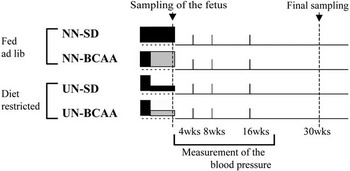
Pregnant rats were randomly assigned to one of four nutritional groups from 7.5 to 21.5 dpc: normally nourished (NN) and undernourished (UN) groups with an SD or with an isocaloric BCAA-supplemented diet (NN–SD, NN–BCAA, UN–SD and UN–BCAA; n = 7 for each group; Fig. 1). The NN group was fed a diet ad libitum, and the food supply to the UN group was restricted to 30% of the food consumed by pregnant dams fed SD ad libitum in a preliminary observation. Dams in the food restriction group were fed the respective diets ad libitum on the evening of 21.5 dpc, just before the night of parturition, to prevent mothers from eating their own pups. After birth, pups were weighed, and litter size was adjusted to four male and four female pups per litter. They were nursed by their own mothers fed SDs ad libitum until weaning, and male offspring were used for this study.
Experimental design. Pregnant rats were divided into four groups at 7.5 days postcoitum: fed ad libitum (normally nourished: NN) with a standard diet (NN–SD group), or with a branched-chain amino acid (BCAA)-supplemented diet (NN–BCAA group); or food-restricted (undernourished: UN), using either an SD (UN–SD group) or a BCAA-supplemented diet (UN–BCAA group), to 30% of control.

Measurement of systolic blood pressure
At 4, 8 and 16 weeks of age, the systolic blood pressure (SBP) of offspring in the four groups (n = 10 for each group) was measured using an indirect tail-cuff method (MK-2000; Muromachi Kikai Co., Ltd, Tokyo, Japan). Rats were placed in restrainers (plastic holders) several times in the week before blood pressure measurement. Measurement was performed by the same individual who handled and took daily care of studied animals. Pre-warming was not done. At least five consecutive cycles (inflation/deflation) were performed on each rat and the mean of the last five recordings was determined as the SBP.
Sample collection
A total of 21.5 dpc pups were delivered by uterine incision, and fetuses of similar litter size (7–11) were used for fetal analysis in order to eliminate the effect of litter size on fetal growth. Each fetus was weighed. Fetal left kidneys were quick-frozen in liquid nitrogen and stored at −80°C until use, and right kidneys were fixed in 10% formalin.
For analysis of adult offspring, rats were killed at 30 weeks of age. Left and right kidneys were collected as described above. Blood was sampled by heart puncture into a glass tube containing EDTA and centrifuged at 3000 rpm for 30 min, and the plasma were stored at −20°C.
Glomerular number and size
Glomerular number was evaluated by a modified method of McVary and Maizels.Reference Bassan, Trejo and Kariv 18 – Reference McVary and Maizels 20 Previous reports suggest that the technique is reliable and the result accurately represents nephrogenesis.Reference Bassan, Trejo and Kariv 18 In brief, formalin-fixed and paraffin-embedded kidneys were cut into 5-μm thick sections, and stained with hematoxylin and eosin. An index of glomerular number (mean number per section) was determined for each rat by counting all glomeruli in three longitudinal sections per rat, including both poles and the renal pelvis, using high-power magnification (×400). The mean coefficients of variation in glomerular count among three sections of each rat were 4.6% in fetal kidneys and 6.9% in adult kidneys. Fifteen glomerular areas in each section of the kidney were calculated to assess glomerular size using DP2-BSW software (Olympus Co., Ltd, Tokyo, Japan).
Plasma angiotensin II concentration
Plasma samples underwent extraction through Sep-Pak C18 cartridges (Waters Co., Milford, MA, USA). The plasma angiotensin II concentration in adult offspring at 30 weeks of age was assayed with an ELISA kit (Peninsula Laboratories, Belmont, CA, USA).
Quantitative RT-PCR analysis of ATR1a, ATR1b and ATR2
Total RNA was extracted from fetal and adult kidney using Sepasol reagent (Nacalai Tesque, Kyoto, Japan) according to the manufacturer's instructions. The mRNA expression of angiotensin II receptors was measured by real-time quantitative RT-PCR using Taqman™ technology (Model 7000 sequence detector, Applied Biosystems, Foster City, CA, USA) as previously described.Reference Mogami, Yura and Itoh 8 The forward and reverse primers were as follows, listed 5′–3′: ATR1a (forward): TCACAGTGTGCGCGTTTCAT, ATR1a (reverse): TATCCCGACCCGGAATGGT, ATR1a (Fam/Tamra probe): TGAGTCTCGGAATTCGACGCTCCC, ATR1b (forward): TCTCAGCATCGATCGCTACCT, ATR1b (reverse): ACGTAGTAGTAGACCGATTACC, ATR1b (Fam/Tamra probe): TCCACCCAATGAAG, ATR2 (forward): AATTACCCGTGACCAAGTCTTGA, ATR2 (reverse): ACCGAAGGGAAGGTACAAGA, ATR2 (Fam/Tamra probe): AGCTGCTGTTGTGTTGGCATTCATCATT (Applied Biosystems). Primer and probe sets of The TaqMan® GAPDH Control Reagents (4308313, Applied Biosystems) were used for the quantification of GAPDH mRNA expression.
Immunohistochemistry
Immunostaining for ATR2 was performed in 48 h formalin-fixed and paraffin-embedded fetal and adult kidney. The kidney was cut into 5-μm thick sections. An endogenous peroxidase block was performed using 3% hydrogen peroxide. Subsequently, non-specific background blocking was done using powdered milk diluted to 3% with PBS (-) for 30 min. Slides were then incubated with a polyclonal antibody to rat ATR2 antigen (diluted 1:50; SC-7420; Santa Cruz Biotechnology Inc., Santa Cruz, CA, USA) for 1 h at room temperature. Normal goat IgG (diluted 1:50; SC-2028; Santa Cruz Biotechnology Inc.) was used as a negative control. Immunodetection was carried out using the Universal Immuno-enzyme Polymer system (Histofine MAX-PO (G); Nichirei Biosciences Inc., Tokyo, Japan) as provided by the manufacturers.
Western blot analysis
Protein extraction from renal tissue and immunoblotting was carried out as previously described.Reference Mogami, Yura and Itoh 8 In order to assess levels of ATR2 and β-actin expression, 20 μg protein was analyzed by Western blotting with a polyclonal ATR2 antibody (1:1000 dilutions; SC-7420; Santa Cruz Biotechnology Inc.) and β-actin (1:5000 dilutions; ab8227; Abcam, Cambridge, MA, USA). The membrane was incubated in the secondary antibody; goat anti-rabbit IgG, diluted to 1:30,000. The signal was detected by chemiluminescence (Amersham ECL Plus Western Blotting Detection Kit, GE Healthcare Bio-Sciences, Uppsala, Sweden) with exposure to Amersham Hyperfilm ECL (GE Healthcare Bio-Sciences).
Statistical analysis
One-way analysis of variance and Student–Newman–Keuls test were used to make individual comparisons among the four groups.
Results
Maternal food consumption and weight of offspring
Mean ad libitum food consumption of NN–BCAA dams from day 7 to day 21 of gestation was similar to that of UN–SD dams (176.6 ± 2.9 g in NN–BCAA and 179.1 ± 3.9 g in NN–SD). Food consumption of UN–SD dams and UN-BCAA dams during maternal food restriction was 30.8% that of NN–SD dams fed ad libitum during pregnancy.
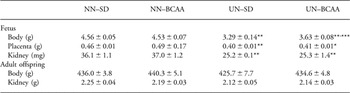
Fetal body weights in the UN groups were significantly reduced as compared to those in the NN groups (Table 1). Among the UN groups, isocaloric diet supplemented with BCAA partially ameliorated fetal body weights (UN–SD v. UN–BCAA, P < 0.05; Table 1). As for adult offspring weights at 30 weeks of age, no significant difference was observed among the NN and UN groups with and without BCAA supplementation.
Body, placenta and kidney weight of male fetus and adult offspring

Fetus: day 21 of gestation, adult offspring: 30 weeks of age.
Values are shown as mean ± s.e.m.
*P < 0.05 compared with NN–SD and NN–BCAA.
**P < 0.01 compared with NN–SD and NN–BCAA.
***P < 0.05 compared with UN–SD.
Nine to fourteen pups from at least four litters were randomly selected and measured.
In order to investigate the effects of BCAA on overall renal development, kidney weight was measured in fetal and adult offspring. The UN groups had diminished fetal kidney weight compared with the NN groups, but the difference in adult kidney weight was not obvious at 30 weeks. BCAA supplementation had no significant effect on kidney weight both in the NN and UN groups.
Influence of maternal diet on offspring blood pressure
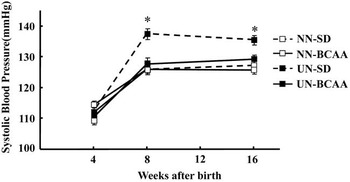
At 4 weeks of age, there was no significant difference in SBP among the NN and UN groups with and without BCAA supplementation (Fig. 2). Consistent with previous reports, the SBP in UN–SD was significantly elevated at 8 weeks of age.Reference Kawamura, Itoh and Yura 5 In contrast, BCAA supplementation prevented increased blood pressure in UN–BCAA. The lowering of SBP in UN–BCAA in comparison with UN–SD persisted even up to 16 weeks (Fig. 2). This result is strongly suggestive of a possible role of BCAA in the regulation of blood pressure.
Influence of maternal nutrition on systolic blood pressure of offspring. The systolic blood pressure of normally-nourished (NN)–standard diet (SD), NN–branched-chain amino acid supplemented diet (BCAA), undernourished (UN)–SD and UN–BCAA offspring at 4, 8 and 16 weeks of age was demonstrated (n = 10 for each group). Systolic blood pressure was significantly increased in UN–SD at 8 and 16 weeks of age. Values are mean ± s.e.m. *P < 0.05 compared with all other groups.

Offspring glomerular number and size
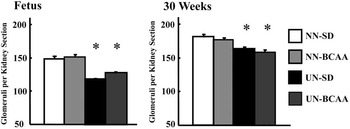
Reduced glomerular number index observed in UN–SD (Fig. 3) was in agreement with previous studies.Reference McMullen, Gardner and Langley-Evans 10 , Reference Singh, Cullen-McEwen and Kett 12 BCAA supplementation does not correct the decrease in glomerular number in the UN–BCAA group.
Alteration of offspring glomerular number mediated by maternal nutrition. Glomerular number in the kidney of normally nourished (NN)–standard diet (SD), NN–branched-chain amino acid supplemented diet (BCAA), undernourished (UN)–SD and UN–BCAA offspring at 21.5 dpc (left panel; n = 5 for each group) and 30 weeks of age (right panel; n = 10 for each group). Values are mean ± s.e.m. *P < 0.01 compared with NN–SD and NN–BCAA.

Glomerular size was also examined as an indicator of compensatory enlargement. There were no significant differences among the four groups in adult male offspring (NN–SD: 7875.0 ± 177.6 μm2; NN–BCAA: 7749.1 ± 195.6 μm2; UN–SD: 7932.6 ± 333.8 μm2; UN–BCAA: 8373.8 ± 286.3 μm2; n = 11–12 in each group).
Plasma angiotensin II concentration
There was no significant difference in plasma angiotensin II concentration among the four groups in adult offspring (NN–SD: 15.6 ± 2.6 pg/ml; NN–BCAA: 13.9 ± 1.4 pg/ml; UN–SD: 16.1 ± 2.6 pg/ml; UN–BCAA: 17.1 ± 2.8 pg/ml; n = 7–8 in each group). Therefore, the regulation of circulating angiotensin II levels was less likely to be involved either in the elevation of SBP in UN–SD or in its improvement in UN–BCAA.
Alterations of angiotensin II receptors expression in kidney
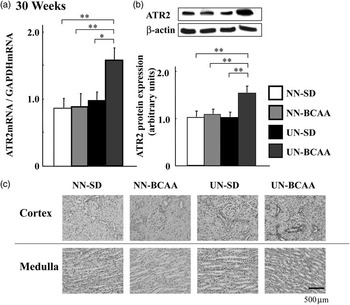
In order to examine the influence of maternal nutrition on angiotensin II receptors expression in the kidney, sequential expression levels of ATR1a, ATR1b and ATR2 mRNA were determined by real-time PCR. As for ATR1a and ATR1b mRNA expression, no significant differences were observed in fetal and adult kidney among the four groups (data not shown). Although there was no difference of ATR2 expression in the fetal kidney among the four groups (data not shown), significant augmentation of ATR2 expression in the adult kidney was demonstrated in UN–BCAA (Fig. 4a). This finding was confirmed by examination of protein expression of ATR2 using Western blot analysis (Fig. 4b) and immunohistochemistry (Fig. 4c). ATR2 was localized primarily in distal tubes and collecting ducts (Fig. 4c), as previously reported.Reference Miyata, Park, Li and Cowley 21 These results suggest that BCAA can enhance renal ATR2 expression not in the NN group but in the UN group.
The mRNA and protein expression of angiotensin II receptor type 2 in offspring kidney: (a) ATR2 mRNA expression in the offspring kidney at 30 weeks of age (n = 10 for each group), (b) Immunoblot of ATR2 in the kidney at 30 weeks of age (n = 10 for each group), (c) Representative ATR2 expression in the cortex and medulla. *P < 0.05, **P < 0.01 compared with all other groups. NN–SD, a normally nourished group with a standard diet (SD) NN–BCAA, an NN group with a BCAA-supplemented diet; UN–SD, an undernourished (UN) group with an SD; UN–BCAA, a UN group with a BCAA-supplemented diet.

Discussion
An increasing body of evidence shows that maternal undernutrition elevates the SBP of offspring.Reference Gluckman and Hanson 1 – Reference Ozaki, Nishina, Hanson and Poston 4 , Reference Brawley, Itoh and Torrens 22 , Reference Holemans, Aerts and Van Assche 23 Food restriction or low-protein diet is a common method applied as maternal undernutrition in animal models. Thus, nutrient composition as well as the amount of maternal food intake can influence offspring SBP. We previously reported that 30% maternal food restriction elevated the SBP of offspring and that high-protein diet during pregnancy recovered the elevation of offspring SBP in mice.Reference Kawamura, Itoh and Yura 5 , Reference Kawamura, Itoh and Yura 6 In this study, we elucidated the effects of BCAA supplementation in rat offspring with maternal food restriction. We performed 70% maternal food restriction to develop our experimental model, following the studies of Vickers' group,Reference Vickers, Ikenasio and Breier 24 , Reference Krechowec, Vickers, Gertler and Breier 25 as rats are more tolerant to food restriction. The SBP of offspring with maternal food restriction on an SD was elevated significantly, but not on an isocaloric BCAA-supplemented diet, indicating that the nutrient component rather than the amount of food intake during pregnancy might be dominant in the regulation of developmental hypertension in undernourished offspring.
Decreased nephron number is a possible determinant of developmental hypertension.Reference Woods, Weeks and Rasch 14 , Reference Hoy, Hughson, Bertram, Douglas-Denton and Amann 26 Previous studies reported reduced nephron number by 15–45% in animal models with various adverse environments during pregnancy.Reference Langley-Evans, Welham and Jackson 9 – Reference Pham, MacLennan and Chiu 11 , Reference Vehaskari, Aviles and Manning 13 In this study, glomerular number index was significantly suppressed in the UN–SD group, in agreement with previous studies. Moreover, reduced nephrone endowment observed in the fetal stage was not recovered by postnatal normal nutrition and still apparent at adulthood. Wlodek suggested that the effect of undernutrition on nephrogenesis is primarily a postnatal event.Reference Wlodek, Westcott, Siebel, Owens and Moritz 27 , Reference Wlodek, Mibus and Tan 28 However, in their study using uterine arterial ligation, prenatal undernutrition was limited only during 3–4 days from day 18 of gestation to parturition. Therefore, reduced nephrogenesis with/or increased apoptosis during prenatal undernutrition might be recovered by postnatal nutritional improvement. In our experiment, prenatal undernutrition continued for at least 14 days. These different experimental designs may explain why reduced nephron endowment was not recovered by postnatal normal nutrition.
The reduction in the number of glomeruli (19.8% in the fetal stage and 10.1% in the adult stage) is relatively small in this study. The subtle change may result in relatively slight elevation of blood pressure in UN–SD. Consistent with this finding, neither renal pathologic change (Fujii, T. et al., unpublished observation) nor compensatory glomerular enlargement was observed in the UN–SD group. The influence of BCAA supplementation on nephrogenesis was not found in the NN–BCAA and UN–BCAA groups, suggesting that other mechanisms underlie the prevention of hypertension through BCAA supplementation.
The renin-angiotensin system in offspring is thought to be affected by an adverse intrauterine environment.Reference McMullen, Gardner and Langley-Evans 10 , Reference Singh, Cullen-McEwen and Kett 12 , Reference Zohdi, Moritz and Bubb 29 , Reference Hoppe, Evans, Bertram and Moritz 30 Some studies have reported that renal reninReference Bogdarina, Welham, King, Burns and Clark 17 or ATR1 expressionReference Sahajpal and Ashton 31 , Reference Vehaskari, Stewart and Lafont 32 is upregulated in offspring with maternal low-protein diet, whereas other studies and this study have shown that no significant changes were observed in circulating angiotensin II and ATR1 expression.Reference McMullen, Gardner and Langley-Evans 10 , Reference Wlodek, Westcott, Siebel, Owens and Moritz 27 , Reference Zohdi, Moritz and Bubb 29 The distinction may result from the timing of the sample collection or conditions for an adverse intrauterine environment. ATR2 activation is thought to oppose many of the physiological effects of ATR1. A previous study using a rat model of reduced uterine perfusion reported no significant augmentation of ATR2 protein expression in offspring kidney at 4 weeks of age,Reference Zohdi, Moritz and Bubb 29 , Reference Vehaskari, Stewart and Lafont 32 consistent with our result observed in the UN–SD group. However, ATR2 expression was enhanced in UN–BCAA in this study. It was reported that renal expression of ATR2 is downregulated in rat offspring with maternal low-protein diet.Reference Ruiz-Ortega, Esteban and Suzuki 33 In addition, insulin, insulin-like growth factor or interleukin-1 may augment ATR2 expression in mouse fibroblast cells or in vascular smooth muscle cells in vitro.Reference Ichiki, Kambayashi and Inagami 34 , Reference Kambayashi, Nagata, Ichiki and Inagami 35 BCAA is not only a known insulin secretagogue in humans,Reference Floyd, Fajans, Conn, Knopf and Rull 36 but also it promotes protein synthesis in myocytes through activation of mammalian target of rapamycin (mTOR).Reference Kimball and Jefferson 37 It is tempting to speculate that BCAA augmented ATR2 mRNA expression via intracellular activation of mTOR signal and through insulin-IGF signaling pathways.
Increased ATR2 expression decreases sodium reabsorption and leads to decreased blood pressure in the rodent.Reference Tsutsumi, Matsubara and Masaki 38 , Reference Li, Gao and Grobe 39 Salt-sensitive elevation of the SBP is observed in murine offspring with prenatal undernutrition.Reference Augustyniak, Singh, Zeldes, Singh and Rossi 40 Therefore, augmented ATR2 expression in the kidney of UN–BCAA might be a possible compensatory mechanism that accounts for the prevention of increased blood pressure. To clarify a role for ATR2 in regulating offspring blood pressure in prenatal undernutrition and BCAA supplementation, further studies using ATR2 knockout animals as well as ATR2 antagonists or agonists such as PD123319 or CGP42112A will be helpful.Reference Wenzel, Krebs and Benndorf 41 Since extrarenal tissues, such as endothelium and sympathetic nerve activity, also play an important role in regulating blood pressure, further investigation is needed to fully understand BCAA-mediated compensatory mechanisms.
Amino acid supplementation during maternal nutrient restriction influences offspring nephrogenesis and the regulation of blood pressure. Glycine supplementation during maternal low-protein diet attenuates increased blood pressure.Reference Brawley, Torrens and Anthony 42 l-citrulline supplementation improves caloric restriction-induced low nephron number, but fails to prevent hypertension.Reference Tain, Hsieh and Lin 43 Maternal BCAA supplementation promotes fetal growth of growth-retarded fetal miceReference Mogami, Yura and Itoh 8 and prevents developmental hypertension in this study. Moreover, utero-placental insufficiency decreases serum BCAA levels in the growth-retarded fetal rat.Reference Ogata, Bussey and Finley 44 In humans as well, plasma BCAA concentrations of the umbilical artery and vein are lower in growth-restricted fetuses than in appropriate for gestational age fetuses.Reference Cetin, Marconi and Bozzetti 45 Taken together, BCAA supplementation may be a reasonable approach to prevent adverse outcome in offspring with intrauterine undernutrition.
In this study, we performed 70% maternal food restriction. The offspring showed a rather severe birth weight reduction (25–30%) than did human small for gestational age (SGA) infants. However, UN offspring in this study demonstrated catch-up growth during development. In this context, the present model mimics milder growth restriction among the human SGA population.Reference Hokken-Koelega, De Ridder and Lemmen 46 As cross-fostering was not done in this study, postpartum refeeding of the starved dams may promote postnatal growth of UN offspring and affect their later metabolic sequelae. We have not speculated on an effect of BCAA on human intrauterine growth restriction (IUGR) from this study, because the present animal model reflects only a partial component of human IUGR, that is, nutrient restriction. In addition, it is not examined in this study for how long the effect of BCAA on systolic blood pressure lasts. Further extended study is necessary using various kinds of animal models to establish the usefulness of BCAA supplementation in human IUGR.
In summary, BCAA supplementation during maternal food restriction prevents developmental hypertension together with increased ATR2 expression in adult offspring kidney. Further investigation of the mechanisms underlying the BCAA-mediated regulation of blood pressure may lead to prevention of increased risk of cardiovascular disease later in life.
Acknowledgments
This work was supported by grants-in-aid for Scientific Research from the Ministry of Education, Science, Culture and Sports, Japan (nos 17390450, 17591728, 17591730, 17659513, 18390446, 21592094 and 21592096); the Research Grant for Cardiovascular Disease from the Ministry of Health, Labor and Welfare; the Smoking Research Foundation; Takeda Science Foundation; Takeda Medical Research Foundation; The Naito Foundation; Uehara Memorial Foundation; the Food Science Institute Foundation; Novo Nordisk Pharma Ltd, and Precursory Research for Embryonic Science and Technology (PRESTO), Japan Science and Technology (JST). The authors wish to acknowledge Mrs Akiko Abe and Ms Miki Tatebayashi for secretarial and technical assistance.
Statement of Interest
None.