The MS&T (Materials Science and Technology) 2016 Technical Meeting and Exhibition took place in Salt Palace Convention Center in Salt Lake City, UT on 23–27 October 2016. Salk Lake City is the capital of Utah, located at the core of the Salt Lake City metropolitan area with a total population of 1 153 340. Downtown's headquarters of the Mormon Church, home to the majestic, 19th-century Salt Lake Temple and the neo-Gothic Assembly Hall. Salt Lake City has been also developed with many outdoor recreation facilities primarily for skiing and hiking. It hosted the Winter Olympics in 2002.
The annual MS&T meeting is co-organized by four leading materials science-related societies, including ACerS (The American Ceramic Society), AIST (Association for Iron and Steel Technology), ASM International (The American Society for Metals), and TMS (The Minerals, Metals and Materials Society). All of them have over 10 000 members, consisting of engineers, scientists, researchers, manufacturers, educators, students, and other professionals in the materials field. This year MS&T has also extended its co-sponsorship with NACE International, having over 36 000 members and focusing on corrosion prevision, and control. The attendees shared their up-to-date scientific research and professional information through plenary lectures, short courses, technical symposia, special events, and exhibition.
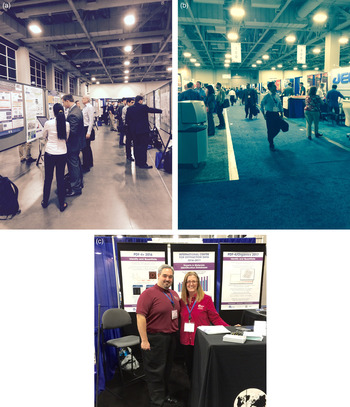
MS&T 2016 hosted three plenary lectures, six memorial lectures, seven short courses, 80 technical symposia, and events for students, underrepresented/minority groups, and various society members. The technical symposia covered the topics, including additive manufacturing, biomaterials, ceramic and glass materials, electronic and magnetic materials, energy, fundamentals, characterization and computational modeling, iron and steel, materials–environment interactions, nanomaterials, processing and manufacturing, and other special material-related topics. MS&T 2016 also hosted poster sessions on those topics [see Figure 1(a)] and three young professional development programs. The details on the symposia and programs can be viewed at http://www.matscitech.org/technical-program/.
(Colour online) (a) MS&T 2016 Poster Session, (b) Exhibition hall, and (c) ICDD booth.

The conference started on Sunday with different committee and business meetings, social functions, and short courses. The ASM-sponsored short courses ranged from manufacturing to computational modeling and from microstructure studies to materials failure analysis. The technical symposia and exhibition started on Monday. Plenary lectures were all organized on Tuesday morning, including Dr. Julie A. Christodoulou (Office of Naval Research) on “Elegant Solutions: Exploration and Outcomes that Matter”; Professor Bruce Dunn (University of California, Los Angeles) on “Designing Ceramics for Next-Generation Energy Storage Systems”; and Professor David K. Matlock (Colorado School of Mines) on “Enhancing the Fatigue Performance of Steel: Have We Learned Anything from the Past?”
In addition to the primary lectures, 80 technical symposia covered a wide range of topics related to materials. The symposium on Applications of Low Emittance Synchrotron X-ray Sources to Mesoscale Materials Studies focused on two topics: Coherent Diffraction and Combined Techniques, as well as Applications, Motivators, and Enabling Technologies. The symposium explored advanced micron resolution measurements, coherent diffraction measurements, and the combination of micron and nanometer measurements for meso-scale studies of materials behaviors, properties, and responses, and the development of multi-scale models with predictive character. It also revealed the approaches combining micron, sub-micron resolution, and computational materials data. For example, invited speaker Dr. Jonathan Almer, Argonne National Laboratory, presented “A High-energy Microscope at the Upgraded Advanced Photon Source”. With the new capability, Dr. Almer discussed the selected applications, such as thermo-mechanical loading, in situ ion-irradiation and additive manufacturing, and the efforts to couple the multi-scale information with modeling approaches in order to facilitate materials development. Another invited speaker was Dr. Richard Sandberg from Los Alamos National Laboratory on “Revolutions in Coherent X-ray Sources Will Enable Dynamic Nanometer Scale Strain Imaging in Structural Materials”; Dr. Mark Bourke from Los Alamos National Laboratory on “Process and Performance Control at the Mesoscale and the MaRIE Project”; Dr. Yong Chu from Brookhaven National Laboratory on “Routine Hard X-ray Imaging at the Deep Nanoscale”; Dr. Henning Poulsen from Risoe DTU on “Multiscale Movies of Microstructure Evolution”; and Professor Matthew Miller from Cornell University on “Understanding the Performance of Structural Materials using High Energy X-rays”.
Carbon dioxide emission control was another topic of focus at MS&T 2016. The symposium on Materials and Processes for CO 2 Capture, Conversion and Sequestration had sessions on sorbents, metal–organic framework materials, physical and electrochemical carbon dioxide capture and sequestration, and carbon dioxide conversion. Advanced experimental and computational modeling techniques and modeling–experiment connection were presented. The symposium also discussed the challenges and possible solutions of capturing a large amount of CO2. The invited presentations included “Review of in situ Diffraction CO2 Capture Studies Using Porous Materials” by Dr. Winnie Wong-Ng, National Institute of Standard and Technology; “Dynamic Characterization of Clays for CO2 Storage Using Molecular Dynamics Simulations and X-ray Scattering Methods” by Dr. Greeshma Gadikota, Princeton University; “Sorbent Slurries for Precombustion CO2 Capture” by Dr. Jeffrey Culp, National Energy and Technology Laboratory; “Hybrid Polymer/Inorganic Membrane Process for CO2 Capture from Natural Gas Power Generation” by Dr. Tim Merkelm, MTR; and “Mixed in and Electron Conducting Membranes for Electrochemical Carbon Capture and Conversion” by Professor Kevin Huang, University of South Carolina.
The MS&T 2016 exhibition ran from Monday to Wednesday, and hosted 83 companies, demonstrating the latest scientific technologies and services to the attendees. It showcased instruments, books, computer hardware, scientific software, and equipment. Figures 1(b) and 1(c) show the exhibition and the booth of International Center for Diffraction Data (ICDD), focusing on publication of the Powder Diffraction File databases.