This article reports on the qualitative component of an Australian Research Council (ARC) Linkage study entitled ‘Building the future for remote Indigenous students in Australia: Examining the qualitative and quantitative findings of a Northern Territory study into future goals, motivation, learning and achievement of secondary students in cultural context’. ‘Indigenous’ is used to describe students throughout the article except where participants specifically identified as Torres Strait Islander or Aboriginal. The article examines very remote, remote and urban Indigenous students’ views on: (1) the value of education/school/self, (2) learner future goals, (3) learner motivation, and (4) learning preferences.
Background Context
The low secondary school retention and completion rate for Indigenous students has long been recognised as a serious problem in Australia. Recent national figures indicate that ‘Year 7/8 to Year 12 school retention rates for Indigenous students have improved over the last ten years (from 35% in 1999 to 45% in 2009)’ (Purdie & Buckley, Reference Purdie and Buckley2010, p. 1). However, compared to national non-Indigenous students’ attendance figures (77%), there is still a long way to go to achieve parity in Indigenous student attendance. The Northern Territory (NT) Department of Education and Training (DET) Annual Report 2011–12 revealed that while Indigenous student school attendance rates in the NT showed modest improvement at 68.2 % in 2012, they remained well below that of non-Indigenous students at 80.1%, possibly reflecting that:
Indigenous attendance rates are volatile and often follow seasonal trends associated with extreme weather patterns experienced across the Territory. Student mobility is high and continuity in learning programs is a major challenge as irregular attendance or chronic under-attendance impacts negatively on student outcomes. (DET, 2012, p. 33)
The 2006 Australian Bureau of Statistics (ABS, 2009) census data indicated that just over one third of the NT population (210, 000) was Indigenous. The 2008 National Aboriginal and Torres Strait Islander Social Survey found it was a young population with the average age being 21 years and just over one third aged under 15 years (ABS, 2008). Significantly, Altman, Biddle, and Hunter (Reference Altman, Biddle and Hunter2008) revealed that 70% of the NT Indigenous population live in poverty in very remote settlements where there are few or no jobs. In 2011, Indigenous students accounted for 40.8% of the total NT school population, as compared to 4.8% across the rest of Australia (DET, 2012). Based on the 2009 National Assessment Program for Literacy and Numeracy (NAPLAN) results, Silburn, Nutton, McKenzie, and Landrigan (Reference Silburn, Nutton, McKenzie and Landrigan2011) indicated:
. . . just 39.9% of year 3 Indigenous students in the NT had English reading proficiency at or above the national minimum standard in comparison with 75% of Indigenous year 3 children living elsewhere in Australia. (p. 3)
Critically, in relation to this study, they cited the Ministerial Council on Education, Employment, Training and Youth Affairs’ argument that NAPLAN data suggested the literacy and numeracy gap for Indigenous students appeared to increase the longer students remained in school during their years of compulsory school attendance (Silburn et al., Reference Silburn, Nutton, McKenzie and Landrigan2011, p. 3). Given these factors, attempting to hear the voice of young Indigenous people based in remote locations was an important goal for this study.
There were a number of policy changes that influenced Indigenous education over the period that this project took place. The first, by the NT Government, was the introduction in 2007 of middle schooling. This meant that from 2008 secondary education commenced with Year 7 instead of Year 8. While it was suggested this might artificially increase students counted as secondary instead of primary students (DET, 2012, pp. 44–45), the reality is that by 2010, Indigenous students accounted for approximately 40% of the secondary student cohort in the NT.
The second major policy impact for remote community schooling also occurred in 2007 as a result of the Commonwealth government intervention, otherwise known as the Northern Territory Emergency Response (NTER). The NTER, prompted by concerns about abuse of children, was a compulsory intervention by the federal government into 73 Indigenous NT communities and required changes to the law. During 2007–2008, among other measures, the Australian government, through its Department of Families, Housing, Community Services and Indigenous Affairs (FaHCSIA), enabled the quarantining of 50% of community members’ welfare payments when children were found not to be enrolled in or attending school (FaHCSIA, 2011a). This measure was widely resented and criticised, as noted in the 2008 NTER Review Board report (FaHCSIA, 2012). The perception that schools had supplied enrolment and attendance data did not improve community-school relations (Kroneman, Reference Kroneman2007). The NTER expired in 2011 and was replaced by Stronger Futures in the Northern Territory (FaHCSIA, 2011b), a policy that continues to discipline families through curtailing access to welfare payments through the School Enrolment and Attendance Measure (SEAM). Yet, 5 years of the Intervention saw no improvements in secondary school enrolments and attendance (FaHCSIA, 2011a, p. 3). Clearly, punishing families for not making their children attend school has not been an effective strategy.
Although many reasons for lack of attendance have been posited (Purdie & Buckley, Reference Purdie and Buckley2010; Reid, Reference Reid2008; Schwab, Reference Schwab1999), there has been limited research into the issues of motivation and achievement among Indigenous secondary students living in remote communities, particularly not in a large scale or systematic way. This research was undertaken to address this gap in the research.
Overview of the Study
This article reports on a qualitative study undertaken with Indigenous students within a larger quantitative survey study. Among other issues, the larger study investigated Indigenous secondary students’ motivation, future vision and ways of learning. Quantitative findings indicated a range of factors influenced Indigenous students in the NT in terms of their motivation, achievement and desire to complete schooling, but it is beyond the scope of this article to report on those findings.
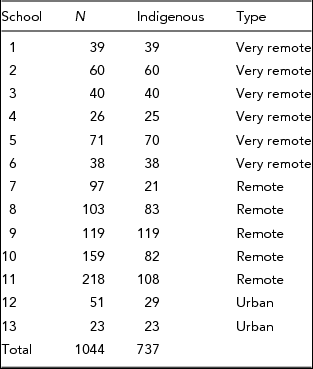
Schools identified in collaboration with the NT DET were invited to participate. Consideration was given to: (1) ensuring a geographic spread of schools throughout the Central Australian Desert and the ‘Top End’ of the NT; (2) incorporating urban, remote and very remote schools; and (3) incorporating schools with sufficient numbers of Indigenous students enrolled and attending regularly. Table 1 details the number of students and schools by location. The research team adopted the advice of the NT DET with reference to localities: ‘urban’ refers to secondary schools in the largest towns in the NT (Darwin or Palmerston); ‘remote’ refers to the smaller towns of Alice Springs or Katherine; and ‘very remote’ refers to Aboriginal communities located in very remote areas, including the town of Tennant Creek.
Number of Participants in Different Schools
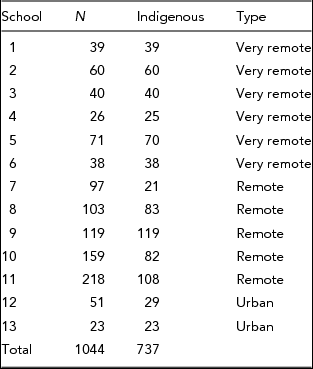
Note: Total very remote Indigenous students surveyed = 272; Total remote Indigenous students surveyed = 413; Total urban Indigenous students surveyed = 52; Total non-Indigenous students surveyed in very remote & remote schools = 285; Total urban non-Indigenous students surveyed = 22.
There were 1,044 participants in the quantitative study, of whom 70.4% were Indigenous students and 29.6% were non-Indigenous Australians.
Method
The qualitative study sought to understand and compare the views of Indigenous students living in different NT contexts regarding the value of education, their post-school aspirations, what motivated them to engage in school-based learning experiences and how they liked to learn. Data were collected through two sources: (1) written responses to open-ended questions, and (2) a series of interview questions. Both were combined to provide a rich data set of participants’ views. Essentially, the study investigated the research question: ‘How do Indigenous students talk about their education in terms of the value of education, their future orientation, their motivation to learn and preferred learning approaches?’
Open-Ended Questions in Survey Tool
The survey included five open-ended questions, four of which required students to respond in their own words and one of which contained options students could choose from. The number of Indigenous student responses to the five questions were as follows:
1. What would you like to do after you complete high school? Why? (401 responses)
2. What sort of training would help you to achieve what you want to do after you complete school (e.g., university, apprenticeship, training course, none)? Why? (289 responses)
3. How important is it to you to complete high school? Why? (360 responses)
4. Do you think completing high school will help you to get a job? Why?/Why not? (278 responses)
5. How important is it to you to get a job? Why? (233 responses).
Interview Data Collection
The interview participants comprised 68 Indigenous students, 36 of whom were males and 32 females, enrolled across Years 5 to 12, with 30 students from very remote schools, 30 from remote schools, and 8 from urban schools. Interviewees were recruited from the group of students who undertook the survey and volunteered to participate.
The student interview data were collected in the period 2007–2008. Interviews were semi-structured using a series of open-ended questions. Participants had written parental/family consent to be interviewed and recorded and were assured of anonymity. Informed consent was obtained prior to interviews. A local Indigenous person was employed to explain the research and consent form to parents. Schools facilitated consent where a parent was not contactable on the day interviews took place. Students without parent consent were not included.
Student interviews were conducted in school hours, on school premises, and varied in length from 5 to 60 minutes, with the average being 15 minutes. Students were interviewed individually or in pairs, if they preferred, by one or two members of a research team consisting of two Indigenous females, two non-Indigenous males and a non-Indigenous female.
There were differences in how many of the interview questions very remote students answered as compared to students in other locations. Urban students responded to all of the questions, remote students to approximately 95%, and very remote students chose not to or did not respond to nearly a third (29.2%) of the questions. There could be many reasons for this, including a lack of understanding of the questions due to a limited use or understanding of English, the fact that some questions may have asked for information that was not within their experience or that they chose not to answer due to discomfort with the interviewer, tiredness as a result of the number of questions being asked, or because they simply no longer wanted to participate. The content of the questions, the use of English and/or resistance to engaging with an unfamiliar interviewer in what must have been a strange situation for some of these students may well have impacted on the data collection aspect of this study, especially for students in very remote locations. In addition, conventions around asking or responding to questions — for example, the expectation of an immediate answer — could also have affected students’ responses.
Data Analysis
Interviews were assigned a code to protect the identity of the interviewee and were then transcribed. Records of interviews were retranscribed by a linguist familiar with Aboriginal English and the Indigenous languages of the NT to more carefully examine the meaning of student responses. Transcripts were then analysed by the research team for themes and trends as well as differences and/or similarities relative to students’ geographical locations.
Throughout this article, student quotes have been edited to reduce length and will be attributed by category of student interviewee (i.e., male/female; urban/remote/very remote) in order to ensure the promise of anonymity that was made to all respondents.
Limitations
Limitations of this study included: (1) the use of English only in a multilingual context and written English on the survey where most students lacked strong literacy, (2) managing consent through the school, and (3) the representativeness of the sample. A number of strategies were put in place to minimise, as much as possible, the impact of these factors.
In relation to language use and literacy, most students indicated on the survey that they spoke English at home. However, very remote students who were the least likely to speak English at home, wrote very few words in response to the five open-ended questions. The use of home language for interviews is recognised as a more effective and supportive approach, but it was beyond the time limits and financial capacity of this study to engage formally trained interpreters. In recognition of the diversity of English language skills in the classroom and in order to maximise student response rates, researchers read the open-ended questions, one at a time, aloud to students and gave them time to fill in their answers. Students who requested help in writing answers were supported by local Indigenous and non-Indigenous staff, including teachers, teacher assistants, and research assistants.
In terms of managing consent, schools were approached months before data collection and school personnel discussed the research with parents over the intervening period. Students were also asked verbally if they agreed to participate. Some parents may have felt obligated to provide consent due to the well-documented unequal power relations that can exist between schools and Indigenous families (Boughton, Reference Boughton2000; Herbert, Reference Herbert, Cadman and O’Regan2006; Malin, Reference Malin2003). In addition, some students may also have felt they had no option but to participate when asked to volunteer by both their teachers and outsiders to their community.
The DET was a project partner and the schools were the contact point for this study. Hence, the students who participated were those attending school during the researchers’ visits. This means that the voices of students who did not attend school during researchers’ visits were not included. Essentially, this study sought to understand the motivations of those students who were at school rather than those who were not.
These limitations do not invalidate the fact that a large number of Indigenous students currently participating in the NT school system provided their views on a topic of importance to them. Their views were a valuable contribution to understanding what motivates Indigenous learners who persist in attending school.
Findings
The focus of the qualitative study was to investigate Indigenous secondary students’ views of the factors that affect their schooling, using the following concepts to describe and discuss these factors:
• Valuing Education/School/Self;
• Future Goals;
• Motivation; and
• Learning Preferences.
Therefore, the student responses have been grouped into themes that reflect the purposes of the study. Each of the themes will be discussed separately.
Valuing Education/School/Self
Students were asked about their views on education and what value it held for them: whether they thought it was important for children, including themselves, to go to school and, if so, why; what they thought happened to children who did not attend school or dropped out of school early; how long they thought that children should stay in school and how long they intended to stay.
All respondents indicated that they thought it was important to come to school. The most common reasons given were ‘to learn’, ‘in order to get a good job’, and ‘to get a lotta money’. These responses indicated that students valued school to the extent that they linked schooling with positive outcomes. For example, one student spoke of the connection of schooling to future obligations; hence, the notion that school is valued because it helps to ‘. . . get you ready for the real world when you stop living at home and go out and get a job and a house and a family’ (female, Year 8, very remote).
One remote, female, Year 9 student suggested that from preschool onwards, school was important because it prepared you for the future and helped you learn how to behave toward others, ‘knowing right from wrong’. It was also a way to provide good role models for younger family members. She emphasised her intention to finish Year 12.
In fact, almost every student interviewed said they wanted to stay at school until Year 12. The extent of this response indicates that students had made an appraisal of the worth of school to them and that they had made a decision to stay the distance. The few exceptions were those students who had determined they wanted to obtain an apprenticeship in a field where the required training was not available in their schools.
The analysis of the student responses regarding how they value school highlights some differences between student groups. For instance, compared to most of the very remote Indigenous students interviewed, urban and remote Indigenous student responses suggested an underlying difference in their perceptions of the value of school. Trends in the data from students in very remote schools indicated that they may see going to school and getting an education as essentially about English; in particular, learning English language and literacy. For example, one very remote, male, Year 12 student explained that school was important ‘in order to speak English well’.
Differences were also seen in the amount of detail and variety of answers provided by students in different locations. Students in less remote and urban schools provided more detailed and varied responses regarding what they perceived to be the ultimate value and purpose of school education:
You need like a good education for when you want to get a job, you need something good on your resumé. (female Year 10 remote student)
School helps you to learn so you know what's going on in life, and yeah, helps you in life . . . because the job I want, it helps, such as for health. You learn about diseases . . . I think without education you go nowhere . . . go around in circles. (2 females, Year 9 remote students)
Typical of the very remote students were these responses when asked about why they go to school:
For learning, for English. (male Year 10 student)
Learning maths, and English, times tables. No swearing. No fighting. Go to school every day. Need to talk English. (female Year 7 very remote student)
Comments from students living in larger population centres may reflect their exposure to more varied outcomes of schooling or even be a consequence of their broader English vocabulary. It cannot be overlooked, however, that these differing responses may also be an indicator of the realities of life for the students living in different locations. Young people leaving school in very remote communities have few employment options (Rivers, Reference Rivers2012). It may be that one clear benefit they see for their years of schooling is the opportunity to learn the English language. Learning English may also be important to them for reasons other than gaining employment, such as watching movies, gaining a license, or undertaking other activities that require English.
The role of the learning environment and its possible influence on how students might value their schooling, in terms of what's in it for them, is further reinforced when considering the issue of future goals.
Future Goals
Students were asked at interview to respond to questions such as how long they intended to stay at school, what they wanted to do after leaving school, and how school could help them achieve their goals as a way to determine their future goals. Their responses were analysed together with Indigenous student responses to the written survey questions regarding future job interests. These data indicated that they hold a range of employment-related future goals, regardless of location.
Students in remote and urban locations named a variety of specific jobs including Qantas pilot, fighter pilot, lawyer, doctor, marine biologist, fish farmer, veterinarian, ranger, aeronautical engineer, mechanical engineer, teacher, PE teacher, dance teacher, sports star, community sport and recreation officer, personal fitness trainer, chef, soldier, mechanic, miner, nurse, childcare worker, health worker, policeman, shopkeeper, hairdresser, waitress, truck driver, office-worker, cleaner. Four students enrolled in remote or urban schools were already working part time in their chosen fields.
Most participants from very remote schools mentioned fewer job options and were unsure about the training they would need in order to qualify for them. While some very remote students named specific jobs (such as teacher, ranger, policeman, childcare worker, and shop worker) the data revealed that the majority saw the Community Development Employment Projects (CDEP) program as the most likely source of future employment for them.
When asked what they studied at school, very remote participants listed most often reading, writing, maths, English, AL (Accelerated Literacy), and PE (Physical Education). Students appeared to regard AL as a separate subject from English, although it is designed to reinforce English literacy, and to differentiate both AL and English from reading and writing. It could also be that students are more interested in these subjects because they all relate to learning English, which is, as noted above, a reason that many students gave for going to school. Students in the remote and urban schools also listed English, maths, reading, writing and PE, but added science, SOSE (Studies of Society and Environment), LOTE (Languages other than English), art, drama, home economics, woodwork and metalwork. It may be that there is a marked difference in the subject options available to students in different locations, with far fewer subjects on offer in very remote locations.
All student responses nevertheless showed a genuine desire to learn, a recognition that education has a purpose, an awareness of schooling as contributing to their futures, and an understanding that the future was composed of responsibilities that accompany adulthood. These responses demonstrated that Indigenous students from all locations valued education as something that prepares you for the future, and anticipated that their future would include some form of employment.
Motivation
Students responded to questions about what school meant to them, whether they enjoyed school (and, if so, what they enjoyed about school), and whether they enjoyed competition with each other in class. This set of interview questions aimed to explore what drives students to engage in school.
Almost all students indicated they enjoyed school. They regarded it as an intensely social place where they made and met friends. One very remote Year 12 male student expressed this by saying he came to school ‘because you have more fun. A lot of children come to school. Make lots of friends’. An urban Year 9 male student indicated that he most enjoyed coming to school for ‘friends, social reasons’. Several remote male and female students at different year levels identified the importance of school as a place for socialising, for chatting to friends and catching up with mates. One Year 9 female student clearly articulated why school mattered so much to her, including relationships with her teachers as being important as well:
I love seeing my friends and I love seeing the teachers too, because sometimes the teachers go away . . . and it's really good to see them back, because I have a really close relationship with most of my teachers. As well as my friends, seeing them everyday is important to me.
Almost all male and some female students nominated sport or PE as their favourite part of school. Several boys in one school spoke extensively about the Clontarf Football Academy, its rigour, the interstate sporting trips, and the new friends it enabled them to make. Stronger Smarter Sisters and Girls at the Centre, the equivalent programs for girls, drew similarly enthusiastic comments from female students.
Only two students spoke about not enjoying school, preferring other forms of learning. An urban Year 8 male student indicated that the only thing he enjoyed at school was doing his electives — art, woodwork, metalwork and PE. The other, a remote Year 11 female student, was enrolled in a VET childcare apprenticeship through the school. She reported finding it difficult to cope with the constant shuttling to and from work at the childcare service, school and home, saying she would prefer not to be at school at all:
I don't like the pressure of having set times to do things, I just don’t. I’d like to be doing more childcare things, I enjoy doing it, but being at school is a struggle, because I find it so boring.
While most students declared that they were regular school attenders because they enjoyed school, they also indicated that they knew young people who did not attend school regularly or who had dropped out of school. More significantly, most demonstrated that they were aware of what happened to students who did not attend school by giving examples of the antisocial behaviours of some of the young people they knew no longer attended school on any regular basis, if at all.
Just as students were very positive about the socialisation aspects of school, they also provided other insights into why they came to school. Most students interviewed said that school was preferable to being at home. A number of male students attending remote schools provided commentary about their motivation. ‘Lot of sport here’ was the verdict of a 16-year-old male student at boarding school, while a Year 9 male student defined school as being the place where ‘you’re listening, and doing your work in class, you’re active’, and a Year 8 student said that in his experience, you ‘do chores at home, and see friends at school’. A female Year 9 student at a remote school said, ‘I like being challenged and I get that at school rather than sitting at home’.
One very remote Year 9 male student's comment illustrates the role his uncle has played in getting him to school. He reported that his uncle had told him: ‘Just go to school and try and learn; listen to the teacher. Don't backchat your teachers; have respect for the teachers by doing your work.’
Teachers often endorse competition to motivate student learning. Students provided some interesting insights into how they regarded these motivational efforts. They spoke of competition at home as basically confined to sport and mundane domestic issues such as ‘who's first in the shower’, but almost all students rejected the notion of competing in class. One student in a very remote school, explained: ‘Not really . . . like everyone's good at doing some things. Maybe they’re good at sports, maybe I’m good at reading and writing; everybody's got different things.’
Some male students’ responses from remote and urban schools confirmed this:
Well, there's always people who are the smarter ones, and I mean, I’m only interested in the average. I don't try to be better than anybody. I just do what I can do.
No, we just do our work and get along. We try to be good at work, but . . . we just finish quick and then we can talk.
Rather than compete in class, students talked about helping each other out:
Maths, like if you can't do an equation, they’ll help you out.
Sometimes, when they don't know stuff, I’ll help them, and when I don't know anything, they’ll help me.
A female student in a very remote school explained that competition in class just did not happen there:
It's a bit different here than it is in . . . [town]. Everybody here just supports everybody else. People get teased and everything in . . . [town] because they’re not as smart as other people, but here it doesn't matter . . . they don't care about how smart people are.
Even in remote and urban schools, most female Indigenous students indicated that they did not compete in class, preferring to keep competition in the sporting arena.
But there were exceptions, as demonstrated in the following admissions to competing in the classroom:
I do, I do. One of my friends is always getting better grades than me and I hate it, hate it with a passion, so I always try and do better, but she always wins. I don't like it . . . She's great at maths, she's great at English, she's perfectly perfect. Except she can't do art. (female Year 11 remote student)
If like someone says something that's really not nice we kind of have a competition against each other. Sometimes I think that it's not all about being the best; it's about being, doing, trying your hardest and being a good sportsman, yeah. (female Year 7 urban student)
The students participating in this research were attending school where many of their counterparts had chosen not to attend, suggesting that they have made a choice to attend. The strongest motivations they provided for attending school were the opportunities that school provided to play sports and for enjoying the company of their peers. Despite their interest in sport where the competition to win is highly motivating, when asked about competition in school work, most of the students tended to endorse collaboration over competing with each other.
Learning Preferences
In order to explore students’ learning preferences they were asked questions about how they liked to learn: differences and similarities they saw between learning at school and home; what they shared at home and in school; whether or not they did homework; whether/how their parents/family participated in school, and what help or what support they received.
Students often spoke about their teachers as key to their learning. A remote Year 9 female student described her teachers as: ‘A bit different to any other teachers that you get in private schools. They’re easy to get on with and they’re more open-minded to what teenagers today would be thinking.’
Asked to describe what made a teacher good or bad, some remote Year 10 male students suggested that a cool teacher was ‘one who doesn't growl’ or ‘one who lets me work on my own and helps me when I need it’. For these students, a bad teacher was one who ‘just keeps you in for no reason’.
Technology is an emerging tool in NT schools as internet service providers extend their services further into the remote areas. All students interviewed had access to computers at school. They mentioned that they were banned from using computers if their behaviour was bad. Many of the students in remote and urban schools also had access to computers, books and DVDs at home, unlike most of the students in very remote schools. A remote Year 9 female student indicated: ‘Yeah, Mum has to be up to date with everything, so we have a computer and TV to help us. Books, yes, my sister brings home all these books for me to read.’
Regardless of their geographic locations and whether or not they lived with one, both or neither parent/s, most students described their parent/s or guardians as important in their schooling, providing material and psychological support. For most of them, material support included food, clothing and getting them up in the morning in time for school. As a remote Year 9 female student pointed out: ‘My mum's always worrying if I have breakfast in the morning as it's better for you, your brain's able to work better for you if you’ve got food in your stomach.’
And a remote Year 11 female student highlighted the psychological support she received:
My mum definitely doesn't want me to leave [school] . . . she would make me come at like 6 am if she could. She makes sure I wake up and come. She supports me a lot, like she helps me to understand the reason for things that are happening and that just makes it easier. And she just helps me understand I have to do it because it leads to something.
However, for some students, their parents’ participation in the school was seen as a source of embarrassment or as a result of getting into trouble. When asked whether their parents came to the school, most said ‘no’. ‘Only when I’m in trouble’ said a remote Year 9 male student. A remote Year 8 female student said: ‘I don't want them to come. They’re an embarrassment . . . when I was in primary school they used to come sometimes, but I told them not to come any more.’ This is consistent with the experience of Indigenous students in another recent NT study that focused on parent engagement in schools (Lea, Wegner, McRae-Williams, Chenhall, & Holmes, Reference Lea, Wegner, McRae-Williams, Chenhall and Holmes2011).
Homework is one of the basic learning strategies teachers have used to consolidate student knowledge and understanding of subject content and build mastery in key areas. In this study, students were asked if their schools prescribed homework and, if so, where they did it, how much they did, and whether their parents/guardians or other family members helped them with it. Only three very remote students indicated that they did regular homework. Yet they also indicated that this homework was specially set for them because they were more advanced than the rest of their class. While not all remote or urban schools set homework, when they did, students’ responses indicated that it was usually done under the supervision of teachers after hours on school premises in a homework centre in the school or, for boarders, at the hostel where they boarded. Most students who did homework at home indicated they were helped by one or other parent, uncle or older sibling when they sought help. As an urban Year 7 female student said: ‘My mum helps me as well . . . yeah. She makes it better for me to understand than what the teachers say ‘cause sometimes I don't know what they mean.’
Several students, however, proudly averred that they could do their homework on their own and did not need help.
The amount of homework set varied from school to school and year level to year level and not all students did what was set them, some males citing football training as their excuse. The mothers of two female students were currently undertaking further qualifications, and this was perceived as beneficial because in each case mother and daughter helped each other.
Some very remote students provided quite specific information in comparing home to school. For example, three of the thirty students from very remote schools pointed out that learning did not stop at the school gates. At home they reported they learnt traditional skills including hunting, as well as the domestic skills needed to ensure a clean and healthy home and the cooking skills needed to feed the family. The majority of very remote students saw nothing in common between home and school, insisting that the two domains were ‘different’.
When asked about how important they considered ‘sharing’, both at home and at school, all students indicated that they shared information, clothes, shoes and food with their family; and most indicated that at school they shared clothes, school equipment, money and food with their friends, especially if their friends were hungry.
When it came to sharing knowledge and information, student responses revealed that group work was encouraged in some schools and in some subjects more than in others, although group work was preferred by almost all students to working on one's own. A male Year 9 student in an urban school admitted that: ‘Yeah, it's [group work or sharing] better than sitting there by yourself. . . it happens, but mostly you want it to happen. Yeah, people are nice enough to help out each other if they need it.’
Two remote Year 9 male students explained why they preferred working in groups or pairs:
You don't have to think by yourself, you get other brains and work together. They can help you out with answers you don't know.
‘Cause you’re all thinking of different ideas and you’re learning more off the other people's ideas.
Some students, however, preferred to work in a group only when starting new work:
When it comes to something, if it's something just starting, I’ll work in a group at first, but once I get the hang of it, I’ll just go off by myself so I can concentrate easier and I get it done a lot quicker and better when I’m doing it by myself.
For other students, there was always the chance that: ‘Sometimes you can get the real smart kid to do it for you, so you get good grades.’
The findings regarding the learning preferences indicated that these students value teachers who support and understand them, appreciate parents who support them by helping with homework and providing the necessities of life to enable them to get to school and, for the most part, being allowed to work together in groups and help each other.
Conclusions
The most important finding from this study was that virtually all of the 68 Indigenous students interviewed, regardless of location, indicated that they valued education, enjoyed school for a variety of reasons, and anticipated that they would learn something in school that would help them in the future. In terms of learning approaches, most students identified their preference to work in groups and to help each other complete set tasks rather than compete. Teachers and departmental staff working with these students should take heart from these findings. At least for the students who are at school, school has meaning and is valued.
Despite the overall commonality in student responses, regardless of location there were also some important response variations by location. We discuss two key variations: very remote students’ post-school aspirations and their valuing of school as a place to learn English. In discussing these variations it is important to remember that ‘remote’ in this study refers to towns such as Alice Springs and Katherine and ‘urban’ refers to the small cities of Darwin and Palmerston. The very remote schools participating in this study are located in communities well away from the dominance of mainstream culture, where local languages are more commonly spoken than English, and where services and resources are limited as compared with larger remote and urban locations. In addition, school infrastructure in very remote settings tends to be basic and teaching staff turnover is high.
Post-School Aspirations
Very remote students reported that they aspired to locally relevant work roles; for example, at the shop, the childcare centre, the health clinic, the school and through the CDEP scheme. The CDEP program was mentioned frequently as a preferred post-school employment destination. Given the relatively limited employment opportunities available in very remote communities (McRae-Williams, Reference McRae-Williams and Gerritsen2011), the jobs students mentioned would likely be the main work roles available to them. The common aspiration of very remote students to work for CDEP may reflect the endorsement that CDEP has received by local residents in many very remote communities, as pointed out by Altman (Reference Altman2009):
From an Aboriginal perspective, CDEP is liked because it provides a means to undertake meaningful activity, work extra hours, earn extra money, to have the flexibility to participate in the customary economy and in ceremony, and to live on ancestral lands. (Altman, Reference Altman2009, p. 8)
However, CDEP was not mentioned by remote and urban students, although the scheme was still operating in these locations at the time of this study (Altman, Reference Altman2009; Hunter & Gray, Reference Hunter and Gray2012). The reasons why urban and remote students did not mention CDEP as a post-school employment option are not known, but we could speculate that students’ increased choice of occupation may have contributed to their disinterest in CDEP. Another possible explanation is that urban and remote students were becoming aware of the federal government decision in 2005 to phase out the CDEP scheme as part of the ‘closing the gap’ in Indigenous disadvantage measure, and direct remote Indigenous people into ‘real’ jobs. As such, they may not have considered CDEP as an option. As it has turned out, the removal of CDEP was staged over a long period of time and removed first in urban and regional areas. In 2013, CDEP was finally replaced by a similar scheme called the Remote Jobs and Communities Program (RJCP; Hunter & Gray, Reference Hunter and Gray2012). This move, in part, demonstrates the federal government's acceptance of the likely negative impacts associated with a complete abolition of some sort of work-for-the-dole program in very remote communities. As Altman (Reference Altman2009) saw it:
As CDEP is dismantled, participants will be given the choice of mainstream work or welfare, with the proviso that work might require migration from home communities. People will be moved from productive work to welfare. (pp. 8–9)
Valuing School for Learning English
While very remote students’ responses indicated that they saw value in school for many of the same reasons as their urban and remote counterparts, their responses also indicated that they found it particularly useful in providing them with English language skills. There are a few interpretations of this finding. From a positive perspective, teachers in the NT should be encouraged that English acts as an incentive for very remote Indigenous students to attend school. An explicit prioritising and focus on English language instruction, coupled with systematic and explicit teacher support to learn how best to teach English effectively, could be a point of re-entry for disengaged students and for keeping them in school when they are already there.
However, the research findings from this study do not detail the uses students had in mind for learning to speak English. How or why this interest in English has developed in students is not clear from the data. The recent numerous changes in policy direction in regard to language use in remote Indigenous schools in the NT — for example, the ambivalent attitude of education authorities to bilingual education, with its frequent removal and reintroduction (see ABC, 2009) — clearly sends a message to remote Indigenous communities that English is not only important but more important than home languages. Students’ interest in learning English may reflect their awareness that their home language is not valued.
We know that Indigenous languages in the NT are under serious threat and they continue to decline in use (Simpson, Caffery, & McConvell, Reference Simpson, Caffery and McConvell2009). When children stop speaking it, their language begins to die. Schools support children across the world to develop as confident home language users as they learn English as well. In the NT, where Indigenous language use is the strongest in Australia, children should not have to choose between their home and the English language.
Final Thoughts
The interview responses from the students participating in this study have generated a number of propositions and some questions worthy of further examination. Key propositions include:
1. Indigenous students who attend school in the NT have found reasons to value it and enjoy going to school for a variety of reasons;
2. As key English speaking institutions in very remote communities, schools are accepted and used by students as a resource for learning English. This, combined with students’ association of school with social interaction and sporting activities, becomes their main motivation for going to school; and
3. English language proficiency levels, miscommunication and misunderstanding of interview and or cultural factors contribute to variations in responses to interview questions between very remote students and those in urban and remote locations.
As discussed earlier, the limitations of this study presented many challenges for both researchers and participants. Nevertheless, the findings contribute to a developing understanding of the motivations of Indigenous students in relation to their schooling. Findings of this research direct attention away from blaming either the students and their families or the schools and their teachers for the problems that persist. Instead, they highlight the fact that Indigenous students who attend school, regardless of location, say that they do so for reasons similar to those of other students across the NT. This being the case, the research prompts a call for researchers, policy makers, practitioners and school leadership to examine and invest in ways to keep students engaged and learning once they are there. The research also prompts significant questions for further study, including: Why do NT school statistics continue to show even motivated students struggle to achieve and complete their schooling? What do the Indigenous youth who have withdrawn from school (and were therefore not accessed in this research) say about the schooling experience and their goals and aspirations for the future?
Acknowledgments
Sincere thanks are given to Leonora Adidi, Alma Mir, Jan Whittle of Batchelor Institute of Indigenous Tertiary Education and Paul Atkins, whose help with logistical matters and in collecting data cannot be understated; and thanks also to Liz Grylls, Chow Kui Foon and Arief D. Liem for assistance with statistical analyses. We also sincerely thank the children, staff, communities and schools that gave their time to participate in this important project. Finally, this research was supported by an Australian Research Council Linkage Grant LP0561651 in collaboration with the Northern Territory Department of Employment, Education and Training, for the project entitled: ‘Building the Future for Indigenous students: The relationship of future vision, learning, and motivational profiles to school success’.
About the Authors
Jeannie Herbert is Pro-Vice Chancellor, Indigenous Education and Foundation Chair of Indigenous Studies at Charles Sturt University. Her long career across all sectors of education, in particular Indigenous education, culminated in her being awarded an Australia Medal (AM) in 2012 for her service to Indigenous tertiary education.
Dennis M. McInerney is Chair Professor of Educational Psychology at the Hong Kong Institute of Education. He is Co-Director of the Assessment Research Centre of the Institute. Professor McInerney's major areas of research interest are cross-cultural studies of learning and motivation, self-processes and adaptive psychological determinants of school behaviour, and instrument design and validation.
Lyn Fasoli is an American Australian who has worked in the Northern Territory for over 30 years. She currently works as Associate Professor in the Higher Education and Research Division at Batchelor Institute of Indigenous Tertiary Education where her research focuses on Indigenous education, early childhood education and care, children's service training and development and leadership practices.
Peter Stephenson moved to the Northern Territory in 2004 to implement a newly accredited degree and later oversaw the development of research training awards at Batchelor Institute. In his current role as Head of Higher Education and Research, Peter has strategic and operational responsibility for the Institute's Research Plan and its higher education teaching partnership with Charles Darwin University.
Lysbeth Julie Ford has researched and written on Australian education and Indigenous languages for over 30 years. She has worked with the last fluent speakers of endangered Aboriginal saltwater languages of the Daly River region in the Northern Territory, to record and document their languages; co-authored a Murrinhpatha-English legal glossary and a Batjamalh/Emmi ethno-botanical dictionary; and, most recently, a book documenting the musical genre wangga. For several years she taught linguistics to a wide range of Indigenous students at Batchelor Institute, and still tutors Indigenous tertiary students at Charles Darwin University. In 1997 she co-authored the monograph Open and Flexible PhD Study and Research.