Introduction
The classical indications for antipsychotic treatment are schizophreniform disorder, schizophrenia, mania and schizoaffective disorder (Glick et al., Reference Glick, Murray, Vasudevan, Marder and Hu2001). However, antipsychotics are widely used for a broader range of conditions (off-label use), such as behavioral and psychological symptoms of dementia (BPSD). These symptoms include verbal and physical aggression, agitation, hallucinations, depression, delusions, wandering, and sleep disturbances (Liperoti et al., Reference Liperoti, Pedone and Corsonello2008), which cause severe emotional distress for nursing home residents, as well as for caregivers and nursing staff. Antipsychotics have been widely used as a first-line treatment and increasingly used since the introduction of atypical antipsychotics, which are perceived as having a better side-effect profile (Briesacher et al., Reference Briesacher2005).
Serious adverse effects, such as extra-pyramidal symptoms, metabolic effects (Muench and Hamer, Reference Muench and Hamer2010), cerebrovascular events (Schneider et al., Reference Schneider, Dagerman and Insel2005), and increased mortality (Trifiro et al., Reference Trifiro, Verhamme, Ziere, Caputi, Stricker and Sturkenboom2007; Ballard et al., Reference Ballard2009) have been associated with long-term use of antipsychotics. Since the announcement of serious adverse effects, several safety warnings have followed. For example, in the public health advisory of April 2005, the US Food and Drug Administration (FDA) issued a warning of increased risk of mortality in older adults with dementia using atypical antipsychotics. In 2008, the FDA updated and extended the warning to all antipsychotics. Yet, despite safety warnings, antipsychotics are still widely used in off-label mode for BPSD (Glick et al., Reference Glick, Murray, Vasudevan, Marder and Hu2001; Briesacher et al., Reference Briesacher2005). Moreover, antipsychotics only have modest efficacy in the case of BPSD, specifically in treating the symptoms of aggression and psychosis, but the evidence with regard to efficacy for other BPSD symptoms is not convincing (Ballard and Waite, Reference Ballard and Waite2006; Ballard et al., Reference Ballard2008). These findings underscore the problem of injudicious initiation and argue against long-term use of antipsychotics in older adults.
Several validated screening tools have been used for assessing inappropriate prescribing in older adults: the Beers criteria (Fick et al., Reference Fick, Cooper, Wade, Waller, Maclean and Beers2003); the Improved Prescribing in the Elderly Tool (IPET) (Naugler et al., Reference Naugler, Brymer, Stolee and Arcese2000), the Assessing Care of Vulnerable Elders (ACOVE) under-use criteria (Shekelle et al., Reference Shekelle, MacLean, Morton and Wenger2001); the Medication Appropriate Index (MAI) (Hanlon et al., Reference Hanlon1992); the Bergen District Nursing Home study indicators (Ruths et al., Reference Ruths, Straand and Nygaard2003; Ruths, Reference Ruths2008), and more recently the Screening Tool of Older Person's Prescriptions (STOPP)/Screening Tool to Alert doctors to Right Treatment (START) (Gallagher et al., Reference Gallagher, Ryan, Byrne, Kennedy and O'Mahony2008).
We already know that in nursing homes a high level of psychotropic drug utilization occurs (Azermai et al., in press). Consequently, the aim of this study was to investigate antipsychotic drug use in Belgian nursing homes, and explore potentially inappropriate use of antipsychotics by using inappropriate prescribing indicators selected from existing validated screening tools.
Methods
The current study used data from the Prescribing in Homes for the Elderly (PHEBE) study, a multicenter research investigation that aimed to investigate the overall drug utilization in Belgian nursing homes. The PHEBE study in general (Elseviers et al., Reference Elseviers, Vander Stichele, Soenen, Gobert, van Bortel and van de Voorde2010) and psychotropic drug utilization in particular have been described in detail elsewhere (Azermai et al., 2010), so only the principal features are briefly outlined.
phebe
The PHEBE study was undertaken during 2005 in nursing homes with at least 30 beds that offered both home replacement and nursing care. It was a cross-sectional, descriptive study of a representative, randomized, and stratified 10% sample of Belgian nursing homes. The Ethics Committee of the Scientific Society of Flemish General Practitioners approved the PHEBE project (approval number 2005–007).
Data collection
In each consenting nursing home, 30 residents (and 10 reserves) were randomly selected. Data collection at the resident level included administrative, clinical, and medication aspects. For collection of medication data, the medication charts of each resident were copied and transcribed with a computer-assisted data entry program. The case-mix, activities of daily living (ADL), and mental status of residents were assessed using the Katz scale. This instrument is mandatory in Belgian nursing homes, based on ADL on the one hand, and presence or absence of dementia on the other (Katz and Akpom, Reference Katz and Akpom1976). Dementia is expressed as disorientation in time and place, varying from grade 1 (absence of dementia) to grade 5 (fully expressed dementia).
For collection of clinical data, we sent a questionnaire with 28 items, focusing on clinical and care problems (i.e. problems with a predominant nursing care burden), to the treating general practitioner (GP) of each included resident. In addition, GPs received a standardized printout of the medication chart for verification and confirmation of the medication use as “chronic”, and were asked to tick a predefined list of main indications for each medication. The questionnaire and medication list with indications added were returned to the study center in a pre-stamped, anonymous envelope. Based on the collected clinical information from the GPs, we excluded residents in palliative care. Additionally, institutional characteristics were collected, including type of institution (public or private non-profit), the proportion of residents treated by the medical coordinator, the nursing staff rate, and medication dispensed by a hospital pharmacist.
Antipsychotic drug utilization
Antipsychotic drugs (N05A) were coded according to the Anatomical Therapeutic and Chemical (ATC) classification (version 2005). Residents were identified as antipsychotic drug users if one or more antipsychotic agents were prescribed. Duplicate antipsychotic therapy was defined as the concomitant use of two or more different antipsychotic medications. Chronic use was defined as antipsychotic medications used for at least three months. Additionally, antipsychotics were further classified into typical and atypical agents.
Development of inappropriate prescribing indicators for antipsychotics
A search strategy was undertaken to identify existing validated screening tools, aiming to select potentially inappropriate prescribing indicators for antipsychotics. We screened six validated tools, of which three were excluded (ACOVE, IPET, MAI). The ACOVE under-use criteria were taken into consideration but were not found to be relevant in our study. IPET consisted of only 14 criteria with important flaws, and MAI had no explicit referral to specific drug classes, which is problematic in older adults (Gallagher et al., Reference Gallagher, Ryan, Byrne, Kennedy and O'Mahony2008). Thus, we included three validated tools (updated Beers criteria 2003, BEDNURS, and STOPP) for the development of inappropriate prescribing indicators for antipsychotics.
A table of inappropriate prescribing indicators was constructed based on three domains: comorbidities, and the combinations and duration of therapy. Indicators focusing on combination and duration of treatment were mainly selected from BEDNURS whereas indicators focusing on inappropriate use in specific comorbid conditions were selected from the updated Beers criteria and STOPP. One STOPP indicator (“use of anticholinergics to treat extra-pyramidal side-effects of antipsychotic medications”) was not included due to lack of information in our study, and therefore a lack of applicability. The PHEBE database was then searched for inappropriate prescribing indicators electronically. A summation score was created by adding the various flags together. Last, we developed a dichotomous variable; “inappropriate prescribing”. For the development of a risk profile for inappropriate prescribing, we excluded two indicators that were not present, and one indicator (chronic use) that was present in almost all residents.
Statistical analysis
The data were analysed using the SPSS v15.0 (SPSS, Inc., Chicago, IL, USA). Differences between groups were analyzed through cross-tabulation, and the statistical significance was evaluated with a χ2 test.
A risk profile for inappropriate prescribing was developed based on significant risk factors in univariate analysis, which were afterwards inserted in a multivariate regression model using the “enter” method. The level of significance was set at p < 0.05.
Results
Description of the study population
The total sample included 76 nursing homes and 2510 residents for whom administrative and medication data were available. Clinical information based on the returned printouts by the GPs was available for 1906 residents. A total of 176 residents were excluded as they were being treated in palliative care, leaving 1730 residents for whom clinical data and medication data were available.
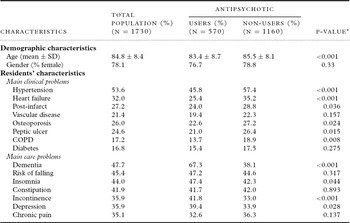
The mean age of the included residents was 85 years (SD 8.0) of whom 78% were female. The mean number of chronic medications was seven drugs (SD 3.4) per resident. GPs diagnosed 48% of the total population with dementia, 44% with insomnia, and 36% with depression (Table 1). Residents had an average of 2.6 clinical problems and 3.1 care problems.
Description of the study population

*p-value of the difference between users and non-users; COPD = chronic obstructive pulmonary disease.
Description of antipsychotic drug utilization
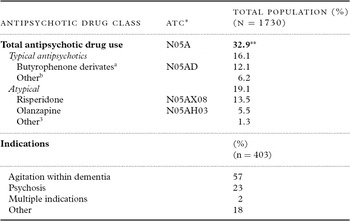
The prevalence of antipsychotic drug utilization in Belgian nursing home residents was 33% (n = 570) (Table 2). Typical antipsychotics accounted for 16% of use, with haloperidol being most commonly prescribed. Atypical antipsychotics, predominantly risperidone, accounted for 19% of use. Concomitant use of two or more antipsychotic medications was found in 5% of cases.
Prevalence and indications of antipsychotic drug use

*ATC = anatomical therapeutic and chemical classification; **Sum of classes and subclasses exceeds the total use due to duplicate use.
a Butyrophenone subclasses included haloperidol (N05AD01) (5%), melperone (N05AD03) (3%), pipamperone (N05AD05) (3%), bromperidol (N05AD06) (0.2%), benperidol (N05AD07) (0.4%)
b Other typicals included phenothiazines (N05AA/N05AB) (2.1%), benzamides (N05AL) (3.2%), thioxanthene derivates (N05AF) (0.6%), diphenylbutylpiperidine (N05AG) (0.3%); 3other atypicals included quetiapine (N05AH04) (1%), clozapine (N05AH02) (0.3%), aripiprazol (N05AX12) (0%), sertindol (N05AE03) (0%), paliperidone (N05AX13) (0%)
The main indications for prescribing antipsychotics were agitation within dementia (57%), and psychosis with or without dementia (23%).
Antipsychotics were mostly prescribed in residents aged <80 years (41%), followed by residents in the age category of 80–89 years (31%), and residents older than 90 years (29%). No significant difference was found in antipsychotic drug utilization when comparing males and females.
Advancing dementia was associated with higher use of antipsychotics, increasing from 17% in stage 1 of the Katz scale (absence of dementia) to 51% in stage 4 (severe dementia), but decreasing to 46% in stage 5 (fully expressed dementia).
A significant decrease in antipsychotic drug use was found when more than one third of residents were treated by the medical coordinator (36% vs. 28%, p = 0.001), and when medication was dispensed by a hospital pharmacist (34% vs. 23%, p < 0.001). Use of antipsychotics was not associated with nursing staff rate, or with type of institution.
Risk profile for antipsychotic drug utilization
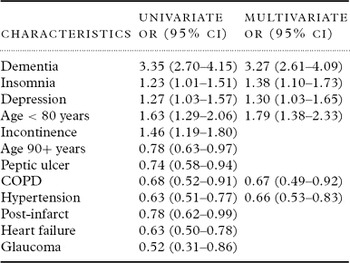
Factors associated with increased risk for antipsychotic drug use in nursing home residents included age defined as <80 years (OR: 1.79; 95% CI: 1.38–2.33); dementia (OR: 3.27; 95% CI: 2.61–4.09); insomnia (OR: 1.38; 95% CI: 1.10–1.73); and depression (OR: 1.30; 95% CI: 1.03–1.65) (Table 3). Factors associated with decreased risk for antipsychotic use included arterial hypertension (OR: 0.66; 95% CI: 0.53–0.83); chronic obstructive pulmonary disease (COPD) (OR: 0.67; 95% CI: 0.49–0.92); and peptic ulcer (OR: 0.78; 95% CI: 0.60–1.02).
Clinical characteristics associated with antipsychotic drug use

CI = confidence interval; COPD = chronic obstructive pulmonary disease.
Description of inappropriate prescribing
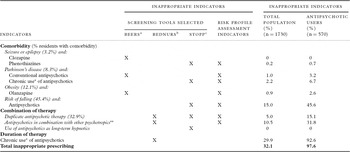
Based on the Beers criteria, BEDNURS indicators, and STOPP criteria, a total of ten antipsychotic prescribing indicators were selected. Because the inappropriate prescribing indicator “chronic use of antipsychotics” was observed in almost all residents, a very high number of potentially inappropriate prescribing antipsychotics (98%) was found (Table 4). In 32 % of residents, antipsychotic users scored on one indicator but the majority scored on several indicators with 41% scoring on two, 19% on three, and 6% on four or more. The indicators “clozapine with seizures or epilepsy” and “antipsychotics used as hypnotics” were not seen in this sample. Among users, the highest scoring indicators were: long-term use (93%), use of antipsychotics despite risk of falling (46%), combined use with other psychotropic drugs (32%), and combination therapy with duplicate antipsychotic medication regimens (15%) (Table 4). Inappropriate prescribing related to specific comorbid conditions was mainly found in residents with Parkinson's disease (n = 144; 8%) of whom almost one third received antipsychotics (n = 41) in mostly a chronic fashion. Among users with Parkinson's disease, 39% used typical agents.
Description of inappropriate prescribing indicators for antipsychotics

*In this study defined as ≥ 3 months; **Antipsychotics, antidepressants, and benzodiazepines.
aFick et al. (Reference Fick, Cooper, Wade, Waller, Maclean and Beers2003); bRuths et al. (Reference Ruths, Straand and Nygaard2003); c Gallagher et al. (Reference Gallagher, Ryan, Byrne, Kennedy and O'Mahony2008).
Risk profile for inappropriate prescribing
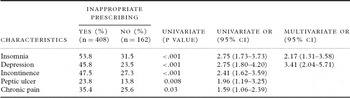
The dichotomous variable “inappropriate prescribing” with exclusion of “chronic use”, which occurred too frequently, “antipsychotics as hypnotics”, and “clozapine with seizures” (did not occur), was used to assess the risk for inappropriate use of antipsychotics. The analyses were only conducted for antipsychotic drug users (n = 570), of whom 72% (n = 408) scored on one of the remaining seven indicators. Antipsychotic drug users with insomnia (OR: 2.17; 95% CI: 1.31–3.58) and depression (OR: 3.41; 95% CI: 2.04–5.71) had a higher risk of potentially inappropriate use of antipsychotics (Table 5). Incontinence (OR: 2.41; 95% CI: 1.62–3.59), peptic ulcer (OR: 1.96; 95% CI: 1.19–3.25), and chronic pain (OR: 1.59; 95% CI: 1.06–2.39) were also associated with a higher risk of inappropriate prescribing, but only in the univariate analysis.
Clinical characteristics associated with inappropriate prescribing in antipsychotic drug users (n = 570)

Discussion
The prevalence of antipsychotic drug use in Belgian nursing homes was found to be 33 %. Although the prevalence of our study is based on data from 2005, recent international studies still show high use of antipsychotics ranging from 46% in Austria (Mann et al., Reference Mann, Kopke, Haastert, Pitkala and Meyer2009) to 24% in the USA (Kamble et al., Reference Kamble, Chen, Sherer and Aparasu2008), and 19% in Norwegian nursing homes (Testad et al., Reference Testad2010). In our study, antipsychotics were mainly used for dementia-related agitation. While we lack information regarding how antipsychotic treatment was initiated, evidence-based dementia guidelines (Scottish Intercollegiate Guidelines Network, 2006; National Institute for Health and Clinical Excellence, 2007) indicate that treatment should be considered after risk-benefit analysis and when non-pharmacological approaches alone are insufficient. Additionally, treatment should be temporary and regularly reviewed (at least every three months or according to clinical need).
The appropriateness of antipsychotic prescribing was investigated by ten inappropriate prescribing indicators. Two inappropriate indicators did not occur at all, and the indicator “clozapine use in seizures” might even be extended to non-recommended use in older adults in general.
The main prescribing problems concerned duration and combination of therapy. Almost all antipsychotic users (98%) were found to have potentially inappropriate prescribing, mostly due to the high prevalence of chronic use (93%), pointing to a lack of reassessment. Combination of antipsychotics with other psychotropics was defined as a potentially inappropriate indicator, and was present in one third of users (32%). However, in some cases, multiple psychotropic drug use can be justified as appropriate prescribing. A combination of therapy with duplicate antipsychotic medication regimens was found in 15% of users, which raises serious concerns regarding safety profiles, as well as the appropriateness of prescribing. Most of the comorbidities for which antipsychotic use is not recommended tended to occur infrequently, except for Parkinson's disease. In this instance, we found that one third of residents with the disease received antipsychotics (mostly chronically), and were prescribed typical agents in 39% of cases, despite clear side effects, such as extra-pyramidal symptoms.
It has been hypothesized that inappropriate medication use in general and antipsychotics in particular are associated with risk of falling in older adults (Landi et al., Reference Landi, Onder, Cesari, Barillaro, Russo and Bernabei2005; Berdot et al., Reference Berdot2009). Residents perceived as at risk for falling might be less likely to receive antipsychotics but the design of our study did not permit confirmation of this as risk of falling in older adults is often multifactorial and not exclusively associated with the use of psychotropics.
A higher risk of antipsychotic drug use was found in residents younger than 80 years, and for treating dementia, insomnia, or depression. Advancing dementia resulted in increased antipsychotic use but decreased in the subgroup of fully expressed dementia (stage 5). This phenomenon might be associated with a general physical deterioration of these residents.
Although not considered indications for antipsychotics, insomnia and depression still resulted in higher use. However, residents with dementia may have an increased risk of depression and insomnia as part of their BPSD spectrum. On the other hand, residents with cardiovascular risks or COPD received less prescribed antipsychotics. It may be that GPs perceive a higher risk of adverse effects in residents with severe underlying diseases or it is possible that severely ill residents show less behavioral disturbances.
When developing a risk profile for “inappropriate use”, depression and insomnia remained the most important risk factors. This is not surprising given that depression and insomnia are diagnoses often treated with psychotropic medication, and therefore resulting in the inappropriate prescribing indicator “combination of antipsychotics with other psychotropics”.
Last, regarding institutional characteristics, we found that those residents treated by a medical coordinator or had medication dispensed by a hospital pharmacist were associated with less use of antipsychotics. This could be explained through the additional training and expertise of a medical coordinator and by more active participation of the pharmaceutical care provider, which is useful for improving antipsychotic therapy, and medication therapy in general. However, we could not find a significant relationship between the nursing staff rate and antipsychotic drug utilization. In the past, understaffing has been found to be associated with excessive antipsychotic use in the USA (Hughes and Lapane, Reference Hughes and Lapane2005), although more recently, Castle and colleagues (2009) found that antipsychotic use in the USA was associated with organizational and market characteristics when adjusting for facility, staffing, and resident factors. Potentially effective approaches to reduce antipsychotic use are education regarding non-pharmacological approaches for BPSD and a greater involvement of pharmacists to enhance suboptimal prescribing (Castle et al., Reference Castle, Hanlon and Handler2009).
Limitations and strengths
The cross-sectional design of this exploratory study precluded the investigation of temporal changes with regard to drug use, the assessment of causality, and the relationship between process and outcome. Indications for prescribing were filled in retrospectively by the treating GP, which may have influenced data reliability. Another methodological limitation was the use of disorientation in time and place to evaluate dementia with the Katz scale instead of more generally used validated screening tools. Also, we lacked an objective assessment of BPSD with the Neuropsychiatric Inventory (NPI).
It is also possible that the prescribing quality of antipsychotic drugs has improved compared since our 2005 results due to consecutive FDA warnings, which have been echoed in the Belgian medical press.
The strengths of this study are the substantial and representative sample of residents, and data collection from primary sources (medication chart and GP). Our clinical questionnaire on residents’ health problems was designed specifically for the appraisal of prescribing quality, and inappropriate antipsychotic drug indicators were selected from existing, validated screening tools, and transcribed electronically into a summation score for potentially inappropriate use.
Conclusion
The indicator-driven analysis of antipsychotic prescribing quality in Belgian nursing homes has revealed a need for improvement. The main prescribing problems were found in the duration and combination of antipsychotic therapy. Risks and benefits of off-label use need to be evaluated more consciously at the start of therapy and at periodic re-evaluations of chronic use, particularly for residents with BPSD.
Conflict of interest
None.
Description of the authors' roles
M. Azermai formulated the research question, performed the analyses and wrote the paper. M. Elseviers supervised the statistical analyses and assisted with writing the paper. M. Petrovic helped write the paper and provided input from a geriatric point of view. L. van Bortel helped write the paper and proofread it. R. Vander Stichele assisted with the writing of the paper.
Acknowledgments
We would like to thank Dr. Debruyne for his contribution to this paper, based on his psychiatric expertise.