Second language (L2) influence on the first language (L1) has been documented across a variety of linguistic domains, from phonology to pragmatics (for overviews, see Cook, Reference Cook2003; Pavlenko, Reference Pavlenko2000, Reference Pavlenko, Schmid, Köpke, Kejser and Weilemar2004). It appears, however, that different lexical, semantic and syntactic domains may display differential vulnerability to L2 influence on the L1. For instance, in Pavlenko's (Reference Pavlenko2002, Reference Pavlenko2010) studies, late Russian–English bilinguals displayed L2 influence on L1 in lexicalization of emotions but not in lexicalization of motion. Thus, although there is growing evidence that the L1 is vulnerable to a backwards effect of learning an L2, much remains to be understood about the timing and scope of this effect.
The present study explores L2 influence on L1 in the domain of concrete words, namely common household objects, using three groups of Russian–English bilinguals: early, childhood and late bilinguals. The last group, as in Pavlenko's (Reference Pavlenko2002, Reference Pavlenko2010) earlier studies, consists of sojourners who came to the US as students or professionals. The first two groups consist of young adults from immigrant families who grew up in the United States, receiving somewhat reduced input in their chronological L1 Russian. In the literature, such speakers are variably referred to as childhood bilinguals, heritage language learners, L1 attriters or incomplete acquirers. In lay conversations, their L1 competence may be derisively labeled “kitchen Russian”.
Our three groups of bilinguals all resided in the US at the time of testing and all used both Russian and English in their daily lives. However, they differ in the extent to which each language has been dominant for them over their lifetime, as well as their age of immersion in the English-speaking environment. The early bilinguals have had the least exposure to Russian and the most extensive, earliest exposure to English. Conversely, the late bilinguals have had the most extensive exposure to Russian and the least extensive exposure to English. By comparing these groups, we will be able to evaluate how age of arrival influences the appearance of an L2 influence on the L1 word choice.
The domain of household objects offers several advantages for the study of bilinguals’ linguistic categories. To begin with, naming of household objects, or “kitchen language”, is one of the few domains where the L1 input remains fairly constant for immigrant children. As long as a family continues to use the L1 at home, which all of the families of our study participants did, immigrant children will regularly hear L1 words referring to common household objects, such as cups, plates or knives. Consequently, differences found between early and late bilinguals in this domain cannot be explained away simply by lack of exposure (although it is possible that some low-frequency words may be absent in the input). Second, the objects themselves are familiar to all participants; consequently, differences in performance are not likely to be explained by differences in familiarity with the objects in question (and, in fact, familiarity judgments obtained in our study were comparable across groups). Third, as will be shown later, the naming of household objects, and in the present case drinking containers, is subject to substantial cross-linguistic variation. The existence of variation across languages is a prerequisite for the opportunity to see influences of L2 on the L1.
Naming of household objects by monolinguals. Several decades ago, Labov (Reference Labov, Bailey and Shuy1973) argued that naming patterns for household objects are anything but transparent, despite the familiarity of the objects themselves. His groundbreaking study demonstrated that while the naming of prototypical examples of English cup, bowl or vase remains relatively constant across various conditions, the naming of peripheral containers is affected by not only their physical properties, such as the width/height ratio, but also the perceived function. The same container may be named cup when filled with coffee and bowl when filled with mashed potatoes.
Intrigued by these findings, other linguists and psychologists have made use of household objects to examine the learning and use of linguistic categories, that is, mental representations of objects commonly referred to by the same name (e.g., Ameel, Malt & Storms, Reference Ameel, Malt and Storms2008; Ameel, Storms, Malt & Sloman, Reference Ameel, Storms, Malt and Sloman2005; Andersen, Reference Andersen1975; Frumkina, Miheev, Mostovaia & Riumina, Reference Frumkina, Miheev, Mostovaia and Riumina1991; Goddard, Reference Goddard1998; Kempton, Reference Kempton1978; Kronenfeld, Reference Kronenfeld1996; Kronenfeld, Armstrong & Wilmoth, Reference Kronenfeld, Armstrong, Wilmoth and Dougherty1985; Malt & Sloman, Reference Malt and Sloman2003; Malt, Sloman & Gennari, Reference Malt, Sloman and Gennari2003; Malt, Sloman, Gennari, Shi & Wang, Reference Malt, Sloman, Gennari, Shi and Wang1999; Wierzbicka, Reference Wierzbicka1984). These studies have demonstrated that acquiring adult-like patterns of reference to such familiar objects is no simple task. Both Andersen (Reference Andersen1975) and Ameel et al. (Reference Ameel, Malt and Storms2008) found that children (English-speaking in the first case; Dutch-speaking in the second) took up to twelve years to acquire native adult naming patterns for objects such as mugs, cups and glasses.
Other studies have demonstrated that the particular naming patterns for such household objects are not shared across languages. Kronenfeld and associates (Reference Kronenfeld, Armstrong, Wilmoth and Dougherty1985; see also Kronenfeld, Reference Kronenfeld1996) asked speakers of English, Japanese and Hebrew to name eleven drinking containers and found that the different languages divided them by name in somewhat different ways. For instance, American English speakers placed tea cups, plastic cups, paper cups and mugs into a single category cup, while Hebrew speakers used their closest corresponding category, sefel, for tea cups, metal cups and coffee mugs. Paper and Styrofoam cups were placed by Hebrew speakers into the category cos, along with objects called glass by Americans. Japanese speakers subdivided cups and mugs into kappu (containing prototypical cups such as tea cups, metal cups, coffee mugs) and koppu (containing drinking vessels made out of non-traditional materials such as paper and Styrofoam cups, tumblers, glasses).
Kronenfeld et al. explained these differences in terms of the salient attributes of the core category members. Thus, in English the overriding determinant for glass appeared to be material (hence, the placement of paper and plastic containers into the category cup), while in Hebrew it seemed to be shape (hence, placement of paper and Styrofoam cups into the category cos along with the glass vessels). Hebrew and Japanese further differed in the shape associated with their roughly corresponding categories: in Hebrew a prototypical cos had a cylindrical shape without handles, while the most typical Japanese gurasu were non-cylindrical stemmed objects made of glass, best exemplified by what English speakers would call brandy snifter. The researchers also pointed to differences in function: English speakers, for instance, used the term cup mainly for containers for hot drinks and glass for containers for cold drinks.
Malt and colleagues (Reference Malt, Sloman, Gennari, Shi and Wang1999), using a larger set of objects – sixty – similarly found substantial differences in the naming patterns for bottles, jars and other common containers for speakers of three languages (American English, Mandarin Chinese and Argentinian Spanish). Importantly, they (Malt et al., Reference Malt, Sloman and Gennari2003) established that the three languages did not differ simply by diverging in classification of peripheral members of otherwise comparable categories. Some categories in a given language did not have strongly shared prototypes or membership with any category in the other languages; the category memberships cross-cut each other more radically.
Malt et al. (Reference Malt, Sloman, Gennari, Shi and Wang1999) asked participants to sort the objects according to their physical and functional similarities in addition to naming them. Differences in the naming patterns did not parallel differences in perceived similarity, i.e., objects perceived as similar were sometimes given different names and vice versa (see also Kronenfeld et al., Reference Kronenfeld, Armstrong, Wilmoth and Dougherty1985). Perceptions of the physical and functional similarity of the objects were highly correlated across languages, despite the divergences in linguistic category membership. The dissociation between naming patterns and perceptions of similarity suggests that the naming of household objects is driven not only by their physical and functional properties but also by cultural and linguistic histories of particular language communities. Malt and associates (Reference Malt, Sloman, Gennari, Shi and Wang1999, Reference Malt, Sloman and Gennari2003) outlined several factors that could lead to differences in naming, including the salience of the domain in a particular community, the order, timing of appearance, and function of particular objects in the community, and the level of differentiation among objects encouraged by the languages’ morphology. Because each language community has a unique combination of values on these dimensions, cross-linguistic variation in naming such objects is likely to be the rule rather than the exception.
In sum, the body of evidence about the naming of common household objects demonstrates that naming patterns are complex, vary across languages and are not governed fully by similarity among the members but, rather, are influenced by linguistic and cultural histories. Furthermore, the acquisition of these linguistic categories takes an extended period of time even for monolingual speakers, a function most likely of multiple factors including their partial independence from the groupings given by similarity, and the resultant complexity and the diversity of category sizes and dimensions that may be relevant within a single language. These observations challenge a common view of concrete noun pairs as translation equivalents in the bilingual lexicon (e.g., De Groot, Reference De Groot, Frost and Katz1992, Reference De Groot, Schreuder and Weltens1993, Reference De Groot and Cook2002; Kroll & Stewart, Reference Kroll and Stewart1994) and suggest that naming patterns for concrete objects present an important domain for the study of cross-linguistic influence.
Naming of household objects by bilinguals. To date, only a few studies have explored household object naming by bilingual speakers. In discussing these studies, we will use the term bilinguals to refer to all speakers who use more than one language in their daily lives, thus including trilinguals and multilinguals. We favor the term “bilinguals” because the focus of the previous studies and the present one is on the interaction between two languages. We further distinguish between L2 learners, acquiring L2 knowledge in the classroom, and L2 users, who learned the L2 later in life, use it on a regular basis and do not attend L2 classes.
Existing data provide some evidence that the word-to-referent mappings a bilingual has acquired or is acquiring in one language can influence the mappings they establish in the other language. Malt and Sloman (Reference Malt and Sloman2003) examined the influence of language proficiency and the length of residence in the target language country on the naming patterns of L2 users of English from a variety of language backgrounds. The participants were asked to name, in English, pictures of common household objects (storage containers and housewares for preparing and serving food) and rate their typicality with respect to several English names (e.g., bowl, bottle). While L2 users’ naming patterns became more like those of native English speakers with the rise in proficiency and the length of residence, even the most advanced L2 users, who had been in the US for eight or more years and had ten or more years of formal English instruction, exhibited some discrepancies from native speakers’ naming patterns and typicality judgments.
Although Malt and Sloman (Reference Malt and Sloman2003) were not able to fully evaluate if the slow mastery was directly related to interference from the L1 mappings (due to the diverse language backgrounds of their participants), Graham and Belnap (Reference Graham and Belnap1986) provide evidence that cross-linguistic differences may lead to divergence from native naming patterns. The researchers examined the naming patterns of L1 Spanish learners of L2 English in contexts where category boundaries in English did not correspond to those in Spanish (e.g., silla and banco in Spanish cover the range of objects divided into chair, stool and bench in English). They found that intermediate and advanced L2 learners of English who had resided in the US for less than a year followed L1 naming patterns in the use of the L2.
Ameel et al. (Reference Ameel, Storms, Malt and Sloman2005) compared naming patterns of twenty-five Dutch–French simultaneous bilinguals with those of monolingual speakers of the two languages, holding the social context constant (all participants resided in Belgium). The participants were asked to name common household objects and to judge their similarity. Similar to the previous studies by Malt et al. (Reference Malt, Sloman, Gennari, Shi and Wang1999) and Malt and Sloman (Reference Malt and Sloman2003), the stimuli consisted of large sets (more than sixty each) of pictures of common storage containers and housewares. Monolinguals’ responses revealed differences between Dutch and French naming patterns. For instance, the twenty-five objects called fles (roughly, English bottle) in Dutch were divided between the categories of bouteille (for larger bottles) and flacon (for smaller ones) in French. Simultaneous bilinguals displayed a converging naming pattern, using words in the two languages in more similar ways than the monolinguals did. For instance, French bouteille was used more similarly to Dutch fles by the bilinguals, leaving their use of flacon for fewer objects.
The presence of L1 transfer and discrepancies between L2 users and target language speakers for late bilinguals, and of converging naming patterns for simultaneous bilinguals, reinforce the suggestion from studies of monolinguals that the language-specific naming conventions for household objects may be difficult to acquire. They further suggest that a source of difficulty in establishing target-like mappings may lie in the influence one language has on the other in establishing these mappings. Target-like word-to-referent mappings would require a speaker to avoid or overcome the influence of the other language, but the data suggest that this may not be possible. These studies, however, are limited to L1 influence on L2 and the mutual influence of two languages acquired in parallel. We now consider implications for the current issue of interest, the possibility of an L2 influence on L1.
The present study. Although the data from both monolinguals and bilinguals just discussed suggest that mastery of L2 word-to-referent mappings will be difficult, the Malt and Sloman (Reference Malt and Sloman2003) study nevertheless indicated that L2 users do make substantial progress toward this goal over a period of time. If the process begins by the importing of L1 mappings into the L2, followed by adjustments to gradually bring L2 into closer correspondence with native speaker usage, we can characterize this learning process as a process of restructuring linguistic categories to converge on the target (for an in-depth argument, see Pavlenko, Reference Pavlenko and Pavlenko2009; see also Jiang, Reference Jiang2000). But if categories are restructured in the L2, and if knowledge of the two languages is stored in some way such that the one can influence the other, the possibility is raised of whether the development of the L2 categories exerts a backwards influence on the L1. The present study focuses on the possibility of a backward influence of the new language of Russian immigrants, English, on their use of Russian terms for drinking vessels. Past research has not yet found evidence of such an L2 → L1 influence on use of concrete nouns for common objects, but, rather, has suggested that such influences may occur primarily for abstract words and complex expressions (Cook, Reference Cook2003; Pavlenko, Reference Pavlenko2002, Reference Pavlenko2010). Evidence for such an influence in this study will suggest that the potential for L2 → L1 influences may extend to words from many form classes and in virtually any domain.
By examining groups of language users who have left their L1 environment at different ages, we will be able to investigate the conditions under which any such L2 → L1 interaction may arise. Our primary focus is on the speaker's linguistic trajectory and proficiency level. Is such an influence limited to those who acquire native-like L2 proficiency and are less competent in the L1 (by virtue of leaving the L1 environment early)? Or will even those who acquire a native-like L1 proficiency before entering the L2 environment, and whose L2 proficiency is less, show such an influence? Alternatively, perhaps such an influence is most likely to emerge in those whose proficiency in both languages is at slightly lower levels, leaving both in a state of vulnerability and ongoing evolution.
We will also consider the types of changes involved in any such cross-language influence shifts in usage. For instance, are influences most likely to appear for categories that are broader in the L1 than in the L2, or those that are narrower, or can changes result in some categories broadening and others narrowing? Although theories of word learning in developmental psychology have variously proposed that refining word knowledge in a native language might consist predominantly of either broadening or else narrowing (e.g., Clark, Reference Clark and Moore1973 vs. Nelson, Reference Nelson1974), recent work suggests that some word meanings can broaden over time and others can narrow, depending on the complexity of the category and the features that must be attended to in order to master adult patterns of use (Ameel et al., Reference Ameel, Malt and Storms2008; Mervis, Reference Mervis and Neisser1987). In a related vein, the likelihood of cross-language influences might be influenced by various factors such as the typicality profiles of individual objects; for instance, an object that is atypical of its L1 category but more typical of an L2 category may be most susceptible to being reassigned in the L1 in a way that reflects the L2 usage. Thus broadening or narrowing may depend on the particular composition of L1 and L2 categories.
We first asked whether native speakers of the two languages divide the objects in our stimulus set into linguistic categories differently. Given that they do, we then asked how Russian–English bilinguals name the objects in their L1 Russian. We address this question with particular attention to how the age of arrival affects bilingual performance in L1 Russian, and we also examine what the nature of any changes might be across the different groups.
Method
Participants
The first two groups of participants in the study were twenty native speakers of American English who were students at Lehigh University and Temple University, United States, and twenty native speakers of Russian who were students at the University of Kazan, Russia. Demographic information was collected using a language history questionnaire described below. All participants in both groups rated themselves at 7 on a 1–7 scale in their native language across four skills: listening, speaking, reading and writing. Only a few, however, were completely monolingual. Most English-speaking participants had some knowledge of another language, most commonly Spanish, in which they rated themselves at lower levels of proficiency. Several of the Russian participants also had knowledge of another language, most commonly English and/or Tatar. Some rated themselves as bilingual in Russian and Tatar, but none rated themselves proficient in English. As seen in Appendix A, this modest third-language knowledge is similar to the bilingual sample where some participants also had some knowledge of another language in addition to English and Russian. Based on this information, in what follows we will not refer to our participants as “monolinguals”, even though this is the label commonly used for participants with low levels of proficiency in foreign languages. Rather, we will call them “native speakers” of Russian and English. This label also has its problems since our bilingual participants are also native speakers of one or the other language. To differentiate the last from the first two groups, we will refer to them throughout as “bilinguals”.
Russian–English bilinguals were undergraduate and graduate students and staff members at Temple University. Based on the age of arrival (AOA) in the US, they were divided into three groups, described in more detail below: early bilinguals (n = 9), childhood bilinguals (n = 9) and late bilinguals (n = 11). Individual participant information is presented in Appendix A along with their self-assessment scores for English and Russian (averaged across their reading, writing, listening and speaking ratings).
Early bilinguals were between the ages of 18 and 24 (M = 19.9, SD = 2.0). They arrived in the US between the ages of 1 and 6 (M = 3.4, SD = 1.9) as members of Russian-speaking immigrant families from Russia, Ukraine, Uzbekistan and Moldova. All grew up in Russian-speaking families, using Russian at home with family members and relatives, and English outside the home (including with Russian-speaking friends). All attended English-speaking schools. By the time of the study, they had spent between 13 and 18.5 years in the US (M = 16.5, SD = 2.0). They rated themselves at the top of the proficiency scale (M = 7.0, SD = 0) in English across the four skills and lower in Russian (M = 4.5, SD = 1.8).
Childhood bilinguals were between the ages of 18 and 27 (M = 20.7, SD = 3.0). They arrived in the US between the ages of 8 and 15 (M = 11.7, SD = 2.3) as members of Russian-speaking immigrant families from Russia, Ukraine and Latvia. All began their education in Russian-language schools and continued in English-speaking secondary schools in the US. Growing up in the US, they continued to use Russian at home with family members and relatives and English outside the home (including with Russian-speaking friends). By the time of the study, they had spent between 6 and 12 years in the country (M = 9.0, SD = 2.1). They rated themselves at almost the top of the proficiency scale in English (M = 6.6, SD = 0.8) and slightly lower in Russian (M = 5.9, SD = 1.2).
Late bilinguals were between the ages of 21 and 37 (M = 28.0, SD = 5.2). They arrived in the US between the ages of 19 and 27 (M = 22.8, SD = 2.4) as students from Russian-speaking families in Russia, Ukraine and Armenia. Nine participants had graduated from Russian-language secondary schools, one from a Ukrainian–Russian bilingual school, and one from an Armenian–Russian bilingual school. The majority had also received undergraduate education in Russian. By the time of the study, they had spent between 6 months and 15 years in the US (M = 5.2, SD = 4.5). In the US they used Russian with Russian-speaking friends and colleagues and on the phone with family members and friends at home, and English for work and study and with English-speaking friends. They rated themselves somewhat below the top of the proficiency scale in English (M = 5.4, SD = 1.0) and at virtually the top in Russian (M = 6.9, SD = 0.4).
Native speakers of English and Russian received course credit or participated as unpaid volunteers. The bilinguals were paid for their participation.
Materials
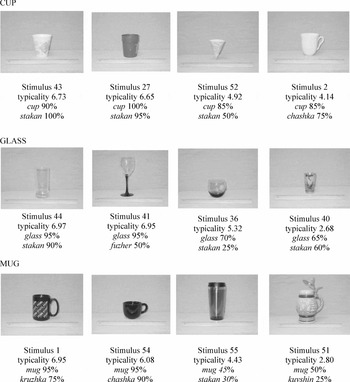
Materials consisted of photographs of sixty common drinking containers, made specifically for the study. The set consisted of objects that were likely to be called cup, mug or glass in English and chashka, kruzhka or stakan, in Russian. (Chashka is commonly translated as cup, kruzhka as mug, and stakan as glass, although, as our data will show, these terms are not nearly as closely equivalent as such translations imply.) The objects were chosen to represent a wide range of drinking containers and included containers made in the US (e.g., a beer stein) and those made in Russia (e.g., a tea glass in a metal podstakannik ‘glassholder’). Particular efforts were made to include a range of paper, plastic and Styrofoam drinking containers, because such containers elicited cross-linguistic differences in previous studies (Kronenfeld et al., Reference Kronenfeld, Armstrong, Wilmoth and Dougherty1985). The large size of the stimulus set and a wide range of objects in it allowed for a sensitive comparison of patterns of word use. The objects were photographed in color against a neutral gray background with a constant camera distance to preserve relative size. A 12-inch ruler was placed in front of each object to provide absolute size information. Figures 1 and 2 provide examples of the stimuli. (Category names, their production frequency and typicality ratings in the figures are derived from data to be discussed later; they were neither part of the stimuli seen by participants nor ascribed to objects at the time of stimulus selection.)
Examples of drinking containers with different degrees of typicality of English names, along with the English and Russian dominant name for each object and percentage of native speakers who produced the name.

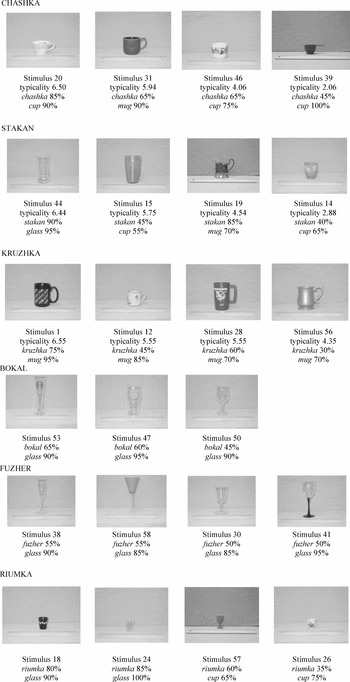
Examples of drinking containers with different degrees of typicality of Russian names, along with the English and Russian dominant name for each object and percentage of native speakers who produced the name. Typicality ratings were not collected for bokal, fuzher and riumka, so they are arranged from left to right in order of frequency with which the name was generated by the native Russian speakers (see next page).

An on-line questionnaire was used to determine participants’ language backgrounds. Questions asked about age, gender, academic year and major, and, in the case of bilingual participants, AOA in the US, length of residence in the US and contexts of language use. Proficiency estimates (for reading, writing, listening and speaking) were obtained for English, Russian and any additional languages by asking participants to click on a number between 0 (labeled “not at all”) and 7 (labeled “native or native-like”) for each skill in each language. Other studies have shown that similar self-report measures correspond well to performance measures of proficiency (Dufour & Kroll, Reference Dufour and Kroll1995; Kroll, Michael, Tokowicz & Dufour, Reference Kroll, Michael, Tokowicz and Dufour2002).
Procedure
All the data in the study were collected via a website that had two versions, one in English and the other in Russian. Both versions were extensively piloted among native speakers of the two languages and Russian–English bilinguals, to ensure the clarity of instructions and correspondence between the two texts. Native speakers of English accessed the English-language version of the website, and native speakers of Russian and the Russian–English bilinguals used the Russian version.
Data collection was performed online but an experimenter helped administer the tasks, offering clarifications, when necessary, in the language of the task. Native speakers of English were assisted by a native speaker of English (at Lehigh University) or a Russian–English bilingual (at Temple University). Native speakers of Russian (tested in Russia) were assisted by a native speaker of Russian. Bilinguals were assisted by two Russian–English bilinguals. In the beginning of the study, the researchers engaged all bilingual participants in an informal conversation in Russian to help them shift from an English-language to a bilingual mode (Grosjean, Reference Grosjean2008). To confirm their fluency, they also elicited several narratives in Russian from each bilingual participant.
The procedure took between forty-five minutes and an hour. Each participant first filled out the online language history questionnaire and then performed five consecutive tasks. In task 1, Naming and Confidence, the sixty photographs were presented one at a time, on the computer screen, in randomized order. The participants were asked to name the objects as they would in an ordinary conversation and to indicate how confident they were that other native speakers would use the same name to refer to the object, using a Likert-scale from 1 (labeled “not very confident at all”) to 7 (labeled “very confident”).Footnote 1 In task 2, Familiarity, the same sixty photographs were presented in a different randomized order and participants were asked to rate the familiarity of each sort of object depicted on a Likert-scale from 1 (labeled “not very familiar at all”) to 7 (labeled “very familiar”). In tasks 3–5, Typicality, the same sixty photographs appeared in a randomized order (different for each task) and participants were asked to rate the typicality of each object with regard to a name using a Likert-scale from 1 (labeled “not very typical at all”) to 7 (labeled “very typical”). For English speakers each object was first rated with respect to mug, then cup and then glass; for Russian speakers and bilinguals the order was kruzhka, chashka, stakan. One bilingual did not complete tasks 3–5 and four native speakers of Russian did not complete tasks 4 and 5, due to connectivity failures in the web-based database. No data from them are included in the respective typicality analyses.
Results and discussion
We describe the results in two parts. First we examine the naming patterns of native speakers of English and Russian to determine whether there are systematic differences in the naming of the objects for them. Then, we examine the naming patterns of the three groups of bilingual speakers to ask if there is evidence of an L2 influence on L1 naming, and, if so, what the nature of the influence is.
Naming patterns for native speakers of Russian and English
Main categories
The names produced for each object were tallied for each language group, producing a frequency distribution in each language. In the few cases where a participant gave two alternative names for the same object, we used the first of the two. Because responses frequently included modifiers, tallies were based on the head noun of each response (e.g., a funny cup, a Dixie cup and a glass cup all counted as instances of cup). In the Russian data, words with diminutive endings, such as stakanchik, were counted as instances of head nouns, i.e., stakan.
Confidence, familiarity and typicality ratings were averaged across respondents for each object in each category for which ratings were collected. The native speakers of Russian and English and the early and childhood Russian bilinguals all had a mean confidence in their choices (across the sixty stimuli) of above 5 on the 7-point scale, whereas early bilinguals had a mean confidence of 4.4. This dip for the early bilinguals is consistent with their lower self-reported proficiency in Russian. All groups were reasonably familiar with the stimuli, with the average familiarity rating across the sixty stimuli for the four groups ranging from 5.3 to 6.3. Native speakers of Russian, the only group not resident in the US at the time of testing, had the lowest mean familiarity rating (5.3, SD across items = 1.6), but native speakers of English, resident their entire lives in the US, also produced a mean familiarity rating below 6 (M = 5.8, SD across items = 1.3). Thus the stimulus set seems to primarily contain objects quite familiar to all groups studied, with a small number less familiar to them. We will discuss typicality ratings in connection with analyses below.
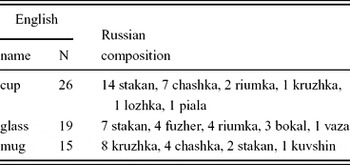
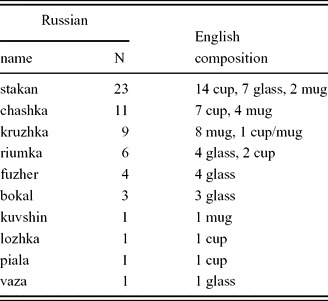
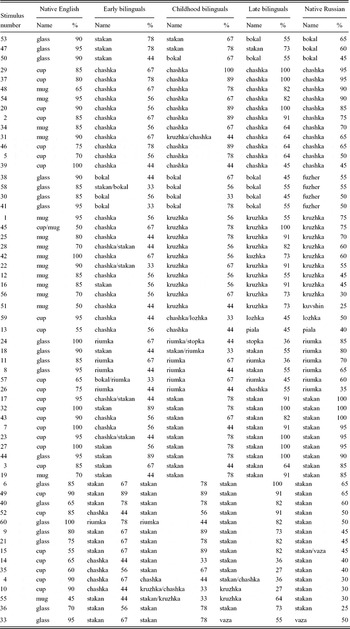
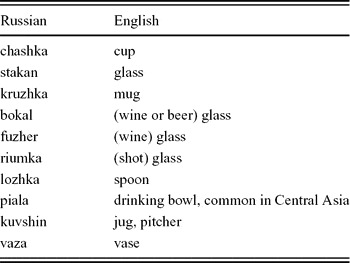
Our first analysis considers only the dominant (most frequent) name for each object. This measure provides a good intuitive sense of how naming patterns differ between the two languages. Tables 1 and 2 show the dominant names for native speakers of English and Russian and the number of objects, out of sixty, for which each name was dominant. Table 1 also gives the composition of each English category in terms of the names assigned by Russian speakers to its members. Table 2 gives the composition of each Russian category in terms of the names assigned by English speakers to its members. Table 3 lists the sixty objects grouped according to the native Russian name, giving the native Russian and English dominant name for each object and the frequency with which that name was produced (as well as the dominant names and production frequencies for the bilingual groups, discussed later). For comparison, Table 4 provides standard English dictionary translations of the Russian names. Their validity is poor, as will immediately become apparent.
Linguistic categories for native English speakers and their composition in terms of native Russian speakers’ dominant names.

Note. N refers to the number of objects out of sixty for which the name given was dominant.
Linguistic categories for native Russian speakers and their composition in terms of native English speakers’ dominant names.

Note. N refers to the number of objects out of sixty for which the name given was dominant.
Dominant names for the four language groups (grouped according to the dominant native Russian name).

Note. % refers to the percentage of participants who produced the name listed.
Standard dictionary translation equivalents for Russian and English.

As expected, for native English speakers the objects fell into three categories: cup, glass and mug. For native Russian speakers, the objects were spread across ten categories: chashka, stakan, kruzhka, riumka, fuzher, bokal, kuvshin, lozhka, piala and vaza. Thus, the two groups differed in the number of linguistic categories that were dominant for at least one object. This observation alone indicates that the division of objects by name must differ to some extent between the two languages.
One possibility is that Russian speakers simply subdivide some English categories, thus observing the same basic groupings but differentiating some subgroups within them (Malt et al., Reference Malt, Sloman and Gennari2003). Tables 1, 2 and 3 reveal that the relation between the two languages’ linguistic categories is more complex. There are some similarities in the way the two languages divide up the objects by name. For instance, the nine objects called kruzhka in Russian were all called mug in English (or, in one case, evenly divided between cup and mug), and the eleven objects called chashka in Russian were mostly called cup in English, both consistent with standard translation equivalents. However, the data also reveal a surprising degree of dissimilarity in the groupings. English cup is used more broadly than chashka, encompassing more than twice as many objects, but at the same time, not all objects called chashka were labeled cup by English speakers. Conversely, although stakan is usually translated as glass and is a large category, only seven of the nineteen objects called glass in English were called stakan by Russians. Twelve additional objects called glass were distributed across four different Russian names, and the bulk of objects named stakan by Russians were called cup by English speakers. Overall, only twenty-two of the sixty objects fell into categories across the two languages that would be predicted by the usual translation pairs of cup/chashka, glass/stakan and mug/kruzhka. Thus, the relation between the two sets of linguistic categories displays a substantial degree of cross-cutting (Malt et al., Reference Malt, Sloman and Gennari2003) rather than close correspondence or clean nesting of subcategories.
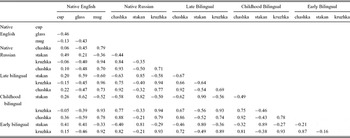
Some sense of how the features associated with the words may differ between the two languages can be gained by considering the characteristics of the objects that are named as members of each linguistic category and their relative typicality. Figure 1 provides examples of objects at various levels of typicality for English categories (along with information on their dominant name in both languages), and Figure 2 provides the same for Russian. Kuvshin, lozhka, piala and vaza, used with low consensus for one object apiece, are not illustrated. The overall correlation of typicality ratings across the sixty stimuli for pairs of words (e.g., for chashka and cup) also provides a sense of the extent to which the linguistic categories share prototypes and typicality distributions. Pearson correlationsFootnote 2 between all pairs of typicality distributions for the two native speaker groups (as well as for the other groups, discussed later) are given in Table 5. We consider first the three pairs of words usually taken to be translation equivalents and then discuss the remaining Russian terms.
Correlation of typicality ratings.

Note. Correlations of .22 and above in this table are significant at p < .05 or better.
Cup vs. chashka
The objects rated most typical of cup by English speakers, all having cup as their dominant name in the naming data, were tapered containers without handles, made out of paper, Styrofoam, plastic, metal or ceramic, intended for cold drinks (illustrated by Figure 1, stimuli 43 and 27). Other objects rated as moderately typical of cup and having cup as their dominant name included a conical paper object for drinking water from a dispenser (Figure 1, stimulus 52), objects for drinking coffee or tea with handles (Figure 1, stimulus 2) and several plastic or glass objects for measuring cooking ingredients (see stimulus 39 in Figure 2 under CHASHKA). Cup is thus a rather diverse category, encompassing a variety of materials and shapes, with or without handles, and intended for drinks that are hot or cold, but it has as its prototype tapered, handleless objects for cold drinks. In contrast, the objects rated most typical of chashka by Russian speakers, all having chashka as their dominant name in the naming data, were objects that were shorter, ceramic, slightly rounded at the bottom, having handles, and intended for warm drinks (Figure 2, stimuli 20 and 31) – mostly objects that the English speakers called tea cup or coffee cup. In fact, all of the objects having chashka as their dominant name were of similar description, and typicality ratings for other sorts of objects dropped off considerably more sharply than did ratings for objects in the lower half of the cup distribution (Figure 2, stimuli 46 and 39). As seen in Table 5, the typicality distributions across the sixty objects for cup and chashka did not correlate significantly, reflecting the fact that the objects most typical as cup were very atypical as chashka. These two linguistic categories thus share some membership but appear to be centered on different prototypes and to differ a great deal in their breadth. As pointed out by Goddard (Reference Goddard1998), older generations of English speakers may have resembled Russian speakers more closely in their prototype selection, while the young generation that grew up with paper and plastic drinking containers (and little use of traditional tea cups) has shifted its typicality judgments.
Glass vs. stakan
The objects rated most typical of glass by English speakers, all having glass as their dominant name in the naming data, were tapered containers without handles, made of glass, that varied in height and in whether they had stems or not (Figure 1, stimuli 44, 41 and 36). All were intended for cold drinks, some specifically for alcoholic drinks and others for more general purposes. Other highly typical glasses were similar in description, and typicality ratings dropped off sharply for other sorts of objects (Figure 1, stimulus 40). The objects rated most typical of stakan by Russian speakers, all having stakan as their dominant name in the naming data, were tapered containers without handles, made out of paper, Styrofoam, plastic, metal, glass or ceramic – in short, encompassing some typical of English cup, but also including objects made of glass (Figure 2, stimuli 44 and 15). Unlike glasses, however, the glass containers among the stakan set can be used for hot drinks, in particular tea (Frumkina et al., Reference Frumkina, Miheev, Mostovaia and Riumina1991). To prevent scalding, a glass of hot tea is commonly served in a metal glass-holder, a podstakannik Footnote 3 (e.g., Figure 2, stimulus 19). Smaller and shorter objects of any material, even if tapered and without handles, were rated lower in typicality (Figure 2, stimulus 14). As seen in Table 5, the typicality distributions across the sixty objects for glass and stakan showed only modest correlation. For these two categories, then, there is some overlap in typical members (tall, glass objects for cold drinks) but Russian admits a broader range of materials and encompasses objects intended for hot drinks while excluding objects with stems regardless of material.
Mug vs. kruzhka
Mug and kruzhka correspond more closely than the other two pairs, with largely overlapping membership that focuses on ceramic objects for hot drinks that have vertical rather than tapered sides (and hence wide rather than small bottoms) and a handle (Figures 1 and 2, stimulus 1; also Figure 2, stimuli 12 and 28). Typicality distributions for the two words correlated extremely highly, as Table 5 shows. Differences were found in containers slightly tapered toward the bottom – these were named mug by English speakers but chashka by Russian speakers (Figure 2, stimulus 31; see also Figure 1, stimulus 54 under MUG) or had low name agreement (Figure 2, stimulus 56). Three other objects deviating from typical kruzhkas and mugs but having mug as their most frequent English name were also given other names in Russian: two made of glass or clear plastic were called stakan, and one rounded one with a lid (Figure 1, stimulus 51) had kuvshin as its dominant Russian name (though with low consistency). It appears that these two categories have very similar prototypes but the Russian category admits less variation than the English one.
Additional Russian terms
Russian speakers used seven terms in addition to the three that named the largest categories. Four of the terms (piala, lozhka, vaza and kuvshin) were dominant for only one object apiece and were used by only 25–50% of participants for the object (the objects apparently not being clear-cut examples of any linguistic category). We will not discuss these further. Of greater interest are the terms bokal, fuzher and riumka. Bokal and fuzher were each dominant for several objects typically used for alcoholic drinks, such as wine, champagne or martinis, and having the dominant name of glass in English (Figure 2). This difference in naming patterns seems to stem from the difference in the salient properties associated with the linguistic categories. In English, as mentioned earlier, key attributes of glass seem to be material and the use for cold drinks. English speakers are not required to differentiate lexically between glasses with and without stems, or glasses used for alcoholic and non-alcoholic drinks. If they want to do so, they can use functional modifiers, such as wine, beer or martini, and such modifiers did often occur in the naming data. In contrast, in Russian, the distinction between stakan on the one hand and bokal and fuzher on the other is obligatory and involves both shape and function. Objects called stakan do not have a stem and are typically used for non-alcoholic drinks (although at times also for vodka), while bokal and fuzher are applied to tall glass containers, usually with stems, used for alcoholic drinks (Frumkina et al., Reference Frumkina, Miheev, Mostovaia and Riumina1991). Bokal is the more comprehensive of the two terms because it can refer to glass containers with and without a stem, including glass containers with a handle that may be alternatively called kruzhka; fuzher, on the other hand, refers only to glass containers with stems. In the naming data, two of the objects were frequently named bokal but never fuzher (Figure 2, stimuli 53 and 47); in contrast, all four objects having fuzher as their dominant name were called bokal by some participants.
Riumka was the dominant Russian name for six objects: four small, handleless glass containers without stems (illustrated in Figure 2 by stimuli 18 and 24), one small, handleless wooden container with a stem (Figure 2, stimulus 57), and one small, handleless porcelain container without a stem (Figure 2, stimulus 26). The glass ones were named glass in English; the latter two, cup. English speakers are not required to differentiate between different types of glasses or cups but if they wish to signal the size and function of the containers in question they can do so with modifiers, such as shot glass. Russian speakers, on the other hand, are required to lexically distinguish these on the basis of their shape and function. Riumka (as well as the less frequently used terms stopka, stoparik and shkalik) refers to small handleless containers used for hard liquor, typically but not necessarily made of glass (Frumkina et al., Reference Frumkina, Miheev, Mostovaia and Riumina1991). (Like bokal, riumka has somewhat wider distribution and can refer to containers with and without stems, while stopka and other related terms refer to containers without stems.)
Summary of dominant names for native speakers of English and Russian
The two groups showed most agreement when naming ceramic containers for hot drinks that have vertical sides, wide bottoms and a handle: in English they were named mug and in Russian kruzhka. They differed, however, in the use of other names. Cup, in English, is a broad category encompassing objects with and without handles, made out of a variety of materials, and used for hot and cold drinks, as well as for measuring purposes. Glass, in contrast, is heavily constrained by material, but it includes objects with or without a stem, and used for alcoholic and non-alcoholic drinks. Together, these two categories encompass most of the objects in the English-language data. Russian, on the other hand, provides names encoding more specific distinctions in terms of shape, size and function. Chashka favors small containers with handles used for hot drinks, bokal/fuzher tall containers, with or without a stem, used for alcoholic drinks, and riumka/stopka small containers, with or without a stem, used for hard liquor. Stakan seems to name the broadest, most diverse of the Russian categories, referring to containers made of a variety of materials and used for either hot or cold drinks; however, it is limited to a substantial extent to objects that are taller, tapered and handleless, and so does not have the degree of shape variation that the broadest English category, cup, does.
The cross-linguistic differences in naming patterns identified in our consideration of dominant names identify key places to look for a backward influence of L2 on L1 in the Russian–English bilinguals with varying ages of arrival. They allow us to ask whether the bilinguals follow the Russian usage where it differs from the English pattern, or whether they shift in their usage (and their understanding of the associated properties) such that the three major terms, chashka, stakan and kruzhka, come to resemble the English terms more, and such that they drop the additional distinctions reflected in the terms bokal, fuzher and riumka.
Name distributions for native speakers of Russian and English
Before examining the performance of bilinguals, we describe here a second measure of correspondence between the Russian and English speakers. Although dominant names give a good intuitive sense of the naming patterns, they capture only a portion of the responses, because for many objects there was some diversity in native speakers’ name choices. That is, the percentage of participants who used the dominant name for an object was often less than 100% (for information on all names and frequency of production, see Appendices B and C). A more complete assessment of the extent of correspondence between two groups’ naming patterns would take into account the names produced for an object that are less frequent. We compared the two sets of naming responses using a measure developed by Malt et al. (Reference Malt, Sloman, Gennari, Shi and Wang1999; see also Ameel et al., Reference Ameel, Storms, Malt and Sloman2005) that takes into account the entire range of responses to each object and the frequency of each. The idea is to compare the similarity of each object's name distribution to that of every other object's using a Pearson correlation, to see to what extent the two objects are similar in what they can be called. For each pair of objects within a language, we calculated the correlation, across all the names, between the name frequencies for those objects. For each language, this measure gives us 1,770 correlations consisting of the name distribution similarity for each possible pairing of the sixty objects. The 1,770 name similarity values for one language group can then be correlated with the name similarity values of a different language group, despite the fact that the actual names they produced are in different languages. This second-order measure reflects the extent to which the two languages correspond in the pairs of objects that have similar name distributions.
The current analysis reports the correlation between the two native speaker groups, but this measure will also be useful in comparing the naming patterns of the different bilingual groups to one another and to native speakers of Russian (as well as to native speakers of English). Even when comparing groups using Russian, they may differ in the number or specific set of terms produced, making it impossible to directly correlate their naming matrices.
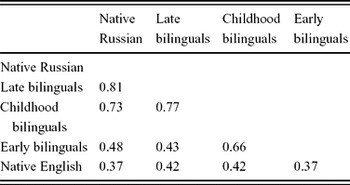
Table 6 gives the correlation between the native Russian and English language groups’ name similarity measures (as well as the other groups’, to be discussed later). The correlation between the native speakers is similar to the level of agreement shown by English, Chinese and Spanish monolingual speakers on this measure for naming patterns for household containers (Malt et al., Reference Malt, Sloman, Gennari, Shi and Wang1999). This value shows that much of the variance (86%) in the naming of each group is unaccounted for by the naming of the other. Thus, whatever common non-linguistic understanding of the objects and their properties may exist for the two groups, it makes only a modest contribution to determining their naming patterns. Much of the language-specificities of the naming patterns must result from differences in cultural and linguistic histories (Malt et al., Reference Malt, Sloman, Gennari, Shi and Wang1999).
Correlations of name similarity measures.

Note. All correlations in this table are significant at p < .001 or better.
Bilinguals’ naming patterns
We now turn to the bilinguals’ performance and examine how each group relates to the other bilinguals and to native speakers of Russian and English. We first discuss the correlations of name similarity matrices to provide an overview of the relations of the groups to one another. We then return to considering dominant names in order to shed light on what kind of naming shifts account for the differences among the groups.
The correlations of the bilingual name similarity matrices with that for native Russian speakers show an orderly shift as a function of age of arrival. The late bilinguals’ naming pattern correlates most strongly with the native speakers, followed by the childhood bilinguals, and then by the early bilinguals. This progressive reduction in correlation indicates that the bilinguals are moving farther from the native pattern with earlier age of arrival in the English-speaking environment. The drop-off in correlation from the childhood to early bilinguals is greater than from late to childhood, suggesting that even though the differences in age of arrival are approximately equal between the three groups, the early bilinguals have a proportionally greater influence of the second language experience. The correlations among the bilingual groups themselves are also orderly: the late bilinguals correlate more strongly with the childhood bilinguals than they do with the early bilinguals, and the early bilinguals correlate more strongly with the childhood bilinguals than with the late bilinguals.
There is, however, one aspect of the correlations that is less regular. If the progression away from the Russian native pattern with earlier age of arrival is because speakers are moving closer to the English native pattern, then one would expect to see correlations with the English pattern correspondingly increasing. Late and childhood bilinguals show slightly increased correlation with the English pattern compared to the correlation of Russian natives. However, early bilinguals, surprisingly, show only the same level of correlation with English as native speakers of Russian. One possible explanation is that although the bilinguals shift progressively away from the native Russian pattern, they do not actually shift toward the English pattern. Instead, their Russian word use might become more random (less closely tied to either language), perhaps because they have learned the language less well and use words less systematically. The alternative is that the pattern may become more like English in some ways but less like English in others. Based on consideration of the specific dominant names that emerge for objects for each group, along with typicality ratings, we will argue below for the second possibility and suggest a reason that this outcome comes about.
We now turn to consideration of the names given in Table 3 and typicality correlations given in Table 5 along with typicality ratings for some individual objects reported in the text. We begin with the late bilinguals and then move to the childhood bilinguals followed by the early bilinguals, in order to trace the evolution away from the native pattern with earlier age of arrival.
Late bilinguals
The late bilinguals differed from native Russian speakers on dominant names for twelve of the sixty objects. A small portion of the difference seems to be due to the loss of two words that were not dominant for any object for the late bilinguals. One was kuvshin, the dominant term for native Russian speakers for just one stimulus, an elaborate rounded beer stein with a lid that elicited a diverse set of names (the most frequent being kuvshin at 25%) (Figure 1, stimulus 51). The late bilinguals used kruzhka with fairly high agreement (73%) for this object, expanding the set named kruzhka by one compared to native speakers, and consistent with the English speakers’ dominant name of mug (50%) for the object. This object was rated very low for typicality as kruzhka by Russian speakers (2.8 on the 7-point scale) but higher in typicality as mug by English speakers (4.2); thus the late bilinguals may be adapting their kruzhka usage to English mug. More importantly, fuzher, which was the dominant name for four objects for native Russian speakers (Figure 2), did not occur as dominant for any object for the late bilinguals (although it did occur with low frequency in the full set of names generated). All four of these objects had bokal as their dominant name for the late bilinguals. As discussed earlier, bokal and fuzher are applied to tall glass containers for serving alcoholic drinks, but bokal is the broader of the two terms. Bokal can refer to glass containers with and without a stem, while fuzher applies only to ones with stems. It seems that the late bilinguals are more likely to default to the broader term, reducing use of the more specialized one when naming the four objects with stems. Thus the late bilinguals have somewhat expanded their use of both kruzhka and bokal in compensation for lesser use of two more specialized words, kuvshin and fuzher, and in the case of kruzhka may be influenced by the English use of mug.
Other discrepancies from the native Russian naming provide some additional suggestion of an L2 influence. Although bokal clearly remains productively in the vocabulary of these bilinguals, one object named bokal by the majority (60%) of Russian speakers was named stakan by most (73%) of the late bilinguals. This object was a glass vessel for drinking beer with only a slightly graduated lower portion (Figure 2, stimulus 47). English speakers called it glass with high consensus (95%), and the late bilinguals conformed to the English usage of glass rather than segregating it with the other objects earning the more specialized bokal label in Russian. Two other objects receiving the specialized name riumka by native speakers with a high degree of consensus (80% and 65%) received a dominant name of stakan from the bilinguals (e.g., Figure 2, stimulus 18). The use of stakan is consistent with English, in which both were called glass. Another object with the dominant name of riumka (35%) in Russian became chashka (55%) for bilinguals, consistent with the English preference (75%) for cup (Figure 2, stimulus 26). Two other objects named stakan by native Russian speakers (though with low consensus at 30% each), became kruzhka for the bilinguals. One, a tall thermal travel container for coffee, was named kruzhka with moderate consensus (64%) and mug by English speakers (45%) (Figure 1, stimulus 55). The other, a glass measuring cup, was called kruzhka with low consensus (27%). Although it was called cup by English speakers with high consensus (90%), it is atypical as a cup (3.4) and physically may resemble other things called mug as much as ones called cup. Thus in both cases the exclusion from stakan by bilinguals may be influenced by the more restricted range of English glass that resulted in English speakers’ choice of other terms for these objects.
Interestingly, in the case of riumka, these late bilinguals may be reflecting more L2 influence than either early or childhood bilinguals. As we will indicate later, the other two bilingual groups showed fewer shifts away from riumka for the same objects. The slightly greater L2 influence for these particular objects for late bilinguals may be related to differences in participants’ life trajectories and social practices. Early and childhood bilinguals are children of immigrants who settled in Russian-speaking areas of Philadelphia and New Jersey. They have continued to celebrate holidays, birthdays and other occasions that involve family and family friends in a Russian-speaking environment and thus may receive more reinforcement in the use of Russian terms for containers for alcoholic drinks. Late bilinguals, on the other hand, are students and professionals who arrived in the US on their own. Consequently, occasions on which they or others consume alcoholic drinks may be more likely to take place in an English-language context, making the English-language terms more salient or activated.
It is striking that the observed shifts come about even though the late bilinguals arrived in the US as young adults, with fully developed native competence in Russian. The late bilinguals’ naming patterns indicate that L2 influence may affect L1 performance even in adulthood, after native linguistic categories have become fully established in the native language environment.
Childhood bilinguals
The childhood bilinguals differed from the native Russian speakers on dominant names for twelve of the sixty objects, and in addition had four more words for which they tied use of a different name with use of the same term as native speakers. Thus overall, they showed only a modestly greater shift away from the Russian dominant names, consistent with the observation that the further reduction in difference in name similarity matrix correlations with native Russian speakers was relatively small. Some of the difference comes from further attrition of vocabulary words. In addition to having no objects for which fuzher was the dominant name, childhood bilinguals dropped the use of piala and vaza (each dominant for one object for Russian speakers and late bilinguals). The piala object for native speakers of Russian and late bilinguals was a small round Styrofoam container (for e.g., take-out soup); its dominant name was chashka among childhood bilinguals, consistent with the English dominant name cup. The other object, called vaza by about half of Russian speakers and late bilinguals, was labeled stakan by a majority of childhood bilinguals (78%), consistent with the use of glass by 95% of English native speakers for the object.
In addition, lozhka was the dominant name for one object for native speakers of Russian and late bilinguals; it became tied with chashka for that object for the childhood bilinguals. Although the shift in percentage of lozhka was small (50% for natives, 45% for late bilinguals, 33% for childhood bilinguals), the emerging use of chashka here is also consistent with the use of cup by 95% of English native speakers for the object (a small plastic measuring cup). In both of the cases of increased use of chashka, this use violates the native tendency to limit chashka to objects with handles for hot liquids. The adoption of stakan for the remaining object (a tall, glass, decorative vessel) is also consistent with the English focus on glass material for the name glass. Thus in these cases, absence of specialized words has again resulted in expansion of more general terms, an expansion in a direction that seems to reflect the influence of English terms. Whereas the late bilinguals may have originally learned the more specialized terms in Russia but dropped them from use in the US, the childhood bilinguals may not have ever acquired them. Consequently, we may say that late bilinguals display actual attrition of the lexicon, while childhood bilinguals likely display incomplete acquisition.
Several other differences from the native Russian pattern are also noteworthy. This group, like the late bilinguals, uses bokal for the four stemmed objects called fuzher by native speakers, but at the same time continues the reduced use of bokal for the three glass drinking vessels with less prominent stems. Whereas late bilinguals replaced one bokal with stakan, the childhood bilinguals replaced two with stakan with substantial consensus (67% and 78%) (Figure 2, stimuli 53 and 47). Both are objects called glass with high frequency by native speakers of English (90% and 95%). The remaining object likewise is called glass in English (90%) but has a more obvious stem than the other two, apparently sufficient to motivate retention as bokal for the childhood bilinguals (Figure 2, stimulus 50). Stakan also was used with some frequency (33%, tied with riumka) for a small blue shot glass that was labeled riumka by 80% of native Russian speakers (Figure 2, stimulus 18), consistent with the increased use of stakan (55%) for this object by late bilinguals. English speakers called this object glass with high consensus. Thus stakan continues to expand to cover more objects labeled glass in English, while use of more specialized terms is lost or focused (in the case of bokal and riumka) on the more typical, distinctive examples of the term.Footnote 4
Finally, the use of chashka expanded for the childhood bilinguals relative to the native Russian speakers and late bilinguals. In addition to the increased use in connection with objects called more specialized names by native Russian speakers and late bilinguals, chashka became the dominant name for one object called stakan by native speakers and it tied with kruzhka for another called stakan by native speakers. Both were relatively low in frequency as chashka (33% and 44%) but gained further in use among the early bilinguals, as we will discuss, suggesting a genuine shift taking place. Both were low in frequency (30% each) as stakan and low in typicality (2.3 and 1.8) as stakan for native Russian speakers but high in frequency (90% each) and moderate in typicality (4.9 and 3.4) for English speakers, implicating an influence of English. Both violate constraints on chashka for native speakers of Russian (one being a ceramic cup having no handle, and the other being a measuring cup not intended for drinking hot liquids), again suggesting that for these childhood bilinguals the category is becoming more associated with features of the English category cup.
Together, these results suggest that the combination of input received by these childhood bilinguals in the Russian-language environment and, upon arrival, in the family was sufficient to develop the five main linguistic categories but not the less common, more specialized terms. Although the major categories are developed and used largely in agreement with Russian patterns, at the same time, their use is altered by the absence of the more specialized terms and by an apparent influence of L2 English.
Early bilinguals
The early bilinguals differed more sharply in dominant names from the native Russian speakers than the other two groups did, consistent with their substantially reduced correlation with the native speaker name similarity matrix (Table 6). Thirty-one of the sixty objects had a different dominant name from that in the native Russian data, about twice as many as for the other two bilingual groups.
A substantial portion of the difference in the early bilinguals’ performance compared to the other two bilingual groups is due to the complete absence of kruzhka from the set of names that were dominant for at least one object. Kruzhka was the dominant name for nine objects for native speakers, and the other two bilingual groups added slightly to that number, but the early bilinguals had no objects for which kruzhka was dominant. Instead, chashka or stakan (mostly chashka) was the dominant name in every case for which kruzhka was dominant in each of the other three groups. This loss of kruzhka in production, and the consequent expanded use of chashka and stakan, explains why the correlation of the early bilingual name similarity matrix with the English speakers actually decreases relative to the late and childhood bilinguals despite their lower correlation with native Russian speakers. For the other two bilingual groups, the distribution of kruzhka corresponds fairly closely to the distribution of English mug. For the early bilinguals, however, there is no single term that applies to the cases of English mug and not to objects not called mug.
Kruzhka does appear with low frequency in the complete naming data. However, its use is restricted to three participants in the group, two of whom left the Russian context at age 6, the upper end of the range for this group (and consistent with Andersen's, Reference Andersen1975, observation that mug was learned later than cup in her sample, around age 6). We note, though, that the typicality ratings for kruzhka, averaged across all the early bilinguals, were still highly consistent with those of the native speakers and other two bilingual groups (Table 5). And the childhood bilinguals made fairly liberal use of the word in their naming data. The high typicality correlation, along with this evidence that bilinguals who are more proficient in Russian do produce the term, suggests it is likely that most or all of the early bilinguals heard kruzhka in adult speech at home and did acquire a passive grasp of the word and its pattern of use, even though the word is not salient enough or activated enough for them to use it in production.
Eight of the nine objects with the dominant name kruzhka for native speakers of Russian had chashka as their dominant name for the early bilinguals, all being ceramic, metal or plastic drinking vessels with handles and bottoms as wide as the top (e.g., Figure 2, stimuli 1 and 12). Chashka also covered the objects named kuvshin (the lidded rounded drinking vessel for beer; Figure 1, stimulus 51), lozhka (the plastic measuring cup) and piala (the Styrofoam take-out container) by native Russian speakers. Furthermore, chashka appeared as the dominant name for seven objects named stakan by native speakers (two paper cups of different sizes, a paper cone for drinking water, and two handleless cups for drinking tea, a glass measuring cup and a Styrofoam container, and was tied with stakan for two more, both paper cups) (e.g., Figure 1, stimuli 43 and 52; Figure 2, stimulus 14). Each of these eighteen objects had as their dominant name either mug or cup in English. Thus chashka seems to have expanded to take over drinking vessels for hot drinks with bottoms as wide as the top (named mugs or kruzhkas by native speakers of English and Russian) and objects with a variety of shapes, materials and functions that are included within English cup. The latter objects are excluded from the native Russian chashka because they lack handles, are not intended for hot drinks and/or are made of paper or glass. In contrast they are acceptable as stakan for Russian speakers because of their relevant shape and the flexibility of this category on material, but they are excluded from English glass based mainly on their material (or, in the case of the glass measuring cup, on the basis of the shape including the handle). Thus the early bilinguals are expanding chashka to encompass English mug as well as English cup, and at the same time are contracting stakan to bring it in closer correspondence to English glass.
Also in keeping with the shift of stakan to become more similar to English glass, the early bilinguals continued the trend shown by the other two bilingual groups to substitute stakan for bokal in the case of glass vessels with only slightly tapered lower parts (rather than conspicuous stems). Stakan was the dominant name for all three of the objects called bokal by Russian speakers, of which one had become stakan for the late bilinguals and two for the childhood bilinguals (Figure 2, stimuli 53, 47 and 50). Stakan was also tied with bokal (33%) for one of the four objects having more pronounced stems that were fuzher for native speakers of Russian and bokal for the other two bilingual groups. Stakan was also dominant (56%) for one object having kruzhka as its dominant name for all of the other groups, a clear glass mug. Following the pattern of the childhood bilinguals, stakan was also dominant for one object called riumka by Russian speakers (a small blue glass for alcoholic drinks) and the one called vaza by Russian speakers (a decorative, tall glass). These shifts are all consistent with the idea that stakan has become more similar to English glass for the early bilinguals, focusing more heavily on the material of glass than the Russian stakan does. (In fact, the glass mug was called mug by 85% of English speakers; thus the early bilinguals are slightly overgeneralizing on the material property.) Finally, the early bilinguals also continued the trend toward a simpler use of riumka, applying it with considerable consensus (78%) to the small, narrow glass for which childhood bilinguals showed lesser preference. In sum, the early bilinguals show not only incomplete acquisition of specialized terms but appear to substantially adjust their use of common terms to bring them into closer correspondence to the major English terms.
What category characteristics contribute to shifting name choices?
Although the evidence is strong that the Russian categories have been influenced by English, it is by no means the case that the early bilinguals have simply mapped Russian names onto English categories. One major discrepancy is the somewhat surprising expansion of chashka in production to cover objects that English speakers call mug and native Russian speakers (and late and childhood bilinguals) call kruzhka (despite being capable of providing native-like ratings of the typicality of objects as examples of kruzhka). The distinction between the stockier vessels for hot drinks and the more tapered, delicate ones may be a more subtle one than the distinctions involved in stakan vs. chashka and glass vs. cup and thus conceptually seemingly less demanding of lexical contrast to a less-than-proficient speaker. Also contributing may be an effect of the word perhaps being lower in frequency in input and thus lower in salience or activation level within the lexicon. It would be interesting to know if these speakers routinely fail to make the cup–mug distinction in English, both languages thus suffering from the reduced input level that a bilingual will receive in each (e.g., Gollan, Montoya, Fennema-Notestine & Morris, Reference Gollan, Montoya, Fennema-Notestine and Morris2005) or whether their greater proficiency in English results in their making this lexical distinction.
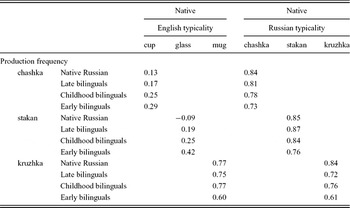
But beyond the absence of kruzhka, the use of chashka and stakan are still far from fully mirroring the use of English cup and glass even for early bilinguals. Seven of the twenty-six objects having cup as their dominant name in English had a name other than chashka as dominant for the early bilinguals, and seven of the nineteen objects having glass as their dominant name did. To better assess the relative contributions of English and Russian naming patterns to bilingual naming, we correlated native speaker typicality ratings for objects as cup and glass and as chashka and stakan with the frequency of production of chashka and stakan for each object by the bilingual groups. Within native speaker data, the rated typicality is a strong predictor of likelihood that participants will produce that name for the object. As Table 7 shows, the frequency with which Russian speakers produced the names chashka, stakan and kruzhka across the sixty items correlates highly with their rated typicality of each object as an instance of that word.
Correlation of native English and Russian typicality ratings with production frequencies for Russian speaker groups.

Note. Correlations of .22 and above in this table are significant at p < .05 or better.
What is of interest now is the strength of correlation with each bilingual group's production frequency for a word with the native Russian typicality ratings for that word, and with the native English typicality ratings for the closest corresponding English word. Table 7 shows that the late bilinguals show strong correspondences of their production frequency for chashka and stakan with the Russian typicality ratings for these words, and poor correspondences with the English typicality ratings for cup and glass. Moving from the late bilinguals to the childhood bilinguals and then the early bilinguals, correlation with the Russian typicality ratings decreases, and correlation with the English typicality ratings for cup and glass increases. However, in both cases, the production frequency for early bilinguals has a substantially higher relation to the Russian typicality ratings than to the English typicality ratings, indicating that the production pattern is still dominated by exposure to Russian and has not simply become the use of Russian words applied in patterns given by English. (The only exception to this pattern is for kruzhka, where correlations with native kruzhka and mug typicality ratings decrease in parallel. This outcome no doubt comes about because typicality ratings for native kruzhka and mug are extremely highly correlated, as Table 5 shows, and as the bilinguals reduce production of kruzhka they move away from the usage predicted by both sets of typicality ratings.)
We can also make use of the typicality ratings to gain some information about which objects are most likely to shift in their naming from the Russian to the English pattern with earlier age of arrival in the US. One might hypothesize that the objects most typical of the Russian categories would be most resistant to change, and the ones least typical would be more likely to shift. However, there is another obvious hypothesis, namely, that the English pattern is most likely to be adopted for objects that are high in typicality with respect to the English names and least likely for those less typical of the English names. Since the objects least typical of the Russian categories are not necessarily those most typical of the English ones, these two tendencies may compete or interact in determining the likelihood that any object will shift in its naming. And, of course, logically, it may be the case that neither influence is the key to the shifts that take place.
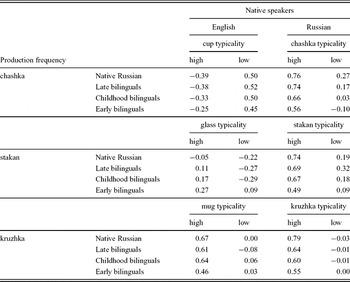
To assess whether objects most likely to have altered naming patterns are associated with high or low typicality in each language, we divided the sixty typicality ratings given by native English speakers for cup, glass and mug and by native Russian speakers for chashka, stakan and kruzhka into lower and upper halves of typicality and correlated the name production frequencies within each half for the four Russian groups. We then looked at whether the correspondence increased or decreased from the native speakers to the early bilinguals. The results differed depending on the particular word involved, as shown in Table 8.
Correlation of native English and Russian speakers’ typicality ratings for the thirty most and least typical objects with production frequencies for Russian speaker groups.

Note. Correlations of .29 and above in this table are significant at p < .05 or better.
For chashka, the correlation of production frequency with Russian typicality decreased for both high and low typicality objects; the correlation with English typicality increased for high typicality items but was virtually unchanged for low typicality. For stakan, the correlation of production frequency with Russian typicality decreased for both high and low typicality objects; the correlation with English typicality increased for both high and low typicality items. For kruzhka, the correlation with Russian typicality decreased for high typicality objects and was essentially unchanged for low; likewise, the correlation with English typicality decreased for high typicality objects and was essentially unchanged for low. Thus there is no strong across-the-board generalization about whether peripheral items with respect to one language are most likely to be dropped from a category, or central items with respect to the other are most likely to be adopted. To the extent that any trend can be identified, it would be a tendency toward both being true (with two of the three words showing increased correlations for typical objects in English and all of them showing decreased correlations for atypical objects in Russian, in addition to other shifts in correlation values).
As we have noted already, the particular patterns of gains and losses in coverage of the three words differ. Chashka expands across the bilingual groups but comes to encompass not only more of English cup but also some of English mug. Stakan expands in some directions and contracts in others. Kruzhka contracts drastically by becoming very low frequency altogether. Some of the shifts may be linked to the relative typicality profiles of the respective categories, as we have just discussed. However, there may be additional contributing influences that we have not examined here. These influences may include input frequency with regard to particular types of items, the extent of discrepancies between the native speaker uses of particular pairs of categories, the presence or absence of more specialized terms covering part of the semantic space encompassed by a more general term for one language, and the difficulty of abstracting the features that govern use of either specialized or more general words in either or both languages for particular categories.
General discussion
Our study examined word-to-referent mapping for drinking vessels in native speakers of Russian and English and in L1 Russian of three groups of Russian–English bilinguals: early, childhood and late bilinguals. Several findings of the study are particularly important for understanding bilingual lexical development.
First, native speakers of Russian and English differed systematically in the naming of drinking containers, establishing the existence of cross-linguistic differences in the structure and boundaries of respective linguistic categories. These findings are consistent with those of previous cross-linguistic studies (Ameel et al., Reference Ameel, Storms, Malt and Sloman2005; Kronenfeld et al., Reference Kronenfeld, Armstrong, Wilmoth and Dougherty1985; Malt et al., Reference Malt, Sloman, Gennari, Shi and Wang1999, Reference Malt, Sloman and Gennari2003) and indicate that concrete noun pairs in the bilingual lexicon do not necessarily map onto the same set of referents. Words commonly taken to be translation equivalents, such as cup/chashka, stakan/glass and mug/kruzhka, may differ substantially in the structure and boundaries of respective linguistic categories.
Second, our findings show that an L2 → L1 influence in the mental lexicon can occur even in a domain involving concrete nouns naming familiar, common household objects. Although one might speculate a priori that such a domain might not produce L2 → L1 influence, our preceding observation may provide a key insight into why such an influence can take place. Namely, although the objects involved are familiar, and the nouns are common and their referents concrete, the linguistic categories that the nouns define are not, themselves, strongly determined by unique perceptually given property clusters in the world. That is, although use of a noun is linked to certain sets of properties in each individual case, there are multiple possible ways of dividing up the domain to form meaningful sets of objects sharing overlapping properties. Because different languages evolve different solutions to the problem of dividing up the objects by name, and because the clusters to be learned are not self-evident independent of language input, word use may be less stable and less pre-determined by mere observation of structure in the world than one might imagine. Thus naming patterns for these common objects in one language can be swayed by exposure to patterns in another just as use of more complex or abstract language is.
Third, our data have illuminated the progression of L2 → L1 influence as a function of age of arrival in the L2 environment (a variable that reflects, at least within our groups, both extent of L1 mastery and length of immersion and extent of L2 mastery). Not surprisingly, it was strongest in the early bilinguals for whom their chronological L2 English is the dominant language, and weakest in late bilinguals for whom L1 Russian is still the dominant language. At the same time, all three groups demonstrated the L2 influence in the structure (i.e., salient attributes) and the boundaries of linguistic categories. It is striking that the late bilingual group showed some L2 influence, given that they have achieved full native mastery of L1 before leaving Russia, and, furthermore, their exposure to English has been relatively limited and their (self-rated) mastery of English is incomplete. This finding suggests that modest L2 → L1 influence may occur for virtually any group of speakers given moderate exposure to the L2. Since, for the most part, our late bilinguals had been in the US only a short time, their L2 influence might increase with longer immersion in the English language environment. However, childhood bilinguals showed a relatively small increase in the degree of L2 influence relative to the late bilinguals, despite a substantially longer period of stay in the US and higher self-rated proficiency in English. The largest L2 influence, and the biggest jump from the previous group, was in the case of the early bilinguals, who rated themselves only slightly more proficient in English than the childhood bilinguals but substantially less proficient in Russian. This pattern suggests that it may be the incomplete mastery of the L1 that leaves it most vulnerable to L2 influence, rather than the degree of exposure to or mastery of the L2 itself.
This observation about the locus of the major L2 influence indicates that L1 use within the family may not be sufficient to ensure that children who arrive at early ages develop native-like L1 naming patterns even for the most familiar household objects. Our early bilinguals showed substantial alteration of their pattern of mapping of two words, chashka and stakan, to objects. They also showed gaps in word production, failing to use a number of terms used by the other groups, including not only several low production frequency terms but one, kruzhka, used with high consensus by the other groups for a number of objects. The reduced total exposure to Russian most likely makes their learning experience insufficient for full mastery, similar to sub-adult performance of monolingual children up to about age 12 in Andersen's (Reference Andersen1975) and Ameel et al.'s (Reference Ameel, Malt and Storms2008) developmental studies. In addition, the early bilingual children are exposed to English, which alters the acquired patterns. From a practical perspective, if more native-like performance is desired in the non-dominant language for early bilingual children, some supplemental exposure or schooling may be necessary.
Our four Russian groups all consisted of participants who were adults at the time of testing. The progression in the degree and locus of influence of L2 English on L1 performance is thus not in any literal sense a developmental trend. Yet the progression of influence is orderly, both in quantity and quality, with groups building upon the deviations from native performance with increasingly earlier age of arrival. This progression indicates that the particular deviations from native Russian performance are not just reflections of generically poorer, more random performance in L1 with lesser exposure to it, but rather can reveal something meaningful about how the Russian word knowledge and naming choices are influenced by exposure to English word use. Consistent with Ameel et al.'s (Reference Ameel, Malt and Storms2008) developmental study, changes across our language groups do not seem to be limited to either narrow categories broadening or broad categories narrowing. Shifts go in both directions, influenced by both the nature of the L1 target categories and the L2 influence categories. Thus, as we have discussed, chashka is a rather narrow category centered on small cups with handles for hot liquids, and admitting little else, whereas cup is a much more diverse category. In this case, the bilingual L1 Russian usage moves from the more narrow Russian-like pattern to a broader, more English-like pattern. On the other hand, stakan is a category that is perhaps more constrained than cup, but still much broader than glass, at least on the dimension of material. In this case, the bilingual L1 Russian usage moves from the broader Russian-like pattern toward greater constraint on the material dimension, consistent with English.
Changes across the groups also suggest a progressive tendency toward productive loss of terms that are less common (kuvshin, piala, vaza, lozhka, fuzher) as well as loss or narrowing of terms that are more specialized in their meaning, although perhaps not very low frequency in occurrence (kruzhka, bokal, riumka). The case of kruzhka is particularly remarkable in this regard because it maps very closely onto English mug, used with high consensus by the English native speakers for a number of objects and so highly likely to be present in the English input the early bilinguals have experienced. Its loss for the early bilinguals (and the difficulty that monolingual children show in acquiring mug; Andersen, Reference Andersen1975) suggests that the early bilingual vocabulary development may suffer from the reduced input in the non-dominant language.
Finally, the progression of changes suggests that a variety of dimensions can serve as the basis for change, depending on the particular words involved in both L1 and L2. In the chashka case, broadening occurs by loosening of constraints on shape, material and presence of a handle; in the stakan case, narrowing occurs by increasing the constraint on material. Height or height-to-width ratio also appears to be a dimension attended to and that may shift in its perceived relevance to a category, as in the incorporation of a narrow glass into riumka rather than stakan. These shifts may be driven by some interaction of the typicality of exemplars of the L1 categories and their relation to the typicality of exemplars of the L2 categories, with a pull toward incorporating typical L2 objects but resistance at the same time to loss of typical L1 objects.
Thus there is no across-the-board trend for L1 categories to become looser by virtue of exposure to another language, nor for them to shrink, nor to shift only to incorporate certain particularly salient attributes or only the most typical items of the L2. Rather, the changes seem to result from a complex interaction of the semantic content of the various options available in both languages. This interaction may be difficult to characterize in detail but it has a simple end result: L1 categories that are more like L2 categories regardless of their particular relations.
Appendix A. Participant demographic information

Note. Each individual's language proficiency rating is the average of his or her ratings for listening, speaking, reading and writing.
Appendix B. Proportion of native Russian speakers’ responses to each object across the names that were dominant (most frequent) for at least one object in the stimulus set

Note. Where proportions do not sum to 100, lower-frequency names were also produced. Boldface indicates the most frequent response for an object.
Appendix C. Proportion of native English speakers’ responses across names that were dominant (most frequent) for at least one object

Note. Where proportions do not sum to 100, lower-frequency names were also produced. Boldface indicates the most frequent response for an object.