Introduction
SMCs, defined as the subjective awareness of memory loss, are common in later life (Abdulrab and Heun, Reference Abdulrab and Heun2008). Evidence suggests that SMCs are a risk factor for future cognitive decline as well as for MCI and dementia (Jonker et al., Reference Jonker, Geerlings and Schmand2000; Glodzik-Sobanska et al., Reference Glodzik-Sobanska2007; Jessen et al., Reference Jessen2010). However, many researchers have found that SMCs are more associated with depressive symptoms than with objective memory performance (Clarnette et al., Reference Clarnette, Almeida, Forstl, Paton and Martins2001; Ronnlund et al., Reference Ronnlund, Vestergren, Mantyla and Nilsson2011; Buckley et al., Reference Buckley2013). For this reason, the diagnostic relevance of SMCs is still unresolved. MCI is widely considered a prodromal phase of dementia and many individuals with MCI convert to Alzheimer's disease (AD). SMCs are a cardinal feature of MCI, and the diagnostic criteria for MCI include SMCs (Petersen et al., Reference Petersen2001). While some researchers raise questions about the diagnostic value of SMCs in MCI (Mitchell, Reference Mitchell2008; Lenehan et al., Reference Lenehan, Klekociuk and Summers2012), many individuals with MCI seek help for SMCs. Therefore, establishing the clinical value of SMCs has important research and clinical value. However, few studies have examined the clinical correlates of SMCs in individuals with MCI.
SMCs can be assessed by single questions (simple “yes” or “no” questions in self-reported memory complaints) or memory questionnaires. However, the majority of questions ask about episodic memory for past life events, commonly referred to as RM. Other important aspects of memory have been somewhat underestimated in assessing SMCs, notably PM, or memory for intentions. As a measure of SMCs, we used the PRMQ, which rates the frequency of everyday memory failures, including the failure to remember past events (i.e. RM) and to realize future intentions (i.e. PM) (Smith et al., Reference Smith, Sala, Logie and Maylor2000).
The aim of this present study was to examine the clinical correlates of SMCs (measured as SMC severity using PRMQ) in individuals with MCI. Furthermore, we examined whether there are the differences of the clinical correlates due to different aspects of memory complaints (prospective vs. retrospective complaints).
Methods
Participants
A total of 66 participants (mean age: 65.7 ± 8.01 years) participated in this study. All participants were recruited from the Memory Disorders Clinic of the Department of Neurology at The Catholic University of Korea, Daejeon St. Mary's Hospital. Demographic characteristics are given in Table 1. All participants underwent a detailed medical history, physical and neurologic examinations, a brain scan, and a neuropsychological test.
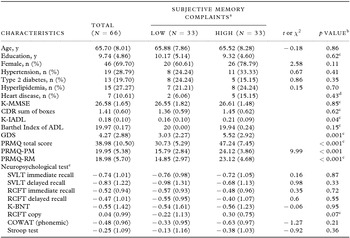
Demographic and clinical characteristics and cognitive measures of all participants, low SMC group, and high SMC group

Values are reported as the mean (SD) or the number (percentage).
aWe defined those participants with a PRMQ total score < 39 as the low SMC group and those participants with a PRMQ total score ≥ 39 as the high SMC group.
bTwo-sample t (or Mann–Whitney U) tests and χ2 (or Fisher's exact) tests for comparisons between two groups were performed on continuous variables and categorical variables, respectively. Significant at p < 0.05.
cMann–Whitney U test; dFisher's exact test.
eNeuropsychological test scores are age- and education-adjusted z scores.
Note: SMC = subjective memory complaint; K-MMSE = Korean version of Mini-Mental State Examination; CDR = Clinical Dementia Rating; K-IADL = Korean-Instrumental Activities of Daily Living; GDS = Geriatric Depression Scale; PRMQ = Prospective and Retrospective Memory Questionnaire; PM = prospective memory; RM = retrospective memory; SVLT = Seoul Verbal Learning Test; RCFT = Rey Complex Figure Test; K-BNT = Korean version of the Boston Naming Test; COWAT = Controlled Oral Word Association Test.
The diagnostic criteria for MCI were based on those proposed by Peterson et al. (Petersen et al., Reference Petersen2001) and Winblad et al. (Reference Winblad2004). The criteria for MCI included the following: (1) SMCs by the patient, preferably confirmed by an informant; (2) cognitive impairment below at least the 10th percentile of the age- and education-adjusted norm in one or more of four cognitive domains from the neuropsychological test battery (i.e. memory, executive function, visuospatial function, and language); (3) normal general cognitive function: Korean version of the Mini-Mental State Examination (K-MMSE) ≥ 24 (inclusive); (4) largely intact functional activities, defined here as intact basic activities of daily living (ADL) and instrumental ADL, which is described later; (5) a Clinical Dementia Rating (CDR) score of 0.5; and (5) the absence of dementia (by DSM-IV criteria).
Participants were excluded if they had major neurologic or psychiatric illnesses (e.g. schizophrenia, major depression), history of stroke, history of significant head trauma, unstable medical illness, history of brain surgery, history of alcohol or substance abuse, structural brain abnormalities (like territorial infarction, intracranial hemorrhage, brain tumor, hydrocephalus, other focal lesions, etc.), or illiteracy. Any participants taking psychoactive medications that could possibly affect cognitive function (e.g. antidepressants, neuroleptics, chronic anxiolytics or sedative hypnotics, etc.) were excluded.
The study was approved by the Institutional Review Boards of the institution of The Catholic University of Korea, Daejeon St. Mary's Hospital.
Measurements
Subjective memory complaints
SMCs were assessed using the PRMQ (Smith et al., Reference Smith, Sala, Logie and Maylor2000). The PRMQ contains 16 items that describe everyday memory failure of both prospective (eight items) (e.g. “Do you decide to do something in a few minutes’ time and then forget to do it?”) and retrospective (eight items) memory (e.g. “Do you forget something that you were told a few minutes before?”). For each item, participants were requested to rate the frequency of failure on a 5-point Likert-type scale that ranged from 5 (very often) to 1 (never). The ratings result in a score from 16 to 80, with higher scores representing more memory complaints, which can be divided into separate 8-item PM and RM subscores (range = 8–40). The reliability (internal consistency) of the PRMQ total score and the prospective and retrospective subscores have been found to be acceptable (Cronbach's α was 0.89, 0.84, and 0.80, respectively) (Crawford et al., Reference Crawford, Smith, Maylor, Della Sala and Logie2003). Reliability of the PRMQ total scale and of the PM and RM subscales in the present study was also high (Cronbach's α of 0.90, 0.81, and 0.83, respectively). The translated Korean form of PRMQ was used for this study (Byun and Kim, Reference Byun and Kim2009).
Additionally, participants were divided into two groups based on their PRMQ total score: MCI participants with low SMCs (PRMQ total score < 39, N = 33) and those participants with high SMCs (PRMQ total score ≥ 39, N = 33). The mean of the present sample was comparable to that found in a validation study of the PRMQ (Crawford et al., Reference Crawford, Smith, Maylor, Della Sala and Logie2003). We determined whether the two groups differed with regard to their demographic and cognitive measures.
Neuropsychological test
The participants received the K-MMSE (Kang et al., Reference Kang, Na and Hahn1997) for global cognitive functions and CDR (Morris, Reference Morris1993). Neuropsychological tests included four cognitive domains: (1) language: the Korean version of the Boston Naming Test (K-BNT) (Kim and Na, Reference Kim and Na1999); (2) visuospatial: the Rey Complex Figure Test (RCFT) copy (Kang and Na, Reference Kang and Na2003); (3) memory: the Seoul Verbal Learning Test (immediate recall by three learning-free recall trials of 12 words and 20-min delayed recall), and RCFT (immediate recall and delayed recall) (Kang and Na, Reference Kang and Na2003); (4) executive: the phonemic Controlled Oral Word Association Test (COWAT) (Kang et al., Reference Kang, Chin, Na, Lee and Park2000) and the Stroop Color-Word Test (Lee et al., Reference Lee, Kang and Na2000). The raw scores from K-MMSE and each cognitive test were transformed into age- and education-adjusted z scores using normative data (Kang and Na, Reference Kang and Na2003; Ahn et al., Reference Ahn2010). Cognitive functions were considered to be impaired when a decline was observed in at least one test of at least one domain with a score below the 10th percentile (−1.28 SD) of the age- and education-adjusted norms. For the memory domain, participants who scored below the 10th percentile on the SVLT delayed recall or RCFT delayed recall were identified as having an abnormal memory function.
Depressive symptomatology
Participants’ depressive symptoms were assessed using the Korean version of the Geriatric Depression Scale (GDS) (Bae and Cho, Reference Bae and Cho2004), which is based on the original version of the GDS (Yesavage et al., Reference Yesavage1982). The 15-item version GDS (GDS-Short Form) was administered. Higher scores on the GDS indicate stronger depressive symptoms, and a score of eight or greater is suggestive of depression (Bae and Cho, Reference Bae and Cho2004).
Functional assessments
We used the Barthel Index of activities of daily living (B-ADL) (ratings between 0 and 20, with higher scores reflecting lower levels of dependence) (Mahoney and Bathel, Reference Mahoney and Bathel1965) to evaluate basic ADLs and the Korean Instrumental Activities of Daily Living (K-IADL) (Kang et al., Reference Kang, Choi, Lee, Kwon, Na and Han2002) to evaluate IADLs. The K-IADL assesses 11 items: shopping, transportation, managing finances, housework, preparing meals, using the telephone, taking medication, recent memory, hobbies, watching television, and home maintenance. All items in the K-IADL were rated on a 4-point scale ranging from 0 (normal performance) to 3 (unable to complete) and N/A (not applicable). The K-IADL score was calculated as follows: total sum/(11 − number of N/A items), with higher scores reflecting worse IADL performance. The functional status of the IADL was classified as abnormal if the score was greater than 0.43 on the K-IADL scale (Kang et al., Reference Kang, Choi, Lee, Kwon, Na and Han2002).
Statistical analyses
Two-sample t tests or a Mann–Whitney U test were used for comparisons of continuous variables between two groups (low SMCs vs. high SMCs) while categorical variables were compared using χ2 tests or Fisher's exact test. To assess whether the severity of SMCs is related to study variables, univariate regression analyses between each PRMQ score (total, PM, log-transformed RM) and the age, education level, K-MMSE, GDS score, K-IADL score, and cognitive measures were performed for the entire sample. Because the distribution of PRMQ-RM scores was skewed, values were log-transformed for analysis. Analyses of the univariate regression indicated no violation for assumption of the regression residuals (normality, independence, homoscedasticity) and therefore this analytic approach was appropriate. In addition, Spearman correlational analyses were used to evaluate relationships between the GDS/K-IADL scores and other variables.
To further explore the results of the univariate regression analyses above and beyond the influence of demographic variables, hierarchical multiple regression analyses were performed with each PRMQ score (total, PM, and log-transformed RM) as a separate criterion for the entire sample. Multiple regressions for each model indicated no violation of linearity, multicollinearity, or homoscedasticity. The distributions of the regression residuals for each model were normally distributed.
Statistics were performed with JMP pro 11.0.0 (SAS Inc., Cary, NC) and SPSS software package version 19.0 (SPSS Inc., Chicago, IL, USA). A value of p < 0.05 was considered significant.
Results
Demographic and cognitive data
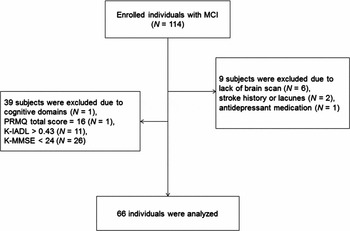
As shown in Figure 1, 114 individuals with MCI enrolled in this study. Forty-eight participants were excluded due to lack of brain scan, stroke history or lacunes, antidepressant medication, unmet criteria for cognitive domains, no self-reported complaints on the PRMQ scale, a K-IADL score > 0.43 (N = 11), and a K-MMSE score < 24 (i.e. K-MMSE scores between 18–23). Entire sample (N = 66) was divided in half, using the mean of the PRMQ total score (38.98) into subjective memory low complainers and high complainers. Demographic and clinical characteristics of all participants and the low (PRMQ total score < 39) and high (PRMQ total score ≥ 39) SMC groups are presented in Table 1. There were no significant differences in age, education, sex, K-MMSE score, medical illnesses, or cognitive measures between the low and high SMC groups. However, the high SMC group showed significantly higher GDS (U = 279.0, p = 0.001, Cohen's d = 0.951) and K-IADL (U = 381.5, p = 0.035, Cohen's d = 0.560) scores than the low SMC group (Table 1).
Flow chart of participant enrollment.

SMCs and their associations with depressive symptoms, IADL performance, and cognitive measures
Table 2 shows the results of univariate regression analyses between PRMQ total scores and other variables for the entire sample. We also analyzed associations between the PRMQ-PM and PRMQ-RM (log-transformed) subscores and other variables.
Subjective memory complaintsa and their associations with demographics, depressive symptoms, IADL and cognitive measures

aThe severity of SMCs were measured using the PRMQ total score, which is divided into the PRMQ-PM and PRMQ-RM subscores.
Each row represents a distinct linear regression analysis with 1 outcome (each PRMQ score) and 1 independent variable.
bLog-transformed PRMQ-RM score.
cEach score of K-MMSE and cognitive measures is an age- and education-adjusted z score.
*p < 0.05; **p < 0.01; ***p < 0.001.
Note: PRMQ = prospective and retrospective memory questionnaire; PM = prospective memory; RM = retrospective memory; K-MMSE = Korean version of Mini-Mental State Examination; K-IADL = Korean-Instrumental Activities of Daily Living; GDS = geriatric depression scale; SVLT = seoul verbal learning test; RCFT = rey complex figure test; K-BNT = Korean version of the Boston Naming Test; COWAT = controlled oral word association test.
Higher PRMQ total scores were significantly associated with higher GDS (t(64) = 4.172, p < 0.001) and K-IADL (t(64) = 3.326, p = 0.001) scores (Table 2). The results for PRMQ-PM (t = 3.983, p < 0.001 for GDS; t = 2.446, p = 0.017 for K-IADL) and PRMQ-RM (t = 3.658, p < 0.001 for GDS; t = 3.539, p < 0.001 for K-IADL) scores were similar to those of PRMQ total scores (Table 2). In regard to cognitive measures, each PRMQ score (total, PM, and RM) was not associated with cognitive test scores (Table 2). Additionally, the K-IADL and GDS scores were not significantly associated with the cognitive test scores.
Hierarchical regression analysis
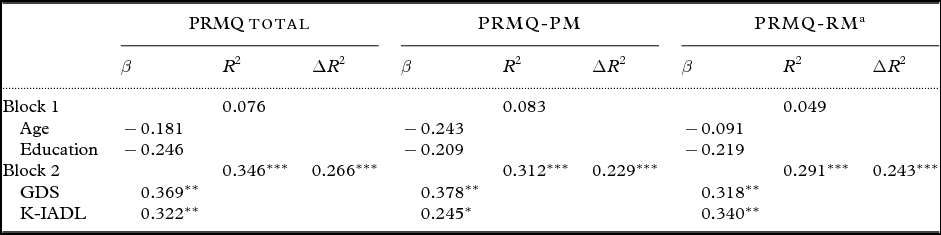
To further explore the univariate regression analyses (i.e. associations between SMC severity and K-IADL/GDS scores) above and beyond the influence of demographic variables (i.e. age and education), hierarchical multiple regression analyses were performed with each PRMQ score (total, PM and log-transformed RM) as a separate dependent variable to predict SMC severity. We entered demographic variables (age and years of education) as independent variables into the first block (block 1) and then the K-IADL and GDS scores as independent variables into the next block (block 2). Hierarchical regression analyses for each PRMQ score are summarized in Table 3.
Hierarchical multiple regression results predicting the severity of SMCs as measured with PRMQ

Values of the standardized regression coefficients (β) represent when the variables were first entered.
aLog-transformed PRMQ-RM score.
*p < 0.05; **p < 0.01; ***p < 0.001.
Note: SMC = subjective memory complaint; PRMQ = Prospective and Retrospective Memory Questionnaire; PM = prospective memory; RM = retrospective memory; β = standardized regression coefficient; Δ = change; GDS = geriatric depression scale; K-IADL = Korean-Instrumental Activities of Daily Living.
For regression analyses of the PRMQ total score, demographic variables (age and years of education) failed to contribute to the PRMQ total score (F(2, 63) = 2.596, p = 0.083) when entered first. In contrast, entry of the K-IADL and GDS scores accounted for a further 27.0% of the variance (F change(2, 61) = 12.609, p < 0.001). The total model accounted for 34.6% of the variance (F(4, 61) = 8.080, p < 0.001, effect size Cohen's f 2 = 0.413) in the PRMQ total score. Both GDS (β = 0.369, p = 0.001) and K-IADL (β = 0.322, p = 0.007) scores contributed significantly to the model (Table 3).
The results of the regression analyses of the PRMQ-PM score were similar to those of the PRMQ total score. The total model accounted for 31.2% of the overall variance in the PRMQ-PM score (F(4, 61) = 6.910, p < 0.001, effect size Cohen's f 2 = 0.333), with both GDS (β = 0.378, p = 0.001) and K-IADL (β = 0.245, p = 0.041) scores contributing significantly to the PRMQ-PM score (Table 3).
The results of the regression analyses of the PRMQ-RM (log-transformed) score were also similar to those of the PRMQ total score and the PRMQ-PM score, with the model explaining 29.1% of an overall variance in the PRMQ-RM score (F(4, 61) = 6.269, p < 0.001, effect size Cohen's f 2 = 0.341). However, the β value of the K-IADL score (β = 0.340, p = 0.006) was higher than that of the GDS score (β = 0.318, p = 0.007) (Table 3).
The hierarchical multiple regression analyses excluding those participants with a GDS score at or above eight (N = 7, 10.6%) yielded results that are similar to those reported in Table 3. However, the contribution of the GDS score to the PRMQ-RM score did not remain significant (β = 0.248, p = 0.057).
Discussion
In the present study, clinical correlates of SMCs in individuals with MCI were examined. The results of this study demonstrate that in participants with MCI, the severity of SMCs is associated with increased depressive symptoms and worse IADL performance, while higher PRMQ total scores are related to higher GDS and K-IADL scores. Objective memory impairment was not associated with the severity of SMCs. In addition, regressional analyses resulted in differences between the main contributors of the PRMQ-PM and PRMQ-RM subscores, although the GDS and K-IADL scores each independently predicted SMC severity (measured as PRMQ total score). The main contributors to the PRMQ-PM and PRMQ-RM subscores were the GDS and IADL scores, respectively.
Our results showed no relationship between the severity of SMCs (measured with PRMQ total score) and objective memory performance or other types of cognitive performance. These findings are consistent with prior reports (Cook and Marsiske, Reference Cook and Marsiske2006; Lenehan et al., Reference Lenehan, Klekociuk and Summers2012; Buckley et al., Reference Buckley2013); however, findings of SMCs in relation to cognition in MCI are not consistent among studies (Buckley et al., Reference Buckley2015; Gifford et al., Reference Gifford2015). Overall, it remains unclear how SMCs relate to cognition.
With regard to depressive symptoms, our study demonstrated that SMC severity is associated with more depressive symptoms. Depressive symptomatology has a well-established association with SMCs in healthy older adults (Clarnette et al., Reference Clarnette, Almeida, Forstl, Paton and Martins2001; Ronnlund et al., Reference Ronnlund, Vestergren, Mantyla and Nilsson2011; Buckley et al., Reference Buckley2013; Reference Buckley2015). However, the findings of SMCs in relation to depressive symptoms in individuals with MCI are also not consistent among studies (Lenehan et al., Reference Lenehan, Klekociuk and Summers2012; Buckley et al., Reference Buckley2013). These discrepant findings within and across the literature could relate to different SMC assessment methods.
Additionally, the present study revealed a relationship between SMC severity and IADL performance. For IADL performance, it has been reported that deficits in executive functions, episodic memory, and PM are related with IADL problems in older adults (Koehler et al., Reference Koehler2011; Woods et al., Reference Woods, Weinborn, Velnoweth, Rooney and Bucks2012). In our study within a sample of individuals with MCI, no associations were observed between objective cognitive performance and SMC severity or IADL performance. The neuropsychological tests herein might not capture the aspect of cognition ubiquitous in complex instrumental functions. Although the links among objective cognitive performance, IADL and SMCs are unclear, these findings of SMC severity and IADL performance suggest that the severity of SMCs might reflect pathological features of MCI.
With regard to the analyses of PRMQ-PM and -RM subscores, we observed similar findings to those of the PRMQ total scores. Each score was associated with stronger depressive symptoms and worse IADL performance (Table 2). When we examined the main predictors of each PRMQ-PM and -RM subscore, the strongest predictor of the PRMQ-PM score was the GDS score, while the strongest predictor of the PRMQ-RM score was the K-IADL score (Table 3). These differences in the main predictors of PM and RM scores suggest that RM complaints based on IADL could be more highly associated with the organically driven pathological features of MCI than with PM complaints.
This is a cross-sectional study that is limited to a sample of individuals with MCI. Direct causal relationships between SMC severity and GDS/IADL scores could not be concluded from these results. Further longitudinal studies will be important to help clarify whether these findings of MCI could be used to assess the future risk of dementia. In addition, this is a small sample of participants recruited from the Memory Disorders Clinic. This sample, therefore, is not representative of the MCI population. Our results need to be replicated in larger samples. Finally, the PRMQ scale used herein has been validated in a large sample of the general adult population (Crawford et al., Reference Crawford, Smith, Maylor, Della Sala and Logie2003). In the original study, the PRMQ scale assessed older adults with and without dementia (Smith et al., Reference Smith, Sala, Logie and Maylor2000). However, whether SMCs could be captured effectively with this scale, specifically in individuals with MCI has not been established. Further validation studies in a larger population with MCI would help to further evaluate SMCs in individuals with MCI.
Conclusions
This is the first study that examines prospective versus RM complaints of SMCs in relation to depressive symptoms and IADL performance in individuals with MCI. Our study reveals that within a sample of individuals with MCI, the severity of SMCs is associated with depressive symptoms and IADL impairment. Furthermore, our results show that PM complaints among SMCs are more associated with depressive symptoms than with IADL problems and that RM complaints are more associated with IADL impairment than with depressive symptoms. These results could inform diagnostic approaches to the clinical evaluation of SMCs in individuals with MCI.
Conflict of interest
None.
Description of authors’ roles
S. Y. Ryu designed the study and contributed to the concept of the paper. All authors contributed to the acquisition of data. S. Y. Ryu was responsible for statistical analyses, performed interpretation of data and wrote the first draft of the paper. All authors contributed to revising the manuscript for content and approved the final version.