Surgical-site infection (SSI) is a surgical complication associated with increased morbidity, mortality, and costs. Reference Cassini, Plachouras and Eckmanns1,Reference Badia, Casey, Petrosillo, Hudson, Mitchell and Crosby2 Although SSI may occur following any surgical procedure, the highest incidence is observed after colorectal surgery. 3,4 Because surveillance is considered an important component of strategies implemented to reduce SSI, Reference Horan, Gaynes, Martone, Jarvis and Emori5 the European Centre for Disease Prevention and Control (ECDC) harmonized the methods for SSI surveillance in European hospitals in 2000 and implemented of the Healthcare-Associated Infection Surveillance Network (HAI-Net) in 2008. Since then, increasing numbers of hospitals from each country have adhered to it. In their latest annual report, the incidence of SSI following colorectal surgery decreased only slightly across the European region, with Portugal leading the European incidence of SSI following open colon surgery. 3 The SSI incidence in the country, however, has not decreased since 2013. 4 From 2015 to 2018, Portugal adopted a 3-year challenge named Stop Infeção Hospitalar! to decrease the incidence of 4 types of healthcare-associated infection (HAI): central-line–associated bloodstream infection, catheter-associated urinary tract infection, ventilator-associated pneumonia, and SSI. This program urges the adoption of the best practices based on the highest-quality evidence available. In the 12 participating institutions, accounting for 19 hospitals, decreases have occurred in all types of HAI except SSI in colorectal surgery. 6
Targeted approaches are needed to decrease the burden of this infection. The effectiveness of interventions depends on the vulnerability and magnitude of the selected target to be addressed. The HAI-Net protocol requires hospitals to routinely collect patient and unit-based indicators such as demographic data, standardized operative procedure codes and procedure-related risk factors. The latter represent known risk factors for infection and are used for benchmarking between institutions. 7 Although many original articles have reported estimates of the association between risk factors and SSI following colorectal surgery, few have considered their impact. Reference Thelwall, Harrington, Sheridan and Lamagni8–Reference Ribeiro, Bellusse, Martins de Freitas and Galvão11 Two studies estimated the impact for abdominal surgery as a whole, Reference Thelwall, Harrington, Sheridan and Lamagni8,Reference Caroff, Chan and Kleinman9 and, to the best of our knowledge, none has included an adjustment for the interaction between risk factors; they have all analyzed a single determinant. Hence, the comprehensiveness of these variables in explaining SSI incidence is yet to be determined. Even though variables include nonmodifiable risk factors, which are unsuitable targets for interventions, their relative contribution to infection may assist hospitals in determining a baseline optimal incidence and in setting achievable and realistic goals for prevention.
We assessed the impact of risk factors for SSI after colorectal surgery collected in the scope of European surveillance, in Portuguese hospitals. Using the population attributable fraction (PAF), it is possible to determine how much of the incidence may be attributed to a specific risk factor. By accounting for the nonindependence of risk factors, we intended to provide more accurate estimates and to provide a combined PAF value to serve as a measure of the comprehensiveness of current surveillance indicators.
The protocol of this study was submitted and approved by the Ethics Committee of Instituto de Saúde Pública da Universidade do Porto (CE20171), in November 2020. No informed consent was deemed necessary.
Methods
Population and data source
Data on the number of colorectal procedures and SSI were retrieved from the electronic platforms of the Portuguese Directorate General of Health, which include the database of the National Epidemiological Surveillance of hospital-acquired infections in intensive care units; bloodstream infections; Clostridioides difficile infections; and SSI following colorectal surgery, cholecystectomy, caesarean section, cardiac surgery, hip and knee arthroplasty, and laminectomy. Portugal is part of HAI-Net, and surveillance is performed similarly across different settings. Hospitals are required to routinely collect patient and unit-based indicators such as demographic data, operation codes under the International Classification of Diseases, Ninth Revision, compliance with prevention bundle, antibiotic use and antimicrobial resistance, and procedure-related risk factors, following a standardized data set provided by the ECDC. Data collection is performed retrospectively because infection preventionists manually review each surgical procedure to retrieve procedural data and infection outcome. Data collection is recommended for a minimum of 3 months and/or 30 surgical procedures per year. 7 The data set uses the surgical procedure as the unit of measurement, registering all variables as different columns. Until mid-2018, the data set consisted of a single spreadsheet containing all data. Thereafter, although there was no change in the HAI-Net protocol nor in surveillance practices, the data-set structure changed with a new software developed in response to an operating system that was unable to be updated. Antibiotic use, SSI type, microorganism isolation, and resistance profile began to be registered in separate sheets, linkable by the identification number of the procedure, surgery date, and hospital.
In our analysis, we included only those procedures performed in hospitals that reported colorectal surgeries each year, from 2015 to 2019, to ensure that the same population was being analyzed throughout the study period. All included hospitals were state-owned general hospitals. Procedural variables collected under HAI-Net were included in the final analysis. Nonmodifiable risk factors included the American Society of Anesthesiologists (ASA) physical status classification, wound classification, urgent operation, and male sex. Modifiable risk factors included the duration of operation, open surgery, and the use of prophylactic antibiotic. Age, the number of operating room door openings, multiple operations, and implant in place were not considered because we could not find any systematic review establishing their significant association with the outcome. Data on compliance with the prevention bundle were unavailable.
Definitions
We defined SSI following the ECDC criteria in the HAI-Net protocol. 7 ASA classification was designed to assess and communicate a patient’s preanaesthesia medical comorbidities. A score of 1 refers to a normal healthy patient, and a score of 6 refers to a declared brain-dead patient. Reference Doyle, Goyal and Bansal12 In line with most literature, Reference Xu, Qu and Gong13,Reference Hou, Gan and Zhou14 we considered as a risk factor an ASA score of 3 or above, referring to patients with severe systemic disease.
We considered the Centre for Disease Control and Prevention (CDC) classification of the cleanliness and condition of wounds, given its widespread use and ability to help predict the likelihood of surgical site infections, postoperative complications, and reoperation. Reference Herman and Bordoni15,Reference Altemeier, Burke, Pruitt and Sandusky16 We considered a wound class III or IV as a risk factor, in line with the ECDC risk index. 7
Duration of surgery was cutoff at 180 minutes, and all surgeries beyond that time were considered risk factors. Reference Xu, Qu and Gong13 The absence of antibiotic prophylaxis was considered a risk factor. In Portugal, cefoxitin in a single dose is the mandatory antibiotic for colorectal surgery, except when the patient is allergic to penicillin with high risk of anaphylaxis, in which case metronidazole and gentamicin are the indicated antibiotics, in a single dose. 17 Male sex was considered a risk factor, as were urgent operations and open surgery.
Measures of association
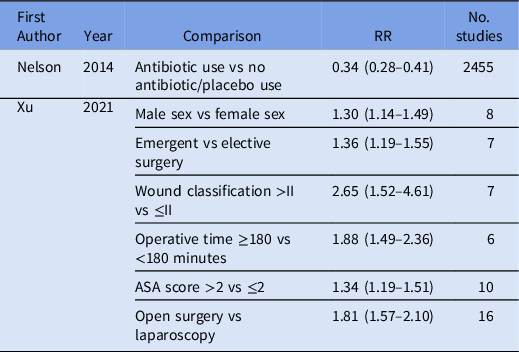
Reports published until January 26, 2022, were identified by searching PubMed. Measures of association were retrieved from published systematic reviews with meta-analyses (Table 1). Reference Xu, Qu and Gong13,Reference Nelson, Gladman and Barbateskovic18 In the case of antibiotic prophylaxis, because it was studied as a protective factor, we considered the inverse of the published relative risk (RR).
Articles from which Measures of Association were Retrieved

Note. ASA, American Society of Anaesthesiologists. RR, relative risk.
Statistical analysis
The PAF for each risk factor was calculated using the Levin formula. Reference Levin19 We applied adjusted relative risk estimates to these formulas. The formula assumes independence of risk factors, which may be false in this case, so we used a weighted-sum approach, which allowed for full interaction between exposure and covariates, Reference Benichou20 where weight was defined as 1 minus is the proportion of variance shared with the other risk factors, was calculated via principal component (ie, communality), following the example of previous articles in the field of dementia prevention. Reference Norton, Matthews, Barnes, Yaffe and Brayne21–Reference Ma’u, Cullum, Cheung, Livingston and Mukadam24
Weighting was also considered for the estimation of individual adjusted PAF. The formulas used are available as a supplement (Supplementary Methods online).
To deal with potential heterogeneity in the data, a sensitivity analysis was performed considering only the hospitals that participated in Stop Infeção Hospitalar! whose data were potentially more reliable.
Statistical analyses were performed using Microsoft Excel 2016 (Microsoft, Redmond, WA) and IBM SPSS Statistics, version 27 (IBM, Armonk, NY). We applied a significance level of 0.05.
Results
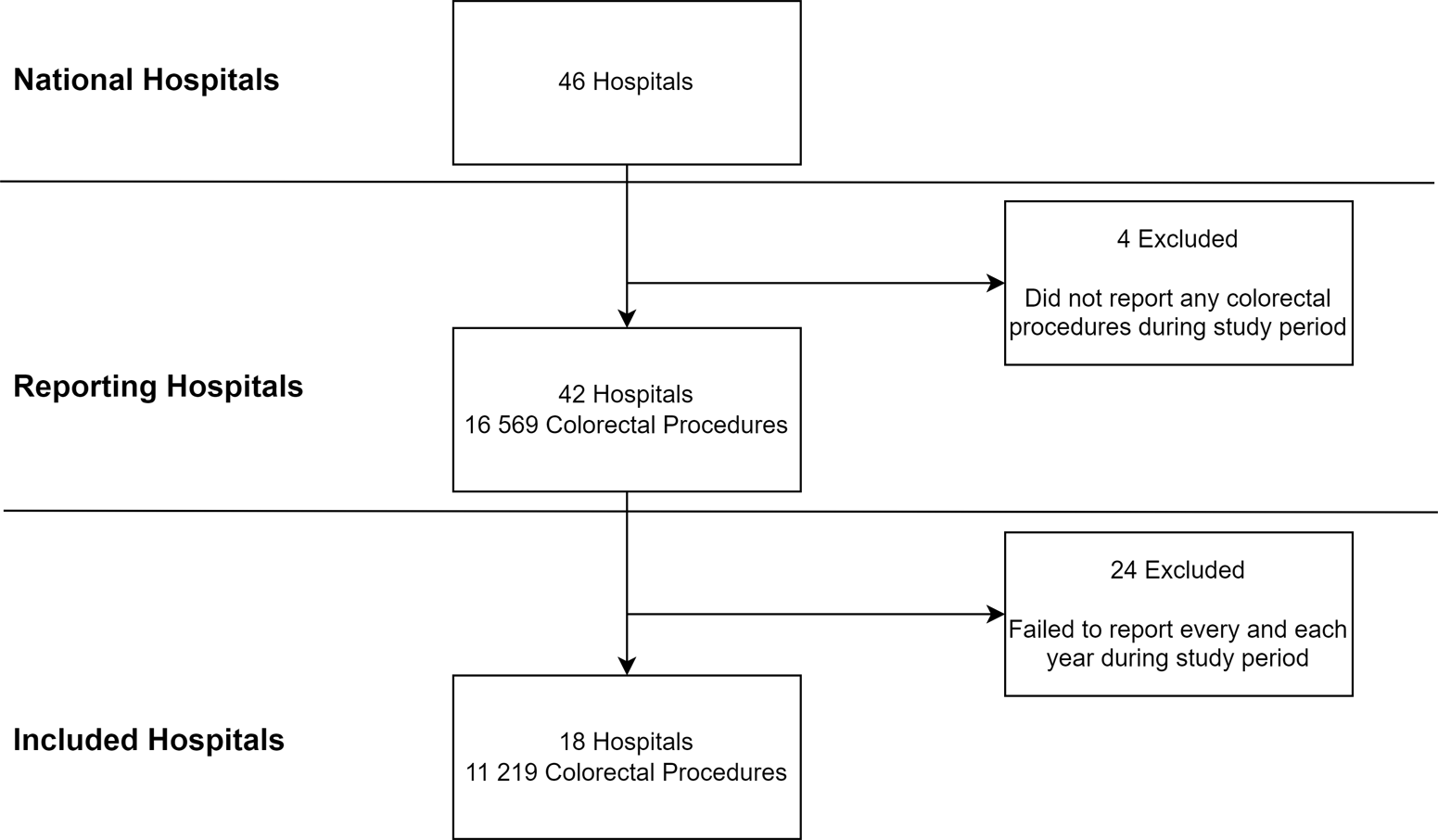
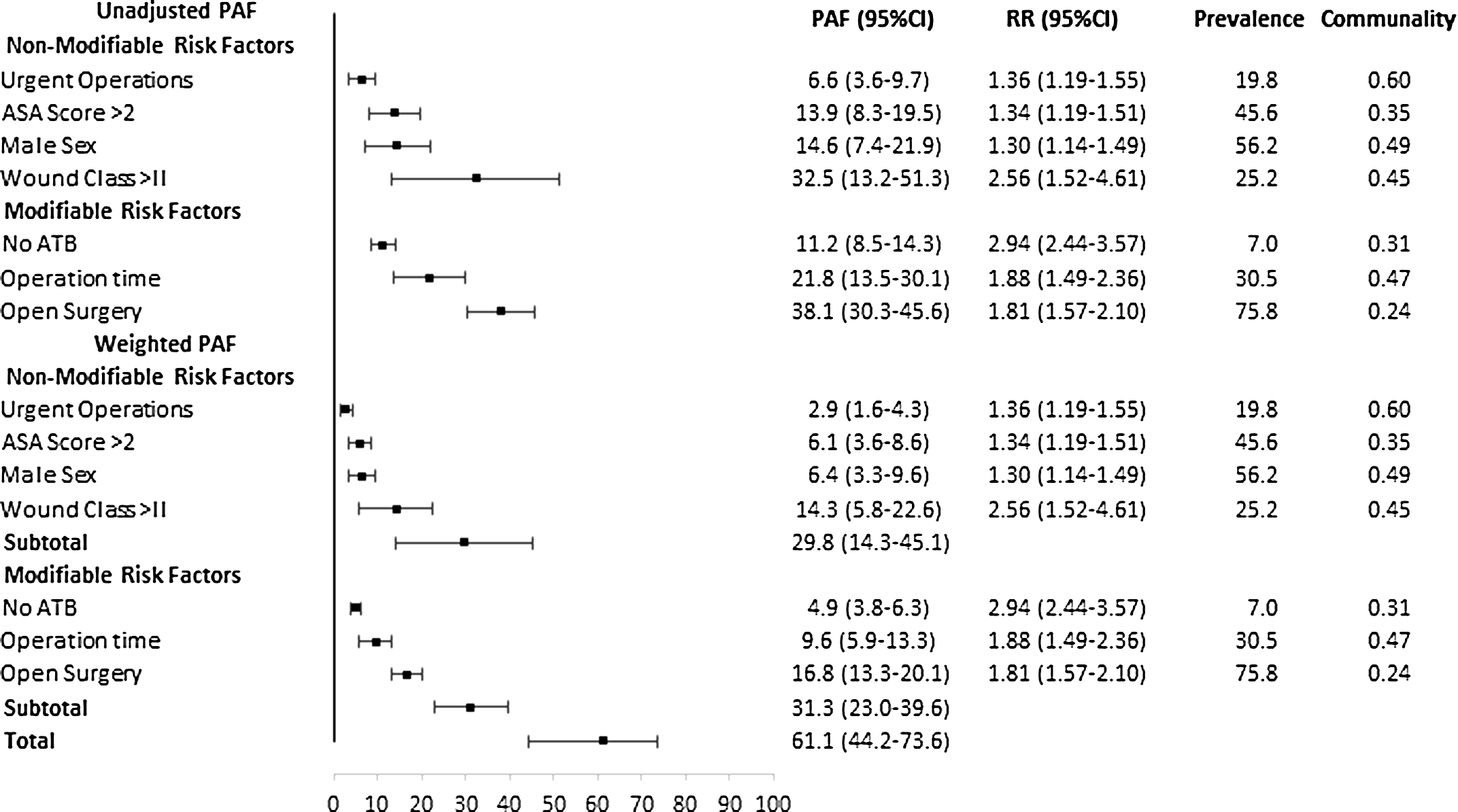
Consequently, among 42 reporting hospitals reporting 16,569 procedures, 18 hospitals were included, representing 11,219 colorectal procedures reported nationwide (68%) (Fig. 1). Most patients were male (57.2%), and the median age was 70 years. The overall cumulative incidence of SSI was 16.8%. The prevalence of each characteristic, RR and overlap of variance are presented in Figure 2. Overlap was calculated for 10,572 procedures, following case-wise deletion of procedures missing at least 1 risk factor. Deleted procedures (median age, 71 years; interquartile range [IQR] 61.5–79; 58.7% of males) were demographically similar to included procedures (median age, 70 years; IQR, 60–78; 57.1% of males), with no marked differences in operation times: median, 140 minutes (IQR, 94–190) versus median, 145 minutes (IQR, 100–200). Deleted procedures (those with at least 1 missing risk factor), however, had a slightly higher proportion of patients with an ASA score of 3 or above (50.7% of patients with ASA scores >2 vs 47.4%). Overlap in variance ranged from 24% for open surgery to 63% for male sex.
Flow chart of included hospitals.

The proportion of SSI attributed to all risk factors was 61.1%. Modifiable variables accounted for 31.3% of incidence, and nonmodifiable variables accounted for the remaining combined PAF. The modifiable risk factor with highest adjusted PAF was open surgery (16.8%), and the prevalence of this factor has been decreasing in recent years (Table 2). The nonmodifiable risk factor with highest adjust PAF was wound class superior to II (14.3%). Respectively, lack of prophylactic antibiotic (4.9%) and urgent operations (2.7%) were the risk factors with lowest PAF score (Fig. 2).
Population attributable fraction, relative risk, prevalence and communalities for patients submitted to colorectal surgery in Portugal, between 2015 and 2019. Note. ASA, American Society of Anaesthesiologists; ATB, Antibiotic; CI, Confidence Interval; PAF, Population Attributable Fraction; RR, Relative Risk.

Use of Open Surgery Over Time, and Respective Population Attributable Fraction

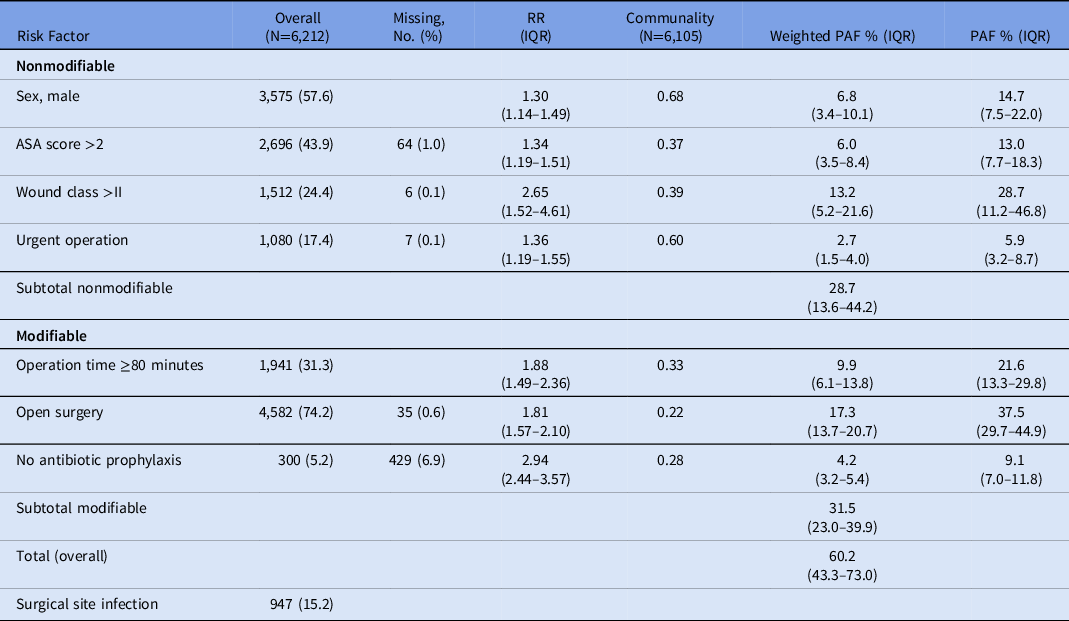
When considering only the hospitals that participated in Stop Infeção Hospitalar!, values did not change significantly. Overall adjusted PAF remained at 60.2%, with 31.5% attributed to modifiable risk factors and 28.7% attributed to nonmodifiable factors. Open surgery (17.3%) and wound class > II (13.2%) remained the variables with the highest impact, whereas urgent operation (2.7%) and lack of prophylactic antibiotic (4.2%) were the variables with the lowest estimates (Table 3).
Population Attributable Fraction (PAF) for Patients Undergoing Colorectal Surgery in Hospitals Participating in Stop Infeção Hospitalar!

Note. ASA, American Society of Anaesthesiologists. PAF, population attributable fraction. RR, relative risk; IQR, interquartile range.
Discussion
Our findings suggest that the risk factors traditionally used for colorectal surgery SSI surveillance in the European setting account for ∼60% of its incidence. Ergo, a substantial proportion of SSI incidence is explained by variables that are not present in the current methodology. Modifiable risk factors may be responsible for at least 31% of SSI incidence. Of the 3 strongest risk factors with highest impact on SSI following colorectal surgery, 2 factors were potentially modifiable. Interventions focusing on adopting techniques that are less invasive and that provide shorter surgeries may be optimally suited for prevention. The use of laparoscopy has been steadily increasing in recent years, both nationally (Table 2) and internationally, Reference Ghadban, Reeh and Bockhorn25,Reference Stormark, Søreide and Søreide26 and its progressive introduction has been shown to work as a protective factor not only for overall and incisional SSI but also for organ-space SSI. Reference Arroyo-Garcia, Badia and Vázquez27 These results suggest that although these risk factors cannot be entirely eliminated, there is still a considerable margin to decrease their prevalence and, thus, their impact on SSI incidence. Nonmodifiable variables estimates are mainly dependent on the wound classification, in which the estimate has low precision. Urgent operations and lack of antibiotic prophylaxis, although relevant risk factors for SSI, had the lowest PAFs due to their low prevalence.
Our results suggest that unmeasured risk factors may be responsible for 40% of incidence, a high enough value to warrant close attention. The HAI-Net protocol determines the collection of the same variables for all surgical procedures to guarantee comparability, yet risk factors may be surgery specific. The closing technique of ileocolic anastomosis have been shown to be associated with SSI and could be relevant to monitor, even if it applies solely to colorectal surgery. In contrast to most other surgery types, SSI after colorectal procedures is mainly attributed to endogenous gut bacteria. 3 Therefore, all operative factors associated with more invasive procedures or delayed wound healing are expected to have a considerable impact on SSI incidence and could be considered. Comorbidities are also not directly included in the HAI-Net protocol. Even if comorbidities are unlikely to be acutely modifiable prior to surgery, knowing their impact would help to ascertain the acceptable baseline level for each setting, considering the patient case mix. Nonetheless, most comorbidities (ie, obesity, smoking habits, alcohol use, diabetes) are indirectly expressed in the ASA classification. Reference Doyle, Goyal and Bansal12 Comorbidities such as diabetes, which are usually studied in a dichotomous manner, Reference Xu, Qu and Gong13 are evaluated as well-controlled factors or are not in the preoperative assessment and, thus, better represent the overall status of the patient. Because many comorbidities tend to be present in the same patients, an adjusted PAF would most likely yield low estimates for each individual factor. A weighted PAF of 6% for the ASA score may suggest that regardless of the how comprehensive a surveillance system may be on the patient’s medical history, its impact on SSI incidence may be low. Even so, patient and procedural variables may not tell the full story. Some part of the missing picture may be attributable to hospital characteristics, such as availability of surveillance, or surgeon caseload volume. However, robust studies providing accurate estimates are still lacking. Reference Malheiro, Peleteiro and Correia28 Nevertheless, compliance with prevention care bundles may be the most relevant missing variable. Care bundles consist of a set of simple, strong evidence-based practices that, when implemented in a combined and consistent manner, improve patient outcomes, with a higher impact than the addition of each intervention effect. 29 Although they have been shown to decrease SSI after colorectal surgery up to 45%, their success is deeply dependent on compliance with the entire bundle. Reference Zywot, Lau, Fletcher and Paul30,Reference Pop-Vicas, Abad, Baubie, Osman, Heise and Safdar31 Suboptimal compliance rates may justify Portugal’s place in SSI incidence at the European level and are strong candidates for the unexplained remaining incidence we found. 3
Our secondary analysis of hospitals participating in Stop Infeção Hospitalar! showed that, for engaged hospitals, measured variables explain a lesser proportion of infection. Surveillance may decrease SSI rates through feedback and surveillance effect, which may justify why participating hospitals, with more robust surveillance teams, have a higher proportion of infection attributed to unmeasured risk factors. Reference Gastmeier, Schwab, Sohr, Behnke and Geffers32 Nonetheless, the difference was not significant. Although we acknowledge that no surveillance network can include every single risk factor for infection, it is vital to understand which variables are relevant enough to warrant inclusion in future updates of the protocol.
To the best of our knowledge, this is the first study to address the impact of risk factors in the context of SSI in colorectal surgery and the first in the infection prevention and control field to adjust estimates for nonindependence of risk factors. The weighted-sum approach also allows the estimation of a combined PAF that is interpretable as a measure of the combined impact of the risk factors considered, which is a known limitation of unadjusted impact measures. Although it has been described previously as a method of adjusting PAF for confounding, the ideal weight remains a matter of discussion. Reference Benichou20,Reference Darrow and Steenland33 The use of communalities is a novel solution that has only recently been used in the field of Alzheimer’s disease and dementia. Reference Mukadam23,Reference Ma’u, Cullum, Cheung, Livingston and Mukadam24 It allows researchers to account for interaction between risk factors and provides a more robust, even if conservative, estimate than simply applying adjusted relative risk using the Levin or Miettinen formula, both of which have been shown to yield tremendous bias. Reference Benichou20,Reference Darrow and Steenland33 In our analysis, there was no obvious heterogeneity of variables, with all variables sharing some variance with the others. No variable was redundant, and all were usually defined by a communality >90%. Reference Tabachnick and Fidell34
Our sample size, the use of national data following the European methodology of surveillance, and the use of measures of association published in peer-reviewed meta-analysis are study characteristics that strengthen the external validity of our findings. Nonetheless, variations are expected in different settings. Prevalence estimates are setting dependent and may justify a differential impact elsewhere. Open surgery is still more prevalent in our setting than in other European countries, Reference Ghadban, Reeh and Bockhorn25,Reference Stormark, Søreide and Søreide26 and the same is true for the ASA score. Reference Hennessey, Burke, Ni-Dhonochu, Shields, Winter and Mealy35
Notably, hospitals are not required to provide data for all performed procedures. Hence, potential selection bias may occur for procedures registered in national databases. Likewise, the variance overlap was calculated for 83% of our sample, which could have affected its representativeness. Most of the excluded procedures were missing data on antibiotic prophylaxis due to the changes in the data set outlined earlier. Although missing procedures were demographically similar to included procedures, differences in proxies of infection, such as the ASA score and the operation time, meant that included procedures had a higher risk of infection. We were unable to determine whether this had any influence in the values estimated. Nonetheless, our sensitivity analysis provided communalities in approximately the same relative position for each risk factor, with only minor changes in weighted PAF values. Other missing data, such as the proportion of laparoscopic surgeries that ended up as open surgeries, were unavailable.
In conclusion, variables routinely collected under the ECDC HAI-Net protocol explain 60% of SSI incidence after colorectal surgery, meaning that a relevant proportion of SSIs remains unaccounted for by current surveillance indicators. Interventions focusing on shorter, less invasive procedures may be optimally effective in reducing the burden of infection.
Supplementary material
To view supplementary material for this article, please visit https://doi.org/10.1017/ice.2023.40
Acknowledgments
Financial support
This article is financed by national funds through Fundação para a Ciência e Tecnologia (FCT) in the scope of projects UIDB/04750/2020 and LA/P/0064/2020. R.M. has a PhD scholarship attributed by FCT (reference no. 2021.05994.BD).
Conflicts of interest
All authors report no conflicts of interest relevant to this article.