Introduction
Technology has been one of the most frequently visited topics in archaeology (e.g. Dobres Reference Dobres2010; Dobres & Hoffman Reference Dobres and Hoffman1994; Lechtman Reference Lechtman, Lechtman and Merrill1977). In the preceding decades, studies aiming at the understanding of prehistoric technology have gone through an important turn, thanks in part to the proposals made by the anthropology of technology (Lemonnier Reference Lemonnier1986; Reference Lemonnier1992). Based on the seminal works of Mauss ([1935] Reference Mauss1973) and Leroi-Gourhan ([1945] Reference Leroi-Gourhan1988; [1964] Reference Leroi-Gourhan1993), this line of work propelled an understanding of technology beyond its economic role, considering it as part of the wider historical, social and cultural fabric developed by human communities. In this new scenario, technology has been approached via the cognitive, symbolic, cultural and social aspects of manufacturing actions (Lemonnier Reference Lemonnier1986; Schlanger Reference Schlanger, Renfrew and Zubrow1994; Sigaut Reference Sigaut and Ingold1994; Van der Leeuw Reference Van der Leeuw, Renfrew and Zubrow1994). Technology thus includes the imaginaries and intangible dimensions of social groups.
In the Andes, this way of approaching technology has been widely discussed, even before the proposals of the anthropology of technology (e.g. Earls & Silverblatt Reference Earls, Silverblatt, Lechtman and Soldi1985; Lechtman Reference Lechtman, Lechtman and Merrill1977; van Kessel Reference van Kessel1989). This is largely due to the importance of anthropological perspectives in the region, which showed the historic and symbolic character of technologies. In archaeology, and particularly in Andean archaeology, this approach has been led by Lechtman (Reference Lechtman, Lechtman and Merrill1977; Reference Lechtman1985), who introduced the concept of technological style, highlighting the relevance of the attitudes and cultural principles of the artisans in the making of objects. For this scholar, techniques used in the production of a given object are stylistic and symbolic actions; objects reflect values and symbolic principles of the communities that produced them (Lechtman Reference Lechtman, Lechtman and Merrill1977; Reference Lechtman1985).
This approach had a major impact, contributing to the rescuing of the historic and symbolic contexts of Andean technologies. Attempts like this show a strong cognitive emphasis founded on the idea that technologies express cultural values or principles, imposed by an artisan based on his/her particular cultural-historic context onto an inert, raw material. Thus, they understand technologies through a human-centred paradigm, reducing the social and technological exclusively to the human. This leaves aside the fact that materials, their properties and the processes of manufacture are the result of the interactive nature of a complex field of relations between humans and other-than-humans who animate a world (Conneller Reference Conneller2011; Ingold Reference Ingold2013; Jones & Alberti Reference Jones, Alberti, Alberti, Jones and Pollard2013). Further, society, and thus technology, is the result of a series of mediations and assemblages between humans and other-than-humans through time, in a specific field of interactions and relations (De Landa Reference De Landa2006; Hamilakis Reference Hamilakis2017; Harris Reference Harris2017; Hodder Reference Hodder2012; Latour Reference Latour2005). Other-than-humans, then, cannot be seen simply as passive recipients of symbolic principles imposed through making.
The importance of other-than-humans in Andean social life has been extensively acknowledged. They can even be seen as true other-than-human persons who participate in political processes and in the reproduction of communities (e.g. Allen Reference Allen and Bray2015; De la Cadena Reference De la Cadena2015; Manheim & Carreño Reference Manheim, Salas Carreño and Bray2015; Sillar Reference Sillar2009). Considering this, here we explore Andean technology through the study of Diaguita rock art in the north Central region of Chile from a relational perspective (Fowler Reference Fowler2013; Watts Reference Watts and Watts2013), which highlights the fabric of assemblages activated through the act of making. It is within this fabric that a series of other-than-human actors animate a historically constituted world. We base our discussion on Allen's (Reference Allen2002; Reference Allen and Bray2015) and van Kessel's (Reference van Kessel1989; van Kessel & Condori Cruz Reference van Kessel and Condori Cruz1992) proposals, which argue that in the Andes, technology is a discourse and a practice of reciprocal and symmetrical relations between different beings, humans and other-than-humans, through different ritualized practices, of which the main goal is to nurture the world and secure its well-being.
Instead of centring on the instruments and the gestures used to produce rock art (e.g. Álvarez et al. Reference Álvarez, Fiore, Favret and Castillo2001; Bednarik Reference Bednarik.1998), we will focus on understanding the set of combined actions that led to its production and how they were oriented towards the establishment and maintenance of relations with different members of the collective. These relations, we argue, aimed at keeping the order and balance of the world, allowing its continuity and reproduction. In this context, we see the chaîne opératoire as more than a culturally defined sequence of stages to produce a given object: rather as the activation of significant relations between multiple beings. In this way, rock art was an active player in its historical and spatial context, and not simply the expression of given ideas or values. Such an approach goes beyond the study of rock-art technology as a combination of gestures and tools, as well as a representational approach to its meanings, prioritizing the argument that media are both material and relational practices (Mitchell Reference Mitchell2013).
Technology as a relational web
The study of technology has been central in the history of archaeology (Trigger Reference Trigger1989), but the last decades have seen a turn in the field. The anthropology of technology, mainly based on Mauss's proposals ([1935] Reference Mauss1973), has offered new ways of understanding techniques as social and material phenomena, related to cognitive, symbolic, cultural and social aspects of manufacturing actions (Coupaye Reference Coupaye2013; Dobres Reference Dobres2010; Lemonnier Reference Lemonnier1986; Pfaffenberger Reference Pfaffenberger1992; Schlanger Reference Schlanger and Schlanger2006; Sigaut Reference Sigaut and Ingold1994). As Gell argued (Reference Gell1988; Reference Gell, Pinney and Thomas1992; see also Schlanger Reference Schlanger and Schlanger2006), the effectiveness of techniques does not need to be materially evident, and magical attitudes also play a relevant role in the overall technical processes.
Within this frame, chaîne opératoire has been used as a key concept in the study of technology through which to understand the unfolding relations between the physical and social body of the producers and the lived, dynamic and constantly becoming material world. Also, it has been argued that through the chaîne opératoire, social and symbolic principles about materials are embodied and materialized (Dobres Reference Dobres2000, 162–5). Thus, several scholars have focused their research on the symbolic, cognitive and social aspects associated to the production of the material world (e.g. Dobres Reference Dobres1995; Gosselain Reference Gosselain2000; Hegmon & Kulow Reference Hegmon and Kulow2005).
In the Andes, cognitive and cultural aspects of technology have been discussed by numerous scholars, mostly inspired by the work of Heather Lechtman (e.g. González Reference González2007; Lau Reference Lau2010; Sillar Reference Sillar1996). Lechtman proposed the concept of technological style, which considers the ‘attitudes of artisans toward the materials they used, attitudes of cultural communities toward the nature of technological events themselves, and the objects resulting from them’ (Lechtman1977, 10). This implies that the way in which a given object is produced has a series of cultural and cosmological values that are later considered part of the value of the object. From a different perspective, Earls and Silverblatt (Reference Earls, Silverblatt, Lechtman and Soldi1985) have argued that technology involved in agricultural practices was immersed in a cultural network linked to specific values and particular cultural cosmologies, which required certain symbolic procedures for its functioning (see also Páez Reference Páez2016).
These proposals coincided with works from the anthropology of technology, which showed the importance of the sequences involved in the production of objects, seeing them as chains of actions imbued with cognitive and symbolic elements, giving values to the objects through the process of making (Coupaye Reference Coupaye2013; Gell Reference Gell1988; Reference Gell, Pinney and Thomas1992). Although these proposals have offered great contributions to the study of archaeological materials, we think that the cognitivist approach that dominates them—associated with ideas of symbolism and meaning, as well as to the essentialist distinction between human and material—has obliterated some key aspects of Andean technologies, particularly the complex webs of dependency in which humans participate with a series of other-than-humans that are essential for the constitution and reproduction of the world (Allen Reference Allen2002; Reference Allen and Bray2015; Bray Reference Bray and Bray2015; Haber Reference Haber2009; van Kessel & Condori Cruz Reference van Kessel and Condori Cruz1992).
Allen (Reference Allen and Bray2015, 29) has argued that in the Andes ‘technology becomes a type of discourse not only about the world but with the world’. A technology with the world presumes the involvement of a series of other-than-human beings that conform and animate the Andean landscape. These beings have different effects on social life that depend on their positions within the field of relations, shaped by the historic becoming of these communities (Pauketat Reference Pauketat2013; Watts Reference Watts and Watts2013). These relations are based on reciprocity, which involves a constant feedback as well as obligatory and dependant relationships with given places and other members of the collective (Allen Reference Allen and Bray2015). These mutual, reciprocal and dependent practices between humans and other-than-humans create relational communities (sensu Harris Reference Harris and Watts2013) in the Andes that include a number of participants that go beyond those who are exclusively human (Allen Reference Allen and Bray2015; Bray Reference Bray2009; Reference Bray and Bray2015; Haber Reference Haber2009).
This idea has been acknowledged and discussed in the ethnographic work of van Kessel (Reference van Kessel1989; van Kessel & Condori Cruz Reference van Kessel and Condori Cruz1992) on Andean technology and productive systems. For this scholar, technology in the Andes aims at the ‘nurturing of the world’, at helping the Earth give birth (van Kessel Reference van Kessel1989, 76). In such a view, to produce is to activate and reproduce relations with a series of other-than-humans who are considered as ‘living persons, worthy of respect, who act based on their own character and destiny, and who reciprocate with humans’ (van Kessel & Condori Cruz Reference van Kessel and Condori Cruz1992, 64 [authors’ translation]). These relations are symbiotic, as the productive activity creates objects which, in turn, create people and their communities.
To conceive of technology as nurturing or raising the world (see Haber Reference Haber2009) requires considering the process of making as a set of relational practices, as techniques linking humans with other-than-humans, in a mutual dynamic of nurturing. As Allen (Reference Allen2002) has suggested, life in the Andes is a constant unfolding of rights and duties between different kinds of beings. In contrast to what has been proposed by the anthropology of technology, the process of making is not mediated by cultural values and cosmological principles that are materialized in the object through the chaîne opératoire, but rather is a practice based on reciprocal relations between humans and other-than-humans, which are relevant for the upbringing of the world and the maintenance of its well-being. Thus, the effectiveness of these technologies does not rely on what they symbolize or the properties that the artisan gives to the object in the process of making it (Gell Reference Gell, Pinney and Thomas1992), but rather on the properties and capacities given by the interrelation between different beings in the process of making.
Ingold (Reference Ingold2013) has criticized—although not from Andean studies—how the focus of technology studies has been set on the idea that objects are produced with a rational plan that includes different stages. Just like van Kessel, Ingold (Reference Ingold2013; see also Mitchell Reference Mitchell2013) argues that the process of making is more important than the final object itself. It is through the making that a field of relations is woven between humans and materials (other-than-humans), shaping the trajectories of movements upon which social life is constituted and reproduced (Ingold Reference Ingold2013). Therefore, chaînes opératoires can be addressed as the unfolding, through the act of making, of a set of relations between humans, materials and other-than-humans.
Considering the above, chaînes opératoires do more than just sequence a production process by which cultural values are added to the object produced; instead, they should be understood as activating the historically constituted field of relations where relational communities, with their different members, unfold. This is in tune with what Conneller (Reference Conneller2011, 20) has called a ‘rhizomatic châine opératoire [which] shifts focus from sequences, solid forms and homogeneous matter, towards a focus on connections, assemblages and heterogeneous, processual matter’.
This approach to technology considers relations between humans and other-than-humans not only as technical, but also spatial and temporal, and involving the mutual affection of its members, whether humans, things, places, phenomena, etc. In this sense, the final object is itself the relations between the set of beings participating in a historically specific and dynamic world. Relations between humans and materials need to be considered as links between mutually affecting beings, and what has been seen as a sequence can then be widened to speak of a technological meshwork, composed by the relations and practices required for the production of a given object, and with it, for the upbringing of the world. In view of this, we cannot understand technology and chaînes opératoires outside the historical and social modes of existence of a relational community.
This understanding of technology will serve as a frame to explore the ways in which rock-art production, the techniques involved and the overall technology associated with it played a part in the larger socio-political organization of the Diaguita people in north Central Chile, southern Andes. In general terms, studies on rock-art technology have been centred on evaluating and characterizing the tools used, with a strong emphasis on replicative studies (e.g. Álvarez et al. Reference Álvarez, Fiore, Favret and Castillo2001; Bednarik Reference Bednarik.1998; Reference Bednarik2007; Kumar & Krishna Reference Kumar and Krishna2014; Méndez Reference Méndez2008; Vergara Reference Vergara2013). Approaches to technology from a theoretically oriented perspective or taking into consideration the chaîne opératoire are scarce in rock-art studies (Bednarik Reference Bednarik.1998, Reference Bednarik2007; Fiore Reference Fiore2007; Valenzuela Reference Valenzuela2007; Vergara & Troncoso Reference Vergara and Troncoso2015), as are relational approaches to rock art, which have mainly focused on visual elements, oral traditions, landscape and the qualities of the rocks (e.g. Brady & Bradley Reference Brady and Bradley2014; Brady et al. Reference Brady, Bradley and Kearney2016; Robinson Reference Robinson, Alberti, Jones and Pollard2013; Valle Reference Valle2015).
Approaching Diaguita rock art
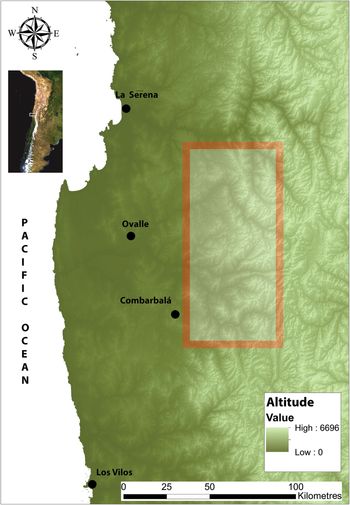
The Diaguita people inhabited the valleys of north Central Chile (between 28° and 32° S Lat) from c. ad 1000 to c. 1540 (Fig. 1). This area is characterized by a semi-arid environment and a fragmented landscape consisting of a series of narrow fluvial valleys running from east to west and delimited north and south by high-altitude Andean mountains. These valleys are connected by north–south ravines.
The area of study.

The Diaguita based their economy mainly on agriculture and their settlement pattern was dispersed, with domestic areas scattered through the valleys, located on river terraces used for agricultural production. Social organization was based on the extended family (who shared a common living and productive space) and not on hierarchical relations. Economically, each of the domestic units was autonomous and self-sufficient (Troncoso Reference Troncoso1999; Troncoso et al. Reference Troncoso, Vergara and Pavlovic2016). These local households would come together into a larger social organization comprising the communities living in a same valley. These larger unities coincide with the differential use of decorative patterns in pottery in each valley, as has been proposed by González (Reference González2010).
The Diaguita produced large amounts of rock art, particularly petroglyphs. In our surveys, covering almost 250 sq. km, we have identified around 3000 engraved rocks with Diaguita petroglyphs, and thousands of individual motifs. Petroglyphs have been found in small sites with as few as one engraved block, or in large concentrations, with sites of more than a hundred engraved rocks. To characterize briefly the rock art produced by Diaguita communities, we will consider three main aspects: its location and spatial organization; its iconography; and the techniques employed in its production (see also Troncoso Reference Troncoso, Alconini and Covey2018).
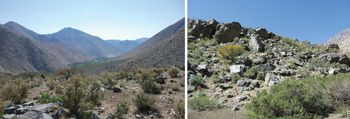
Spatially, petroglyphs were never made within the domestic or productive area. On the contrary, rock-art sites are located on the hillsides of the valleys, between 2 and 10 km distant from residential spaces. Rock-art sites are associated with ravines that create natural paths connecting different valleys of this region (Figs 2 & 3). Thus, rock art was actively excluded from the areas of daily activities, being located in what can be seen as transitional areas between the used space of the valley—the terraces and water—and the space where no activity was carried out—as no archaeological evidence of Diaguita presence has been found beyond rock-art sites in the hills. In terms of the landscape, while the first spaces correspond to the fertile bottom of the valley, the second are arid mountainous areas in between the several valleys of the region.
Landscapes in the area of study, with valley bottoms and ravines.

A view of Diaguita rock-art site.

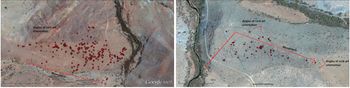
We have found that Diaguita rock-art sites tend to follow a linear pattern, with the engraved faces of the rocks being visible while climbing up the hill, that is, visible on the way out of the valley (Fig. 4). Although hundreds of rocks are available in the places where rock art was made, Diaguita people chose only certain rocks, prioritizing the production of a linear organization of petroglyphs. In general terms, spatial studies have not found any pattern in the distribution of the motifs within the sites with the exception of one type of motif depicting a head: the so-called ‘masks’. These engravings are made in specific locations within the site: in the entrance (border) of each site, where the valley is no longer visible, or where some other change in the landscape is suddenly visible. It seems as if rock-art sites are centred around these features, where the separation from the daily used spaces became visually apparent.
Spatial organization of rocks and movement within two sites: Hacienda El Chacay and Cuesta Pabellón.

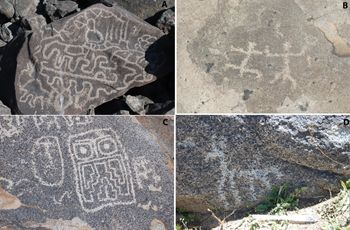
Iconographically, this rock art is characterized by the dominance of non-figurative motifs, which are made based on circles, lines and rectangles, combined following particular symmetry patterns—horizontal translation and rotation (Fig. 5). The scarce figurative motifs can be classified as zoomorphic (identified as guanacos (Lama guanicoe): Troncoso Reference Troncoso2012); simple anthropomorphs made by combining circles and lines; and heads, all of which are never part of a scene. The latter motifs are the most visually complex, being usually quadrangular in shape with composite inner decorations, frequently using geometric figures to depict face features, while using the most complex symmetry patterns of any Diaguita rock-art motif (see Fig. 5c). Also, head motifs are the only ones present in rock art that are also used on other media, particularly on pottery decoration.
Different types of Diaguita rock-art motifs: (a) non-figurative; (b) anthropomorphic; (c) heads; (d) zoomorphic.

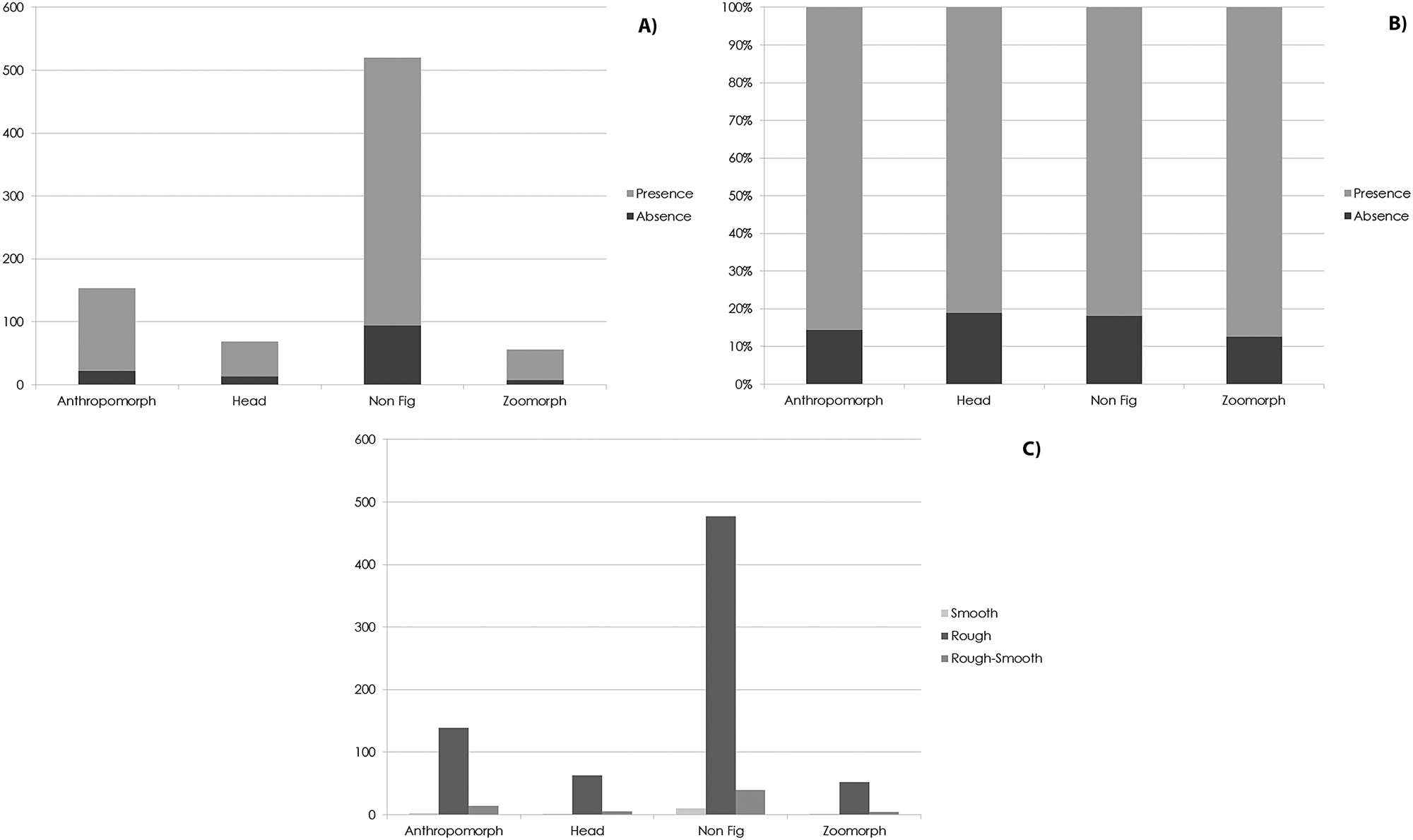
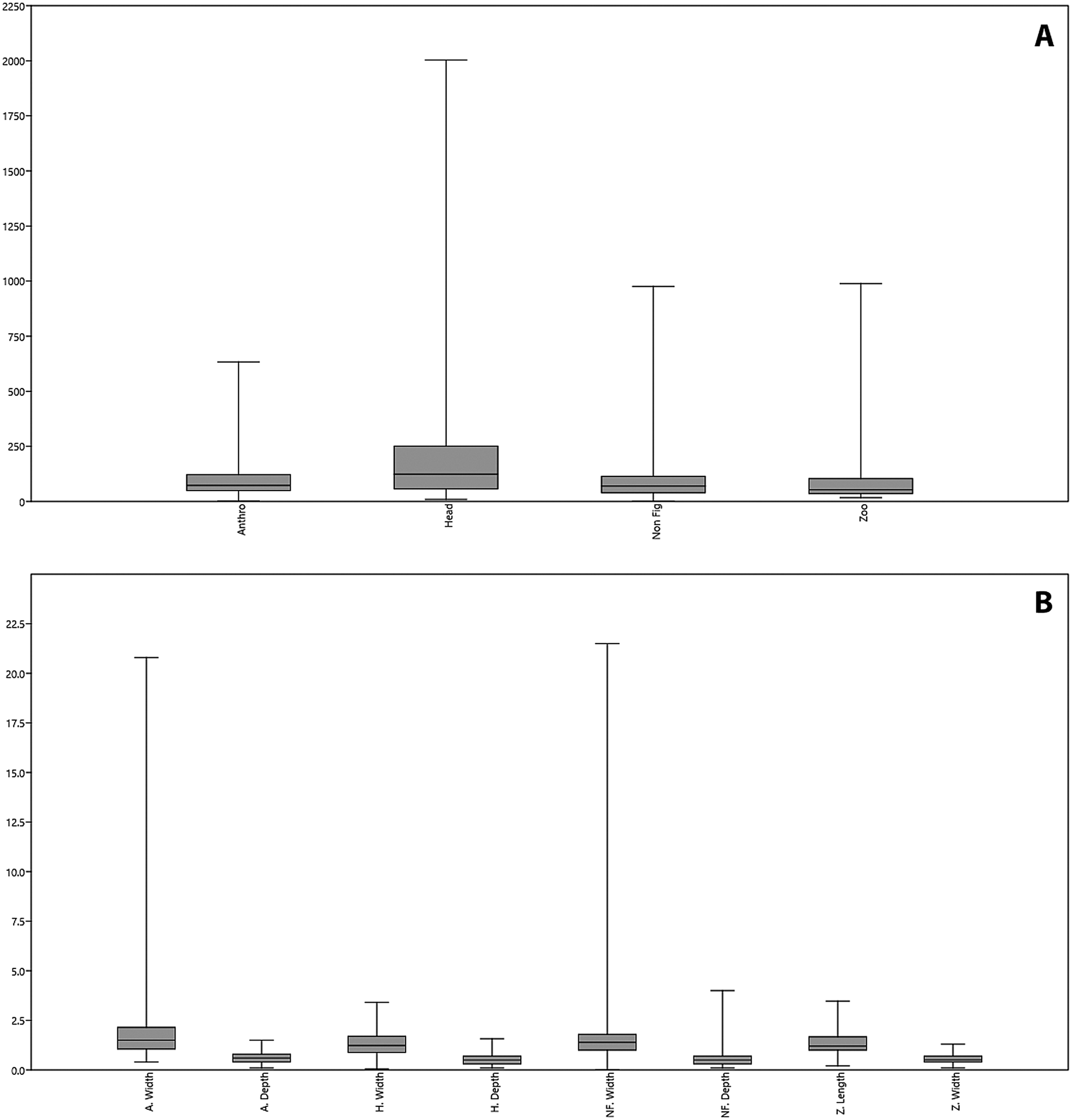
Technically, Diaguita rock art is highly heterogeneous. Macroscopic and microscopic analyses of the grooves show technical variability: the grooves tend to be discontinuous rather than continuous (Fig. 6a), with most of the petroglyphs showing rock cortex that was not completely removed by pecking (Fig. 6b). This suggests that the technical procedures employed required different time investments, something that is reinforced when considering the metric attributes of the petroglyphs. As can be seen in Figure 7, the width and length of the grooves tend to be irregular, showcasing a practice that did not require a controlled and regular stroke, allowing a wide range of groove widths within a same motif.
Technical attributes of rock art: (a) presence/absence of continuous pecking by type of motif; (b) presence/absence of rock cortex by type of motif; (c) types of groove surface by type of motif.

Metric attributes by type of design: (a) groove length; (b) width and depth of groove.

The above suggests that there was not one standardized way of producing petroglyphs, and that the total removal of cortex was not sought. We think that this is related to the possibility of different people producing rock art, people with different degrees of ability in terms of the control of the stroke and the extraction of the cortex, being a rather expeditive practice. Further evidence for this are the shallow depth of the grooves (Fig. 7b) and the rough surface of most of the stroke imprints (Fig. 6c), which suggest that the grooves were made with few strokes and not scraped (Vergara & Troncoso Reference Vergara and Troncoso2015). The manufacture thus involved the direct pecking of the rock, which is consistent with the scarce global evidence of indirect pecking in rock-art production (Bednarik Reference Bednarik2007). All of the above suggests that, in general, motifs did not require many strokes to be produced.
Experimental studies and stratigraphic excavations near rock-art panels have shown that the tools used for producing petroglyphs were angular clasts, available in the same sites or in their immediate surroundings. These tools are characterized by having sharp borders which are easily and efficiently produced and reactivated (Vergara & Troncoso Reference Vergara and Troncoso2015), having similar characteristics to those identified in other regions of the world (e.g. Álvarez et al. Reference Álvarez, Fiore, Favret and Castillo2001; Bednarik Reference Bednarik.1998; Reference Bednarik2007). Thus, tools were widely available, which strengthens our proposal that different people could have produced these petroglyphs and that it was an expeditive practice.
Although the vast majority of the petroglyphs do not need a large labour investment or particular abilities as they are small, include cortex and grooves are irregular (Vergara et al. Reference Vergara, Troncoso, Ivanovic, Bednarick, Fiore, Basile, Huisheng and Kumar2016), there are differences based on the time needed to produce them. When considering the total length of the grooves of different motifs, we noticed that the head motifs demanded more time to be produced, having the longest grooves (Fig. 7). These grooves are also more regular, having constant widths, and strokes removed most of the cortex, creating a higher contrast between the motif and the rock surface. Also, the use of complex symmetrical patterns demands of the artisan some special abilities and/or more experience in the production of petroglyphs. These features indicate that the production of these heads involved more energy and labour investment, as well as probably more time and more developed skills, suggesting that they were made by particular people and not just anyone (Vergara et al. Reference Vergara, Troncoso, Ivanovic, Bednarick, Fiore, Basile, Huisheng and Kumar2016). Head motifs were then unique, being also scarce within the sites and the region: while they are present in most sites, there are usually no more than two or three of them per site.
Relational technology and Diaguita rock art
As discussed above, Andean technology is based upon the reciprocal exchange between humans and their world and the transformations associated to these exchanges (Allen Reference Allen2002; Reference Allen and Bray2015; Bray Reference Bray2009; Reference Bray and Bray2015; van Kessel Reference van Kessel1989; van Kessel & Condori Cruz Reference van Kessel and Condori Cruz1992). It participates within a historically constituted frame of relations, in which humans raise and nurture the world. How can these ideas help us re-assess our understanding of rock-art production from a technological perspective? We argue that this way of looking at Andean technology helps us understand Diaguita rock art as a relational technology and practice, and thus it requires us to widen our focus beyond technical gestures and instruments and consider the field of relations woven between humans and other-than-humans through the act of making.
Considering the characteristics of Diaguita rock art and looking at the chaîne opératoire involved in its production (see also Vergara & Troncoso Reference Vergara and Troncoso2015), we argue that production starts with the movement of humans from their residential areas to the borders of the valleys, spatially distancing themselves from these daily used spaces. This separation is not only physical, but also experiential, as rock-art sites mark the entrance to spaces that are not usually used by these communities. This separation also involved the movement from a green and fertile area to arid ravines and mountains in a journey that covers, at least, a couple of kilometres. Although we have no evidence as to what kind of activities were carried out in those seldom used spaces, we could argue that hunting, collection of firewood, or movement towards other valleys were among them. Also, the absence of archaeological deposits on rock-art sites, or any evidence of other types of artefacts, shows how the experiences in these spaces were different from those stimulated by the residential sites and the activities occurring there (Troncoso & Armstrong Reference Troncoso, Armstrong, Pellini, Zarankin and Salerno2017).
This experiential and practical separation is reinforced by the following stages of the chaîne opératoire (Vergara & Troncoso Reference Vergara and Troncoso2015), consisting of the production of rock art and/or the observation of previously engraved rocks. Neither of these activities occurred in the residential spaces, and even motifs being produced in rock art were mostly not available on other media (with the exception of heads, as will be further discussed later). In addition, the expeditive nature of the tools used to engrave the rocks and the use of materials sourced from the same sites to produce them show how encapsulated in a particular space the stages of production of rock art were. The linear organization of the blocks within the sites implies that intra-site mobility and observation of the petroglyphs were key in the experience of producing, thus affecting the experience of the artisans and visitors in a way that was not affected in the settlement sites. Previously marked rocks also incite people to follow an already set spatial arrangement. All of this stresses once more the differences between these rock-art spaces and daily residential spaces.
Rock-art production involved a wide range of activities, from the movement to a different space, the production of the tools, the strokes on the rocks, and the observation of already engraved rocks. This process was carried out in an organized manner, without directly transforming previously engraved motifs, as indicated by the scarce number of superimpositions (less than one per cent) and the lack of retouching of the motifs, although the same rock could be engraved more than once. The prioritization of a given orientation for the engraved faces of the rocks also indicates the organized production of rock art.
The segregation of rock-art production from daily activities and spaces unfolded a particular kind of relationality, encouraging bodily, material and experiential links that were different from those lived within the residential spaces. Humans moved from their dwellings far from their daily experiences and sensorial stimuli, to a different space where sensoriality was marked by rock art, sounds, smells and visual fields produced mainly by other-than-humans (Troncoso & Armstrong Reference Troncoso, Armstrong, Pellini, Zarankin and Salerno2017). Following ideas by Sørensen (Reference Sørensen2015), we can suggest that people moved from one atmosphere to another, participating in a new set of relations including phenomena, matter, beings and a landscape different to their dwelling areas.
The field of relations unfolded through rock-art production made mediating spaces of the sites with petroglyphs. On the one hand, these sites are located between the areas used daily by the Diaguita communities (river terraces) and those very rarely used (ravines and hills). While close to river terraces Diaguita material evidence is abundant, with residential structures and crop fields, beyond rock-art sites there is no archaeological evidence of these communities, suggesting a very different use of the space, with different social practices and experiences. Rock-art sites are, then, mediating between two different taskscapes (sensu Ingold Reference Ingold1993) and experiences.
On the other hand, as other authors have identified (e.g. Ampuero & Hidalgo Reference Ampuero and Hidalgo1975; González Reference González2010; Troncoso et al. Reference Troncoso, Vergara and Pavlovic2016), each valley in this region seems to have been inhabited by a particular community with some degree of socio-political autonomy during Diaguita times. By being in ravines associated to mobility routes connecting different valleys, rock-art sites are located in places that mediate between different communities, marking the spaces of leaving and entering the valleys, and thus the territories of the communities.
Rock-art sites were also places mediating between different human members of the Diaguita communities. Considering the lack of formal public spaces (such as plazas), the repetition of the social practice of marking rocks (evidenced in the many rocks engraved in each site and the region) and the many hands involved in rock-art production, rock art sites were spaces that allowed people, through circulation and inter- and intra-action with marked rocks and the images on them, to relate with each other. Rock-art sites possibly played the role of public spaces (Troncoso & Armstrong Reference Troncoso, Armstrong, Pellini, Zarankin and Salerno2017; Troncoso et al. Reference Troncoso, Vergara and Pavlovic2016). They were visited and intervened by multiple people in a multi-temporal effort, as petroglyphs were produced through the years, as suggested not only by the large numbers of petroglyphs in some sites, but also by the different weathering of petroglyphs in the same block and panel. Co-occurrence among human beings, then, was mediated and articulated by marked rocks and images anchored in the stones and landscape.
By becoming a mediating place, rock-art sites not only encouraged the interaction between different humans, communities or taskscapes; they made possible the relationship between humans and other-than-humans, also members of the extended relational communities of the Diaguita. Such a mediating role is particularly relevant in the Andean world. As different scholars have suggested, a basic principle in the organization of the world for Andean people is the existence of a multiplicity of beings and other-than-human persons, who are distributed in opposite but complementary pairs, generating a dual world. The two segments of the world are inhabited by and contain the different participants of the world and the phenomena that animate the world (Allen Reference Allen and Bray2015; Harris & Bouysee-Cassagne Reference Harris, Bouysee-Cassagne and Albo1988; Mariscotti Reference Mariscotti1978). Life in the Andes is a constant transaction between human and other-than-human persons, structured by rights and duties which make it possible to raise and nurture the world, multiples beings and life (e.g. Allen Reference Allen2002; Reference Allen and Bray2015; De la Cadena Reference De la Cadena2015; Manheim & Salas Carreño Reference Manheim, Salas Carreño and Bray2015). One of the duties is to maintain the halves that shape the world, keep them separate and strengthen the centre.
In the Andean world (and in analogic ontologies, following Descola Reference Descola2013; Reference Descola2014), centres or mediating spaces keep the opposite and complementary sections apart, maintaining the balance that allows the world to reproduce. In fact, as has been argued by Harris and Bouysee-Cassagne (Reference Harris, Bouysee-Cassagne and Albo1988, 240), the multiple other-than-human and human participants of each half ‘cannot coincide, they reject, annul and oppose each other, as day and night, water and fire, as enemies’ (translation is ours). This speaks about a tension between them, and to mediate it is a dangerous task. Dangers are caused by the constant possibility of an excess of contact between the halves, which would provoke the loss of identity of the different beings and the creation of a homogenous, unorganized whole. On the other hand, the total separation of these halves would tear the world apart, making it impossible to relate, to connect, or, in Descola´s terms, to create analogies. Mediation occurs in a liminal world, between beings and energies that are radically different and opposed.
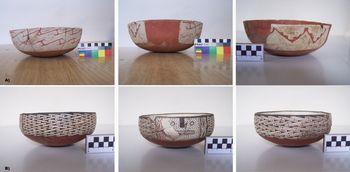
This kind of organization is not unknown for Diaguita culture. As iconographic analysis of pottery has shown, the dual organization of the decorative field as well as the alternance of opposite colours and motifs are a structural principle of decorative patterns (González Reference González2013, fig. 8a). Also, some authors have identified this dual system in funerary offerings (Ampuero Reference Ampuero1994).
Diaguita pottery: (a) pot showing a dual organization of motifs; (b) zoo-anthropomorphic ceramic pots where a head is located between two decorative fields, acting as a centre.

Rock-art sites, then, constituted mediating places that marked the separation between different spaces (bottom valley/ravines and mountains, residential/non-residential) and communities. This procedure made it possible to keep the elements composing different dualities apart and avoid contact between them. Their physical location facilitated their role of mediating between humans, but also the mediating function required engagement with a series of other-than-human beings each inhabiting this world and avoiding contact with the opposite, as we can also see in the pottery.
Based on the above, we can understand the practice of engraving rocks in the landscape as a transactional practice, one in which humans interacted among themselves, but also with other-than-human beings. Each productive act was then an attempt to reproduce and re-activate this field of relationships, keeping the balance between the different segments of the world. In this way, producing rock art was not just the marking of a space with discourses and meanings, but rather was an embodied practice of affection, interaction and transaction. The privileged position acquired by these spaces, thanks on the one hand to the practices of pecking and on the other to the petroglyphs that remained in the sites, made possible the relation between humans and other members of the collective, extending it across time. In this way, these mediating places also encompassed different times and different acts of balancing.
In this way, and following van Kessel's (Reference van Kessel1989; van Kessel & Condori Cruz Reference van Kessel and Condori Cruz1992) and Allen's (Reference Allen2002; Reference Allen and Bray2015) proposals, to produce rock art was a practice that facilitated the upbringing and reproduction of the Diaguita world through keeping the opposites separate and avoiding their contact. Making, in this context, was more than the expression of a series of symbolic elements: it set in motion a field of historically constituted relations that included both humans and other-than-humans. These participants of the meshworks integrated, mediated and reproduced the balance of the world in these spaces; a world and a community composed by different members and different times was displayed through the affective capacities of these spaces in this particular historical fabric.
Following the above argument, it is possible to think about the production of Diaguita rock art as a historically situated practice. The field of relationships made possible by rock-art production involved the configuration of an onto-political dynamic, in which multiple participants (humans and other-than-humans), affected each other, which required the updating and maintenance of a system based on dualities, in order to keep the world in order.
Relational heads and community
The relational role of rock-art sites is clearly expressed by the presence and affects of the head motifs previously discussed. As we mentioned before, head motifs show a set of iconographic, spatial and technical differences when compared to the rest of the Diaguita rock-art motifs. These images are the most complex, expressed in the kinds of symmetry patterns used, the regularity of the grooves and the overall length of them, all of which suggest that they required the highest energy investment for their production (Vergara et al. Reference Vergara, Troncoso, Ivanovic, Bednarick, Fiore, Basile, Huisheng and Kumar2016) (Fig. 5c). The uniqueness of these motifs is also expressed in their iconography, insofar as they depict heads, a highly relevant element in the Andean world, associated to notions of fertility, ancestry and political power, among others (Arnold & Hastorf Reference Arnold and Hastorf2008). There are two other particularities to the heads: i) they are always located in central spaces or where changes in the visual field or in the movement pattern occur within the site; and ii) they are the only kind of petroglyph motif that has been found on other media, in this case ceramic pots. In fact, a particular piece of Diaguita pottery corresponds to the so-called zoo-anthropomorphic ceramic pots, where a human-feline head is depicted and framed by two decorative bands using non-figurative motifs based on dual scheme of opposite figures by forms or colour (Fig. 8b). Heads in pottery are only depicted in this kind of vessel.
Heads in petroglyphs and heads in pottery can be understood as a mediating element, a kind of centre. Heads in pottery present attributes associated to felines, such as the presences of dots and incisive teeth. These characteristics have been interpreted in relation to a being that mediates between two different spaces, one that has the ability to transform and change, hence the feline features (González Reference González2013; Latcham Reference Latcham1926; Troncoso Reference Troncoso2005).
We argue that heads on rock art act in a similar way as in pottery. They not only show a certain level of transformation of the human face, but they are also located in a central space within rock-art sites, as discussed above, marking a transition between spaces within rock-art sites (i.e. closed versus open viewshed). These attributes lead us to suggest that these heads are somehow related to leaders of the Diaguita communities. Although the archaeological record suggests a rather egalitarian society, funerary contexts have shown that, within their homogeneity, there are some graves with elements of the so-called hallucinogenic complex, particularly spatulas and inhaling tubes. Bioanthropological studies, although scarce, have shown that the bodies in these tombs lack muscular attachments, and also had slightly different diet than the rest of the bodies, as shown by isotopic levels (Alfonso et al. Reference Alfonso, Troncoso, Misarti, Larach and Becker2017; Troncoso Reference Troncoso1999). This suggests the existence of some kind of difference between people buried with the hallucinogenic complex and the rest of the social group. We think that these people acquired a different position within their communities. This difference would have been based on their knowledge, but more interestingly, on their use of hallucinogenic substances, which in the Andes facilitated the transformation of some people into their alter egos, usually felines (Saunders Reference Saunders1998). Through these transformations, these people had the ability to connect between different spaces and worlds, and through their knowledge and abilities engage with humans and other-than-humans. In this way, they were enacted as mediators which would have made them leaders within the political webs of their time, involved in establishing and re-actualizing relations with the different members of the extended and relational Diaguita community. Their position of mediators between opposite elements is clearly expressed in the visual structure of the so-called zoo-anthropomorphic pot and the spatial emplacements of heads within rock-art sites.
We argue that these heads can be seen as composite identities, following Severi's discussion on the chimerical aspects and the legitimacy of art (Reference Severi2015; Reference Severi2016). From this perspective, heads are the sum of a series of relations, but at the same time they are more than these relations. It is in these motifs that energies and different members of the collective came together in a given place. These heads are the relations between the community and their world, their landscape and the material attributes of it. Heads synthesize the technological web aiming at the reproduction of the world through the maintenance of the balance between its different participants and energies. This is why heads are technically the most complex type of petroglyph design (Vergara et al. Reference Vergara, Troncoso, Ivanovic, Bednarick, Fiore, Basile, Huisheng and Kumar2016): their production was a transaction with the synthesis of the community at different scales, with its different members and times, which required a set of abilities and knowledge that other acts of interaction with the rocks did not. Producing the heads activated a whole political field, building social difference by stressing the role of those who initiated these relations. We are not, however, arguing that these motifs represented the leaders as specific persons. Rather, we propose that heads functioned at different levels, first as distributed persons (sensu Gell Reference Gell1998) associated to the leader and his/her capacity to mediate and keep the balance of the world; and secondly, they acted as a composite identity that maintained and reproduced a community anchored to the landscape, and to a history that was woven in the practices of engraving and visiting these spaces.
Thus, rock art was the fixing and actualizing of a series of relations that went beyond the mere act of pecking on rocks to produce a petroglyph. For Domínguez Rubio (Reference Domínguez Rubio2015), there is a discrepancy between things and objects, in which the former ‘should be understood as material processes that unfold over time, while objects are the positions to which those things are subsumed in order to participate in different regimes of value and meaning’ (Reference Domínguez Rubio2015, 61–2). In this sense, for this scholar an object refers to a specific position in the dynamic existence of a thing. Following this distinction, petroglyphs were an attempt to avoid the separation between the thing (in this case the mediating space with its dynamic energies and other-than-human participants) and the object, the ordered, balanced place allowing the world's reproduction. In other words, rock art permitted this space to stop being a process, making it into a position, an organized object that had a role to play both for and within the community. Thus, we can think of the continuous production of rock art in these sites as a way of constantly enforcing the mediating role of this place, where different members of the collective meet each other in a controlled way. Rock-art production can be seen as a curatorial technology: it aimed at the actualization of the link between the community and its landscape and between humans and other beings. It is in this process that these communities became distributed communities across a wide range of different members (Harris Reference Harris and Watts2013).
Concluding remarks: relational technologies in the Andes
Using rock art as a study case, we have discussed the relational character of Andean technology. By combining archaeological, anthropological and ethnographic information, we explored an approach that highlights the historic link between humans, other-than-humans, social life and landscape in the process of rock-art making. Through this process, world and community are cultivated (van Kessel Reference van Kessel1989), according to a basic principle of the Andean world: the constant and necessary exchange and circulation of vitality flows between different members of this world, aiming at the maintenance of life (Allen Reference Allen and Bray2015; Bray Reference Bray and Bray2015).
Moving away from cognitive and symbolic approaches to technology allowed us to understand these productive actions within a complex historical and social framework, where different beings articulated with specific times and spaces, in order to reproduce the world. In this way, objects and the productive process are not passive elements upon which meanings, cognitive principles or representations are imposed. Rather, it is from these acts and the new entities produced that a complex relational field is woven, bringing to the fore certain beings and places and excluding others. Thus, each productive act articulates and reproduces these fields, connecting different members of the collective, times and spaces within socio-political processes. In other words, these acts produced communities’ landscapes and history itself.
In this paper we have tried to highlight the relationship between rock art and a series of other-than-humans and humans in specific spaces, thus bringing to the forefront the creation and maintenance of a mediating space that made possible the continuation of a distributed community. In that same process, we argue, not only was the community created, but also a socio-political dynamic related to the becoming of these communities and of particularly relevant members of them, who secured the mediation of the different members of the collective. In this way, each stroke on the rocks activated multiple beings, times and social elements in this faraway corner of the Andes. The act of pecking was as relevant, or more so, than the motifs depicted.
Making petroglyphs set in motion a series of relations between different beings, and the sequence of actions leading to the production of a petroglyph aimed at making these relations visible, revealing something that made possible the keeping of order. In this sense, each technique employed was based upon, and triggered by, the interconnections between different beings and their qualities. The sequential understanding of the making is thus limited, and we proposed a broader view where techniques unfolded into a technological web that included the artisan's actions, materials and tools, but also the participation of other-than-human beings, and the relations established between them.
Petroglyph making can be seen as a pago, an offering made by humans in order to secure the reciprocal link with other members of their world. The artisans in this context engraved rocks in an already living space, where energies and the qualities of materials gathered. We agree with Ingold's proposal as to how people ‘follow them [the materials], weaving their own lines of becoming into the texture of material flows comprising the lifeworld’ (Ingold Reference Ingold2011, 215). This idea reinforces our argument that producing rock art is not a one-way stream of impositions, but rather the interaction between humans and the materials, and other other-than-humans, in a reciprocally affecting dynamic.
Petroglyphs themselves are not final products; they are the means for the maintenance of these spaces and the actualization of the relations that were mediated there. Thus petroglyphs themselves played a role in attempts to keep the world in order, to balance its different members and control their energies. Engravings on the rocks and the technical actions required for their production played a fundamental part in nurturing the world.
Acknowledgements
A preliminary version of this paper was presented at the conference ‘Technology: Ideology, Economics and Power in the Andes’ held at the UCL Institute of Archaeology in 2015. We would like to thank Bill Sillar, Viviana Siveroni and Miguel Fuentes for organizing such an interesting and thought-provoking conference, and also the participants of the conference, who gave us valuable feedback. We are also grateful to the editors of this journal and to the anonymous reviewers who provided important suggestions for improvements. This research was funded by Fondecyt grants 1150776 and 1170408. Special thanks to the members of our archaeological team who have been the real support of this work.