INTRODUCTION
Luidia clathrata (Say 1825) is a common species of starfish in the western Atlantic Ocean ranging from the east coast of the United States to Brazil. It inhabits sandy-bottom areas ranging from 0–40 m depth, and is often found in bays (Franz et al., Reference Franz, Worley and Merrill1981; Hendler et al., Reference Hendler, Miller, Pawson and Kier1995; Lawrence et al., Reference Lawrence, Durán-González, Solís-Marín and Herrera2013). Previous studies have investigated physiological responses to temperature and salinity (Forcucci & Lawrence, Reference Forcucci and Lawrence1986; Watts & Lawrence, Reference Watts and Lawrence1990a, Reference Watts and Lawrenceb; Hintz & Lawrence, Reference Hintz and Lawrence1994), regeneration rate of the rays (Pomory & Lares, Reference Pomory and Lares2000) and biochemical composition (Watts & Lawrence, Reference Watts and Lawrence1990a; Knott & Hopkins, Reference Knott, Hopkins, Mooi and Telford1998).
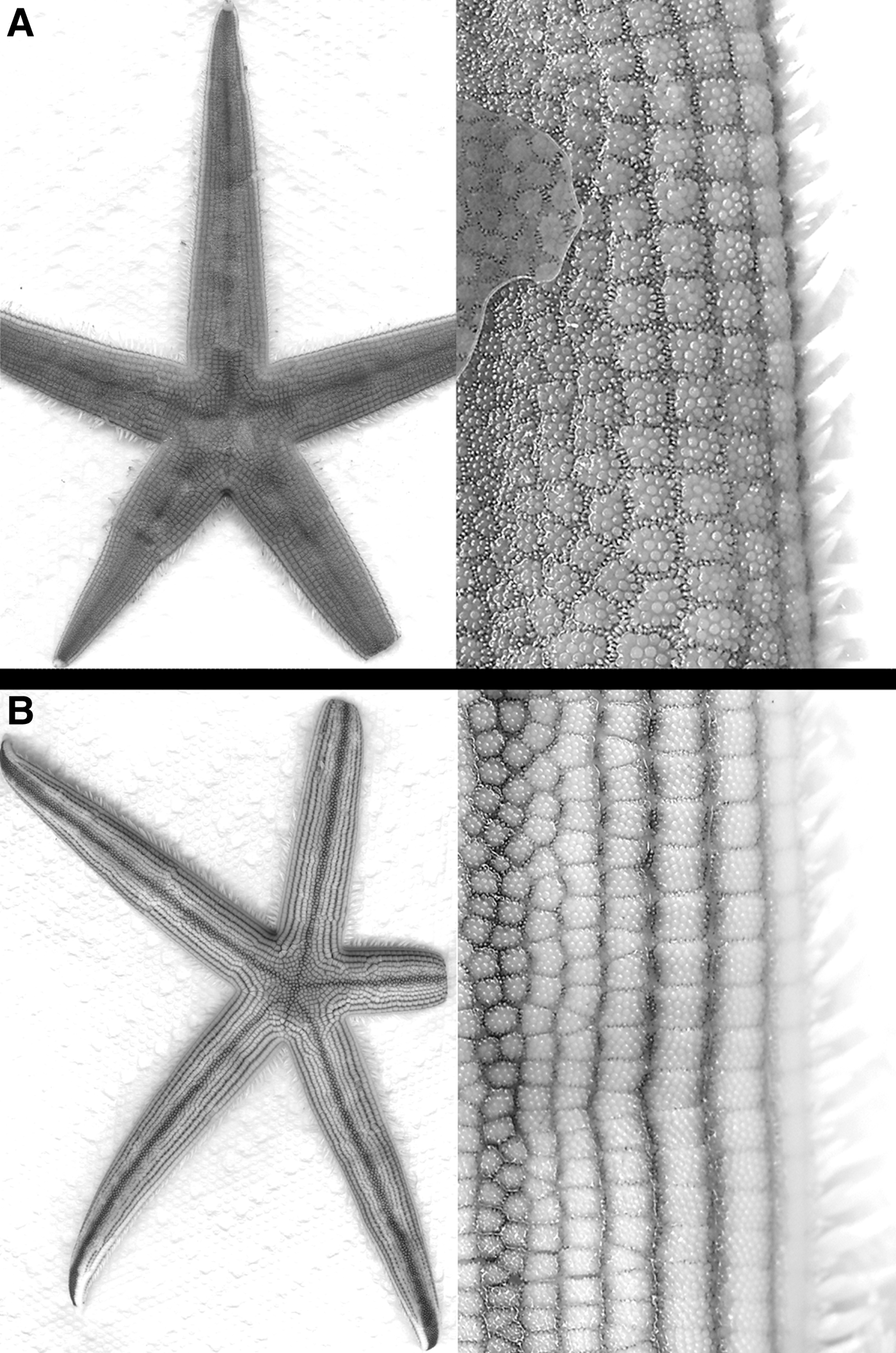
In the past L. clathrata was described as having two colour morphs of grey and tricolour (Knott & Hopkins, Reference Knott, Hopkins, Mooi and Telford1998). The grey morph exhibits dark grey paxillae, while the tricolour morph has cream-coloured paxillae with orange shading on the edge of each ray on the aboral surface. Other characteristics which have been used to distinguish among the colour morphs include the arrangement, size and shape of paxillae on the arms, and the inferomarginal spines near the mouth (Knott & Hopkins, Reference Knott, Hopkins, Mooi and Telford1998; Hopkins & Knott, Reference Hopkins, Knott, Harris, Böttger, Walker and Lesser2010). Knott & Hopkins (Reference Knott, Hopkins, Mooi and Telford1998) also found allozyme differences between the two colour morphs collected from coastal areas of Alabama and Florida. Knott & Wray (Reference Knott and Wray2000) included the two colour morphs, one individual from the Gulf of Mexico and one individual from the Atlantic Ocean, in a larger study evaluating relationships among several orders within the Asteroidea using a section of the COX-1 gene and found a genetic difference among the colour morphs with a homology score of 79%. Based on morphological, allozyme and COX-1 data, Hopkins & Knott (Reference Hopkins, Knott, Harris, Böttger, Walker and Lesser2010) described the colour morphs as two species with the grey morph as L. clathrata and the tricolour morph as Luidia lawrencei Hopkins & Knott, Reference Hopkins, Knott, Harris, Böttger, Walker and Lesser2010, with the establishment of a new holotype for L. clathrata.
Colouration and morphology may vary greatly within a species, so comparative approaches using other aspects of the biology of an organism should be considered when assessing similarity or dissimilarity of populations. Even though allozyme analysis has been widely used, estimates of genetic differentiation based on allozyme data alone provide only a crude measure of genetic divergence between species (Bush, Reference Bush1975; Zhang et al., Reference Zhang, Leung, Chan, Chen and Wu2002). Due to the complex genetic make-up of organisms, molecular evidence supporting taxonomic relationships should include more than one sampled individual to ensure better representation of the population. Palumbi (Reference Palumbi1994) suggested that investigations of speciation looking for differences in more than one level of an organism's biology would lead to an increased understanding of the underlying genetic mechanisms that result in separation and niche differentiation. As speciation takes place the incipient species should show some shifts in responses to resources/conditions, shifts which may help explain the basis of their splitting (Nosil, Reference Nosil2008).
The distributions of the colour morphs in the Gulf of Mexico seem to differ, with the grey morph usually found in depths ranging from 5–20 m, and often within estuaries; while the tricolour morph is found in depths ranging from 20–40 m, and rarely within estuaries (Hopkins et al., Reference Hopkins, Thompson, Knott, Tingle, Carnevali and Bonasoro1999; Hopkins & Knott, Reference Hopkins, Knott, Harris, Böttger, Walker and Lesser2010; Lawrence et al., Reference Lawrence, Durán-González, Solís-Marín and Herrera2013). Two possible environmental differences that correlate with the distributions are sediment type and salinity (Hopkins & Knott, Reference Hopkins, Knott, Harris, Böttger, Walker and Lesser2010; Lawrence et al., Reference Lawrence, Durán-González, Solís-Marín and Herrera2013). Sediment particle size is an important factor determining distribution and diversity of species both geographically and bathymetrically (Whitlack, Reference Whitlack1981; Etter & Grassle, Reference Etter and Grassle1992; Gray & Elliott, Reference Gray and Elliott2009). Salinity is one of the most important environmental determinants of organismal performance, distribution and abundance in estuarine marine environments (Gunter, Reference Gunter1961; Kinne, Reference Kinne and Kinne1971; Stickle & Diehl, Reference Stickle, Diehl, Jangoux and Lawrence1987; Berger & Kharazova, Reference Berger and Kharazova1997). Most echinoderms are stenohaline, with only a few species routinely found in estuarine habitats (Russell, Reference Russell and Lesser2013). Luidia clathrata can survive long-term hyposaline conditions as low as 17 g kg−1 and tolerate short-term exposure as low as 14 g kg−1 (Ellington & Lawrence, Reference Ellington and Lawrence1974). Forcucci & Lawrence (Reference Forcucci and Lawrence1986) demonstrated that lowered salinity inhibits growth, food intake and activity level in L. clathrata. Based on collection records, none of the past research has included L. lawrencei (Lawrence et al., Reference Lawrence, Durán-González, Solís-Marín and Herrera2013).
Given the limited amount of literature available for the newly established species L. lawrencei and the suggested environmental differences where the two species are commonly found, the present research implemented a comparative approach evaluating L. lawrencei and L. clathrata as to possible genetic (COX-1), behavioural (sediment preference) and physiological (salinity tolerance) differences. Hebert et al. (Reference Hebert, Ratnasingham and deWaard2003b) found the mean divergence for COX-1 in echinoderms was 10.9%, which suggests that if L. clathrata and L. lawrencei are separate species per cent divergence within this gene would be expected to exceed 10%. Sand tends to be finer in estuaries, and coarser, as well as mixed with shell fragments, offshore (Swift et al., Reference Swift, Oertel, Tillman and Thorne1991; McManus, Reference McManus1998; Vaughan et al., Reference Vaughan, Griggs, Kim, Bianchi and Smith2009; Williams et al., Reference Williams, Flocks, Jenkins, Khalil and Moya2012). Salinity can be highly variable and lower in estuaries compared with offshore areas (Boyer et al., Reference Boyer, Levitus, Garcia, Locarnini, Stephens and Antonov2005; Telesh & Khlebovich, Reference Telesh and Khlebovich2010). Based on distribution records of the two species (Lawrence et al., Reference Lawrence, Durán-González, Solís-Marín and Herrera2013) and suggestions made in Hopkins & Knott (Reference Hopkins, Knott, Harris, Böttger, Walker and Lesser2010), it is hypothesized that L. clathrata should have a preference for smaller grain sizes and be more tolerant of lower salinity, while L. lawrencei should prefer larger grain sizes and be less tolerant of lower salinity.
MATERIALS AND METHODS
Collection and laboratory acclimation
Specimens of L. clathrata (Figure 1A) were collected using an otter trawl in Pensacola Bay, Florida (30°21′1N 87°12′22W) at a depth of 5–10 m, and specimens of L. lawrencei (Figure 1B) were collected using an otter trawl just outside Pensacola Bay in the Gulf of Mexico (30°12′6N 87°12′81W) at a depth of 15–30 m in November 2007 and April 2008. Starfish were held in 38 l glass aquaria at a temperature of 21–23°C and a salinity of 35 g kg−1 for 3 weeks before starting experimentation. Each aquarium contained an air-driven box filter, recirculating water independently in each tank, and mixed grain sand (3 cm deep) collected from Pensacola beach. Two starfish were randomly assigned to each tank, one from each species. Individuals within a tank were separated from one another by a perforated plastic divider set in the middle of the tank allowing water to circulate, but preventing starfish from physically coming in contact. Each starfish was fed 3 g of previously frozen bay scallops every third day. Temperature and salinity were monitored daily; ammonia, phosphate and pH levels were monitored weekly.
Photographs showing morphology of (A) Luidia clathrata and (B) Luidia lawrencei.

Genetic similarity
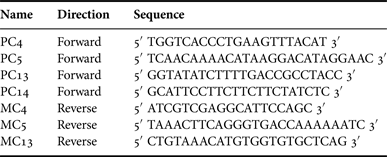
Starfish (five of each species) were preserved in 95% ethanol, and DNA was isolated using the genomic DNA isolation kit by Qiagen from approximately 10 tube feet from each individual. Primers targeting three segments of the mitochondrial COX-1 gene (Table 1) were designed based on published sequences of Luidia quinalia (Matsubara et al., Reference Matsubara, Komatsu, Araki, Asakawa, Yokobori, Watanabe and Wada2005; NCBI Accession #NC006664), L. clathrata (Knott & Wray, Reference Knott and Wray2000; NCBI Accession #AF217377) and previously published primers by Folmer et al. (Reference Folmer, Black, Hoeh, Lutz and Vrijenhoek1993). All customized primers were made by Sigma-Aldrich. The Accuprime Taq DNA polymerase high fidelity kit by Invitrogen was used for PCR. Four 50 µl reaction tubes were prepared per sample. Each reaction included ~100–250 ng of isolated total DNA, 20 pmol of each of the forward and reverse primers, and 2.5 units of AccuPrime Taq High Fidelity in final 50 µl of 1X AccuPrime PCR Buffer II. The specificity of PCR reaction was tested with four reactions per set of primers; one included both forward and reverse primers, while the other three were negative controls to test the specificity of amplification of each primer set.
Primers used for targeting segments within the COX-1 gene in Luidia clathrata and Luidia lawrencei.
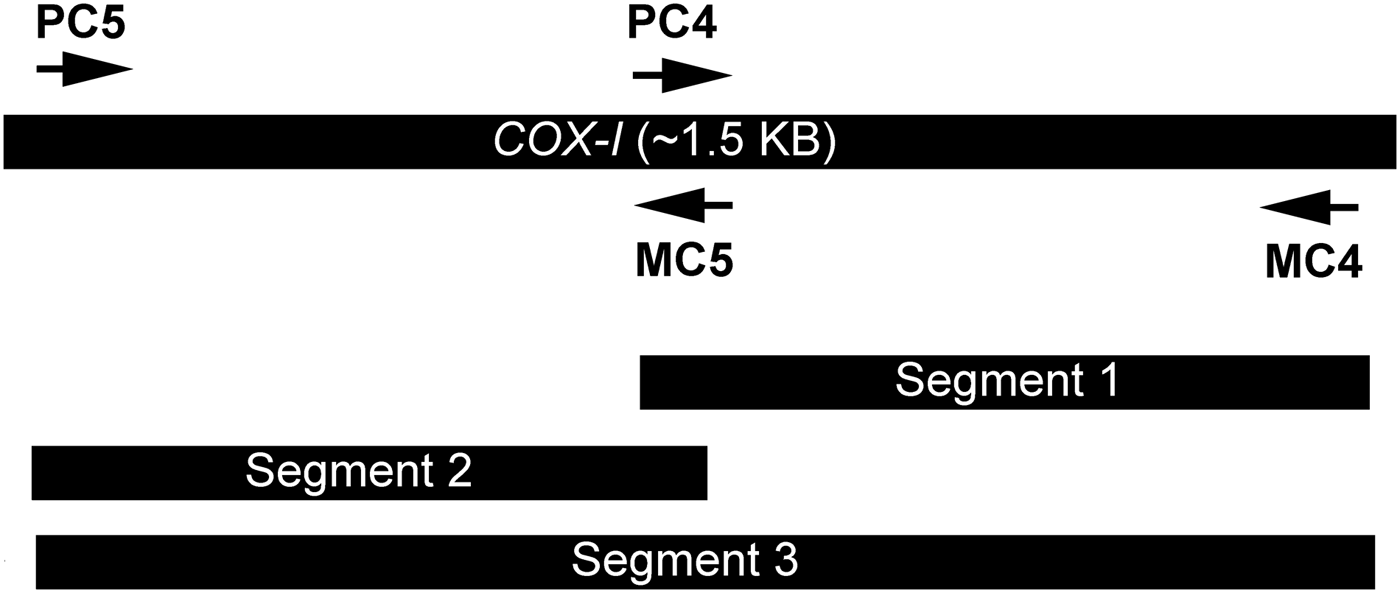
Three segments derived from COX-1 gene were amplified: Segment 1 using primers PC4 and MC4 targeted a ~600 bp fragment close to the 3′ end of the COX-1 gene, Segment 2 using primers PC5 and MC5 targeted a ~600 bp fragment close to the 5′ end of the COX-1 gene, and Segment 3 using primers PC5 and MC4 targeted a ~1200 bp fragment containing most of the COX-1 gene (Figure 2). In order to determine whether samples from different areas of the same starfish rendered different mtDNA sequences, mtDNA was obtained from tube feet of two different arms (internal replication) of four L. lawrencei. An additional fifth individual with only one arm sampled was also included. Conditions of PCR of segment 1 from L. lawrencei were 5 min at 94°C for initial denaturing followed by 30 cycles of 30 s at 94°C (denaturation), 30 s at 54°C (annealing) and 1 min at 68°C (extension), and one final cycle of extension for 10 min at 68°C. Conditions of PCR for segment 1 of L. clathrata (N = 5, tube feet of one arm per individual sampled, no internal replication) were 5 min at 94°C for initial denaturing, followed by 30 cycles of 30 s at 94°C (denaturation), 30 s at 50°C (annealing) and 1 min at 68°C (extension), and one final cycle of extension for 10 min at 68°C. Primers PC13, PC14 and MC13 targeting overlapping areas of segments 1 and 2 were also used to amplify the COX-1 gene (data not shown).
Schematic presentation of the three COX-1 gene amplicons, Segments 1–3, used in mtDNA analysis of Luidia clathrata and Luidia lawrencei.
The amplified COX-1 gene segments were sequenced by the Columbia University Medical Center (CUMC) DNA sequencing facility using the above primers. Sequence files obtained from CUMC were analysed using FinchTV (Geospiza, chromatogram viewer: http://www.geospiza.com/Products/finchtv.shtml), and only areas within the sequence that resulted in clear peaks (high confidence in the nucleotide that was identified) were used to create final sequences. Final sequences were compared with the NCBI database using BLAST (http://blast.ncbi.nlm.nih.gov/). MEGA v. 5 (http://www.megasoftware.net/mega.php) was used to compare alignments and calculate per cent genetic homology among samples from the current experiment, and with GenBank sequences from Luidia foliolata.
Sediment preference
Sediment preference analysis was carried out by sieving (US standard testing sieves) dry sand collected from Pensacola beach into four different grain size fractions of 1000–1999, 500–999, 250–499 and 125–249 µm. A choice and control chamber were constructed from a square plastic tub (43 × 43 × 18 cm) divided into four sub-compartments by a +-shaped divider (4 cm high) attached to the bottom. Each sub-compartment in the choice chamber was filled with sand of a different grain size fraction. Each sub-compartment in the control chamber was filled with unsieved, mixed-grain sand. Both chambers contained water similar to the holding aquaria, but without filtration. Individuals (N = 37 L. clathrata, N = 34 L. lawrencei) were placed in the centre of both the choice and control chambers, allowing contact with sediment in each of the four sub-compartments, and first choice of burial was recorded.
Distribution among the four sub-compartments of choice and control chambers for each species was compared with a null hypothesis of equal distribution by goodness-of-fit tests, and between species by contingency table tests (Zar, Reference Zar2010). Goodness of fit tests and contingency table tests were calculated using a corrected log-likelihood statistic (Smith et al., Reference Smith, Rae, Manderscheid and Silbergeld1981). The six tests involving sediment preference were considered a family of tests with a family-wise α = 0.05. The individual α for each of the six tests was set using a modified Bonferroni method to control for multiplicity (Holm, Reference Holm1979; Lehmann & Romano, Reference Lehmann and Romano2005).
Salinity tolerance
Righting response frequency (number of individuals righting themselves after being turned upside down), and righting response time (time for an individual to turn itself right side up after being turned upside down) were recorded as measures of salinity effect (Lawrence & Cowell, Reference Lawrence and Cowell1996). A designation of non-righting response was based on no movement after 30 min of being upside down. Salinities of 30, 25, 22 and 20 g kg−1 were tested in sequential order of decreasing salinity with all starfish finishing a salinity level before the next salinity level was tested. A recovery period in the holding aquaria of at least 24 h was provided between salinity level trials in order to diminish carry-over effects. Righting response times of individuals within the holding aquaria (35 g kg−1) were measured before each new lower salinity trial began.
A separate 38 l aquarium situated near the holding aquaria was used as the salinity test chamber. Filtered natural seawater was diluted using deionized water to create 20 l of lower salinity water (enough to cover a righting starfish). Water temperature and bottom sediment in the salinity test aquarium were similar to the holding aquaria, but without filtration. Individuals were selected one at a time in random order from both species and placed in the salinity test aquarium for 30 min, representing an acute (short-term) salinity change, after which righting response time (s) was recorded and the starfish returned to the holding aquaria. A new 20 l batch of water was mixed for each starfish creating independent replicates of salinity, and eliminating the need for filtration due to the short amount of time that each starfish spent in the salinity test aquarium.
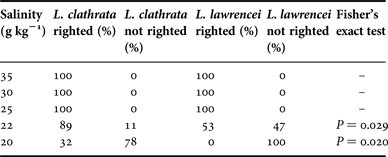
Righting response frequency between species, when fewer than 100% of both species righted, was analysed using Fisher's exact test (Zar, Reference Zar2010). The two tests involving righting response frequency (22 and 20 g kg−1, N = 19 L. clathrata, N = 19 L. lawrencei) were considered a family of tests with a family-wise α = 0.05. The individual α for each of the two tests was set using a modified Bonferroni method to control for multiplicity (Holm, Reference Holm1979; Lehmann & Romano, Reference Lehmann and Romano2005).
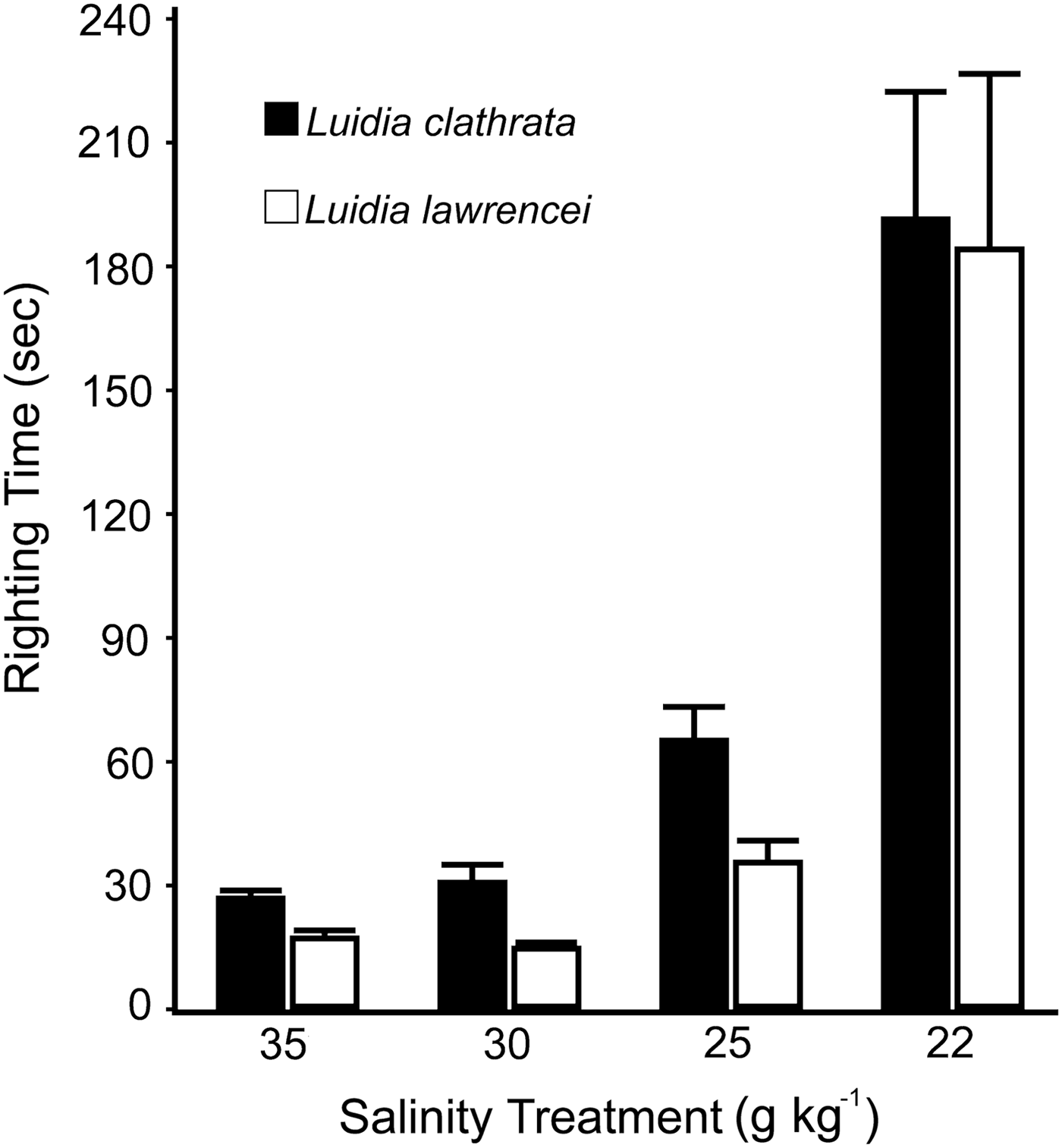
As comparisons between pairs of salinity treatments/trials were of interest and included both repeated measures and independent measures, righting response time within each species was analysed with paired t-tests and between species with independent t-tests (Zar, Reference Zar2010) for salinities of 35, 30, 25 and 22 g kg−1 for individuals that righted at all salinities (N = 17 L. clathrata, N = 10 L. lawrencei). No L. lawrencei righted at 20 g kg−1, so that salinity treatment was not included in the righting response time analysis. The 28 tests (six tests within each species comparing times at the four ‘control’ trials of 35 g kg−1, six tests within each species comparing times at the four different salinities using the average time of the four ‘control’ trials for the 35 g kg−1 and four tests comparing species to one another at each of the four different salinities) involving righting response time were considered a family of tests with a family-wise α = 0.05. The individual α for each of the 28 tests was set using a modified Bonferroni method to control for multiplicity (Holm, Reference Holm1979; Lehmann & Romano, Reference Lehmann and Romano2005). Normality was tested using skew, kurtosis, D'Agostino-Pearson and Anderson–Darling tests (Anderson & Darling, Reference Anderson and Darling1954; D'Agostino et al., Reference D'Agostino, Belanger and D'Agostino1990; Pomory, Reference Pomory2006). Homogeneity of variance was tested using the Brown–Forsythe test (Brown & Forsythe, Reference Brown and Forsythe1974; Conover et al., Reference Conover, Johnson and Johnson1981). All righting response time data were ln transformed before statistical analysis. Untransformed means and standard errors are presented in the figure.
RESULTS
Genetic similarity
Mitochondrial COX-1 gene segments were amplified from multiple individuals of L. clathrata and L. lawrencei (Figure 2). Sequences from one individual of each species were deposited in GenBank (Table 2). Comparison using the BLAST database confirmed that segment 1 belongs to the COX-1 gene within Asteroidea with the closest matches being L. clathrata COX-1 (partial), GenBank Accession #AF217368.1 at 99% homology and accession #AF217367.1 at 98% homology (both sequences published by Knott & Wray, Reference Knott and Wray2000). The internal replication for L. lawrencei using mtDNA taken from two rays of each individual showed no difference in segment 1 within each individual (100% homology). Sequences from both colour morphs confirmed that segments 1 and 2 overlap to form segment 3, and comparison using the BLAST database confirmed that segment 3 belongs to the COX-1 gene within the Asteroidea.
Accession numbers for individuals of Luidia clathrata (L.c.1) and Luidia lawrencei (L.l.1) collected in the northern Gulf of Mexico for COX-1 segments 1–3.

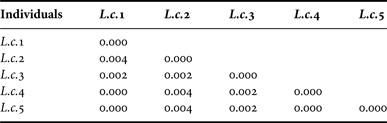
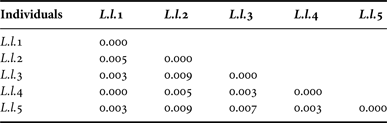
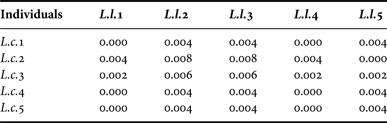
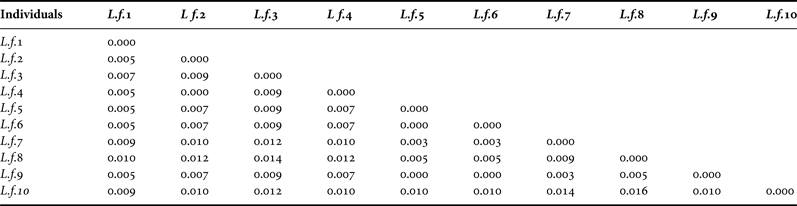
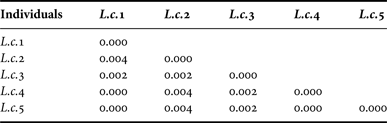
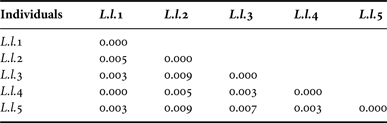
Segment 1 sequences for L. clathrata and L. lawrencei were >99% homologous within (mean distance within L. clathrata = 0.002; mean distance within L. lawrencei = 0.005) and between (mean distance between L. clathrata and L. lawrencei = 0.003) individuals of the two species (Tables 3–5). Segment 2 and segment 3 sequences for all L. clathrata and L. lawrencei were >99% homologous between the two species (data not shown). Final segment size was 583 bp for L. clathrata and 585 bp for L. lawrencei. Similar distance values were found for GenBank sequences within L. foliolata (Table 6). Segment 3 distance values among the three species were L. clathrata & L. foliolata = 0.279, L. lawrencei & L. foliolata = 0.282, and L. clathrata & L. lawrencei = 0.007.
Per cent sequence divergence (0–1) among all five individuals of Luidia clathrata (L.c.1–L.c.5) based on MEGA v. 5 analysis of COX-1 segment 1 (PC4, MC4 primer set).
Per cent sequence divergence (0–1) among all five individuals of Luidia lawrencei (L.l.1–L.l.5) based on MEGA v. 5 analysis of COX-1 segment 1 (PC4, MC4 primer set).
Per cent sequence divergence (0–1) among all five individuals of Luidia clathrata (L.c.1–L.c.5) and Luidia lawrencei (L.l.1–L.l.5) based on MEGA v. 5 analysis of COX-1 segment 1 (PC4, MC4 primer set).
Per cent sequence divergence (0–1) among 10 individuals of Luidia foliolata (L.f.1–L.f.10) based on MEGA v. 5 analysis of GenBank sequences (L.f.1 = DQ380243, L.f.2 = HM542255, L.f.3 = HM542257, L.f.4 = HM473922, L.f.5 = HM473921, L.f.6 = HM473923, L.f.7 = HM473924, L.f.8 = HM473925, L.f.9 = HM473926, L.f.10 = HM473927).
Sediment preference
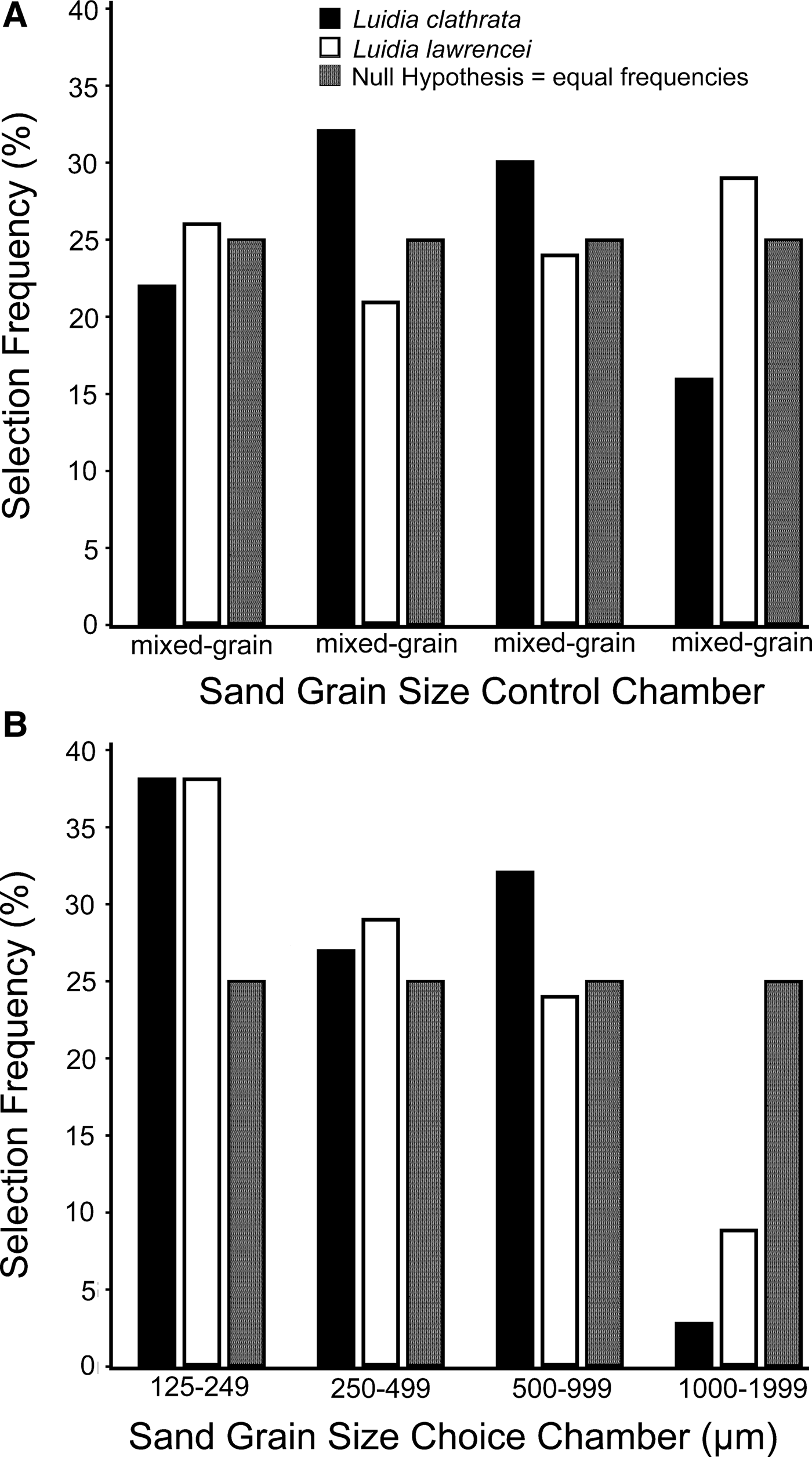
Frequency of selection among the four compartments in the control chamber (Figure 3A) was not significantly different from an equal distribution for L. clathrata (goodness of fit G 32 = 2.48, P = 0.48) or L. lawrencei (goodness of fit G 32 = 0.58, P = 0.9). Frequency of selection among the four compartments in the choice chamber (Figure 3B) was significantly different from an equal distribution for L. clathrata (goodness of fit G 32 = 14.6, P = 0.002), but not significantly different for L. lawrencei (goodness of fit G 32 = 6.89, P = 0.08). No difference was found between the species for control (contingency table G 32 = 2.65, P = 0.45) or choice chambers (contingency table G 32 = 1.64, P = 0.65).
Sediment preference (% frequency of burial) of Luidia clathrata (N = 37) and Luidia lawrencei (N = 34): (A) control chamber with four compartments each containing mixed-grain sand; (B) choice chamber with four compartments each containing a different grain size range (125–249, 250–499, 500–999, and 1000–1999 µm).
Salinity tolerance
All individuals of both species righted in 35, 30 and 25 g kg−1 salinity, while L. clathrata righted significantly more frequently than L. lawrencei in 22 and 20 g kg−1 salinity (Table 7). In comparing salinity treatments within each species, mean righting times of both species were ordered 35 g kg−1 = 30 g kg−1 <25 g kg−1 <22g kg−1 (Figure 4). No significant difference in mean righting times was found between successive pairs of 35 g kg−1 control trials for either L. clathrata or L. lawrencei, however there was a significant difference between the first and last control trial (not shown). In comparing salinity treatments between the species, mean righting times of L. lawrencei were significantly faster than L. clathrata at 35, 30 and 25 g kg−1. No significant difference was found in mean righting times between the species at 22 g kg−1.
Righting times (mean ± SE) in each salinity treatment of Luidia clathrata (N = 17) and Luidia lawrencei (N = 10).
Per cent righting response frequency in Luidia clathrata and Luidia lawrencei (N = 19 for both species) when exposed to different salinities for 30 min from a starting condition of 35 g kg−1.
DISCUSSION
Genetic similarity
The sequencing results from segment 1 indicate a smaller genetic difference between L. clathrata and L. lawrencei than previously reported by Knott & Wray (Reference Knott and Wray2000) for a very similar segment. Based on the sequence comparison between the two species using all three segments within COX-1, there is 99–100% sequence homology among all sampled individuals of both species. The fast evolution of mtDNA often causes heteroplasmy (Tang & Huang, Reference Tang and Huang2010), which is a concern when working with mtDNA. Given the 100% homology obtained in the internal replication experiments for L. lawrencei, no significant genetic variation existed among mtDNA taken from different rays of the same individuals. This result suggests that heteroplasmy is not a major concern in the experimental starfish for this specific gene.
A difference in sequence homology in the COX-1 gene of approximately 10% has previously been used as the level of difference to distinguish species of the class Asteroidea (Hebert et al., Reference Hebert, Ratnasingham and deWaard2003b; Waters et al., Reference Waters, O'Loughlin and Roy2004). For example, Waters et al. (Reference Waters, O'Loughlin and Roy2004) confirmed the existence of four species of the starfish Patiriella from southern Australia employing a partial section within the COX-1 gene with a mean divergence among species of 9.8%. Based on that benchmark, and the fact that variation within is similar to variation between the two morphologies investigated in this study, the individuals tested in this study are members of the same species by exhibiting a difference in the sequence homology of the COX-1 gene of less than 1%. This result does not support previous evidence presented by Knott & Wray (Reference Knott and Wray2000), which suggested that the difference in sequence homology for a partial segment within COX-1 was greater than 10%.
Some of the difference in the genetic results of the two studies may be due to differences in the geographic location of the sampled individuals. Knott & Wray (Reference Knott and Wray2000) used one individual from the Gulf of Mexico for one species and one individual from the Atlantic Ocean for the other species (E. Knott, personal communication), while in the current study individuals of both species came from the northern Gulf of Mexico. Given that COX-1 has been widely used as a barcode for taxonomic discrimination (Hebert et al., Reference Hebert, Cywinska, Ball and deWaard2003a, Reference Hebert, Ratnasingham and deWaardb), our genetic data support the existence of enough gene flow among the sampled populations in the Pensacola area to prevent genetic differentiation of the COX-1 gene. We have no explanation for the allozyme differences found by Knott & Hopkins (Reference Knott, Hopkins, Mooi and Telford1998), which were from starfish from the same geographic area, in relation to our genetic results. The results raise interesting questions about the degree of genetic variation related to geography of the two phenotypic morphologies of Luidia. Comparison of multiple specimens of each morphology within and between locations in the Gulf of Mexico and Atlantic Ocean would be of interest. Xiao et al. (Reference Xiao, Liu, Yuan and Sha2013) concluded that several species of Luidia found near China, that had been described based on morphology, were not genetically distinct, and suggested they should be considered one species.
Sediment preference
Control chamber results suggest that the frequency of burial for both species in the choice chamber was not biased by the experimental set-up. Avoidance of the coarsest grain size exhibited by L. clathrata is not surprising given the type of substrate, fine sand/mud, typically found in bays where L. clathrata is common (Klinger, Reference Klinger1978; Hopkins et al., Reference Hopkins, Thompson, Knott, Tingle, Carnevali and Bonasoro1999; Pomory & Lares, Reference Pomory and Lares2000; Hopkins & Knott, Reference Hopkins, Knott, Harris, Böttger, Walker and Lesser2010; Lawrence et al., Reference Lawrence, Cobb and Talbot-Oliver2012). Klinger (Reference Klinger1978) found no preference of grain size in L. clathrata for a range of grain sizes similar to our three smaller grain size choices. Frequency of burial for L. lawrencei was also greater at the smaller grain sizes, but not statistically significant. Frequency tests are sensitive to small sample sizes. We suggest a P value of 0.08 in the choice chamber vs 0.9 in the control chamber indicates that L. lawrencei probably does show a similar pattern of selection as L. clathrata. The outcome certainly indicates that L. lawrencei did not preferentially select larger grain sizes.
Coarse sediments may present mechanical difficulties to burying, which would be problematic when attempting to escape predators (Zimmerman et al., Reference Zimmerman, Stancyk and Clements1988; Boos et al., Reference Boos, Gutow, Mundry and Franke2010). Stoner & Ottmar (Reference Stoner and Ottmar2003) showed that juvenile Pacific halibut and northern rock sole preferred smaller grain sizes where they were able to bury faster. Boos et al. (Reference Boos, Gutow, Mundry and Franke2010) documented that Ophiura albida preferred to bury in finer sediments in the presence of a predator, as well as when foraging for prey. Given that low-energy areas support a greater diversity of organisms (Gray & Elliott, Reference Gray and Elliott2009), predatory pressure is high in estuaries and organisms with the ability to bury have a higher chance of survival than those that spend most of their time on the surface (Virstein, Reference Virstein1979).
A correlation between sediment particle size and distribution has been documented for several echinoderms (e.g. Ferber & Lawrence, Reference Ferber and Lawrence1976; Roberts, Reference Roberts1979; Clements, Reference Clements1988). Populations of a single species can show preference towards more than one sediment type at different stages in their life history. For example, Himmelman & Dutil (Reference Himmelman and Dutil1991) recorded intra-specific variation in sediment preference for two asteroid species, Asterias vulgaris and Leptasterias polaris, with preference towards a particular substrate type based on size class. They suggested that the change in habitat preference in A. vulgaris and L. polaris may be associated with increasing size driving them to move to greater depths in search of bigger prey.
The hypothesis for L. clathrata of selecting smaller grain sizes was confirmed. In the case of L. lawrencei, the hypothesis of selecting larger grain sizes was not confirmed. The lack of difference in comparing the species to one another suggests sediment type is a not a good environmental variable for separating them, at least for asymptotic size adults.
Salinity tolerance
Righting response times of both species indicate little change in activity level in higher salinities (35 and 30 g kg−1); however, activity level in both species decreased in reduced salinities (25 and 22 g kg−1). The righting response times of individuals in control salinity 35 g kg−1 before each reduced salinity trial indicates minimal carry-over effects, and both species responded in a similar manner across time. Ellington & Lawrence (Reference Ellington and Lawrence1974) showed that lowered salinity (16 g kg−1) resulted in increased righting times and cessation of podia movement in L. clathrata. Watts & Lawrence (Reference Watts and Lawrence1990b) reported decreased salinity (as low as 16 g kg−1) resulted in a significant increase in righting times in L. clathrata, especially noticeable within the first 24 h of exposure. Kaack & Pomory (Reference Kaack and Pomory2011) found regeneration of rays in L. clathrata slowed down considerably at lower salinities (20 g kg−1). Similar results have been reported for other echinoderms including the asteroids Asterias forbesi (Loosanoff, Reference Loosanoff1945), Leptasterias hexactis (Shirley & Stickle, Reference Shirley and Stickle1982), Asterias murensis, Patiria pectinifera (Kashenko, Reference Kashenko2003), Patiriella mortensi and Patiriella regularis (Barker & Russell, Reference Barker and Russell2007).
Righting response frequency results confirmed the hypothesis that L. clathrata would exhibit a higher tolerance to reduced salinity than L. lawrencei. Luidia clathrata was collected within Pensacola Bay, which regularly ranges between 20–34 g kg−1 (Hagy et al., Reference Hagy, Lehrter and Murrell2006), while L. lawrencei was collected outside of the bay in an area were salinity stays fairly constant at 35 g kg−1. Organisms that are periodically exposed to fluctuations in salinity can develop mechanisms that allow them to survive in stressful environments (McLusky & Michael, Reference McLusky and Michael2004; Lau et al., Reference Lau, Lau, Qian and Qiu2009). Luidia clathrata has some ability to osmoregulate. Ellington & Lawrence (Reference Ellington and Lawrence1974) concluded that L. clathrata uses a combination of coelomic fluid volume regulation and intracellular osmotic regulation in order to survive in decreased salinity conditions. Hintz & Lawrence (Reference Hintz and Lawrence1994) found that intracellular osmotic regulation can occur at different stages of development in L. clathrata.
Collection location may also explain why L. lawrencei was significantly faster at righting than L. clathrata at higher salinities. It is unlikely that individuals of L. clathrata collected in Pensacola Bay for this study had recently been exposed to salinities higher than 25 g kg−1 for an extended period. While an acclimation period (3 weeks) to 35 g kg−1 was provided for both species, it may not have been sufficient for L. clathrata to completely acclimate to higher salinities, and suggests salinity acclimation may be a relatively long-term physiological response.
Acute changes in salinity had a differential effect on the activity levels of L. clathrata and L. lawrencei, which may be indicative of separation of species; however, similar results have been obtained within different populations of the same species based on strong acclimation responses (Stickle & Diehl, Reference Stickle, Diehl, Jangoux and Lawrence1987). Binyon (Reference Binyon1961) recorded a 15 g kg−1 divergence in the lower limits of salinity tolerance between populations of the starfish Asterias rubens from the North Sea and the Baltic Sea, referring to the two populations as physiological races of the same species. Himmelman et al. (Reference Himmelman, Guderley, Vignault, Drouin and Wells1984) suggested that sea urchins, Strongylocentrotus droebachiensis, that live in estuaries with variable salinity exhibit greater tolerance to osmolarity changes when compared with populations of the same species that live in constant oceanic salinity. Held & Harley (Reference Held and Harley2009) documented differences in feeding rates and righting times in response to acute salinity changes for two populations of the starfish Pisaster ochraceus taken from sites with differing ambient salinity and concluded that P. ochraceus populations are capable of local acclimatization to low salinity conditions.
Summary
Our initial assumption in starting this study was that L. clathrata and L. lawrencei were two different species, and the purpose was to investigate possible factors leading to their separation. The genetic results, however, call that initial assumption into question. Even though we found some variation between the two in the behavioural responses to different types of sediments, and more dramatic physiological responses to acute salinity changes, these results are not uncommon for populations of a single species that have been exposed to different environmental conditions. If the COX-1 DNA sequence similarity is interpreted as evidence for species similarity of the two colour morphs, we interpret the other results as long-term acclimation effects. We suggest that the five-armed Luidia populations in the Gulf of Mexico and Atlantic Ocean would make a good model for further exploration of genetic-geographic variation and how that variation is related to phenotypic plasticity of morphology, behaviour and physiology based on environmental conditions.
ACKNOWLEDGEMENTS
We thank John Lawrence for confirmation of species identification, James Hammond for help during the entire study, the crew of RV ‘Bellows’ for help during collection of animals, and the Office for Research and Sponsored Programs at the University of West Florida for a Scholarly and Creative Activities grant (M.P.C.) providing partial funding for the study.