


%20--%3e%3c!DOCTYPE%20svg%20PUBLIC%20'-//W3C//DTD%20SVG%201.0//EN'%20'http://www.w3.org/TR/2001/REC-SVG-20010904/DTD/svg10.dtd'%3e%3csvg%20version='1.0'%20id='Layer_1'%20xmlns='http://www.w3.org/2000/svg'%20xmlns:xlink='http://www.w3.org/1999/xlink'%20x='0px'%20y='0px'%20width='64px'%20height='64px'%20viewBox='5.5%20-3.5%2064%2064'%20enable-background='new%205.5%20-3.5%2064%2064'%20xml:space='preserve'%3e%3cg%3e%3ccircle%20fill='%23FFFFFF'%20fill-opacity='0'%20cx='37.785'%20cy='28.501'%20r='28.836'/%3e%3cpath%20fill='%23595959'%20d='M37.441-3.5c8.951,0,16.572,3.125,22.857,9.372c3.008,3.009,5.295,6.448,6.857,10.314%20c1.561,3.867,2.344,7.971,2.344,12.314c0,4.381-0.773,8.486-2.314,12.313c-1.543,3.828-3.82,7.21-6.828,10.143%20c-3.123,3.085-6.666,5.448-10.629,7.086c-3.961,1.638-8.057,2.457-12.285,2.457s-8.276-0.808-12.143-2.429%20c-3.866-1.618-7.333-3.961-10.4-7.027c-3.067-3.066-5.4-6.524-7-10.372S5.5,32.767,5.5,28.5c0-4.229,0.809-8.295,2.428-12.2%20c1.619-3.905,3.972-7.4,7.057-10.486C21.08-0.394,28.565-3.5,37.441-3.5z%20M37.557,2.272c-7.314,0-13.467,2.553-18.458,7.657%20c-2.515,2.553-4.448,5.419-5.8,8.6c-1.354,3.181-2.029,6.505-2.029,9.972c0,3.429,0.675,6.734,2.029,9.913%20c1.353,3.183,3.285,6.021,5.8,8.516c2.514,2.496,5.351,4.399,8.515,5.715c3.161,1.314,6.476,1.971,9.943,1.971%20c3.428,0,6.75-0.665,9.973-1.999c3.219-1.335,6.121-3.257,8.713-5.771c4.99-4.876,7.484-10.99,7.484-18.344%20c0-3.543-0.648-6.895-1.943-10.057c-1.293-3.162-3.18-5.98-5.654-8.458C50.984,4.844,44.795,2.272,37.557,2.272z%20M37.156,23.187%20l-4.287,2.229c-0.458-0.951-1.019-1.619-1.685-2c-0.667-0.38-1.286-0.571-1.858-0.571c-2.856,0-4.286,1.885-4.286,5.657%20c0,1.714,0.362,3.084,1.085,4.113c0.724,1.029,1.791,1.544,3.201,1.544c1.867,0,3.181-0.915,3.944-2.743l3.942,2%20c-0.838,1.563-2,2.791-3.486,3.686c-1.484,0.896-3.123,1.343-4.914,1.343c-2.857,0-5.163-0.875-6.915-2.629%20c-1.752-1.752-2.628-4.19-2.628-7.313c0-3.048,0.886-5.466,2.657-7.257c1.771-1.79,4.009-2.686,6.715-2.686%20C32.604,18.558,35.441,20.101,37.156,23.187z%20M55.613,23.187l-4.229,2.229c-0.457-0.951-1.02-1.619-1.686-2%20c-0.668-0.38-1.307-0.571-1.914-0.571c-2.857,0-4.287,1.885-4.287,5.657c0,1.714,0.363,3.084,1.086,4.113%20c0.723,1.029,1.789,1.544,3.201,1.544c1.865,0,3.18-0.915,3.941-2.743l4,2c-0.875,1.563-2.057,2.791-3.541,3.686%20c-1.486,0.896-3.105,1.343-4.857,1.343c-2.896,0-5.209-0.875-6.941-2.629c-1.736-1.752-2.602-4.19-2.602-7.313%20c0-3.048,0.885-5.466,2.658-7.257c1.77-1.79,4.008-2.686,6.713-2.686C51.117,18.558,53.938,20.101,55.613,23.187z'/%3e%3c/g%3e%3c/svg%3e)
%20--%3e%3c!DOCTYPE%20svg%20PUBLIC%20'-//W3C//DTD%20SVG%201.0//EN'%20'http://www.w3.org/TR/2001/REC-SVG-20010904/DTD/svg10.dtd'%3e%3csvg%20version='1.0'%20id='Layer_1'%20xmlns='http://www.w3.org/2000/svg'%20xmlns:xlink='http://www.w3.org/1999/xlink'%20x='0px'%20y='0px'%20width='64px'%20height='64px'%20viewBox='5.5%20-3.5%2064%2064'%20enable-background='new%205.5%20-3.5%2064%2064'%20xml:space='preserve'%3e%3cg%3e%3ccircle%20fill='%23FFFFFF'%20fill-opacity='0'%20cx='37.637'%20cy='28.806'%20r='28.276'/%3e%3cg%3e%3cpath%20fill='%23595959'%20d='M37.443-3.5c8.988,0,16.57,3.085,22.742,9.257C66.393,11.967,69.5,19.548,69.5,28.5c0,8.991-3.049,16.476-9.145,22.456%20C53.879,57.319,46.242,60.5,37.443,60.5c-8.649,0-16.153-3.144-22.514-9.43C8.644,44.784,5.5,37.262,5.5,28.5%20c0-8.761,3.144-16.342,9.429-22.742C21.101-0.415,28.604-3.5,37.443-3.5z%20M37.557,2.272c-7.276,0-13.428,2.553-18.457,7.657%20c-5.22,5.334-7.829,11.525-7.829,18.572c0,7.086,2.59,13.22,7.77,18.398c5.181,5.182,11.352,7.771,18.514,7.771%20c7.123,0,13.334-2.607,18.629-7.828c5.029-4.838,7.543-10.952,7.543-18.343c0-7.276-2.553-13.465-7.656-18.571%20C50.967,4.824,44.795,2.272,37.557,2.272z%20M46.129,20.557v13.085h-3.656v15.542h-9.944V33.643h-3.656V20.557%20c0-0.572,0.2-1.057,0.599-1.457c0.401-0.399,0.887-0.6,1.457-0.6h13.144c0.533,0,1.01,0.2,1.428,0.6%20C45.918,19.5,46.129,19.986,46.129,20.557z%20M33.042,12.329c0-3.008,1.485-4.514,4.458-4.514s4.457,1.504,4.457,4.514%20c0,2.971-1.486,4.457-4.457,4.457S33.042,15.3,33.042,12.329z'/%3e%3c/g%3e%3c/g%3e%3c/svg%3e)
Next Generation EU, specifically its Recovery and Resilience Facility (RRF), has been a groundbreaking new experiment for the EU. From the speed of the reaction at the EU level with an agreement between leaders a few weeks after the COVID-19 crisis erupted, the size of the instrument (being the largest EU fund ever created), to the RRF's design features (including the performance nature of the instrument, its leverage on reforms, and its method of financing), it is a fundamentally novel EU instrument. Aimed at both recovery and resilience, it first led to a firm common response to a simultaneous economic downturn across the EU, ensuring rapid macroeconomic stabilization and preservation of public investment levels, in contrast with previous crises. It has also planted the seeds of a significant increase in the resilience of the EU economy by fostering the implementation of major structural reforms in line with the common priorities of the EU. Lessons about absorption capacity, incentives, flexibility, and governance will all advance future program design in the EU and beyond.
The Genesis of the Recovery and Resilience Facility
Attempts were made in the past to incentivize reform implementation. The adoption of the European SemesterFootnote 1 in the aftermath of the financial crisis increased accountability and peer pressure among member states, but progress on the implementation of annual country specific recommendations was notoriously slow. To spur more rapid progress, proposals such as a Reform Support Programme or a Budgetary Instrument for Convergence and Competitiveness (BICC) for the euro area were being discussed.
Major breakthroughs in EU governance are often fueled by crises. Faced with the COVID-19 crisis, the EU rapidly reacted with emergency instruments that mitigated unemployment risks and allowed more flexible use of EU structural funds. But it quickly became apparent that decisive European action on a larger scale was needed. “Europe showed that it was able to break new ground in a very special situation such as this one,” as Angela Merkel put it on the day of the political agreement on the Recovery and Resilience Facility.Footnote 2
Key Features
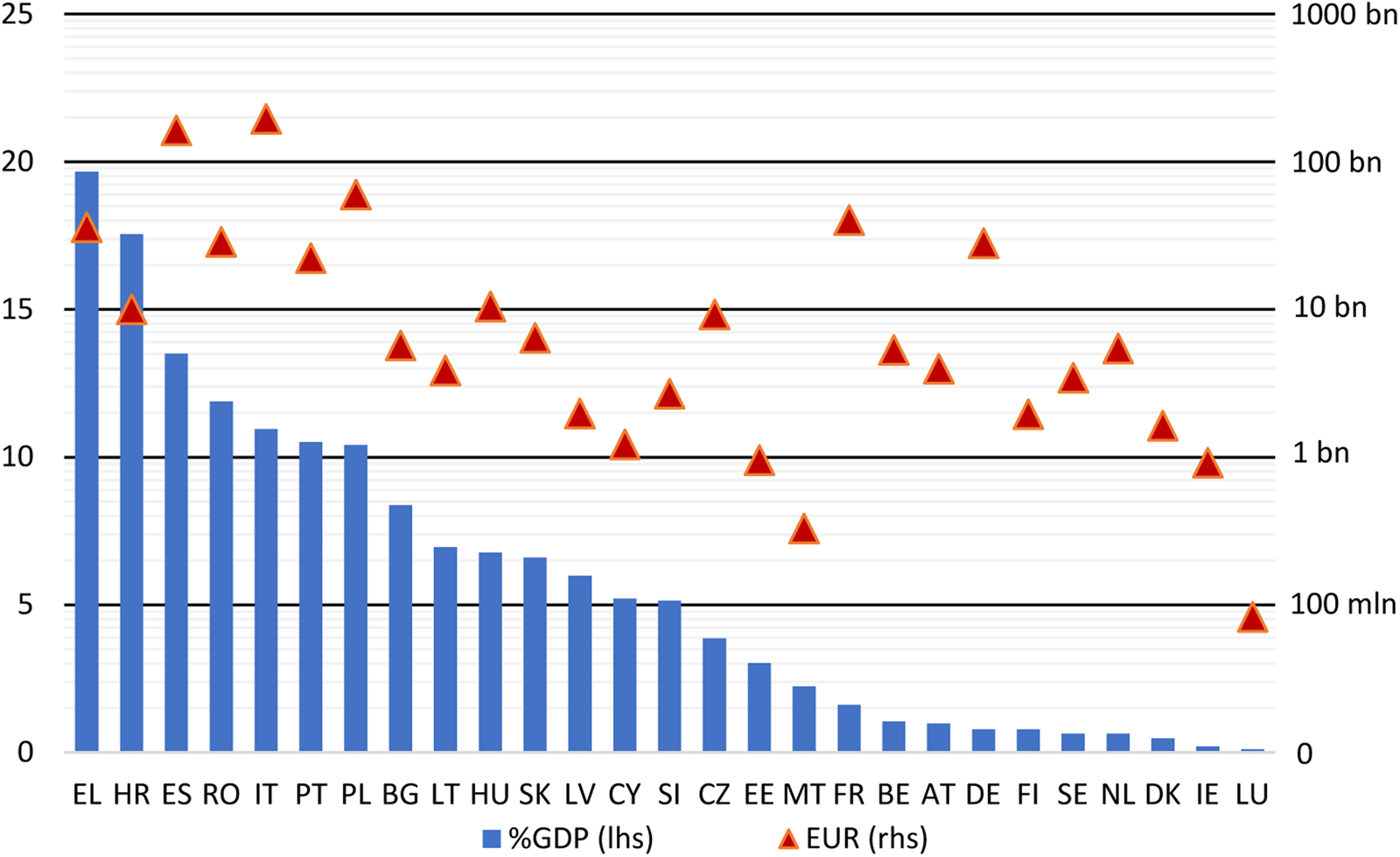
The size of the RRF has provided a macroeconomically significant response to the economic shock of the pandemic. With €648 billionFootnote 3 for investments and reforms (€357 billion in grants and €291 billion in loans), the RRF is the largest instrument of the EU,Footnote 4 accounting for around 4.1 percent of EU GDPFootnote 5 over six years with national allocations of close to 10 percent of GDP for Italy or close to 19 percent for Greece.Footnote 6
To finance the RRF, the European Commission is issuing EU bonds on capital markets, marking the first common EU borrowing of this size.Footnote 7 The amount borrowed between mid-2021 and 2026 will be repaid by 2058 through new own resources in the EU budgetFootnote 8 for grants and through repayments by the borrowing member states for loans.
One of the biggest novelties and advantages of this instrument has been its performance-based nature.Footnote 9 Funds in the RRF are unlocked upon the achievement of milestones and targets, representing concrete steps in the implementation of reforms and investments included in the national Recovery and Resilience Plans (RRPs). This ensures that payments are only made when concrete results have been achieved, thereby using EU funds as leverage to implement key country-specific reforms and investments.
The RRF was also the first instrument to have such demanding requirements about the green and digital transitions, two key priorities of the EU.Footnote 10 The legislation requires that each plan contributes at least 37 percent of its total financial allocation to the green transition, and 20 percent to the digital transition. These contributions have been assessed through demanding methodologies. The methodologies previously employed in cohesion policy have been further improved for the RRF and are now also being applied to the 2021–27 cohesion spending. Moreover, strict conditions on “do no significant harm” (DNSH) entail that RRPs can only be approved if no measure leads to significant harm to environmental objectives.
Main Achievements
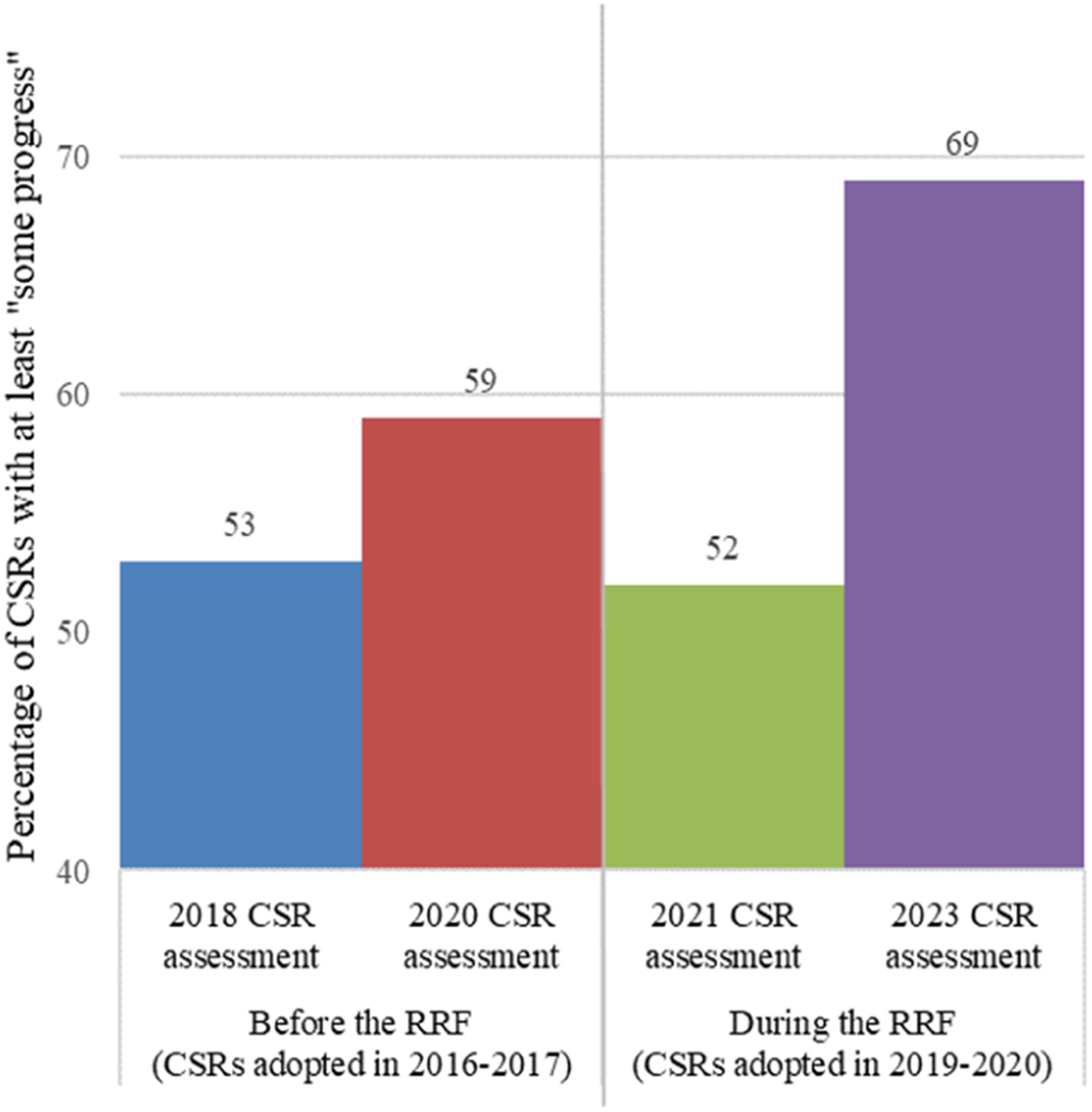
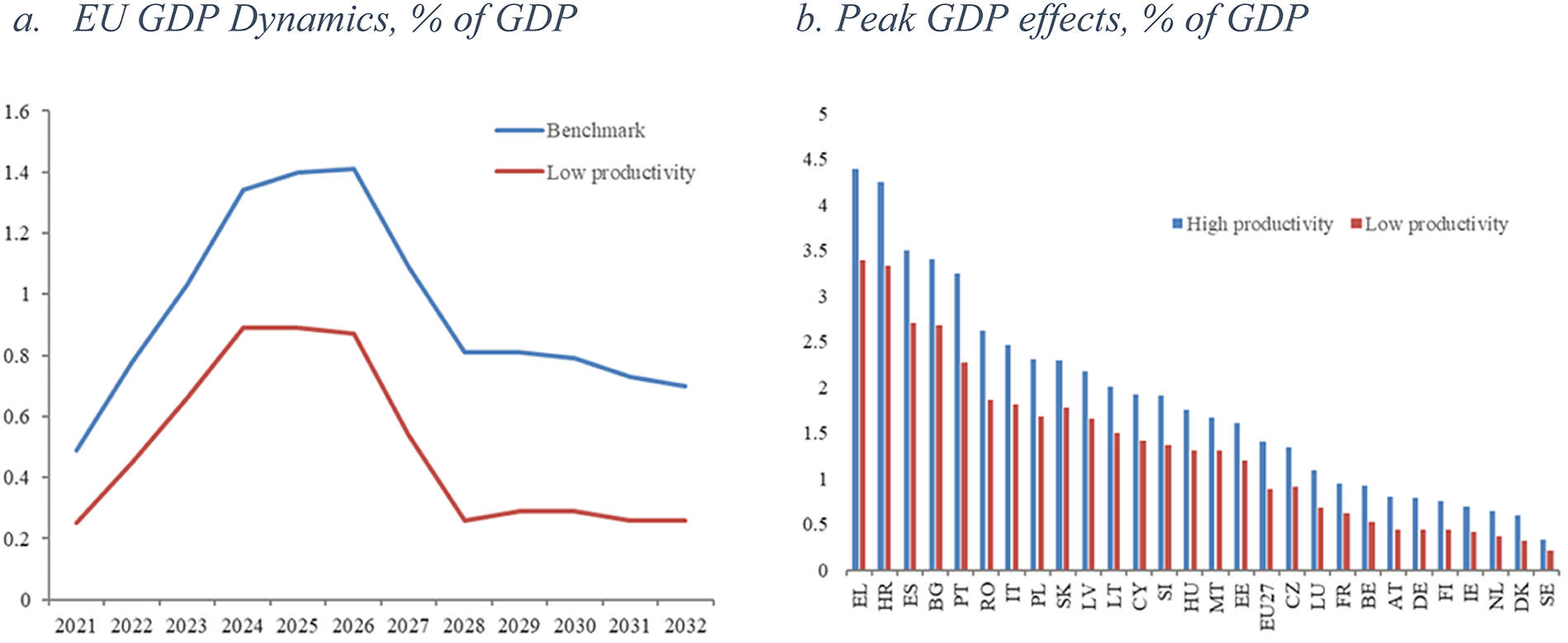
While it is too early to fully assess the impact of the RRF, preliminary conclusions about its achievements can be drawn. First, the mere announcement of the scheme stabilized markets and led to a significant compression of EU bonds spreads by between 50 and 100 basis points for those member states with higher borrowing costs. Second, €56.5 billion in pre-financingFootnote 11 was disbursed immediately upon the approval of the RRPs and provided speedy support. Third, a cut in public investment was avoided compared to previous crisesFootnote 12 with the EU average of public investment increasing from 3.0 percent in 2019 to 3.3 percent in 2022.Footnote 13 As a result, following a steep fall in economic activity in the first half of 2020, by the end of 2022, the volume of EU output was 3.3 percent higher compared to pre-pandemic levels.Footnote 14 Although this cannot be fully attributed to the RRF and any econometric disentanglement of factors is challenging, the RRF has certainly contributed to the speedy recovery. Ex ante modeling estimates show the potentially significant effects on GDP, which are bolstered through cross-country spillovers (Graph 2).Footnote 15 Fourth, the RRF has significantly accelerated the implementation of key structural policies. A multi-annual increase in implementation in the years before the RRF was in the range of 6 percentage points (2018 to 2020), while the RRF fueled an increase of 17 percentage points (2021 to 2023) (Graph 1). Stakeholders and external evaluators recognized that the conditional financial support of the RRF has led to the implementation of long-standing reforms that would not have occurred without the RRF.Footnote 16
Share of CSRs with at least “some progress” before and during the RRF
Notes: The CSR assessment takes into account the implementation of the measures included in the RRPs and of those done outside of the RRPs at the time of assessment. Implemented measures can lead to “some/substantial progress” or “full implementation,” depending on their relevance.
Source: European Commission

RRF-supported structural reforms have fostered progress on common policy priorities, accelerated the green and digital transitions, supported socioeconomic convergence in the EU, and enhanced institutional resilience (including the rule of law). Spain has implemented a labor market reform to address longstanding structural issues such as duality and a high temporary employment rate. Italy is reforming its justice system to reduce the length of civil and criminal proceedings, improve efficiency, and reduce the backlog of pending cases. Greece adopted a reform aimed at streamlining the licensing framework for renewables, including the simplification and digitalization of procedures, and shorter and binding administrative response times. The conditionality of the entire financial envelope on so-called “super milestones,” aimed at ensuring sufficient capacity of the member states to adequately protect the financial interest of the Union, in particular by addressing rule of law challenges, has led to significant improvements in these fields, including in Poland and Hungary.
GDP effects (in % from a no-NGEU scenario), QUEST model scenarios
Notes: In percent deviation from a no-NGEU scenario. In the left panel (a), the blue line reports real EU GDP effects in the benchmark scenario, while the red line depicts the low-productivity scenario. The right panel (b) depicts the respective peak GDP effects for each country. Blue (red) bars report GDP effects in the benchmark (low-productivity) scenario.
Source: European Commission

Lessons Learned
The performance-based nature of the instrument brought a shift toward more effective public spending, focused on results and enhancing predictability and accountability. In particular, the coherent combination and sequencing of reforms and investments, with reforms undertaken first, has helped to create the adequate framework conditions for the implementation of subsequent investments.
The targeted allocation of funds toward more vulnerable member states provided significant incentives for reform implementation to those, but less to others. The allocation key of the RRF was designed to support the most economically vulnerable member states during the COVID-19 crisis. For these member states, financial support from the RRF represents a significant share of their GDP and hence a powerful incentive (Graph 3). However, this key entails that some member states have received a comparatively smaller incentive for reforms and investments.
RRF allocation, EUR bn and as a share of GDP
Notes: Funding allocated to each endorsed RRP (right-hand side) and what this represents as a share of each member state's GDP in 2021 (left-hand side), including grants and loans. The grant allocation formula reflects the share of population in total EU population, the inverse of the GDP per capita relative to the EU average, the average unemployment rate over the past five years compared to the Union average (2015–2019), the relative fall in real GDP in 2020, and the relative fall in real GDP over 2020 and 2021 as compared to the average fall in real GDP in the EU.
Source: European Commission, AMECO

The RRF has achieved a balance between reform incentives and national ownership. National ownership is key to effective reform implementation.Footnote 17 This lesson is reflected in the architecture of the RRF. While member states had to address all or a significant subset of CSRs, the choice of which CSRs to address and how to do so was left to them. The design and assessment of the plans has been built on extensive exchanges between the Commission and member states. Finally, stakeholder consultations during the preparation of the RRPs contributed to building a broader degree of ownership.
The integration of key EU policy orientations into the RRF has allowed the instrument to align national policies with the highest priorities of the EU and rapidly adjust this instrument to new ones. The policy orientations toward the green and digital transitions have proved successful in attracting €275 billion and €130 billion in planned spending, respectively. Following the Russian invasion of Ukraine, the RRF's focus on green aspects allowed for the REPowerEU amendments, which rapidly reduced dependence on Russian fossil fuels. Many of the needed measures were already present in RRPs, and through 2023, almost all member statesFootnote 18 added REPowerEU chapters to their RRPs, with new or scaled-up reforms and investments dedicated to diversifying energy supplies, increasing energy savings, and accelerating the development of renewable energy.
The limited timeline of the RRF has some advantages. A limited timeline was a legal requirement due to the RRF's legal basis in Article 122 of the Treaty on the Functioning of the EU. The short time frame acted as a strong incentive to act fast. Some literature suggests that reforms are more likely to be implemented when they are seen as urgent.Footnote 19 Despite the need to amend their plans to benefit from the additional REPowerEU chapters, the spike in inflation, and disruptions of supply chains, a remarkable 75 percent of the milestones and targets planned to be achieved by the end of 2023 were either assessed positively by the Commission or reported as completed by the member state. Implementation is expected to further gather pace. At the time of writing, the Commission is in the process of assessing fifteen payments worth €22 billion, with a total of €125 billion expected to be paid in 2024. A large part of the delays in disbursing funds reflects the RRF's demanding reform conditionality and protection of the financial interest of the Union. Finally, some reforms are politically more difficult to implement, and careful implementation may result in better outcomes.
But the relatively short time scale of the RRF also brought challenges. Some projects with lengthier and more complex implementation timeframes were not included in the RRF, notably cross-border projects, even though they can entail positive spillover effects. In addition, the limited time frame accentuates longstanding absorption issues in some member states. The payout rates assumed by the timeline of the RRF were between two and six years shorter than the historical payout rates of EU funds.Footnote 20 The RRF's timeline, size, and the fact that it is implemented in parallel with the EU's cohesion funds, have contributed to this challenge, and have possibly caused delays in cohesion spending. Member states’ absorption capacities are linked to their administrative capacities, which have shown limits in their ability to deal with the extra workload created by the RRF. However, delays remain limited compared to absorption issues observed for past instruments.Footnote 21
There are trade-offs between protecting the EU's financial interests and limiting the administrative burden for member states. While member states have stressed the positive impact of a performance-based instrument on reform delivery, they have also conveyed that the performance-based nature of the instrument did not bring administrative simplification. According to member states, the administrative burden is mainly due to the demanding audit and control requirements, the extent of information required to demonstrate the fulfillment of milestones and targets, and additional reporting requirements. While limiting unnecessary administrative burden and ensuring proportionate reporting requirements are important, this needs to be balanced against the imperative to manage EU funds appropriately to protect the financial interests of the Union and ensure transparency.
There are further trade-offs between flexibility and accountability. Predictability for the member states, as well as transparency and accountability toward the Council, the European Parliament, and taxpayers requires conditions to be defined with a certain degree of granularity. At the same time, member states have found the definition of milestones and targets to be too detailed and rigid. They also considered the revision of the plans with assessment by the Commission and approval by the Council to be burdensome and slow. When designing future instruments, the need to balance granularity and diligence with sufficient flexibility should be kept in mind.
Conclusion
The RRF's breakthrough has not only provided a rapid and decisive response to the economic implications of the COVID-19 crisis, but also initiated major strategic investments and structural reforms to strengthen the resilience and growth potential of the EU economy and provided a key impetus for the implementation of the green and digital transitions. Its key innovative features have proven effective. Despite challenges in terms of administrative burden, a limited implementation timeline, and some limited delays, the RRF has shown impressive results. It also provides valuable insights for future program design in the EU and beyond. The impact of a performance-based approach to public spending, the balance between incentives and national ownership, and the balance between flexibility and accountability all serve as lessons for the future. Already, this novel approach to EU spending has inspired the design of new programs such as the Social Climate Fund, the Ukraine Facility, and the Reform and Growth Facility for the Western Balkans. Drawing the right conclusions from the RRF, acknowledging successes while learning from the challenges, will be key in shaping future instruments.

 Open access

