





Significant outcomes
-
• Although the national sentinel surveillance systems identified share common objectives, they differ in structure, data sources, and operational design.
-
• Surveillance systems that include interdisciplinary sentinel components are supported by public agencies and gather data from multiple sources may be especially valuable for monitoring changes in illicit drug use.
Limitations
-
• This review focused on active national sentinel surveillance systems whose main objective was the surveillance of illicit drug use.
-
• The design and data derived from sentinel systems may not have been reported in scientific journals and can only be accessible through institutional or grey literature sources.
-
• Surveillance systems are not consistently defined or named sentinel, increasing the possibility of overlooking valuable research.
Introduction
Epidemiological surveillance provides public health with the information needed for sound decision-making. In essence, surveillance is focused on the collection, analysis, and interpretation of population-based data. These data are relevant for assessing trends and behaviour patterns of health determinants or outcomes (Ramirez Fernandez & Ordonez Iriarte, Reference Ramírez Fernández and Ordóñez Iriarte2005).
Surveillance of illicit drug use is challenging, as the introduction of new substances or changing patterns of use occurs very quickly. Thus, using surveillance systems that focus on surveys or hospital administrative data poses the risk that the information will be obsolete as soon as it is collected, since the data collection and reporting process takes time. Delays in data availability may limit the usefulness of traditional surveillance systems for health policy planning related to illicit drug use.
The continual emergence of novel drugs or changes in consumption patterns have paved the way for new approaches, such as active systems based on a sentinel approach. A sentinel surveillance approach offers one way to move quickly on signals that could trigger a response. These signals would identify anomalies in data, monitor actions undertaken and highlight areas that may require more specific follow-up. Through a simple protocol and frequent communication, a sentinel approach blends new and existing data to provide prompt reporting with limited resources (Nsubuga et al., Reference Nsubuga, White, Thacker, Anderson, Blount, Broome, Chiller, Espitia, Imtiaz, Sosin, Stroup, Tauxe, Vijayaraghavan, Trostle, Jamison, Breman, Measham, Alleyne, Claeson, Evans, Jha, Mills and Musgrove2006). Based on the surveillance of specific populations or sites, sentinel surveillance systems can emit alerts across large areas. When it comes to their design, coordinated partnership with both reporting sites and key informants is critical to achieving the stated objectives (Murray, Reference Murray and Quah2017; Guillot et al., Reference Guillot, Bouchard, Aenishaenslin, Berthiaume, Milord and Leighton2022). These systems require few resources; however, the commitment of key informants at sentinel sites must be assured (World Health Organization Regional Office for Africa, 2015).
Sentinel surveillance systems are also frequently integrated into broader early warning frameworks aimed at detecting emerging substances. These approaches typically rely on the triangulation of multiple data sources, including clinical observation, forensic analysis, and community-based reporting (Freestone et al., Reference Freestone, Siefried, Peacock, Fletcher, Barratt, Sutherland, Ezard, Doumany, MacDonald, Kypri, Acheson and Clifford2025).
Since traditional approaches that rely on population-based surveys or hospital admissions are proving ineffective in providing accurate data in a timely fashion (Wood et al., Reference Wood, de la Rue, Hosin, Jurgens, Liakoni, Heyerdahl, Hovda, Dines, Giraudon, Liechti and Dargan2019; Reuter et al., Reference Reuter, Caulkins and Midgette2021), a sentinel approach could be a valid complement. Sentinel systems have potential but have not been sufficiently described in the monitoring of behaviour patterns, such as drug use.
Therefore, the aim of this scoping review was to identify and characterise the main aspects of active national surveillance systems which have a sentinel component targeted at monitoring illicit drug use worldwide.
Material and methods
To identify active national surveillance systems with a sentinel component targeted at monitoring illicit drug use, we performed a scoping review following the PRISMA-ScR guidelines (Tricco et al., Reference Tricco, Lillie, Zarin, OBrien, Colquhoun, Levac, Moher, Peters, Horsley, Weeks, Hempel, Akl, Chang, McGowan, Stewart, Hartling, Aldcroft, Wilson, Garrity, Lewin, Godfrey, MacDonald, Langlois, Soares-Weiser, Moriarty, Clifford, Tunçalp and Straus2018). A bibliographic search was conducted in Medline (Ovid), EMBASE, Web of Science and CINAHL using search terms such as ‘sentinel’; ‘sentinel network’; ‘sentinel surveillance’; ‘early warning’; ‘drug abuse’; ‘drug misuse’ and ‘substance-related disorders’. Search strategies were independently designed for each database and can be consulted in Supplementary Table S1 of Appendix 1. The search was not restricted by language or publication date and covered a period until February 2025. To be included, articles were required to describe or analyse data from surveillance systems that 1) have an established structure, 2) are supported by public agencies, 3) self-report their national scope, 4) have their results accessible via online repositories and 5) are ‘active’. For eligibility purposes, systems were considered ‘active’ if they had published results within the previous four years (February 2021–February 2025), as a pragmatic indicator of recent operational activity.
We excluded articles mentioning surveillance systems which did not have illicit drug surveillance as their main designated objective. Three independent researchers reviewed the titles and abstracts of records identified, along with the full text of those complying with eligibility criteria. The references of the studies included were thoroughly reviewed to capture other possible relevant studies.
After the pool of articles was identified, an extensive search for grey literature and technical reports focusing on the identified surveillance systems was performed. Key institutional staff were contacted to complete operational information such as periodicity of publication of results, the individual responsible for data analysis and the criteria for the inclusion of sentinel sites. The following information was extracted in an ad-hoc data-extraction table: year of development and country of origin; sentinel population and key features; key informants/sentinel reporters; number of sentinel units; sources of information; monitored drugs; sentinel sites; frequency of data collection; the webpage of the site; coordination centre; method of data collection; characteristics of the drugs collected; incentives to population under surveillance; and the limitations of the surveillance system as described in the articles.
We performed a narrative synthesis of the main variables of interest.
Results
Results of the search
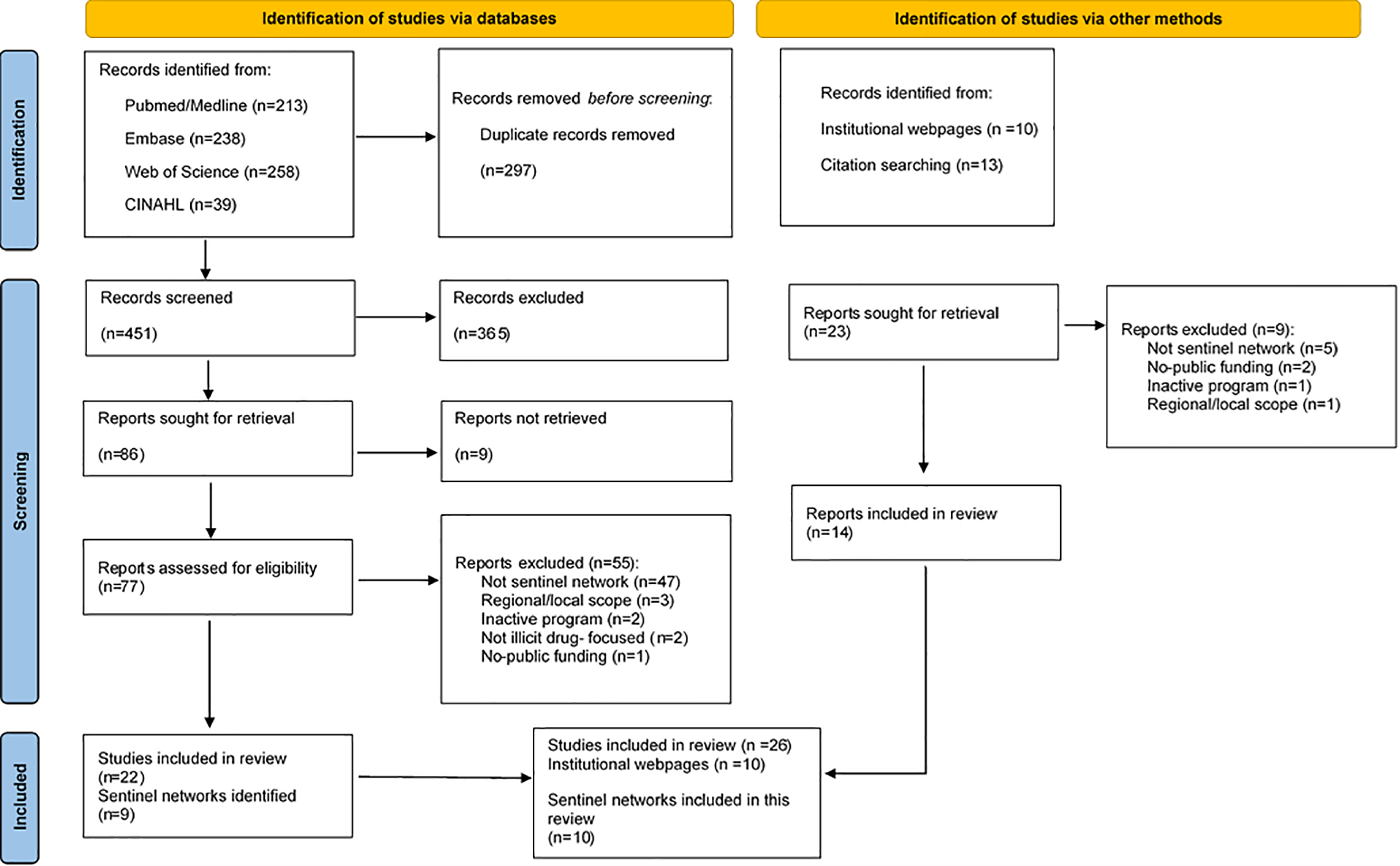
As a result of the searches, 451 records were identified, of which 86 were selected for full-text reading. After full-text reading, the resultant pool of articles was 26. Most of the excluded records described other types of surveillance or were sentinel surveillance networks focused on infectious or sexually transmitted diseases (Figure 1). Studies not included are described in Supplementary Table S2 of Appendix 1.
Flowchart identification of studies yielded by Medline (Ovid), EMBASE, Web of Science and CINAHL search.

Characteristics of the sentinel surveillance systems identified
A total of ten national sentinel surveillance systems targeting illicit drug use and including at least one sentinel component were identified in the 26 articles included.
-
• Four networks were identified in Oceania: the Emerging Drugs Network of Australia-EDNA (Smith et al., Reference Smith, Soderstrom, Dawson, Alfred, Greene, Isoardi, McCutcheon, Oosthuizen, Ezard, Burcham and Fatovich2022), the Illicit Drug Reporting System-IDRS (Shand et al., Reference Shand, Topp, Darke, Makkai and Griffiths2003; Horyniak et al., Reference Horyniak, Dietze, Lenton, Alati, Bruno, Matthews, Breen and Burns2017; Sutherland et al., Reference Sutherland, Uporova, King, Chandrasena, Karlsson and Jones2023b), the Ecstasy and Related Drugs Reporting System-EDRS (Dunn et al., Reference Dunn, Bruno, Burns and Roxburgh2011; Horyniak et al., Reference Horyniak, Dietze, Lenton, Alati, Bruno, Matthews, Breen and Burns2017; Sutherland et al., Reference Sutherland, Karlsson, King, Uporova, Chandrasena and Jones2023a) and the Drug Use Monitoring Australia Program-DUMA (Vicknasingam et al., Reference Vicknasingam, Bennett, Brownstein, Caris, Garnier and Johnson2002; Shand et al., Reference Shand, Topp, Darke, Makkai and Griffiths2003; Voce & Sullivan, Reference Voce and Sullivan2022).
-
• Three were identified in North America: the Drug Abuse Warning Network-DAWN (Crane, Reference Crane2013; Substance Abuse and Mental Health Services Administration, 2023), the National Drug Early Warning System-NDEWS (Artigiani & Wish, Reference Artigiani and Wish2020; Cottler et al., Reference Cottler, Goldberger, Nixon, Striley, Barenholtz, Fitzgerald, Taylor and Palamar2020; NDEWS National Drug Early Warning System, 2020) and the Canadian Community Epidemiology Network on Drug Use-CCENDU (Young et al., Reference Young, Pirie, Buxton and Hosein2015; The Canadian Centre on Substance Use and Addiction, 2024).
-
• Two were identified in Europe: the French Addictovigilance Network (Jouanjus et al., Reference Jouanjus, Gibaja, Kahn, Haramburu and Daveluy2015; Micallef & Mallaret, Reference Micallef and Mallaret2016) and the European Drug Emergencies Network-EURO-DEN Plus (Wood et al., Reference Wood, Heyerdahl, Yates, Dines, Giraudon, Hovda and Dargan2014; Dines et al., Reference Dines, Wood, Yates, Heyerdahl, Giraudon, Sedefov, Hovda and Dargan2015a; Reference Dines, Wood, Yates, Heyerdahl, Hovda, Giraudon, Sedefov and Dargan2015b; Crulli et al., Reference Crulli, Dines, Blanco, Giraudon, Eyer, Liechti, Miro, Hovda, Heyerdahl, Yates, Vallersnes, Wood and Dargan2022; Noseda et al., Reference Noseda, Franchi, Pagnamenta, Muller, Dines, Giraudon, Heyerdahl, Eyer, Hovda, Liechti, Miro, Vallersnes, Yates, Dargan, Wood and Ceschi2023; European Monitoring Centre for Drugs and Drug Addiction, 2024).
-
• One was identified in Africa: the South African Community Epidemiology Network on Drug Use-SACENDU (Parry et al., Reference Parry, Bhana, Plüddemann, Myers, Siegfried, Morojele, Flisher and Kozel2002; Pluddemann et al., Reference Plüddemann, Parry, Myers and Bhana2004; Hornsby et al., Reference Hornsby, Erasmus, Harker, Johnson, Moletsane and Parry2024).
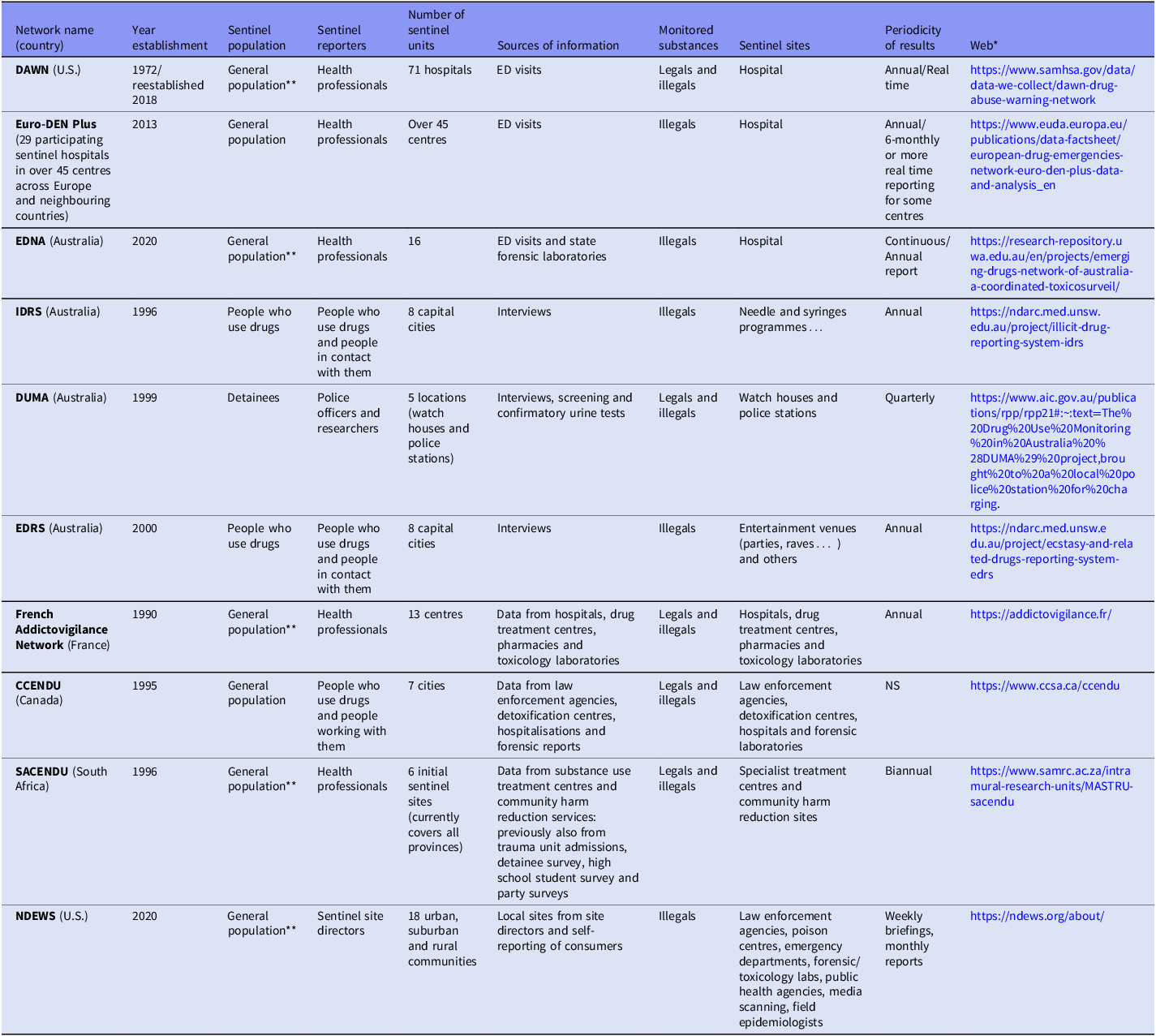
The first was set up in the United States in 1972 (Crane, Reference Crane2013; Substance Abuse and Mental Health Services Administration, 2023) and the most recent were established in 2020 (Cottler et al., Reference Cottler, Goldberger, Nixon, Striley, Barenholtz, Fitzgerald, Taylor and Palamar2020; Smith et al., Reference Smith, Soderstrom, Dawson, Alfred, Greene, Isoardi, McCutcheon, Oosthuizen, Ezard, Burcham and Fatovich2022). These surveillance systems are often integrated as part of larger national programmes. Despite being mainly coordinated by their respective governments, some have public universities as partners (Table 1).
Characteristics of the active national sentinel networks by main source of information

Table 1. Long description
A table comparing characteristics of active national sentinel networks by main source of information. The table has 11 rows and 9 columns. The columns are Research name (country), Year established, Type of sub-unit, Sentinel reporters, Number of sentinel reporters, Sector of information, National coordination, Frequency of results, Probability of results, and Web. The rows are as follows: Row 1: D A S H (U S), 1972, General population, Health professionals, 71 hospitals, ED visits, Legal and illegal drugs, Hospital, Annual/Real time, Annual/Real time, https://www.samhsa.gov/data/, https://www.samhsa.gov/data/, https://www.samhsa.gov/data/, https://www.samhsa.gov/data/, https://www.samhsa.gov/data/, https://www.samhsa.gov/data/, https://www.samhsa.gov/data/, https://www.samhsa.gov/data/, https://www.samhsa.gov/data/. Row 2: Euro D I R Plus (Denmark, Finland, Norway, and Sweden), 2013, General population, Health professionals, Over 45 sentinels, ED visits, Legal and illegal drugs, Hospital, Annual/Real time, Annual/Real time, https://www.ssb.no/en, https://www.ssb.no/en, https://www.ssb.no/en, https://www.ssb.no/en, https://www.ssb.no/en, https://www.ssb.no/en, https://www.ssb.no/en, https://www.ssb.no/en, https://www.ssb.no/en. Row 3: E D N A (Australia), 2020, General population, Health professionals, 16, ED visits and laboratories, Legal and illegal drugs, Hospital, Continuously, Continuously, https://www.ncpic.org.au/, https://www.ncpic.org.au/, https://www.ncpic.org.au/, https://www.ncpic.org.au/, https://www.ncpic.org.au/, https://www.ncpic.org.au/, https://www.ncpic.org.au/, https://www.ncpic.org.au/. Row 4: I D S M (Australia), 1996, People who use drugs, People who use drugs and people who inject drugs, 8 capital cities, Interviews, Needle and syringe programmes, Quarterly, Quarterly, https://www.ncpic.org.au/injecting/, https://www.ncpic.org.au/injecting/, https://www.ncpic.org.au/injecting/, https://www.ncpic.org.au/injecting/, https://www.ncpic.org.au/injecting/, https://www.ncpic.org.au/injecting/, https://www.ncpic.org.au/injecting/, https://www.ncpic.org.au/injecting/. Row 5: D U N A (Australia), 1999, Detainees, Police officers and researchers, 5 locations (adult watch-house detainees), Interviews, Legal and illegal drugs, Watch-Houses and police stations, Quarterly, Quarterly, https://ndarc.med.unsw.edu.au/resources/research-tools/duna, https://ndarc.med.unsw.edu.au/resources/research-tools/duna, https://ndarc.med.unsw.edu.au/resources/research-tools/duna, https://ndarc.med.unsw.edu.au/resources/research-tools/duna, https://ndarc.med.unsw.edu.au/resources/research-tools/duna, https://ndarc.med.unsw.edu.au/resources/research-tools/duna, https://ndarc.med.unsw.edu.au/resources/research-tools/duna, https://ndarc.med.unsw.edu.au/resources/research-tools/duna. Row 6: E D R S (Australia), 2000, People who use drugs, People who use drugs and people who inject drugs, 8 capital cities, Interviews, Legal and illegal drugs, Entertainment venues (parties, festivals, and others), Annual, Annual, https://ndarc.med.unsw.edu.au/resources/research-tools/edrs, https://ndarc.med.unsw.edu.au/resources/research-tools/edrs, https://ndarc.med.unsw.edu.au/resources/research-tools/edrs, https://ndarc.med.unsw.edu.au/resources/research-tools/edrs, https://ndarc.med.unsw.edu.au/resources/research-tools/edrs, https://ndarc.med.unsw.edu.au/resources/research-tools/edrs, https://ndarc.med.unsw.edu.au/resources/research-tools/edrs, https://ndarc.med.unsw.edu.au/resources/research-tools/edrs. Row 7: French Illicit Drug Surveillance Network (France), 1990, General population, Health professionals, 13 centres, Data from hospital emergency, Poison control centres, and toxicology laboratories, Legal and illegal drugs, Hospitals, drug treatment centres, and laboratories, Annual, Annual, https://www.ofdt.fr/, https://www.ofdt.fr/, https://www.ofdt.fr/, https://www.ofdt.fr/, https://www.ofdt.fr/, https://www.ofdt.fr/, https://www.ofdt.fr/, https://www.ofdt.fr/. Row 8: C C S A N (Canada), 1995, General population, People who use drugs and people who inject drugs, 7 cities, Data from law agencies, hospitals, treatment facilities, and forensic laboratories, Legal and illegal drugs, Law enforcement agencies, hospitals, treatment centres, and forensic laboratories, N/S, N/S, https://www.canada.ca/en/health-canada.html, https://www.canada.ca/en/health-canada.html, https://www.canada.ca/en/health-canada.html, https://www.canada.ca/en/health-canada.html, https://www.canada.ca/en/health-canada.html, https://www.canada.ca/en/health-canada.html, https://www.canada.ca/en/health-canada.html, https://www.canada.ca/en/health-canada.html. Row 9: S A C E N D (South Africa), 1996, General population, Health professionals, 6 vital statistics offices and 1 urban and rural sentinel sites, Data from treatment centres, community-based organizations, and law enforcement agencies, Legal and illegal drugs, Sentinel treatment centres and law enforcement agencies, Annual, Annual, https://www.sacend.org.za/, https://www.sacend.org.za/, https://www.sacend.org.za/, https://www.sacend.org.za/, https://www.sacend.org.za/, https://www.sacend.org.za/, https://www.sacend.org.za/, https://www.sacend.org.za/. Row 10: N D E W S (U S), 2020, General population, Sentinel site directors, 18 urban, suburban, and rural sentinel sites, Local data from sentinel sites, Legal and illegal drugs, Law enforcement agencies, hospitals, emergency departments, public health laboratories, and community health centers, Weekly, Weekly, https://www.hhs.gov/, https://www.hhs.gov/, https://www.hhs.gov/, https://www.hhs.gov/, https://www.hhs.gov/, https://www.hhs.gov/, https://www.hhs.gov/, https://www.hhs.gov/. Row 11: S E S T (Spain), 1996, General population, Health professionals, 20 sentinel sites, Data from treatment centres, Legal and illegal drugs, Sentinel treatment centres, Annual, Annual, https://www.pnsd.mscbs.es/, https://www.pnsd.mscbs.es/, https://www.pnsd.mscbs.es/, https://www.pnsd.mscbs.es/, https://www.pnsd.mscbs.es/, https://www.pnsd.mscbs.es/, https://www.pnsd.mscbs.es/, https://www.pnsd.mscbs.es/.
NS, not specified; ED, emergency department.
*Some web links may not be accessible or may function differently depending on the reader’s geographic location.
**Representative sample.
These surveillance systems are characterised by three aspects: 1) population under surveillance/sentinel population, 2) key informants/sentinel reporters and 3) source of information. Regarding the sentinel population, the identified systems mainly monitor the general population, apart from three of the sentinel networks which rely on people who use drugs or detainees. The sentinel reporters are mainly researchers, public health specialists or trained personnel, and volunteers. This information for each of the systems identified can be found in Supplementary Table S3 of Appendix 2. Information is sourced through emergency departments (EDs), interviews with sentinel populations and community resources such as drug rehabilitation centres or law enforcement agencies (Table 1).
Emergency departments
Three of the sentinel surveillance systems employ ED visits as a source of information: DAWN, Euro-DEN and EDNA. These sentinel surveillance systems monitor drug-related presentations using health professionals as informants. Although all aim to monitor illicit or new psychoactive drug-related trends and harms, their surveillance approaches differ regarding case definitions, data collection procedures and the use of toxicological confirmation. Two sentinel surveillance systems also collect the co-use of alcohol with other drugs as well as alcohol consumption by minors (Table 1 and Supplementary Table S3 (Appendix 2)).
Interviews
Three of the sentinel surveillance systems employ interviews as the main source of information: IDRS, DUMA and EDRS. All three are in Australia and monitor people who use drugs and detainees through self-reporting or reporting by people in contact with these populations. Additional data is collected to complete the information such as drug purity, related deaths and biomarker analysis. These sentinel surveillance systems are located in rehabilitation centres, law enforcement agencies and nightlife venues. Mostly information on illegal drugs is collected. Information elicited includes consumption history, drug market characteristics and other characteristics related to drugs and illicit drug use (Table 1 and Supplementary Table S3 (Appendix 2)).
Community resources
Four of the sentinel surveillance systems employ multiple community resources as their main source of information: French Addictovigilance Network, CCENDU, SACENDU and NDEWS. Community resources refer to drug rehabilitation centres, health centres such as trauma units, law enforcement agencies and forensic laboratories, among others, and cover a broad landscape of drug use. These systems monitor the general population using different sentinel reporters, with two of the four systems using health professionals. All sentinel surveillance systems collect information on both legal and illegal drugs through different methods such as the collection of standardised forms, review of drug-related death data, spontaneous reporting and surveys (Table 1 and Supplementary Table S3 (Appendix 2)).
Although NDEWS shares this community resource-based approach, it stands out for the integration and triangulation of a wider range of complementary data sources. NDEWS incorporates real-time digital surveillance, wastewater analysis, and signals from informal sources such as toxicologists, funeral directors, journalists, and people who use drugs through NDEWS Rapid Street Reporting programme.
Discussion
This review identified ten active national sentinel surveillance systems targeting illicit drug use, and, in some cases, the detection of novel psychoactive substances. Despite the systems sharing a similar process, no approach is completely the same. Identifying these different characteristics makes it possible to define specific aspects that could be included in the design of new sentinel systems directed toward illicit drug use monitoring and surveillance (Welty et al., Reference Welty, Harrison, Abram, Olson, Aaby, McCoy, Washburn and Teplin2016).
Descriptions of the characteristics of the sentinel population or the sentinel reporters are often limited in the literature despite their central role in shaping the type and quality of data obtained. Importantly, while the recruitment strategies of the sentinel population or the selection of the reporters introduces methodological considerations, the strategies do not undermine the sentinel value of the information gathered. In addition, surveillance of illicit drug use is challenging because its use is relatively uncommon in the general population and stigma may limit participation (Bathish et al., Reference Bathish, Madden, Duff and Ritter2024). The systems that carry out sentinel surveillance among users outside the hospital setting, such as IRDS and ERDS, typically recruit from syringe exchange centres, online platforms or nightlife venues (clubs, festivals), and may complement recruitment using a peer-referral or snowball technique. Focusing the sentinel population on persons under detention is an interesting approach, especially considering that the prevalence of drug consumption among them is higher than in the general population (Welty et al., Reference Welty, Harrison, Abram, Olson, Aaby, McCoy, Washburn and Teplin2016).
People with lived experience of drug use represent a highly diverse population, which makes defining the sentinel focus very challenging. Nevertheless, focusing on people who currently use drugs may offer early indications of new substances or changes in patterns of use (Soussan & Kjellgren, Reference Soussan and Kjellgren2016; Brunt et al., Reference Brunt, Nagy, Bucheli, Martins, Ugarte, Beduwe and Ventura Vilamala2017). For this reason, their contribution has been regarded as central in some sentinel models. At the same time, earlier studies highlighted methodological concerns regarding self-reported data in specific contexts (Sloan et al., Reference Sloan, Bodapati and Tucker2004). Some networks that use drug users as sentinel reporters provide incentives to participants. This aspect is controversial, especially in addiction research (Manriquez Roa & Biller-Andorno, Reference Manriquez Roa and Biller-Andorno2022).
In addition, information on drug-related behaviours or trends often relies on user self-report or that of their companions. However, in rapidly evolving illicit markets, substances consumed may differ from what individuals believe they have taken, which can introduce uncertainty in the absence of biological confirmation.
Purposeful sampling is another feature of sentinel surveillance. Some networks strategically position data collection in areas identified as high risk based on prior evidence. NDEWS, one such system, conducts rapid field assessments in locations characterised by high prevalence or rapidly changing patterns of drug use through its Rapid Street Reporting programme (Cottler et al., Reference Cottler, Goldberger, Nixon, Striley, Barenholtz, Fitzgerald, Taylor and Palamar2020; Palamar et al., Reference Palamar, Acosta, Cleland and Sherman2021). Similarly, DAWN incorporated components based on EDs in strategically selected areas to strengthen the early detection of emerging drug-related threats (Crane, Reference Crane2013; Substance Abuse and Mental Health Services Administration, 2023). In the context of purposeful sampling, many sentinel surveillance systems contribute to early warning functions by permitting the timely identification of emerging substances and unusual patterns of harm. Effective early warning approaches rely on collaboration between clinical services, forensic laboratories, and public health authorities, as well as on the triangulation of multiple data sources (Freestone et al., Reference Freestone, Siefried, Peacock, Fletcher, Barratt, Sutherland, Ezard, Doumany, MacDonald, Kypri, Acheson and Clifford2025). The systems identified in this review reflect varying degrees of this integrated model. However, the available literature rarely provides data on how quickly signals are generated, how they are interpreted, or whether they lead directly to documented public health responses.
The establishment of the sentinel component in nightlife venues could provide valuable information. This approach is implemented in SACENDU (Pluddemann et al., Reference Plüddemann, Parry, Myers and Bhana2004) and EDRS (Horyniak et al., Reference Horyniak, Dietze, Lenton, Alati, Bruno, Matthews, Breen and Burns2017). Another very interesting sentinel approach in leisure environments was conducted as repeated cross-sectional studies in clubs and music festivals, where the attendees are the sentinel population (Palamar et al., Reference Palamar, Le, Cleland and Keyes2023). It would be beneficial to integrate this approach into a sentinel illicit drug use surveillance system, allowing for a more complete and up-to-date understanding of the landscape regarding patterns of use and emerging trends among specific populations.
We identified other surveillance systems with a sentinel-like component worthy of discussion; however, they did not meet the inclusion criteria. In the case of Canada, the Canadian Hospitals Injury Reporting and Prevention Program was identified. This system collects self-reported data by means of a questionnaire distributed to patients who visit the EDs of sentinel hospitals (mainly paediatric) for treatment of trauma or other ailments (Campeau et al., Reference Campeau, Champagne and McFaull2022). Since it does not focus its activity directly on the surveillance of illicit drug use, this system was not included (Buxton et al., Reference Buxton, Spearn, Amlani, Kuo, Lysyshyn, Young, Purssell, Papamihali, Mill and Shapiro2019; McFaull et al., Reference McFaull, Champagne, Thompson and Bang2020). Other networks that have not been active in the last four years, such as the Swedish project STRIDA (Helander et al., Reference Helander, Bäckberg, Hultén, Al-Saffar and Beck2014), IONA (Identification Of Novel psychoActive substances) (Newcastle University, n.d.), and PSCAN (Psychoactive Surveillance Consortium and Analysis Network), had characteristics similar to those identified in the surveillance systems included in this review, and had EDs as a source of recruitment (Monte et al., Reference Monte, Hopkinson, Saben, Shelton, Thornton, Schneir, Pomerleau, Hendrickson, Arens, Cole, Chenoweth, Martin, Adams, Banister and Gerona2020). We have also identified some non-national systems that are not currently active but still contribute with interesting perspectives. This is the case of the Olympic surveillance system set up in Sydney in 2000 by the New South Wales Department of Health. This sentinel surveillance system is relevant as an historical example of an event-based sentinel surveillance (Indig et al., Reference Indig, Thackway, Jorm, Salmon and Owen2003). Establishing sentinel surveillance systems for illicit drug use and misuse during these types of events is of value not only from the perspective of health planning but also from the perspective of public health monitoring. It is also worth noting that other drug surveillance systems are wastewater analysis systems, which provide essential information for drug surveillance which lacks a population correlate. Finally, an institution that supports drug monitoring with a global perspective is the UNODC (United Nations Office on Drugs and Crime). This organisation collects information on drugs from member states and also runs the Global SMART (Synthetics Monitoring: Analyses, Reporting and Trends) Programme. This programme provides technical support to forensic laboratories, law enforcement agencies and researchers from partner governments in priority regions, with the aim of generating information on synthetic drugs (Laboratory and forensic science. United Nations Office on Drugs and Crime, n.d.).
This review has limitations. Surveillance systems that could have a clear sentinel component are not always classified as such, creating the possibility that published studies or surveillance systems might have been overlooked. Another limitation is the identification of sentinel systems whose main objective is not solely related to illicit drug use, but also captures other aspects, such as road accidents associated with illicit drug use (Dunn & Kelley-Baker, Reference Dunn and Kelley-Baker2021). Despite the fact that sentinel surveillance systems operate across various jurisdictional levels, we focused on the national level. Local systems are less representative of the national situation, mainly due 1) to their smaller population coverage; 2) the use of complementary sources such as surveys is limited, as these are rarely conducted at the this level; 3) the health areas covered by EDs tend to encompass larger areas, thus limiting the usefulness of the local systems; and 4) the resources available are fewer (Mounteney & Leirvåg, Reference Mounteney and Leirvåg2004). In addition, rapidly evolving surveillance initiatives may not always be captured in peer-reviewed literature and the design and results of sentinel systems may only be available through institutional sources, as is the case of the Epidemiological Surveillance System for Addictions (Sistema de Vigilancia Epidemiológica de las Adicciones-SISVEA) (Dirección General de Epidemiología, 2022). Although this system appears to have a sentinel component, this could not be confirmed due to the limited and difficult-to-access information available. In addition, access to some institutional webpages or online repositories was not consistent across locations or settings at the time of review, which may have limited the retrieval or verification of updated information for some systems. For this reason, direct contact with selected representatives or identified experts was used, where feasible, to clarify specific factual or operational aspects. Finally, the inclusion criteria of being considered ‘active’ should be interpreted in the context of the COVID-19 pandemic, which may have affected data collection, reporting continuity, or publication frequency in some surveillance systems.
This is the first review conducted with the aim of identifying and characterising sentinel surveillance focused on illicit drug use or drug misuse. These systems could be of value in the monitoring of illicit drug use by avoiding the limitations associated with traditional surveillance systems, especially the paucity of data and the inability to provide up-to-date information in a timely manner. The advantages of a sentinel system become more evident over time. As the length of time in which they operate increases, regular and systematic data collection help to identify when an apparent change becomes a meaningful trend or is an unsustained fluctuation (Crane, Reference Crane2013; Jouanjus et al., Reference Jouanjus, Gibaja, Kahn, Haramburu and Daveluy2015; Micallef & Mallaret, Reference Micallef and Mallaret2016; Substance Abuse and Mental Health Services Administration, 2023). The impact of such sentinel systems has the potential to reach beyond the monitoring of illicit drug use and could be used to monitor the impact of legislation and/or the control of other substances such as tobacco or alcohol. Sentinel reporting should be multidimensional and based on a variety of populations such as people who use drugs, health professionals and stakeholders at the community level. Investment of public funds to support sentinel surveillance appears critical, as their findings support the implementation of practices, programmes and policies at both the national and sub-national level.
Conclusion
The objective for this review was not solely to identify the sentinel systems monitoring illicit drug use, but rather to identify the various components of sentinel drug surveillance systems. Having identified such disparate forms of surveillance is a strength, and provides insight into how sentinel surveillance on illicit drug use can be structured. Sentinel systems share the capacity to adapt to rapidly evolving drug markets, and pinpoint changing patterns of use. Strengthening coordinated surveillance systems is therefore essential to support timely monitoring and informed public health responses. Surveillance systems that integrate interdisciplinary sentinel components, are supported by public institutions, and draw on multiple data sources may provide a robust framework for monitoring illicit drug use and emerging drug-related harms.
Supplementary material
The supplementary material for this article can be found at https://doi.org/10.1017/neu.2026.10090.
Data availability statement
Data derived from public domain resources.
Acknowledgements
The authors gratefully acknowledge the representatives/contact persons from the different networks included in this study for their support in fact-checking and providing updated information for this manuscript.
Author contributions
SC and AT participated in the development of the methodology, formal analysis, investigation, writing the original draft and reviewing and editing. LVL participated in the conceptualisation, formal analysis, investigation, reviewing and editing. JRC, CCP, LMG, GG and CGT participated in the formal analysis, investigation, reviewing and editing. JA and SK participated in the formal analysis, reviewing and editing. LBC participated in the formal analysis, funding acquisition, reviewing and editing. MPR participated in the conceptualisation, development of the methodology, formal analysis, investigation, reviewing and editing.
Funding statement
This study was primary funded by the Carlos III Health Institute (ISCIII) through project PI25/00937 and co-funded by the European Union. Cottler received funds through the National Drug Early Warning System Coordinating Center (5U01DA051126-05).
Competing interests
None.


 Open access

