In 1891, Luther H. Gulik, a prominent member of the international leadership of the YMCA of the United States, established the triangle as the YMCA symbol. He saw the triangle as a symbol imbued with Christian beliefs that would become the spearhead of a worldwide missionary movement. About the Triangle, Gulik wrote:
The triangle stands . . . for the symmetrical man, each part developed with reference to the whole, and not merely with reference to itself. . . . What authority have we for believing that this triangle idea is correct? It is scriptural. . . . Such statements as, “Thou shalt love the Lord Thy God with all they heart and soul and mind and strength,” indicate . . . the scriptural view . . . that the service of the Lord includes the whole man. The words, which in the Hebrew and Greek are translated “strength,” refer in both cases entirely to physical strength.Footnote 1
As the YMCA International Committee's first secretary for athletic work (1889–1902), Gulik had strong reason to create a symbol that could be recognized anywhere in the world. He was a firm believer in the expanding Muscular Christianity movement, which glorified patriotic duty and manliness expressed through athletics, and a strong believer in the civilizing agency of missionary Protestantism as it sought to establish a United States Christian righteous empire.Footnote 2
During and after the Spanish American War of 1898, which ended four centuries of Spanish rule, the YMCA became an integral ally in the United States invasion of Puerto Rico, Cuba, and the Philippines. Entering these islands as the Army and Navy YMCA, the organization helped to establish the new imperial hegemony by developing missionary activities and creating a modern athletic culture, all part of fulfilling US promises to fostering and develop liberal democratic institutions.Footnote 3 While Gulik never set foot in Puerto Rico, he did articulate and institutionalize the parameters that made athletic activities and sport an essential part of the religious mission of the YMCA, not only in the United States but also in Puerto Rico and beyond.Footnote 4
Although the YMCA entered Cuba and the Philippines as well as Puerto Rico with the US Army in 1898, this article will focus on Puerto Rico, since it was here that the YMCA had a more stable and fertile ground for proselytizing. Puerto Ricans, familiar with modern sports since before 1898, were also familiar with and often admiring of the US's democratic tradition and liberal economy.Footnote 5 Their admiration for US republicanism and capitalism, especially in contrast to what they felt to be an oppressive Spanish monarchy, allowed them to welcome and conditionally accept the YMCA's premise of promoting their mental, spiritual, and physical well-being.Footnote 6 This article will show that in the midst of these imperial, colonial, and hegemonic transitions, religion and sport became a significant element in the negotiations over the meaning of culture and progress.
Despite Spanish repression in the island, Puerto Rico remained a predominantly Catholic society and carried centuries-long traditions as the home of a Hispanic Caribbean people with a politically informed elite. Although there were some Protestant groups on the island before 1898, the US missionary endeavor in Puerto Rico after 1898 was different: it was part of a concentrated Americanization project, intended to turn what the US considered backward traditions, including Spanish Catholicism, into civilized and progressive values of Anglo-Saxon Protestantism and democracy.Footnote 7 However, proponents of Americanization in Puerto Rico faced a 400-year-old Catholic and Hispanic society led by an articulate Puerto Rican elite that was already carrying out its own hegemonic agenda.Footnote 8
This article will demonstrate that along with a military and missionary invasion, a new approach to play and recreation—known as sports—became an imperial tool in the attempt to transform Puerto Ricans to fit American values.Footnote 9 For the YMCA, sport, or “physical work” as they called it, would help US officials turn Puerto Ricans into the American ideal of physical strength, which was inherently tied to ideas of Christian strength. On the other hand, Puerto Ricans saw sports as an example of the cultural progress promised by the United States.
However, the story of sports and religion within the US imperial regime in Puerto Rico—nearly 120 years old at this writing—cannot be simplified to a story of oppression and resistance. The development of sports within a missionary institution like the YMCA involved a process of negotiation between, on the one hand, a colonial people looking to modernize and on the other, a modern imperial nation looking for territorial and commercial expansion. As historian Solsiree del Moral argues in the case of Puerto Rico's education system, Puerto Ricans were selective in the process of Americanization, rejecting incongruent values and adopting progressive ones.Footnote 10 For Del Moral, Puerto Rican teachers served as intermediaries of a citizenry that sought to benefit from the values of an American education for social mobility and progress, while rejecting the imposition of English as the medium of instruction. In the case of the YMCA, young Puerto Rican men adopted and helped popularize modern US sports but dismissed conversion to Protestantism.
Moreover, religious oppositions cannot be simplified to US Protestants versus Puerto Rican Catholics. What we see instead is the bifurcation of Puerto Rican Catholics, some of whom continued to defend the Hispanic tradition and Puerto Rican autonomy, and some who were tended to be pro-American. Despite their disadvantaged relation to the United States, Puerto Ricans exerted a degree of agency over the terms of Americanization, in this case sport and religion, to deny complete acculturation and to continue the pursuit of their own ideals of national progress.
Although Puerto Ricans expressed open resistance to the US military authority during and immediately after the war, the political leadership did not demand immediate political emancipation.Footnote 11 Instead, they opted to work with the new imperial regime, one that carried the reputation of democracy, freedom, and liberalism in their search for progress. One especially admired feature of US culture was the country's advanced system of sports, represented in the YMCA. As this article will show, the YMCA, especially in the capital San Juan, was accepted primarily for its sports programming.Footnote 12
This article places politics, religion, and sport in Puerto Rico in historical context to bring to light how they intersected in Puerto Rico with US imperialism, and how this intersection came into contact with a Puerto Rican society steeped in Spanish Caribbean traditions that at the same time yearned to become a liberal democracy. We will discuss the YMCA's religious and sports activities, which climaxed in 1917 with World War I, and demonstrated its close affinity with the US armed forces. The article concludes with some reflections on the effects of the YMCA and Puerto Ricans' early negotiations over religion, sports, and empire, and how these simultaneously affected a growing sense of national identity and the consolidation of colonialism.
Empire, Religion, and Sports
Expansion and the search for new markets was not unique to the United States, but was also a European push that led to the conquest of new colonial frontiers in Africa, Asia, and the Middle East. Historian Kristin Hoganson has demonstrated how US politicians, diplomats, and ideologues were driven to demonstrate a manly show of force during the Spanish American War of 1898.Footnote 13 It is important here to note the patriarchal basis of US imperial expansion: it went hand in hand with the YMCA's exclusive focus on young men and its exclusion of women. Further, the YMCA's imperial connections included institutions known for their masculine orientation—sport, politics, and religion—and as such its activities can be viewed as an extension of the imperial manly expansion. One source of US imperialism in this context was a growing sense of religious superiority, combined with an emphasis on sport as a cultural form of progress and modernity.Footnote 14 Rooted in US expansionism was the belief that the country had a moral and Christian obligation to bring the American way of life to barbarous peoples. In 1885, Reverend Josiah Strong in his much-circulated book Our Country expanded the idea that the United States' scientific, political, and material progress was a direct outcome of its Christian Anglo-Saxon civilization. Related to England by blood, racial, and religious ties, the United States had been providentially selected to civilize the world based on Christian values, putting forward what historian Samuel Silva Gotay calls an “imperialist theology.”Footnote 15 Rule of law and civil society combined with “pure spiritual Christianity” made the Anglo-Saxons the selected people to lead global democracy.Footnote 16
By 1898, Cuba, Puerto Rico, and the Philippines were the only remaining colonies of a once-mighty Spanish Empire, now on the verge of collapse due to wars of liberation and political reform. Although Puerto Ricans had managed to obtain a degree of political freedom through the Autonomous Charter of 1897, the United States saw the declining and vulnerable Spanish Catholic monarchy not only as representing backwardness but also as exercising the oppression of these colonial tropical peoples.Footnote 17 While for many in the United States, the Spanish American War of 1898 was primarily a manly war of liberation and imperial expansion, for many others it was an opportunity to bring liberal Christian civility.Footnote 18
Religion is generally accepted as critical in the study of Latin America and the Caribbean.Footnote 19 In that light, Reinaldo Román and Pamela Voekel argue for a shift from studies of secularization to understanding the politics of religion. This is particularly true of Protestantism, and the politics of US-Latin American relations. Protestantism in Cuba and Puerto Rico was present well before 1898, and had developed, to a degree, within the structures of Spanish colonialism.Footnote 20 Evident after 1898, however was something new: the official alliance between missionary US Protestantism and the invading US forces to secure hegemonic imperial occupation.Footnote 21 The prestige of the United States as a wealthy, economically modern country was widely admired among the middle sectors in Latin America, but equally present was scorn for the US's aggressive involvement and imperialistic attitudes toward the region.Footnote 22 In Puerto Rico, the Catholic-Protestant dynamics that developed after 1898, played out in the YMCA, occurred as a result of an imperial project facing a society already engaged with its own religious power dynamics, including the popular rejection of the island's elitist and declining Catholic Church.Footnote 23 Nonetheless, Puerto Ricans remained mostly Catholic.
As they did to religion, Puerto Ricans had a particular relation to sports. In Spain, Cuba, and the Philippines in the nineteenth century, as in other parts of Latin America, sports were known but not yet developed. Plans to incorporate physical education into these countries' frail education systems were attempted, but hardly sustained.Footnote 24 Modern sports were to some degree present in Puerto Rico before 1898, chiefly baseball brought by Cubans starting in the late 1890s.Footnote 25 Gymnastics had been practiced since the 1850s, and other games that are today considered sports, such as bowling, horse-racing, and nautical sports, were also practiced under Spain.Footnote 26 However, the practice of these sports was under the direct supervision and control of Spanish authorities. In Puerto Rico, the Spanish feared that liberal ideas could spread through these modern practices and foment insurrection, as they had in Cuba.Footnote 27
After 1898, the Puerto Rican political leadership, already aware of the civic and social benefits of sports, saw a great opportunity to sponsor sports under the new “modern” regime. Puerto Rican patriot and intellectual Eugenio María de Hostos included sports as part of Puerto Rican freedom claims to the United States. At the foundational assembly of the League of Patriots on October 30, 1898, Hostos stated, “Not less important to the purpose of the League, is the establishment of gymnasiums or target shooting, that, in relation to the duties of the citizen, are truly civic lessons.”Footnote 28
While sport and religion fall into the realm of culture, they are also integrated into the day-to-day negotiations of people with their government and their civic, religious, and imperial institutions. Thomas Carter argues that the study of sport and religion should move away from analysis of “symbolic representations” and instead focus on more practical issues, including “identity politics and the state.”Footnote 29 Other scholars of sport have demonstrated the US's imperial style of presenting them, often with underlying Muscular Christianity ideologies.Footnote 30 Muscular Christianity, in its simple definition, is the belief developed in the industrial West that sought the strengthening of the Christian soul through the strengthening of the body. Yet for historical anthropologist John MacAloon, the development of Muscular Christianity since its nineteenth-century beginnings is more deeply rooted, and has had a central effect on public discourse in the United States relating, for example, to “school spirit, teamwork, duty, protection of the weak, and individual virtue.” Muscular Christianity also influenced other areas of society including “church camps, YMCA/YWCA, Boy Scouts, Girl Scouts, outdoor education, the playground movement, church recreational leagues, the myriad forms of moral validation and exercise and self-help practices, volunteer movements, religious missions, Teddy Roosevelt and the National Parks System . . . and the eugenics movement.”Footnote 31 In short, Muscular Christianity is a central cultural and recreational variant in the modern world.
Muscular Christianity was not limited to Anglo-Saxon Protestants. Catholic theologians have related sports and the body to the soul and spirit since the medieval ages, drawing their ideas particularly from the Gospel of St. Paul.Footnote 32 With the encyclical Rerum novarum of 1891, Pope Leo XIII turned the attention of the Catholic Church to the working classes and their leisure. Pope Pius X (r. 1903–14) was a known sport enthusiast who supported the establishment of Catholic sport associations and even advocated for the 1908 Olympic Games to be held in Rome.Footnote 33 For both Protestants and Catholics, sports were mainly a manly activity. In its most positive light, early Protestant proponents of Muscular Christianity envisioned women as helping men achieve their full Christian potential.Footnote 34 For Catholics, sport was considered threatening for women, since it could damage their decency and jeopardize their modesty.Footnote 35
Sports in the name of imperial interests is not unique to the United States. They had been used in this way by the French and English, particularly in soccer and athletics, and also under missionary agendas.Footnote 36 Generally, in England and the United States, sport has served as an agent of cultural imperialism, skillfully employing the rhetoric of civilization, Christian values, and ‘healthy’ competition.Footnote 37 Underlying this rhetoric were strong beliefs in the supremacy of the white European race, a belief claimed to be scientifically proven under Social Darwinism. Modern sports, in the European and US approaches, grew out of this context and historically often served as a way to exhibit white athletic prowess.Footnote 38 The YMCA, as an English and US-based institution, carried this racist ideology and admitted exclusively young white men. Similarly, modern sport has a strong elitist origin, despite its adoption by the popular classes. Mainly developed as amusement practices for the wealthy of a vast English empire and its American counterpart, modern sports, including the Olympic Movement, can be understood as the story of a group of elitists defending their positions of power and privilege.Footnote 39
In Puerto Rico, cultural imperialism through sport began with the Army and Navy YMCA. The YMCA's popularity among Puerto Ricans was not an isolated phenomenon, nor was Puerto Rico the YMCA's first experience with Latin America.Footnote 40 Well before 1898, the organization was present and active in Argentina, Brazil, Chile, Mexico, and Uruguay. Although the YMCA in Brazil has been mainly associated with sport, its missionary component cannot be ignored.Footnote 41 Sport for the YMCA was the medium for its missionary work, and in Puerto Rico, as in Cuba and the Philippines, the organization was a de facto tool in the imperial project of Americanization.
The Army and Navy YMCA
Manifest Destiny, a concept that led the United States to see itself as the bearer of both the burden and the right to civilize the world, was firmly present in the minds of YMCA leaders of the late 1890s. The Spanish American War was an opportunity to demonstrate that right, and another opportunity for YMCA leaders to prove their patriotism, this time overseas and against a European power. The first report of the Army and Navy Christian Commission of the International Committee of the Young Men's Christian Association stated the following:
Whether the war with Spain was a call of destiny to the United States may be a mooted question; but certain it is that this conflict brought to the Young Men's Christian Association an unprecedented opportunity for a mighty service to those young men who uphold the nation's honor on land and sea. Here was the call of God which [sic] could be unheeded only at gravest peril, for as Emerson well says: “Whatever the place allotted to us by Providence that for us is the post of honor and duty.”Footnote 42
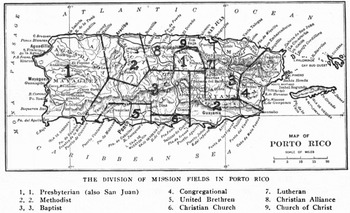
Against the saying “War is hell,” the YMCA sought to make living conditions on the battlefield and in military camps “humane” and Christian.Footnote 43 Their tents were equipped with all the necessary material for their missionary work and a secretary was put in charge of each camp. There was a reading room with daily newspapers, magazines and other reading material; games of skill and recreational sport; and facilities for correspondence, entertainment, music, and meetings. It is true that other major Protestant groups were present on the island, including the Presbyterian, Methodist, Baptist, Congregational, United Brethren, Christian Church, Lutheran, Christian Alliance, and the Church of Christ churches, which divided the island to carry out their evangelization projects (see Figure 1).Footnote 44 However, the YMCA was the only organization with an institutional commitment to physical fitness as a Christian way of life.
Division of the Mission Fields in Puerto Rico

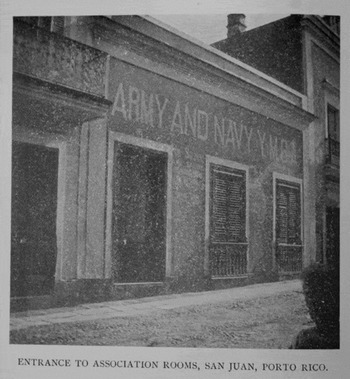
Contrary to historical accounts that assert that the YMCA began operations in Puerto Rico in 1903, the Army and Navy YMCA was on the island as early as 1899.Footnote 45 Frank L. Smith, its first secretary, was known for his zealous religious work and had served as a missionary at US military camps in Camp Lee, Virginia; Jacksonville, Florida; and Savannah, Georgia.Footnote 46 Assisting Governor General Guy Henry in early relief work in the island, Smith had secured a space within the troop's grounds, where he set up tents for recreation.Footnote 47 On April 19, 1899, the Army and Navy YMCA inaugurated its first permanent building in the city center at 42 Calle Sol. It was the first permanent YMCA building established in the three former Spanish territories (see Figure 2).Footnote 48 A New York Times article highlighted this accomplishment:
[The YMCA has] just opened to the public a splendid suite of rooms situated on Calle del Solle [sic], and have all of the conveniences that may be found in the Young Men's Christian Association rooms of most towns of the States. There is a reading room, with late daily papers and magazines; writing tables, with pens, ink, and papers; game room, with checkers, chess, &c., and a very dainty restaurant, with American cooking and English-speaking attendants. The first day the rooms were crowded by the solders and many of the civilians in San Juan.Footnote 49
Entrance to Association Rooms, San Juan, Porto Rico

By 1899, the association had established a reading room, a café, and a recreation room, and in 1900 a permanent library.Footnote 50 The Army and Navy YMCA was there to provide moral and spiritual support to the troops, but it also targeted civilians and locals. Women were excluded, as were black and mulatto young men. The exclusion of women from the YMCA was another contributing factor in the broader discrimination of women and made them outsiders to sport. White elite women did practice the sports the YMCA introduced to Puerto Rico, especially basketball. But they did so only outside the regular hours of the YMCA, to avoid “scaring off” men who might be led to think the sport was only for women and girls.Footnote 51 Certainly, the active nature of sport was unthinkable for women, given the requirements that they exhibit decency, honor, and respectability as defined in turn-of-the-century Puerto Rico. As historian Eileen Suárez Findlay demonstrates, women were subjected to a power relation that valued men's virility far more than women's “weak” femininity and acted to ensure women's proper behavior, effectively excluding them from the public civil sphere.Footnote 52
Only white or light-skinned young men in San Juan with money to pay the membership dues were invited and welcomed to the YMCA activities or the use of its facilities. This restriction applied to soldiers and officers, as well as to civilians. Puerto Ricans of Spanish ancestry or those deemed of “Spanish-Indian origin” could enter.Footnote 53 The Puerto Rican racial schema, similar to that of Cuba, Santo Domingo, and other parts of Latin America, placed Spanish whiteness atop a racist hierarchy that romanticized an indigenous past and devaluated African blackness. The schema historically extends to the point of dismissing African traits in Puerto Rican culture, which has contributed to what anthropologist Jorge Duany has called “making Indians out of blacks.”Footnote 54 The YMCA's acceptance of those with “Spanish-Indian” traits helped some young light-skinned Puerto Rican men to have their whiteness and manliness legitimized by membership in an exclusively white US institution.
Frank Smith left his post as secretary and left the island as well, at some time in the summer of 1899. He was succeeded by Rev. Zerah Collins, a Methodist. Collins quickly began an intensive outreach program. In September alone, he made 40 visits to military vessels in the harbor, distributing magazines and other literature. He also managed to secure an additional space for the YMCA's religious work, in an adjacent building named YMCA Gospel Hall. Here, the religious leaders managed to convert 15 men, “proving the power of Christ to save.”Footnote 55 Chaplain Henry W. Brown of Theodore Roosevelt's Rough Riders visited Puerto Rico in 1899, but Zerah Collins's YMCA was established in Puerto Rico before any other Protestant church mission. He was particularly proud to direct and open several Sunday schools in and around the harbor.Footnote 56 After the disastrous strike of Hurricane San Ciriaco on August 8, 1899, Collins visited the city of Ponce and rural towns of the interior, bringing moral and material support to the “natives.”Footnote 57
With the enactment of the Foraker Act of 1900, Puerto Rico had transitioned from a military regime to a civilian government. The Puerto Rican governor was now an appointee of the US president. An executive council that served as the governor's cabinet and upper house was composed of six Americans and five Puerto Ricans. The governor, the council, and a Puerto Rican elected legislature together marked the beginnings of the colonial state.Footnote 58 Zerah Collins left Puerto Rico soon after, also in 1900. He had been fully invested in the patriotic, men-at-arms aspects of missionary work. The short Puerto Rican campaign and the withdrawal of the combat troops motivated him to leave, thus embarking for Manila in 1900. W. E. Durnstine, who had worked with Collins in San Juan since 1899, stayed on as secretary until 1904. During this period, various Army and Navy YMCA posts around the island closed, concentrating efforts in San Juan.
Local support aided YMCA activities, a fact that challenges the notion that Puerto Ricans between 1900 and 1929 generally resisted, resented, and opposed US colonial rule.Footnote 59 Instead, the Puerto Rican political elite collaborated with the YMCA, in just the same way they collaborated with US colonial administrators during the first two decades of the century, to secure access to power.Footnote 60 In other parts of the world the Army and Navy YMCA centers were supported by the parent organization's general secretary, based in the United States, but in Puerto Rico locals covered the YMCA's financial needs. Following his visit in 1902, Army and Navy Secretary William B. Millar stated that Puerto Rico's YMCA work had been favorable.Footnote 61
From early on, the Army and Navy YMCA influenced nascent educational institutions. When the recently established University of Puerto Rico (1903) hired an instructor of physical culture in 1904, Sergeant Major Rafael Segarra was chosen.Footnote 62 Segarra was followed by Daniel Ashley Beaman, from Springfield, Massachusetts, home of the YMCA's headquarters. Beaman had previously taught gymnastics and military drill at Elm Hill School in Massachusetts, and at the Roosevelt Industrial School in Ponce, Puerto Rico.Footnote 63
However, the YMCA did not grow as expected, mainly due to extensive pressure from certain Catholic groups. After the 1898 invasion, the Catholic Church divided into two camps, one representing the old Spanish tradition in alliance with Puerto Rican autonomists and pro-independence groups and another representing the Americanizing US Catholic Church.Footnote 64 The conservative peninsular pro-monarchical Catholic leaders offered the strongest resistance, adhering to the old Spanish regime with cries of “Long live Catholic Spain!” and “Long live James the Apostle!”Footnote 65 Yet, as the new empire entrenched itself in the island, other segments of the Puerto Rican Catholic leadership were willing to work with and negotiate new terms of religion and Americanization. An article in the pages of El Ideal Católico spoke for the Church's influence in the postwar society:
A people does not transform itself, does not Americanize trying to destroy its faith, forcing the poor to educate without religion, without morals, without beliefs. Place Catholic teachers, teach the Catholic religion to children, with parent approval, and you will see how schools will Americanize and how little by little the Puerto Rican people accepts the systems of progress that exist in the majority of the States of the Union.Footnote 66
For some Catholics, especially the Puerto Rican autonomist branch, Americanization was not a given. It was to be allowed only if the Catholic religion remained untouched, and Protestantism not forced. But the tenets of American progress in education, civil society, political culture, and athletics were appealing to many, especially the autonomist branch that was willing to work with and under the Americans. In 1903, the editors of El Ideal Católico had written:
With love we received the flag of the invader, and we longed for nothing else than to be the children of a glorious fatherland [patria]. But, has the government worked for this type of Americanization? Can we sympathize with a centralizing and almighty power like the one governing us, with partial justice as it has shown? For us, Americanization simply consists of continuing to be who we are, in truth, reason, and justice, strengthen our virtues, discard our vices, and take from the American people all that is necessary for our happiness and progress.Footnote 67
The Catholic Church continued to challenge Americanization throughout the first three decades of US rule in the island. Church leaders' positions regarding Americanization varied, but they maintained their religious authority, which actually rested on papal legitimacy. This connection was even more forceful than it had been earlier, because, also in 1903 and under the papacy of León XIII, the Puerto Rican diocese was separated from the Santiago de Cuba diocese. Now the Puerto Rican church reported directly to Rome. With the separation, the papacy gave de facto ecclesiastical independence to Puerto Rico: Puerto Rican Catholics now had direct access to Rome and were no longer subordinate to the United States.Footnote 68
As the Army and Navy YMCA consolidated during the early 1900s, the lines between civilian and military associates of the YMCA blurred.Footnote 69 In 1904, the new Army and Navy YMCA secretary, W. Frank Gloeckner, emphasized the association's Christian physical training. The YMCA central physical department increased its propaganda, linking the association to the benefits of athletics. The 1905–06 report stated: “Attention has been given to the publication of pamphlets, books, and articles on physical work helpful to physical directors—for example, gymnasiums record books and articles for use in extension work.”Footnote 70 Recognizing the possibilities for using athletics and physical work in its missionary work, the YMCA prepared for the establishment of a civilian organization.
Founding or the San Juan YMCA: 1909–1917
The Army and Navy YMCA closed its doors some time 1906 or 1907, and in 1908, the YMCA International Committee showed interest in establishing a civilian association in the island. John Mott, then already a leader in the World Student Christian Federation, met with William D. Murray, chairman of the YMCA's Foreign Work Department, to discuss establishing an association in the US territory. (Mott, a Methodist layman, was later president of the 1910 World Missionary Conference, and won the Nobel Peace Prize in 1946 for his work in establishing and solidifying Protestant student organizations dedicated to promoting worldwide peace.)Footnote 71 Mott wrote to George F. Tibbitts, who became the first association secretary for the West Indies, at his office in Washington, DC in 1908, and a year later Tibbitts landed in the southern city of Ponce, Puerto Rico to evaluate the possibility of establishing an association there.
Tibbitts was accompanied by Cameron Beck, the appointed associate secretary for Puerto Rico. Both had previously served as secretary and assistant secretary, respectively, for the YMCA in Cincinnati, Ohio. Ponce was then the center of the island's economic liberal elite. The tour took them to San Germán, Mayagüez, Aguadilla, Arecibo, Bayamón, San Juan, Hatillo, Utuado, and Caguas. Meetings along the tour route reflected the YMCA's interest in fostering relations with the elite and its disregard for the working classes. They met with the mayors of cities and their “picked men.”Footnote 72 Talking to such a group, and only to them, it should be of no surprise that Tibbitts reported being “received cordially . . . [and was] deeply impressed with the unanimous desire of the men in all parts of the island to see the work of the Association thoroughly established.”Footnote 73 He also reported having reached multi-party consensus on the YMCA efforts to develop young men in education, gymnasium, social life, and “most highly,” in Bible study and practical religious work. Tibbitts envisioned the establishment of a two-story association building in San Juan that would “exert tremendous influence throughout the Island.”Footnote 74
Indeed, YMCA public relations became more active after 1909. On June 10 and 12, 1909, the widely read newspaper Boletín Mercantil offered general information about the association, and later in the year published the location of its new offices in San Juan. Other newspapers, such as Puerto Rico Progress, covered the growing activities of the YMCA, including in 1910 the association's proposal for the layout and features of the new building.Footnote 75 A fundraising campaign was launched soon afterward, in 1910, with great expectation and enthusiasm. The building's final design consisted of not a two-, but a three-story building with lavish and grandiose details that left the nascent association in precarious debt.
The Puerto Rican liberal pro-American elite filled the board of directors of the San Juan association, indicating not only their interest in its programming, but also their acceptance of US rule and Americanization plans. Among board members were its president, Luis Sánchez Morales, also president of the Puerto Rican Executive Council; Vice-President Robert L. Holmes, a successful businessman; Secretary Martín Travieso Jr., the secretary of Puerto Rico; Treasurer Rafael Castro González, director of the Puerto Rican Territorial and Agricultural Bank; Felix Córdova Dávila, San Juan District Court judge; Emilio del Toro, associate justice of the Supreme Court of Puerto Rico; Francisco del Valle, president of the Insular Board of Health; and Juan B. Soto, professor of Jurisprudence at the University of Puerto Rico.Footnote 76 Other members of the Board were successful US businessmen and colonial administrators, making the YMCA's top leadership a coalition of Puerto Rican and US elites.
Despite the enthusiasm, and even before the building was finished, Tibbitts expressed concern about resistance to the YMCA in San Juan, particularly from the conservative wing of the local Catholic Church. Writing in the spring of 1911 to Hans P. Andersen, a secretary of the YMCA International Commission in New York, Tibbitts noted: “There is great danger of the Spanish priesthood encouraging opposition which might work havoc with unpaid pledges if the work is not soon begun.”
The establishment of the YMCA in San Juan was of particular interest to John Mott, who also kept track of YMCA developments in Jamaica, and the “West Indies overall.”Footnote 77 Mott envisioned Puerto Rico as the headquarters of the West Indies YMCA. In 1912, the San Juan YMCA leadership traveled to St. Kitts, St. Lucia, St. Thomas, Barbados, St. Croix, Antigua, Guadeloupe, and Dominica and Martinique. In St. Thomas, Tibbitts and his team held 30 meetings for Bible study in just two weeks. The evangelistic outreach of the YMCA in Puerto Rico thus had a broad vision, one that would “bring together the young people of both the Latin and the Anglo-Saxon races . . . producing a better understanding and feeling among them.”Footnote 78
The San Juan elite and the general public living near the area surrounding the Puerta de Tierra barrio shared the enthusiasm for the new YMCA. Although the association geared its project mainly to wealthy, light-skinned young men, the enthusiasm for its sports programming was shared by members of the lower classes, blacks and mulattos, and women, despite the fact that these groups were neglected by the institution. During the cornerstone ceremony in 1912, YMCA president for Puerto Rico, Luis Sánchez Morales, spoke (in Spanish) of the benefits of the association, stressing that it was open to people of all creeds, but mainly referring to Protestants and Catholics.Footnote 79 The YMCA was indeed open to all young white Christian men—so long as they certified their Christian faith. Mayor Roberto H. Todd talked about the foundation of the YMCA in London in 1844, and Francisco del Valle Atiles, former San Juan mayor, gave an “eloquent speech about the great benefits” of the Y to the youth of San Juan.
According to news reports, the audience “listened with much attention” and was “profoundly impressed” with his remarks. The first stone was placed by Justice Emilio del Toro, representing the governor, who gave an emotional and “solemn speech” to an admiring crowd of young and old. Governor Colton also put out a positive message:
The YMCA in Porto Rico will have a beneficial and lasting effect not only upon all classes of society; and that the work, if carried on properly, will be a strong influence for bringing together in good understanding the two races which here commingle."Footnote 80
With an attendance of more than 5,000 people, the new YMCA building was inaugurated on Sunday, June 1, 1913. Emilio del Toro, who became one of the Association's most faithful advocates, gave the opening speech. Emphasizing the Christian nature of the association, Del Toro stated that young people needed to develop and nurture three complementary strengths: physical, intellectual, and moral. In this, he faithfully reflected Gulick's Y triangle. He highlighted the new association's features, which included “licit games, library, modern and clean gymnasium, musical instruments, clean and simple restaurant, educational department, and classes that lead the soul . . . to the Christian faith.”Footnote 81 The new association also had an indoor pool, a gymnasium, and a basketball court.Footnote 82 The band of the Puerto Rican regiment of the US Army opened the ceremony with a march and closed by playing Anglo-American patriotic songs: “My Country, 'Tis of Thee,” “Onward Christian Soldiers,” and “Nearer My God to Thee.”Footnote 83
Governor Colton, attending the event, said that Puerto Ricans had “friends beyond our territorial borders” who were willing to help them to progress. He was proud that the new association was the “headquarters of the West Indies and South America,” and that it had an important task: “that of radiating throughout the hemisphere the benefits of the two principal races that occupy it.”Footnote 84 Mayor Todd, who had collaborated with Theodore Roosevelt prior to the invasion of 1898 by providing intelligence reports on Spanish military force, spoke of the YMCA's “moral influence,” assuring it would be an institution of progress for San Juan.Footnote 85 Todd even affirmed that the YMCA was in essence a Puerto Rican institution:
On its board of directors are well known and highly esteemed men, Porto Ricans who are working for the benefit and advancement of their country. The ground upon which this building stands is Porto Rican, which was granted by the insular legislature. A large part of the funds secured for the erection of the building were secured by Porto Rican young men, and it is fitting that it should be named the Young Men's Christian Association of Porto Rico.
The YMCA president for San Juan, Luis Sánchez Morales was head of the executive committee and thus in charge of the implementation of the Americanization project.Footnote 86 He used his power as second in command in the colony to quell anti-Protestant sentiments directed at the YMCA. Stating his Catholic beliefs, and at the same time paying tribute to the people of the United States for their generosity, Sánchez Morales said, “The edifice erected here represents and embodies the efforts of both American and Porto Ricans . . . that it is a symbol of the . . . relationship and ties between the people of Porto Rico and the United States and that the work now auspiciously begun will surely bring the people of the two lands into closer relationship.”Footnote 87
The board of directors, including its president, was comprised of men from government and business who had committed their patronage to the Y, and as such it represented the strategic alliances between the institution and the community. The YMCA secretary was the de facto leader of the organization, responsible for establishing programming, managing the budget, and setting institutional goals. The first years of the civil association paralleled a trend in the larger negotiations of empire. In 1913, Alfred Frederick Grimm, from Racine, Wisconsin, was appointed director of physical culture, to be assisted by Cameron Beck and with George Tibbits as secretary.
Despite the Protestant and Catholic oppositions, the YMCA managed to attract 599 members. Its sport programs flourished, with practice and competitions in basketball, volleyball, athletics, fencing, gymnastics, frontón (also called jai alai, or Basque zesta-punta), swimming, and handball, among others. Noting the popularity of sports and the lack of interest in Bible classes, the YMCA gave emphasis to physical fitness and sport, the core of muscular Christianity. This indirect approach to mission work should not be considered an acknowledgement of failure on the organization's part. Indeed, the YMCA in the early twentieth century shifted its religious policy. Due to its expansionist interest, especially in Latin America where the majority of the population was Catholic, the YMCA was compelled to modify the evangelical test it had formerly administered as a requirement for membership. The test required every young man wishing to enter the association as an active member to sign a declaration swearing allegiance to Protestant evangelical Christianity and affiliation to a Protestant church.Footnote 88 This requirement was challenged by the Mexico City YMCA, which in 1907 modified this rule and began to include Roman Catholics on its board of directors.Footnote 89 A sustained international discussion ensued, as the YMCA was confronted at its core with the paradox between its missionary purpose and beliefs and the inclusion of “all” Christians, including Roman Catholics. The Portland Basis, as the test requirement was also known, was officially upheld until 1931, when the YMCA officially allowed Catholics to be active members. In allowing Luis Sánchez Morales to serve as president of the San Juan YMCA, the institution in Puerto Rico followed Mexico's challenge of the Portland Basis, but it also continued to work toward conversion to Protestantism and supported the Americanization agenda.
Even thought the evangelical test was in place during its early years, the Puerto Rican YMCA was able to survive, due to its flexibility with local Catholics but even more so to its sports programming. This was the experience of the YMCA secretary for Puerto Rico, William G. Coxhead, who arrived in Puerto Rico on September 9, 1914, and remained in the secretary post for 12 years. Coxhead, a Presbyterian, had served as physical director of the YMCA in Mexico City and general secretary of the Chihuahua branches in Mexico between 1907 and 1914.Footnote 90 Having been present during the Mexican challenge to the Portland Basis, Coxhead thought he understood Latin American culture and politics, regardless of the fact that he did not speak Spanish. He was a firm believer in the Y's adoption of Muscular Christianity, having played football in high school. He had also won the James H. Brooks Bible prize. Yet, it is doubtful that Coxhead knew how to bridge the religious divide, regardless of his experience in Mexico. He complained loudly and often about the Spanish Catholics' anti-American sentiment, which seemed to hinder his outreach plans. In 1922, Coxhead, complained about the anti-American attitude of the “Spanish element,” stated that it was because “Porto Rico was taken from Spain by the United States.”Footnote 91 He went on to say that they “are suspicious of the Association also on account of the word Christian in our name”; further, those who had become members of the YMCA had done so only because “certain influential Porto Ricans and Americans ask them to . . . they would be glad to see the Association fail.”
Historian Samuel Silva Gotay has argued that Protestantism grew steadily during the first three decades of US occupation, but the YMCA did not experience this trend.Footnote 92 Between 1914 and 1926, Coxhead repeatedly reported problems in recruiting locals due to their lack of interest in religious classes and Bible study groups. Indeed, the problems with Americanization went hand in hand with conflicts between Protestantism and the preservation of Catholicism, anti-imperial sentiments, and issues of foreign versus local influence. However, even Coxhead was forced to admit that a good number of Puerto Ricans offered mutual collaboration despite Catholic opposition, and he was willing to adapt the Y to local needs.
We have the same general problems which obtain in the other Latin American fields where the Association is established—the opposition of the Catholic church, the Sunday question, etc. . . . I think the opposition of the Catholic Church is stronger and carries more weight here than in Mexico. . . . There is undoubtedly considerable anti-American feeling here and the Association has suffered in the past from prejudice, which undoubtedly exists, against it as a foreign organization. I think this can be overcome somewhat in the future by making the Association more of a Porto Rican institution, getting out all printed matter in Spanish, striving to do things the way they are accustomed to be done in this country, following Latin customs as nearly as we can, catering more to the special needs and desires of the Porto Rican young men than to the foreigners, etc.Footnote 93
In 1915 Coxhead expressed frustration in the face of members' open declaration that they were “entirely indifferent towards such a [Bible] class or not caring to study the Bible.”Footnote 94 Nevertheless, Coxhead and Grimm continued their missionary service, and became deeply involved in the local evangelical community. In 1915, both were elected to office in the newly created Ministerial Association and thereafter were frequently asked to give lectures throughout the island. Once a month, Coxhead sent an article to the newly created magazine Puerto Rico Evangélico with updates from the association, further reporting that “in these and other little ways we have sought to make the missionaries feel that we are one of and with them.”Footnote 95 Many of the evangelical missionaries opened memberships at the Y. Following the accords of the Panama Congress in 1916 to foster interdenominational Protestant collaboration, they joined forces, which in Puerto Rico resulted in the Union of Evangelical Churches of Puerto Rico.Footnote 96
The YMCA Coxhead inherited from Tibbits was housed in a grandiose (but heavily mortgaged) building with a small, unstable, and primarily Catholic membership. Although the association recorded 540 members for the month of September 1914, it retained only 277, of which 65 percent were Catholic, 22 percent Protestant, and 13 percent non-church members. This meant that the Y's active members were only 22 percent of the total; some 78 percent were associate members. Of the 277, 79 were professional men, and 127 young men. From the start of the civil association, the Y attracted large numbers of elite professional men, mainly interested in gymnastics and physical training.Footnote 97
From 1913, the YMCA sports programming became more popular with each passing year, reflecting a great demand even by non-member locals. In 1915, Coxhead reported having the “gymnasium . . . turned over on Saturday afternoons to a group of Porto Rican High School Boys, practically all of whom were not members, for basketball practice.”Footnote 98 Also, despite their official exclusion, the wives of the professional men requested use of the gymnasium twice a week during the summer months to have their daughters practice basketball. By 1917, the Physical Department, as the athletics division was called, was a well-oiled machine that provided multiple sporting activities and had a steady flow of participants. In addition to the gymnasium classes (locals called them circos) members could play basketball (according to the director of the physical department the most popular of sports). There was tennis for the elite men, volleyball for businessmen, track- and-field, hiking trips, and handball, which was popular among the friendly Spaniards in the city.Footnote 99 Although the YMCA sponsored baseball as an American sport, they could not do much to develop it further; according to Grimm; in Puerto Rico, as in other Latin American countries, it was played on Sundays and the association “has taken a firm stand not to participate in any sport conducted on Sunday.”Footnote 100
Basketball was nonetheless especially helpful in spreading the Y's work. Two tournaments existed, one for senior players and one for juniors. The senior league was comprised of the University of Puerto Rico, the Instituto Universitario de José de Diego [sic], and four selected teams from the association. The junior league included the Central High School, Central Grammar School, and four teams from the older boys' groups in the association. The YMCA also scheduled and hosted games between high schools from around the island, attracting many spectators. Protestant churches invited the association to help them introduce games and sports at their churches. Additionally, on May 27, 1916, the YMCA organized and hosted its first annual track-and-field meet, called the Novice Meet. Numerous high schools around the island were invited, and over 100 boys participated. Winners were handed trophies bearing the YMCA name; these were taken back to the schools and served as advertisement to “young men and boys who had not been in touch with the Association.”Footnote 101 For some Puerto Ricans who had been yearning for modern cultural practices since the nineteenth century, the YMCA was the perfect provider.
Hence, the YMCA as an institution sought to aid the colonial Americanizing state in its hegemonic interests. As such, it was important to have the support not only of the people, but also of influential men. In their annual reports, Coxhead and Grimm repeatedly highlighted the prestige of members and the association's ability to attract the “best” men. Coxhead indicated that participants in the gymnastic classes included 16 lawyers, seven doctors, eight government officials, 15 merchants, eight bankers, 23 businessmen, and two judges. Grimm summarized these accomplishments in 1916, stating that the physical department had collaborated with prominent business and professional leaders of San Juan:
In this group we had the Secretary of Porto Rico, who is now Acting Governor, a Judge of the Supreme Court, a Judge of the District Court, a physician who is considered the best surgeon in Porto Rico, a member of the Executive Council of Porto Rico, a member of the Municipal Council of San Juan and the Municipal Physician, the leading contractor of Porto Rico, and many prominent lawyers and businessmen. It has given the Association prestige and influence throughout the Island.Footnote 102
The relation was not one-sided. The Puerto Rican elite sought out the YMCA as a place to learn progressive cultural trends popular in the United States, in this case sports. Participation would help legitimize young men's patriarchal and racial status. Also, these men, especially the politicians, knew that the sport programming carried out by the YMCA was widely popular and that their association with such an institution would boost their own popularity and foster consent among their constituents. The growth in athletic and sporting activities the YMCA experienced did not go unnoticed by the elite and political class, who continued to support its mission. In this regard, YMCA sports provided the modern culture desired by many, and at the same time provided healthy recreation.
The YMCA and World War I: 1917–1926
The United States formally entered World War I in April 1917, just over a month after granting citizenship to all Puerto Ricans. Under the Jones Act, US citizenship did not mean the eventual admission of the island into full US statehood but more likely entailed a well-crafted plan to secure an imperial grip on Puerto Ricans.Footnote 103 US citizenship was unilaterally imposed by the US Congress, despite the opposition of most Puerto Rican legislators, on the grounds that citizenship would create a stronger legal bond between the metropolis and its colonial citizens.Footnote 104 Unable to participate in US elections, send representatives to Congress, or otherwise alter their political conditions as established in 1900 under the Foraker Act, Puerto Ricans found their US citizenship to be more of a symbolic measure than any real inclusion in the US polity. During the war, as it had in the Spanish-American War of 1898, the YMCA in 1917 fully collaborated with the mobilization and training of the troops in Puerto Rico to provide moral, spiritual, and recreational support.
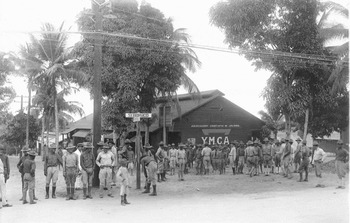
Most of the YMCA's wartime work was concentrated at Camp Las Casas in the Santurce area of San Juan. Between 1917 and 1919, the YMCA had six units and 30 secretaries that provided services to 13,000 Puerto Rican infantrymen.Footnote 105 The YMCA was one of four supporting civil institutions in the camp along with the YWCA, the Knights of Columbus, and the American Library Association. However, the latter three stayed for only a month in 1917. For Coxhead, the war service provided a great opportunity to further promote the YMCA, “which has made it favorably known to the remotest ‘barrio’ of the Island, especially by the Red Triangle and the letters YMCA [see Figure 3], and that it was an organization which stood for friendliness and service to the soldiers. No such opportunity for Christian service was ever before presented in Latin America.”Footnote 106 Coxhead was proud of the missionary work done by the YMCA, which included teaching literacy to over 2,000 men; the transfer of 2,621 remittances totaling $21,311; attracting a total 40,715 men to religious meetings and 12,200 to Bible classes; distributing 11,326 testaments and other scriptures; and nurturing 467 Christian “decisions” (conversions). A letter of appreciation from the general officer, Lt. Herman Goodman, noted that “the ‘Y’ was on the job every hour that the cantonment was open, and filled a want that the men soon learned to take advantage of.”Footnote 107
YMCA Facility at Camp Las Casas, 1917

The YMCA also contributed in another significant way during the war years. In 1917, as the war continued, Alfred Grimm noticed some boys playing and marching in the streets around the YMCA building. It occurred to him that this was the perfect time to establish in Puerto Rico a branch of the Boy Scouts of America, as it would “give to a boy an opportunity to express himself in a martial way by the wearing of a uniform and by his taking part in the many War Activities.” He then recruited boys from within the association, all the while keeping its elitist, sexist, and racist practices. He created a scout committee “of prominent men” and then organized chapters in various schools in San Juan; according to Grimm, the organization spread like “wildfire.” In San Juan, Grimm organized nine troops, one in Bayamón and five in Ponce, with other towns soon to organize.Footnote 108
In 1919, Charles Alvin Brooks published an influential book titled Christian Americanization.Footnote 109 This book brought a new wave of missionary work, following on the boost in US moral stature and global position after World War I. For the United States and the YMCA, this boost and the book's publication were both relevant, because by 1920, after 22 years of Americanization, it appeared to some YMCA officials as if Puerto Ricans had “learned” little. Upon his arrival in Puerto Rico, the YMCA's new physical work director, Herbert Taylor Hitch, commented that what “struck me most forcibly right at the start were . . . the prevalence of American ideas and still withal the practically universal use of the Spanish language instead of the English.”Footnote 110
Despite Hitch's chauvinistic dismay at Puerto Ricans' not having learned English, they had in fact taken to “American ideas” during the 20 years of occupation. The sports program of the YMCA was as popular as ever. Although Protestantism still remained under attack and slow to develop, US sports had fully entered Puerto Rican cultural and social spheres. In 1924 Coxhead summarized the achievement:
The physical work of the Association makes the greatest appeal to the Latin American youth and is always the most popular phase of its activities. And our physical work has been strong and sustained. One reason for the marked success of this Department is that we have always had a trained physical director, devoting all of his time to it. . . . For several years past . . . the Physical Department has successfully conducted city championships in volley ball [sic], basket ball [sic] and tennis. . . . They have brought in many players outside the membership of the Association, and hundreds of people who pay an entrance fee to see the games.Footnote 111
In a classic expression of the patronizing attitude of most US colonial administrators of the time, Coxhead went on to say that these sports had taught Puerto Ricans the American values of “honor, perseverance, self-control, chivalry, and true sportsmanship, so much needed in Latin American life.”Footnote 112 In this regard, Puerto Ricans were indeed Americanizing, just not in the way the imperial state wanted them to. A big aim of Americanization was the incorporation of the English language. Puerto Ricans had not acquired this among their “progressive” values, but instead had fully embraced US sports. Another central aim of Americanization was mass conversion to Protestantism. This had not occurred, perhaps due to resistance by the lingering “Spanish element,” or more likely due to the centuries-old Puerto Rican dismissal of institutional religion in favor of an ingrained household version of Catholicism. Coxhead deplored the difficulty of converting, or even attracting, Puerto Ricans to Protestantism, and by 1925, he had practically given up his missionary zeal:
Indifference to religion is the attitude of the vast majority of the young men. . . . The last five years has not made any appreciable difference in the opportunity for Christianity. . . . I cannot say that I think the YMCA is in a particularly favorable position for rendering large religious service to Porto Rico, at this time. I wish I could say I do."Footnote 113
Nevertheless, Coxhead was not willing to abandon altogether the US tutelage over Puerto Ricans. Although some Protestant churches admitted locals to leadership positions within their institutions, the YMCA showed ongoing reluctance to allow a Puerto Rican to become YMCA secretary. Even though the association provided leadership training to Frank Campos, a graduate of the Presbyterian-oriented Polytechnic Institute of San Germán, he was not seen as a leader and was considered unfit for the promotion to secretary. Coxhead commented:
I do not believe this quality [leadership] is strongly developed in the average Porto Rican young man. The Spanish element, which is so important, is not easily moved to support American institutions, in view of the fact that the United States took Porto Rico from their country.Footnote 114
Coxhead offered some dim promise for the future: “Help from abroad will need to be continued, in order to get promising Porto Ricans trained for Association work. . . . I believe it will be a good many years before foreign leadership can be entirely withdrawn.” Just as Puerto Ricans had been held in colonial subordination allegedly because they were unfit to govern themselves, the YMCA held the same distrust in Puerto Rican ability for institutional leadership. Coxhead was clear about his political loyalties to the empire.
With the elections of 1920, which marked the rise of the Partido Socialista, a new governor arrived, signaling a retrenchment of Americanization and imperialist ideals.Footnote 115 The pro-autonomy Partido Unión, which had managed to gain and hold power, was suddenly cut off from its privileged access to the governor's office, whose new occupant was Emmet Mont Reily. Reily censured all opposition activities, including the slightest discussion of independence, which did not soothe the volatile and unstable political climate. Coxhead agreed with Reily's attitude and actions:
Governor Reily is a Christian man, a member of the Presbyterian Church, and entirely honest and sincere, I think. He announced soon after his arrival, when invited to review the National Guard at its Camp on a certain Sunday that he expected to observe Sunday here as he had been accustomed to at his home, by rest and worship. Judging by the men he has summarily removed from office, he evidently means to clean up politics, which is a stupendous task in almost any Latin American country, because of such differing ideas and ideals.Footnote 116
Coxhead's two sides are evident, and both reflect the YMCA's philosophy in Puerto Rico during its early years there. On the one hand, Coxhead was a forceful missionary, dedicated to the conversion of a conquered people. On the other hand, he was loyal to the empire, regardless of the fact that the new administration openly and dictatorially censured all local major parties and public opinion in regard to independence. Coxhead was in Puerto Rico to perform the duty of Christian Americanization, in response to a call for greater civilization and moral uplifting. Although his Christian beliefs propelled him to reach out to locals, he was not there to fraternize with the subaltern others. It took him years to learn some Spanish. He took vacations with other fellow Americans in secluded resorts, and willingly lived in an American neighborhood. His friends at the YMCA were the American or Americanized Puerto Rican elites, those compliant with the imperial state.
William Coxhead left Puerto Rico in 1926 after 12 years of intense, often frustrating effort to establish a solid and purposeful YMCA. He was supposed to take over an association that would be the bridge between Anglo and Latin America, and the headquarters of the West Indies in building that bridge. However, although John Mott expressed strong interest in the San Juan Association, the YMCA as a whole did not follow up with that aim. Coxhead felt an ongoing isolation and agonized over what he perceived as abandonment by his colleagues in the United States.Footnote 117 His frustration was not unfounded. During his 12-year tenure, the San Juan YMCA had not received a single official visit from any member of the organization's international committee. Protestant churches, in contrast, received yearly visits from continental representatives, sometimes several visits in a single year. Coxhead had no associate secretary with whom to exchange ideas or disclose concerns, as he had had in Mexico and as others posted to Latin America had. He asked for visits and for the establishment of other YMCA in every report since 1914, to no response. In fact, he stopped writing annual reports between 1921 and 1923 because he thought no one was reading them or cared.
The silence and isolation from YMCA headquarters, coupled with the constant attack from Catholics and the religious indifference of young Puerto Rican men, were highly discouraging to Coxhead. He admitted that he had lost enthusiasm for his mission and asked with some urgency that he be removed from his post and that he not be sent to any other Latin American post. He further asked to be sent to another post at “home where it [the YMCA] is better understood and more appreciated that it is in Porto Rico.”Footnote 118 In saying this, Coxhead understood exactly what the YMCA was from his point of view: a Christian civilizing institution driven by the tenets of Muscular Christianity. Unfortunately for him, he misunderstood the meaning that the YMCA had for Puerto Ricans: a progressive institution that fostered modern sports, which in turn could help to uplift society and nurture a healthy modern citizenry.
Conclusion
Between 1926 and 1930, a series of US secretaries took the interim helm of the association. In 1931, Frank Campos finally took office as the first Puerto Rican to lead the YMCA, a generation after its establishment in the island. However, the first 28 years of YMCA activity had left a profound mark in the life and culture of Puerto Rico, a mark that both welcomed modernity through sport and reinforced Catholicism as Puerto Rico's spiritual core. Sports affected all facets of Puerto Rican life, even enabling the island to showcase a colonial national identity through its national Olympic committee.Footnote 119
The fact that Puerto Ricans, for the most part, adhered to Catholicism after the invasion of Protestant missions from 1898 onward points to a failure of the imperial Americanizing state to convert Puerto Ricans. Nonetheless, there is a continuing and increasingly influential Protestant presence not only in Puerto Rico, but in Latin America more broadly. Given the YMCA's active agenda and special interest in Latin America, particularly Argentina, Brazil, Uruguay, Chile, and Mexico, along with the US interest in establishing hemispheric hegemony, the intricacies of the YMCA history as it pertains to both sport and religion cannot be overlooked. The acceptance of sport as a vital part of Latin American society and culture and the continuing politics of religion—both Catholic and Protestant—in Latin America suggest that we should take a close look at the legacies of the YMCA in the region and make an effort to comprehend their effects.
The YMCA arrived in Puerto Rico at the crossroad of two diametrically different empires. This transition disrupted Puerto Rican life to its core, as it not only interrupted the local elite's trajectory for political reform but also made the people confront a rising empire that looked to transform the very essence of their culture and identity. Even so, Americanization was not all despised. While for the most part resisting religious and language conversion, Puerto Ricans welcomed and appropriated a highly admired featured of the new empire's culture. Despite the patronizing, xenophobic, and elitist attitude of its leaders, sports became the reason many Puerto Ricans kept going to the YMCA, and why many more enrolled and attended their tournaments.
Although the YMCA maintained throughout the 1920s a membership segregated by gender, race, and class, the sports programming was so popular that it quickly spread to all sectors of the population. By 1929, it had produced the Puerto Rican Basketball Association. Other Protestant churches and the public school system followed that lead, collaborated with the YMCA, and sought out its advice on programs of physical activity, pointing to the Y's centrality in the early sponsorship, teaching, and development of sports in the island. The sports introduced by the YMCA would spread into the public school system. The YMCA can be seen as an institutional bedrock for sports in Puerto Rico, eventually producing local and Olympic athletes that represented a Latin American colonial nation abroad.
In regard to the YMCA mission, Puerto Ricans selectively negotiated the terms of empire and colonialism. By enthusiastically accepting sports and rejecting mass conversion to Protestantism, while not demanding outright independence, Puerto Ricans consented to a foreign occupation. Yet the hegemony of sport was not blindly accepted because the YMCA's vehicle of its deliverance, Protestantism, was not entirely welcomed. On the other side of this negotiation, Coxhead and the YMCA establishment, confronted by Puerto Ricans' adherence to Catholicism and their Hispanic identity, had to alter their activities and “Hispanicize” the YMCA to advance broader imperial goals. The YMCA even allowed a Catholic, Luis Sánchez Morales, to become the San Juan YMCA president, despite the Portland Basis ban of Catholics from such positions.
What these negotiations imply is that the US imperial occupation was sustained not only by armed forces, but by other less visible powers, including the hegemonic power of sport and its desirability as a modern cultural practice. In the complex web of negotiations between a Spanish Caribbean people and its new colonial overlords, the YMCA, religion, and sport formed a powerful, yet nuanced, triangle of empire.