



Introduction
The black locust gall midge, Obolodiplosis robiniae (Haldeman, Reference Haldeman1847) (Diptera: Cecidomyiidae), is an important invasive insect pest that attacks the locust tree Robinia (Fabaceae) in China. It became one of the serious defoliators and provokes 100% infection rates in the provinces of Liaoning and Hebei (Yang et al., Reference Yang, Qiao, Bu, Yao, Xiao and Han2006). O. robiniae is native to eastern North America (Haldeman, Reference Haldeman1847), but the midge has spread to many countries and regions of Europe and some areas of Asia with international trade activities (Kodoi et al., Reference Kodoi, Lee, Uechi and Yukawa2003; Woo et al., Reference Woo, Choe and Kim2003; Navone & Tavella, Reference Navone and Tavella2004; Duso et al., Reference Duso, Fontana and Tirello2005; Uechi et al., Reference Uechi, Yukawa and Usuba2005; Csoka, Reference Csoka2006; Hoffmann et al., Reference Hoffmann, Lichtenberger and Beiderbeck2007; Wermelinger & Skuhravá, Reference Wermelinger and Skuhravá2007; Roskam et al., Reference Roskam, Aa, As, Bijkerk, Ellis and Moraal2008; Skrzypczynska, Reference Skrzypczynska2008; Jorgensen, Reference Jorgensen2009; Pernek & Matosevic, Reference Pernek and Matosevic2009; Tóth et al., Reference Tóth, Váková and Lukán2009).
O. robiniae was first recorded in China in Qinhuangdao City, Hebei Province in 2004 by Yang et al. (Reference Yang, Qiao, Bu, Yao, Xiao and Han2006). Since that time, it spread quickly, and by 2010, the pest had been found in a total of 27 cities in the Jilin, Liaoning, Shandong, and Hebei provinces and Beijing (Yang et al., Reference Yang, Qiao, Bu, Yao, Xiao and Han2006; Lin et al., Reference Lin, Qiao, Xu and Han2007; Yan et al., Reference Yan, Wang and Li2007; Zhang et al., Reference Zhang, Fu, Wei and Sun2008; Mu et al., Reference Mu, Sun, Lu, Li, Qu and Gao2010). However, as confirmed in this study, O. robiniae is even more widespread and exists in more areas in which its host is distributed in China. The midge damages its host's leaves causing them to roll, which makes the plant to decline and become more vulnerable to infestation by other pest insects, such as longhorn beetles and jewel beetles.
The locust tree is an important type of afforestation tree species in China because of its many important characteristics such as fast growth, strong adaptability, high ability to tolerate drought, salt, and poor soil, and especially its significant roles in water and soil conservation, protection against wind and sand, and street and road greening. There are two species and two varieties of the genus Robinia in China: Robinia pseudoacacia L., Robinia hispida L., Robinia pseudoacacia var. pyramidalis (Pepin) Schneid, and Robinia pseudoacacia var. umbraculifera DC. The locust tree was introduced from Europe in 20th century, and became economically and ecologically important. Therefore it was planted extensively in broadleaved deciduous forests in China, such that currently the planted area exceeds ten million hectares (Xu & Yang, Reference Xu and Yang2006; Zhang et al., Reference Zhang, Lu, Wang and Gao2009).
According to the international standards of phytosanitary measures (ISPM No.2), a pest risk analysis of the gall midge was performed to predict its potential distribution areas in China. The results revealed that the potential distribution range of this species in China is 98.30°–132.03°E and 24.33°–47.41°N using CLMEX software (2nd edition) (Zhang et al., Reference Zhang, Lu, Wang and Gao2009). However, O. robiniae was not distributed over this whole area, possibly because its host tree, R. pseudoacacia L., is primarily distributed in northern China only.
Genetic variation is regarded as an important factor in the colonization of invasive species (Sakai et al., Reference Sakai, Allendorf, Holt, Lodge, Molofsky, With, Baughman, Cabin, Cohen, Ellstrand, McCauley, O'Neil, Parker, Thompson and Weller2001; Facon et al., Reference Facon, Genton, Shykoff, Jarne, Estoup and David2006; Roman & Darling, Reference Roman and Darling2007; Amouroux et al., Reference Amouroux, Normand, Nibouche and Delatte2013; Horst & Lau, Reference Horst and Lau2015). However, invasive species are often expected to undergo reductions in genetic diversity during founding events because new habitats are usually colonized by only a few individuals, which carry only (small) part of the allelic diversity of the source population (Nei et al., Reference Nei, Maruyama and Chakraborty1975). Yet, sometimes genetic diversity in founder populations can be increased because the founding individuals come from different source populations (Davis, Reference Davis2009). Hence, multiple introductions are predicted to increase genetic diversity in founding populations, and as such may contribute to the rapid population growth and expansion of a colonizing species. In this way, they underpin the success of invasions by facilitating local adaptation in new environments and by increasing new trait diversity (Facon et al., Reference Facon, Genton, Shykoff, Jarne, Estoup and David2006).
Successful invasions imply a match between the exotic species and the new local environment (Facon et al., Reference Facon, Genton, Shykoff, Jarne, Estoup and David2006). Prins & Gordon (Reference Prins and Gordon2014) proposed 11 hypotheses to explain biological invasions. Yet, insects appear to be among the more difficult taxa to uncover the biological and ecological factors that explain how some species can colonize new habitats (Suarez et al., Reference Suarez, Holway and Case2001; Boubou et al., Reference Boubou, Migeon, Roderick and Navajas2011; Perdereau et al., Reference Perdereau, Dedeine, Christidès, Dupont and Bagnères2011; Amouroux et al., Reference Amouroux, Normand, Nibouche and Delatte2013).
Molecular genetics is a useful tool in understanding population structure (Kirk et al., Reference Kirk, Dorn and Mazzil2013). The mitochondrial cytochrome oxidase subunit I (COI) gene has been effectively used to analyze insect genetics, evolution, and phylogenetics because it possesses more phylogenetic signal than other mitochondrial genes (Folmer et al., Reference Folmer, Black, Hoew, Lutz and Vrijenhoek1994; Zhang & Hewitt, Reference Zhang and Hewitt1997; Knowlton & Weigt, Reference Knowlton and Weigt1998; Shirota et al., Reference Shirota, Iituka, Asano, Abe and Yukawa1999; Hebert et al., Reference Hebert, Cywinska, Ball and DeWaard2003; Lin et al., Reference Lin, Zeng, Liang, Wu, Gu, Liu and Hu2010) and is commonly regarded as one of the most conserved protein-coding genes in the mitochondrial genomes of animals (Brown et al., Reference Brown, Emberson and Paterson1999). In the present study, we therefore screen COI sequence variation in introduced populations of O. robiniae in China, in order to explore population genetic factors that may correlate with the invasion success of this gall midge.
Materials and methods
Collection and preservation of O. robiniae
Rolled leaves of the host containing mature larvae or pupae of the gall midge were collected from 28 cities in China (fig. 1). Table 1 shows the details of the collection sites. As many samples as possible were collected in each site. Samples were stored in plastic bags of 60 × 40 cm2. Infested leaves were usually selected randomly from different trees, but occasionally when infestation was low, single trees were more thoroughly sampled. All samples were collected between May and June 2013–2014 except HD and YA in August 2013 (table 1).
Obolodiplosis robiniae collection locations in China.

Obolodiplosis robiniae collection data.

Twenty mature larvae or pupae were peeled out of the galls, then put into 100% ethanol, and stored at −20°C. They were used as supplementary materials for DNA extraction if there was not enough adult material. All other larvae and pupae were placed in transparent glass jars (15 × 30 cm2) covered with moistened gauze and kept at room temperature (approximately 25°C) to rear adults. After emergence, 20 adults per location were put into a 1.5 ml centrifuge tube, and were frozen (−20°C) for DNA extraction within a period of 1 month. The remaining adults were preserved in 100% ethanol at −20°C.
Because the larvae are usually parasitized by their natural enemy Platygaster robiniae Buhl and Duso (Hymenoptera: Platygasteridae), and high rates of parasitism were observed in our study, we selected adults for DNA extraction from each site except for Chengdu, Guiyang, Nanjing, Xian, and Yantai. From these localities, we had to use larvae because we could not rear sufficient numbers of adults. These larvae were collected from the first or second generation, even if the locust gall midge may produce up to six generations per year (Wang, Reference Wang2009; Mu et al., Reference Mu, Sun, Lu, Li, Qu and Gao2010; Shao et al., Reference Shao, Ma, Shao, Lv and Han2010). This is because the parasitic load in the first two O. robiniae generations is lower than in later generations.
DNA extraction, gene amplification, and sequencing
For each individual, total DNA was extracted from the entire body using the methods described by Zhou et al. (Reference Zhou, Wan, Zhang and Chen2007). A region of the COI gene was polymerase chain reaction (PCR)-amplified (Saiki et al., Reference Saiki, Gelfand, Stoffel, Higuchi, Horn, Mullis and Erlich1988) with the following pair of primers: LCO1490 5′-GGTCAACAAATCATAAAGATATTG G-3′ (forward) (Folmer et al., Reference Folmer, Black, Hoew, Lutz and Vrijenhoek1994), and COIA 5′-CCCGGTAAAATTAAAATATAAACT TC-3′ (reverse) (Funk et al., Reference Funk, Futuyama, Orti and Meyer1995). The COI fragment amplified by LCO1490 and COIA is approximately 676 bp long (Uechi et al., Reference Uechi, Yukawa, Tokuda, Ganaha-Kikumura and Taniguchi2011) corresponding with positions 1752–2190 of the mitochondrial genome of Drosophila yakuba Burla (Diptera: Drosophilidae) (Clary & Wolstenholme, Reference Clary and Wolstenholme1985). This COI region covers a part of the COI region that is used for DNA barcoding (658 bp from the 5′end) (Hebert et al., Reference Hebert, Cywinska, Ball and DeWaard2003) and a region that has been adopted for molecular phylogenetic analyses of Cecidomyiidae (439 bp from the 3′-end) (Kodoi et al., Reference Kodoi, Lee, Uechi and Yukawa2003; Uechi et al., Reference Uechi, Yukawa, Tokuda, Ganaha-Kikumura and Taniguchi2011). The PCR reactions were performed in 0.5 µl of each primer (10 µmol), 12.5 µl 2× Taq PCR Master Mix (TIANGEN), 10.5 µl ddH2O and 1 µl DNA template in a final volume of 25 µl. The amplifications were performed in 0.2 ml tubes in an Eppendorf B Mastercycler (Eppendorf, Germany) with the following profile: the mixtures were incubated for 5 min at 94°C (initial denaturation step), followed by 30 cycles consisting of 94°C for 45 s, 54°C for 45 s and 72°C for 1 min, then 5 min at 72°C, and finally held at 16°C. Successful amplification was verified with 1% agarose gels using a slab gel apparatus with 3 µl of the amplification products. The sequencing reaction was performed using an ABI BigDye Terminator version 3.1 cycle sequencing kit on an ABI 3730XL (SinoGenoMax, China).
Data analysis
The sequences were edited and aligned with the Staden Package (Staden et al., Reference Staden, Beal and Bonfield1999) and Clustal X version 1.81 (Thompson et al., Reference Thompson, Gibson, Plewniak, Jeanmougin and Higgins1997). The aligned DNA sequences were imported into MEGA version 5.0 (Tamura et al., Reference Tamura, Peterson, Peterson, Stecher, Nei and Kumar2011) to calculate the nucleotide and haplotype diversities for each population. The genetic diversity indices, including the haplotype diversity, number of polymorphic (segregating) sites (S), nucleotide diversity (π, the mean number of differences between all pairs of haplotypes) and the average number of nucleotide differences (k) were calculated using DnaSP version 5.0 (Librado & Rozas, Reference Librado and Rozas2009). The significances of pairwise Fst values among populations were calculated using same software and ARLEQUIN 3.11 (Excoffier et al., Reference Excoffier, Laval and Schneider2005).
The nucleotide sequence data reported in this paper have been deposited in the GenBank nucleotide sequence databases with the following accession numbers KM984772–KM984799 and KP184500–KP184502.
Results
Sequence composition
A total of 560 individuals from 28 populations were sequenced, and a final COI alignment of 676 bp in length was obtained by using the primers for LCO1490 and COIA. No insertions or deletions were found. The average compositions of the nucleotides A, G, C, and T were 28.8, 13.8, 15.4 and 42.0%, respectively. As expected, the sequences were extremely rich in A + T, which accounted for an average of 70.8% of the nucleotides.
Sequence variation
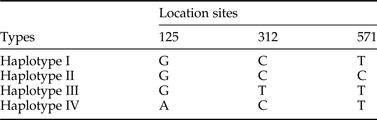
The 676-bp gene sequences revealed 673 conserved sites and only three variable sites two of which were parsimony informative. Of these three substitutions, one (125) occurred at the second codon position, one (312) at the third codon position, and the other (571) at the first codon position. Two substitutions caused changes in the amino acids. The first (571) caused an H to Y change, and the second (125) caused an R to H change.
Only four haplotypes were detected (tables 2 and 3), confirming the low degree of polymorphism. As table 2 shows, haplotype I was characterized by G (125), C(312), and T(571) at the three variable sites. The three other haplotypes are named as follows: haplotype II with C(571), haplotype III with T(312), and haplotype IV with A(125). Haplotype I occurred in 550 of the 560 individuals (98.2%) and was found in all 28 populations. Haplotype II was observed in population DD (3 individuals), haplotype III in population TA (1 individual) and haplotype IV in population YK (6 individuals) (table 1). Each of these three haplotypes (i.e., II, III, and IV) can be derived from haplotype I via single substitutions, involving transitions. Therefore, it is likely that haplotype I is the ancestral haplotype, more so as it is by far the most frequent haplotype. The low genetic diversity of the 28 populations is also evident from the extremely low values of the average number of nucleotide differences, the haplotype (gene) diversity, and the nucleotide diversity, which were 0.035, 0.035, and 0.00005, respectively.
Alignment of the variable sites of the partial COI haplotypes. The numbers indicate the positions of the variable sites in the alignment.
Haplotypes from 28 locations.

Genetic differentiation among populations
The pairwise F st values among 28 populations varied between 0.0000 and 0.2632. Several significant F st values were observed: the highest is 0.2632 between YK and other populations except DD and TA, followed by 0.2256 between YK and TA, then 0.2106 between YK and DD, followed by 0.1053 between DD and other populations, and 0.0792 between DD and TA. However, 324 of the 378 F st values were ≤0, which suggests that, although there was a high level of genetic differentiation between YK, DD, and TA populations, the total genetic differentiation was very low.
Discussion
Our study explores population genetic diversity in a new invasive pest, O. robiniae, which has been widely spread in Europe and Asia in recent years and provides insight into its invasion success. Our results revealed a low level of nucleotide diversity (π = 0.00005) in the partial COI sequences among populations from sites separated by distances of up to 1600 km from Yantai (Shandong Province) to Tianshui (Gansu Province) in the east and west, respectively, and approximately 1900 km from Changchun (Jilin Province) to Guiyang (Guizhou province) in the north and south, respectively.
This extremely limited genetic diversity probably reflects a founder effect, eventually combined with a bottleneck, causing a severe loss of haplotypes (Nei et al., Reference Nei, Maruyama and Chakraborty1975). O. robiniae indeed arrived probably only very recently in China, since there are no records of this gall midge before 2006 (Yang et al., Reference Yang, Qiao, Bu, Yao, Xiao and Han2006). Yet, its host R. pseudoacacia was introduced into China approximately 130 years ago (Pan & You, Reference Pan and You1994) and is currently widely planted in vast areas. Such a low genetic diversity has also been reported in mango blossom gall midge, Procontarinia mangiferae (Felt) (Amouroux et al., Reference Amouroux, Normand, Nibouche and Delatte2013).
Despite this low genetic diversity, O. robiniae spread successfully in China, probably through human activity and as a result of its own biological and ecological characteristics.
First, the host plant of O. robiniae, R. pseudoacacia, is widespread in China. Second, O. robiniae lays eggs on mature plants in spring when they rapidly develop. The gall midges then start attacking the root suckers from mid-summer onward when mature host trees grow slow and decline. Duso et al. (Reference Duso, Boaria, Surian and Buhl2011) reported two strategies by which the gall midges cope with adverse environmental conditions: (1) larvae diapause in summer and (2) pioneering adults are produced in late summer. Although we have no precise data on diapause of O. robiniae in China, we did observe larvae on the leaves of mature host trees in early summer, and adult midges on root suckers in late summer. Due to a lack of comparative data from O. robiniae in its native range, we do not know whether the two strategies mentioned above are new. Yet, a plastic diapause period in new habitats has been recorded in the gall midge Procontarinia mangiferae (Felt) (Amouroux et al., Reference Amouroux, Normand, Nibouche and Delatte2013)
All in all, O. robiniae seems to have r-selected traits since (1) it requires around 15 days to develop from egg to adult in summer (Yang et al., Reference Yang, Qiao, Bu, Yao, Xiao and Han2006), (2) it produces four to six generations a year in China, and (3) it may have up to 192 eggs in the ovary (Park et al., Reference Park, Shin, Kim and Park2009). Life-history strategies with more r-selected traits including short generation time, high fecundity, and high growth rate are commonly (Prins & Gordon, Reference Prins and Gordon2014), but not always (Sakai et al., Reference Sakai, Allendorf, Holt, Lodge, Molofsky, With, Baughman, Cabin, Cohen, Ellstrand, McCauley, O'Neil, Parker, Thompson and Weller2001), observed during the establishment of successful invasive species.
The lack of strong competitors could be another factor explaining the success of O. robiniae in China. Although several defoliators, such as the geometrid moths Meichihuo cihuai Yang, Apocheima cinerarius Erschoff, and Zamacra excavata Dyar (Qiang et al., Reference Qiang, Bing, Sun, Du and Li2002), feed on the black locust tree in China, they all have only one generation per year and the period that their larvae attack their host plant involves only about 20 days from mid-April to mid-May (Qiang et al., Reference Qiang, Bing, Sun, Du and Li2002), after which leaves of infested plants can still re-develop gradually. Furthermore, these defoliators are relatively rare as they were hardly found during our sampling. This suggests that O. robiniae probably does not suffer much from interspecific competition in China.
Acknowledgements
The authors would like to thank Ruixing Zhao (Forest Protect Station of Liaoning Province), Yanping Yu (Forest Protect Station of Jilin Province), Kaipeng Zhang (Jingyuetan National Forest Park), Chao Li (Forestry Survey and Planning Institute of Guizhou Province) and Xiangchen Cheng (General Station of Forest Pest Management, State Forestry Administration) for their great support and help with the sample collection in the fields. The authors also thank Professor Zhongqi Yang (the Biological control lab of the Chinese Academy of Forestry) for identifying the species. They also thank Dr, Yong Li for discussions about the data, and they sincerely thank the other members of the Plant quarantine lab and Plant Pathology Lab of the Chinese Academy of Forestry for helpful comments. This work was funded by Central Nonprofit Research Institutes Fundamental Research Fund Project CAFRIFEEP201102-3.



