Introduction
ABI is estimated to affect approximately 31,000 people in SA or 2.2% of the population (Australian Institute of Health and Welfare [AIHW], 2007). The long term, disabling effects of brain injury can include difficulty with psychosocial adjustment, cognitive changes, physical disability and behavioural sequelae which can significantly impact activities of daily living, employment prospects, relationships and quality of life (Ashley, Leal, Mehta, & Ashley, Reference Ashley, Leal, Mehta, Ashley, Ashley and Ashley2010; Bryan, Harrington, & Elliot, Reference Bryan, Harrington, Elliott and Ashley2010; Moore, Indig, & Haysom, Reference Moore, Indig and Haysom2014; Ponsford, Sloan & Snow, Reference Ponsford, Sloan and Snow2012). The lasting ramifications of ABI also extend to the experience of the family and wider support network.
Frequently unprepared initially and ill-equipped with knowledge or access to support, family members work tirelessly to promote success through rehabilitation, transition back to community and long-term adjustment (Gan, Campbell, Gemeinhardt & McFadden, Reference Gan, Campbell, Gemeinhardt and McFadden2006). The research literature extensively documents the caregiver burden, emotional stress and resultant social isolation families experience following ABI (Ergh, Rapport, Coleman, & Hanks, Reference Ergh, Rapport, Coleman and Hanks2002; Gan, Gargaro, Bandys, Gerber & Bosten, Reference Gan, Gargaro, Brandys, Gerber and Boschen2010; Kneafsey & Gawthorpe, Reference Kneafsey and Gawthorpe2004; Perlesz, Kinsella, & Crowe, Reference Perlesz, Kinsella and Crowe2000; Phelan et al., Reference Phelan, Griffin, Hellerstedt, Sayer, Jensen, Burgess and van Ryn2011; Ponsford, Olver, Ponsford & Nelms, Reference Ponsford, Olver, Ponsford and Nelms2003; Sander, Maestas, Clark, & Havins, Reference Sander, Maestas, Clark and Havins2013). Family caregivers are at increased risk of mental health issues such as clinical depression, anxiety and burnout, resulting in reduced quality of life and decreased family cohesion (Turner et al., Reference Turner, Fleming, Parry, Vromans, Cornwell, Gordon and Ownsworth2010). In particular, family members with limited access to support are frequently unable to cope, resulting in high rates of relationship and marital breakdown (Godwin, Chappell, & Kruetzer, Reference Godwin, Chappell and Kruetzer2014; Gosling & Oddy, Reference Gosling and Oddy1999; Kieffer-Kristensen, Teasdale, & Bilenberg, Reference Kieffer-Kristensen, Teasdale and Bilenberg2011; Kruetzer, Mawitz, Hsu, Williams, & Riddick, Reference Kruetzer, Marwitz, Hsu, Williams and Riddick2007; Ponsford & Schoenberger, Reference Ponsford and Schoenberger2010).
In situations where the family unit is maintained, family members often adopt the long-term roles of carer, advocate, therapist and coordinator, particularly when living in rural/regional areas (Brain Injury Australia, 2011; Griffin et al., Reference Griffin, Friedemann-Sanchez, Jensen, Taylor, Gravely, Clothier and van Ryn2012). The opportunity for families to access social support services following injury has been shown to significantly increase coping strategies and lower stress levels (Sheija & Manigandan, Reference Sheija and Manigandan2005; Winstanley, Simpson, Tate & Myles, Reference Winstanley, Simpson, Tate and Myles2006). This is less likely to be available in rural and remote geographic locations where access to support services is limited (Brain Injury Australia, 2011; Griffin et al., Reference Griffin, Friedemann-Sanchez, Jensen, Taylor, Gravely, Clothier and van Ryn2012; Jones & Curtin, Reference Jones and Curtin2010). Given the considerable role families sustain in the lengthy rehabilitation process, it is considered vital for all families to have access to ongoing support, wherever they reside (Chan, Parmenter, & Stancliffe, Reference Chan, Parmenter and Stancliffe2009; Ponsford & Schoenberger, Reference Ponsford and Schoenberger2010).
In SA, state wide inpatient and ambulatory rehabilitation services are provided by the South Australian Brain Injury Rehabilitation Service (SABIRS). Within the community, specialist disability services including care services, equipment, limited therapy services, and accommodation are provided by Disability SA (DSA), a government service provider for individuals under 65 years. Community and lifestyle programs are available within metro regions through the Brain Injury Network of SA (BINSA) including their Springboard program, the Community Re-entry Program at Flinders University, Take 5 and North-East Networks.
Findings from a recent state report revealed serious concerns with a chronically under-funded and crisis driven disability system in SA which often failed to respond to the ongoing needs of individuals with ABI and their families (SA Health, 2012). Current service delivery issues include an absence of designated services for specialist counselling, advice and support for families, in addition to the need for comprehensive information and educational resources for carers and individuals with ABI. In SA, low levels of available social support have resulted in high levels of caregiver burden (Singh, Reference Singh2008). Although research indicates the need for family support, minimal resources exist (Boschen, Gargaro, Gan, Gerber, & Brandys, Reference Boschen, Gargaro, Gan, Gerber and Brandys2007). This appears particularly striking in regional and remote areas, given the minimal brain injury network focus outside the major city of Adelaide.
According to the National Rural Health Alliance Inc. (2012), 38% of Australians with ABI live in remote and regional locations, with evidence of inequity across brain injury rehabilitation and longer term support opportunities nationally which still needs to be addressed. More locally, the ABI Model of Rehabilitation for South Australia (SA Health, 2012) highlights the inequity in brain injury rehabilitation across the geographically diverse brain injury population in SA with a key recommendation for equitable service access for people living in outer metropolitan areas and the country. It is crucial that service provision is holistically designed to promote the mental health and wellbeing of the person with ABI and his or her family across varying geographic circumstances.
Within this study, the term “family” refers to the network of people affected by ABI. This includes the person with ABI, together with his or her partner, parents, children, siblings, extended family and close friends who provide support. Using a prospective qualitative design, the current article examines and compares supports needed by families living in a major city (metropolitan area) and regional/remote locations across SA, and identifies supports which could be augmented by family peer support networks following ABI.
Method
Participants
Survey data was sought from family members (>18 years) who provided support to an adult with ABI living in SA. A total of 2,502 surveys were posted to families who had received services from SA Brain Injury Rehabilitation Services (SA BIRS) between 2002 and 2012. An additional 110 surveys were distributed to SA disability and carer groups.
Data Collection and Procedures
Data collection commenced with a 22-question survey seeking a range of sociodemographic data, basic details of the ABI, and areas of unmet need, including the open-ended question examined in this article: “What supports would be most helpful to assist your family in coping with the challenges of living with ABI?” Focus groups were then conducted to explore in further detail the supports that would be most helpful in assisting families following ABI. Due to the interpersonal nature of focus groups, the presence of and interaction with other people facilitates the generation and extension of ideas and suggestions.
At the end of the survey, respondents indicated his or her interest in participating in a focus group by returning the consent and contact details form together with the survey. Criteria for participating in focus groups were the same as survey participation, however also open to adults with ABI over 18 years who had the capacity to provide informed consent (or had a legal guardian who could provide consent).
The Australian Bureau of Statistics “Australian Standard Geographic Classification (ASGC) Remoteness Area” (AIHW, 2004) was used to classify participants into groups according to their residential postcode (major city, inner regional, outer regional, remote and very remote). Individuals were then separated according to geographical locations, and five focus groups were held in varying locations set across metro and regional SA (two metro, two inner regional, one outer regional).
Sampling of respondents occurred using maximum variation sampling techniques (Patton, Reference Patton2002) to ensure diversity of experiences of the population. Respondents from each geographical region were systematically invited via telephone by the researchers to attend their closest or most convenient group, ensuring a mix of gender, age, people with ABI and family members. Attendance ranged from 5 to 13 participants per group, and consisted of a combination of family members who provide support to adults with ABI (partners, parents and siblings) and adults with ABI. Participants were invited to arrive for a cup of coffee/tea 30 minutes prior to the session commencing, and encouraged to stay after to debrief with fellow participants. Reimbursement for travel and related expenses was offered to all participants.
Focus groups were facilitated by an experienced Rehabilitation Counsellor (second author) and supported by a Bachelor-level research assistant. Groups ran for 90 minutes, and began with broad open-ended questions, allowing participants to share their experiences of ABI. Each group was then asked to identify areas in which they felt they would like support (refer to Appendix for focus group interview schedule). Each focus group was audio recorded and transcribed verbatim, with identifiers removed to maintain confidentiality.
Data Analysis
Survey data were entered and analysed using SPSS 20. Means, ranges and 95% confidence intervals are presented. Group differences for categorical variables were analysed by chi-squared tests (group sizes permitting), and mean differences analysed with t-tests. Responses to the final open-ended survey question and focus group transcripts were imported to NVivo 10 and analysed separately using qualitative content analysis (Graneheim & Lundman, Reference Graneheim and Lundman2004). Two independent raters read through all responses several times to gain a deeper understanding (raters were a PhD-level researcher and a research assistant who attended all focus groups). Responses were then coded by allocating text to themes as they emerged. In addition, transcripts and emerging themes were reviewed by the research team, and major themes identified, with revisions made. Raters used iterative constant comparison to identify new themes as they emerged. If the raters did not achieve consensus, themes were revised and expanded, and the process repeated until consensus was achieved. Themes from the survey question and focus groups were then aggregated. Geographical (ASGC) groups were collapsed into two categories for analysis in this article: (1) major city and (2) regional/remote (inclusive of inner and outer regional, remote and very remote).
Rigor
All focus groups were led by the same facilitator and assistant, with the same prompting questions utilised. The research team read all transcripts and provided feedback on emerging themes to ensure interpretation of text was reliable and themes appropriate. Two independent raters (including the first author) were responsible for all qualitative data analysis, with themes coded then checked and recoded until consensus was achieved.
Results
Participants
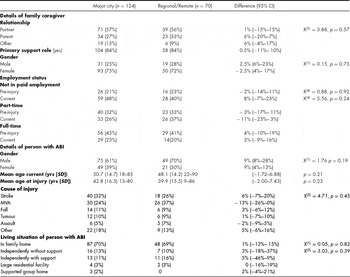
Two hundred and seven surveys were returned unanswered and an additional 24 households phoned to decline to participate (e.g., due to death of person with ABI, no family to complete the survey, not interested or not eligible). The survey was completed by 194 family members (8% response rate), with 64% (n = 124) from the major city and 36% (n = 70) from regional and remote SA (Table 1). This closely resembled the distribution of people with ABI across the national population between these two geographic location types (National Rural Health Alliance Inc., 2012). There were no significant group differences between geographical location with respect to relationship, primary support role, caregiver gender, employment status of caregiver at pre-injury or current, gender of person with ABI, current age or age at time of injury, cause of injury or living situation of person with ABI. Three quarters of family respondents were female, in line with broader Australian statistics indicating women are the predominant providers of informal support for family members with a disability (ABS, 2004). The ABI gender ratio was 2:1 males to females, with similar gender distribution reported in wider national statistics of ABI with males representing 68% of people with ABI under 65 years (AIHW, 2007). Time since injury ranged from 6 months to 40 years, with a mean of 8 years (SD 7.26), reflecting a range of needs which change over time.
Family Demographic and Injury Details by Geographical area

For categorical variables, differences in proportions presented as percentages with 95% CIs and subject to rounding error for small sample sizes, group differences analysed using chi-squared tests.
Continuous variables or mean differences are presented with 95% CIs, with t-tests to determine group differences.
Ninety-seven survey respondents indicated their interest in participating in a focus group. A total of 43 participants attended one of five groups (29 family members, 14 people with ABI; 30 females, 13 males). Twenty one attendees (49%) were from the major city, with 14 (33%) from inner regional, and 8 (19%) outer regional areas. There were no remote or very remote participants within focus groups.
Survey and Focus Group Data
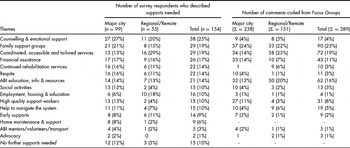
The final open-ended survey sought information on “What type of supports would be most helpful to assist your family in coping with the challenges of living with ABI?” This question was answered by 154 family members (99 from the major city; 55 from regional/remote), and explored within all five focus groups (n = 43). A total of 293 survey comments were coded to 15 emerging themes, with only 15 participants indicating no further supports were needed. Analysis of focus group transcripts revealed themes which mirrored those from the survey, and proportions of survey and focus group responses are presented in Table 2. Each theme is described in detail below, with selected quotes from the survey and focus groups included to illustrate and represent the range of comments within each theme.
Supports Identified as Most Needed from Survey & Focus Groups

Counselling and Emotional Support
“Counselling” was both the most frequently cited term within survey responses and the highest requested support by families in metro regions within the survey (27%). Although also mentioned regularly by regional/remote participants, this topic was not a strong feature from focus groups, possibly due to the stigma of discussing emotional distress in a group setting compared to an anonymous survey. There were frequent requests for ongoing access to counselling services (beyond those available from psychologists under government-funded schemes), more affordable counselling, with a focus on loss and grief, mental health support (depression and anxiety), and an opportunity to receive emotional support regarding fears and anxieties for family members in addition to the person with ABI:
Please think about providing support and advice for counselling for families at the time to prepare them for the loneliness and difficulties. The shockwaves from an injury like this don't stop. It's worse than a bad marriage as there is no escape and nowhere to go. Living with such grief for my husband and what he is going through has been difficult to deal with as a result, I’ve just become very cold just to cope. So please, think about the families as much as you think about the patient. (#40; Wife, metro)
Phone help. Sometimes my husband gets verbally and physically violent with no memory of it ten minutes later. However I am left in a traumatised state with no-one to talk to. (#9; Wife, inner regional)
Family Support Groups
Participants from metro and regional/remote areas voiced a strong desire for social connection, opportunities to share experiences, and gain new perspectives in family support groups. The desire for support groups was the most common theme identified within focus groups, with family groups described as a means of reducing experiences of isolation. Although it is acknowledged that participants attending focus groups may have been those most likely to be interested in ongoing support groups, this type of support was also frequently cited within survey responses. In particular, the opportunity to “give back” and support other families was highlighted:
For me, ability to contact carers in similar circumstances who have been through similar experiences and can share insights and strategies. Hearing stories of recovery. (#190; Wife, metro)
Participants from regional/remote areas identified this as a significant gap in current available supports, highlighting geographical access difficulties:
Support groups are very hard to find. You have to go to them when they should come to us. (#61; Male friend, outer regional)
Coordinated, Accessible & Tailored Services
The need for increased access to, and coordination of, health and disability services was the most frequent theme among regional/remote respondents from both survey and focus groups:
I haven't seen a lot of support for him at all in 3 years. I sort of thought he would see someone maybe every year, but I haven't seen anything at all. (Wife, Outer Regional Focus Group)
Participants referred to difficulties accessing services that were: unavailable; available at the wrong times of the day (no after-hours services); or inflexible. Particular emphasis was placed on the inequity of accessing services from regional and remote locations:
We live in remote SA. We would have more help if we lived in a city area but we choose to remain here. (#10; Wife, remote)
People to help with transition back into normal living in country SA are non-existent. (#19; Wife, regional)
Financial Assistance
A range of comments revealed high levels of financial stress from both geographical groups. Support for a no-fault insurance scheme from participants with traumatic brain injury (TBI) was strong. Comments under this theme ranged from the need for carer remuneration to fund supports, ongoing rehabilitation and aids, travel to and from Adelaide, more access cab vouchers and access to financial advice:
The National Disability Insurance Scheme would be a great help if we could access funds to provide my wife rehab facilities such as more physio, massage, exercise machine (cost prohibitive). (#53; Husband, metro)
Continued Rehabilitation Services
Ongoing access to a range of allied health services was identified across geographical areas, including ongoing Physiotherapy, Occupational and Speech Therapy, Psychology, Neuropsychology and Social Work:
Neuropsychologist - available after hours when [son] is distressed, usually after 10pm–1am. Creative speech therapist to assist both [son] and I with communication challenges. Dietician and fitness therapist to advise and support [son] so I don't get caught up in constant arguments. (#174; Mother, metro)
The need for flexible rehabilitation arrangements was also expressed, in addition to services tailored to specific populations (such as younger age-group):
Better rehab – CLOSER and ongoing with opt in/out options (#4; Wife, inner regional)
Respite
Respondents identified the need for formal respite options in addition to some “spare time” and time spent apart. Appropriate, age appropriate respite was commonly identified:
More respite in adequate places-not nursing homes. (#22; Wife, metro)
ABI Education, Information & Resources
Participants from both metro and regional/remote areas identified the need for further information about ABI. Requested information covered a range of themes, including strategies on how to deal with mood swings, anger, depression, personality changes, memory and financial management, and inviting rehabilitation specialists for question and answer sessions:
Maybe workshops with others in similar situations, outlining the process that lay ahead. Someone to translate medical mumbo jumbo into layman's terms. (#91; Daughter, metro)
One regional focus group participant described the discrepancy in level of education and resources provided across different conditions:
I felt that when my stepfather got diagnosed with diabetes they got all these resources, all these booklets and courses and programs and equipment and I thought okay, diabetes is a challenge but that's nothing compared to living with brain injury. (Wife; Regional Focus Group)
Social Activities
Respondents described the need for social activities as a family, and also individually. This theme appeared more frequently among metro respondents than those from regional/remote areas:
More socialising to help gain social skills. It would be great if there were events where families could get-together. I get frustrated that there is very little if anything for people recovering from brain injuries and their families. (#7; Wife, metro)
Employment, Housing and Education
Regional/remote participants made many more comments related to support and assistance to find work for the person with ABI, in addition to finding appropriate independent or supported housing and study options:
A nursing home for people under 65 years with rehab facilities, e.g., physio, counselling with activities to suit a younger person and the support to encourage participation. (#107; Mother, Inner regional)
Assisting with finding employment, re-education (to help him cope when he cannot do the work he was trained to do). (#77; Wife, metro)
High Quality Support Workers
Metro participants most frequently made comments under this theme. The need for continuous (permanent) disability support workers who know the client and family well, are motivated to facilitate positive change, are well trained with ABI specific skills and are well renumerated was highlighted:
Access to workers who are well trained and who show motivation and ingenuity, who care, respectful, innovative, energetic and suitably educated and who are prepared to work with families in a committed and continuous fashion. (#28; Mother, metro)
Help to Navigate the System
Regardless of location, comments included difficulties knowing what services and supports were available, and requested assistance in learning how to navigate the health and disability system.
A “show bag” of services available and who to contact, e.g., Centrelink, Stroke Foundation, support group. (#59; Mother, rural)
A person to sit down and tell us about all the services and payment we are able to access without us finding out years later. (#165; Husband, metro)
Having a plan: Where do you go, what do you do, and who do you ask? (Wife, Outer Regional Focus Group)
Early Supports
One common theme was the request for supports in the early stages following the ABI (within first year post-trauma):
Early support in hospital from those who have first-hand experience of what happened, to show there is light at the end of the tunnel. (#84; Husband, metro)
Some form of family counselling in the early days would have been helpful for our whole family, in order to understand and cope with the changes and problems. (#103; Wife, metro)
Home Maintenance and Support
A number of survey respondents from the metro area requested assistance with house cleaning, garden and home maintenance. These are described as additional costs that budgets which are already stretched cannot include.
ABI Mentors/Volunteers
Volunteers and mentors were identified as another avenue of increasing social opportunities for their family member with ABI, providing transport, and increasing opportunities for communication.
Advocacy
The following two survey participants requested advocacy support:
I needed to get a local [Member of Parliament] to support me. (#131; Wife, metro)
Changes need to happen with bureaucrats to make system work better to get the answers you need when advocating for son, instead of going around in circles dealing with them, causing lots of frustration. They need to treat carers better and show them respect. (#190; Mother, metro)
The desire to develop a lobby group for families affected by ABI was raised numerous times within focus group discussions. In particular, issues included lobbying for carer wages, time off, holidays and superannuation, and well-staffed community accommodation. One recurrent issue was the need for ABI to be acknowledged within Centrelink Disability Support Pension and Carer Payment application and review forms, in addition to the need for family care givers to receive recognition for the executive functioning support provided following ABI in order to access Carer Payment. Families experiencing exhaustion found this extremely challenging and were frustrated that this time consuming and ongoing role fell to them:
You’ve got to have the energy to access it. (Mother, Metro Focus Group)
Development of a Family Peer-Support Model
A family peer-support model may provide a framework for addressing a range of needs across regional and metropolitan settings. In 2012, the themes from this study were analysed to identify which supports could be provided by a new state-wide peer support network called Families4Families Inc in order to augment supports available to families following ABI in SA. Figure 1 illustrates each theme, with bold boxes highlighting peer-support roles, and dotted lines indicating relationships between themes (e.g., family support groups also provide emotional support and should be tailored to meet the needs of children and young carers).
Shaded boxes highlight peer-support roles. Arrows indicate sub themes, and dotted lines indicate relationships between themes.

Discussion
This study has identified 15 areas of needed support by families following ABI across all geographical areas of SA. Although all themes were identified by both geographic groups, regional/remote participants commented more frequently on the need for coordinated, accessible and tailored services. A strong focus was placed on the need for counselling and emotional support, as well as family support groups from both major city and regional/remote participants. Other needs included: financial assistance; respite (including emergency accommodation); ABI education and information; social activities; access to employment, appropriate housing and education; high quality support work (including well renumerated, educated and motivated workers); early supports; home maintenance and support; mentors/volunteers for people with ABI; and advocacy.
Many elements of these findings have also been recommended by previous studies (Ergh et al., Reference Ergh, Rapport, Coleman and Hanks2002; Keiffer-Kristensen et al., Reference Kieffer-Kristensen, Teasdale and Bilenberg2011; Moreno-Lopez, Holttum, & Oddy, Reference Moreno-Lopez, Holttum and Oddy2011; NIH Consensus Development Panel on Rehabilitation of Persons with Traumatic Brain Injury, 1999; Verhaeghe, Defloor, & Grypdonck, Reference Verhaeghe, Defloor and Grypdonck2005), identifying family members would benefit from support groups, skills training, and networking. Gan et al. (Reference Gan, Gargaro, Brandys, Gerber and Boschen2010) reviewed the qualitative literature and identified four priority areas of caregiver support following ABI which echo the findings of this study: (a) information and education in dealing with the effects of the brain injury, (b) emotional and practical support for family members, (c) continuous, comprehensive and long-term supports, and (d) social and community integration of the person with brain injury.
As needs varied across the different phases of rehabilitation and community living, the type of information required by people with ABI and their family (including education on brain injury, treatments and consequences) changed as care settings, level of functioning and personal roles change. This is also highlighted by Rotondi, Sinkule, Balzar, Harris, & Moldovan (Reference Rotondi, Sinkule, Balzer, Harris and Moldovan2007), who state:
Services need to be responsive to changes in needs over time, accessible to consumers of services for as long as they are required, and designed to be directed and customised by users. (p. 14)
Providing information and support during transition periods (often considered under “early supports”) was identified as an area of need in the current study. This involves appreciating families may not yet have a clear understanding of specific needs at this point, with many identifying contact with families with lived ABI experience would have been helpful at this early stage. Higher levels of caregiver stress and strain during the transition from hospital to home has been previously documented (Turner et al., Reference Turner, Fleming, Parry, Vromans, Cornwell, Gordon and Ownsworth2010). These results reflect the role changes and innumerable emotional, practical and financial difficulties that confront the family at this time.
Comments from both the survey and all focus groups have illustrated the desire for services to be inclusive of the entire family (family-centred) rather than solely patient/client-centred. The need for a family systems approach to family intervention after ABI is strongly advocated within the current literature (Gan et al., Reference Gan, Campbell, Gemeinhardt and McFadden2006, Reference Gan, Gargaro, Brandys, Gerber and Boschen2010), unfortunately not widely experienced by participants. Family systems theory shifts the focus from an individual to the family (Corey, Reference Corey2009). This approach considers the entire family as a unit rather than targeting only the person with ABI or their primary caregiver. In Chan et al.'s (Reference Chan, Parmenter and Stancliffe2009) review paper on the impact of TBI on mental health outcomes for individuals and their families, the authors call for greater support and assistance for family carers of individuals with TBI. The “client” in rehabilitation and community life is not just the person with TBI, but must include the family who support the person over their life:
The shift in focus is important for appropriate planning, formulation of policy and allocation of adequate resources to ensure better re-integration into the community. Failure to do so will only be costly for the society and government, as when families break down, the “burden” of caring will become the responsibility of government agencies. (p. 6)
Gan et al. (Reference Gan, Gargaro, Brandys, Gerber and Boschen2010) reiterates the need for ABI support services that are family systems-based. The individual with ABI is a part of a family system and the whole system needs to be supported: “Brain injuries affect families, not just individuals” (p. 16). The current study appreciates the potential challenges of balancing person-centred and family-centred approaches to foster ongoing, flexible support. In recognising the importance of supporting each family as a dynamic unit, the need for effective case management to facilitate genuine response to the needs of each person within that unit is acknowledged. Effective support including partners and children has been highlighted, including age-appropriateness and cultural considerations of all forms of support and services. Of particular note, equitable access to services and supports spanning regional/rural locations is still to be achieved.
Around one-third of participants were from regional/remote locations, which has provided opportunities to examine differences across geographical areas. Results highlight a range of service delivery issues, which mirror those identified by the State wide Rehabilitation Clinical Network's ABI Model of Rehabilitation for South Australia (SA Health, 2012). Both papers identify the continued inequitable service access for people living in outer metropolitan areas and the country.
Although findings reveal similarities in need across major city and regional/remote participants, the latter placed less emphasis on the need for additional social supports. In contrast, comments from regional/rural respondents more frequently identified the need for continued, coordinated and accessible disability and health services. The National Rural Health Alliance Inc. (2012), describe the challenges for families living with ABI who live in rural or remote areas of most Australian states as having “little or no capacity to support the person with a recent brain injury to maximise the rehabilitation-related opportunities to ‘live well with a changed life’” (p. 3). The inequity also raises concern about how to improve long term general support services (home care and community support services) for people with ABI who live in rural and remote areas as well as support for family members/caregivers. Support and training on brain injury must be made available to families and caregivers in order to best prepare the person and family for managing life at home. Of note, focus group participants from regional/rural areas made more comments requesting education, information and resources on ABI than participants from metro areas. Due to geographical location, family members who reside in regional and more remote areas may generally be more isolated therefore information and education on ABI are crucial to acquire relevant skills and develop appropriate strategies to cope and to deliver the best possible care for the person with ABI.
It is hoped that significant changes forthcoming with the establishment of the National Disability Insurance Scheme across Australia may help to bridge these inequities (National Rural Health Alliance Inc. 2012; Productivity Commission, 2011). However, this is only possible if appropriate, effective and sustainable supports are developed to address family needs across both metro and regional/remote locations.
The Families4Families Inc peer-support model has been developed to provide a framework for addressing a range of needs across regional and metropolitan settings. The emotional, educational, social and practical supports provided in this model include: emotional support through family support groups (including groups for children, young carers and partners); education, information and resources on ABI; social activities (including extended family members); help to navigate the system; early peer support available within early phases of ABI (during inpatient stays); and self-advocacy training. This model was developed as an 18 month pilot between January 2013 and June 2014 and has continued with further funding. In 2015, Families4Families Inc now runs 16 local groups across 9 metro and 5 regional areas across SA providing monthly support group meetings (including information and education sessions by invited professionals), social events, online groups, an early support program and young carer groups to over 300 member families. Measurement of longitudinal outcomes of participation is currently underway, examining the quality of life, mental health and caregiving experiences of participants. Further research examining the effects and sustainability of family peer support models after brain injury (including a focus on regional/remote areas) is required.
A number of limitations within this study are acknowledged. The survey response rate of 8% limits the generalisability of findings. Inferences about the role of metro versus regional/remote locations are constrained by a non-representative sample size. The low survey response rate may be due to many families possibly moving residence since accessing SA BIRS services up to 10 years previously, mortality, no longer perceiving difficulties to be associated with the brain injury, or not having a family member to complete the survey. A reminder letter or follow-up survey may have increased survey response rates, however this was not done due to limited resources and database access restrictions. It is, however, worth noting that although the response rate was low, the sample of 194 family caregivers places this study as one of the largest family needs studies in the ABI literature. Although survey and focus group participants represent a self-selected sample with possible bias, a broad range of experiences and views were shared with large samples in both the survey and focus groups sufficient to draw clear qualitative themes. This study was limited to South Australian participants, however findings have broad relevance with implications for clinical practice and development of community supports nationally and internationally.
Conclusion
This research has identified a range of supports considered most needed by families following ABI across metropolitan and regional/remote geographical areas in SA. Findings reflect an under-funded and crisis driven disability system, which often fails to respond to the needs of families following ABI across all geographical areas. These limitations are not unique to this state, and are reported in other jurisdictions both nationally and internationally. This research provides a framework for addressing needs across rural, regional and metropolitan settings. Families have articulated the desire for ongoing access to family-centred supports and services that reflect their changing needs over time. The role of peer support networks within this environment can assist families navigate what services are available, to access and share information and resources on ABI, provide opportunities to provide and receive emotional support to share grief, anger, desperation, frustration, hope and celebration following ABI, and to provide social, recreational and educational opportunities which foster resilience and positive coping strategies.
Declaration of Interest
The authors report no conflicts of interest.
Acknowledgements
This project was funded by the Julia Farr M S McLeod Benevolent Fund with the support of the Community Re-entry Program, Flinders University. We gratefully acknowledge Prof Richard Bruggemann, Dr Miranda Jelbart, Beverly Dodd, Sarah Lamshed and Hannah Fahey for their support, and Dr Ruth Walker for her expert advice. Sincere thanks to all the families who generously participated in this study.
Ethical approval was granted by the Flinders University Social and Behavioural Research Ethics Committee (Project No 5457) and the Royal Adelaide Hospital Research Ethics Committee (Protocol No 120619).
Appendix
Focus Group Interview Schedule:
-
• Can you describe your family's experiences since the brain injury?
-
• What have you found to be valuable in terms of support? What has worked well?
-
• What gaps in supports and services have you experienced?
-
• What services and supports would you like to see or more of?
-
• How could an ABI Family Peer Support Network best be designed to meet these needs?