Introduction
Bilingual speakers are constantly juggling two or more languages in their brain (we follow the conventional use of the word bilingual to refer to persons to who use two or more languages). One intriguing question is how words are mentally represented and accessed by bilingual speakers compared to monolinguals. Bilinguals may have a larger vocabulary, which not only includes translations of the same concepts but also several words and concepts unique to one language. Further, concepts may merge across languages in a way that diverges from conceptual representations of monolingual speakers (Ameel, Malt, Storms & Van Assche, Reference Ameel, Malt, Storms and Van Assche2009; Dong, Gui & MacWhinney, Reference Dong, Gui and MacWhinney2005). There is some (albeit limited) evidence that bilinguals produce fewer direct translation equivalents for verbs compared to nouns (Gentner, Reference Gentner1981; Prior, MacWhinney & Kroll, Reference Prior, MacWhinney and Kroll2007; van Hell & de Groot, Reference van Hell and de Groot1998). For instance, in a double translation task most of the original nouns, but not verbs, were preserved in the final translation (Gentner, Reference Gentner1981). And, in a single word translation task, bilinguals produced a wider range of translations for verbs compared to nouns (Prior et al., Reference Prior, MacWhinney and Kroll2007). These differences between verbs and nouns highlight the need to further understand if and how the lexical category of a word influences bilingual lexical organization.
Differences between verbs and nouns
Verbs and nouns are processed in distinct neural regions (Faroqi-Shah, Sebastian & van der Woude, Reference Faroqi-Shah, Sebastian and van der Woude2018). Morphosyntactic differences between verbs and nouns include distinct sentential roles, morphological markings, and the extent of subcategorization information. Semantically, nouns refer to entities that can be counted or individuated, while verbs refer to events and actions that are temporally transient; nouns are more weighted with sensory-perceptual attributes, while verbs predominantly have functional-motoric associations (O'Grady, Reference O'Grady1997; Warrington & Shallice, Reference Warrington and Shallice1984). Given these differences, and the noun-centric focus of most empirical and theoretical research on bilingual lexical representation, this study aims to advance current understanding of bilingualism by comparing the characteristics and psycholinguistic predictors of verb and noun retrieval.
In monolinguals, numerous studies indicate that verbs are more challenging to retrieve and produce than nouns. Cross-linguistically, children acquire verbs later than nouns (Gentner, Reference Gentner and Kucszaj1982; Haman et al., Reference Haman, Luniewska, Hansen, Simonsen, Chiat, Bjekic and Armon-Lotem2017). Verb retrieval is more vulnerable to neuropathology than noun retrieval (Matzig, Druks, Masterson & Vigliocco, Reference Matzig, Druks, Masterson and Vigliocco2009). In adults, picture naming response times are longer for action pictures than object pictures across languages, as revealed by Szekely, D'Amico, Devescovi, Federmeier, Herron, Iyer, Jacobsen and Bates (Reference Szekely, D'Amico, Devescovi, Federmeier, Herron, Iyer, Jacobsen and Bates2005) for a large set of action and object pictures of the International Picture Naming Project (IPNP) (Bates, D'Amico, Jacobsen, Szekely, Andonova, Devescovi, Herron, Lu, Pechmann, Pléh, Wicha, Federmeier, Gerdjikova, Gutierrez, Hung, Hsu, Iyer, Kohnert, Mehotcheva, Orozco-Figueroa, Tzeng & Tzeng, Reference Bates, D'Amico, Jacobsen, Szekely, Andonova, Devescovi, Herron, Lu, Pechmann, Pléh, Wicha, Federmeier, Gerdjikova, Gutierrez, Hung, Hsu, Iyer, Kohnert, Mehotcheva, Orozco-Figueroa, Tzeng and Tzeng2003). These response time differences persisted even after controlling for variables such as lexical frequency, age-of-acquisition, and picture name agreement (Szekely et al., Reference Szekely, D'Amico, Devescovi, Federmeier, Herron, Iyer, Jacobsen and Bates2005). In the present study, we refer to the slower action naming speed as a verb cost. There are also qualitative differences between these two lexical categories. For example, compared to object naming, action naming is more influenced by name agreement (Kauschke & von Frankenberg, Reference Kauschke and von Frankenberg2008) and cognitive control (Shao, Roelofs & Meyer, Reference Shao, Roelofs and Meyer2012), and is less influenced by lexical frequency (Szekely et al., Reference Szekely, D'Amico, Devescovi, Federmeier, Herron, Iyer, Jacobsen and Bates2005) and imageability ratings (Kauschke & von Frankenberg, Reference Kauschke and von Frankenberg2008). In light of these quantitative (verb cost) and qualitative (psycholinguistic predictors) differences in monolinguals, it is unclear if there are additional representational and retrieval differences between verbs and nouns in bilinguals.
The Bilingual Cost
Bilingual speakers retrieve words more slowly and experience more tip-of-the-tongue states than monolingual speakers, which we refer to as bilingual cost (Gollan & Acenas, Reference Gollan and Acenas2004; Gollan, Montoya, Fennema-Notestine & Morris, 2005; Ivanova & Costa, Reference Ivanova and Costa2008; Kohnert, Hernandez & Bates, Reference Kohnert, Hernandez and Bates1998). When bilinguals perceive or retrieve words in one language, it automatically activates related words within- and across- languages (Dijkstra & Van Heuven, Reference Dijkstra and Van Heuven2002; Grainger, Reference Grainger1993; Marian & Spivey, Reference Marian and Spivey2003). This cross-language activation could strengthen the lexical representations of the cross-language translations. Conversely, the activated translations could cause cross-language interference or competition during lexical selection (Green, Reference Green1998; Kroll, Bobb, Misra & Guo, Reference Kroll, Bobb, Misra and Guo2008; Sandoval, Gollan, Ferreira & Salmon, Reference Sandoval, Gollan, Ferreira and Salmon2010; Sullivan, Poarch & Bialystok, Reference Sullivan, Poarch and Bialystok2018). Given some evidence that verb translations are more variable across languages (Gentner, Reference Gentner1981; Prior et al., Reference Prior, MacWhinney and Kroll2007), cross-language activation and interference allow us to make two contrasting predictions about how the bilingual cost may be manifested across lexical categories. On the one hand, fewer direct connections between verb translations implies that lexical representations of verbs are less likely to get consolidated by automatic cross-language spreading of activation (Wolff & Ventura, Reference Wolff and Ventura2009). This predicts that bilinguals would show an even larger bilingual cost for verb naming compared to noun naming. The converse argument is that verbs will show a smaller bilingual cost because fewer cross-language lexical competitors are activated during verb retrieval and hence there is less cross-language interference for verbs compared to nouns. Only two picture naming studies provide insights into verb-noun differences. In terms of accuracy, six-year old Russian–German bilingual children had no bilingual cost for verbs while they had a bilingual cost for noun naming (Klassert, Gagarina & Kauschke, Reference Klassert, Gagarina and Kauschke2014). Picture naming speed in Mandarin–English bilingual adults revealed a smaller verb cost compared to a noun cost (Li, Faroqi-Shah & Wang, Reference Li, Faroqi-Shah and Wang2019). Both these studies suggest smaller bilingual costs for verbs; indicating the need for further research on bilingual cost in the context of lexical categories.
Studies of the bilingual cost (using nouns) have identified some influencing factors. These include: the age-of-acquisition of individual concepts (Palmer & Havelka, Reference Palmer and Havelka2010), age of L2 acquisition (Bylund, Abrahamsson, Hyltenstam & Norrman, Reference Bylund, Abrahamsson, Hyltenstam and Norrman2019), phonological similarity of translations (Sadat, Martin, Magnuson, Alario & Costa, Reference Sadat, Martin, Magnuson, Alario and Costa2016), and word frequency (Gollan, Montoya, Cera & Sandoval, Reference Gollan, Montoya, Cera and Sandoval2008). Of these, word frequency has received considerable attention, with bilinguals showing a larger frequency effect (slower naming of less frequent words), especially in their less dominant language (Duyck, Vanderelst, Desmet & Hartsuiker, Reference Duyck, Vanderelst, Desmet and Hartsuiker2008; Gollan et al., Reference Gollan, Montoya, Cera and Sandoval2008; but see Sadat et al., Reference Sadat, Martin, Magnuson, Alario and Costa2016). Given that verbs are less influenced by frequency in monolinguals (Bonin, Boyer, Méot, Fayol & Droit, Reference Bonin, Boyer, Méot, Fayol and Droit2004; Cuetos & Alija, Reference Cuetos and Alija2003; Shao et al., Reference Shao, Roelofs and Meyer2012; Szekely et al., Reference Szekely, D'Amico, Devescovi, Federmeier, Herron, Iyer, Jacobsen and Bates2005), it is crucial to examine frequency effects across lexical categories in bilinguals to understand bilingual (verb vs. noun) costs. Frequency also interacts with bilinguals’ ability to translate between languages (De Groot, Reference de Groot1992; Li et al., Reference Li, Faroqi-Shah and Wang2019), showing the importance of examining frequency effects along with translation. Translation ability (both accuracy and speed) is often used as a proxy measure of cross-language connections (Kroll & Stewart, Reference Kroll and Stewart1994; Kroll, van Hell, Tokowicz & Green, Reference Kroll, van Hell, Tokowicz and Green2010). Given that the interpretation of verb-noun differences in bilingual cost hinges on the strength of cross-language connections, we examine cross-language connections by measuring translation speeds across lexical categories.
In addition to uncovering bilingual lexical organization, a comparison of verb and noun naming in bilingual speakers could help us adjudicate between different theoretical accounts of the bilingual cost. The dominant theory of bilingual cost is based on the premise that compared to monolingual speakers, bilinguals typically have less language experience in any one language. As a result, lexical and phonological representations of bilinguals have less practice overall and may be less ingrained, less precise, with weaker mappings between semantics and phonology, leading to less automatic word retrieval. This frequency lag hypothesis (also called weaker links hypothesis) proposes that the bilingual-monolingual difference in lexical retrieval is a quantitative difference, and the underlying mechanism is a frequency effect (Gollan et al., Reference Gollan, Montoya, Cera and Sandoval2008). That is, just as in monolinguals, less frequently used words are less accessible than words that are used more frequently. Hence, frequency effects are proposed to be larger for bilinguals, especially in the non-dominant language. Several studies have confirmed a larger frequency effect for bilinguals (e.g., Duyck et al., Reference Duyck, Vanderelst, Desmet and Hartsuiker2008; Gollan et al., Reference Gollan, Montoya, Cera and Sandoval2008, Reference Gollan, Slattery, Goldenberg, Van Assche, Duyck and Rayner2011; Ivanova & Costa, Reference Ivanova and Costa2008; Lemhöfer, Dijkstra, Schriefers, Baayen, Grainger & Zwisterlood, Reference Lemhöfer, Dijkstra, Schriefers, Baayen, Grainger and Zwisterlood2008; Li et al., Reference Li, Faroqi-Shah and Wang2019; Sullivan et al., Reference Sullivan, Poarch and Bialystok2018). However, a bilingual frequency lag has not been reported in the dominant language (Duyck et al., Reference Duyck, Vanderelst, Desmet and Hartsuiker2008; Li et al., Reference Li, Faroqi-Shah and Wang2019), when bilinguals and monolinguals are matched for language proficiency (Diependaele, Lemhofer & Brysbaert, Reference Diependaele, Lemhofer and Brysbaert2013; Gollan et al., Reference Gollan, Slattery, Goldenberg, Van Assche, Duyck and Rayner2011), when overall response speed is considered (Sadat et al., Reference Sadat, Martin, Magnuson, Alario and Costa2016), or when phonological similarity is factored in (Sadat et al., Reference Sadat, Martin, Magnuson, Alario and Costa2016).
The bilingual cost has also been explained on the assumption that word retrieval in bilinguals encounters greater lexical competition than it does for monolinguals because related words from both languages are co-activated (Green, Reference Green1998; Hall, Reference Hall2011; Kroll, Bobb, Misra & Guo, Reference Kroll, Bobb, Misra and Guo2008; Kroll & Stewart, Reference Kroll and Stewart1994; Lee & Williams, Reference Lee and Williams2001; Sandoval et al., Reference Sandoval, Gollan, Ferreira and Salmon2010; van Hell & de Groot, Reference van Hell and de Groot1998). This cross-language competition occurs over and above the within-language lexical competition that all speakers (monolingual and bilingual) encounter, and could cost them word selection time and accuracy. Empirical support for this cross-language interference hypothesis (also referred to as competition hypothesis) comes from cross-language intrusions (Sandoval et al., Reference Sandoval, Gollan, Ferreira and Salmon2010), slower naming in one language if the same words have just been named in the other language (Misra, Guo, Bobb & Kroll, Reference Misra, Guo, Bobb and Kroll2012), and the interference of picture naming in the presence of cross-language semantic or phonological distractors (Hermans, Bongaerts, de Bot & Schreuder, Reference Hermans, Bongaerts, de Bot and Schreuder1998). However, there is evidence against cross-language interference. For instance, picture naming is facilitated when translations are presented as distractors in a picture word interference paradigm (Costa, Miozzo & Caramazza, Reference Costa, Miozzo and Caramazza1999; Dylman & Barry, Reference Dylman and Barry2018), or when pictures are more easily translatable between languages (Gollan et al., 2005; Li et al., Reference Li, Faroqi-Shah and Wang2019). Further, pictures of nouns whose translations are phonologically similar (cognates) are named faster (Costa, Caramazza & Sebastian-Galles, Reference Costa, Caramazza and Sebastian-Galles2000). In all these instances, translations are found to facilitate rather than interfere with noun retrieval, and we revisit this translation facilitation in the General Discussion.
In sum, two accounts of bilingual cost stem from research on noun retrieval: lower language use (frequency lag/weaker links) and cross-language interference. While there is evidence in favor of both accounts, not all empirical findings can be explained by any one account. One way to adjudicate between these accounts and gain a better understanding of bilingual word retrieval is to examine frequency and translatability effects in verbs. While the original accounts do not explicitly refer to lexical category differences, the accounts can be tested against each other by how well they accommodate findings across lexical categories.
The present study
The overarching goal of this study was to examine verb retrieval in bilinguals to elucidate bilingual lexical representation and test alternate hypotheses about bilingual cost. We studied verb and noun retrieval in fluent college-aged English–Spanish bilinguals. In Experiment 1, we first asked if bilinguals differ from monolinguals in their verb and noun retrieval. We examined this in terms of both qualitative and quantitative differences. The qualitative analysis examined the influence of psycholinguistic variables (Szekely et al., Reference Szekely, D'Amico, Devescovi, Federmeier, Herron, Iyer, Jacobsen and Bates2005). The quantitative analysis examined the magnitude of bilingual cost across verbs and nouns.
In Experiment 2, we tested the two theoretical accounts for the bilingual cost (frequency lag and cross-language interference) by examining the effect of lexical frequency and word translatability across noun and verb naming. The frequency lag/weaker links account predicts the bilingual cost to be similar for verbs and nouns as long as these stimuli are matched for frequency. The cross-language interference account predicts a negative effect of translatability – that is, words that can be more easily translated across languages will be named more slowly due to greater interference from the translations.
Experiment 1
This experiment examined bilingual picture naming speeds for the entire set of object and action pictures from the International Picture Naming Project (IPNP, Bates et al., Reference Bates, D'Amico, Jacobsen, Szekely, Andonova, Devescovi, Herron, Lu, Pechmann, Pléh, Wicha, Federmeier, Gerdjikova, Gutierrez, Hung, Hsu, Iyer, Kohnert, Mehotcheva, Orozco-Figueroa, Tzeng and Tzeng2003; Szekely et al., Reference Szekely, D'Amico, Devescovi, Federmeier, Herron, Iyer, Jacobsen and Bates2005). We first examined the influence of psycholinguistic predictor variables (qualitative differences) across lexical categories. The choice of predictors was based on what has been typically examined in picture naming studies (Bonin et al., Reference Bonin, Boyer, Méot, Fayol and Droit2004; Cuetos, Alvarez, Gonzalez-Nosti, Meot & Bonin, Reference Cuetos, Alvarez, Gonzalez-Nosti, Meot and Bonin2006; Szekely et al., Reference Szekely, D'Amico, Devescovi, Federmeier, Herron, Iyer, Jacobsen and Bates2005), and included conceptual-semantic factors (age of acquisition, conceptual complexity, visual complexity, complex words, shared name across pictures) and lexical-phonological factors (frequency, word length, initial frication). We added lexical category and bilingual status as predictors. Next, we examined the magnitude of bilingual verb versus noun cost (quantitative difference).
Methods
Participants
Twenty college students participated (15 females, 5 males; Mean age = 20.2 years). Participant details are in Table 1. All participants considered themselves to be highly proficient in English and Spanish, and had acquired both languages before 11 years of age. Based on the Bilingual Language Profile (BLP, Birdsong, Gertken & Amengual, Reference Birdsong, Gertken and Amengual2012), there was no difference between the ages of acquisition of English and Spanish (t(19) = 1.3, p > .05). The BLP yields a language dominance index by subtracting total scores of individual language ratings. The language dominance index (Mean = 61, SD = 26.5) is in the middle quartile, indicating high proficiency of both languages (allowable range is −218 to 218). English proficiency scores were higher (t(19) = 2.9, p < 0.01) showing English dominance. Henceforth, we refer to English as L1 (dominant language) and Spanish as L2 (less dominant language).
Demographic information of participants in Experiments 1 and 2 from responses to the Bilingualism Language Profile (Birdsong et al., Reference Birdsong, Gertken and Amengual2012).

Materials
Picture stimuli were black-and-white line drawings of 520 objects and 275 actions from the IPNP (Bates et al., Reference Bates, D'Amico, Jacobsen, Szekely, Andonova, Devescovi, Herron, Lu, Pechmann, Pléh, Wicha, Federmeier, Gerdjikova, Gutierrez, Hung, Hsu, Iyer, Kohnert, Mehotcheva, Orozco-Figueroa, Tzeng and Tzeng2003). For each picture, the IPNP database provides empirically determined dominant names, naming speeds. It also provides name agreement, target name's word length in characters, whether it is a compound word (e.g., firetruck), word frequency (Baayen, Piepenbrock & van Rijn, Reference Baayen, Piepenbrock and van Rijn1993), objective age of acquisition (Fenson et al., Reference Fenson, Dale, Reznick, Bates, Thal and Pethick1994), conceptual complexity (number of items in the picture), visual complexity (jpeg file size), and items with a shared name (words with noun-verb homophones). Overall, as reported in Table 3 of Szekely et al. (Reference Szekely, D'Amico, Devescovi, Federmeier, Herron, Iyer, Jacobsen and Bates2005), action pictures had significantly shorter word length, higher word frequency, later age of acquisition, greater visual and conceptual complexity, higher homophony and fewer instances of compound words. The only parameter in which action and object names did not differ was frication in the word initial position.
Procedure
After providing informed consent, participants filled out a background questionnaire and the Bilingual Language Profile (Birdsong et al., Reference Birdsong, Gertken and Amengual2012). Participants were tested individually in each language on separate days at least one week apart. The sequence of testing language (Spanish or English) and word category (noun or verb) was counterbalanced across participants. We followed the procedures described in norming studies of IPNP (Szekely et al., Reference Szekely, D'Amico, Devescovi, Federmeier, Herron, Iyer, Jacobsen and Bates2005). Participants were instructed to name pictures using a single word as quickly and accurately as possible and to avoid coughs, false starts, and hesitations. Each trial began with a centered fixation cross “+” for 200 ms, followed by the target picture for 3000 ms. The next trial began 1000 ms after the voice key detected a response or after 3000 ms. There was a short break after every 50 trials. For each block (verb, noun, English, Spanish), participants were given two practice trials with pictures that were not experimental stimuli. DMDX (Forster & Forster, Reference Forster and Forster2003) was used for stimulus presentation and measurement of voice onset latencies. During the testing, a research assistant took notes regarding accuracy and possible RT contaminations (coughs, lip smacking etc.). Responses were audio-recorded for later verification and manually checking response times.
Data analysis
Following the procedures used by Szekely et al. (Reference Szekely, D'Amico, Devescovi, Federmeier, Herron, Iyer, Jacobsen and Bates2005), valid responses were those with the target name and usable response times (voice key was trigged and there were no coughs, hesitations, false starts, or prenominal verbalization such as “that's a ball”). Based on the range of reaction times reported by Szekely et al. (Reference Szekely, D'Amico, Devescovi, Federmeier, Herron, Iyer, Jacobsen and Bates2005), valid responses that were faster than 600 ms and slower than 3000 ms were excluded as outliers. Statistical analyses were performed on the remaining responses. For statistical analyses monolingual picture naming times were obtained from the IPNP database, which provides mean picture naming times collapsed across participants (Szekely et al., Reference Szekely, D'Amico, Devescovi, Federmeier, Herron, Iyer, Jacobsen and Bates2005). The IPNP participants were native speakers of English with no other language exposure prior to 12 years of age (p. 9). We restricted our monolingual comparisons to English speakers and did not use Spanish speakers’ data because action naming times for Spanish were unavailable from the IPNP database and it was not clear if the native Spanish speakers (college students in Tijuana, Mexico) were monolingual (Bates et al., Reference Bates, D'Amico, Jacobsen, Szekely, Andonova, Devescovi, Herron, Lu, Pechmann, Pléh, Wicha, Federmeier, Gerdjikova, Gutierrez, Hung, Hsu, Iyer, Kohnert, Mehotcheva, Orozco-Figueroa, Tzeng and Tzeng2003). One of the actions (act58) was excluded from analysis because its target name was a noun (tornado). All statistical analyses were conducted using SPSS (IBM corporation, version 24.0).
Results
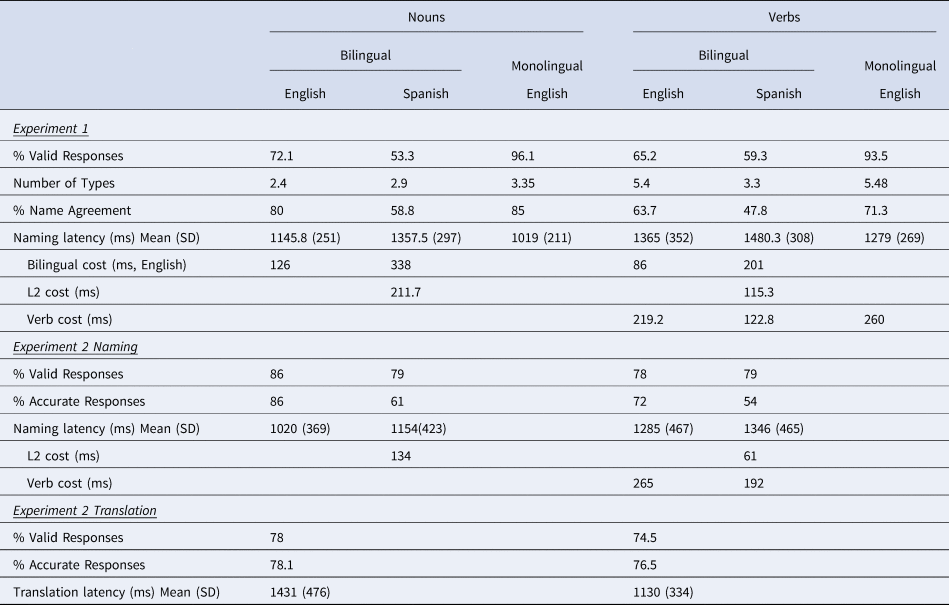
Descriptive details of the bilingual naming responses and the comparable monolingual naming responses reported by Szekely et al. (Reference Szekely, D'Amico, Devescovi, Federmeier, Herron, Iyer, Jacobsen and Bates2005) are in Table 2.
Description of naming responses. The monolingual English data are from the International Picture Naming Project (Szekely et al., Reference Szekely, D'Amico, Devescovi, Federmeier, Herron, Iyer, Jacobsen and Bates2005). On the basis of bilingual self-ratings, English is the dominant language (L1), and Spanish is the less dominant language (L2). Bilingual cost = Monolingual English RT minus Bilingual English RT; L2 cost = Bilingual L2 RT minus Bilingual L1 RT; Verb cost = Bilingual Verb RT minus Bilingual Noun RT

Predictors of naming latencies
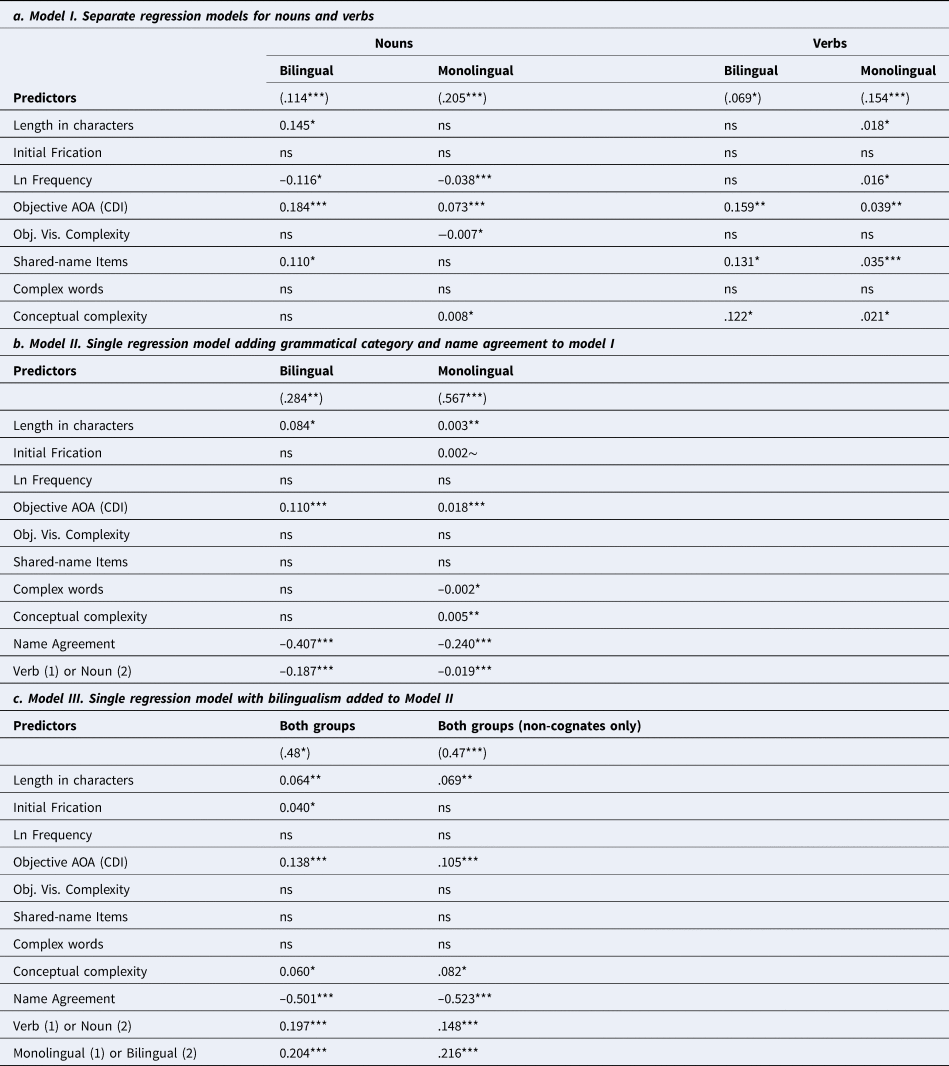
To examine factors that predict naming speeds of verbs and nouns in bilinguals, stepwise regressions were conducted to test the contribution of each factor when other factors are controlled (as per Szekely et al., Reference Szekely, D'Amico, Devescovi, Federmeier, Herron, Iyer, Jacobsen and Bates2005). Three sets of regressions were conducted. First, separate regressions were conducted for object and action naming to examine the contribution of the factors used by Szekely et al. (Reference Szekely, D'Amico, Devescovi, Federmeier, Herron, Iyer, Jacobsen and Bates2005): word length, initial frication, word frequency (Baayen et al., Reference Baayen, Piepenbrock and van Rijn1993), age of acquisition (Fenson et al., Reference Fenson, Dale, Reznick, Bates, Thal and Pethick1994), objective visual complexity, conceptual complexity, items with a shared name, and compound words (e.g., firetruck). Second, we combined the object and action naming data into a single regression model and assessed the contribution of lexical category and name agreement. Finally, we combined bilingual and monolingual data across object and action naming to assess the additional contribution of bilingualism. The results of the three regression analyses are in Table 3, which shows the standard regression coefficients and the unique variance contributed by each predictor after all other predictors had been entered into the regression.
Predictors of English action and object naming times. The values represent unique variance (β) in the last step of the stepwise regression model. The numbers in parentheses are the total variance of the model (R2). The monolingual English data are from the International Picture Naming Project (Tables 10 & 13 in Szekely et al., Reference Szekely, D'Amico, Devescovi, Federmeier, Herron, Iyer, Jacobsen and Bates2005).

(*** = p < .001; ** = p < .01; * = p < .05 level; ~ = p < .1)
In the first set of regression analyses, the model was significant for both object (R2 = 11.6%, p < .001) and action (R2 = 6.9%, p < .05) naming. For object naming, earlier age of acquisition, higher lexical frequency, shorter word length and shared name significantly predicted faster naming times (Table 3a). For actions, naming speed was predicted by early age of acquisition, the presence of a shared name and lower conceptual complexity. Comparing the regression patterns between bilingual and monolingual speakers (from Szekely et al., Reference Szekely, D'Amico, Devescovi, Federmeier, Herron, Iyer, Jacobsen and Bates2005, Table 10) shows that, while this eight-predictor model accounts for a smaller variance in bilingual naming speed, the overall pattern of significant predictors is largely similar across the two groups, with minor differences. For noun naming, bilinguals showed a word length effect and an absence of a conceptual complexity effect. For verb naming, bilinguals did not show word length and frequency effects (unlike the monolingual group).
Including lexical category and name agreement in the second set of regression analyses increased the predictive accuracy of the model to 28.4% (p < .001) (Table 3b) compared to 56.7% for monolinguals (Table 13 of Szekely et al., Reference Szekely, D'Amico, Devescovi, Federmeier, Herron, Iyer, Jacobsen and Bates2005). For both groups, the significant predictors in decreasing order of importance were: higher name agreement, lexical category (noun), earlier age of acquisition and shorter word length. Additionally, monolingual naming times were faster for simple (not compound) words and lower conceptual complexity. Replacing the name agreement values with those calculated from the current bilingual group slightly increased the variance explained by name agreement from −0.41 to −0.44.
Finally, inclusion of bilingual status as a dichotomous variable in a third regression model increased the model variance to 48% (p < .001), and the significant predictors in decreasing importance were higher name agreement, absence of bilingualism, noun, earlier age of acquisition, shorter word length, lower conceptual complexity and absence of frication (Table 3c). As a further check on model fit, we re-ran the regression by 1) replacing the CELEX frequencies with SUBTLEX frequencies (Brysbaert & New, Reference Brysbaert and New2009), and 2) excluding all cognates. Cognates were defined as items whose Spanish and English target names were related in form (phonological and/or orthographic, e.g., serve-servir), or whose synonym was related in form (cocodrillo – alligator). 46% (N = 240) and 37.4% (N = 103) of object and action stimuli respectively were cognates. The model fit changed slightly (50.7% with SUBTLEX, 47% with non-cognates, p < .001).
Bilingual cost: verbs and nouns
The naming latencies are illustrated in Figure 1. To examine the quantitative effect of bilingualism on word naming, English noun and verb naming times were compared between bilingual and monolingual speakers using a linear mixed effects model (LME) on raw (untransformed) response times (Lo & Andrews, Reference Lo and Andrews2015) with language group (monolingual, bilingual), lexical category (noun, verb) and the interaction term as fixed factors and items as the random factor. The intercept was included in the model for fixed and random factors and random slopes were also includedFootnote 1. There was a main effect of language group (β = −86.7, SE = 13.9, t = −6.2, p <.001) and word type (β = −219.8, SE = 19.6, t = −11.2, p < .001). In addition, there was a significant interaction between language group and word type (β = −40.4, SE = 17.2, t = −2.3, p < .05). That is, bilinguals were slower than monolinguals for both objects and actions, showing a bilingual cost (mean difference in RT = 106.5 ms, SE = 13.8), actions were named slower than objects, showing a verb cost (mean difference in RT = 239.7 ms, SE = 13.8), and the bilingual cost was smaller for actions than for objects (mean difference in RT = 127.1 ms versus 86 ms).
Bilingual and monolingual picture naming times for nouns and verbs in Experiment 1. The monolingual data are from Szekely et al. (Reference Szekely, D'Amico, Devescovi, Federmeier, Herron, Iyer, Jacobsen and Bates2005). Error bars indicate standard error of the mean. *** = p < .001; * = p < .05.

The results were unchanged when cognates were excluded. There was a main effect of group (β = −.026, SE = .005, t = −4.6, p <.001) and word type (β = −.07, SE = .007, t = −8.8, p < .001), and an interaction (β = −.03, SE = .006, t = −4.06, p < .001). Therefore, the smaller bilingual cost for actions was not because there were more verb cognates.
Comparison of Spanish and English
We compared bilingual speakers’ naming speed across their two languages (L1 and L2) and word categories using LME (Baayen, Davidson, & Bates, Reference Baayen, Davidson and Bates2008) with language (English, Spanish), lexical category (noun, verb) and their interaction term as fixed factors, items and trial as the random factors and including random slopes and random intercepts for both fixed and random factors. Picture naming latencies were significantly slower in Spanish compared to English, showing a L2 cost (β = −177.6, SE = 17.7, t = 10.03, p < .001), and for actions compared to objects, showing a verb cost (β = −122.1, SE = 16.5, t = −7.3, p < .001). There was a significant interaction between language and word category (β = 62.4, SE = 21.1, t = −2.9, p < .01), showing that the verb cost was smaller in Spanish (122.4 ms) compared to English (219.2 ms). Or stated differently, Spanish naming latencies were much slower than English naming latencies for nouns (211.7 ms) than for verbs (115.3 ms).
Discussion
Experiment 1 asked if bilinguals show qualitative and quantitative differences from monolinguals in their action and object naming performance. Monolingual performance was extracted from naming times published by Szekely et al. (Reference Szekely, D'Amico, Devescovi, Federmeier, Herron, Iyer, Jacobsen and Bates2005) for the same stimuli.
Predictors of bilingual word retrieval speed
One predictor showed a robust effect on naming times across all regression analyses: age of acquisition (AoA). AoA has been identified in numerous prior studies (e.g., Ellis & Morrison, Reference Ellis and Morrison1998; Lachman, Shaffer & Hennrikus, Reference Lachman, Shaffer and Hennrikus1974; Palmer & Havelka, Reference Palmer and Havelka2010), and the current findings highlight the importance of this factor for bilingual naming times. AoA effects are assumed to arise due to conceptual complexity because easier concepts (such as concrete entities) are acquired earlier. AoA effects are also considered to represent connection strengths between semantic and lexical representations as these are strengthened over time with repeated retrieval (Ellis & Lambon Ralph, Reference Ellis and Lambon Ralph2000). Studies have also shown that when AoA is considered, lexical frequency effects are diminished (e.g., Morrison, Hirsh & Duggan, Reference Morrison, Hirsh and Duggan2003). This might explain the relatively modest influence of frequency on naming times in the present study (Table 3a). Moreover, frequency effects disappeared when name agreement and lexical category were introduced into the regression for both monolinguals and bilinguals (Table 3b and c). This is an important finding, as it shows the limits of frequency effects on word retrieval. It also shows that an account of bilingual cost that solely relies on usage frequency might be too narrow in scope. Name agreement reflects the different lexical labels that might be competing for selection. Items with low name agreement take longer to name because of the need to resolve among these alternate lexical labels. The robust effect of lexical category on naming times indicates that, for both monolinguals and bilinguals, the slower naming times of verbs cannot be explained away by other factors such as age of acquisition, name agreement or conceptual complexity (Szekely et al., Reference Szekely, D'Amico, Devescovi, Federmeier, Herron, Iyer, Jacobsen and Bates2005). Finally, two articulatory-phonological variables showed an effect on naming times: word length and initial frication. Word length effects are consistent with the view that articulation is initiated after all syllables are planned (Roelofs, Reference Roelofs1996) and hence longer words have slower naming times. Initial frication shows an effect on naming times because word onset is harder to detect by voice key trigger or manual coding because words with initial fricatives have a more gradual onset, compared to words that begin with articulatory closure such as stops and affricates. In summary, the regression analyses highlight two main points. First, naming times in bilinguals and monolinguals are influenced by qualitatively similar predictors, with robust effects of AoA, name agreement and lexical category. Second, bilingualism (bilingual cost) and lexical category (verb cost) have a significant influence on naming speed, while frequency has weak effects on naming speed.
Bilingual cost: verbs and nouns
This study found a bilingual cost, which was larger for Spanish (L2) compared to English (L1), replicating prior studies (Bylund et al., Reference Bylund, Abrahamsson, Hyltenstam and Norrman2019; Gollan & Acenas, Reference Gollan and Acenas2004; Gollan et al., Reference Gollan, Montoya, Fennema-Notestine and Morris2005a; Ivanova & Costa, Reference Ivanova and Costa2008; Kohnert et al., Reference Kohnert, Hernandez and Bates1998). The crucial question was whether bilingual cost differed across lexical categories. In both languages, the bilingual verb cost was smaller in magnitude than the bilingual noun cost. And, in the bilingual group, L2-L1 difference for verbs was smaller than the L2-L1 difference for nouns. Our study replicates Li et al.'s (Reference Li, Faroqi-Shah and Wang2019) findings with Mandarin–English speakers by using a much larger set of IPNP stimuli.
Now let's examine the two theories of bilingual cost. The frequency lag/weaker links theory gave two predictions: a larger bilingual cost for the less dominant language and no difference in bilingual cost across lexical categories. While the first prediction was supported, the second prediction was not. Rather than entirely dismissing the frequency lag account, we need to consider the possibility that verb retrieval inherently differs from noun retrieval and is less affected by frequency, as we found in the regression analyses and has been reported in prior studies of monolinguals (Bonin et al., Reference Bonin, Boyer, Méot, Fayol and Droit2004; Cuetos & Alija, Reference Cuetos and Alija2003; Shao et al., Reference Shao, Roelofs and Meyer2012; Szekely et al., Reference Szekely, D'Amico, Devescovi, Federmeier, Herron, Iyer, Jacobsen and Bates2005). In experiment 2, we aim to replicate the smaller influence of frequency on verbs (compared to nouns) by directly manipulating the lexical frequency of target names.
For the cross-language interference account, verbs were predicted to show a smaller bilingual cost based on the assumption that verb translations are less tightly linked across languages (Prior et al., Reference Prior, MacWhinney and Kroll2007; van Hell & de Groot, Reference van Hell and de Groot1998). While this prediction was supported, one needs to test the underlying assumption that cross-language connections for verbs are weaker than for nouns. In Experiment 2, this was done by eliciting translations for nouns and verbs, and then examining the relationship between translation speed and picture naming speed.
Experiment 2
The main goal of this experiment was to better understand the smaller bilingual verb cost found in Experiment 1. The crucial comparisons were between lexical categories and between L1 and L2, and not across monolingual and bilingual groups. To confirm that the frequency lag/weaker links account alone is insufficient to explain verb retrieval costs in bilinguals (Gollan et al., Reference Gollan, Montoya, Cera and Sandoval2008), this experiment compared the magnitude of frequency effect across lexical categories. To examine if a smaller cross-language interference was the source of a smaller verb cost, the connection strength across translation equivalents was tested by comparing translation speed for each lexical category. Translation speed has been used as a proxy for the strength of cross-language connections in prior studies (de Groot, Reference de Groot1992; Kroll & Stewart, Reference Kroll and Stewart1994). For the cross-language interference account to successfully explain the smaller bilingual verb cost, we should observe longer translation times (~weaker cross-language connections) for verbs compared to nouns. Additionally, we expect to observe the general patterns predicted by each account: slower naming times and a larger frequency effect in the non-dominant language as predicted by the frequency lag/weaker links account, and a negative association between naming speed and translation speed is predicted by the cross-language interference/competition account. Given that both frequency and cross-language interference could play a role in bilingual language production (in addition to other factors not tested in this study, such as cognate status), these two variables were analyzed in a single statistical model.
Methods
Participants
A new group of twenty highly proficient English–Spanish bilinguals were recruited (18 females, 2 males; Mean age = 21 years). All participants were exposed to Spanish at birth, and all (but one) were exposed to English before the age of 12 years. Participant details are in Table 1. Self-ratings of language proficiency using the Bilingual Language Profile (Birdsong et al., Reference Birdsong, Gertken and Amengual2012) showed a mean language dominance score of 32.3 (SD = 38.3). English proficiency was higher than Spanish proficiency (t(19) = 4.2, p < 0.001), showing English dominance (L1 = English, L2 = Spanish). Additionally, proficiency was objectively determined by an oral interview in both languages (“What do you do on a typical Monday?”) and an online lexical test (Lexical Test for Advanced Learners of English, LexTale, www.lextale.com, Lemhöfer & Broersma, Reference Lemhöfer and Broersma2012). The oral interviews were scored according to the American Council on the Teaching of Foreign Languages’ (ACTFL) proficiency guidelines (Swender, Conrad & Vicars, Reference Swender, Conrad and Vicars2012), and participants with ratings of Advanced, Superior, or Distinguished in both languages were included. The mean online LexTale score was 84.2% (SD = 10.4).
Stimuli
One hundred object pictures (50 Low Frequency (LF), 50 High Frequency (HF)) and 94 action pictures (50LF, 44HF) were selected from the IPNP stimuli (Supplementary Materials). Words were categorized as low or high frequency based on both English (SUBTLEXus, Brysbaert & New, Reference Brysbaert and New2009) and Spanish (SUBTLEX-ESP, Cuetos, Glez-Nosti, Barbon & Brysbaert, Reference Cuetos, Glez-Nosti, Barbon and Brysbaert2011) spoken word frequencies. The LF words varied in frequency from 0–25/million and the HF words had a frequency greater than 40/million. Verb and noun stimuli can differ across numerous dimensions (imageability, homophony etc.), such that it is nearly impossible to match them on all variables (as noted by Szekely et al., Reference Szekely, D'Amico, Devescovi, Federmeier, Herron, Iyer, Jacobsen and Bates2005), and doing so could result in a very skewed set of stimuli that are not characteristic of prototypical nouns and verbs. Hence, we matched verbs and nouns on just the crucial variable of interest, word frequency. The verbs and nouns did not differ in log frequency values (English: t(192) = 1.4, p >.05); Spanish: t(192) = 1.8, p >.05). Given the high influence of name agreement on naming times in Experiment 1, we matched the HF and LF stimuli on English name agreement using the H-statistic (Bates et al., Reference Bates, D'Amico, Jacobsen, Szekely, Andonova, Devescovi, Herron, Lu, Pechmann, Pléh, Wicha, Federmeier, Gerdjikova, Gutierrez, Hung, Hsu, Iyer, Kohnert, Mehotcheva, Orozco-Figueroa, Tzeng and Tzeng2003) (nouns: t(98) = −1.25, p > .05; verbs: t(98) = 1.50, p > .05). Seventeen nouns and 11 verbs were either direct cognates or cognates of close synonyms (e.g., robar-steal). Given that Spanish and English share a large number of cognates, we included the cognates to get a more ecologically realistic distribution of stimuli.
Procedures
Participants were tested individually over two sessions at least a week apart. The first session measured language proficiency and picture naming in one language. The second session included picture naming in the other language and the translation task. The sequence of language (Spanish or English) and word category (verb or noun) was counterbalanced across participants. Stimuli were presented in a random sequence for both picture naming and translation.
Picture naming task
The procedures were identical to Experiment 1.
Translation task
Printed words (Spanish picture names) were presented individually in two blocks (verbs and nouns). Participants were asked to translate the words from Spanish to English as quickly as possible. The trial and stimulus durations were the same as the picture naming task.
Data analysis
Procedures for recording and checking response times, determining valid responses and outlier exclusion were the same as Experiment 1 (and Li et al., Reference Li, Faroqi-Shah and Wang2019; Szekely et al., Reference Szekely, D'Amico, Devescovi, Federmeier, Herron, Iyer, Jacobsen and Bates2005). The distribution of responses is given in Table 2. Statistical analyses were performed using SPSS, IBM Corporation, version 24.0. Unless otherwise stated, linear mixed effect models were tested with participants and items as random effects with random slopes and intercepts included for fixed effects. We first examined translation speed differences across lexical categories to test the prediction that verbs generally have poorer translatability (and hence longer translation speeds). Next, we examined the effects of lexical category, frequency and translatability on picture naming speed in each language. To examine the effect of translatability on picture naming speed, each individual participant's naming responses were sorted into high and low translatability items based on translation speed obtained from the translation task for that participant. If a translation was invalid (3000 < ms < 500), the corresponding picture name was excluded. If a translation was incorrect, the corresponding picture name was grouped into the low translatability category. Thus, the translatability for each item for each participant was individually determined and converted into a dichotomous variable.
Results
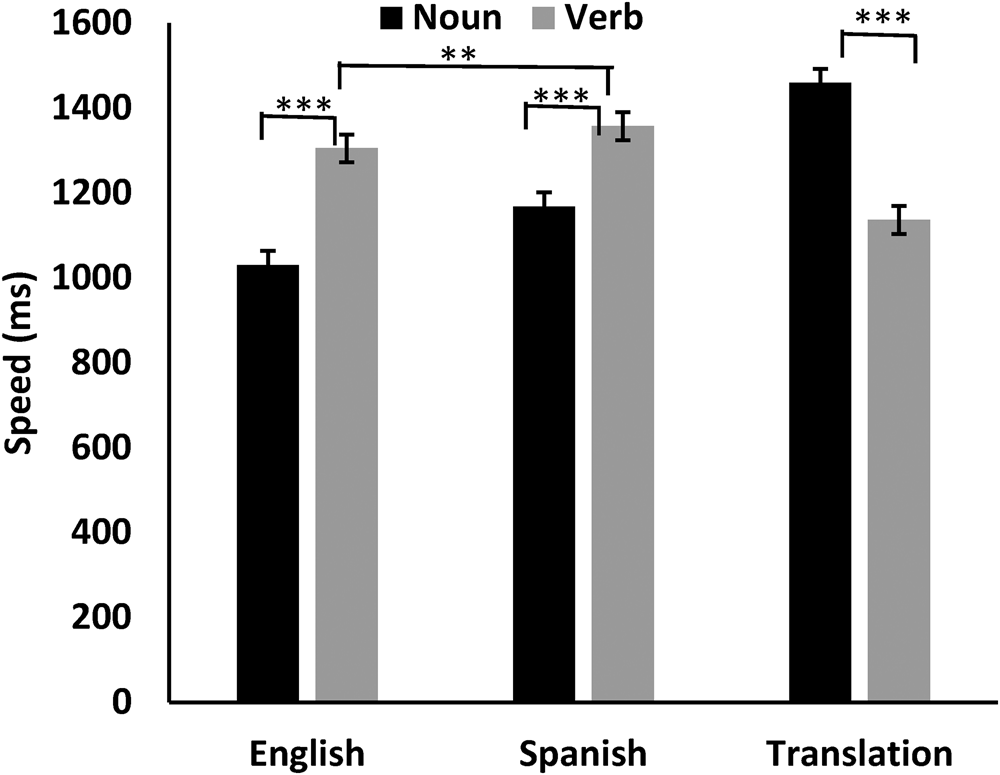
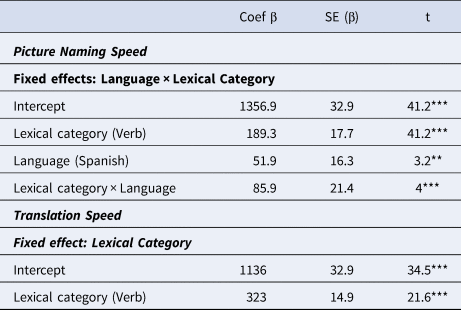
Picture naming and translation responses are illustrated in Figure 2 and the results are shown in Tables 2 and 4. In the picture naming task, verbs were slower than nouns (mean difference = 232.3 ms, SE = 13), Spanish naming was slower than English naming (mean difference = 94.9 ms, SE = 10.8), and the Spanish-English difference was smaller for verbs (mean difference = 52 ms, SE = 8) than for nouns (mean difference = 137.9 ms, SE = 10.1). That is, similar to Experiment 1, the L2 cost (slower naming in L2) was smaller for verbs than for nouns. In the translation task, participants did not differ in accuracy between nouns and verbs (Wilcoxon signed-ranks, Z = .45, p > .05). This comparable translation accuracy for verbs and nouns is important in interpreting translation speed differences because it eliminates the possibility of a “speed-accuracy trade-off”. That is, if verbs had lower translation accuracy, then it could be argued that only “easy” verbs were accurately translated, resulting in faster verb translation speeds. In the translation task, verbs (M = 1136 ms, SE = 32.9) were translated faster than nouns (M = 1459 ms, SE = 33.5). To understand if translation speed is influenced by any variables, we ran a linear regression analysis with translation speed as the dependent variable and the following predictors: lexical category (noun = 1, verb = 2), word length (in English), name agreement (English), age of acquisition, cognate status, English frequency and Spanish frequency (see Experiment 1). The model was significant (F(6,181) = 21.8, R2 = .41, p < .001), with lexical category as the only significant predictor (β = −.68, p < .0010). Thus, there do not seem to be other influences on translation speed.
Bilingual picture naming and translation times for nouns and verbs in Experiment 2. Error bars indicate standard error of the mean. Translations were from Spanish to English. p-values: *** < .001; ** < .01; * < .05.

Results of statistical analyses of picture naming and translation times for Experiment 2. p-values: *** < .001; ** < .01; * < .05.

We explored how translation speed was associated with lexical frequency and picture naming speed. Translation speed and lexical frequency (in English) were not correlated for nouns (Pearson r = −.16, p =.11) or verbs (Pearson r = −.15, p =.15), which was important to determine so that there is no collinearity confound when analyzing frequency and translation speed in the same statistical model (next section). Translation speed was significantly positively correlated with English and Spanish picture naming for both nouns and verbs, even when the effects of frequency were controlled (all bivariate correlations r > .11, p < .01).
Effects of frequency and translatability on picture naming speed
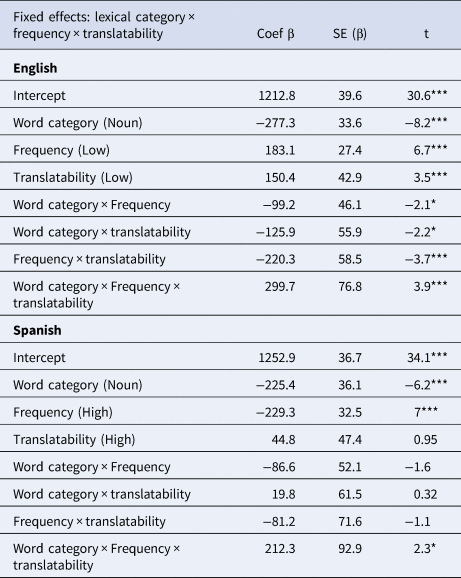
For the main analysis of this experiment, picture naming speed in each language was analyzed separately using a 3-way LME with lexical category (noun, verb), frequency (low, high) and translatability (low, high) as fixed effects and participants, and items as random effects. The intercept was included for both fixed and random effects (Table 5 and Figure 3). In English, there were significant main effects of lexical category (naming times are faster for nouns than verbs), frequency (naming times are faster for high frequency than low frequency words) and translatability (naming times are faster for high translatability than low translatability words). There was also a significant 3-way interaction between lexical category, frequency and translatability, showing that translatability effects are found only for low frequency nouns and high frequency verbs. Two-way interactions between lexical category and frequency/translatability (p < .05) showed that frequency and translatability effects were smaller for verbs (mean difference for frequency = 73 ms, for translatability = 40ms) than for nouns (mean difference for frequency = 124 ms, for translatability = 64ms). Spanish picture naming showed main effects of lexical category (nouns are named faster than verbs) and frequency (faster naming for high frequency words) and a significant 3-way interaction between lexical category, frequency and translatability, showing that translatability effects are found only for low frequency nouns.
Bilingual picture naming showing the interaction between frequency and translatability for nouns (a) and verbs (b). Error bars indicate standard error of the mean. p-values: *** < .001; ** < .01; * < .05.

Results of the three-way interaction between lexical category, frequency and translatability for picture naming times in Experiment 2. p-values: *** < .001; ** < 01; * < .05.

In sum, high frequency facilitated naming in both lexical categories and both languages; the frequency effect was larger in Spanish (nouns = 209 ms, verbs = 188ms) than in English (nouns = 124 ms, verbs = 73ms) and for nouns than for verbs. High translatability facilitated naming of low frequency nouns in English and Spanish and high frequency verbs in English. Spanish picture naming differed from English picture naming in the following ways: 1) there was a larger frequency effect in Spanish compared to English, 2) there was no main effect of translatability, and 3) translatability did not facilitate high frequency verbs. The translation task involved translation from Spanish to English, hence it is not surprising that translation speeds (English names) were more strongly associated with English picture naming RT than with Spanish picture naming RT. The results did not change when only non-cognates were analyzed, and these statistics are provided in the Supplementary Materials (Supplementary Materials).
Discussion
The primary goal of Experiment 2 was to test two possible explanations for the smaller bilingual verb cost by examining frequency and translatability effects across lexical categories and languages. We found that verbs showed smaller frequency effects and were translated faster than nouns. For all words, translation speed was positively correlated with naming speed.
Frequency effect for verbs and nouns
The finding of a larger frequency effect on picture naming speed in Spanish compared to English is consistent with the classic prediction of the frequency lag/weaker links account that the less dominant language would show stronger frequency effects. Verbs showed smaller frequency effects compared to nouns, which replicates the findings of the regression analyses in Experiment 1. This experiment confirms that frequency has a smaller role on verb naming than it does on noun naming in bilingual speakers, as with monolingual speakers (Bonin et al., Reference Bonin, Boyer, Méot, Fayol and Droit2004; Cuetos & Alija, Reference Cuetos and Alija2003; Shao et al., Reference Shao, Roelofs and Meyer2012; Szekely et al., Reference Szekely, D'Amico, Devescovi, Federmeier, Herron, Iyer, Jacobsen and Bates2005). This finding, however, is different from Li et al. (Reference Li, Faroqi-Shah and Wang2019), who found no difference in the magnitude of frequency effect between nouns and verbs. In fact, Li et al. (Reference Li, Faroqi-Shah and Wang2019) did not find a frequency effect for nouns in their monolingual and bilingual speakers’ L1, an effect that is typically very robust (Oldfield & Wingfield, Reference Oldfield and Wingfield1965). This suggests that their noun stimuli may not have provided a sufficient frequency contrast to elicit a frequency effect. Differences in languages (Mandarin–English vs English–Spanish), participants’ age of L2 acquisition, and statistical analyses methods could have also contributed to the different findings between Li et al. (Reference Li, Faroqi-Shah and Wang2019) and the present study.
The pattern of smaller frequency effects for verbs compared across both Experiments indicates that the frequency lag account cannot serve as the sole explanation for bilingual cost, and other factors, particularly lexical category and translatability, need to be considered in explaining bilingual word retrieval.
Translatability of verbs and nouns
For both nouns and verbs, translation speed, which was our measure of cross-language connectivity, was positively correlated with picture naming speed and had a significant main effect on naming, such that low translatabilty words were named more slowly. This is consistent with other studies showing an association between translation speed/accuracy and picture naming speed/accuracy (Gollan et al., Reference Gollan, Bonanni and Montoya2005b; Li et al., Reference Li, Faroqi-Shah and Wang2019). However, it is inconsistent with the basic premise of the cross-language interference/competition account that stronger cross-language connections would trigger greater competition during lexical retrieval resulting in slower naming times.
Translation speed was faster for verbs compared to nouns. At minimum, the cognitive demands of the translation task involve the following steps: reading a word, finding a cross-language equivalent, and articulating the translation. The faster verb translation speed couldn't arise from faster reading times for verbs because verbs and nouns were frequency matched, and, in fact, studies have found slower reading (lexical decision) speed for verbs compared to nouns (Kauschke & Stenneken, Reference Kauschke and Stenneken2008; Yang, Shu, Bi, Liu & Wan, Reference Yang, Shu, Bi, Liu and Wang2011). Retrieving the translation could occur through direct lexical links between translation equivalents, especially for low-proficiency bilinguals (per Kroll & Stewart's Revised Hierarchical Model, Reference Kroll and Stewart1994), or through conceptual mediation (Spanish stimulus>>conceptual representation>>English translation). Irrespective of whether this study's participants accomplished the translation task through direct lexical connections or conceptual mediation, the fact that verbs were translated faster indicates stronger cross-language connections between verb translations than between noun translations.
To explain why the bilingual cost is smaller for verbs compared to nouns, we propose that verbs receive an extra activation boost (or facilitation) from their more strongly connected translation, speeding up lexical access. This facilitation is weaker for nouns, especially for high frequency nouns (as evidenced by the interaction between lexical category, frequency and translatability, Table 5). To explain the smaller verb cost in Spanish compared to English in both Experiments, we further propose that the less dominant language (Spanish in our study) benefits more from this cross-language translation facilitation than the dominant language. Other potential reasons for a smaller bilingual verb cost that were not tested in this study are discussed under General Discussion.
We now revisit the initial assumption of weaker cross-language connections for verbs to reconcile our findings with the limited evidence available (Prior et al., Reference Prior, MacWhinney and Kroll2007; Prior, Kroll & Macwhinney, Reference Prior, Kroll and Macwhinney2012; van Hell & de Groot, Reference van Hell and de Groot1998). One study used a double-translation task, in which a paragraph is translated from English to another language, and a new speaker translated the other-language translation back into English (Gentner, Reference Gentner1981). When the original and double-translated English versions were compared, there were fewer verbs than nouns in common. Another study counted the number of within-language and between-language word associations that were translations (van Hell & de Groot, Reference van Hell and de Groot1998), and found a marginally lower number of such translations for verbs (28%) than for nouns (30.9%). This difference was significant by participants (F1) but not by items (F2). Prior et al. (Reference Prior, MacWhinney and Kroll2007) counted the number of different translations produced for each stimulus in a written translation task and found that a larger number of verbs (55–57%) produced more than one translation than nouns did (42–45%). The number of translations was predicted by imageability, frequency, cognate status, lexical category and word class ambiguity. A later study examined the probability that a translation will be used and found an influence of word length, imageability, and cognate status, but not lexical category (Prior et al., Reference Prior, Kroll and Macwhinney2012). Across these small number of studies, it appears that while verbs produce a wider variety of translations, this can be attributed to other factors that tend to differ between nouns and verbs, and not to lexical category membership per se. As for translation speed across lexical categories, the only comparison is with Li et al. (Reference Li, Faroqi-Shah and Wang2019), who did not report a direct statistical comparison between verb and noun translation speed, and found no significant interaction between translation speed and word category (Table 3 in Li et al., Reference Li, Faroqi-Shah and Wang2019). The direction of translation (non-dominant to dominant) was the same in both studies. However, as mentioned earlier, there were some differences in participant characteristics and methods (especially noun stimuli and statistical approaches) across the two studies. This highlights the importance of replicating the findings of the current study with further research into lexical category differences.
In summary, we found that 1) frequency effects are smaller for verbs compared to nouns, showing the limits of the frequency lag/weaker links account, and 2) translatability is positively associated with word naming speed, showing the untenability of the cross-language interference account. Based on the faster translation speeds of verbs, we suggest that verbs may receive a stronger facilitation from their translations than nouns, probably accounting for the smaller bilingual cost for verbs compared to nouns. It should be noted, further, that translation effects interact in complex ways with frequency and lexical category, as these are found in specific instances (low frequency nouns and high frequency verbs).
General discussion
The main purpose of this study was to examine verb naming in bilinguals within the context of current accounts of bilingual lexical organization. In the following paragraphs, we discuss the general differences across lexical categories, the magnitude of verb cost in bilinguals, and implications for models of bilingual lexical organization. But first, we point out cautions in interpreting the findings of this study. Findings from a picture naming task may have limited generalizability to the cognitive processes that occur in natural bilingual communication, particularly with reference to retrieval of verbs in sentence contexts and of non-imageable nouns and verbs. Translations were elicited in a single direction (non-dominant-to-dominant language), and thus lexical category differences in translation speed may need further replication.
Differences between verbs and nouns
Across both experiments, verb naming was slower than noun naming, consistent with prior monolingual (Haman et al., Reference Haman, Luniewska, Hansen, Simonsen, Chiat, Bjekic and Armon-Lotem2017; Kauschke & von Frankenberg, Reference Kauschke and von Frankenberg2008; Shao et al., Reference Shao, Roelofs and Meyer2012; Szekely et al., Reference Szekely, D'Amico, Devescovi, Federmeier, Herron, Iyer, Jacobsen and Bates2005) and bilingual findings (Hernandez et al., Reference Hernandez, Cano, Costa, Sebastian-Galles, Jucandella and Gascon-Bayarri2008; Kambanaros, Grohmann & Michaelides, Reference Kambanaros, Grohmann and Michaelides2013; Li et al., Reference Li, Faroqi-Shah and Wang2019). This is remarkable given that verbs had overall higher usage frequency and were shorter in length than nouns in Experiment 1 (Szekely et al., Reference Szekely, D'Amico, Devescovi, Federmeier, Herron, Iyer, Jacobsen and Bates2005), and were matched for frequency in Experiment 2. As is evident from the name agreement scores in Table 2, both monolinguals and bilinguals produced a wider variety of names for action pictures than for object pictures. Action pictures may have lower name agreement because participants may be selecting among a larger number of alternate names (sleep/nap/lay/dream vs. bed, eat/bite/chew vs. apple). This increased need for resolution among more responses may increase processing time, resulting in longer verb naming times. To understand why action pictures would activate a larger number of alternate names than object pictures, we need to consider the components of picture naming. At minimum, these include basic visual processing, object recognition, scene analysis (especially for actions), activation of target lexical representations (in the target language), selection among lexical representations, phonological and articulatory planning (Indefrey & Levelt, Reference Indefrey and Levelt2004). Action scenes, like “driving” in Figure 4, not only entail recognition of multiple entities (man, steering wheel, placement of hands etc.), but also drawing inferences about the relationships among these entities to generate the possible action name. The regression analysis results in Experiment 1 are consistent with the idea that both name agreement and conceptual complexity (i.e., number of items in the picture) influence picture naming speed (Table 3). Additionally, verb naming times could be longer because verbs activate thematic role knowledge, such as knowledge of typical agents (arresting-cop), patients (arresting-criminal), instruments (stirring-spoon), and features of their patients (manipulating-naive) (Ferretti, McRae & Hatherell, Reference Ferretti, McRae and Hatherell2001). Evidence for the influence of thematic role knowledge on verb naming times comes from longer latencies for transitive compared to intransitive verbs (Kauschke & von Frankenberg, Reference Kauschke and von Frankenberg2008). In sum, there are numerous reasons that could increase verb naming times, particularly greater perceptual/event recognition times and greater name ambiguity (Prior et al., Reference Prior, MacWhinney and Kroll2007). These additional influences on verb naming could also account for the diminished influence of word frequency on verb naming speed, as was evident in both experiments in this study with bilinguals, and in prior research with monolinguals (Bonin et al., Reference Bonin, Boyer, Méot, Fayol and Droit2004; Cuetos & Alija, Reference Cuetos and Alija2003; Shao et al., Reference Shao, Roelofs and Meyer2012; Szekely et al., Reference Szekely, D'Amico, Devescovi, Federmeier, Herron, Iyer, Jacobsen and Bates2005).
Illustration of processes involved in picture naming (A, B) and translation (C) of nouns and verbs in highly proficient bilingual speakers in the BILINGUAL INTEGRATED GRAMMATICAL CATEGORY (BIGC) MODEL. Dotted lines represent connections between verbs and their thematic roles, solid lines represent cross-language connections between translations, with thicker lines (between verbs) representing stronger connections. High frequency nouns have a higher activation level, represented by bold font (camion, truck). The “C” system (from Dylman & Barry, Reference Dylman and Barry2018) refers to the cognitive control mechanism that controls the language in which to speak.

The bilingual cost is smaller for verbs
The intriguing aspect of verb naming latencies is that their slowdown as a function of bilingual status (Experiment 1, Li et al., Reference Li, Faroqi-Shah and Wang2019) and L2 status (Experiments 1 and 2; Li et al., Reference Li, Faroqi-Shah and Wang2019) is smaller compared to the slowdown observed for nouns. Our investigation targeted translatability and frequency effects. The faster translation speeds for verbs compared to nouns suggest stronger cross-language connections and stronger facilitation by translations for verb retrieval. This explains the smaller verb cost in picture naming. Across both experiments, verbs had smaller frequency effects even though verb frequencies were matched (Experiment 2) or higher than (Experiment 1) noun frequencies. The frequency lag hypothesis does not provide a satisfactory explanation of smaller verb frequency effects. The current study thus identifies the limitations of frequency effects on bilingual language processing (Gollan et al., Reference Gollan, Slattery, Goldenberg, Van Assche, Duyck and Rayner2011; Sadat et al., Reference Sadat, Martin, Magnuson, Alario and Costa2016).
There are possibly other factors that influence how words from each lexical category are retrieved, and this needs further experimentation. For example, there is some evidence that verbs may rely to a greater extent on cognitive control than nouns (Shao et al., Reference Shao, Roelofs and Meyer2012; Silveri & Ciccarelli, Reference Silveri and Ciccarelli2007). Although the extent to which bilinguals and monolinguals differ in their reliance on domain general cognitive control mechanisms during lexical retrieval is still unclear (Bialystok, Craik & Luk, Reference Bialystok, Craik and Luk2008; Faroqi-Shah, Sampson, Pranger & Baughman, Reference Faroqi-Shah, Sebastian and van der Woude2018), it is plausible that bilingualism, verbs and cognitive control interact to yield a smaller bilingual cost for verbs. Second, the regression analyses in Table 3 (a and b) show that conceptual complexity, which is higher in verbs, exerts a smaller influence on bilingual naming times (compared to monolinguals), and this could potentially contribute to a smaller bilingual verb cost. Third, there could be simultaneous cross-language interference effects at play, especially for nouns. Cook and Gor (Reference Cook and Gor2015) found that words with more robust phonological-lexical representations (as determined by a translation rating task) were more likely to show cross language interference effects in a lexical decision task. Finally, picture naming of verbs is much slower than that of nouns due to a variety of reasons as discussed in the previous section (in monolinguals and bilinguals). This could place limits on how much more slowly bilinguals could name verb pictures (a ceiling effect), thus diminishing the magnitude of the verb cost.
Implications for models of bilingual lexical representation
The classic model of bilingual lexical representation (Kroll & Stewart, Reference Kroll and Stewart1994) proposed two distinct lexicons for L1 and L2. This assumption of language-specific lexicons has been challenged by numerous findings whose discussion is beyond the scope of this paper (see reviews in Basnight-Brown, Reference Basnight-Brown, Heredia and Altarriba2014; Brysbaert & Duyck, Reference Brysbaert and Duyck2010; Dijkstra et al., Reference Dijkstra, Wahl, Buytenhuijs, Van Halem, Al-Jibouri, De Korte and RekkÉ2019; Dong et al., Reference Dong, Gui and MacWhinney2005; and examples of recent evidence in Dylman & Barry, Reference Dylman and Barry2018; Ibrahim, Cowell & Varley, Reference Ibrahim, Cowell and Varley2017). Based on the strength of this evidence, we assume an integrated lexicon that houses lexical representations for both languages.
In Figure 4, starting with Dylman and Barry's (Reference Dylman and Barry2018) framework of a shared bilingual lexicon, we integrate what is currently known about verb and noun retrieval in bilinguals to propose how these might be organized in the mental lexicon. The Bilingual Integrated Grammatical Category (BIGC) model in Figure 4 represents lexical organization in highly proficient bilingual speakers like those of the present study. We use low and high frequency verbs and nouns as examples to illustrate frequency effects. We use a lemma tier (instead of “semantic features”) to incorporate syntactic information inherent to verb representations. Connections between verbs and their arguments (drive-truck) are represented with dotted lines, the evidence for which comes from priming paradigms (Ferretti et al., Reference Ferretti, McRae and Hatherell2001). Within the lexical-phonological tier, higher frequency nouns (camion, truck) have a higher baseline activation level (Dijkstra et al., Reference Dijkstra, Wahl, Buytenhuijs, Van Halem, Al-Jibouri, De Korte and RekkÉ2019) as illustrated by the bold font, causing them to be retrieved faster than lower frequency nouns. This frequency difference is not depicted for verbs given that they are less influenced by frequency. The stronger cross-language connections of verb representations, which account for their faster translation speeds, are represented with thicker lines between verb translations (conducer-driving, patinar-skating). There would also be stronger lexical connections between cognates (Costa, Santesteban, & Cano, Reference Costa, Santesteban and Cano2005), which are not represented in Figure 4 for simplicity. The shaded region around verbs denotes a lexical separation between verbs and nouns, based on evidence of verb-noun double dissociations in bilinguals (Faroqi-Shah & Waked, Reference Faroqi-Shah and Waked2010; Kambanaros & van Steenbrugge, Reference Kambanaros and van Steenbrugge2006) and monolinguals (Caramazza & Hillis, Reference Caramazza and Hillis1991) with brain injury.
Conclusions
The first Experiment highlighted the role of conceptual (age of acquisition, name agreement), perceptual (picture complexity), and articulatory (initial frication and word length) factors in picture naming speed, in addition to bilingual status and lexical category. Further examination of the latter two variables across two experiments provided converging evidence that the bilingual cost was smaller for verb naming than it was for noun naming (consistent with Li et al., Reference Li, Faroqi-Shah and Wang2019). Lexical frequency exerted a smaller effect on verb naming than it did on noun naming. Verbs were also translated faster than nouns, despite their longer picture naming times. The smaller bilingual cost for verbs is explained by stronger cross-language connections between verb translations, which facilitates their retrieval and partially offsets the bilingual cost. Noun retrieval, in contrast, is more dependent on usage frequency. Thus, the frequency lag account better explains noun retrieval, and a cross-language facilitation from translations better explains verb retrieval.
This study illustrates the limits of lexical frequency on word retrieval. The absence of cross-language interference from translation equivalents, as measured by the association between translation and picture naming speed, questions the assumption that the lexical representations of the two languages of a bilingual compete during language production (Green, Reference Green1998; Hall, Reference Hall2011; Lee & Williams, Reference Lee and Williams2001; Sandoval et al., Reference Sandoval, Gollan, Ferreira and Salmon2010; van Hell & de Groot, Reference van Hell and de Groot1998), although a bilingual might require extra cognitive effort to maintain a single output language. To conclude, the present study highlights the importance of diversifying the kinds of words that are used to investigate the intricacies of bilingual lexical representation, particularly by including verbs.
Supplementary Material
For supplementary material accompanying this paper, visit https://doi.org/10.1017/S1366728921000213.
Acknowledgements
We thank Kyra Paticoff for assistance with developing the stimuli, Jiae Yoon for assistance with data collection and analysis, and Molly Harman, Melissa Stockbridge, and Ayesha Hayat for response scoring.