


‘It follows that representation and truth are a considerable distance apart, and a representer is capable of making every product there is only because his contact with things is slight and is restricted to how they look’.
– Plato Republic 10.598b (Trans. Waterfield 1998, 348)Ancient Mediterranean studies and AI technologies
The so-called artificial intelligence (AI) revolution has been positioned as the next great tipping point in human history. As boasted by Sam Altman, co-founder of OpenAI, technology has ‘brought us from the Stone Age to the Agricultural Age and then to the Industrial Age’ (Altman Reference Altman2024). Altman, along with many in his field, claim that AI will bring humanity ‘shared prosperity to a degree that seems unimaginable today; in the future, everyone’s lives can be better than anyone’s life is now’ (Altman Reference Altman2024). While wealthy techno-optimists like Altman tout AI as the future saviour of humanity and the planet, critics have raised alarms around the social and environmental impacts of algorithmic thinking and corporate AI systems as part of the broader growth of surveillance capitalism and expansion of wealth inequality (O’Neil Reference O’Neil2016; Eubanks Reference Eubanks2018; Noble Reference Noble2018, Zuboff Reference Zuboff2018; Benjamin Reference Benjamin2019; Bender et al. Reference Bender, Gebru, McMillan-Major and Shmitchell2021; Crawford Reference Crawford2021; Barassi Reference Barassi2021; Adams Reference Adams2025; Bender and Hanna Reference Bender and Hanna2025; Hao Reference Hao2025; Sadowski Reference Sadowski2025). Such critiques highlight the extractive colonial logics embedded in these technologies through the scraping and coding of data, the extractive labour practices around data refinement, the discrimination of automated algorithmic decision-making, and the inequities within the social and environmental impacts borne.
There is no clear consensus around the exact definition of AI, nor even for the human intelligence it seeks to mimic (Crawford Reference Crawford2021, 7–9; Hao Reference Hao2025, 89–93). In general, the term AI refers to systems that are capable of performing tasks association with human intelligence, including learning, reasoning, and problem solving. In practice, the most prominent AI systems are constructed using natural language processing, machine learning, and computer vision techniques that train programs to recognize and predict patterns in language and images. These models, trained on ever-expanding and progressively more polluted datasets, consume astronomical natural resources, capital, and labour (Bender et al. Reference Bender, Gebru, McMillan-Major and Shmitchell2021; Crawford Reference Crawford2021; Adams Reference Adams2025; Hao Reference Hao2025; Sadowski Reference Sadowski2025). They are also increasingly being employed in algorithmic systems tasked with making automated decisions on everything from social media content exposure to healthcare and social welfare programs to financial lending and employment to policing and surveillance. Automated algorithmic systems, promoted for their purported efficiency and objectivity, are proving to be ‘neither artificial nor intelligent’ (Crawford Reference Crawford2021, 8). Instead, they replicate and amplify the impacts of an immeasurable number of human choices and biases.
The rapid growth of AI adoption has profound implications within and beyond ancient Mediterranean studies (AMSFootnote 1 ) research and education. For practitioners within these fields, it represents the most recent example within a long history of emergent technologies that have impacted our disciplinary methods and workflows, from the introduction of the camera and digital documentation procedures to the adoption of advanced analytical tools and digital data sharing practices (Crymble Reference Crymble2021). Although AI applications had already found their way into research and teaching practices (e.g., Google Translate and audio transcription services), the public accessibility of generative AI platforms like ChatGPT (released by OpenAI in November 2022) has produced effects that seem more immediate and significant than previous new technologies.
While educators have overwhelming focused on the impacts of generative AI on student learning and academic honesty, the growing integration of AI-powered tools within AMS research and teaching deserve focused reflection from a humanistic perspective (i.e., with a ‘human-centric approach’ that aspires to ‘serve the development of human capabilities, protect human dignity and agency, and promote justice and sustainability’; UNESCO 2024, 15). This reflection should explicitly and critically address the role of AMS-related practitioners and methods in corporate AI tool development, as well as our complicity in the systemic impacts generated through our use of such tools in our research and teaching. Before integrating AI into the classroom, educators should further assess the ways in which AI tools and outputs are being employed to supplement – or in some cases replace – learner activities and cognitive tasks and address the impacts of these interventions on learning objectives.
One important intersection between AMS-related fields and AI technologies is the humanistic teleology of their design. This is reflected in the language employed around AI systems, which are said to ‘think’ and ‘see’ like humans. The pursuit of this objective – to capture and mimic human behaviour and thought – has generated significant junctions between the theories and methodologies employed in AI and AMS fields. Relevant methods and examples include source criticism and provenance identification, classification and taxonomy design, social theory and behavioural analysis, and philology and linguistics. These junctions represent the purposeful integration of historical and anthropological methods and research into the training models and data employed in the development of AI technologies. In turn, AI tools are being interjected into AMS disciplines through deliberate adoption and unsanctioned student use. For example, practitioners are using AI-powered analytical tools, especially language processing tools used in text and inscription translation, in AMS research and teaching. Universities and professional organizations are also encouraging, and sometimes mandating, the adoption of AI tools within learning management system (LMS) platforms and classroom learning activities.Footnote 2
Those advocating for AI in education tend to claim benefits to student access and support through democratized, immediate, and personalized learner support. Though preliminary, a meta-analysis of early gen-AI use in education suggests potential benefits to initial skills acquisition (Mo et al. Reference Mo, Huang, Yang, Özen, Maeda and Olenchak2026), particularly in STEM fields; however, other fields like writing show distinct cognitive declines with large language model (LLM) use (Kosmyna et al. Reference Kosmyna, Hauptmann, Yuan, Situ, Liao, Beresnitzky, Braunstein and Maes2025). While technologically driven access and learner-tailored curricula are highly appealing goals, similar ‘Ed-tech’ promises have repeatedly failed to deliver democratizing benefits (Bender and Hanna Reference Bender and Hanna2025, 96–98).Footnote 3 Furthermore, the narrow focus on user benefits decontextualizes corporate AI technologies from their broader developmental and operational worlds. Before advocating for the adoption of AI tools and outputs, educators should prioritize robust literacy training among teachers and learners. This training should develop the requisite knowledge, skills, and ethical frameworks needed to evaluate AI systems and their outputs. For AMS learners, this also involves an understanding of the theoretical, methodological, and practical junctions between AMS and AI technologies, including their epistemological and teleological commonalities engendered through shared colonial origins and long histories of cooperation and collaboration with political and military institutions.
AI as a concept coalesced in the 1950s after Alan Turing posed the question of whether machines could ‘think’ (leading to the development of the Turing Test). Shortly after, mathematics professor John McCarthy convened a workshop at Dartmouth University centred on ‘automata studies’, for which he coined the term ‘artificial intelligence’. This meeting, The Dartmouth Summer Research Project on Artificial Intelligence, was supported in part by the US Office of Naval Research (Crawford Reference Crawford2021, 184). In the 1960s, AI development grew through the integration of affect recognition within computer vision research, based in part on the cross-cultural ethnographic work of Paul Ekman, which was funded by the Department of Defense’s Advanced Research Projects Agency (DARPA) (Crawford Reference Crawford2021, 151–161).
Through the late twentieth and early twenty-first centuries, the US government and military continued to shape the development of AI through large contracts tendered by defence and intelligence departments (Crawford Reference Crawford2021, 181–209). This led to the dominance of US corporations, particularly the so-called ‘big five’ (Amazon, Apple, Google, Meta, and Microsoft) in AI development, though this dominance is increasingly diminishing. Conflict over the ethical implications of AI use in military operations led to over 3100 staff at Google signing a petition in 2018 to demand that the corporation pull out of a signed collaboration agreement with the Pentagon to work on the Algorithmic Warfare Cross-Functional Team (also known as Project Maven; Crawford Reference Crawford2021, 191). After Google acquiesced to this demand and ended their participation in the project, they released their Artificial Intelligence Principles policy, which stated that they would not pursue AI applications that would be used to make ‘weapons or other technologies whose principal purpose or implementation is to cause or directly facilitate injury to people’ or ‘gather or use information for surveillance violating internationally accepted norms’ (stipulations Google later removed in a February 2025 amendment). This did not slow the participation of the broader AI industry in defence contracts, with powerful private sector players emerging within the field of surveillance technology.
One of the most prominent of these players is the American data mining and software engineering company Palantir, that designs systems to support ‘critical government and commercial enterprises in the West, from the factory floors to the front lines’ (Palantir, Home Page). Palantir’s participation in numerous defence contracts, including Project Maven, exemplifies the complex network of relationships between wealthy financiers, AI developers, and military institutions. Palantir’s co-founder and chairman, Peter Thiel, is common collaborator and financial backer of prominent AI figures such as Elon Musk and Sam Altman (two of the original founders of OpenAI). The relationship between Musk and Thiel, among many others in Silicon Valley, is also underscored by an adherence to a shared ideology – Eurocentrism and a fetishization of ‘Western Civilization’ (Figure 1). Palmer Luckey, founder of Oculus and the military defence technology company AndurilFootnote 4 (backed by Thiel’s Founders Fund), has characterized AI-powered weapons as ‘the technologies that will keep our values safe’, and insists that the US and their western allies must dominate the field of military technologies because ‘technological superiority is a prerequisite for ethical superiority’ (Luckey Reference Luckey2018, minutes 1:58, 16:35). These sentiments are exemplified in The Technological Republic: Hard Power, Soft Belief, and the Future of the West (Karp and Zamiska Reference Karp and Zamiska2025), co-written by Palantir co-founder and CEO Alex Karp, that advocates for the ‘engineering elite of Silicon Valley’ to acknowledge their obligations to the American ‘National Project’, particularly through their participation in the defence of the nation against both foreign and domesticate threats. The valorization of ‘western’ ideals by many members of tech industry, working in partnership with the US government and Department of Defense, is part of a broader expansion of surveillance capitalist agendas.

The intersection of militarized technology, capital, and ‘western’ ideologies in the US – which sociologist Jathan Sadowski has termed a ‘fusion of techno-capitalism and techno-nationalism’ (Sadowski Reference Sadowski2025, 95) – is in many ways not a new phenomenon. Aimé Césaire identified this intersection as a key feature of European colonialism, which ‘began to ‘propagate’ at a time when it had fallen into the hands of the most unscrupulous financiers and captains of industry’, leading to ‘the highest heap of corpses in history’ (Césaire Reference Césaire2000, 45). The introduction of AI into this imperial cocktail has yielded disastrous impacts on communities and heritage throughout the ‘Majority World’ outside of AI-powered imperial cores.Footnote 5 Prominent examples include the US bombing of the Shajareh Tayyebeh primary school in Minab, Iran in February 2026, alongside the use of AI-powered weapons by the Israeli army in the ongoing genocide in Gaza (e.g., Projects Lavendar, Where’s Daddy, and Gospel), which the Human Rights Watch has identified as war crimes (Human Rights Watch’s September 2024 report). The lack of precision targeting in these digital tools represents a violation of International Humanitarian Law, specifically the Laws of War concerning distinction between military targets and civilians as outlined in the Geneva Conventions (1949 and after) and the ICC’s Rome Statute (1998). The devastation caused by such systems – provisioned largely by American corporations like Palantir – has led to extensive destruction of human life, infrastructure, and cultural heritage (Figure 2).Footnote 6
The Great Omari Mosque in Gaza, showing damage from Israeli air strikes as an example of recent cultural heritage damage associated with AI-powered military violence (image credit Fadel Al Utol, February 2025).

Cultural heritage loss represents a critical nexus point between AI technologies and AMS-related disciplines. It also parallels the well-documented interlacing of archaeological exploration, military intelligence, and imperial politics in historical disciplines, starting with foundational figures within Mediterranean, West Asian, and North African archaeology like Gertrude Bell and T.E. Laurence. Franz Boas, an early leading figure in American anthropology, was famously censured by the American Anthropological Association (AAA) in 1919 for denouncing four anthropologists that he claimed ‘prostituted science by using it as a cover for their activities as spies’ (Boas Reference Boas1919). Nearly a century later, the US government launched the Human Terrain System (HTS), which included anthropologists and social science experts in support teams tasked with providing cultural information on local communities in which the military was operating (specifically Iraq and Afghanistan). While Boas’ complaints were met with censorship, the AAA board released a statement against the HTS project (AAA Statement, October 31, 2007), stating that it violated the AAA Code of Ethics provision that anthropologists do no harm to their research subjects (Code of Ethics 1998: section III, A, 1). Though this represented a positive change in disciplinary ethics, there remain many ways in which militarized data and technology are embedded in historical and archaeological practice. For example, declassified CORONA imagery is regularly used in GIS studies, with little consideration for its military origins or the lack of consent provided by local communities.
Displaced cultural heritage in museums holdings represents another well-documented issue in AMS fields resulting from colonial and military histories and early disciplinary practices. Emerging digitization and reproduction technologies like 3D scanning and AI, though much lauded for expanding access and preservation, are also engendering new issues, particularly around data sovereignty (Tayiana Maina and Moiloa Reference Tayiana Maina and Moiloa2022; Kamash Reference Kamash and Rubina2023; Lucarelli Reference Lucarelli, Palladino and Bodard2023). The reproduction of displaced or destroyed cultural heritage risks reenacting colonial extraction as part of what is being termed ‘digital colonialism’ (Munawar Reference Munawar2017; Stobiecka Reference Stobiecka2020; Kamash Reference Kamash and Rubina2023). Digitization and digital dissemination often reinforce inequities through digital divides, including unequal access to high-speed broadband, digitization technologies, server capacity, and project funding, alongside linguistic and other structural divides (Noble Reference Noble2018, 160–162; D’Ignazio and Klein Reference D’Ignazio and Klein2020; Tayiana Maina and Moiloa Reference Tayiana Maina and Moiloa2022; Paul Reference Paul2025). Digital colonialism can also result from Eurocentric epistemologies and goals in project design, as seen in the recent digital reproduction of the destroyed Arch of Triumph from Palmyra (Munawar Reference Munawar2017; Khunti Reference Khunti2018; Kamash Reference Kamash and Rubina2023; Sabrine, et al. Reference Sabrine, Awad, Hasan and Rollo2024) and – perhaps most egregiously – the 3D reproduction of the vocal tract of the ancient Egyptian priest Nesyamun (Stevenson Reference Stevenson2022; Johnston, Reference Johnston and Johnstonforthcoming). While institutions often promote digitization as ‘a strategy for future oriented safekeeping, distribution, and greater engagement’, it is crucial that we assess whose needs and goals are served by these projects, and whether we are ‘making decisions about digitization that ensure these objectives are met in ethical, equitable ways’ (Tayiana Maina and Moiloa Reference Tayiana Maina and Moiloa2022). This is especially true with the growth of AI technologies, particularly generative AI, which pose heightened data sovereignty and appropriation risks (Whaanga Reference Whaanga and Lewis2020).
Developing the capacity to understand and assess digitization and AIs, including the ethics of automated algorithmic decision-making, serves to prepare learners not only for historical study, but also for ethical engagement with the systems governing the world around them. The AI-centred literacies identified here align with the core objectives of key AI literacy frameworks in education (see below), while addressing field-specific topics, notably the recursive relationship between historical and anthropological research and developing technologies. These literacies are designed to complement and scaffold onto common core competencies of classical, historical, and anthropological education, encouraging learners to connect and critically assess AI and other related technologies as extensions of historical data and analytical practices. Importantly, addressing the foundational structures and logics of AI economies situates learners to critically assess the AI tools and outputs that they encounter alongside the resulting political, social, and environmental impacts.
Ancient Mediterranean studies and core literacies
Teaching in AMS and its associated subfields is an interdisciplinary endeavour. AMS students develop a number of core competencies, including those that would align with what is alternatively known as data or information literacy. Information literacy comprises ‘the set of integrated abilities encompassing the reflective discovery of information, the understanding of how information is produced and valued, and the use of information in creating new knowledge and participating ethically in communities of learning’ (ACRL 2015, 8). The collection and analysis of material and textual data, the development of historical conclusions from this evidence, and the communication of these conclusions are core learning objectives of AMS teaching. The practice of ethically situating this knowledge within communities of learning is especially important for AMS given the popularity of Greco-Roman antiquity and its assigned importance as the ‘origins’ of ‘Western Civilization’.
The use of technology in contemporary data collection and analysis has created a close intersection between information and digital literacies. As advanced digital tools allow datasets and analytical complexity to grow in scale, the impacts of taxonomic and ontological choices are amplified. The so-called ‘black box’ nature of many technologies, in which users know the inputs and outputs of a system but not its computational mechanics, makes it especially important that learners are trained to understand these systems and their computational logics. These competencies are a part of what is known as digital literacy, which can be defined as ‘the ability to access, manage, understand, integrate, communicate, evaluate and create information safely and appropriately through digital technologies’ (UNESCO, A Global Framework of Reference on Digital Literacy Skills for Indicator 4.4.2). AI Literacy, which encompasses many aspects of information and digital literacies, can be seen as part of what has been termed ‘metaliteracy’, which is comprised of ‘an overarching set of abilities in which students are consumers and creators of information who can participate successfully in collaborative spaces’ (ACRL 2015, 8).
Though there is no universal definition of AI Literacy, there are two prominent approaches to the topic. Frameworks common in academic and education fields (e.g., UNESCO’s AI Competency Framework for Students; the OECD’s Empowering learners for the age of AI framework) adopt human-centred approaches to AI Literacy with a focus on cognitive and affective competencies relating to understanding how AI is built, how it works, and what its impacts are. Other frameworks, particularly those shared by corporate AI developers, adopt a more skills-centred approach focused on practical competencies relating to understanding how to use AI tools, how to manage AI tools, and how to design and develop AI tools. These latter frameworks are ‘often designed and/or provided by private companies’, tend to ‘focus on technical skills to operate profit-driven AI platforms’, and ‘seldom engage with the broader critical issues of the implications of AI for learning and citizenship, more broadly’ (UNESCO 2024, 12).
AI Literacy guides developed by and for educators, like the UNESCO and OECD frameworks, align core competencies towards meeting the demands of AI-embedded futures in order to ‘shape responsible and creative citizens that can co-create these desirable futures’ (UNESCO 2024, 12). Accordingly, such frameworks structure their competencies around humanist criteria (e.g., ‘a human-centred mindset, ethics of AI, AI techniques and applications, AI system design’ in the case of the UNESCO framework), with scaffolded levels of student engagement (e.g., the capacities to understand, apply, and create). The resultant AI competencies are framed around three pillars – knowledge, skills, and values (UNESCO 2024, 18; the OECD framework’s structuring concepts are ‘knowledge, skills, and attitudes’; OECD 2025, 18). By integrating critical competencies with cognitive, practical, and affective criteria, these literacy frameworks aim to develop students who are ‘conscious and knowledgeable’ about AI advantages and limitations (UNESCO 2024, 14).
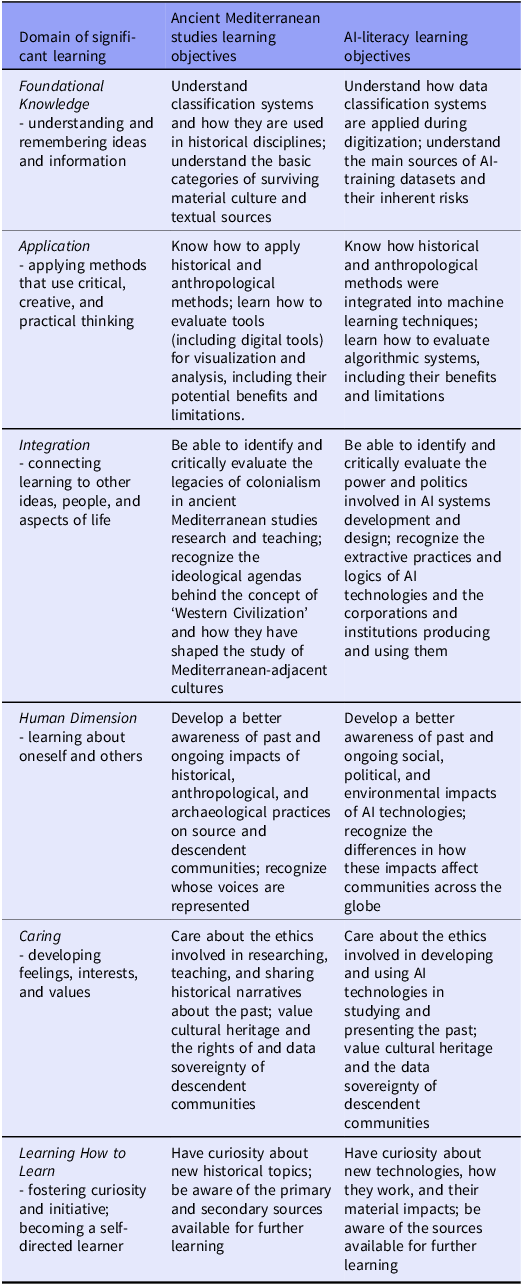
These capacities are particularly important since the development of generative AI, as the origins and authenticity of information are increasingly less transparent. As outlined in the UNESCO AI literacy framework, ‘the pre-condition for responsible use consists in students’ abilities to detect the trustworthiness and proportionality of AI tools’ (UNESCO 2024, 14). This analytical capacity, known as ‘evaluative judgment’ (Bearman et al. Reference Bearman, Tai, Dawson, Boud and Ajjawi2024), aligns very closely with core AMS learning, particularly source criticism and provenance studies skills. AI technologies are also connected to other core aspects of AMS learning, such as classification and taxonomy, social theory and behavioural analysis, and philology and linguistics. In alignment with these subjects, three AI literacies are proposed here for integration into AMS teaching (particularly when AI tools and outputs are employed): the ability to identify and analyse the impact of taxonomic frameworks and data training inputs on algorithmic outputs; to understand the development of computational models and algorithmic reasoning and their applications; and to critically evaluate the ethical and environmental impacts of algorithmic reasoning and AI technologies. These literacies are translated into learning objectives according to the Taxonomy of Significant Learning, which is a learner-centred constructivist paradigm incorporating both cognitive and affective learning objectives (Fink Reference Fink2003). The AI-focused learning objectives are designed to scaffold onto learning objectives that are common in AMS teaching (see Table 1), while fostering capacity building in alignment with all three of the UNESCO framework pillars (knowledge, skill, and values).
Disciplinary and AI-Centred Learning Objectives Designed According to the Taxonomy of Significant Learning (Adapted from Fink Reference Fink2003, 30–35)

Table 1. Long description
Table with two columns: Ancient Mediterranean studies learning objectives and AI-literacy learning objectives. Each row represents a different domain of significant learning: Foundational Knowledge, Application, Integration, Human Dimension, Caring, and Learning How to Learn. Each cell describes specific learning objectives within these domains.
Literacy 1: encoding the world – data and classification
As a legacy of the European enlightenment, the drive to generate encyclopedic knowledge about all aspects of the known world, organized into relational and hierarchical taxonomies, has served to frame the ontologies and epistemologies of AMS-related disciplines. Whether it is anthropological taxonomies of early hominins, Winckleman’s art historical system of sculptural development, archaeological ceramic typologies, or epigraphic morphologies, classification systems were ‘designed to put order into disordered evidence’ (Renfrew and Bahn Reference Renfrew and Bahn2018, 119). While teaching the contents of such systems, it is also requisite that students learn the limitations of classification as an analytical tool, particularly the risk of allowing classifications to become deterministic, ‘rather than using them merely as one means of giving shape to the evidence’ (Renfrew and Bahn Reference Renfrew and Bahn2018, 119). Furthermore, classification reflects the interdependence of power and knowledge as famously highlighted by Michel Foucault: ‘the exercise of power perpetually creates knowledge and, conversely, knowledge constantly induces effects of power’ (Foucault Reference Foucault and Gordon1980, 52). This is especially true in AMS-related fields like archaeology, as a result of its ‘strongly colonial history’ and practices that are ‘grounded in Western ways of categorizing, knowing, and interpreting the world’ (Atalay Reference Atalay2006, 280).
There are many examples from AMS-related fields that reflect colonial power through the capacity to categorize and interpret. One of the most egregious is the work of craniologists like Samuel G. Morton, who employed Eurocentric classification systems as part of his racial-science research. His classification system, which incorporated the Hellenistic Apollo Belvedere sculpture as a model (Morton et al. Reference Morton, Nott and Gliddon1855, 458–459, figs. 339–352), exemplifies the coloniality and classification practices critiqued by Atalay. The extensive harms caused by Morton’s research and collecting practices have now moved from analogue to digital through the development of facial recognition and surveillance applications within AI (Adams Reference Adams2025, 46–53; Crawford Reference Crawford2021, 123–149). Craniometric measurements, in combination with affect recognition (based on the DARPA funded ethnographic research of EkmanFootnote 7 ), have placed anthropological methods within the very foundations of computer vision AI systems, embedding the biases of early anthropological practices.
Further bias is integrated during data collection. AI systems are predicated on scaling data and compute (effectively processing power; Hao Reference Hao2025, 59–61, 115–138). To achieve the scale necessary for deep learning, companies like OpenAI have opted to prioritize quantity over quality, abandoning data curation in favour of using larger and heavily polluted datasets (e.g., Common Crawl; Bender et al. Reference Bender, Gebru, McMillan-Major and Shmitchell2021, 613–614; Hao Reference Hao2025, 135–137). System outputs are then refined through ‘reinforcement learning from human feedback’ (RLHF) workers tasked with tagging records and flagging harmful content (see discussion below). Bias is again inserted through the tagging process, both through the personal perspectives of the tagger as well as the classification lexicon (e.g., including categories for ‘doctor’ and ‘female doctor’ but not ‘male doctor’). The most influential of which, the WordNet’s lexical database used in the development of ImageNet, is problematic in its restrictive binary organization of data and inclusion of harmful and racial stereotypes (Crawford Reference Crawford2021, 108–109, 136–144; D’Ignazio and Klein Reference D’Ignazio and Klein2020, 18). The large-scale scraping of available – and often copyrightedFootnote 8 – digital data has also injected sample biases into AI training, as ‘nonwestern people, experiences, and languages are barely represented in the datasets on which AI technologies are trained and from which AI systems interpret the world they encounter’ (Adams Reference Adams2025, p.10). Writing about web algorithms, critical data scholar Safiya U. Noble has advocated for the use of a Black feminist lens that ‘[contextualizes] information as a form of representation, or cultural production, rather than as seemingly neutral and benign data’ (Noble Reference Noble2018, 108).
AI-automated data classification systems are employed in AMS-focused research for various tasks, such as cuneiform transliteration and translation, petrographic analysis, and GIS mapping (e.g., Bogacz and Mara Reference Bogacz and Mara2022; Capriotti et al. Reference Capriotti, Devoto, Scardapane, Mignardi and Medeghini2025; Orengo et al. Reference Orengo, Conesa, Garcia-Molsosa, Lobo, Green, Madella and Petrie2020). Within the classroom, educators can address the uses and limitations of automated classification methods either during direct practical training, or by drawing on existing publications as case studies, serving both AMS and AI learning objectives. Examples relating to AI technologies can demonstrate key forms of data bias in research, such as researcher biases in data selection and categorization and sampling bias in the use of digital data that reflects only a small subset of the overall population. For example, how might the impact of ceramic assemblage training data – often drawn from existing collections in which whole vessels and decorated wares predominate – affect the training of automated pottery classification program (such as the ArchAIDE App)? By fostering the capacity to identify and analyse data classification systems, we can prepare learners to consider how these frameworks, and the human bias encoded in them, shape algorithmic system outputs.
Literacy 2: mimicking human thought – machine learning and algorithmic reasoning
Most large corporate AI systems like OpenAI’s ChatGPT are LLMs, which are natural language processing neural networks that use pattern recognition and probability models to determine the likelihood of words or ‘strings’ occurring (Bender et al. Reference Bender, Gebru, McMillan-Major and Shmitchell2021; Bender and Hanna Reference Bender and Hanna2025, 23–28). In order to achieve the scale needed to pursue artificial general intelligence or AGI (machines that surpass human intelligence), these neural networks were transformed into deep learning systems by superimposing stacked and connected network layers (Hao Reference Hao2025, 97–99). In doing so, and in exponentially increasing the training data used while decreasing quality controls (Bender et al. Reference Bender, Gebru, McMillan-Major and Shmitchell2021), AI design moved from the realm of human oversight into a ‘black box’ in which no one – not even the system’s designers – truly know or can control what patterns the system ‘learns’ and how it will ‘behave’ (Hao Reference Hao2025, 107; see also Benjamin Reference Benjamin2019).
Despite the opacity of machine learning mechanics, the data collection and curation needed to train AI systems are guided by human priorities and choices. These choices determine how data are organized and classified (as discussed above), which data are deemed relevant to a particular topic, and how those data are weighted in algorithmic systems and automated decisions. These choices are then encoded in the system parameters, giving ‘concrete form to human values’ (Sadowski Reference Sadowski2025, 4). As emphasized by critical AI scholar Kate Crawford, AI ‘is not an objective, universal, or neutral computational technique’, but a body of systems ‘designed to discriminate, to amplify hierarchies, and to encode narrow classifications’ (Reference Crawford2021, 211). Racial, economic, and other social biases in automated decision-making – what critical information studies scholar Safiya U. Noble has termed ‘technological redlining’ (Reference Noble2018, 1) – have been documented in all spheres of society, including social programs like housing, child protective services, and healthcare, financial lending and employment, surveillance, policing, and sentencing, and border and immigration control (see below). Sociologist and social justice in technology scholar Ruha Benjamin has termed this system the ‘New Jim Code’ (Benjamin Reference Benjamin2019).
As with the earlier work of Morton and Ekman, anthropologists are among those developing algorithmic logics for AI applications. PredPol (now Geolitica), the predictive policing program developed in 2010 by a collaboration involving UCLA anthropology professor Jeff Brantingham, is a particularly relevant example. Previous crime data from Los Angeles was used to train an AI system to ‘[identify] the times and locations where specific crimes are most likely to occur’, and to automatically increase patrols in those locations (PredPol, About). By basing patrolling priorities on past arrest data, specific ‘high risk’ communities – communities that had been previously subject to excessive surveillance – were targeted for further policing. The system was therefore self-perpetuating, reflecting a profound failure to recognize that the use of crime statistics from a department with a notoriously problematic history of policing to justify further surveillance would lead to bias amplification. PredPol also demonstrates the sinister effects of AI ‘tech-washing’, by which the perceived neutrality and objectivity of data systems serve to occlude the very human agendas behind their use. As noted by data scientist Cathy O’Neil, PredPol ‘empowers police departments to zero in on the poor’ by using ‘cutting-edge technology (powered by Big Data)’ to justify their actions – the result being ‘that we criminalize poverty, believing all the while that our tools are not only scientific but fair’ (Reference O’Neil2016, 91).
Examples like PredPol, which failed to account for the impacts of bias in algorithmic design, raise important considerations for even seemingly straightforward LLM use in AMS research. The natural language processing structure of LLMs has made them particularly well-suited to machine translation, and numerous projects focused on the decipherment, reconstruction, and parts-of-speech (POS) tagging of texts, papyri, and inscriptions have employed them (e.g., Bamman and Burns Reference Bamman and Burns2020; Bogacz and Mara Reference Bogacz and Mara2022). However, using these systems requires that researchers and students understand the ‘stochastic parrot’ nature of LLMs, which work by ‘haphazardly stitching together sequences of linguistic forms it has observed in its vast training data, according to probabilistic information about how they combine, but without any reference to meaning’ (Bender et al. Reference Bender, Gebru, McMillan-Major and Shmitchell2021, 616–617). Within AMS research, this means that primary text translation will mimic the language and perspectives of the previous translations it has ‘read’. For example, the Latin BERT model, trained on sources from antiquity to the twenty-first century, cannot account for nuanced language shifts over time. Word interpretation will also skew towards the dominant voices for both authorship and translation. For example, an LLM trained on an open access antiquity-specific dataset will be prone to sounding like an early-twentieth-century translation of Cicero or Livy. By mimicking patterns without meaning, an LLM translation is like a stochastic parrot or, to Plato, an ϵἴδωλον (Republic 10.598b).
The underlying goals in algorithmic design – in which positive responses are prioritized – have also made AI systems prone to ‘hallucinations’ (a deliberately anthropomorphizing term; Bender and Hanna Reference Bender and Hanna2025, 167). Prioritizing efficiency and cost minimization in systems largely trained on polluted data has led to common output inaccuracies, from false statements and misinformation to invented content (e.g., fake publications or case law; Hao Reference Hao2025, 113–114). The frequency of hallucinations in generative AI outputs, as well as the opacity of information sourcing, has heightened the importance of source criticism and provenance skills, which are core competencies in AMS teaching. Existing algorithmic tools like the Latin BERT model or Stanford’s ORBIS network model of Roman transportation system can be integrated into classroom activities that task students with critically assessing the algorithmic design and data selection choices and the resulting influence on system outputs (see, for example, Ratzan Reference Ratzan and Heath2020 for an excellent classroom activity to target information literacy using ORBIS). As automated algorithmic systems and generative AI platforms are being broadly adopted by governments, universities, and students themselves, AI literacies can help learners to transparently evaluate systems that are designed for opacity.
Literacy 3: artificial intelligences and their material consequences
When considering the impacts of AI and automated algorithmic technologies – what O’Neil has called ‘weapons of math destruction’ – it is important to consider all stages of the development and production lifecycle. As Crawford observes, to understand the political machinations of corporate AI systems, we need to ‘ask what is being optimized, and for whom, and who gets to decide’ (Reference Crawford2021, 9). As shown repeatedly by those studying the impacts of AI development, ‘the dividing line between the winners and the losers of AI is gendered, racialized, and locational’ (Adams Reference Adams2025, 125).
The extractive and colonial logics of corporate AI technologies and economies have led many to view the growth of automated industries as a new form of imperialism (Hao Reference Hao2025; Adams Reference Adams2025). In the Empires of AI, Karen Hao outlines the ways that AI empires ‘project tantalizing ideas of modernity and posture aggressively about the need to defeat other empires to provide cover for, and to fuel, invasions of privacy, theft, and the cataclysmic automation of large swaths of meaningful economic opportunities’ (Reference Hao2025, 17). The AI industry has grown rapidly to the point that it ‘operates at a planetary scale, with a footprint in every corner of the globe’ (Adams Reference Adams2025, 3). When it comes to the harmful impacts of AI development, they are overwhelmingly and disproportionately affecting marginalized groups within imperial cores and those in the majority world (Gebru and Torres Reference Gebru and Torres2024, 17; Bender and Hanna Reference Bender and Hanna2025, 156–161). The well-documented environmental impacts include the vast consumption of water resources by data centres during machine learning training and consumer use as well as the extensive environmental pollution generated during mining, technology manufacturing, and electronics disposal (Bender et al. Reference Bender, Gebru, McMillan-Major and Shmitchell2021, 612–613; Crawford Reference Crawford2021, 23–51; Adams Reference Adams2025, 80–82). Even before the development and release of ChatGPT and related generative AI programs, water scarcity represented a major driver of global migration (Adams Reference Adams2025, 179); the exponential rise in water consumption since their widespread availability is a global concern.
AI technologies are also built on extractive and exploitative labour practices. As datasets increased, AI became dependent on manual auditing techniques (e.g., reinforcement learning from human feedback or RLHF; Hao Reference Hao2025, 189–223). RLHF auditing requires the manual review of visual and textual content for inaccuracies and harmful material. To meet these needs, a massive gig economy of ‘wide-scale labor exploitation’ arose (Hao Reference Hao2025, 194), filtered through crowdworking platforms like Amazon’s Mechanical Turk, Sama, and Scale AI’s Remotasks. Workers were solicited from places in the majority world, especially those experiencing economic hardship, and paid a few dollars an hour to review exceptionally damaging content featuring violence, bestiality, and sexual exploitation (including of children; Crawford Reference Crawford2021, 63–87; Bender and Hanna Reference Bender and Hanna2025, 41–66; Adams Reference Adams2025, 100–122; Hao Reference Hao2025, 189–223; Sadowski Reference Sadowski2025, 104–129).Footnote 9 Many companies boasting AI-driven applications also employ underpaid workers to maintain a façade of automation, in a practice writer Astra Taylor has termed ‘fauxtomation’ (Figure 3). Fauxtomation helps to drive hype and corporate valuation, which all serves the ‘AI Con’ (Bender and Hanna Reference Bender and Hanna2025).
Sketch demonstrating ‘Fauxtomation’, in which corporations project a faulty image of AI automation for systems that are actually reliant on underpaid human labour (image credit: Jono Hey/Sketchplanations, CC BY-NC 4.0).

Algorithmic discrimination, environmental degradation, and labour exploitation are among the most well-documented human costs. It is also becoming clear that, just as humans have shaped the design of AI systems, AI systems are beginning to shape human behaviour. A recent MIT study has demonstrated the cognitive impacts of AI on learning, showing that learners who employ generative AI tools like ChatGPT when writing essays face ‘a likely decrease in learning skills’ (Kosmyna et al. Reference Kosmyna, Hauptmann, Yuan, Situ, Liao, Beresnitzky, Braunstein and Maes2025, 2). The study found that ‘brain connectivity systematically scaled down with the amount of external support’, with weaker neural connectivity documented on electroencephalography imaging among those participants using LLM tools (Kosmyna et al. Reference Kosmyna, Hauptmann, Yuan, Situ, Liao, Beresnitzky, Braunstein and Maes2025). While some positive impacts in initial skills acquisition were cited (Kosmyna et al. Reference Kosmyna, Hauptmann, Yuan, Situ, Liao, Beresnitzky, Braunstein and Maes2025, 139), sharp declines in memory and content ownership were documented with LLM use (137–138), as were increasing homogeneity in essay topics (122–135), suggesting that the use of LLMs ‘not only shaped neural dynamics but also steered participants toward particular concepts and linguistic forms’ (132). Despite these potential declines in cognitive engagement and communication development, the American History Association released their ‘Guiding Principles for Artificial Intelligence in History Education’ only two months later (August 5, 2025), which included an AI policy template for educators to adopt in which AI tools were deemed acceptable for performing an extensive array of historical work, such as summarizing literature, producing bibliographies and historical reproductions, correcting grammar, and even adding essay content.
Alarmingly, far worse social outcomes from generative-AI use are emerging. Most sobering is the growing number of documented cases of so-called AI psychosis, which have been attributed to LLMs tendency to ‘mirror, validate or amplify delusional or grandiose content, particularly in users already vulnerable to psychosis’ (Morrin et al. Reference Morrin, Nicholls, Levin, Yiend, Iyengar, DelGuidice, Bhattacharya, Tognin, MacCabe, Twumasi, Alderson-Day and Pollak2025). As noted by psychologists, generative AI chatbots present risks to individuals’ capacity to ‘reality monitor’ (e.g., to distinguish true from false), which along with the copious misinformation being disseminated in chatbot outputs, serves to ‘(threaten) our trust in each other and in our institutions’ (Garry et al. Reference Garry, Henkel and Foster2024). Following the deaths of two teenage boys in 2025, wrongful death lawsuits were filed in California and Florida against OpenAI and the makers of Character AI, alleging that the platforms were found to have validated their thoughts of self-harm.Footnote 10 These public health outcomes are catastrophic and highlight the need for enhanced AI governance.
Within the classroom, discussions around – and especially employment of – emergent technologies, including AI tools and outputs, should be guided by humanist perspectives that explicitly consider and address the past and ongoing social, political, and environmental impacts of these tools and how these impacts have differentially affected communities across the globe. This is especially important in AMS learning focused on cultural heritage, in which digitization, 3D printing, virtual reality, and now AI have been taken up with a rapidity that has outpaced the creation of clear ethical guidelines, creating loopholes through which organizations can ‘disregard basic ethical considerations in their recreation of historical objects and sites’ (as in the case of the 3D recreation of the Palmyran arch; Khunti Reference Khunti2018, 9). Introduction of digital and digitizing tools should be grounded in considerations of both material and digital concerns, including issues surrounding access and digital divides, data sovereignty, and the potential risks of engaging in digital colonialism.
Towards ethical digital futures
While many corporate AI systems have been designed to surveil and universalize ‘western’ values (see esp. Benjamin Reference Benjamin2019), others are pursuing decolonial forms of AI technology and governance (Adams Reference Adams2025, 155–166, 175–177; Mohamed et al. Reference Mohamed, Png and Isaac2020). For many researchers and organizations, within and particularly outside of the US, this involves documenting AI errors and advocating for AI governance to protect against social and environmental harms (e.g., O’Neil Reference O’Neil2016; Eubanks Reference Eubanks2018; Noble Reference Noble2018; Crawford Reference Crawford2021; Adams Reference Adams2025; Bender and Hanna Reference Bender and Hanna2025, 163–198). Organizations like The Human Error Project, AlgorithmWatch, and the Distributed AI Research Institute (DAIR), have been active in documenting AI errors in profiling technologies and social systems, maintaining algorithm auditing databases, and advocating greater regulation around AI development and use. These projects share core missions of working towards ‘eliminating AI harms’, while also ‘accelerating [the] imagination and creation of new technologies and tools addressing the needs of our communities’ (DAIR, ‘Our Work’).
DAIR, co-founded by Timnit Gebru (former technical co-lead of the Ethical Artificial Intelligence Team at Google), engages in humanity-focused AI solutions that seek to ‘mitigate, disrupt, eliminate, and slow down the harms caused by AI technology, and to create spaces that allow us to imagine otherwise’ (DAIR, ‘Our Work’). This push towards imagined alternatives reflects an important anthropological critique of techno-capitalist and techno-military systems, which have ‘stalled innovation and creativity’ and ‘prevented us from imagining the many radical ways in which technological change could transform our society’ (Barassi Reference Barassi2021, 250). Here, Veronica Barassi is drawing on her mentor, David Graeber, who – like Sadowski after him – argued that neither capitalism nor emergent technologies are natural or predetermined (Graeber Reference Graeber2015, 25; Sadowski Reference Sadowski2025, 207–211).
This view challenges the techno-determinism underlying most AI messaging, which positions it as inevitable, inflexible, and irresistible (Sadowski Reference Sadowski2025, p.197). AI corporations are dependent on the widespread acceptance of this inevitability. It underwrites their justification of widespread intellectual property theft, their extractive labour practices, and their techno-nationalist defence of invasive privacy violations – all under the guise of pursuing ‘human good’. In practice, techno-determinism serves the generation of hype and, therefore, astronomical project valuations (Bender and Hanna Reference Bender and Hanna2025, 8–20; Sadowski Reference Sadowski2025, 194–200). This is all part of the ‘AI Con’, by which ‘a few major well-placed players are poised to accumulate significant wealth by extracting value from other people’s creative work, personal data, or labor, and replacing quality services with artificial facsimiles’ (Bender and Hanna Reference Bender and Hanna2025, 4).
The pursuit of alternative AI futures is a crucial part of countering the techno-deterministic messaging of Silicon Valley and other centres of AI development. To achieve alternative and decolonial AI futures, Mohamed et al. (Reference Mohamed, Png and Isaac2020) advocate that we ‘strengthen the social contract through ethical foresight and the multiplicity of intellectual perspectives available to us’ in order to produce AI technologies that ‘enable greater well-being’ and ‘justice for all’ (659). These goals are manifest in the decolonial AI work of collectives like DAIR, as well as numerous other small-scale initiatives tackling food insecurity (e.g., in Tanzania) and addressing healthcare inequities by expanding care access (e.g., in Nigeria, Pakistan, India, and Uganda; Adams Reference Adams2025, 175–177).
AMS students and scholars can play an important role in achieving alternative AI futures. We can bring multidisciplinary and diachronic perspectives to the pressing political, social, and environmental challenges being wrought by corporate AI producers. By incorporating critical AI literacy into our courses, we will not only prepare our students to navigate the growing empires of AI but, perhaps, also situate them to ethically contribute to the design of the next generation of AI technologies. The technocapitalist ideologies and Eurocentric values embedded in many algorithmic systems, the resulting bias amplification in these systems’ outputs, and the broad social and environmental impacts of AI technologies are critical global issues. Understanding the complex theoretical, methodological, and practical junctions between AMS-related fields and AI technologies requires that we acknowledge that historical and archaeological research and education are not ‘politically neutral’ endeavours (hooks Reference Hooks1994, 37; Hamilakis Reference Hamilakis2004). Similarly, AI systems are not neutral tools, and whatever our individual interest in and use of them may be, our engagement with corporate AI provides support, legitimization, and ultimately user training and data that enable the social and environmental harms characteristic of corporate AI. Engaging in critical assessment of the foundational structures and logics of AI systems and AI economies in our classrooms can prepare our students to understand and mitigate the extractive and harmful impacts of such systems on the study of the past and the formation of the future.
Acknowledgement
I would like to thank my WWU department colleagues and the anonymous peer reviewers, whose comments and suggestions for improvement greatly enhanced the final version of this article. All errors remain my own. A draft version of the article can be found on EdArXiv: https://doi.org/10.35542/osf.io/69w8z_v3.
Competing interests
The author declares no conflict of interest.




 Open access

