Introduction
Cochlear implantation has revolutionised the management of sensorineural hearing loss in the paediatric population. When paired with intensive auditory habilitation, cochlear implantation provides hearing adequate for the development of receptive and expressive language so that children with bilateral severe to profound sensorineural hearing loss have the ability to be educated in a mainstream environment.
Cochlear implants have an external component that receives and processes sound, as well as an internal component that stimulates the cochlear nerve, providing the recipient with sound perception.Reference Wilson, Zeng, Popper and Fay1 The surgical placement of the internal device is typically well tolerated and accomplished in a one-to two-hour procedure. The biocompatible internal device has a 15-year survival rate of 99 per cent, which is among the highest among medical implants.2,Reference Wilson3
Complications after cochlear implantation are rare, but an increased incidence of meningitis has been observed in children with cochlear implants in comparison with age-matched children from the general population.Reference Reefhuis, Honein, Whitney, Chamany, Mann and Biernath4–Reference Terry, Kelt and Jeyakumar8 Reefhuis et al. reported a greater than 30-fold increase in the risk of meningitis associated with cochlear implantation.Reference Reefhuis, Honein, Whitney, Chamany, Mann and Biernath4 Furthermore, children with inner ear malformations, who are often candidates for cochlear implants because of the severity of hearing loss, are at higher risk for bacterial meningitis.Reference Kahue, Sweeney, Carlson and Haynes9,Reference Mylanus and Rotteveel Leeuw10 Pathogens are believed to migrate along the implanted electrode from the middle ear into the inner ear which in turn communicates with cerebrospinal fluid.Reference Kahue, Sweeney, Carlson and Haynes9,Reference Mylanus and Rotteveel Leeuw10 The risk was even higher in patients who received specific cochlear implants with an associated electrode positioner.Reference Reefhuis, Honein, Whitney, Chamany, Mann and Biernath4,Reference Lalwani and Cohen5 These devices have since been recalled.
Meningitis itself is a common cause for sensorineural hearing loss, often requiring urgent cochlear implantation, and children with a previous history of meningitis are also at an increased risk of developing it again. Other risk factors include very young age, immune compromise and neural prostheses such as shunts.Reference Kahue, Sweeney, Carlson and Haynes9
In view of this increased risk of meningitis, a number of countries have established immunisation guidelines for patients with cochlear implants.Reference Kahue, Sweeney, Carlson and Haynes9,11 The New Zealand Immunisation advisory centre recommends Streptococcus pneumoniae, Haemophilus influenzae B and annual seasonal influenza vaccinations.12 There was no public funding for cochlear implant recipients in New Zealand before June 2008 for pneumococcal vaccines and before July 2015 for the influenza vaccine; however, vaccines could be obtained privately.
We recently reported a low vaccination rate amongst adult cochlear implant recipients in New Zealand.Reference Mitchell, Nakhid-Schuster and Neeff13 Those findings led to this investigation in children. While meningitis as a complication of cochlear implantation is rare, it has significant associated morbidity and mortality.Reference Cohen, Roland and Marrinan14 Disease prevention is therefore imperative.
Aim
The aim of this study was to investigate the vaccination compliance in children with cochlear implants according to the National Immunisation Guidelines and compare the immunisation rates before and after the addition of the pneumococcal conjugate vaccine onto the general funding list. We also wanted to compare the uptake rates before and after the introduction of publicly funded pneumococcal polysaccharide and seasonal influenzae vaccines for cochlear implant patients as a special population group. Additionally, the local rate of meningitis following cochlear implantation was reviewed to identify potential risk factors for developing meningitis in our population.
Study design
This was a retrospective review of data from the paediatric database of the Northern Cochlear Implant Programme, Auckland, New Zealand, and immunisation records of the National Immunisation Register.11 This study was approved by the Northern Cochlear Implant Programme research committee and met criteria for exemption from the Health and Disability Ethics Committee under the audit and related activity provision.
Materials and methods
Demographic information, date of surgery and indication for surgery were obtained from a de-identified database of cochlear implant recipients from the Northern Cochlear Implant Programme. All paediatric patients of the Northern Cochlear Implant Programme born after the introduction of the National Immunisation Register in January 2005 to October 2019 were identified. Events of meningitis were reviewed.
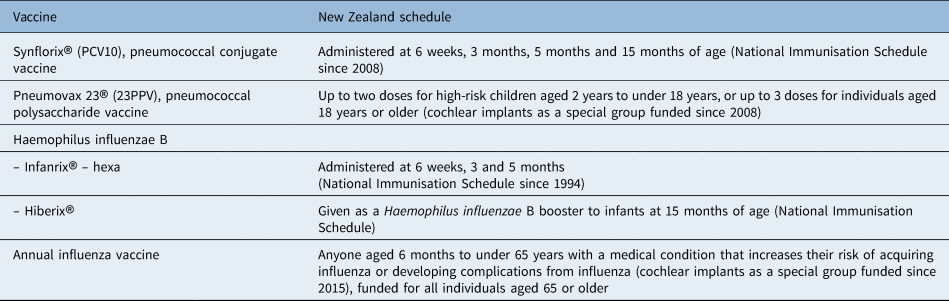
Vaccination rates pre- and post-introduction of vaccination funding were compared. Compliance with vaccination was determined by reviewing the number and type of vaccines administered as per schedule (Table 1). Results were compiled and calculated using Microsoft Excel® spreadsheet software.
The current recommended vaccination coverage for cochlear implant patients in New Zealand

Results
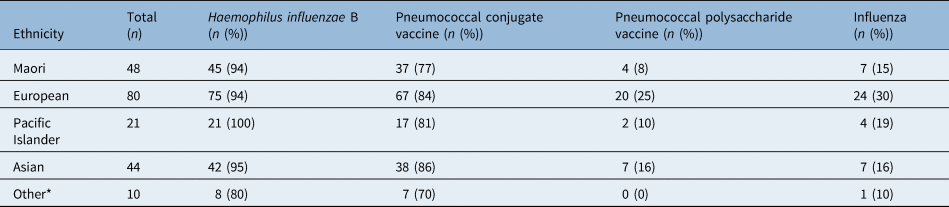
The Northern Cochlear Implant Programme paediatric database contained information on 266 children who underwent cochlear implantation before the age of 18 years; 63 of these children were born prior to the introduction of the National Immunisation register in January 2005. Therefore, a total of 203 cochlear implant recipients were included in the study. There were 108 (53.2 per cent) male patients and 95 (46.8 per cent) female patients. The mean age at the time of surgery was 8.1 years (range, 9 months to 15 years). Ethnicity data is displayed in Table 2 below.
Vaccination rates according to ethnicity

*Includes African, Latin American and Middle Eastern ethnicities
Vaccinations
A total of 191 (94.1 per cent) children were immunised against H Influenzae B; 4 children missed their booster (Hiberix®) at 15 months of age. Forty-three children (21.2 per cent) received the influenza vaccine, but 160 had no evidence of influenza immunisation. The pneumococcal conjugate vaccine was administered in 166 children (81.8 per cent); however, only 33 of 195 (16.9 per cent) eligible children (age greater than 2 years) received the pneumococcal polysaccharide vaccine. Only 20 out of 195 eligible children (10.3 per cent) received the pneumococcal conjugate, pneumococcal polysaccharide, Infanrix® hexa, Hiberex® and influenza vaccines. Three parents declined all vaccinations, and an additional 2 parents declined the H Influenzae B and pneumococcal conjugate vaccines at 15 months of age. A greater number of parents declined the yearly influenza vaccines. There were 2 incidences of meningitis among this population (n = 203) post-implantation.
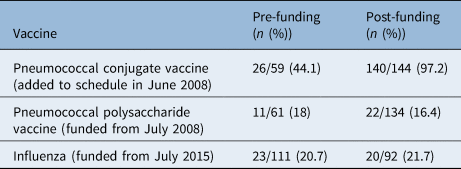
Table 3 shows a comparison between the vaccination coverage of children who had their first implant before and after the introduction of funded vaccines for cochlear implant recipients.
Vaccination compliance before and after the introduction of funded vaccines for cochlear implant recipients

Immunisation events can also be retrospectively added to the National Immunisation Register. Of the 63 patients born prior to the launch of the National Immunisation Register in January 2005, 15 (23.8 per cent) had a record of H influenzae vaccination, 17 had a record (26.9 per cent) for seasonal influenza, 13 (19.7 per cent) had a record for pneumococcal conjugate vaccine and 7 (11.1 per cent) for pneumococcal polysaccharide vaccine.
Discussion
The New Zealand National Immunisation Register provides a comprehensive record where children are registered at birth. Less than 1 per cent of parents and guardians choose to opt out of this process. The National Immunisation Register is updated directly by recognised immunisation providers following an immunisation event.15
H Influenzae B vaccination has been part of the National Immunisation Schedule since 1994, and the pneumococcal conjugate vaccination was added to the schedule in June 2008. It is of no surprise that once the pneumococcal conjugate vaccination became fully funded, the vaccination rate improved markedly from 44.1 per cent before June 2008 to 97.2 per cent after June 2008.
The overall immunisation coverage was low with only 10.3 per cent receiving a complete schedule of H Influenzae, S Pneumoniae and influenza vaccine.
There are limited studies on vaccination compliance in cochlear implant patients. Piotrowska et al. observed a 49.2 per cent streptococcal pneumonia vaccination rate despite the vaccine being mandatory and publicly funded for cochlear implant patients in Poland.Reference Piotrowska, Paradowska-Stankiewicz and Skarzynski16 A recent Spanish study showed that only 5.71 per cent of the cochlear implant patients had 100 per cent compliance to their vaccination schedule. Their paediatric population had pneumococcal conjugate and H influenzae B vaccine compliance rates of more than 90 per cent.Reference Fernandez-Prada, Madronal-Menendez, Martinez-Ortega, Ramos-Martin, Fernandez-Noval and Huerta-Gonzalez17 This is comparable with our findings following the introduction of additional funding of vaccinations for cochlear implant recipients.
In the USA, Carpenter et al. found improvement in pneumococcus vaccination rates ranging from 49 per cent to 99 per cent across various population groups following various methods of information dissemination and reminders.Reference Carpenter, Limb, Francis, Gottschalk and Niparko18 Volsky et al. observed a 70 per cent pneumococcal vaccination compliance. The most important factor appeared to be encouraging patients to vaccinate prior to surgery.Reference Volsky, Ballard and Moody-Antonio19
The majority of meningitis cases following cochlear implantation reported in the literature were related to S pneumoniae and H influenzae type B, two of the most common causative agents in acute bacterial otitis media. Acute otitis media is the most likely cause for meningitis beyond the first 30 days following cochlear implantation because of bacterial spread along the pathway of the electrode.Reference Rubin and Papsin20 Seasonal influenza vaccine has been shown to reduce the incidence of acute otitis media.Reference Clements, Langdon, Bland and Walter21,Reference Heikkinen, Ruuskanen, Waris, Ziegler, Arola and Halonen22 Pneumococcal infections predominantly affect children younger than 2 years of age and adults above the age of 60 years.Reference Breiman, Spika, Navarro, Darden and Darby23 These two groups account for the overwhelming majority of cochlear implant recipients.
Our first meningitis case occurred within three weeks of cochlear implant surgery, and it was secondary to a non-typeable H influenzae infection. This is suggestive of a surgical or patient-related factor as opposed to acute otitis media. The patient also had an inner ear malformation. Unfortunately, an effective vaccine against non-typeable H influenzae is not currently available. Our second patient required a cochlear implant because of bilateral profound sensorineural hearing loss following recurrent streptococcus pneumonia meningitis. This patient had an associated inner ear dysplasia.
Cost is a well-recognised barrier to access to healthcare. Free vaccination is provided to New Zealand residents according to the National Immunisation Schedule and, as expected, our study showed a clear improvement in compliance with pneumococcal conjugate vaccination following additional funding for cochlear implant patients as a special group and its subsequent addition to the National Immunisation Schedule. However, we did not observe a similar increase in the uptake of yearly influenza and pneumococcal polysaccharide vaccination. As such, this raises the possibility of a lack of awareness of vaccination guidelines for cochlear implant recipients. The findings of this study are different to those observed in our adult cohort12 as the majority of adult cochlear implant recipients received their childhood vaccinations before H influenzae B and pneumococcal conjugate vaccination were added to the National Immunisation Schedule. Compared to adults, our paediatric patients had lower coverage with vaccines usually indicated for adults over the age of 65 years (seasonal influenza and pneumococcal polysaccharide vaccination). Individuals under the special group provision, including cochlear implant recipients, have not been extensively studied for their compliance with recommended vaccines. The overall influenza vaccine uptake for adults older than 65 years was only 56 per cent in 2018 despite being eligible for funded vaccines.Reference Nowland, Murfitt and Turner24 A survey of 101 pregnant women carried out at Wellington Hospital, New Zealand, showed a 76 per cent influenza vaccine uptake rate. The primary reason for vaccination was neonatal protection. The most common reasons given for non-compliance were not receiving information about the vaccine or not receiving the vaccine.Reference Andre, Gavrilov, Graham, Scheck, Chandler and Hunter25
The literature suggests that a lack of knowledge on influenza disease and the vaccine represents the biggest barrier to vaccination. This revolves around concerns about vaccine safety, doubts about its effectiveness and the misconception that influenza is not a serious condition.Reference Naleway, Henkle, Ball, Bozeman, Gaglani and Kennedy26,Reference Kadi, Atif, Brenet, Izoard and Astagneau27 Seasonal influenza can cause severe illness and even death in high-risk individuals. Unfortunately, it is often confused with the common cold despite being responsible for 490 600 hospitalisations and 34 200 deaths in the USA during the 2018–2019 season.28
The use of reminders and recall systems has been associated with an improvement in influenza vaccination rates.Reference Cooper and Walton-Moss29 In addition, some cochlear implant programmes have recruited an infectious disease vaccine specialist to help address their low compliance, and this has resulted in a substantial improvement in compliance.Reference Jin, Tellez, Chia, Lu, Chadha and Pauwels30 These are options that we are considering.
An underestimation of the true impact of funded vaccines is a potential limitation of this study because we excluded children born before the National Immunisation Register was introduced in 2005. Most of these children were not included in the data available on H influenzae B coverage which is usually administered in the first 15 months of life. H influenzae B vaccination has been part of the National Immunisation Schedule since 1994; therefore, these children were probably vaccinated before 2005, but this was not recorded. On the other hand, funding for pneumococcus and influenza vaccination was initiated in 2008 and 2015, respectively, and some are missing out on these vaccines.
• Children with cochlear implants have a higher incidence of meningitis compared with the general population
• Risk factors include inner ear malformations and very young age
• There is an unsatisfactory vaccination rate in these high-risk patients
• There is a positive impact of adding recommended vaccines to the publicly funded national immunisation schedule
• There are complexities in improving compliance to fully funded vaccines that are not part of the national immunisation schedule
Conclusion
In conclusion, despite established vaccination guidelines, the Northern Cochlear Implant Programme paediatric vaccination rates among children who are cochlear implant recipients were lower than expected. Work needs to be done to address this. A letter from the Northern Cochlear Implant Programme has been drafted to be sent to general practitioners regarding the availability and requirement of these vaccines for children whose immunisations are not up to date. Furthermore, we also plan to add vaccination coverage to our database at the Northern Cochlear Implant Programme and implement a formal process to check and ensure that the appropriate vaccines have been administered. We will also recommend and document vaccination before cochlear implant surgery on our patients.
Acknowledgement
We would like to acknowledge the assistance of the Hearing House, Auckland, New Zealand. This study would not have been possible without their support.
Competing interests
None declared