Healthcare-associated infections (HAIs) are acquired while receiving medical treatment in a healthcare facility. 1 Patients suffering from HAIs can encounter prolonged lengths of stay (LOS), a decline in their quality of life, or in the worst case, death.Reference Klevens, Edwards and Richards 2 According to Marchetti et al,Reference Marchetti and Rossiter 3 HAIs impose both clinical and economic burdens on the healthcare system and are some of the most devastating and costly illnesses worldwide. Among Southeast Asian countries between 2000 and 2012, the pooled prevalence of HAI was reported to be 9.0% (95% confidence interval [CI], 7.2%–10.8%) with an incidence density of 20 cases per 1,000 intensive care unit (ICU) days.Reference Ling, Apisarnthanarak and Madriaga 4 The most common types of HAIs include hospital-acquired pneumonia (HAP), ventilator-associated pneumonia (VAP), surgical site infection (SSI), catheter-associated urinary tract infection (CAUTI), and central line-associated bloodstream infection (CLABSI).Reference Magill, Edwards and Bamberg 5
In low- and middle-income countries, the emergence of MDROs is a major public health concern.Reference Laxminarayan, Duse and Wattal 6 , 7 The primary contributors to multidrug-resistant (MDR) bacterial infections in developing countries are methicillin-resistant Staphylococcus aureus (MRSA), vancomycin-resistant enterococci (VRE), extended-spectrum β-lactamase (ESBL)–producing organisms, MDR A. baumannii (MDR-AB), MDR Pseudomonas aeruginosa (MDR-PsA), and MDR Klebsiella pneumoniae (MDR-KP).Reference Lim, Takahashi and Hongsuwan 8
Multidrug-resistant healthcare-associated infections (MDR-HAIs) are emerging and spreading globally, particularly among patients admitted to ICUs.Reference Kollef and Fraser 9 Lim et alReference Lim, Takahashi and Hongsuwan 8 estimated that 43% of deaths associated with HAIs in the ICU were due to MDROs. Although a recent systematic review on the burden of HAI in developing countries was published,Reference Allegranzi, Bagheri Nejad and Combescure 10 no comprehensive reviews of antimicrobial resistance patterns in Southeast Asia have focused primarily on MDRO. Therefore, we performed a systematic review of the cumulative incidence and prevalence of MDR-HAI among ICU patients in Southeast Asia. We also sought to clarify the local distribution of different categories of MDROs. We evaluated the case fatality rate, LOS, and healthcare cost of patients colonized by or infected with MDROs and compared them to control groups.
METHODS
Study Design
This systematic review was performed and reported in accordance with the Preferred Reporting Items for Systematic Reviews and Meta-Analyses (PRISMA) guidelines.Reference Liberati, Altman and Tetzlaff 11
Search Strategy and Study Selection
We conducted a comprehensive literature search in PubMed, EMBASE, CINAHL, EconLit, and the Cochrane Library databases from their inception through September 30, 2016, using the following search strings: (1) “Acinetobacter baumannii” or “Pseudomonas aeruginosa” or “Escherichia coli” or “Klebsiella pneumoniae” or “Enterobacteriaceae” or “Staphylococc*” or “Enterococc*” or “microorganism*” or “bacteria”; (2) “extended-spectrum beta-lactamase” or “multidrug-resistant” or “extensively drug-resistant” or “pandrug-resistant” or “carbapenem-resistant” or “colistin-resistant” or “polymyxin-resistant” or “methicillin-resistant” or “vancomycin-resistant”; (3) “intensive care unit” or “ICU” or “critically ill”; (4) “healthcare-associated” or “hospital-acquired” or “nosocomial” or “device-associated” or “central line-associated” or “ventilator-associated” or “catheter-associated”; (5) “infection*” or “bloodstream infection*” or “bacteraemia” or “bacteremia” or “septicaemia” or “septicemia” or “pneumonia” or “urinary tract infection*” or “surgical site infection*” or “wound infection*”; (6) “Burma” or “Brunei” or “Cambodia” or “East Timor” or “Indonesia” or “Laos” or “Malaysia” or “Myanmar” or “Philippines” or “Singapore” or “Thailand” or “Vietnam.” These sets of terms were also combined using AND. We screened the reference lists of all included studies and relevant systematic reviews to identify additional eligible studies. A detailed search strategy is provided in eTable 1.1 of the online supplementary material.
Inclusion Criteria
To be eligible for inclusion, studies fulfilled the following criteria: (1) randomized controlled trials, cohort studies, before-and-after studies, or interrupted time series; (2) related to any type of MDRO (as defined in the Outcomes and Definitions section); (3) studied ICU patients; (4) conducted in Southeast Asian countries; (5) reported any of the following outcomes: incidence, prevalence, mortality, LOS, and cost attributed to hospitalization. Limits were set to include studies published in English. Animal studies, reviews, editorials, letters and commentaries, and studies reporting other outcomes were excluded from this systematic review.
Study Selection and Data Extraction
Three independent investigators (P.P., D.K., and S.N.) screened titles and abstracts of retrieved references for potentially relevant studies. Full-text papers of the studies that met the eligibility criteria in the first stage were further assessed against the inclusion criteria. Any discrepancies were resolved by discussion with the other investigators (N.T., K.K., A.S., A.P., and N.C.) until consensus was reached. From each of the included studies, the following data were extracted: name of the first author, year and country of publication, study design, study duration, study population characteristics (including sex, age, caused organism, type of resistance, type of HAI, type of ICU), criteria used for the diagnosis of MDR, and outcomes of interest.
Outcomes and Definitions
Primary outcomes were cumulative incidence and prevalence. Cumulative incidence was defined as the number of new MDR cases per 100 patients admitted to an ICU over a defined period. Prevalence was defined as the number of MDRO cases per 100 patients infected with organism regardless of drug resistance. Secondary outcomes were mortality, LOS, and cost attributed to hospitalization. We defined MDR as acquired nonsusceptibility to at least 1 agent in ≥3 antimicrobial categories. We defined extensively drug resistant (XDR) as nonsusceptibility to at least 1 agent in all but ≤2 antimicrobial categories. We defined carbapenem resistance as nonsusceptibility to at least 1 of 3 carbapenem antibiotics tested: imipenem, meropenem, and doripenem. We defined pan-drug resistant (PDR) as nonsusceptibility to all agents in all antimicrobial categories.Reference Magiorakos, Srinivasan and Carey 12
Quality Assessment
Study quality was assessed using the Strengthening the Reporting of Observational Studies in Epidemiology (STROBE) statement.Reference von Elm, Altman and Egger 13 Two investigators (A.S. and N.T.) independently assessed the quality of the studies. Differences in assessment were resolved by consensus. Included studies were categorized into 3 quality groups: high quality (fulfilled >80% of STROBE criteria), moderate quality (fulfilled 50%–80% of STROBE criteria), and low quality (fulfilled <50% of STROBE criteria).Reference Ling, Apisarnthanarak and Madriaga 4
RESULTS
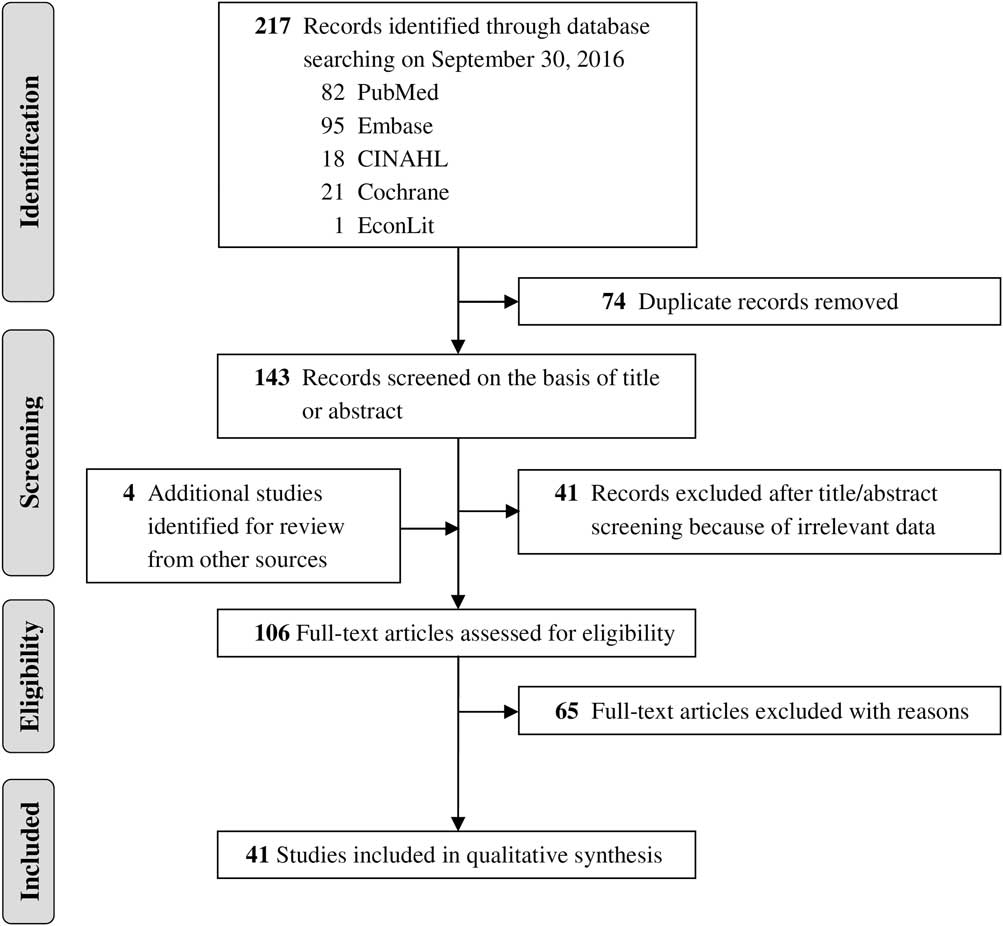
Overall, 217 records were identified through our database search. After removing 74 duplicate records, 143 potentially relevant studies and 4 additional studies from other sources were retrieved in full text and were assessed according to the eligibility criteria. Finally, 41 studies meeting the inclusion criteria were included in this systematic review (Figure 1).
Flow diagram of search strategy and study selection.

Characteristics and Quality of Included Studies
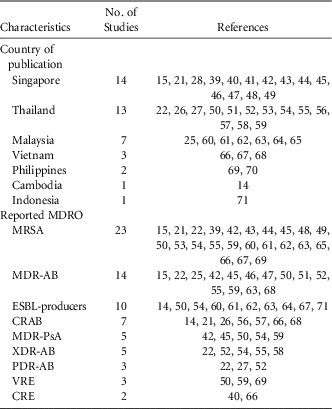
In total, 41 studies published between 1994 and 2016 were included; together, they included 22,876 ICU patients. Most of the studies were conducted in Singapore (14 studies), followed by Thailand (13 studies), and Malaysia (7 studies). The most frequently reported MDRO were MRSA (23 studies), followed by MDR-AB (14 studies), ESBL-producing organisms (10 studies), and CRAB (7 studies). Different types of ICUs were investigated: medical, surgical, neonatal, pediatric, burn, and tetanus units. Aggregate and detailed descriptions of these studies are provided in Table 1 of the text and eTable 2.1 of the supplementary material, with full reference list in Appendix 5. Our quality assessment based on the STROBE checklist showed that 41% of included studies were of high quality, while 49% were of moderate quality and 10% were of low quality (eTable 3.1).
Aggregate Description of Included Studies

NOTE. MDRO, multidrug-resistant organism; MDR-AB, multidrug-resistant Acinetobacter baumannii; ESBL, extended-spectrum β-lactamase; CRAB, carbapenem-resistant A. baumannii; MDR-PsA, multidrug-resistant Pseudomonas aeruginosa; XDR-AB, extensively drug-resistant A. baumannii; PDR-AB, pan-drug-resistant A. baumannii; VRE, vancomycin-resistant enterococci; CRE, carbapenem-resistant Enterobacteriaceae.
Outcomes
Cumulative incidence
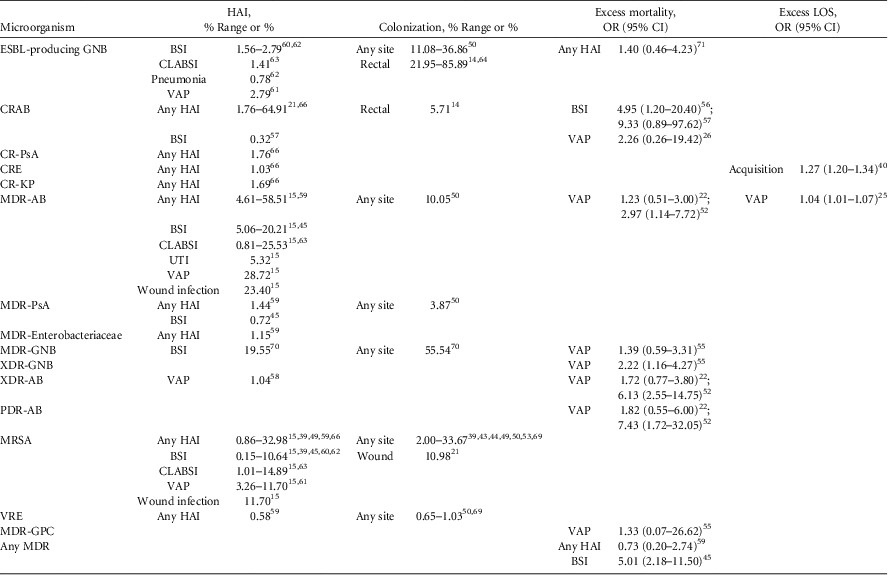
Cumulative incidences of MDR-HAI were reported in 26 studies (Table 2). Incidence rates of HAI caused by ESBL-producing Enterobacteriaceae ranged from 0.78% to 2.79%. Newborns hospitalized in neonatal ICU (NICU) represented a population at high risk of ESBL acquisition with 2 NICUs, in Cambodia and Malaysia, reporting a high colonization rate with an ESBL range up to 85%.Reference Turner, Pol and Soeng 14 Incidences of MRSA infections acquired in the ICUs of Southeast Asia seemed to have stabilized around 0.86% to 1.23%, except for a study by Chong et al,Reference Chong, Ahmed, Tay, Song and Tan 15 which reported the incidence of MRSA infection to be 32.98% in the burn unit. These incidence rates are comparable to those reported in the West.Reference Lukac, Bonomo and Logan 16 – Reference Dantes, Mu and Belflower 18 However, the incidence of infections due to CRAB and MDR-AB in Southeast Asia were higher compared to other areas,Reference Hidron, Edwards and Patel 19 , Reference Choi, Kwak and Yoo 20 ranging from 1.76% to 64.91% and 4.61% to 58.51%, respectively. Notably, the upper bound of all incidence rates was obtained from a burn unit.Reference Chong, Ahmed, Tay, Song and Tan 15 , Reference Chim, Tan and Song 21 The cumulative incidences of MDRO colonization are also shown in Table 2.
Cumulative Incidence of Hospital-Acquired Infection (HAI) and Colonization, Excess Mortality, and Excess Length of Stay (LOS) due to MDROs in Southeast Asia

NOTE. MDRO, multidrug-resistant organism; OR, odds ratio; CI, confidence interval; ESBL, extended-spectrum β-lactamase; GNB, gram-negative bacteria; BSI, bloodstream infection; HAI, hospital-acquired infection; CLABSI, central line-associated bloodstream infection; VAP, ventilator-associated pneumonia; CRAB, carbapenem-resistant A. baumannii; CR-PsA, carbapenem-resistant Pseudomonas aeruginosa; CRE, carbapenem-resistant Enterobacteriaceae; CR-KP, carbapenem-resistant Klebsiella pneumoniae; MDR-AB, multidrug-resistant A. baumannii; UTI, urinary tract infection; MDR-GNB, multidrug-resistant gram-negative bacteria; MDR-PsA, multidrug-resistant Pseudomonas aeruginosa; MRSA, methicillin-resistant Staphylococcus aureus; XDR-GNB, extensively drug-resistant gram-negative bacteria; XDR-AB, extensively drug-resistant A. baumannii; PDR-AB, pan-drug-resistant A. baumannii; VRE, vancomycin-resistant Enterococcus spp.; MDR-GPC, multidrug-resistant gram-positive cocci.
Prevalence
Prevalence rates of MDRO from a total of 19 studies are summarized in eTable 4.1 of the supplementary material. Among the Enterobacteriaceae causing HAI in ICU patients, 58% were ESBL producers. Most of the prevalence data were limited to VAP and BSI. Acinetobacter baumannii was the leading cause of VAP, followed by CR-PsA and MRSA. The distribution of AB resistance patterns was 62% CR, 1.3%–12% MDR, 18%–35% XDR, and 1.9% PDR. Among different organisms causing BSI and CLABSI, MRSA was the most prevalent (13%–17.7%), followed by MDR-AB, and CRAB.
Case fatality rate
Case fatality rates (CFR) were reported in 12 studies. The excess mortality in patients with VAP caused by MDROs are presented in Table 2. After adjusting for confounding variables, patients with MDR-AB, XDR-AB, and PDR-AB pneumonia died at 1.2, 1.7, and 1.8 times higher rates than those with drug-susceptible AB, respectively.Reference Inchai, Pothirat, Liwsrisakun, Deesomchok, Kositsakulchai and Chalermpanchai 22 However, antimicrobial resistance did not statistically significant increase mortality. Notably, patients with CRAB BSI had a 4.95 times higher rate of death than those with carbapenem-susceptible AB (CSAB). This observation is also consistent with previous studies on hospital mortality in patients with CRAB BSI.Reference Esterly, Griffith, Qi, Malczynski, Postelnick and Scheetz 23 , Reference Shorr, Zilberberg, Micek and Kollef 24
Length of stay and healthcare costs
The comparison of LOS between patients infected with an MDR strain and those with a drug-susceptible strain are displayed in Table 2. Of 8 studies reporting LOS, 7 reported that total hospital or ICU LOS tended to be longer for patients with MDR infections. For example, Janahiraman et alReference Janahiraman, Aziz and Hoo 25 found that, on average, patients infected with MDR-AB stayed in the ICU for an additional 15.3 days, compared to 17.9 days for those without MDR-AB. Importantly, not all studies performed statistical adjustments to minimize potential confounders between groups.
Currently, only a few studies reported the healthcare costs associated with MDRO infections in Southeast Asia. Thatrimontrichai et alReference Thatrimontrichai, Techato and Dissaneevate 26 reported that patients with CRAB VAP had a higher median total hospital cost when compared to patients with CSAB VAP (US$11,773 vs US$9,735). Apisarnthanarak et alReference Apisarnthanarak, Pinitchai, Thongphubeth, Yuekyen, Warren and Fraser 27 did not compare the costs between MDR and non-MDR but demonstrated that the average total hospitalization cost per patient colonized or infected with PDR-AB was high (US$366±100) and was lower after a multifaceted infection control intervention (US$204 ±88). Ng et alReference Ng, Earnest, Lye, Ling, Ding and Hsu 28 reported that the hospitalization costs in patients with MDR BSI were higher (USD 8,638) than those with non-MDR BSI.
DISCUSSION
To our knowledge, this study is the first systematic review providing a comprehensive summary of MDR-HAI in Southeast Asia. We have demonstrated that the burden of MDRO represents a major threat for ICU patients in Southeast Asia, with comparable or even greater epidemiological relevance than in Western countries. ICUs become the epicenters of antimicrobial resistance in hospitals due to several factors. Among them are the density of vulnerable populations as well as the severity of their underlying illnesses. Inadequate infection control measures, invasive medical procedures,Reference Kollef and Fraser 9 and high consumption of antibioticsReference Vincent, Rello and Marshall 29 contribute as well.
Our study reveals that Southeast Asia experiences a higher burden of AB than other low- and middle-income regions, especially incidences of HAI due to CRAB and MDR-AB. A possible explanation for these high incidences could be the tropical climate in Southeast Asia, where a year-round warm and humid climate favors the growth of AB. Reports on seasonal increase in nosocomial AB infections in the summer months support this hypothesis.Reference Smith 30 , Reference McDonald, Banerjee and Jarvis 31 Again, it is essential to note that the upper range of incidences were derived from burn units.
Acinetobacter baumannii is commonly found in the hospital environment, as well as being a normal inhabitant of human skin. Acinetobacter baumannii that colonize burn wounds can be especially problematic because it can progress to infection of the underlying tissues and subsequently spread systemically.Reference Trottier, Segura, Namias, King, Pizano and Schulman 32 Acinetobacter baumannii is mainly transmitted by the hands of healthcare workers or through indirect contact with contaminated environments.Reference Roberts, Findlay and Lang 33 The unique risks of AB cross contamination in the burn environment include contaminated hydrotherapy water, common treatment areas, and contaminated equipment such as mattresses.Reference Simor, Lee and Vearncombe 34 However, airborne transmission of AB infection in hospitals also occurs.Reference Rock, Harris, Johnson, Bischoff and Thom 35
Improving adherence to basic infection control practices, including contact precautions, patient cohorting, hand hygiene, and environmental cleaning, seem to be the most important strategies for preventing CRAB and MDR-AB transmission and infection and should be emphasized. Well-designed studies assessing the efficacy of individual and bundled infection control measures focusing on CRAB and MDR-AB are needed in Southeast Asia. Continued surveillance of CRAB and MDR-AB in healthcare settings are needed to develop individualized strategies to prevent and control resistant strains in response to rapid epidemiological changes.
Our findings also show a high prevalence of CRAB, XDR-AB, and MRSA VAP in most ICUs. The prevalence of MRSA VAP in Southeast Asia is consistent with studies in Western countries,Reference Blot, Koulenti and Dimopoulos 36 , Reference Weiner, Webb and Limbago 37 which reported MRSA as a leading cause of VAP. Notably, the prevalences of CRAB, XDR-AB, and VAP in Southeast Asia were higher than those reported in the West.Reference Blot, Koulenti and Dimopoulos 36 , Reference Weiner, Webb and Limbago 37 Interestingly, a potential dose–response relationship between the degree of resistance and excess mortality was observed in patients with VAP caused by MDR-AB, XDR-AB, and PDR-AB. The CFR for XDR-AB VAP exceeded 50% and even approached 70% among cases with PDR-AB VAP. This finding is consistent with other studies reporting high CFRs from highly resistant AB infections.Reference Poulikakos, Tansarli and Falagas 38 Patients positive for MDROs have a higher mortality rate because sicker patients are easily colonized with any MRDO. Furthermore, PDR-AB is considered virtually untreatable because it is simultaneously resistant to all approved antimicrobial agents. In this review, we also found that MDRO infection or colonization in patients receiving intensive care may be associated with increased morbidity as measured by prolonged LOS.
Despite the recognition of the severity of the problem, accurate epidemiologic data on MDR-HAI in some Southeast Asian countries are scarce and incomplete. In developing countries, most registries are government funded and lack a research component. Our estimates maybe underestimated due to the limited data. Further active surveillance studies are therefore needed.
We recommend urgent implementation of infection control policies. Active surveillance screening before ICU admission of specific populations, or in patients with a history of MDRO or high risk of community-acquired MDRO, could be worthwhile in preventing cross contamination in the wards and ICUs. Implementation of successful antimicrobial stewardship programs is also required in Southeast Asia because of the high prevalence of MDROs. Moreover, further studies are needed from Southeast Asian countries to gather detailed explanations on the magnitude and trends of infections caused by MDROs. Research methodology standardization is needed so that the measurement of epidemiological data, the measurement of antimicrobial consumption, and case definitions are consistent among studies, which would enable the findings to be comparable across countries.
Our study has some limitations. First, LOS comparisons should be interpreted with caution because not all studiesReference Janahiraman, Aziz and Hoo 25 , Reference Ling, Tee and Tan 40 performed statistical adjustments to eliminate confounder bias. Second, data regarding types of infection are limited. Information on incidence and prevalence are mostly limited to overall HAI and VAP. Third, because of the paucity of available data related to LOS and healthcare cost, the effects of infections caused by MDRO on LOS and healthcare cost remain unclear.
In summary, this study highlights the importance of MDR HAIs in Southeast Asia. Countries within this region are often burdened with gram-negative rather than gram-positive MDROs, especially CRAB and MDR-AB. Multifaceted strategies are needed to tackle the problem of resistance. These strategies should include infection control, rapid and reliable detection of MDROs, guideline development, regulation enforcement, and continuing education. Furthermore, awareness programs and campaigns through mass media would be useful in educating and empowering the public on the management of MDRO. In conclusion, this review provides a key message that should catch the attention of all stakeholders and should raise awareness of the importance of MDROs and AB in Southeast Asia.
ACKNOWLEDGMENTS
Financial support: No financial support was provided relevant to this article.
Potential conflicts of interest: All authors report no conflicts of interest relevant to this article. The authors would like to thank Mr. David G. Funk for his editorial assistance in this manuscript.
SUPPLEMENTARY MATERIAL
To view supplementary material for this article, please visit https://doi.org/10.1017/ice.2018.58