


In a luncheon address at the annual meeting of the German Studies Association in 2013, David Blackbourn delivered an impassioned plaidoyer to “grow” German history, i.e., to rescue it from the temporal “provincialism” that has, he believes, increasingly characterized the study of Germany over the past two decades. Blackbourn was critical of the growing emphasis on the twentieth century and especially the post-1945 period—not because of the quality of the work per se, but rather because of the resultant neglect of earlier periods and the potential loss of valuable historical insights that this development has brought in its wake.Footnote 1 There have been other seemingly seismic shifts in the profession as a whole that have not left the history of Germany and German-speaking Central Europe untouched: greater emphasis on discourse analysis and gender, memory and identity, experience and cultural practices (i.e., the “linguistic turn” and the “new” cultural history).Footnote 2 Accompanied by a decline in interest about Germany exclusively as a “nation-state,” the last decade in particular has seen a spike in “global” or “transnational” approaches.Footnote 3 And, like other fields, the study of Germany has also witnessed greater interest in the study of race, minorities, immigration, and colonization—what Catherine Epstein referred to as the “imperial turn” in a piece that appeared in the journal Central European History (CEH) in 2013.Footnote 4
Other changes are more specific to the field of German-speaking Central Europe, especially since the political Wende of 1989–1990. This includes a veritable explosion in the study of the German Democratic Republic (GDR); a greater interest in the Habsburg lands and especially in the Holocaust; a move away from the type of traditional structural analysis associated most closely with the so-called Bielefeld School; as well as a precipitous decline in interest about the working classes and class more generally (the last development is, of course, part of a more general trend in historiography). Some of these shifts had already begun in the mid to late 1980s and thus predate the Wende, but all have clearly accelerated since 1989–1990.
Donna Harsch has conveniently categorized the reasons for these shifts into factors that are “external” and “internal” to the discipline.Footnote 5 The collapse of state socialism in East Europe and the subsequent opening of the archives, as well as the rise (once again) of “globalization,” clearly belong to the former. To the latter belongs the general shift away from traditional social history and structural analysis and toward more “socio-cultural” perspectives, which came in the wake of the postmodern challenge. There are other factors as well: the “thirty-years rule” in the archive clearly helps explain the flood of work on the Federal Republic, for example. Along with the spectacular nature of the fall of the Berlin Wall in November 1989, the waiving (by and large) of this rule in the case of the GDR obviously accounts for the sudden interest in East Germany. Like those “archive rats” scornfully described by Stalin, hordes of historians (including the present author) descended on the GDR's carcass to perform a postmortem on the now defunct SED state.Footnote 6
In his talk “Honey, I Shrunk German History,” Blackbourn also emphasized the material incentives for focusing on twentieth-century and especially post-1945 history: it is “where the money is” in terms of research grants and the job market—clearly important considerations for young scholars in search of funding and employment. Blackbourn rightly asks why “their elders have created these incentives.”Footnote 7 At least one reason seems apparent: deans, department heads, and other academic administrators realize that instructors have the best chance of filling seats in the classroom by focusing on more recent developments—not only recent, but also spectacular and sensational, shocking and lurid. For better or worse, the inclusion of words such as Hitler and Holocaust in course titles—as well as the titles of academic books—simply “sells” better in a society that, for whatever reasons, demonstrates little interest in older and/or less sensational historical developments (unless they have to do with war or sex). And that seems to be as true of Europe as of North America.
* * *
To what extent has the content of Central European History conformed to the shifts that have taken place since the Wende of 1989, above all the growing focus on post-1945 history—especially that of the GDR—at the expense of earlier periods; on the Holocaust; and on the various postmodern “turns” and new paradigms, from gender and the body to transnationalism and post-colonialism? And what light, if any, does this shed on more general patterns underlying the historiography of German-speaking Europe over the past quarter century?
Before examining this question and diving into the statistics, it is worth considering the goals of CEH. In a programmatic statement that appeared in the very first issue of March 1968, founding editor Douglas Unfug wrote that the scope of the new journal would be
broadly rather than narrowly defined… the editors will seek to maintain a balance between works of broad synthesis and of specialized research, among studies of all periods from the Middle Ages to the present, and among studies using traditional approaches to history and those employing recent or experimental methodological approaches.
Introducing a useful index of the first twenty years of CEH that he compiled in 1987, Unfug admitted that the first years of publication had “yielded a catch mainly from the school of recent, political history. The preparation of this index, however, has brought a sense that perhaps the goals have been approached more closely with the passage of time.”Footnote 8 Was he correct? And has CEH come closer to achieving those goals over the past quarter century?
The following statistical analysis of CEH is based on two sets of lists. One set relies on Unfug's index for the years 1968–1987, the other on a systematic examination of every issue of CEH published between 1990 and 2014. Within each set, research articles and review essays are classified according to temporal period, thematic topic, and method or approach. A few cautionary points are worth noting. In the first place, articles were assigned to various rubrics primarily based on their titles, which means that different choices (and even rubrics) were possible. Whether the piece made a conscious reference in its title to a certain time period, theme, or approach, such as gender, Weimar, Alltagsgeschichte, war, or class, played a determinative role in how it was categorized. The point is that the following statistics are rough indications of general trends. Second, an analysis of articles provides some important insights, but it is clearly not the only or necessarily even the best way to take stock of the field using CEH as a measure. A more accurate method would involve an analysis of book reviews, which CEH only began publishing in 1991—and which Blackbourn usefully analyzed at five-year intervals from 1995 to 2010.Footnote 9 Third, given that the selection of articles reflects, to some extent, the taste of the editor and the board of editors, an analysis of actual submissions would also provide a better sense of how the field has evolved since the Wende. To my knowledge, this information is only available for the years when Kenneth Ledford served as editor, i.e., 2005–2014, as well as for my own tenure as editor.
With those caveats in mind: to what extent has the history of German-speaking Europe “shrunk” to the twentieth century and especially the post-1945 period? CEH published 376 articles (including review essays) through 1987, and 438 since 1990. During the first period, roughly 53 percent of all articles covered the period up to 1914, and 47 percent the period since World War I. Those numbers have reversed since 1990: 44 percent covered the period up to 1914, 56 percent the period since World War I (Charts 1 and 2). The numbers have flipped, but not in an overly dramatic way, especially since this came largely at the expense of the nineteenth century, i.e., earlier periods have enjoyed an increase in coverage as well. What is dramatic is the increase in the number of articles on the post-1945 period: only 3.5 percent from 1968 to 1987—and 21 percent since 1990 (Charts 3 and 4), with a huge jump beginning in 2005.Footnote 10 Given the benign neglect of the post-1945 period from 1968 to 1987 (for obvious reasons related to the thirty-year rule and the strictures of the East German state), this is not only an understandable but also a welcome development: to put it simply, the postwar period had Nachholbedarf! Moreover, questions related to the development of the two postwar states are arguably just as important, just as worthy of explanation and scholarly attention, as modern Germany's checkered pre-1945 history. Their remarkable stability following the bloody debacle of the Third Reich is one such question. Most people seem to be drawn to car wrecks, which is perhaps one reason there are no memorable novels about happy couples: still, the singular success of the Federal Republic after 1945 is a story worth telling and explaining, warts and all. The same can be said with respect to the longevity of the GDR, which, after all, lasted longer than the Weimar Republic and the Third Reich combined.Footnote 11
Temporal coverage of all CEH articles (1968–1987): before and after 1914

Temporal coverage of all CEH articles (1990–2014): before and after 1914
(N.B. Thirty-three articles that straddle the 19th and 20th centuries are not included)

Temporal coverage of all CEH articles (1968–1987) by historical era

Temporal coverage of all CEH articles (1990–2014) by historical era
(N.B. Forty-two articles that cover overlapping time periods are not included: eighteen on the Kaiserreich through the Third Reich, fifteen on the nineteenth and twentieth centuries, and nine on the twentieth century)

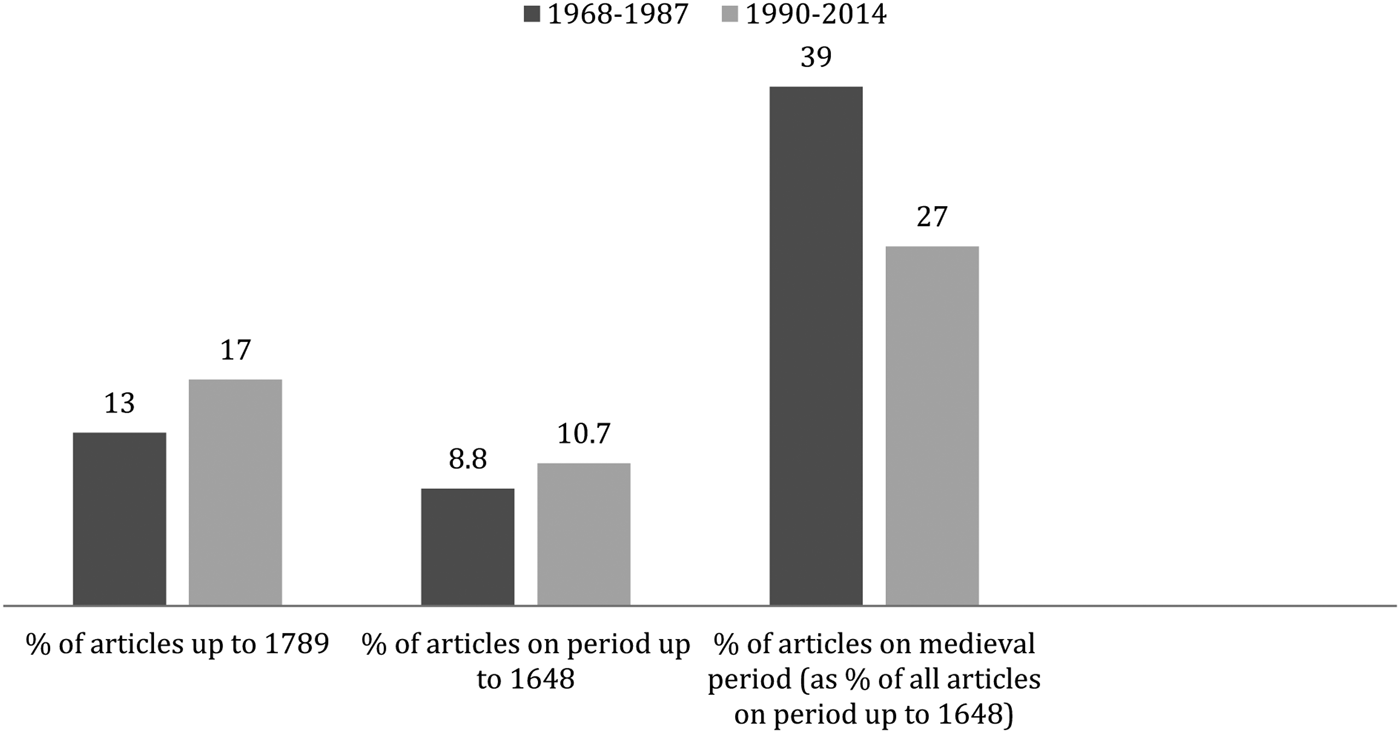
What about the common complaint, not new since 1989, that CEH neglects the premodern period? Barkin's final—and his successor's first—editorial statements drew attention to this point. Barkin, who served as editor from 1991 to 2004, explained that there were “few submissions” on the medieval period and on the eighteenth century, and that if he “had to do it over again,” he would have devoted “more energy to attracting manuscripts from premodern scholars.”Footnote 12 In point of fact, the percentage of articles covering the period up to 1789 was only 13 percent from 1968 to 1987, and 17 percent since 1990—a slight increase since the Wende, with almost 62 percent of the latter covering the period up to 1648 (Chart 5). The percentage of articles devoted to the middle ages and the early modern period remained steady at around 10 percent before and after the Wende. Although the raw number of articles that appeared on medieval Germany remained the same (thirteen) from 1968 to 1987 and from 1990 to 2014, they have decreased in the last twenty-five years as a percentage of total articles on the period up to 1648, i.e., there has been a marked increase in published work on the Reformation—in raw numbers: fifteen articles between 1968 and 1987, thirty-one since 1990 (Chart 4).
Coverage of the premodern period as a percentage of all articles in CEH
As noted earlier, there has been a significant drop in the percentage of articles dealing with the “long nineteenth century,” from 36 percent between 1968 and 1987 to 22 percent since 1990—making coverage of the entire century roughly on par with that of the Weimar Republic and the Third Reich together, as well as with the post-1945 period as a whole (Charts 3 and 4). The most dramatic thematic decreases since the Wende appear to have been the 1848/49 revolutions (two articles, down from ten between 1968 and 1987), and unification and Bismarckian Germany (only six, down from at least two dozen between 1968 and 1987). This is a surprising development, especially since one might have expected the events of 1989–1990 to have spurred renewed interest in 1848, as well as the earlier process of unification. That they did not no doubt reflects the decline of interest in “old-fashioned” political history—and, perhaps, a sense that the Sonderweg debate had run out of steam.
Despite the upsurge in post-1945 history, work on Weimar and the Third Reich has continued to make up the largest single group of articles since the Wende—even if it dropped significantly as a percentage of all articles: 36 percent between 1968 and 1987, 28 percent from 1990 to 2014. There has been an even more interesting development in terms of relative coverage, however: whereas two-thirds of all articles on the interwar period were devoted to Weimar from 1968 to 1987, nearly 60 percent have focused on some aspect of the Third Reich since 1990 (Chart 6). This shift in emphasis from Weimar to the Third Reich corresponds to the new “vanishing point” of German history described by Helmut Smith, i.e., the turn in attention away from 1933 (why did Weimar collapse? who voted for Hitler?) and toward 1941 (i.e., the Holocaust).Footnote 13 In fact, the number of articles on the “Final Solution” increased fourfold, from only four between 1968 and 1987 to sixteen since the Wende. The percentage of total articles on German-Jewish history, antisemitism, and the Holocaust almost doubled as well, from 4.5 percent (1968–1987) to 8 percent (1990–2014). By way of comparison, twenty-seven articles about the rise of the Nazis and the collapse of Weimar appeared between 1968 and 1987—but only four since 1990. Whatever the reasons, this is arguably a healthy development—if one agrees that the nimbus of “incomprehensibility” around 1933 was largely a result of our conflating that fateful year with the even worse horrors associated with 1941. In other words, 1933 has become demystified—not least thanks to all the painstaking work on electoral patterns in late Weimar—and we have finally come to realize that the “incomprehensible” is less why the Nazis came to power or went to war, but rather why the Holocaust took place.
Coverage of Weimar and the Third Reich as a percentage of all articles in CEH on the interwar period

What about geographic coverage? Catherine Epstein writes in her CEH piece that the events of 1989 and their aftermath “revitalized” the field of Habsburg studies because of greater access to the archives, as well as the post-Wende rise of nationalist strivings and ethnic warfare in the region.Footnote 14 This “new attention” to the Habsburg lands has not found expression in the pages of CEH, alas, where the percentage of articles devoted to Austria, the Habsburg lands (including the successor states of the empire), as well as Switzerland decreased from almost 15 percent between 1968 and 1987 to less than 6 percent since 1990 (Chart 7). With respect to regional breakdown, old favorites such as Prussia have remained a popular topic since the Wende, with no less than sixteen articles that had the word Prussia in their titles. The other region that attracted the most attention was Saxony, no doubt thanks to greater archival access, as well as to the region's vibrant industrial past.
Percentage of all CEH articles on Austria, the Habsburg lands, and Switzerland

There have also been some noteworthy trends in the journal with respect to historical topics and approaches. “Traditional” social history, which historians of Germany only really began to practice after 1970, has been a mainstay of CEH since its founding. As Chart 8 makes clear, roughly one-fifth of all articles published between 1968 and 1987, and almost one-quarter published since 1990, look at questions pertaining to the working classes (peasants, farmers, artisans) and the poor; elites and professionals; urban history, migration, and demography; welfare policies and health issues. It is worth emphasizing that only four articles published since 1990 consciously address the term class as such, and only one focused on Marxism (a review essay on the Marx-Engels Gesamtausgabe).Footnote 15 By contrast, there had been sixteen on socialism, Marxism, and communism between 1968 and 1987. Given the inglorious demise of state socialism in East Europe in 1989, the decline since that time is not a surprising development.
Thematic coverage of all CEH articles (using categories from the 1987 Unfug index)
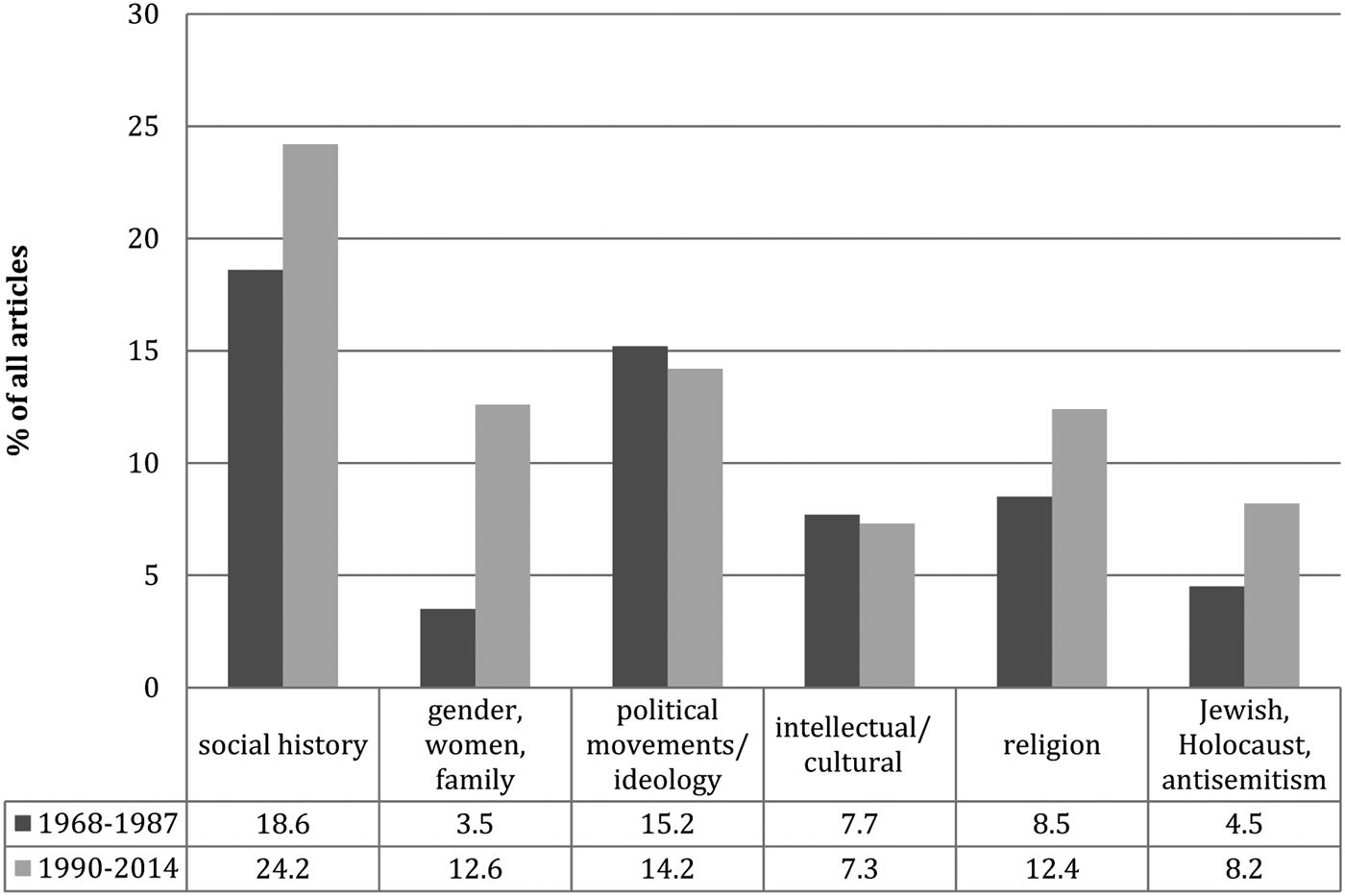
What about more traditional types of history? The number of articles on intellectual and (“big C”) cultural history (including cultural politics) remained steady at slightly more than 7 percent during both publishing periods, as did those on political movements, parties, parliament, and ideology: 15 percent from 1968 to 1987, 14 percent since 1990 (Chart 8). Other “traditional” topics have also remained strong since 1990 (Chart 9; Unfug's index does not include figures for these subfields). Almost 11 percent focused on war and diplomacy, the military and militarism, foreign policy and foreign relations. Another 6 percent looked at questions related to traditional political authority, the law, citizenship, and “state-building” (there was a special symposium on “state-building” in the “Third Germany” in 1991). Approximately 7.5 percent focused on economic issues, including industry, business, commerce, and technology; and 13.5 percent looked at religion and morality—with, for some reason (perhaps greater sensitivity to the plight of minorities), twice as many articles since the Wende about Catholics than about Protestants.
Thematic coverage as a percentage of all CEH articles (1990–2014)

The largest increases since 1990 came in the areas one might expect (Chart 8). Articles dealing with issues of gender, women, family, and youths increased almost fourfold: from 3.5 percent between 1968 and 1987 to almost 13 percent since 1990. Yet, there have also been some surprising thematic absences, i.e., topics that have not been covered in CEH since the Wende (or only sporadically). This includes, for example, repression in the GDR and under the Third Reich (excluding, of course, the Holocaust), as well as resistance to the SED regime and the Nazis. In addition to the conspicuous dearth of articles on class and Marxism, fascism as a topic unto itself has been another nonstarter. There has also been very little on unification or on post-Wende Germany, i.e., on the early years of the “long twenty-first century”—no doubt because of the thirty-year rule in the archives, as well as the curious belief that recent events cannot really be considered “history” (as if when an event worthy of historical attention took place were more important than how a historian approaches its study).
What about other new approaches and methods besides gender—especially the “new” cultural history, discourse analysis and the “linguistic turn,” biopolitics, memory and Vergangenheitsbewältigung, identity and mentality? Not surprisingly, these did not constitute a category in Unfug's 1987 index—though he did count no less than fifty-four articles that used “quantitative methods.” (There have been none since 1990—based on titles alone. In fact, this review essay might be the first exercise in Cliometrics to appear in CEH in decades.) Since 1990, approximately one-fourth of all articles have addressed such topics: from madness to death, consumption to carnival, hobbies to Heimat to human rights (Chart 9). It is worth noting that roughly two-thirds of those have focused on various forms of memory and identity, including Vergangenheitsbewältigung and victimization, museums and monuments (10.5 percent); and issues related to race and racism, xenophobia and colonial rule (almost 5 percent since 1990).
The only approach besides gender and the “new” cultural history that seems to have gained real traction in CEH is transnational/comparative history, with nine articles appearing since 2000. As for microhistory and Alltagsgeschichte, which Geoff Eley hailed in 1989 as the “most important new departure in West German historiography in the past decade”: only four specimens seem to have appeared between 1990 and 2004 (one of which was a review article), and none since. During that period, only three articles self-consciously dealt with the “linguistic turn,” symbols, and semantics—one of which was by Eley, another by Kathleen Canning.Footnote 16 This is all the more surprising given a special issue that appeared during the Wende in the fall of 1989, entitled “German Histories: Challenges in Theory, Practice, Technique,” with contributions on postmodernism, feminist and gender history, as well as the “linguistic turn.” (The issue also included a piece by Eric Johnson about “Quantitative Social Science History in Postmodern Middle Age”—perhaps the very last article in CEH on that old “new” history, as he dubbed it).Footnote 17
Should the dearth of articles on these themes suggest an aversion to these new methods—if not in the field as a whole, then in the editorial offices of CEH (keeping in mind that submissions are perhaps a better gauge of the field than publications)? In his final issue in late 1990, Douglas Unfug reflected on his tenure as editor, the state of the field, and his predictions for the future. Likely with an eye to the David Abraham affair, which filled the pages of a memorable issue published in 1984, Unfug wrote that the “controversies” of North American historians working on Central Europe were “occasionally bitter,” but that they were not “easily reducible to questions of method or theory” (though a case could be made that the Abraham controversy was indeed in large part about method and theory). “One reason may be,” Unfug continued, “that they have not been notably innovative in methodology or subject; many of the controversies that have affected the profession at large have glanced off of them. They have tended to deal with social history in terms posed by politics, and they have been reluctant to turn social or political conflicts into questions of language”—a nod to (or dig at) the linguistic turn. He attributed this “lack of innovation” not to “methodological conservatism or resistance to fashion” per se, but rather to the fact that “in the end most work in the field continues to circle… around the central question of what the Third Reich really means.” Unlike historians of Germany, who tended to focus on “what has gone or can go wrong with Germans,” those more “innovative” scholars not working on Germany were “in a better position to focus… on what has gone or can go wrong with all of us.” Unfug then predicted that the events of 1989–1990 would likely “direct even more attention to old-fashioned questions centering on politics.”Footnote 18
He turned out to be wrong on the last point. But what about Unfug's claims concerning a “lack of innovation”? It is not clear that the field continues to circle around the question of what the Third Reich really means—though its shadow certainly looms, in one way or another, over the pre-1933 and post-1945 eras as a whole. And, of course, even scholars working on the Third Reich as such have been more sensitive to “newer” approaches. Still, one cannot dismiss Unfug's points altogether: those employing “new” approaches to the history of Germany have largely followed the lead of scholars working in other fields. An analysis based primarily on titles says little, of course, about the extent to which historians of German-speaking Central Europe have been methodologically conservative or resistant to fashion: leaving aside the fact that one-fourth of all CEH articles since 1990 have self-consciously embraced “new” topics and approaches, it is difficult to gauge the extent to which the new fashions have informed the method adopted in articles that do not self-consciously draw attention to their approach. It may be that practitioners in the field “wear their theory lightly.” More to the point, attention to language, gender, and “small c” culture may have just become part of their DNA—just as Marxism had been for an earlier generation focused on class.
* * *
In his 2013 address at the GSA, Blackbourn also lamented the fact that the recent “return of large-scale history and boldly framed arguments that extend through time” has “bypassed” our field, and he is surely correct.Footnote 19 But is this necessarily a worrying development? Notwithstanding all of the good reasons Blackbourn provides for extending our temporal scope beyond the twentieth century: in the end, it should ultimately be the questions, answers, and insights we gain that count above all else. Temporal provincialism has potentially serious drawbacks, above all the loss of the “longer view” and other insights gained by a salubrious confrontation with pasts that truly are a “foreign country.” But, as innovative historical work over the last half century has shown—including work that has appeared in the pages of CEH—answers to momentous historical questions about the “human condition” can be found just as well in microhistorical studies dealing with the everyday lives of “ordinary” individuals or obscure hamlets—even ones focusing on the post-1945 period. As Schopenauer succinctly put it: “…. the events and history of a village and of a kingdom are essentially the same; and we can study and learn to know humanity just as well in the one as in the other.”Footnote 20
The parochial debates over method also become less important if we consider the study of the past—or any humanist endeavor—to be akin to thrusting one's head inside a giant bubble: wherever and however one thrusts should afford some glimpse of and greater understanding of humanity. History as such is a large enough table for all of us to sit at comfortably and partake of the feast. A more convivial feast is one, of course, in which everyone brings a different type of “dish”—along with the recipe (i.e., method)—to the table to share with everyone else. As former editor Kenneth Barkin put it: “excellent history can be written based on a variety of theories, and with the employment of a diverse number of methodologies.”Footnote 21 This liberal precept has guided and will continue to guide CEH in its search for the finest and most innovative research on the history of German-speaking Central Europe—regardless of theme, theory, topic, or timespan.



