The Infectious Diseases Society of America/Society for Healthcare Epidemiology of America guidelines for implementing an antibiotic stewardship program (ASP) recommend the development of interventions targeting patients with specific syndromes such as Staphylococcus aureus bacteremia (SAB).Reference Barlam, Cosgrove and Abbo 1 The use of information technology (IT) through the electronic medical record (EMR) in the form of automated alerts or electronic order sets, can facilitate this strategy.Reference Forrest, Van Schooneveld, Kullar, Schulz, Duong and Postelnick 2 In the present study, we investigated the impact of an ASP-led intervention consisting of real-time feedback and the use of an electronic order set on clinical outcomes and compliance with quality processes of care in the management of SAB.
METHODS
Study Setting and Design
The study was a quasi-experimental interrupted time series (ITS) conducted at a community teaching hospital. Patients 18 years of age and older with at least 1 blood culture positive for S. aureus were included. Only the first episode of bacteremia per patient during the study period was included. The preintervention period extended from July 2014 to February 2015, and the postintervention period extended from May 2015 to December 2015. Hospital-wide education about the intervention occurred during March and April 2015, so these months were excluded from the analysis. We excluded patients transferred from another facility with a known diagnosis of SAB as well as patients who died, were discharged, or left the hospital against medical advice prior to a report of S. aureus in blood.
Data on baseline demographics and clinical and treatment characteristics were collected. The University of Miami Institutional Review Board approved the study.
Microbiology Laboratory Procedures
Throughout the study, standard culture and reporting practices were followed by the microbiology laboratory. 3 Species identification was performed by latex agglutination, and antimicrobial susceptibility testing was performed using the Vitek-2 system (bioMerieux, Durham, NC).
Intervention
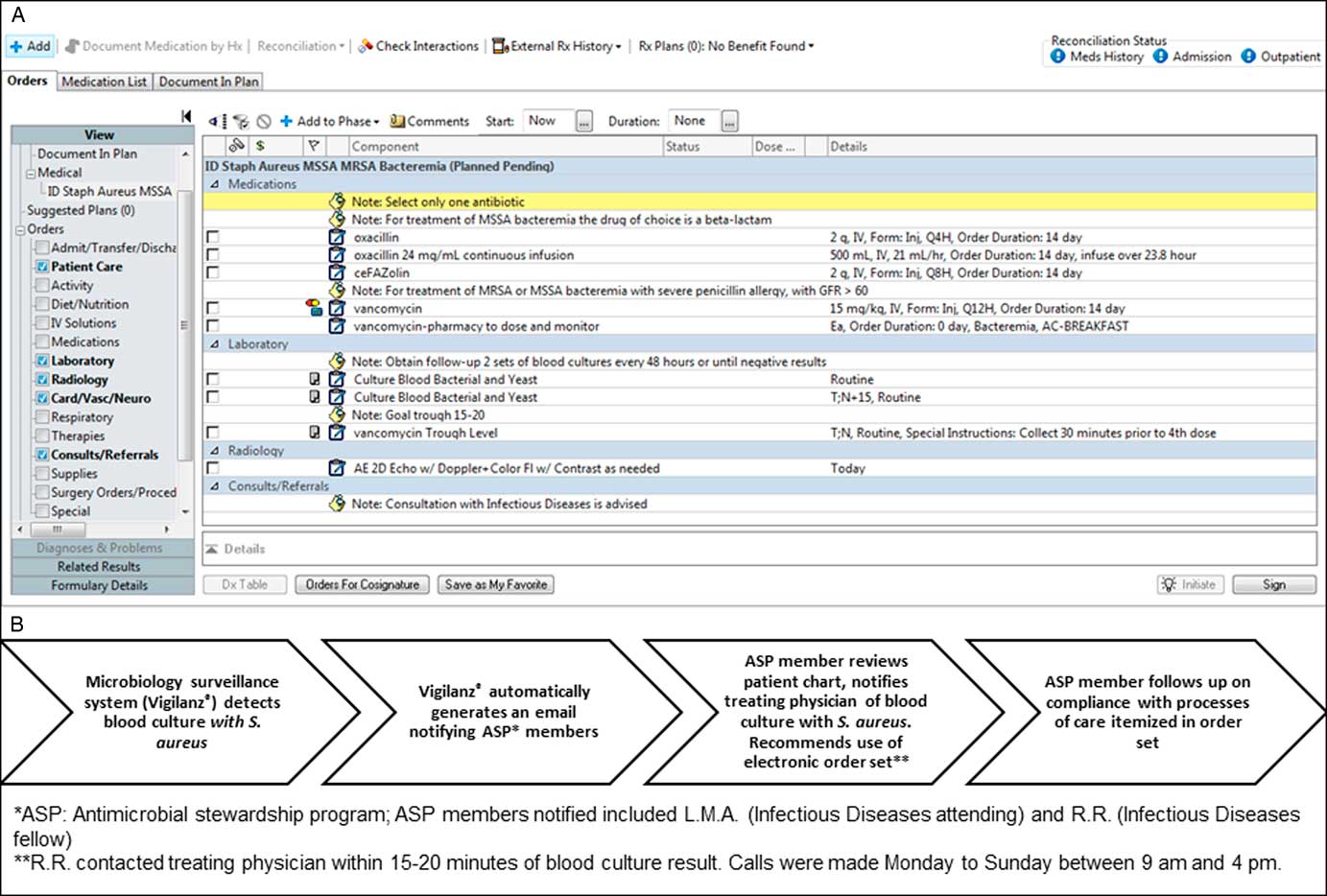
An electronic order set was designed within the EMR (Cerner, Kansas City, KS) containing the orders considered as basic processes of care in the management of SAB. Two infectious diseases (ID) physicians and 1 ID pharmacist determined these components. The order set was developed by the local information technology (IT) department (Figure 1A). The steps involved in triggering the use of the order set are displayed in Figure 1B.
(A) Electronic order set for the management of Staphylococcus aureus bacteremia. (B) Workflow followed during the post-intervention period. ASP, antimicrobial stewardship program.

Outcome Definitions
The main clinical outcome was change in the clinical failure rate ratio, defined as the number of monthly episodes of clinical failure (bacteremia persisting for 6 or more days or in-hospital death) per 1,000 at-risk patient days (calculated monthly as the sum of each patient’s hospital days from the onset of bacteremia). Compliance with and timing of several processes of care were also evaluated on a monthly basis to yield the following statistics: (1) proportion of patients with ID consultation, (2) proportion of patients with methicillin-susceptible S. aureus (MSSA) bacteremia treated with an anti-staphylococcal β-lactam, and (3) proportion of patients having echocardiographic studies. Total length of therapy was calculated based on pharmacy documentation and by reviewing discharge summaries.
Statistical Analysis
Demographic characteristic between the pre- and postintervention groups were compared using the Pearson χ2 test for categorical variables and Wilcoxon rank-sum test for continuous variables.
An ITS design was used to evaluate the impact of the intervention. Different regression models were used to better fit the type of data of the outcome being analyzed.Reference Bonander, Nilson and Andersson 4 , Reference Lopez Bernal, Cummins and Gasparrini 5 All models included a constant, a baseline slope term, and terms to estimate a change in level and postintervention trend. The analyses were performed using Stata version 14 software (StataCorp, College Station, TX) and R studio software (R Foundation for Statistical Computing, Vienna, Austria).
RESULTS
During the study period, 249 patients were identified: 132 in the preintervention period and 117 in the postintervention period. Both groups were similar in their demographic and clinical characteristics (Supplementary Table 1).
Clinical Outcomes
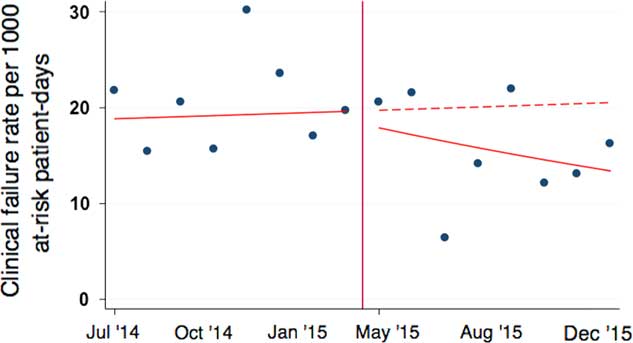
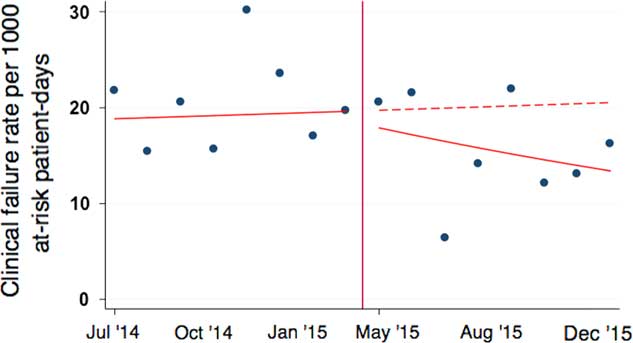
The clinical failure rate ratio (number of events per 1,000 at-risk patient days) after implementation of the intervention compared to the preintervention period was 0.95 (95% confidence interval [CI], 0.81–1.11; P=.52). A small decline was seen in the postintervention trend (rate ratio, 0.95; 95% CI, 0.93–0.98; P=.02) (Figure 1). No effects were detected for the mortality or persistent bacteremia rates (Supplementary Table 2).
Compliance and Timing of Processes of Care
Changes in compliance with processes of care are displayed in Supplementary Table 3. Immediately after implementation of the intervention, patients were twice as likely to have an ID consultation (risk ratio [RR], 2.24; 95% CI, 1.51–3.31; P=.004), and no significant change in the trend was detected thereafter. Among patients with MSSA bacteremia, postintervention patients were 46% more likely to receive treatment with oxacillin or cefazolin (RR, 1.46; 95% CI, 1.06–2.00; P=.041), and there was no significant change in trend. No effect was seen on the proportion of echocardiographic studies done. Median length of therapy in the preintervention period was 15 days compared to 17 days post intervention (P=.071).
The effects of the intervention on the time to compliance with processes of care are displayed in Supplementary Table 4. Improvements were seen in the management of MSSA bacteremia, with a reduction in the median time to administration of anti-staphylococcal β-lactams of 24.93 hours (95% CI, −41.87 to −7.98 hours; P=.014). The postintervention trend remained stable. The median time to ID consultation was 3 days in both periods (P=.951). No change in timing of echocardiographic studies was seen.
DISCUSSION
Our results show that after implementation of an ASP-led intervention consisting of real-time feedback and use of an electronic order set for the management of SAB, there was a decrease in clinical failure rate, greater likelihood of an ID consultation, as well as increased proportion and more timely use of anti-staphylococcal β-lactams in cases of MSSA bacteremia.
Our intervention was delivered as a bundle, which limits the understanding of the clinical impact of each individual component. However, our results reveal that despite the increased likelihood of an ID consultation in the postintervention period, the proportion of patients seen by an ID specialist ranged from 50% to 80%; however, compliance with use of anti-staphylococcal β-lactams was near universal postintervention. This finding could indicate that some physicians might not formally request an ID consultation but are receptive to the antibiotic recommendations delivered by the ASP. Similar to recent publications,Reference Wenzler, Wang and Goff 6 , Reference Eby, Richey, Platts-Mills, Mathers, Novicoff and Cox 7 our study shows that integration of automated alert systems, using the microbiology laboratory and EMR capabilities, can facilitate streamlining the management of SAB, However, interpretation from ID physicians or pharmacists is still needed prior to transmitting recommendations to treating physicians. In places with limited availability of on-site ID specialists, the use of structured clinical pathways with support from ASPs can help guide initial patient care activities.Reference Hogan, Gazarin and Lapenskie 8
This study has several limitations. It was a single-center experience, which decreases the generalizability of these results. The source of infection was based on EMR documentation by the treating physician, which leaves room for misclassification. For patients completing an antibiotic regimen as outpatients, duration of therapy was obtained from discharge summaries and not from pharmacy records. The use of interrupted time series (ITS) analysis strengthened the results; however, our time series was short, which could have rendered it underpowered for detecting changes in level of some outcomes (eg, mortality) or postintervention trends. We also lacked a nonintervention control group, which diminishes confidence that these results were solely due to the intervention.
In conclusion, combining ASP-led real-time feedback with an electronic order set was associated with improved clinical outcomes and greater compliance with quality processes of care in the management of SAB. Strategies combining ASP and EMR resources should be considered to optimize the management of SAB.
Effect of the implementation of an intervention consisting of real-time feedback and the use of an electronic order set for the management of Staphylococcus aureus bacteremia. Solid lines represent the observed slopes of clinical failure rates during the pre- and postintervention periods; dashed line represents the predicted slope for clinical failure rate without the effect of the intervention.
ACKNOWLEDGMENTS
Financial support: No financial support was provided relevant to this article.
Potential conflicts of interest: All authors report no conflicts of interest relevant to this article.
SUPPLEMENTARY MATERIAL
To view supplementary material for this article, please visit https://doi.org/10.1017/ice.2017.325