Implications
Increasing the age at weaning from 3 to 4 weeks improves the welfare of piglets reared outdoors by reducing distress behaviours and improving feeding behaviour. This is relevant considering that a key reason for rearing pigs in outdoor environments is to address ethical concerns of consumers regarding the wellbeing of the animals.
Introduction
Conventional weaning in the pig industry involves exposing young piglets to several concomitant stressors: transfer to a novel environment; separation from the sow and littermates, often mixing with unknown peers; and the loss of the main source of nutrition, i.e. milk. Because this is done without a period of transition necessary to make the solid feed attractive to the piglets, weaning generally is followed by a period of low feed intake (Weary et al., Reference Weary, Jaspers and Hötzel2008). Additionally, at this age the digestive system of the piglets is not adapted to digest solid feed, which predisposes the young animals to diarrhoea and secondary infections (Dong and Pluske, Reference Dong and Pluske2007). In order to overcome this problem, diets especially designed for the digestive system of very young piglets have been formulated (Dritz et al., Reference Dritz, Owen, Nelssen, Goodband and Tokach1996). However, because the behaviour of piglets weaned at very young ages indicates distress and suffering (Weary et al., Reference Weary, Jaspers and Hötzel2008), the age for weaning should not be defined solely based on the performance of the animals.
When lactation takes place in enriched, as opposed to conventional housing environments, the piglets’ responses to weaning generally involve lower frequencies of aggression and abnormal behaviours, and higher frequencies of playing, feeding and resting behaviours (Webster and Dawkins, Reference Webster and Dawkins2000; Cox and Cooper, Reference Cox and Cooper2001; Hötzel et al., Reference Hötzel, Machado Filho, Wolf and Dalla Costa2004), as well as higher growth rates in the post-weaning period (O’Connell et al., Reference O’Connell, Beattie, Sneddon, Breuer, Mercer, Rance, Sutcliffe and Edwards2005). Some factors that may underlie the different behavioural responses to weaning in piglets reared in conventional or outdoor systems are the opportunity to contact piglets of other litters during lactation, which decreases fighting after weaning (Pitts et al., Reference Pitts, Weary, Pajor and Fraser2000; Weary et al., Reference Weary, Pajor, Bonenfant, Fraser and Kramer2002), and the reduction in suckling frequency, which seems to encourage the piglets to explore solid food and spend time away from the sow (Hötzel et al., Reference Hötzel, Machado Filho, Wolf and Dalla Costa2004). Also, access to a richer physical environment containing pasture, soil or other materials that allow piglets in outdoor environments to express exploratory and ingestive behaviours during lactation (Hötzel et al., Reference Hötzel, Machado Filho, Wolf and Dalla Costa2004; Leite et al., Reference Leite, Hötzel, Machado Filho, Martendal, Sommavilla, Batistella and Dalla Costa2008) may increase feeding behaviour in the immediate post-weaning period, thereby reducing the period of starvation that usually accompanies weaning (Bruininx et al., Reference Bruininx, Binnendijk, van der Peet-Schwering, Schrama, den Hartog, Everts and Beynen2002; Weary et al., Reference Weary, Pajor, Bonenfant, Fraser and Kramer2002).
Although the effects of weaning age on the behaviour (Bøe, Reference Bøe1993; Weary et al., Reference Weary, Appleby and Fraser1999a; Worobec et al., Reference Worobec, Duncan and Widowski1999) and physiology (Colson et al., Reference Colson, Orgeur, Foury and Mormède2006; Poletto et al., Reference Poletto, Steibel, Siegford and Zanella2006; Jarvis et al., Reference Jarvis, Moinard, Robson, Sumner, Douglas, Seckl, Russell and Lawrence2008; Sumner et al., Reference Sumner, D’Eath, Farnworth, Robson, Russell, Lawrence and Jarvis2008) of piglets are well documented, no studies on age comparison have been carried out with piglets housed in outdoor systems. Even considering that the stress response to weaning may be reduced by a richer lactation environment, age at weaning may influence the piglets’ behaviour. The aim of this study was to compare the behavioural response of piglets reared and weaned in outdoor housing, weaned at 20 or 30 days of age.
Material and methods
Animals
This study was carried out in the outdoor pig-breeding facilities of the Federal University of Santa Catarina, in Florianópolis, Brazil (27°S), from December to April (summer and early autumn). The piglets used in the present study were born and raised throughout the lactation period in the same outdoor unit. Before weaning, the piglets were reared in extensive outdoor collective maternity, where they had contact with several sows and their litters since birth.
From a group of 33 litters of Large White × Landrace × Duroc sows and three Pietran × Large White sires, 12 groups of four piglets, balanced for live weight, gender and litter of origin, were formed. Each group had piglets from four different litters; two castrate males and two females, two lighter and two heavier than the average weight of the group. Piglets were weaned at an average age of 20 (ranging 19 to 21 days, 6.7 ± 0.1 kg, D20) or 30 days (ranging 28 to 34 days, 7.5 ± 0.1 kg, D30).
After weaning, six groups of four piglets from both D20 and D30 treatments were installed in 36 m2 enclosures with a 1 m2 open shelter. In these enclosures, the piglets had access to earth, and pasture that could be used for foraging activities, but had low nutritive value. Fresh water was freely available in a bowl drinker. A 1 m-wide feed trough located under the shelter was used to provide ad libitum access to a commercial ration appropriate to the age, containing 21.1% crude protein, 3.77% fat, 3.0% crude fibre and 3218 kcal of metabolizable energy/kg (Poli-nutri Alimentos Ltda., Maringá, Parana´, Brazil).
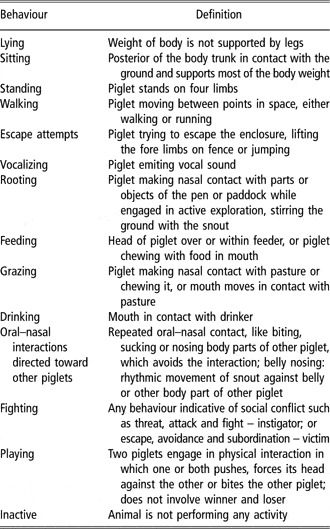
Weaning was carried out between 0800 h to 1200 h of day 1. Behaviour was recorded by direct visual observation (Altmann, Reference Altmann1974), during four consecutive days, from 1400 h to 1800 h, starting on day 1. The position of each piglet and its behaviour (Table 1) was registered by instantaneous sampling carried out every 1.5 min – with a 1 min gap every 10 min – totalling 576 observations/pen per day.
List of behaviours observed and respective description

The effect of age at weaning on the performance of the piglets, which has been presented and discussed elsewhere (Alexandre Filho, Reference Alexandre Filho2002), is not included in this article.
Effects of weaning age (n = 6 groups/treatment) and post-weaning day on frequency of every behaviour, and interactions between both, were analysed by repeated measures analysis of variance, after verification of homogeneity of the variance. Fisher’s protected LSD was used post hoc to test for differences between weaning ages within days. Data are presented as mean ± s.e.
Results
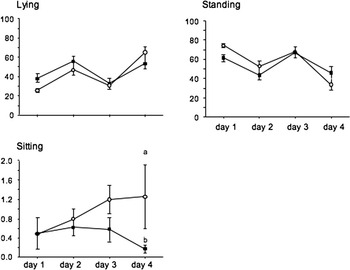
Piglets’ positions are shown in Figure 1. There was no main effect of weaning age on lying or standing position, although there was an interaction between weaning age and day (P < 0.01) on lying and standing (P < 0.01) behaviours, which showed opposite trends. Lying increased, whereas standing decreased, from the first to the last day of observation. Piglets in the D20 treatment spent more time sitting than D30 piglets (P < 0.05), but there were no significant day effect or day-by-weaning age interactions.
Frequency of positions of outdoor reared piglets (mean ± s.e.) weaned at 20 (○) or 30 (▪) days of age, during the first 4 days after weaning (total observations = 575). Day 1 = day of weaning. Differences (LSMeans) between treatments for each day are shown: ab (P < 0.05).

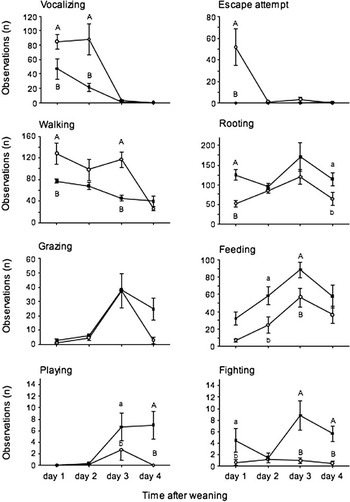
Behaviours are shown in Figure 2. There was an interaction between weaning age and observation day (P < 0.01), and a main effect of weaning age (P < 0.01) for vocalizing, escape attempts and walking. Vocalizations occurred on days 1 and 2 and were higher (P < 0.05) in D20 than D30 piglets. Escape attempts were observed only in D20 piglets, and mainly on day 1. Walking was higher in D30 than D20 piglets on days 1 and 3 (P < 0.01) and decreased with time in both groups.
Frequency of behaviours of outdoor reared piglets (mean ± s.e.) weaned at 20 (○) or 30 (▪) days of age, during the first 4 days after weaning (total observations = 575). Day 1 = day of weaning. Differences (LSMeans) between treatments for each day are shown: ab (P < 0.05) or AB (P < 0.01).

There was a main effect of weaning age on rooting and feeding (P < 0.01), and of days after weaning on grazing (P < 0.001). Feeding was higher in D30 than D20 piglets on days 1 to 3, whereas rooting was higher in D30 than D20 piglets on days 1, 3 and 4.
There was an interaction between weaning age and observation day (P < 0.01), and a main effect of weaning age on fighting (P < 0.01), as well as playing (P < 0.03, for both weaning age and interaction). Fighting was higher (P < 0.05) in D30 than D20 piglets in all days except on day 2. Playing was low during days 1 and 2 in both groups, and increased in D30 but not in D20 piglets (P < 0.05) during the following 2 days.
There was a main effect of weaning age on drinking, which was higher on D30 than on D20 piglets (0.52 ± 0.1 and 0.35 ± 0.1, respectively; P < 0.02). There was also a weaning age-by-day interaction and an effect of day on the occurrence of inactive piglets (P < 0.001). The number of observations increased from days 1 to 4 in both groups, and on day 4 differed between D20 and D30 piglets (439.0 ± 11.7 and 317.8 ± 35.2, respectively; P < 0.05). Oral–nasal interactions directed toward other piglets and drinking were very low in both groups (less than two and six observations/day, for each group on average).
Discussion
Higher frequencies of vocalizations, walking and attempts to escape the enclosure, and lower frequencies of feeding and social interactions observed in D20 piglets, compared to D30 piglets, indicate that piglets reared outdoors have more difficulty adapting to weaning at 20 than at 30 days. In general, the age difference in the behavioural response of piglets reared in outdoor enclosures at weaning was similar to that reported for conventionally housed pigs (Weary and Fraser, Reference Weary and Fraser1997; Worobec et al., Reference Worobec, Duncan and Widowski1999; Colson et al., Reference Colson, Orgeur, Foury and Mormède2006). It must be pointed out that differences in the piglets’ stage of development, which, in the present study, cannot be differentiated from responses to weaning, may explain some differences observed between the treatments.
The present results support other studies that have shown that increasing weaning age can help improve piglets’ feeding behaviour or intake after weaning (Gonyou et al., Reference Gonyou, Beltranena, Whittington and Patience1998; Worobec et al., Reference Worobec, Duncan and Widowski1999; Main et al., Reference Main, Dritz, Tokach, Goodband and Nelssen2004). Low energy intake at weaning is the most important factor affecting small intestine villous height of piglets after weaning (Marion et al., Reference Marion, Biernat, Thomas, Savary, Le Breton, Zabielski, Le Huerou-Luron and Le Dividich2002), and has known negative effects on the piglets’ metabolism, growth and health (Le Dividich and Sève, Reference Le Dividich and Sève2000; Dong and Pluske, Reference Dong and Pluske2007), thus being a major welfare issue. The distress associated with the separation from the sow and the inexperience with ingestion of solid feed at this age possibly underlie the low feeding behaviour during the first days after weaning, with a stronger effect on the youngest group. Intakes of solid feed and feeding frequency tend to be low during the first weeks after birth if piglets are with the sow (Weary et al., Reference Weary, Pajor, Bonenfant, Fraser and Kramer2002; Colson et al., Reference Colson, Orgeur, Foury and Mormède2006). Additionally, intakes are highly variable among litters and within littermates (Pajor et al., Reference Pajor, Fraser and Kramer1991), and not all piglets consume solid feed when it is offered during lactation (Bruininx et al., Reference Bruininx, Binnendijk, van der Peet-Schwering, Schrama, den Hartog, Everts and Beynen2002). As higher intakes of solids before weaning improve intake after weaning (e.g. Bruininx et al., Reference Bruininx, Binnendijk, van der Peet-Schwering, Schrama, den Hartog, Everts and Beynen2002), it has been proposed that one key goal for improving the welfare of piglets at weaning is to achieve high intakes of solid feed before weaning (Weary et al., Reference Weary, Jaspers and Hötzel2008). The outdoor system presents some conditions that may help increase feed intake in the immediate post-weaning period. For example, piglets are exposed to a large group of non-littermates and sows, which could increase their learning of solid-feeding by social facilitation (Morgan et al., Reference Morgan, Lawrence, Chirnside and Deans2001). Furthermore, piglets have the opportunity of experiencing foraging behaviours during lactation through rooting and grazing (Hötzel et al., Reference Hötzel, Machado Filho, Wolf and Dalla Costa2004; Leite et al., Reference Leite, Hötzel, Machado Filho, Martendal, Sommavilla, Batistella and Dalla Costa2008) and of spending time away from the dam (Leite et al., Reference Leite, Hötzel, Machado Filho, Martendal, Sommavilla, Batistella and Dalla Costa2008), which has been shown to increase solid-feed consumption after weaning (Weary et al., Reference Weary, Pajor, Bonenfant, Ross, Fraser and Kramer1999b; Weary et al., Reference Weary, Pajor, Bonenfant, Fraser and Kramer2002). Indeed, weanling piglets from outdoor systems have higher feeding frequencies compared to indoor-housed piglets (Cox and Cooper, Reference Cox and Cooper2001; Hötzel et al., Reference Hötzel, Machado Filho, Wolf and Dalla Costa2004). Despite all these advantages, in the current study, feeding behaviour was low during the first days after weaning and was lower during the first 3 days in the earlier- than in the later-weaned groups. This suggests that, to be effective, any management aiming at increasing piglets’ feed intake in the post-weaning period needs to be associated with an increase in weaning age.
Vocalizations are thought to convey information about the emotional state of young animals prematurely separated from the mother (Newberry and Swanson, Reference Newberry and Swanson2008). Frequencies of vocalizations after separation from the sow are higher in piglets weaned at earlier than later ages (Weary and Fraser, Reference Weary and Fraser1997; Weary et al., Reference Weary, Appleby and Fraser1999a; Colson et al., Reference Colson, Orgeur, Foury and Mormède2006), in smaller, lighter piglets (Weary and Fraser, Reference Weary and Fraser1995; Weary et al., Reference Weary, Lawson and Thompson1996), in piglets kept in colder environments (Weary et al., Reference Weary, Ross and Fraser1997) and in piglets treated aversively during lactation (Hötzel et al., Reference Hötzel, Souza, Machado Filho, Irgang and Probst2007). Though the high frequency of calls observed during the first 2 days after weaning in both treatments – varying from 3.5%–13.0% of the total observations – suggests that weaning was stressful for piglets of both ages, the lower call frequency in D30 than in D20 piglets indicates a better transition to weaning in the older piglets.
Lower frequencies of social interactions, both aggressive and playful, were observed in younger-weaned piglets, suggesting a state of emotional apathy in the younger animals. Usually, high levels of harmful aggression follow weaning when litters are mixed in conventional rearing systems (e.g. Weary et al., Reference Weary, Pajor, Bonenfant, Ross, Fraser and Kramer1999b). Low frequencies of fighting following weaning in this study may have a number of reasons. First, the piglets that formed the new groups were acquainted during lactation, which is known to reduce fighting after mixing (Pitts et al., Reference Pitts, Weary, Pajor and Fraser2000; Weary et al., Reference Weary, Pajor, Bonenfant, Fraser and Kramer2002; D’Eath, Reference D’Eath2005); second, at weaning, these piglets were housed in a large enclosure with relatively low density, where they had the opportunity to root, which is known to reduce peer-directed behaviours (Van de Weerd et al., Reference Van de Weerd, Docking, Day and Edwards2005). Additionally, because of the higher environmental stimulus, outdoor piglets play more during the lactation period (Johnson et al., Reference Johnson, Morrow-Tesch and McGlone2001; Hötzel et al., Reference Hötzel, Machado Filho, Wolf and Dalla Costa2004), which is also thought to reduce fighting after weaning (O’Connell and Beattie, Reference O’Connell and Beattie1999).
The low frequencies of play behaviour in the first days in both groups indicate a distress response to weaning, while the rise in playing behaviour of D30 piglets on days 3 and 4 after weaning suggests an earlier adaptation to weaning than in D20 piglets. As suggested by Donaldson et al. (Reference Donaldson, Newberry, Špinka and Cloutier2002), the negative emotions associated with the separation from the dam may suppress playing behaviour in young piglets by interfering with the ‘having fun’ component of playing, proposed by Špinka et al. (Reference Špinka, Newberry and Bekoff2001). Alternatively, since the ontogeny of social play peaks after 4 weeks of age in piglets (Newberry et al., Reference Newberry, Wood-Gush and Hall1988), the lower frequency of engaging in playful social interactions observed in younger-weaned piglets may also be attributed to differences in the piglets’ development.
In conclusion, the acute behavioural response to weaning observed in piglets reared in an intensive outdoor system is, in general, similar to that described in several studies carried out in conventional confined systems (Bøe, Reference Bøe1993; Gonyou et al., Reference Gonyou, Beltranena, Whittington and Patience1998; Weary et al., Reference Weary, Appleby and Fraser1999a; Worobec et al., Reference Worobec, Duncan and Widowski1999; Colson et al., Reference Colson, Orgeur, Foury and Mormède2006). Although weaning appears to be less stressful for piglets in outdoor than in confined systems (Cox and Cooper, Reference Cox and Cooper2001; Johnson et al., Reference Johnson, Morrow-Tesch and McGlone2001; Hötzel et al., Reference Hötzel, Machado Filho, Wolf and Dalla Costa2004), this study shows that age at weaning influences the adaptation of outdoor-reared piglets to weaning, and that a considerable improvement can be achieved from the 3rd to the 4th week after birth.
Acknowledgements
We acknowledge the help of Renato Egert, Fernando Machado Wolf and Dayane Lemos Teixeira. M.J.H. was supported by a Visiting Researcher Fellowship awarded by the National Research Council of Brazil (CNPq).