1. Introduction
In 2000 the world's leaders adopted the Millennium Development Goals (MDGs), providing a framework for the international community to work together towards ensuring that human development reaches everyone, everywhere, with the ultimate aim of cutting poverty by half, by 2015. South Africa still faces numerous challenges in meeting these goals; about 40 per cent of the country's underprivileged population resides in rural areas and depends either directly or indirectly on land as a source of livelihood (DEA, 2011a). Statistical evidence, thus far, suggests changes in climatic patterns over the past decades in South Africa (Kruger and Shongwe, Reference Kruger and Shongwe2004; Warburton and Schulze, Reference Warburton, Schulze and Schulze2005). Further, these climactic changes are likely to be a more common occurrence in the future (DEA, 2011a). These changing conditions coupled with the already scarce water resources in the country (Durand, Reference Durand2006) are expected to have a significant effect on all sectors of the economy, but more so in the agriculture sector which is directly dependent on climatic variables. South Africa remains vulnerable because of its high dependence on climate-sensitive economic sectors, high levels of poverty and the HIV/AIDS epidemic (DEA, 2011a).
According to the Second National Communication to the United Nations Framework Convention on Climate Change (UNFCCC) report by the DEA, climate change is expected to increase the incidence of food insecurity, exacerbating poverty in South Africa (DEA, 2011a). Overall, the Intergovernmental Panel on Climate Change (IPPC) notes that all four dimensions of food security, namely food availability, food accessibility, food utilization and food systems stability, are expected to be affected by climate change, and this is not only in South Africa but in the greater part of sub-Saharan Africa as well (IPCC, 2007; FAO, 2008). The impacts of climate change on agriculture production, livelihoods and food security therefore continue to remain significant national policy concerns for the South African government (Schulze, Reference Schulze2010). Impacts of climate change on agricultural output can be expected to have not only direct effects on communities in the form of food reductions, but also to have knock-on effects as a whole, affecting economic growth, income and the labour market.Footnote 1
South Africa's smallholder sector will not be spared by these catastrophic climatic events; in fact it remains the most vulnerable due to its high dependence on rain-fed agriculture and limited adaptation strategiesFootnote 2 (Schulze, Reference Schulze2010; DEA, 2011a). Overlooking the role of climate change on South Africa's smallholder agricultural sector may actually dampen the impact of government policy and interventions to reduce food insecurity and meet the MDGs. This study utilizes the nationwide 2008 National Income Dynamics Study (NIDS) and the Ricardian cross-sectional model to examine the response of smallholder subsistence farming households' net revenue to changes in two climatic factors, precipitation and temperature. These small-scale subsistence farmers are poor households who engage in agriculture to supplement their household income and food requirements. In addition to net farming revenue, we also measure how self-reported food adequacy responds to changing precipitation and temperature. Since the results are likely to vary by type of farming system, each of the subsistence farming households is subdivided into the three production systems: specialized crop farmers, specialized livestock farmers and mixed crop-livestock farmers.
Thus far, there has been a rapid increase in literature on climate change and agricultural production in sub-Saharan Africa and elsewhere.Footnote 3 The present study can be seen as complementary to the current Ricardian studies. We follow from Nhemachena et al. (Reference Nhemachena, Hassan and Chakwizira2010) who used GEF data to simultaneously analyze the impact of climate change on net revenue among specialized crop, specialized livestock and mixed farmers. The analysis concentrated on Southern Africa (1,331) using 121 South African farmers, 833 Zambian and 377 Zimbabwean farmers. Due to insufficient observations on specialized livestock farmers, however, separate Ricardian regressions were done for specialized crop farmers and mixed crop-livestock farmers. Accordingly, the current study weighs in on this issue and uses a larger countrywide sample of 1,121 poor South African households who engage in subsistence agriculture and separate our analysis by specialized crop, livestock and mixed crop-livestock farmers. We go a step further to use both objective and subjective outcome measures in our effort to measure these effects. These include net farm revenue (objective measure) which captures both households' food and income generated from agriculture production and self-reported household food adequacy (subjective measure) which is more general and reflexive of households' food availability.
Interestingly, and as expected from this sample of subsistence farming households, simple cross tabulations revealed that the majority of the agriculture produced is retained by the households (58 per cent of the crops harvested and 26.7 per cent of the livestock products). Secondly, a simple polychoric correlation shows a positive and significant sign between agriculture revenue and food adequacy. This suggests that higher agriculture revenue is synonymous with adequate household food among these poor households who practise subsistence farming. The Ricardian regressions show that the climatic variables are significant in predicting net farm revenue and self-reported food adequacy, illustrating that climate change will likely affect the income and diet of poor households who engage in subsistence farming. Specifically, an increase in winter temperature will lead to an increase of R1016.17 in net revenue per farm, while a similar increase in summer temperature will result in a reduction of R713.56. The results also show that a decrease in precipitation will lead to a decrease of R114.41 in winter and R33.80 in summer. More importantly, we observe that the predicted impact (using the HadCM3 model) of a simultaneous decrease in precipitation and an increase in temperature has an adverse effect on net revenue, and will lead to a loss of 151 per cent in farm revenue by 2080. Also importantly, we find specialized crop farming to be the most vulnerable type of production system, while mixed farming appears to be the least vulnerable.
In addition, we made an interesting observation on property rights and land reform: crop farmers earn higher revenue when the land they cultivate is owned by the household; in contrast, livestock farmers have more revenue when the land is communal. The evidence gathered from this study, complementing previous Ricardian models, confirms the impact that climate change will likely have on both the agriculture income and food availability of poor small-scale subsistence farming households in South Africa. The policy message that emanates from the current study is the benefit of diversification or practising mixed farming methods, as we observe the latter to be less vulnerable to the effects of climate change. The remainder of this paper is organized as follows. Section 2 outlines the methodology by providing the analytical framework, description of variables and our econometric model. Thereafter section 3 provides the estimation results and finally section 4 offers the concluding discussion and policy implication. In the online Appendix available at http://journals.cambridge.org/EDE, we provide a detailed literature review on the climate change and food security nexus.
2. Methodology
2.1. Methods of measuring the economic impact of climate change
Two main models are generally employed to measure the economic impact of climate change on agricultural productivity. These include the general equilibrium (economy-wide) and partial equilibrium models. The former models analyze the economy as a system of interdependent sectors, while the latter models look at part of the economy (Deressa and Hassan, Reference Deressa and Hassan2009). An example of the general equilibrium model is the computable general equilibrium (CGE) model which simulates and assesses the structural adjustments that occur in the economy as a consequence of climate changeFootnote 4 (Deressa and Hassan, Reference Deressa and Hassan2009; Nhemachena et al., Reference Nhemachena, Hassan and Chakwizira2010). The partial equilibrium models include the agro-ecological zoning (AEZ), production function and the Ricardian frameworkFootnote 5 (Deressa and Hassan, Reference Deressa and Hassan2009). The Ricardian model is a cross-sectional method to study agricultural production using agro-climatic factors and the value of land or net revenue. The model has the ability to include the adaptation responses of farmers to local climates, which is one of the main advantages of the modelFootnote 6 (Kurukulasuriya et al., Reference Kurukulasuriya, Mendelsohn and Hassan2006; Mendelsohn et al., Reference Mendelsohn, Arellano-Gonzalez and Christensen2009; Di Falco et al., Reference Di Falco, Yesuf, Kohlin and Ringler2012). Another advantage is that the model is cost-effective as data on climatic, production and socio-economic factors can easily be collected from sites (Deressa and Hassan, Reference Deressa and Hassan2009).
One drawback of the Ricardian model is that it excludes other possible adaptation outside farming which is likely to overestimate the damages from climate change (Mendelsohn et al., Reference Mendelsohn, Nordhaus and Shaw1994). This is a minor problem in this study since agricultural land in most rural areas in third world countries has very limited alternatives (Benhin, Reference Benhin2008). A second limitation of the model is the assumption of constant prices (Mendelsohn et al., Reference Mendelsohn, Arellano-Gonzalez and Christensen2009). The main argument here is that the Ricardian price schedule will overestimate the positive effects of climate change since it underestimates damages and overestimates benefits (Adams, Reference Adams1999; Darwin, Reference Darwin1999). The third limitation of the Ricardian approach is that the model does not measure the effect of different levels of carbon dioxide across space which may be relatively important in farm productivityFootnote 7 (Mendelsohn et al., Reference Mendelsohn, Arellano-Gonzalez and Christensen2009). In the current study we adopt the Ricardian model as it takes into account farmers' adaptation strategies and has low data requirements. We use rich cross-sectional countrywide 2008 NIDS data that enable us to study the impact of climate change on a large spectrum of households who use subsistence agriculture to supplement livelihoods. Further, looking at the effects of not only farm revenue but self-reported household food adequacy as well casts a wider net as to how we view climate change and food security among poor subsistence farming households.
2.2. Empirical model specification
The Ricardian model regresses land values against socio-economic and climatic factors to assess the impact of climate change on farm performance. Accordingly, in the model the farms' net revenue (V) is a function of net productivity and costs of farming per hectare as depicted in equation (1).
 $$V = \sum P_{i} Q_{i} \lpar X\comma \; F\comma \; Z\comma \; G\comma \; H\rpar - \sum P_{X} X$$
where P i is the price of crops i, Q i is output of crop i, X is a vector of inputs and does not include land, F is a vector of the climatic variables, H is hydrology/water flow variables, Z is a vector of soil variables, G is a vector of economic variables, P X and is a vector of input prices. The farmer is assumed to choose inputs X to maximize net revenues given the climate, soil and economic conditions. The Ricardian model is based on a quadratic formulation of climate variables, thereby capturing the non-linear relationship between net farm revenues and climate variables as represented in equation (2).
 $$V = \beta_{0} + \beta_{1}F + \beta_{2}F^{2} + \beta_{3}Z + \beta_{4}G + \beta_{5}\log\lsqb H\rsqb + \varepsilon$$
where the error term (ε) captures unobservable effects affecting farmland value. Therefore, in a nutshell, the main focus of the model is to measure the impact of exogenous climate, soil and economic indicators on land values as captured by changes in net revenue. The marginal impact of each of the climate variables (f i ) on farm net revenue in equation (2) is evaluated at the mean as depicted by equation (3):
 $$E\left[{\partial V \over \partial f_i} \right]= \beta_{1\comma j} + 2\beta_{2\comma j} E\lsqb f_{i}\rsqb$$
Our model differs in two ways. First, the standard Ricardian model traditionally includes net revenue or land value per hectare as the outcome variable. Similar to Kabubo-Mariara and Karanja (Reference Kabubo-Mariara and Karanja2007), Seo and Mendelsohn (Reference Seo and Mendelsohn2008) and Nhemachena et al. (Reference Nhemachena, Hassan and Chakwizira2010), our response variable is net revenue, due to data limitation on land size. Secondly, we do not include hydrological variables such as water flows, run-off or irrigation in our model due to data unavailability. The current literature states that precipitation and temperature alone are unlikely to provide a good indication of water availability (such as surface water, ground water or irrigation) for agriculture production (Mendelsohn and Dinar, Reference Mendelsohn and Dinar2003; Kurukulasuriya and Mendelsohn, Reference Kurukulasuriya and Mendelsohn2006). Therefore, adding additional variables which capture surface water and ground water availability in addition to precipitation is recommended. However, according to Kurukulasuriya and Mendelsohn, (Reference Kurukulasuriya and Mendelsohn2006) and Kotir (Reference Kotir2011), more than 80 per cent of farms in Africa depend on rain-fed agriculture. Additionally, Hassan (Reference Hassan2010) and Kotir (Reference Kotir2011) note that less than 5 per cent of land in Africa is irrigated land. Thus the exclusion of irrigation data is unlikely to affect the results in the current context given that it is based on small-scale farmers in South Africa. Our main concern, therefore, in the current study is the exclusion of surface and ground water data. With regard to the surface water, Mendelsohn and Dinar (Reference Mendelsohn and Dinar2003) observed that lack of these data in the Ricardian model underestimates the effects of warming in the United States. Mendelsohn and Dinar (Reference Mendelsohn and Dinar2003) go further to say that the effects, however, are small and that they do not qualitatively change the results that marginal impact has on warming in the United States. However, we are not able to comment on whether this finding is representative in other settings. As such, our results should be interpreted with this in mind. Thus our final model is expressed in equation (4), where is net farm revenue:
 $$V = \beta_{0} + \beta_{1} F + \beta_{2} F^{2} + \beta_{3} Z + \beta_{4} G + \varepsilon$$
2.3. Data sources and definition of concepts and variables
We utilize the 2008 NIDS (see http://www.nids.uct.ac.za) which is collected by the Southern Africa Labour and Development Research Unit (SALDRU). As previously mentioned, the outcome variable is net revenue due to data limitation of land size of the farm. This is defined as the difference between gross revenue and total cost of production, where total cost of production includes transportation, storage, hired labour and machinery, fertilizers, seed and chemicals. Since the climate change impacts are likely to vary by type of production system (Nhemachena et al., Reference Nhemachena, Hassan and Chakwizira2010), we examine separate Ricardian models for specialized crop, specialized livestock and mixed crop-livestock farming systems. In addition, we use an alternative subjective outcome variable – self-reported household food adequacy.Footnote 8 While the net farm revenue captures household food and income, the food adequacy measure is more reflexive of household overall dietary conditions. As previously indicated, the self-reported household food adequacy is likely to be affected by agriculture production and therefore by climate change owing to the fact that according to our data set 58 per cent of the crops produced are retained for household dietary needs and 27 per cent of the livestock products are retained for own consumption as well.
The soil data were obtained from the Institute for Soil, Climate and Water. In total there are 15 different categories of soil in the data.Footnote 9 In the current study long-term normal climate data were obtained from the WorldClim data (see http://www.worldclim.org/). The data consist of 50 years of average precipitation and temperature over the period 1950–2000. Following past Ricardian studies, seasonal averages were computed for temperature and precipitation variables so as to capture the seasonal effects (see Mendelsohn and Dinar, Reference Mendelsohn and Dinar2003; Kurukulasuriya et al., Reference Kurukulasuriya, Mendelsohn and Hassan2006). The seasonal averages were computed following the two major farming seasons in South Africa: summer (December–May) and winter (June–November). The future projections are based on the third version Hadley Centre coupled (HadCM3) model for the years 2020, 2050 and 2080 for the purpose of comparison with previous studies, but choose only one model which is the most conservative model (HadCM3 model). Some of the studies that have been carried out in SSA by Kurukulasuriya et al. (Reference Kurukulasuriya, Mendelsohn and Hassan2006), Benhin (Reference Benhin2008) and Seo et al. (Reference Seo, Mendelsohn, Dinar, Hassan and Kurukulasuriya2009) have indicated that the results appear to be qualitatively the same across alternative models (with the only variation being in the magnitude). Moreover, the current study extends previous studies in South Africa by focusing on net revenue and food adequacy of poor subsistence farming households. This will provide an interesting comparison.Footnote 10 On average the temperature is expected to increase by 1.2°C, 2.4°C and 4.2°C in the years 2020, 2050 and 2080, respectively. Precipitation, on the other hand, is expected to decrease by 5.4 per cent in 2020, 6.3 per cent in 2050 and by a further 9.5 per cent in 2080 on average. Lastly, net revenue is likely to be affected by a host of various farm and household characteristics. Accordingly, the current study uses a number of characteristics as control variables. The selection of these variables follows from current literature and is mainly motivated by the availability of data: whether the farm uses labour and extension services that the household utilizes. The extension services include vet services, pesticides, dips, manure and fertilizers. Our expectation is that these farm characteristics will have a positive effect on net revenue (see Ouedraogo et al., Reference Ouedraogo, Some and Dembele2006; Nhemachena et al., Reference Nhemachena, Hassan and Chakwizira2010).
3. Results
3.1. Descriptive statistics
In table A1 of the online appendix available at http://journals.cambridge.org/EDE, we show the descriptive statistics by type of production system. It is important to emphasize that the main reason why these households participate in subsistence farming is to supplement their household income and to satisfy the household dietary requirements. This is clearly depicted in table A2 of the online appendix which shows the distribution of gross farm revenue by household needs. As is evident, a large proportion of the output from crop farming is used for households' own dietary needs (57.8 per cent), while only 30.1 per cent is sold to generate revenue to supplement household income. In livestock farming a relatively larger proportion of livestock output is sold to generate revenue (48.9 per cent) rather than being kept for the households' own consumption (26.7 per cent). A relatively large amount is also given away as a gift (24.3 per cent). Since livestock is used in a number of African ceremonies, for example bride price (lobola), this trend is not surprising.
3.2. The Ricardian results using net revenue as the outcome variable
3.2.1. The Ricardian results
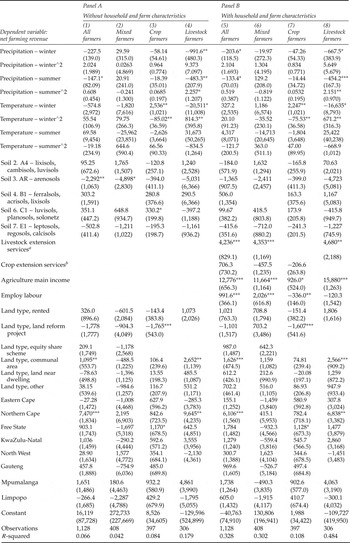
Table 1 shows different specifications of the Ricardian model using net revenue as the outcome variable. In each of the panels we provide the results of the different production systems practised by the households. From the regression results it appears that the various farming systems have different responses to the climatic variables. We test whether the specialized crop, specialized livestock and mixed crop-livestock farmers have similar climatic sensitivity. The F-test is rejected, F(25, 1086) = 1.66, implying that the climatic coefficients are significantly different. Panel B of table 1 (columns 5–8) introduces household and farm characteristics: namely whether the household employs any labour; whether any extension services such as the use of fertilizers and vet services are employed; and whether agriculture revenue is the main source of household income.
Ricardian regressions of net revenue model

Notes: Standard errors in parentheses. ***p < 0.01; **p < 0.05; *p < 0.1. Soil reference: Soil 1. AR – arenosols, acrisols, lixisols. Province dummy reference: Western Cape. Land type dummy reference: household owned. a Livestock extension services include vet services, pesticides and dips. b Crop extension services include manure, fertilizers and pesticides.
Consistent with current studies, the impact of climate change on net revenue will be different for each of the production systems (Nhemachena et al., Reference Nhemachena, Hassan and Chakwizira2010). Furthermore, the estimated coefficients of all the regression models in table 1 show that the climate and soil variables are mostly significant for the different types of production systems, although they appear to be more significant among the specialized crop and specialized livestock farmers. In addition, the significant linear and quadratic coefficients of the climate variables confirm the non-linear relationship between climate and net farming revenue as is evident in the current literature (see, for example, recent work by Kurukulasuriya et al., Reference Kurukulasuriya, Mendelsohn and Hassan2006; Benhin, Reference Benhin2008). The positive sign on the quadratic precipitation coefficient in the summer and winter seasons reveals a ‘U-shaped’ relationship between precipitation and net farming revenue in both seasons. This is consistent with current literature; for example, Seo et al. (Reference Seo, Mendelsohn, Dinar, Hassan and Kurukulasuriya2009) found a positive coefficient in both winter and summer. Kurukulasuriya et al. (Reference Kurukulasuriya, Mendelsohn and Hassan2006) observed similar findings, although these were sensitive to whether the farms were dryland or irrigated farms. In contrast, the negative sign on the quadratic summer temperature shows a ‘hill-shaped’ relationship between summer temperature and net revenue, although the quadratic coefficients are not significant. These findings are also similar to the work of Kurukulasuriya et al. (Reference Kurukulasuriya, Mendelsohn and Hassan2006) and Seo et al. (Reference Seo, Mendelsohn, Dinar, Hassan and Kurukulasuriya2009) for Africa at large. However, the relationship between winter temperature and net revenue remains significant and ‘U-shaped’ for livestock farmers and ‘hill-shaped’ and significant for crop farmers.
Following the current literature, panel B introduces household characteristics that are likely to influence net farm revenue (see Ouedraogo et al., Reference Ouedraogo, Some and Dembele2006; Nhemachena et al., Reference Nhemachena, Hassan and Chakwizira2010). A notable outcome worth mentioning is the difference in the size of the coefficients between panel A and panel B. That is, the Ricardian models in panel B have smaller coefficients (for example, the precipitation in winter coefficient among livestock farmers is −991.6 in panel A, but this same coefficient is −667.5 in panel B) which indicates that, although climate conditions have a significant effect on net farm revenue, various household characteristics (employing labour; using fertilizers, manure or pesticides) play a critical role in mitigating these effects. Also worth noting is that the R-squared statistics are higher among the models in panel B than in panel A, indicating that the additional variables in panel B do belong in the model. Additionally, the F-test on these variables rejects the hypothesis of the additional coefficients in panel B being zero.
Interestingly, panel B shows that the use of livestock extension services such as vet services, pesticides and dips increases revenue. This is represented by the livestock extension services dummy coefficient which is positive and significant. This suggests that livestock farming households who use these services are likely to have higher net revenues. However, the use of crop extension services such as manure, fertilizers and pesticides is not significant among crop farming households, as shown by the dummy coefficient. Another household characteristic that panel B considers is whether agriculture revenue is the main source of household income (that is, 30 per cent or more of total household income). This household characteristic improves net revenue as shown by the positive and significant coefficient of the dummy variable. The type of land used by the household for farming is another characteristic included in panel B. The significant dummy coefficient shows that specialized crop farming households earn more revenue when the land is owned by the household. On the other hand, specialized livestock farming households earn higher revenue when the land is communal, an indication that increasing marginal net benefit is derived by communal access to large tracts of grazing lands.
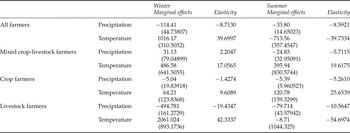
Table 2 examines the marginal effects and elasticity using panel A in table 1. Consistent with current literature, these marginal effects are evaluated at the mean to enable the interpretation of the overall effect of the climatic variables on net revenue (Nhemachena et al., Reference Nhemachena, Hassan and Chakwizira2010). Accordingly, the marginal effect of the precipitation coefficient shows that a marginal decrease in precipitation has the effect of increasing net farming revenue for all households, except for households who practise mixed crop-livestock farming. The precipitation elasticity is negative for both seasons, except for mixed crop-livestock farmers during the winter season. On the other hand, a marginal increase in temperature decreases net farming revenue in summer; however, this increases revenue in winter, suggesting that increase in winter temperature is beneficial to farming. The elasticity is positive for winter and negative for summer temperature, indicating that an increase in temperature has detrimental effects on net farming revenue in summer. When we compare the types of farming systems, we observe that a marginal increase in summer temperature reduces net revenue for specialized livestock farmers, showing that livestock farming is sensitive to an increment of summer temperatures. This is consistent with current literature which shows that livestock farming performs poorly under high temperatures (for example, Seo and Mendelsohn, Reference Seo and Mendelsohn2008). Among specialized crop farming, Benhin (Reference Benhin2008) found that an increase in temperature leads to an increase in net revenue, which is consistent with our results pertaining to specialized crop farming households.
Marginal effects and elasticity

Notes: These are calculated at the mean using the OLS coefficient of models 1–4 in table 1. The standard errors are in parentheses.
3.2.2. Projected impact of climate change
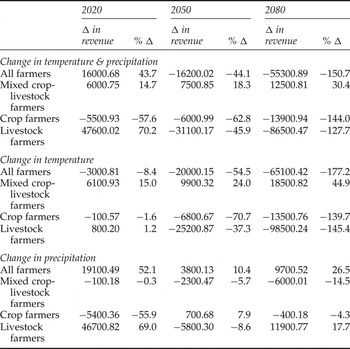
Table 3 shows the impact of future climate change scenarios on the net revenue of poor subsistence farming households. We examine three climate scenarios: the first scenario analyzes an increase in temperature alone, the second scenario assesses a decrease in precipitation alone, while the final scenario looks at a simultaneous decrease in precipitation and increase in temperature. The future projections use the estimated coefficients in panel A of table 1 and the HadCM3 model predictions for 2020, 2050 and 2080. We observe that a simultaneous decrease in precipitation and increase in temperature will have adverse effects on both specialized crop farming households and specialized livestock keeping households. The effects will be stronger among specialized crop farming households (144 per cent decrease in net revenue by the year 2080) than specialized livestock farmers (127.7 per cent decrease by 2080). However, mixed crop-livestock farmers are less likely to feel the concurrent effects. This is observed in the net revenue which remains positive (30.4 per cent) by the year 2080, suggesting that participation in crop production and owning livestock is a potential adaptation strategy.
Climate change impact by type of farmer

Notes: Considers an increase in temperature and a decrease in precipitation. The predictions use the regression models 1–4 of table 1.
The results also reveal that an increase in temperature alone negatively affects net revenue more than a decrease in precipitation alone, highlighting the brutal and pivotal role of global warming on subsistence farming. This is evident from the large percentage deceases in net revenue caused by temperature (the range is between 145 and 177 per cent) compared to the smaller decreases caused by precipitation (4.3 to 14.5 per cent). The future impact of climate change on net revenue (table 3) is also depicted in graphical form in figures A1 and A2 of the online appendix. The net revenue curves are downward sloping indicating that a simultaneous decrease in precipitation and increase in temperature has severe effects on the net revenue of subsistence farming households. Additionally, while a simultaneous change in both precipitation and temperature will have a negative impact, the effects are also likely to be more severe when climate changes as a result of an increase in temperature rather than as a result of a decrease in precipitation alone. This is consistent with current African literature on climate change and farming in, for example, Kurukulasuriya et al. (Reference Kurukulasuriya, Mendelsohn, Hassan and Dinar2008), Seo et al. (Reference Seo, Mendelsohn, Dinar, Hassan and Kurukulasuriya2009) and Nhemachena et al. (Reference Nhemachena, Hassan and Chakwizira2010). As we previously observed, households that practise crop and livestock farming are less likely to be affected by climate change. This is depicted by the net revenue curve for mixed crop-livestock farming households, which is increasing at a decreasing rate, while the specialized crop farmers and specialized livestock farmers' net revenue curves are decreasing.
Furthermore, the distinction between the effects that temperature will likely have on farming and the effects that a decrease in precipitation will have, as indicated earlier, is shown by the net revenue curves in figures A1 and A2. Specifically, whereas the net revenue curves are relatively steeper and downward sloping (except for the net revenue curves belonging to mixed crop-livestock farmers), indicating a gradual decrease in net revenue, the net revenue curves in figure A2 are relatively flatter, indicating that net revenue is likely to remain constant over time.
3.3. The Ricardian results using household food adequacy as the outcome variable
As indicated earlier, the households in this sample mainly engage in agriculture to supplement their household income and meet household dietary requirements. Hence a question worth investigating is the direct effect of climate change on household food availability. This is especially because in table A2 of the online appendix we show that the majority of the agriculture output was retained for households' own dietary requirements. Therefore the pivotal question is whether there is a relationship between household food and agriculture revenue. We test this relationship by comparing self-reported household food adequacy and agriculture revenue using a simple correlation test. We use the polychoric correlation test since the self-reported food adequacy variable is categorical in nature. This implies that the agriculture revenue needs to be converted to a categorical variable as well. We do this by constructing agriculture revenue quartiles. Table A3 in the online appendix shows the correlation between the self-reported food adequacy and household farming revenue. We find a positive and significant sign between agriculture revenue and self-reported food adequacy in general. This suggests that higher agriculture revenue implies higher self-reported food adequacy. This is especially more significant with agriculture revenue from crop farming.
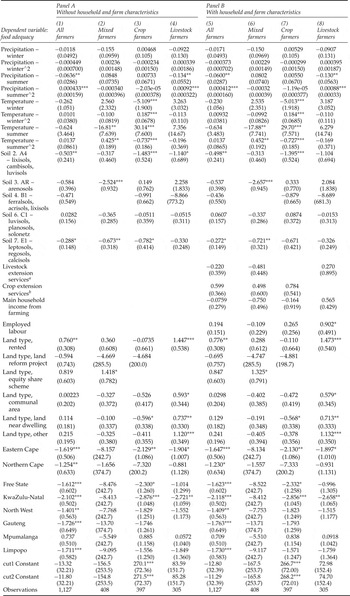
We extend the above analysis to the Ricardian framework where the self-reported food adequacy becomes our response variable and we use similar regressors from table 1. The objective here is to assess the direct impact of climate change on household food. The Ricardian results are shown in table 4. Unlike the ordinary least square (OLS) regressions in table 1, in table 4 we use ordered probit regressions to accommodate the categorical nature of the outcome variable self-reported food adequacy. The Ricardian output in table 4 reveals that climate variables are significant determinants of household food adequacy. These regression models are more significant for specialized crop farming households than for specialized livestock and mixed crop-livestock farmers. This is consistent with our early findings in table A2 which revealed that most of the agriculture output from crop production is retained for household consumption, and also in the polychoric correlation in table A3 that showed crop revenue to be significantly correlated with self-reported food adequacy. Hence one would expect the crop farming regression model to be more significant than the other models. In addition, table 4 also depicts evidence of a quadratic relationship between climate and the response variable. Summer precipitation and winter temperature have a ‘U-shaped’ quadratic relationship and this is significant for specialized livestock farming households and specialized crop farmers, respectively. Winter temperature is significant and has a ‘hill-shaped’ quadratic relationship for crop farmers and is ‘U-shaped’ and significant for mixed crop-livestock farmers.
The marginal effects in online appendix table A5 show that a decrease in summer precipitation decreases food adequacy for all types of farmers, while a decrease in winter precipitation increases food adequacy. We also find that an increase in winter temperature increases food adequacy, while an increase in summer temperature decreases food adequacy for all farmers except for mixed crop-livestock farmers. It is important to note that, although our outcome variable is categorical in nature, the marginal effects are based on linear regressions (OLS) in online appendix table A4 and not the probit models in table 4. This approach follows Angrist and Pischke (Reference Angrist and Pischke2008), who established that similar estimates are produced under linear models even when the outcome is a limited dependent variable (LDV).Footnote 11 See also Ferrer-i-Carbonell and Frijters (Reference Ferrer-i-Carbonell and Frijters2004) for a similar view. In online Appendix table A4 we compare the OLS regression coefficients (used to compute the marginal effects in table A5) and OPROBIT regression coefficients (table 4). We observe the signs and the qualitative tradeoff to be similar between the OLS and OPROBIT regressions, implying that the marginal effects in table A5 are unlikely to be biased by our choice of model.
Ricardian regressions of food adequacy

Notes: Standard errors in parentheses. ***p < 0.01; **p < 0.05; *p < 0.1. a Livestock extension services include vet services, pesticides and dips. b Crop extension services include manure, fertilizers and pesticides.
4. Conclusion and policy implication
The main aim of this study was to determine the impact of climate change on agricultural productivity among poor households. In order to achieve this objective we utilize the Ricardian framework which is a cross-sectional analysis of actual farm performance given varying climatic regions or agro-climatic zones. The Ricardian analysis was based on 1,221 subsistence farming households from the 2008 NIDS. These subsistence farming households are distributed throughout the nine different provinces of South Africa. In addition, the farmers are classified into specialized crop, specialized livestock and mixed crop-livestock farming in order to capture the fact that climate change is likely to affect various farming systems differently. The climate change predictions use the HadCM3 model. The predicted climate data indicate that on average temperature is expected to increase by 1.2°C in 2020, 2.4°C in 2050 and 4.2°C by the year 2080, while average precipitation is expected to decrease by 5.4 per cent in 2020, 6.3 per cent in 2050 and 9.5 per cent in 2080. In general, the results show that the predicted impact of a simultaneous decrease in precipitation and increase in temperature has an adverse effect on subsistence farming households (151 per cent in lost net revenue by the year 2080). Furthermore, and as expected, the results do show that climate change will indeed affect farming systems differently, as we observe that decreases in precipitation and increases in temperature are likely to be more severe among the specialized crop farmers who are likely to lose approximately 144 per cent of their net revenue by 2080. Our results also indicate that, although climate conditions have a significant effect on net farm revenue, various strategies undertaken at the farm level may play a critical role in adaptation to climate change. We find that the use of strategies such as accessing dips among specialized livestock farmers strengthens the resilience of farmers. Our result for specialized crop farmers yields less clear results with fertilizers and pesticide use not being significant for subsistence farmers.
In order to enhance our understanding of the impact of climate change on food security further, we also analyzed the effect of change in temperature and precipitation on self-reported food adequacy in the households of subsistence farmers. Our findings show a strong and positive correlation between self-reported food adequacy and net farming revenue among the subsistence farming households. That is, an increase in farming revenue increases the likelihood of a household having adequate household food supply. We also find that 58 per cent of the total crop production and 26.7 per cent of total livestock products are retained for household dietary needs. Therefore, climate change will not only affect net farming revenue but food adequacy as well for households who mainly participate in subsistence agriculture. The results in this study therefore offer support to the current literature on food security and climate change. Our analysis of poor subsistence farming households yielded further interesting results related to property rights and land reform. We find that while controlling for the effect of changes in temperature and precipitation on net revenues, specialized crop farmers are better off when the farm is owned as opposed to land that is part of a land reform project, rendering efforts by the government to redress land inequality in South Africa particularly vulnerable to the effects of climate change. In the case of specialized livestock farming, more revenue is earned when the land accessed is communal than when the land is privately owned, implying that increasing marginal net benefit is derived by communal access to large tracts of grazing lands for subsistence farmers. This certainly deserves further probing, and hence we highlight this as an important area of future research.
It is worth noting that this study is not without caveats. In general, some of the weakness of the Ricardian model is that the model assumes constant prices; the model does not incorporate carbon fertilization or external policies. In addition to this, similar to the studies by Kabubo-Mariara and Karanja (Reference Kabubo-Mariara and Karanja2007), Seo and Mendelsohn (Reference Seo and Mendelsohn2008) and Nhemachena et al. (Reference Nhemachena, Hassan and Chakwizira2010), our response variable is net revenue instead of net revenue per hectare due to data limitations. Additionally, unlike the current Ricardian models, the current study does not include hydrological variables in the model due to data limitations. However, we take comfort in the fact that Mendelsohn and Dinar (Reference Mendelsohn and Dinar2003) observed that omitting this information from the Ricardian model underestimates the effects of warming, although these effects are small and do not qualitatively change the results. Lastly and most importantly, we acknowledge the uncertainty of climate change projections in the current literature that remain as limitations in the current study in the following ways. Firstly, it is likely that future climates will not resemble the current predicted climates; one needs to use several models to obtain the range of plausible climate scenarios which only improves but does not provide the actual predictions (Kurukulasuriya et al., Reference Kurukulasuriya, Mendelsohn and Hassan2006; Wang et al., Reference Wang, Mendelsohn, Dinar, Huang, Rozelle and Zhang2009). In the current study, however, future projections are only based on one model (HadCM3); using different models such as the Oceanic Canadian Climate Centre (CCC) or Parallel Climate Model (PCM) will likely vary the magnitude of future projections and provide a possible range of expected climate change outcomes (Kurukulasuriya et al., Reference Kurukulasuriya, Mendelsohn and Hassan2006; Hassan, Reference Hassan2010). Secondly, the projections do not take into account the likely adaptation changes in technology or land use or prices or other capital investments which are likely to affect agriculture production and earnings over time (Kurukulasuriya et al., Reference Kurukulasuriya, Mendelsohn and Hassan2006; Seo et al., Reference Seo, Mendelsohn, Dinar, Hassan and Kurukulasuriya2009; Hassan, Reference Hassan2010). That is, the future projections assume constant prices, land use, capital investments and technology over time. Mendelsohn et al. (Reference Mendelsohn, Nordhaus and Shaw1994) were concerned about the effects of changes in weather and economic factors over time, and compares the marginal effects between 1978 and 1982 data. The authors observe the climatic variables to be similar in both years, showing that the climate effects on agriculture do in fact appear to be stable over time; whether their findings are representative in other settings is perhaps questionable. Notwithstanding these caveats, the current study does, however, provide evidence on the impact of climate change on small-scale subsistence farming households as observed through net farm revenue (mainly used for household dietary requirements) and food adequacy. The predictions, however, provide only an indicative effect and it is important that future research incorporates hydrological data, includes farm size information and also tests alternative models to predict the impact of climate change on South African small-scale subsistence farming households.
One of the major concerns of the South African government is to address food security in the era of climate change. Our results indicate that climate change will affect the food availability of poor households who depend on small-scale agriculture to supplement their livelihoods and diet. Diversification is frequently mentioned in the adaptation literature as a potential strategy for climate change. One of the most notable results to emerge from this study is the difference in climate change impact across different farming systems, where we observe that specialized crop farmers are the most vulnerable while mixed crop-livestock farmers appear to be the least vulnerable. Mixed crop-livestock farming is the second most prevalent form of farming in our sample after specialized livestock farming and on average more lucrative than specialized crop farming. Speculatively, it is not unlikely that mixed crop-livestock farming strategies will become more prevalent as farmers begin to respond to changes in climate over time. This is because our results show that mixed farmers are less affected by climate change; thus, as farmers become more aware of this, they are likely to switch to mixed farming. Since the effects of climate change and variability are likely to continue, these subsistence farming households need a solution as to how to shield themselves from these unavoidable changes. There is therefore a need to emphasize the role of mixed crop-livestock farming to these poor farming households in cushioning the effects of climate change. Such crop-livestock diversification strategies are an important policy tool to ensure that adaptive responses of poor households lead to more resilient communities.
Supplementary materials and methods
The supplementary material referred to in this paper can be found online at journals.cambridge.org/EDE.