INTRODUCTION
The family Zoarcidae is one of the most speciose benthic fish families in the Antarctic waters, having 34 known species in 14 genera, according to recent revisions and descriptions (Anderson, Reference Anderson1990, Reference Anderson2006; Moeller & Stewart, Reference Moeller and Stewart2006; Matallanas, Reference Matallanas2008, Reference Matallanas2009a, Reference Matallanasb, Reference Matallanas2010a, Reference Matallanasb). Many specimens of this family were captured with baited traps in the Bellingshausen Sea during the Spanish BENTART Research Programmes (Matallanas & Olaso, Reference Matallanas and Olaso2007).
In the present report, a new species, Santelmoa elvirae sp. nov., is described on the basis of four specimens collected from the Bellingshausen Sea, Southern Ocean, at a depth of 1837 m. The relationships of the new species with Santelmoa carmenae are discussed.
MATERIALS AND METHODS
The type specimens were collected in the Bellingshausen Sea during the Spanish Antarctic expedition BENTART–06 (January–February 2006) on-board of the RV ‘Hespérides’. All the material has been deposited at the UAB fish collection (Zoología, Universidad Autónoma de Barcelona).
Counts, measurements and general terminology follow Gosztonyi (Reference Gosztonyi1977, Reference Gosztonyi1988) and Anderson (Reference Anderson1982, Reference Anderson1988, Reference Anderson1994). Pore terminology follows Gosztonyi (Reference Gosztonyi1977) and Anderson (Reference Anderson1982). Measurements were made with ocular micrometer or dial callipers to the nearest 0.1 mm. Specimens were X-rayed to record both shape and meristics of axial skeleton and vertical fins. Osteological observations were made on one stained specimen. Abbreviations used: SL, standard length; HL, head length; A, anal fin; D, dorsal fin; P, pectoral fin. Tail: from base of first anal fin ray to end of caudal fin.
TYPE MATERIAL
Holotype: female, 305 mm SL (BENTART–06, Bellingshausen Sea, Station MB32N, baited traps; coordinates: 68°48′S 86°38′W; water depth: 1837 m; UAB:B06MBZ39); collected by J. Matallanas 28 January 2006.
Paratypes: male, 351 mm SL (UAB:B06MBZ36), male 349 mm SL (UAB:B06MBZ38), and male 345 mm SL, used for anatomical analysis (UAB:B06MBZ37) captured with the holotype.
COMPARATIVE MATERIAL EXAMINED
Santelmoa carmenae Matallanas, 2010. Holotype male (UAB:B03GSZ51), BENTART–03 cruise to Antarctic Peninsula and Bellingshausen Sea, Station 24N (Gerlache Strait, Antarctic Peninsula; 64°32′58″S 61°97′38″W); collected 26 February 2003 with baited traps, 1056 m depth. Paratype female (UAB:B03GSZ33), paratype male (UAB:B03GSZ42), paratype male (UAB:B03GSZ52), paratype female (UAB:B03GSZ59), paratype female (UAB:B03GSZ60), paratype female (UAB:B03GSZ344), and paratypes (UAB:B03GSZ43) and (UAB:B03GSZ44), used for anatomical analysis, captured with the holotype.
DIAGNOSIS
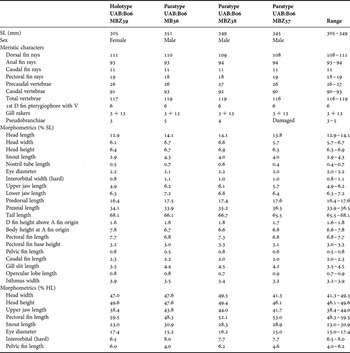
A species of Santelmoa as defined by Matallanas (Reference Matallanas2010a) with the following combination of characters: mouth inferior; vertical folds on posterior end of the upper lip and on the lower lip lobe; oral valve nearly reaching the anterior edge of vomer; two posterior nasal pores; lateral line double with ventral and medio-lateral branches; palatine teeth in single row; dorsal fin rays 108–111; anal fin rays 93–94; pectoral fin rays 18–19; vertebrae asymmetrical, 26–27 + 90–93 = 116–119; gill slit extending ventrally to just lower end of pectoral fin base; two pyloric caeca barely produced; pseudobranch filaments 3–5, elongated. Scales, ventral fins and vomerine teeth present.
Counts and proportional measurements are presented in Table 1.
Counts and measurements of Santelmoa elvirae sp. nov.

SL, standard length; D, dorsal fin; A, anal fin; V, vertebrae; P, pectoral fin; HL, head length.
DESCRIPTION (FIGURES 1–4; TABLE 1)
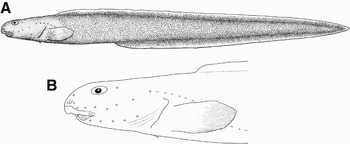
Body ovoid in cross-section; tail elongated and laterally compressed. Head ovoid; snout well developed and rounded, mouth inferior; end of maxilla reaching to a vertical through the centre of eye in female holotype and to posterior margin of pupil in males paratypes; lower lip with a well developed posterior lobe; vertical folds on posterior end of the upper lip and on the lower lip lobe; nasal tube short, unpigmented, not reaching the upper lip when depressed forward. Oral valve nearly reaching the anterior edge of vomer and well separated from the palate laterally. The eye is ellipsoid not entering dorsal profile of head in female holotype, but reaching it in the male paratypes. The gill slit extends ventrally just to the lower edge of the pectoral fin base; opercular lobe small. Upper end of the pectoral fin base at body midline its lower end above ventral profile of body (Figure 1a, b).
Santelmoa elvirae sp. nov., UAB-B06MBZ39 (holotype), 305 mm SL female, from Bellingshausen Sea. (A) Left lateral view; (B) left lateral view of head showing pore pattern.

All teeth are conical. Premaxilla with 4–5 rows anteriorly and single row posteriorly; dentary with 4 irregular rows anteriorly merging suddenly onto single row posteriorly; 6–7 teeth on vomer arranged in two rows. There are three to 6 uniserial teeth on each palatine. Two pyloric caeca barely produced. Gill rakers 3 + 13 forked. Pseudobranch filaments 3–5 are elongated.
Cephalic lateralis pore system has pores small and rounded. Nasal pores 3, one anterior and two posterior nasal; first nasal pore located anteromesial to nostril tube; the two posterior nasal pores located dorsoposterior to it, the posterior one smaller and both coalescent (Figure 1b). Postorbital pores two (positions one and four). Six suborbital pores all on the ventral ramus. Eight preoperculomandibular pores. Interorbital and occipital pores absent. Lateral line configuration double (Figure 1a): ventral branch with numerous closely set neuromasts, beginning just behind the fourth postorbital pore, and extending ventrolaterally to the end of the tail; mediolateral branch originating before anal fin origin and coursing just above mid-body to tail tip. Flesh and skin firm; scales extend completely across body to vertical through mid-pectoral fin, on the ventral surface of the abdomen, between the ventral fins and on vertical fins to about a half their length; pectoral fin base and axil with some scattered scales.
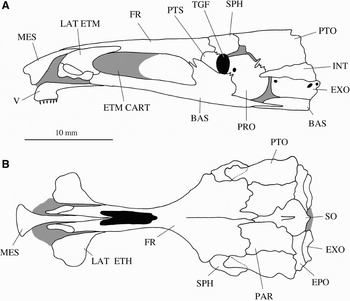
Neurocranium narrowed (Figure 2a, b). Ascending rami of the parasphenoid wing forked, reaching above mid-height of the trigeminofacialis foramen and broadly articulated with the pterosphenoid; frontal and parasphenoid not separated by pterosphenoid. Prootic and pterotic juncture are interdigitating. Intercalar very elongated, protruding into prootic, and excluding exoccipital and pterotic articulation (Figure 2a). Frontal anterior ramus long, with an anterior foramen in the interorbital space; anterior portion of frontals fused with no trace of a suture; posterior portions separate showing a complete suture; frontal corner squared; sphenotic and parietal separated by frontal and pterotic. Supraoccipital with a well-developed median crest posteriorly; supraoccipital excluded from exoccipital by epioccipital (Figure 2b). Ethmoid cartilage protrudes well into the orbital fenestra.
Cranium of Santelmoa elvirae sp. nov., paratype (UAB:B06MBZ37); lateral view (A), dorsal view (B). BAS, basioccipital; EPO, epioccipital; ETM CART, ethmoid cartilage; EXO, exoccipital; FR frontal; INT, intercalary; LAT ETM, lateral ethmoid; MES, mesethmoid; PAR, parietal; PAS, parasphenoid; PRO, prootic; PTO, pterotic; PTS, pterosphenoid; SO, supraoccipital; SPH, sphenotic; TGF, trigeminofacialis foramen; V vomer.

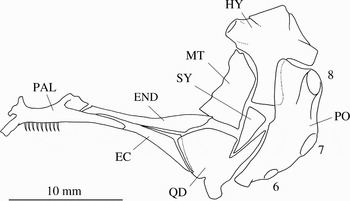
Palatopterygoid series well developed with endopterygoid (=mesopterygoid) and ectopterygoid overlapping more than half of the dorsal and the anterior surface of the quadrate respectively (Figure 3). Metapterygoid is large. Posterior ramus of hyomandibula is short. Symplectic has no posterior strut. Hyoid bar with anterior ceratohyal–posterior ceratohyal (=epihyal) joint serrated. Six branchiostegal rays, four on the anterior ceratohyal and two on the posterior ceratohyal.
Suspensorium and preopercle (PO) of Santelmoa elvirae sp. nov., paratype (UAB:B06MBZ37); external view of the left side. EC, ectopterygoid; END, endopterygoid (=mesopterygoid); HY, hyomandibula; MT, metapterygoid; PAL, palatine; QD, quadrate; SY, symplectic; 6, 7 and 8, preopercular pores.

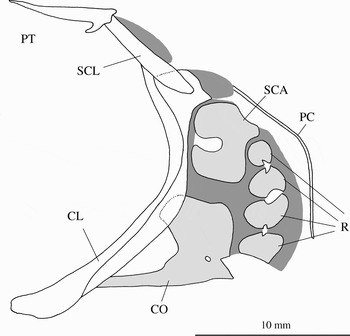
Pectoral girdle (Figure 4) has a strong post-temporal bearing a well-developed ventral ramus. A cartilaginous oval lamina, attached to the posterior part of supracleithrum; another cartilaginous lamina attached to the postero-dorsal end of cleithrum. Scapular foramen is open anteriorly; there is a prominent scapular strut. Coracoid has a well-developed posterior strut and a small foramen. Radials (=actinosts) 4, the uppermost smaller. Three foramina in the cartilaginous basal plate: one between each two radials. Postcleithrum is present. Pelvic fin rays 3, ensheathed by the dermis.
Pectoral girdle of Santelmoa elvirae sp. nov., paratype (UAB:B06MBZ37); external view of the left side. CL, cleithrum; CO, coracoid; PC, postcleithrum; PT, post-temporal; R, radials (=actinosts); SCA, scapula; SCL, supracleithrum.

Vertebrae are asymmetrical, 26–27 + 90–93 = 116–119. Last abdominal vertebra associated with dorsal fin rays 21–22; dorsal fin origin associated with vertebra 6, with no free pterygiophores. Terminal dorsal fin ray associated with second or third preural vertebrae. Three anal fin pterygiophores, with three anal fin rays inserted anterior to the haemal spine of the first caudal vertebra. Terminal anal fin ray associated with second preural vertebra. There is one epural. Caudal fin rays 11, with two associated with the epural, four with the upper hypural and five with the lower hypural.
Colour in alcohol: dark brown uniform; abdomen, dark grey; pectoral and vertical fins, ash-coloured with darker margins; nasal tube unpigmented; lining of mouth light; oral cavity, dark grey; peritoneum, black.
ETYMOLOGY
The new species is named after Elvira, my wife.
DISCUSSION
The new species is placed in Santelmoa by having the following characters: anterior portion of left and right frontals fused; scapular foramen open; anterior ceratohyal–posterior ceratohyal (=epihyal) articulation interdigitating; cranium narrowed; supratemporal commissure and occipital pores absent; intercalar reaching the prootic; ascending rami of the parasphenoid wing high; palatal arch well developed; posterior hyomandibular ramus short; post-temporal ventral ramus well developed; six branchiostegal rays; vertebrae asymmetrical; pelvic fin rays ensheathed; scales, lateral line, pyloric caeca, palatine and vomerine teeth present.
Santelmoa elvirae differs from S. carmenae, type species of the genus, in meristic data (S. elvirae first): dorsal fin rays (108–111 versus 91–95); anal fin rays (93–94 versus 75–79), pectoral fin rays (18–19 versus 16); caudal vertebrae (90–93 versus 75–79); total vertebrae (116–119 versus 99–104). Some morphometric characters are also different in the two species (S. elvirae first): preanal length (33.9–36.5% SL versus 40.1–41.6); tail length (65.5–68.1% SL versus 58.3–59.8), head width (5.7–6.7% SL versus 7.7–10.6); head height (6.3–6.9% SL versus 8.2–8.9). Finally, some additional characters to distinguish the new species from S. carmenae are the following (S. elvirae first): posterior nasal pores (2 versus 1); mouth position (inferior versus subterminal); oral valve (nearly reaching anterior edge of vomer versus overlapping vomer); lateral line configuration (two branches versus three branches); intercalar (protruding into prootic versus reaching prootic); foramina in the basal plate of the pectoral girdle (3: one between each two radials versus 1: between the two central radials).
ACKNOWLEDGEMENTS
I thank the scientific team, the captain, crew and technicians of the RV ‘Hespérides’ for their help during the BENTART–06 cruise, on which the specimens were captured. Special thanks to Dr Ignacio Olaso for helping me on-board with the collection of all type specimens. I am also grateful to Carmen Benito (Manageress, Servei de Radiosòtops, Facultat de Biologia, Universitat de Barcelona, Spain) for the X-rays, and Jordi Corbera for the illustrations. I thank my daughter Muriel for the English correction of the draft manuscript. The constructive criticism of P.R. Moeller and those of another anonymous referee greatly improved the manuscript. The BENTART–06 cruise was supported by the ‘Ministerio de Ciencia y Tecnología, Spain’ (grant number CGL2004-08186). This study was supported by a grant from the Ministerio de Ciencia e Innovación, Spain: ‘Continuación del estudio taxonómico de los Zoarcidae (Teleostei: Perciformes) del Mar de Bellingshausen y de la Península Antártica (Océano Antártico)’ (grant number CTM2009-07583-E).