1. INTRODUCTION
GPS is widely used nowadays but still faces limitations in indoor and dense-urban environments because of the weak received signals. Acquisition of unaided weak GPS signals requires long coherent integration time and more noncoherent integration steps to boost the post-correlation Signal-to-Noise Ratio (SNR). When the coherent integration time is a multiple of one navigation data bit, a search over all possible data bit combinations is required. Since the data bit duration is 20 ms and the data bit edge is synchronized with the 1 ms period Pseudo Random Noise (PRN) code, there are twenty possible bit edge positions. Thus, for weak signals, we have to search over both possible data bit combinations and possible bit edge positions, besides the search of visible satellites, Doppler shifts and code phases.
Many acquisition approaches have been developed. The conventional hardware approach sequentially searches for visible satellites at each possible code phase and Doppler frequency shift bin (Parkinson and Spilker, Reference Parkinson and Spilker1996; Misra and Enge, Reference Misra and Enge2001); a simple but time-consuming method. Then circular correlation method using Fast Fourier Transform (FFT) is introduced to reduce the processing time (Tsui, Reference Tsui2004; Van Nee and Coenen, Reference Van Nee and Coenen1991). Calculation operations are reduced because the correlation at all code phases (or frequency bins) can be computed by one FFT operation, for each Doppler bin (or code phase). In (Tsui, Reference Tsui2004; Lin and Tsui, Reference Lin and Tsui2000; Lin et al., Reference Lin, Tsui and Howell1999), an approach that processes long data coherently with fewer operations, called Double-Block Zero Padding (DBZP), is discussed. It uses a frequency domain method to search over a delay-Doppler space and acquires the GPS signal, using coherent integration time that is a multiple of the 20 ms data bit period. DBZP is especially suitable for unaided software-defined GPS receivers. But the presence of the 50 Hz data bit message and the unknown satellite Doppler shift limit its ability to detect weaker signals through long coherent and noncoherent integrations. Ziedan and Garrison (Ziedan and Garrison, Reference Ziedan and Garrison2004) first modified the DBZP algorithm to solve this problem. The Modified DBZP (MDBZP) algorithm uses a coherent integration time that is a multiple of one data bit, without assuming the availability of any bit edge assisting information. Furthermore, it circumvents DBZP's limitation resulting from the unaccounted effect of Doppler shift on the code duration. It also introduces a frequency bin elimination method after one or several coherent integration steps. Then Heckler and Garrison (Heckler and Garrison, Reference Heckler and Garrison2009) introduced the FMDBZP algorithm based on MDBZP algorithm by eliminating the redundant FFT computations. The number of FFT operations in FMDBZP is found to scale linearly with the coherent integration time, in contrast to the geometric growth experienced in MDBZP. Although FMDBZP can save more operations and memory space than MDBZP, it also can be improved during the coherent integration steps. In this paper, the Optimal Path Search Method (OPSM) is proposed to instead of the All Paths Search Method (APSM) for the FMDBZP algorithm. It consists of unlikely data bit combination path elimination during each coherent integration step to improve the FMDBZP algorithm. It is based on the Viterbi algorithm theory, and aims to reduce the computational operations and save memory space further.
The rest of the paper is organized as follows. In Section 2, the implementation of FMDBZP is illustrated using matrices and figures; in particular, the APSM is introduced. In Section 3, the OPSM during each coherent integration step is proposed based on the Viterbi algorithm. In Section 4, the complexity analysis and comparison between the APSM and the proposed OPSM is analysed. In Section 5, the example testing of the OPSM is presented. In Section 6, conclusions are drawn.
2. IMPLEMENTATION OF FMDBZP
After double-block processing of the received GPS baseband data, zero padding processing of the local code replica and circular correlation between them, an important primary integration matrix M pi will be obtained (Ziedan and Garrison, Reference Ziedan and Garrison2004; Heckler and Garrison, Reference Heckler and Garrison2009; Ziedan, Reference Ziedan2006). The matrix has size of (N b+N b/N db)×N ms, where N b is the number of possible Doppler frequency bins, N ms is number of possible code phase, N db is the number of navigation data bits in the coherent integration time T I. The submatrix of size N b×N ms corresponds to the integration matrix of T I data. The remaining extra submatrix of size (N b/N db)×N ms corresponds to the integration matrix of the next one data bit long data. It will be used later when the possible bit edges are taken into account.
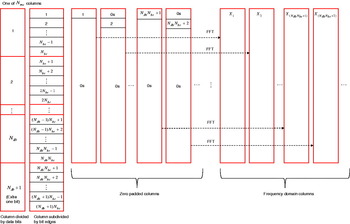
The process is as follows. Divide each one of the N ms columns into (N db+1)N be vectors of length N b/(N dbNbe), where N be is the number of possible data bit edges. Extract each vector from the original column. For each of the 1st to N dbNbeth vectors, remember its original position and then zero pad it into a new vector of length N b. For the (N dbNbe+1)st to ((N db+1)N be−1)st vectors, zero padding them using the same method as the 1st to (N be−1)st vectors, respectively. The (N db+1)N beth vector is discarded. Then ((N db+1)N be−1) vectors of length N b are obtained. The divide and zero padding process is shown in Figure 1. To transform the data to the frequency domain, perform N b-point zoom FFT (Wild et al., Reference Wild, Nieuwkerk and Sittruyen1987; Sorensen and Burrus, Reference Sorensen and Burrus1993; He and Torkelson, Reference He and Torkelson1996; Yang, Reference Yang2001) on the ((N db+1)N be−1) vectors and save the resulted vectors as  . Each member is a vector of length N b.
The division, zero padding and zoom FFT process of one column of the primary integration matrix M pi.

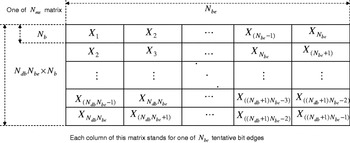
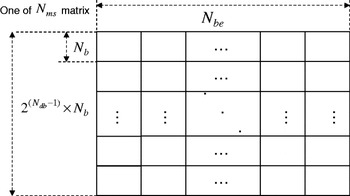
Then, take into account the N be possible navigation data bit edges, and rearrange the  vectors into a matrix of size (N dbNbe)N be. The matrix is named m ti and shown in Figure 2.
The matrix m ti formed by taking into account the N be possible navigation data bit edges.

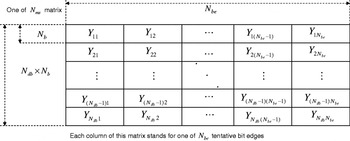
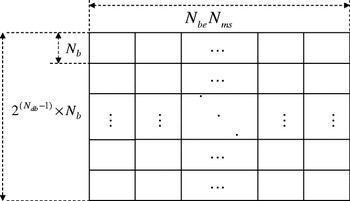
Because every N be data belong to the same data bit, add every N be vectors of each column of matrix m ti in Figure 2. The resulted matrix m bei has size N bNdbNbe and is shown in Figure 3. Each member Y ij is a vector of length N b. The additions are as follows:
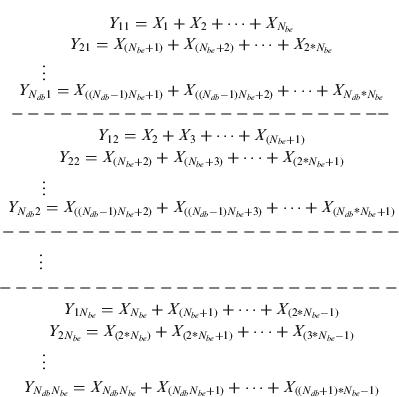
To reduce the calculation operations of Equation Set (1), first calculate 
 , so
 . Then apply the same method to calculate
 to
 .
The matrix m bei formed by taking into account that every N be data lie in the same data bit.

Finally, take into account all the  possible navigation data combination paths when calculate the coherent integration. Take the first column of matrix m bei in Figure 3 as example, the coherent integration operation method on the
 paths is shown in Figure 4. After all the N be columns of matrix m bei in Figure 3 are processed similarly, the partial coherent integration matrix m ci of size
 is obtained, which is shown in Figure 5. Each member is a vector of length
 . Because all the
 possible navigation data combination paths have to be searched exhaustively, we call it the All Path Search Method (APSM).
The APSM: coherent integration operation by taking into account all the  possible navigation data combination paths.

The partial coherent integration matrix m ci formed by taking into account both the N be possible navigation data bit edges and the  possible navigation data combination paths.

After all the N ms columns of the primary integration matrix M pi are processed using the same method as shown in Figures 1, 2, 3, 4, 5 and Equation Set (1), the full coherent integration matrix M ci of size  will be obtained, which is shown in Figure 6. Each member is a vector of length .
The full coherent integration matrix  after all the N ms columns of the primary integration matrix M pi are processed.

To add this coherent integration matrix (size  ) incoherently to the former noncoherent integration matrix (size N bNbeNms), it has first to be circularly rotated at each Doppler frequency bins (Ziedan and Garrison, Reference Ziedan and Garrison2004 [Equation 28]) to compensate the change in code length. Then among all the
 noncoherent integration matrices (size N bNbeNms), preserve the one corresponding to the most likely data bit combination path and discard the others (Ziedan, Reference Ziedan2006). The resulting new noncoherent integration matrix is still of size N bNbeNms.
3. IMPROVED FMDBZP (IFMDBZP)
The APSM shown in Figure 4 has to search all the possible navigation data combination paths. In this Section, the OPSM is proposed to instead of the APSM. It consists of unlikely data bit combination path elimination during each coherent integration step to improve the FMDBZP.
The OPSM is based on the Viterbi algorithm theory (Ziedan, Reference Ziedan2006). The theory is a technique that has been used in many applications. Its objective is to find the optimal solution to a problem, with optimal processing. It estimates the most likely sequence of data, given a set of observations. This is done by dynamic programming, which is an optimal recursive search process (Cormen et al., Reference Cormen and Leisersen1990). In general, dynamic programming can be used to solve a problem if it has the following properties:
• An optimal structure (i.e., the optimal solution to the problem consists of optimal solutions to its subproblems).
• The optimal solution can be expressed in a recursive form.
The idea behind the Viterbi algorithm is that if the most likely sequence of data between points P 0 and P N passes through point P i, then the subsequence from P 0 to P i is also the most likely subsequence. The Viterbi algorithm can be used in the coherent integration operation in Figure 4 by taking into account all the  possible navigation data combination paths. Thus the OPSM is formed to instead of the APSM.
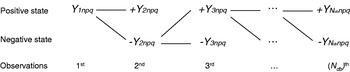
Typically, a problem is formulated for the Viterbi algorithm by representing the system in question with a state diagram, then deriving a trellis graph from it. In our problem, there are 2 states, N db observations and  sequences representing all the possible search paths. The optimal sequence can be found by finding the path with the maximum total weight. Although the optimal sequence can be found by searching all of the paths, such a process is impractical. Instead, the Viterbi algorithm operates recursively and keeps track only of the most likely subsequence after processing each observation. There are two paths to the same state at step i, then only the survivor path, the path with the maximum total weight up to this step, is retained. After processing each observation, there will be only one survivor path. After processing all of the observations, the survivor path with the maximum total weight will contain the most likely sequence.
The matrix m bei in Figure 3 is only one of the N ms matrices formed by taking into account that every N be data lie in the same data bit. Let us mark the full matrix as M bei and rearrange it into a four-dimension matrix. Using Y mnpq represents the element, where m=1,2,…, N db means the mth navigation data bit, n=1,2,…, N b the nth Doppler frequency search bin, p=1,2,…, N be the pth navigation data bit edge, q=1,2,…, N ms the qth code phase search point. The OPSM should be processed for every navigation data bit at every Doppler frequency search bin, every navigation data bit edge and every code phase search point. For m=1, the integration result is I 1npq=Y 1npq. For m=2,3,…, N db, the integration result is determined by:

For m=2, if I 1npq−Y 2npq>I 1npq+Y 2npq, then I 2npq=Y 1npq−Y 2npq;
For m=3, if I 2npq+Y 3npq>I 2npq−Y 3npq, then I 3npq=I 2npq+Y 3npq;
…;
For m=N db, if
 , then
- .
 , then
 .
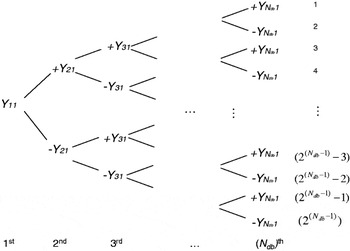
For this example, the trellis graph of the OPSM is shown in Figure 7.  is one of the elements of the final integration result. After all the elements are processed using Equation (2), the final coherent integration M oci will be obtained. M oci has size of N bNbeNms.
The trellis graph of the OPSM.

To add this coherent integration matrix M oci (size N bNbeNms) incoherently to the former noncoherent integration matrix (size N bNbeNms), first it has to be circularly rotated at each Doppler frequency bins (Ziedan and Garrison, Reference Ziedan and Garrison2004 [Equation 28]) to compensate the change in code length. The resulted new noncoherent integration matrix is still of size N bNbeNms.
Because the OPSM needs comparison between the positive and negative states, it is a little more complicated than the APSM. But it does not have to search all the paths and overall it can reduce the calculation operations and save memory space. Furthermore, then the number of data bits N db can be increased appropriately, that is to increase the coherent integration time, to increase the post correlation signal to noise ratio without increasing the overall processing time.
4. COMPLEXITY ANALYSIS AND COMPARISON
The comparison between the APSM and the OPSM will be processed from the aspects of calculation operations and memory space. Because the operations before considering the possible data bit combination paths are the same, the comparison between the two methods starts from where they are different.
It should be pointed out that the primary integration matrix M pi is a complex matrix. All the elements are complex numbers. For two complex numbers, a complex number multiplication equals to four real number multiplications and two real number additions; a complex number addition equals to two real number additions; a comparison operation limits between two real numbers. The addition and subtraction will not be distinguished because they need the same time to process. In this paper, the real number operations are applied to count the operations for both the APSM and the OPSM.
4.1. The All Paths Search Method (APSM)
• At the coherent integration step, when taking into account the
navigation data bit combinations as shown in Figure 4, the number of real number additions is:(3)Taking into account the storage of complex numbers, the needed maximum real number memory space is:(4)• For each element of the full coherent integration matrix M ci, square the real and image parts and then add them. The numbers of real number multiplications and additions are, respectively:
(5)(6)• At the noncoherent integration step, add the current coherent integration matrix (real numbers) to the former noncoherent integration matrix (real numbers). The number of real number additions is:
(7)• Keep the result (real numbers) corresponding to the most likely data bit combination path. The number of comparisons is:
(8)Assume that a real number addition and a comparison need the same time to process. Then for the APSM, the total numbers of real number multiplications, additions and maximum memory space are:(9)(10)(11)
 navigation data bit combinations as shown in









4.2. The Optimal Path Search Method (OPSM)
The analysis of this method is based on N db⩾2.
• At the coherent integration step, when only taking into account the optimal solution among all the possible navigation data bit combination paths as shown in Figure 7, the number of real number additions is:
(12)Take into account the storage of complex number, the needed maximum real number memory space is:(13)For each element of the full coherent integration matrix M oci, square the real and image parts and then add them. The numbers of real number multiplications and additions are, respectively:(14)(15)The number of comparisons is:(16)• At the noncoherent integration step, add the current coherent integration matrix (real numbers) to the former noncoherent integration matrix (real numbers). The number of real number additions is:
(17)Assume that a real number addition operation and a real number comparison operation need the same time to process. Then for the APSM the total numbers of real number multiplications, additions and maximum memory space are:(18)(19)(20)









4.3. The Comparison between the OPSM and APSM
The ratios of the OPSM and the APSM for the total numbers of real number multiplications, additions and maximum memory space are, respectively:

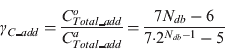
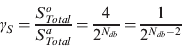
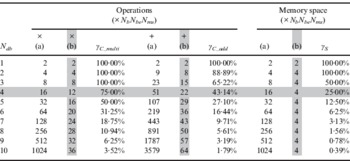
From Equations (21), (22) and (23), it can be concluded that the ratios are only related with N db and they decrease as N db increases. Numerical examples of N db=1, 2, …, 10 are shown in Table 1. Compared to the APSM, the OPSM has no improvement for N db=1, slight improvement (88·89% addition operations) for N db=2, small improvement (65·22% addition operations and 50% memory space) for N db=3, obvious improvement (75% multiplication operations, 43·14% addition operations and 25% memory space) for N db=4, and larger and larger improvement as N db increases. For N db⩾2, no matter how large N db is, the maximum memory space needed is constant.
The comparison between (a) the APSM and (b) the OPSM.

5. NUMERICAL RESULTS
In this section, numerical simulations are run to demonstrate the performances of the FMDBZP algorithm which applies the APSM and the IFMDBZP algorithm which applies the proposed OPSM, respectively.
For signal generators, it generates the baseband GPS signal and sets the sampling frequency f s=5·7 MHz, the Doppler frequency shift 200 Hz. The C/A code phase is 932·5 chips. The Carrier-to-Noise density ratio C/N 0 varies for different signal data. For signal acquisition using both FMDBZP and IFMDBZP algorithms, it sets the coherent integration time T I=80 ms (that is N db=4), the number of possible navigation bit edge N be=10, the number of noncoherent integration  , and the Doppler frequency shift search range [−500, 500] Hz. Then it can be calculated that the number of Doppler frequency search bins is 80, the number of code phase search points is 5700, and the size of the noncoherent integration matrix should be 80×10×5700=456 000.
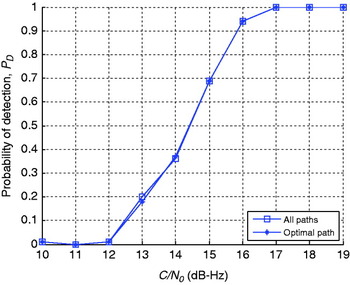
The performances of both FMDBZP and IFMDBZP algorithms, which are shown in Figure 8, are obtained in terms of probability of detection using Monte Carlo simulation method. The probability of detection P D is defined as the probability that the maximum of the final noncoherent integration matrix occurs in the correct cell when a signal is present. The results show that the IFMDBZP algorithm has no performance loss compared to the FMDBZP algorithm. So the proposed OPSM provides a design tool to reduce computation and save memory space without suffering any performance loss.
The final noncoherent integration result.

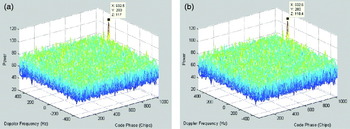
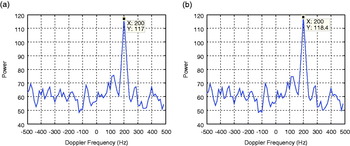
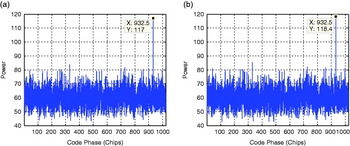
For C/N 0=16 dB-Hz, one successful acquisition using the APSM and the OPSM are shown in Figure 9, Figure 10, and Figure 11, respectively.
The final noncoherent integration result (a) the APSM (b) the OPSM.

Power versus Doppler frequency shift at the correct code phase (a) the APSM (b) the OPSM.

Power versus code phase at the correct Doppler frequency shift (a) the APSM (b) the OPSM.

Both methods give the correct acquisition results. But according to the analysis in Table 1 for N db=4, the OPSM only needs 75·00% real number multiplications, 43·14% real number additions and 25·00% real number memory space comparing to the APSM during the acquisition process. The examples verified that the proposed OPSM can save processing time without suffering any loss compared with the APSM.
6. CONCLUSIONS
Acquisition of weak GPS signals requires long coherent integration time. The Double-Block Zero Padding (DBZP) algorithm can use a long pre-detection integration time without any assisting information to acquire weak GPS signals. The Modified Double Block Zero Padding (MDBZP) algorithm accounts for the Doppler Effect on the code duration. It also develops the Doppler frequency bin elimination method during the noncoherent integration steps. The Fast Modified Double-Block Zero Padding (FMDBZP) algorithm based on the MDBZP algorithm eliminates the redundant Fast Fourier Transform (FFT) computations when considering possible data bit combination paths and bit edge positions. Although the computation burden of FMDBZP is lower than that of MDBZP, it may still be very heavy.
In this paper, the Optimal Path Search Method (OPSM) is proposed to improve the FMDBZP to reduce further the computation processing and save memory space during the coherent integration steps. The analyses show that the proposed OPSM can reduce the computation calculations and save memory space without suffering any loss compared to the All Path Search Method (APSM). And the longer the coherent integration time is, the more benefit one can get from the proposed method. The simulation examples also show that the Improved FMDBZP (IFMDBZP) algorithm using the proposed OPSM has the same acquisition performance as the one using the APSM.
It should be pointed out that, the proposed OPSM can only be used based on FMDBZP but not DBZP or MDBZP. This is because during the coherent integration steps, the FMDBZP eliminates the redundant FFT computations by doing FFT operations (Heckler and Garrison, Reference Heckler and Garrison2009) before taking into account all the possible data bit combination paths.