Infections with methicillin-resistant Staphylococcus aureus (MRSA) represent a critical threat to the health of hospitalized patients and the community at large. Within the healthcare system, intensive care units (ICUs) are major reservoirs of MRSA-colonized and -infected patients.Reference Sydnor and Perl 1 Prevalence of MRSA at admission to ICU of 3.7% to 21%, and acquisition rates during ICU stays of 2.5% to 15% have been reported.Reference Cepeda, Whitehouse and Cooper 2 – Reference Wilson, Huang and McLean 9
Strain typing allows identification of transmission events and, if results are garnered in (near) real time, facilitates the swift implementation of targeted infection control interventions, which may assist in the termination of outbreaks. Techniques utilized in ICUs include pulsed-field gel electrophoresis (PFGE),Reference Cameron, Ferguson and O'Brien 10 , Reference Fung, Ho and Wang 11 spa sequence typing,Reference Khandavilli, Wilson, Cookson, Cepeda, Bellingan and Brown 12 multilocus variable number of tandem repeats fingerprinting/analysis (MLVF/MLVA),Reference Mongkolrattanothai, Mankin, Cranston and Gray 13 and rapid whole-genome sequencing (WGS),Reference Koser, Holden and Ellington 14 all of which have major limitations for outbreak investigation in MRSA-endemic institutions. The multiplex polymerase chain reaction/reverse line blot (mPCR/RLB) platform is a rapid binary MRSA typing method capable of rapidly identifying transmission events with a high level of discrimination,Reference O'Sullivan, Zhou, Sintchenko and Gilbert 15 rendering it uniquely valuable in the delineation of hospital outbreaks.
Colonization pressure (CP) has been shown to increase the risk of MRSA acquisition.Reference Bloemendaal, Fluit and Jansen 16 – Reference Williams, Callery, Vearncombe and Simor 23 Most studies to date have assessed colonization pressure related to all acquisitions of MRSA rather than instances of genotype-confirmed transmission.Reference Bloemendaal, Fluit and Jansen 16 , Reference Ho 18 , Reference Lucet, Paoletti and Lolom 19 , Reference Merrer, Santoli, Appere de Vecchi, Tran, De Jonghe and Outin 21 , Reference Muller, Mauny and Bertin 22 Furthermore, the majority of studies defined CP as the proportion of MRSA-positive patients compared with the total number of patients present, rather than as an absolute value.Reference Bloemendaal, Fluit and Jansen 16 – Reference Lucet, Paoletti and Lolom 19 , Reference Merrer, Santoli, Appere de Vecchi, Tran, De Jonghe and Outin 21 – Reference Williams, Callery, Vearncombe and Simor 23 This approach ignores the potential for the existence of an absolute threshold of CP above which the likelihood of cross transmission increases significantly.
We therefore designed a study to (1) demonstrate the utility of mPCR/RLB strain typing in an Australian ICU and (2) determine the association of absolute CP with genotype-confirmed transmissions.
Methods
Study Design and Setting
This observational cohort study was conducted over 1 year (August 1, 2011 to July 31, 2012) in the 22-bed mixed medical/surgical ICU at Westmead Hospital, a 700-bed tertiary, university-affiliated hospital in Sydney, Australia. The unit consists entirely of single rooms and admits ~1,000 high-acuity patients annually.
Alcohol-based hand rub is mandated for use on entry to and exit from rooms, and contact precautions are instituted for all patients in the ICU. Rooms are terminally cleaned following discharge. There were no changes to infection control practices throughout the study period. Hand hygiene compliance was audited weekly by auditors trained according to standards of Hand Hygiene Australia (http://www.hha.org.au/).
Data Acquisition
Surveillance swabs (anterior nares, axillae, and perineum) for MRSA were obtained from all patients on admission, twice weekly, and upon discharge from the ICU. This surveillance program was in place prior to the beginning of this study. Clinical samples were obtained as required. Decolonization therapy was not routinely undertaken; infections were treated as determined by the attending physician.
The study population was defined as patients at risk of acquiring MRSA in the ICU. This included only patients who were MRSA-negative on admission and who stayed more than 48 hours in the ICU. Those who did not undergo surveillance swabbing within 48 hours of ICU admission were excluded. All patients in the study cohort were followed up during their ICU stay for new-onset MRSA (colonization or infection).
Demographic and disease-related data describing patient characteristics were entered into an Excel spreadsheet (MS Excel 2007), generating an ongoing temporo-spatial record of MRSA in the ICU. The dates and results of surveillance swabs and timing of MRSA acquisitions were recorded. The day of MRSA-acquisition was defined as the date on which a sample (clinical or surveillance) was obtained that subsequently tested positive for MRSA.
Microbiology and Genotyping
Multiple surveillance swabs from individual patients were placed, together, into a single tube of transport medium. MRSA DNA was detected using nucleic acid amplification with the Staphylococcus (4plex) rev 1 kit (Ausdiagnostics®, Sydney, Australia) according to the manufacturer’s directions. PCR-positive samples were cultured on BrillianceTM MRSA agar (Oxoid, Basingstoke, UK) directly and, if culture-negative, following overnight enrichment in methicillin, aztreonam, mannitol salt (MAMS) broth, incubated at 35°C, and subcultured as described above. Characteristic colonies were subcultured onto horse blood agar to ensure purity. PCR-positive, culture-negative samples were rare but were classed as negative. Clinical specimens were cultured using standard microbiology techniques. Colonies were speciated using MALDI-TOF (Bruker Biotyper), and susceptibility testing was performed using automated broth microdilution using BD Phoenix Automated Microbiology System (Becton Dickinson, Sparks, MD, USA).
mPCR/RLB binary genotyping was performed on the patient’s first MRSA isolate from a surveillance swab and all isolates from clinical samples. This method has been extensively described and evaluated; its discriminatory power is comparable with that of PFGE.Reference O'Sullivan, Zhou, Sintchenko and Gilbert 15
Definitions
Patient-days at risk were defined as the day of admission until and including 48 hours post-ICU for all patients discharged alive. Patients discharged home or to another healthcare facility and those who died in the ICU contributed to the number of days at risk until the time of their separation from the ICU.
Imported (prevalent) MRSA cases were those patients with a positive sample (surveillance or clinical) prior to or within 48 hours of admission to the ICU. ICU-acquired (incident) MRSA cases were those with a positive sample (surveillance or clinical) collected more than 48 hours post admission following a negative MRSA-screen at admission.
MRSA acquisition was defined as a genotype-confirmed transmission following identification of a genotype matching that of at least one previously identified patient. Horizontal transmission was defined as transmission between patients in separate rooms who were in the ICU at the same time or within 48 hours of each other at the time of MRSA isolation. Vertical transmission was defined as acquisition by a patient admitted to a room immediately following a previously positive occupant. Other acquisitions were those remaining MRSA-acquisitions for which strain-matched contacts were not identified.
MRSA outbreaks were defined as 2 or more strain-matched transmissions from the same patient source occurring within 1 week and terminating when no further transmissions were demonstrated for a further week.
Colonization pressure (CP) was defined as a daily absolute value representing the total number of MRSA-positive individuals (prevalent + incident) present in the ICU on any given day. CP was calculated daily for the entire study period.
Data Analysis
The statistical software packages SPSS version 21 and S-PLUS version 8 were used for data analysis. Two-tailed tests with a significance level of 5% were used throughout. Kaplan-Meier survival curves were used to illustrate the distribution of time from a patient’s ICU admission to the first MRSA-positive swab.
For each day of the study, the number of patients at risk (ie, MRSA free), the absolute CP, and the number of incident cases of MRSA were recorded. Daily moving averages of the absolute CP for each day were computed for each of the 7 days preceding an acquisition. Poisson regression analysis was used to investigate possible associations between the number of incident cases each day and prior 1–7 day moving averages of the absolute CP.
Results
Study Cohort
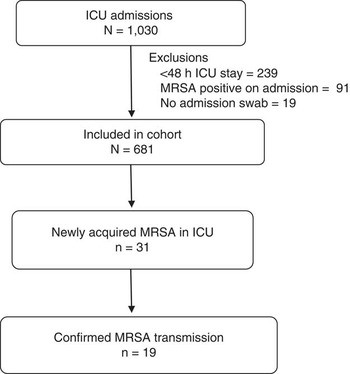
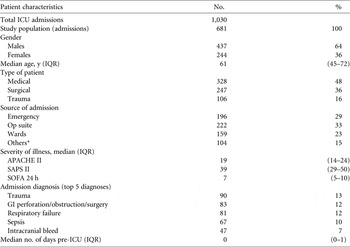
There were 1,030 admissions to the ICU during the study period. Of these, 91 (8.8%) were colonized with MRSA on admission (prevalent cases) and were excluded from the study cohort. Following further exclusions (Figure 1), the final study population comprised 653 patients, with 681 admissions. Clinical characteristics of this population are listed in Table 1.
Enrollment of patients into the study cohort.

Baseline Demographics of the Study Cohort

Note. IQR, interquartile range; ICU, intensive care unit; SAPS II, Simplified Acute Physiology Score II; SOFA, Sequential Organ Failure Assessment score; APACHE II, Acute Physiology and Chronic Health Evaluation II.
* Endoscopy, angiography/cardiac catheter lab, other hospital
Surveillance swabs were collected within 48 hours for 1,011 of all 1,030 (96.2%) admissions. For 681 cohort admissions, surveillance swabs were collected twice weekly for 507 patients (74%), on the day of discharge for 347 patients (51%), and post discharge for 25 patients (3.7%).
MRSA Acquisitions and Genotypes
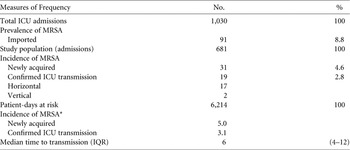
The 681 admissions contributed to 6,214 at-risk patient days; 31 (4.6%) admissions were associated with a MRSA acquisition-incidence rate of 5.0 per 1,000 patient-days at risk (Table 2). A total of 19 of 31 (61%) acquisitions were genotype-confirmed transmissions; 17 (54.8%) of these were horizontal, and 2 were vertical (6.5%; Table 2). No strain-matched contacts were identified for 12 (38.7%) patients.
MRSA Prevalence and Incidence

Note. ICU, intensive care unit; IQR, interquartile range. MRSA, methicillin-resistant Staphylococcus aureus.
* No. per 1,000 patient-days at risk.
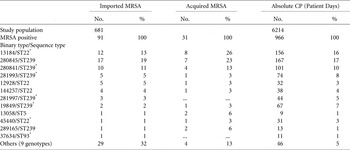
A total of 31 MRSA acquisitions involved 13 genotypes; of these, 8 involved confirmed transmission episodes (Table 3). The most commonly transmitted strain—13184, a subtype of ST22 UK-EMRSA-15—was identified in 6 cases of horizontal (35.3%) and 1 case of vertical (50%) transmission. The sole confirmed transmission resulting in an ICU-acquired MRSA-blood stream infection (BSI) was due to an uncommon subtype (45440) of ST22 UK-EMRSA-15 not previously isolated within the hospital apart from the index (imported) isolate (Table 4).
Prevalence of Common MRSA Genotypes Among the Isolates

Note. MRSA, methicillin-resistant Staphylococcus aureus; CP, colonization pressure.
* Subtypes responsible for cases of MRSA septicemia (280841/ST239 caused 3 of 11 cases)
NB. Not all imported genotypes were included in the table for the sake of brevity
Patient Outcomes

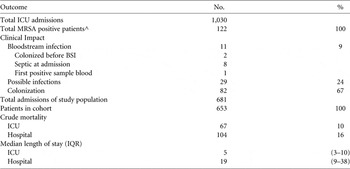
Note. IQR, interquartile range; ICU, intensive care unit; MRSA, methicillin-resistant Staphylococcus aureus; BSI, bloodstream infection.
^ Total (infected +colonized) of imported MRSA and newly acquired MRSA.
The 91 imported MRSA isolates comprised 31 binary types. The most common of these were also the most common endemic strains within our hospital; 280845 (ST239 AUS2/3) and 13184 (ST22 UK-EMRSA-15) represented 19% and 13% of our ICU isolates, respectively (Table 3). Three patients carried 2 genotypes each. All were subtypes of ST239 AUS2/3: (1) 280845 (in urine) on admission, 280841 on a subsequent surveillance swab; (2) 280841 on admission, 280845 on subsequent surveillance; (3) 280845 on admission, later 281993. The MRSA strain was unknown in 9 patients historically identified as carriers but did not swab positive during their admission.
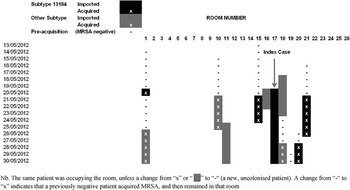
Four separate outbreaks of MRSA colonization occurred during the study period. These events involved genotypes 280845 (Cluster A: 2 transmissions over 3 days); 289165 (ST239 AUS2/3; Cluster B: 2 transmissions over 2 days); and 13184 (Cluster C: 4 transmissions over 9 days in May 2012 [Figure 2]; Cluster D: 2 transmissions in a single day). One patient, admitted for 31 days, was the source of Clusters C and D.
Cluster C outbreak from the index patient in bed 17.

Of all MRSA cases (91 imported +31 acquired =122), 9% were associated with bloodstream infections, 67% with colonization only, and 24% with possible infections (MRSA isolated from a sterile site) (Table 4).
Time-to-Event Analysis
Kaplan-Meier time-to-event graphs were used to plot the cumulative frequency of genotype-confirmed transmissions against time after admission (figure provided on request). The event rate was low beyond 30 days, requiring data to be censored for this analysis. More than 50% of MRSA transmissions occurred during the first week of ICU stay (median, 6.0 d; IQR, 4.0–12.0).
Colonization Pressure
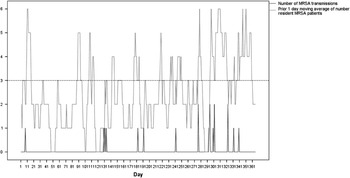
The median daily CP was 2 (IQR, 1–3). Moving averages of the CP on each of 7 days prior to documented transmission events were plotted against the number of genotypically confirmed transmission events on each day of the study (Figure 3). Poisson regression analysis of the data indicated a possible, but not statistically significant (β=0.20; P=0.19), association between a transmission event and the CP on the day before. The number of patients at risk of contracting MRSA on each day was used as the exposure variable in these models.
Temporal trend of relationship between colonization pressure and MRSA transmission. Light grey (top) line demonstrates the prior 1 daily moving average colonization pressure throughout the study period. Dark grey (bottom) line represents transmissions events throughout the study period.

By dichotomizing our data according to the average absolute CP on the day before a transmission event, we were able to demonstrate a statistically significant association between MRSA acquisition and CP when the average number on the previous day equaled or exceeded 3 patients (linear-by-linear association, χ2=7.41; P=0.01).
Hand Hygiene Compliance
Data available from a parallel ongoing audit revealed the median monthly hand hygiene compliance to be 78.8% (range, 52.2–93.3%).
Discussion
This study demonstrates a relatively high rate of prevalent (8.8%) and incident (4.6%) MRSA within our ICU. Genotyping of all isolates using mPCR/RLB revealed a potential source for 61% of acquisitions. Cross contamination occurred despite high rates of compliance with surveillance swabbing at admission (96.2%). Two strains (280845 and 13184) were most prevalent in the general wards were most frequently imported and were responsible for the majority of transmissions. Genotyping facilitated rapid identification of transmission events and played a role in the investigation and management of outbreaks. We demonstrated a statistically significant association between absolute CP and the subsequent risk of MRSA transmission.
Most observed transmission events (n=17; 89.5%) were horizontal. This finding supports the view that the most common vectors for the nosocomial acquisition of MRSA were the contaminated hands of healthcare workers.Reference Thompson, Cabezudo and Wenzel 24 The 2 instances of vertical transmission were considered most likely due to environmental contamination. Our genotype-confirmed transmission rate (61%) was higher than figures reported in other studies.Reference Bloemendaal, Fluit and Jansen 16 , Reference Weist, Pollege, Schulz, Ruden and Gastmeier 25 However, rates of MRSA colonization identified vary according to methods of surveillance (frequency of screening; swab sites; types and numbers of clinical samples; detection method: culture, including media used, vs PCR). Hence, comparison of MRSA rates between different studies is discouraged,Reference Collignon, Looke, Ferguson, McLaws and Olesen 26 and strong conclusions cannot be drawn from the present findings.
mPCR/RLB demonstrated promise as a means of surveillance for the both short- and long-term molecular epidemiology of MRSA within our ICU. The most common imported strains were responsible for the majority of confirmed transmissions. In addition, they matched the MRSA genotypes most frequently encountered in the hospital. mPCR/RLB reliably predicts multilocus sequence typeReference O'Sullivan, Zhou, Sintchenko and Gilbert 15 ; the 2 most common strains (13184, 280845) are subtypes of ST22 UK-EMRSA-15 and ST239 AUS2/3, respectively,Reference O'Sullivan, Zhou, Sintchenko and Gilbert 27 both of which are endemic in South Eastern Australian hospitals.Reference Coombes, Pearson, Christiansen and Nimmo 28 Crucially, the superior discriminatory ability of mPCR/RLB has, to date, identified 24 ST22 and 34 ST239 subtypes.Reference O'Sullivan, Zhou, Sintchenko and Gilbert 15 This ability provides a greater degree of certainty when describing acquisitions as confirmed transmissions. Figure 2 demonstrates the utility of highly discriminatory strain typing in delineating transmission sources during periods of high MRSA prevalence and incidence.
Limitations are encountered when utilizing other genotyping techniques. PFGE has been extensively employed in ICUs,Reference Cameron, Ferguson and O'Brien 10 , Reference Fung, Ho and Wang 11 , Reference Andersen, Lindemann and Bergh 29 – Reference Udo, Aly, Sarkhoo, Al-Sawan and Al-Asar 32 but it is too labor intensive to be used for routine surveillance. spa sequence typing provides rapid results, making it suitable for prospective use.Reference Mellmann, Friedrich and Rosenkotter 33 Its limitations were evident in a study of transmission in a MRSA-endemic environment in which spa typing could not distinguish sufficiently beyond the 2 major strains prevalent in UK hospitals,Reference Khandavilli, Wilson, Cookson, Cepeda, Bellingan and Brown 12 a problem which would be similarly encountered in Australian hospitals. MLVF is rapid and highly discriminatory, but its reproducibility has been questioned.Reference Stefani, Chung and Lindsay 34 Whole-genome sequencing (WGS) was shownReference Koser, Holden and Ellington 35 to be potentially valuable during an outbreak in an English NICU, but it remains expensive, and interpretation of results is yet to be standardized and automated.
Three patients carried a ST239 AUS2/3 subtype on a later swab, differing from the one identified on admission; they were not counted as new acquisitions because MRSA colonization on admission was an exclusion criterion. Therefore, the estimated acquisition rate may have been falsely low. Alternatively, they may have represented strain evolution (likely in 280841/280845, differing by only 1 target) or mixed carriage (likely in 280845/281993).
The patient responsible for 6 transmissions (Figure 2) may have been a “super-shedder.” This phenomenon has been noted in both tracheostomized and urinary-catheterized patients, in situ for 2 and 6 of the transmissions, respectively, and those with desquamative conditions, not evident during the admission.Reference Boswell and Fox 36 , Reference Boyce, Potter-Bynoe, Chenevert and King 37 However, neither the urine nor the sputum grew MRSA, reducing the likelihood of these being contributing factors.
We found a statistically significant increase in the risk of MRSA transmission when the average absolute CP on the day before the event was ≥3. We are unaware of other studies that have linked absolute CP specifically with genotype-confirmed MRSA transmissions. Cheng et alReference Cheng, Chan and Lau 17 demonstrated a link between CP and clone-specific MRSA acquisition rates, but they used a proportionate CP value. Another paper derived a link with an arbitrary absolute CP of ≥2 but no evaluation was performed for genotype-specific acquisitions.Reference Marshall, Richards and McBryde 20 Most studies, however, have assessed proportionate as opposed to absolute CP.Reference Bloemendaal, Fluit and Jansen 16 , Reference Cheng, Chan and Lau 17 , Reference Lucet, Paoletti and Lolom 19 , Reference Merrer, Santoli, Appere de Vecchi, Tran, De Jonghe and Outin 21 – Reference Williams, Callery, Vearncombe and Simor 23 Thus, CP is considered the same if 10 of 20 or 2 of 4 patients are MRSA positive (CP=50%). However, the higher the absolute number of MRSA patients, the greater the opportunities for cross contamination if barrier precautions are not followed. Defining the absolute number of positive patients and the time frame associated with increased risk of transmission gives rise to the possibility of developing an “early warning” system. Once the absolute CP reaches the critical threshold, extra emphasis could be placed on compliance with infection control procedures.
In this study, the risk of MRSA acquisition was time dependent. Although transmission events became increasingly rare with time, they did not plateau on Kaplan-Meier analysis. Increased length of stay is an accepted risk factor for MRSA acquisition.Reference Marshall, Harrington, Wolfe, Fairley, Wesselingh and Spelman 6 – Reference Thompson 8
This study had several strengths. High levels of compliance with admission and subsequent surveillance swabbing during a patient’s stay meant that assessment of MRSA acquisition was relatively accurate, although possibly underestimated because of lower compliance with discharge and post-discharge swabbing. The vast majority of isolates were genotyped, allowing us to confidently classify acquisitions as confirmed versus unconfirmed.
This study had some inherent limitations as well. No swabs of HCW, family members, or of the environment were obtained. CP was calculated generically by the summation of all MRSA cases, rather than grouped as genotype-specific CP due to a lack of overall numbers, limiting the strength of our conclusion. PCR-positive, culture-negative samples were excluded, potentially leading to a minor underestimation of cases. Patients were considered MRSA positive at admission if they had previously been diagnosed regardless of our ICU swab results, potentially leading to an overestimation of MRSA prevalence. Detailed investigation of all known risk factors was not undertaken. This, combined with an overall low event rate, means that definitive causal conclusions could not be drawn from our findings.
Further studies involving real-time analysis and microbiological testing of hypotheses are needed to definitively elucidate the ability of genotyping to assist in understanding and preventing the spread of MRSA. A thorough risk-factor analysis would allow us to solidify the findings with regard to colonization pressure and MRSA transmission risk.
In summary, this study demonstrated the utility of the novel binary genotyping method, mPCR/RLB, in the identification of transmission events in an MRSA endemic environment. Its high discriminatory ability and speed made it suitable for use in the ICU. Furthermore, absolute colonization pressure is significantly associated with MRSA transmission, and routine monitoring of this variable may augment future infection control efforts.
Acknowledgments
The authors wish to thank Carolyn Kim for assembling the databases and Giok Anderson, Jo Tallon, and Kathy Dempsey for assistance collecting the demographic and MRSA data. We extend our sincere gratitude to Professor Jon Iredell for facilitating meetings between the intensive care and microbiology/infectious disease teams. We also thank Dr. Fei Zhou for demonstrating the binary typing method, Monica Cooper for the literature search, Peter Sadler for information assembly, and Tim Sadler and Adam Moody for assistance with the figures.
Financial support: None.
Conflicts of interest: All authors report no conflicts of interest relevant to this article.