Highlights
-
Reversible dementia (ReDem) constituted 20.4% of all dementia cases, with patients presenting at a younger age and with shorter illness durations compared to those with degenerative dementia.
-
Predictive red-flag criteria were significantly more prevalent in the ReDem cohort.
-
Among patients followed, 63.9% reported subjective improvement, and 31.6% demonstrated objective improvement.
Introduction
With the global burden of dementia reaching 57.4 million cases in 2019 and projected to rise to 152.8 million by 2050, neurodegenerative dementias, such as dementia due to Alzheimer’s disease (AD), vascular cognitive impairment and frontotemporal dementia (FTD), account for a significant proportion of cases. Reference Nichols, Steinmetz and Vollset1,Reference Mercy, Hodges, Dawson, Barker and Brayne2 Although it was previously thought to be incurable, Reference Mercy, Hodges, Dawson, Barker and Brayne2 with the advent of emerging disease-modifying therapies, there is a glimmer of hope that all “neurodegenerative” dementias could become “reversible” in the near future. Reference Rabinovici and La Joie3 The quest to reverse dementia began in the 1940s, with the successful treatment of neurosyphilis following the advent of antibiotics. Reference Hahn, Webster and Weickhardt4 Subsequent reports of symptom improvement in patients with normal pressure hydrocephalus further heightened interest in reversible dementias (ReDem). Reference Adams, Fisher, Hakim, Ojemann and Sweet5 Although they represent a small proportion (9–23%) of dementia cases, only 0–10% of them achieve full reversal. Reference Bello and Schultz6–Reference Clarfield10 These numbers offer hope and emphasize the importance of thorough and sometimes extensive evaluations of patients with dementia. Restoring independence in activities of daily living (ADL) in patients with dementia is a crucial goal in their treatment. The range of treatable dementia is diverse, each with its own natural course, treatment approach and therapeutic response, adding to the complexity of managing these cases. Reference Clarfield9 It is vital to understand the occurrence of treatable conditions in patients with dementia to tailor investigative approaches and offer timely treatment. Fortunately, advancements in diagnostics and biomarkers now allow for the early detection of dementia, which is expected to affect the incidence of reversible cases. Reference Porsteinsson, Isaacson, Knox, Sabbagh and Rubino11 Given this background, we aimed to determine the incidence of treatable dementia and delineate the spectrum of diseases presenting with dementia that are amenable to treatment and potentially reversible.
Methods
Patient selection
This retrospective, Cognitive Disorders Clinic (CDC) registry-based observational study was conducted at a tertiary neuroscience institute in South Asia and included all patients who presented between May 2017 and May 2023. The study included patients of any age or sex who experienced a cognitive decline in one or more domains, impacting ADLs, and were found to have a potentially reversible etiology after thorough investigations. Patients with neurodegenerative dementia accompanied by one or more potentially reversible etiologies or uncontrolled comorbid conditions were also included. Patients with incomplete data or an uncertain diagnosis were excluded.
At the time of initial presentation, all patients were first individually evaluated by two cognitive neurologists and then jointly reviewed, and finally, a consensus was reached on the basis of clinical symptoms, cognitive and other examination findings and direct investigations. During retrospective recruitment, cases were selected on the basis of predefined inclusion and exclusion criteria by two blinded investigators. Patient selection, independently conducted by the authors (FA and MSM), showed good interrater agreement.
Medical records were reviewed on the basis of these criteria. The study protocol was approved by the institution’s ethics committee (NIMH/DO/IEC [BS&NS DIV]).
Data collection: The data retrieved from records included sociodemographic profiles, systemic and cognitive symptoms, detailed history of present and past illnesses, comorbidities, drug and exposure history and clinical assessments by a team of cognitive neurology experts. Additionally, scores from a cognitive examination, including the Addenbrooke’s Cognitive Examination-III (ACE-III) scale Reference Mekala, Paplikar and Mioshi12 and dementia severity based on the clinical dementia rating (CDR) scale, Reference Morris13 were also retrieved. Various investigations, including complete blood count, erythrocyte sedimentation rate and biochemical parameters, including serum sodium, potassium, serum glutamic-oxaloacetic transaminase, serum glutamic-pyruvic transaminase, bilirubin, creatinine, urea, free thyroxine (T4) and thyroid-stimulating hormone, were reviewed. CSF analysis was also performed, along with serum and/or CSF autoimmune antibody profiling (N-methyl-D-aspartate receptor, voltage-gated potassium channel, leucine-rich glioma-inactivated 1, contactin-associated protein-like 2, gamma-aminobutyric acid receptor A/B), vitamin B12, folate and homocysteine levels, as were the results of venereal disease research laboratory and rapid plasma reagin tests. Additional investigations to exclude alternative etiologies included the serum antinuclear antibody (ANA) profile, ANA screening, C-reactive protein, anti-neutrophil cytoplasmic antibody and other antibodies, such as anti-thyroid peroxidase and anti-thyroglobulin (anti-Tg). Data from structural brain MRI, electroencephalography and fluorodeoxyglucose-positron emission tomography (FDG-PET) were also collected. Specific tests based on differential diagnosis, such as toxic panels, polysomnography and cardiac evaluation parameters, were also noted. The testing methodology is described in the supplementary article (Supplementary article).
Degenerative dementia (DD) diagnosis
Neurodegenerative dementias, including AD, FTD, corticobasal syndrome (CBS), dementia parkinsonism, dementia with Lewy body (DLBD), Creutzfeldt–Jacob disease, neurodegeneration with brain iron accumulation and adult-onset leukodystrophy, were diagnosed on the basis of clinical history, physical examination and available laboratory investigations, which included structural MRI and FDG-PET MRI. Standard diagnostic guidelines were meticulously followed to define the specific phenotypic presentation of each disease. Reference Albert, DeKosky and Dickson14–Reference Jack, Bennett and Blennow21
Potentially reversible dementia (PRD)
In accordance with Malleta et al., Reference Maletta22 treatable and potentially reversible dementias (PRD) are defined as conditions that, on the basis of detailed clinical history, examination and investigations, can be effectively managed, either fully or partially. This includes secondary dementias caused by various factors, such as structural lesions (e.g., normal pressure hydrocephalus, subdural hematoma and brain tumors), nutritional deficiencies (e.g., vitamin B12 deficiency and folate deficiency), endocrine diseases (e.g., hypothyroidism and hyperthyroidism), vascular diseases, collagenoses (e.g., systemic lupus erythematosus and vasculitis), infectious diseases (e.g., neuroinfections, e.g., meningitis and neurosyphilis and other systemic infections), alcoholic dementia and other diseases (e.g., chronic obstructive respiratory disease and sleep apnea syndrome). It also includes exogenous poisoning, metabolic diseases (e.g., drug poisoning, dyselectrolytemia) and cognitive disorders due to psychiatric diseases (particularly depression and late-onset schizophrenia). Additionally, Brian Draper’s definition emphasizes that treatment should lead to sustained improvement in cognitive function, either reversing existing impairment that meets dementia criteria or preventing progression to dementia in cases where criteria are not yet met. Reference Draper23
Management of these conditions involves medical treatment, surgical intervention, a combination of counseling and therapies or lifestyle changes such as abstaining from certain drugs or habits. This definition applies to conditions where treatment is known to alleviate symptoms or is expected to halt disease progression, if not reduce it. It excludes conditions for which no approved treatment exists or where treatments are still emerging, not yet robustly efficacious or not widely available to patients, such as the current anti-amyloid therapies for AD.
Dual etiology (DE) dementia
Dual etiology (DE) was considered in those patients who met the diagnostic criteria for primary degenerative dementia (DD) but also had one or more associated conditions, which could be new diseases or uncontrolled comorbid conditions, including diabetes mellitus, hypertension, hypothyroidism, heart failure, arrhythmia and chronic obstructive pulmonary disease (COPD), defined on the basis of standard diagnostic guidelines. 24–Reference Elsayed, Aleppo and Aroda28 These additional conditions, along with the primary disease, synergistically worsen symptoms or lead to rapid disease progression. Prompt treatment of these associated conditions is expected to alleviate dementia symptoms to some extent.
Red flags
On the basis of the literature on ReDem, atypical features or red flags were considered. Reference Day29–Reference Chandra, Ray and Isaac31 For all cases of dementia, the following atypical points were assessed as red flags: neurocognitive testing performance incongruent with clinical history, rapid unexplained decline in function, acute or chronic high-risk exposures, younger than expected age at symptom onset, prominent fluctuations, abnormal general or systemic physical examination, a history of high-risk behaviors (past or present) and unexplained or unanticipated findings on the neurological examination.
Follow-up
All recruited patients with PRD and DE dementia were traced, and their follow-up data were captured. Patients who did not return for follow-up were contacted by telephone to obtain their follow-up information. During the follow-up, disease status was assessed in two ways: first, by evaluating subjective improvement on a 1–10 Likert scale (with higher numbers indicating better improvement), and second, by recording the current CDR score.
Statistical analysis
The data were entered into Microsoft Excel (version 2021) and analyzed using IBM-SPSS (version 28; IBM Corp., Armonk, NY, USA). The Kolmogorov—Smirnov test was employed to ensure a normal distribution. Continuous variables are expressed as the means ± SDs (standard deviations) or medians with interquartile ranges (IQRs, Q1–Q3), whereas categorical variables are presented as frequencies, ratios and percentages. Interrater reliability in grouping the cases was assessed using Cohen’s kappa. Parametric tests such as the chi-square (χ 2) test, Fisher’s exact test and independent Student’s t test were used for normally distributed variables. Nonnormally distributed data were analyzed using the Mann–Whitney U test. Binary logistic regression analysis was used to analyze the odds ratios (ORs) and 95% confidence intervals (CIs) of various red flags that were significantly different between the two groups. The results were plotted on a Forrest plot. Statistical significance was set at a two-tailed p-value < 0.05. Data representation was performed via GraphPad Prism version 9.0.
Results
Over a 7-year period from May 2017 to May 2023, our CDC evaluated a total of 1810 cases of dementia. The majority of patients (1440/1810, 79.5%) were diagnosed with purely DD. The remaining 370 patients (20.5%) were considered in the ReDem cohort. Of these, 168 (45.4%) had DD with one or more potentially reversible conditions, classified as DE, whereas 202 (54.5%) had potentially treatable secondary conditions presenting as dementia, classified as PRD.
Thus, the ReDem cohort comprised the sum of the PRD and DE subgroups (Figure 1).
Study flowchart. This flowchart depicts the participant selection process for the study. Initially, 1810 cases of dementia were identified. Among these, 1440 cases were classified as degenerative dementia. The remaining 370 patients were further categorized into reversible dementia groups, including potentially reversible dementia (PRD) and dual etiology subgroups.

Figure 1 Long description
The flowchart begins with 1810 cases of dementia. Of these, 1440 cases are classified as degenerative dementia. The remaining 370 patients are categorized into reversible dementia groups. These groups include degenerative dementia with at least one potentially treatable condition, forming the dual etiology subgroup with 168 cases, and cases with at least one potential treatable etiology, forming the potentially reversible dementia (PRD) subgroup with 202 cases. The dual etiology subgroup has 118 cases with no follow-up, including 107 lost to follow-up and 11 expired. The PRD subgroup has 119 cases with no follow-up, including 111 lost to follow-up and 8 expired. In the dual etiology subgroup, 50 cases are followed up, with 19 showing no improvement and 31 showing improvement, of which 11 show CDR improvement. In the PRD subgroup, 83 cases are followed up, with 29 showing no improvement and 54 showing improvement, of which 31 show CDR improvement.
The ReDem cohort (n = 370) presented at a younger age (57.9 years ± 14.9) and had a lower mean age at disease onset (56.2 years ± 15.3) compared to the DD cohort (n = 1440), which had a mean age at presentation of 61.9 years ± 10.7 years and onset of 59.7 years ± 10.9 years (p < 0.001). Additionally, the ReDem cohort had a shorter duration of illness (20.9 months, IQR 0.0–36.0) than did the DD cohort (24.0 months, IQR 12.0–36.0), p < 0.001.
Both the DD and ReDem cohorts showed a male predominance (66% in DD and 62.2% in ReDem, p = 0.170), with no significant difference in sex distribution between the cohorts. Additionally, there were no differences between the cohorts in terms of mean years of education or rates of bilingualism. In terms of the mean CDR score (DD: 1.5 vs. ReDem: 1.2) and mean ACE-III score (DD: 55.1 vs. ReDem: 69.6), the DD cohort was more cognitively impaired than the ReDem cohort (p < 0.001 for both) (Table 1).
Comparison of clinical-demographic factors between the degenerative and reversible dementia cohorts

Table 1 Long description
The table compares clinical-demographic factors between degenerative dementia and reversible dementia cohorts. It includes data on mean age at onset, mean age at presentation, duration of illness, male gender percentage, mean years of education, bilingual percentage, baseline mean CDR score, and baseline ACE-III score. The degenerative dementia cohort has 1440 participants, while the reversible dementia cohort has 370 participants. Notable trends include a younger mean age at onset and presentation in the reversible dementia cohort, a shorter duration of illness, and higher baseline mean ACE-III scores compared to the degenerative dementia cohort.
ReDem cohort = reversible dementia cohort consisting of the potentially reversible dementia and dual etiology cases; SD = standard deviation; IQR = interquartile range; CDR = clinical dementia rating scale; ACE-III = Addenbrook’s cognitive examination scale score.
Red flags
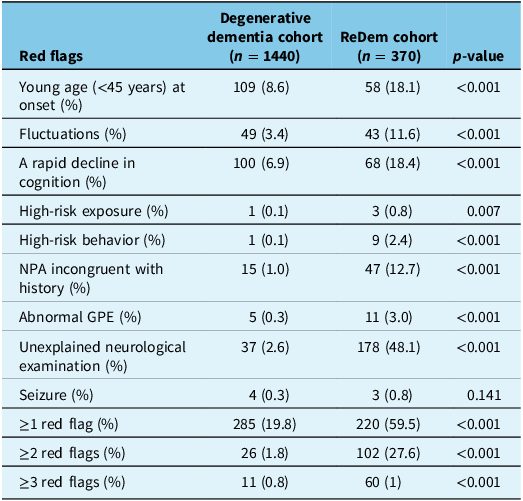
Various red flags were assessed in both the DD and ReDem cohorts on the basis of a detailed history, examination and relevant investigations. In the DD cohort, red flags included young age at onset (8.6%), fluctuations in symptoms (3.4%), rapid decline in cognition (6.9%), high-risk exposure (0.1%), high-risk behavior (0.1%), incongruent neuropsychological assessment (NPA) (1.0%), abnormal general physical examination (GPE) (0.3%), unexplained neurological examination findings (2.6%) and seizures (0.3%).
In comparison, the ReDem cohort presented a greater prevalence of red flags, such as young age at onset (18.1%), fluctuations (11.6%), rapid decline in cognition (18.4%), high-risk exposure (0.8%), high-risk behavior (2.4%), incongruent NPA (12.7%), abnormal GPE (3.0%), unexplained neurological examination findings (48.1%), (p < 0.001 for all comparisons) and seizures (0.8%, p = 0.141).
Furthermore, the ReDem cohort had a significantly greater proportion of one or more red flags (59.5% vs. 19.8% in DD), two or more red flags (27.6% vs. 1.8% in DD) and three or more red flags (1.0% vs. 0.8% in DD) (p < 0.001 for all comparisons) (Table 2).
Comparison of the spectrum of red flags between the degenerative and reversible dementia cohorts

Table 2 Long description
A table with 12 rows and 5 columns compares the prevalence of red flags between degenerative dementia and reversible dementia cohorts. The columns include red flags, degenerative dementia cohort with 1440 participants, ReDem cohort with 370 participants, and p-value. The red flags listed are young age at onset, fluctuations, rapid decline in cognition, high-risk exposure, high-risk behavior, NPA incongruent with history, abnormal GPE, unexplained neurological examination, seizure, one or more red flags, two or more red flags, and three or more red flags. The table shows significant differences in the prevalence of these red flags between the two cohorts, with the ReDem cohort having a higher percentage of red flags in most categories. The p-values indicate the statistical significance of these differences.
ReDem cohort = reversible dementia cohort consisting of the potentially reversible dementia (PRD) and dual etiology (DE) subgroups; NPA = neuropsychological assessment; GPE = general physical examination.
Potentially reversible etiologies
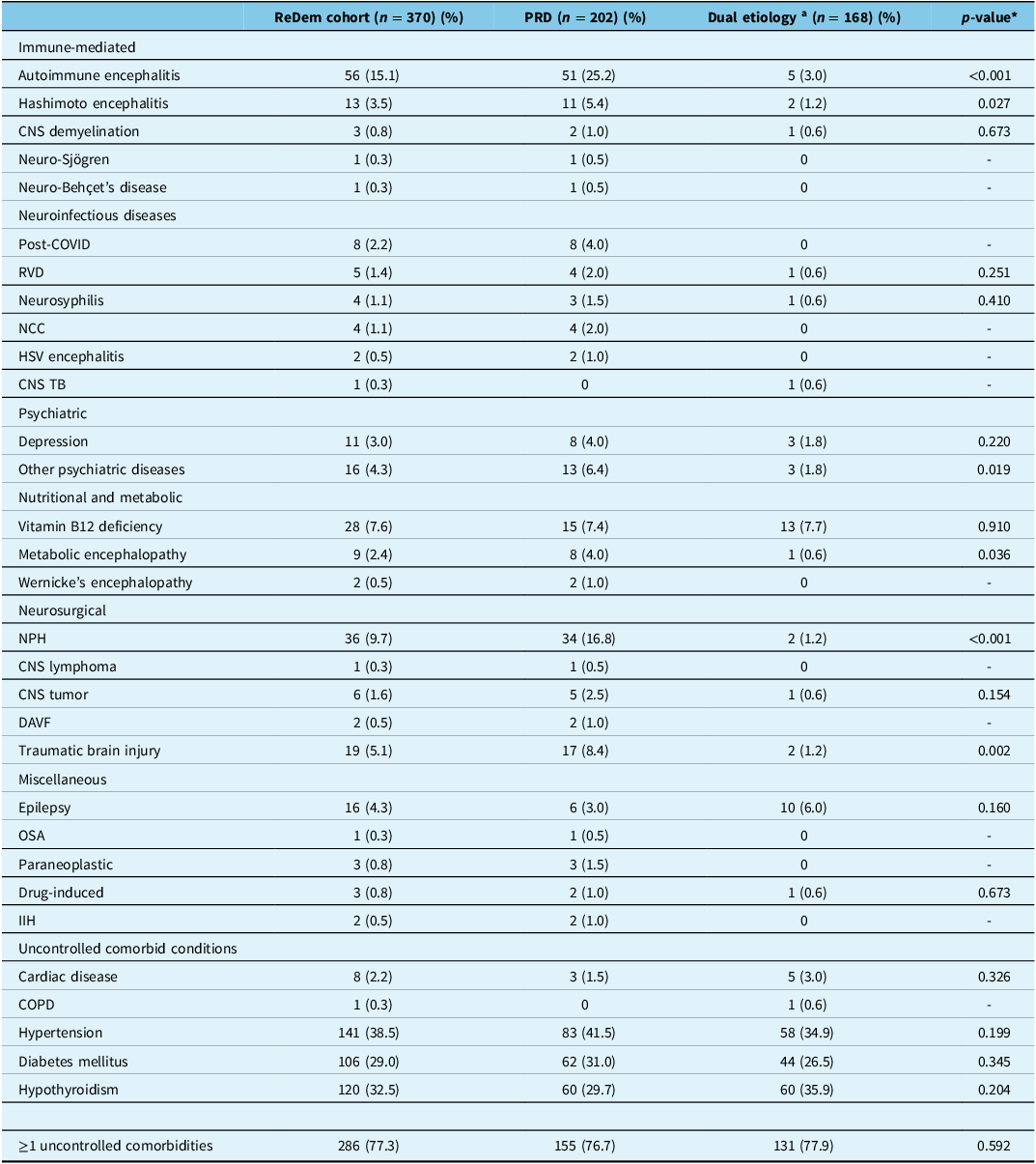
In the ReDem cohort, various potentially reversible etiologies were identified. The immune-mediated causes included autoimmune encephalitis in 56 patients (15.1%), Hashimoto encephalitis in 13 patients (3.5%), CNS demyelination in 3 patients (0.8%) and Neuro-Sjögren syndrome and Neuro-Behçet’s disease each in 1 patient (0.3%). Neuroinfectious diseases included post-COVID-19 neurocognitive impairment in 8 patients (2.2%), HIV-associated dementia in 5 patients (1.4%), neurosyphilis in 4 patients (1.1%), disseminated neurocysticercosis in 4 patients (1.1%), herpes simplex virus encephalitis in 2 patients (0.5%) and central nervous system tuberculosis in 1 patient (0.3%). The neurosurgical conditions included normal pressure hydrocephalus in 36 patients (9.7%), CNS lymphoma in 1 patient (0.3%), CNS tumor in 6 patients (1.6%), dural arteriovenous fistula (DAVF) in 2 patients (0.5%) and traumatic brain injury in 19 patients (5.1%). Psychiatric diseases included depression in 11 patients (3.0%) and other psychiatric diseases in 20 patients (5.4%), including post-traumatic stress disorder (n = 10), anxiety (n = 3), mania (n = 2) and delusional disorders (n = 1). Among the nutritional and metabolic etiologies, vitamin B12 deficiency was observed in 28 patients (7.6%), metabolic encephalopathy in 9 patients (2.4%) and Wernicke’s encephalopathy in 2 patients (0.5%). Other miscellaneous etiologies included epilepsy in 16 patients (4.3%), OSA in 1 patient (0.3%), paraneoplastic syndrome in 3 patients (0.8%), drug-induced encephalopathy in 3 patients (0.8%) and idiopathic intracranial hypertension in 2 patients (0.5%).
Additionally, uncontrolled comorbid conditions were prevalent in the cohort. Cardiac disease, including reduced ejection fraction heart failure (n = 6) and arrhythmia (n = 2), was present in 8 patients (2.2%), COPD in 1 patient (0.3%), hypertension in 141 patients (38.5%), diabetes mellitus in 106 patients (29.0%) and hypothyroidism in 120 patients (32.5%). Overall, 286 patients (77.3%) had at least one uncontrolled comorbidity (Table 3).
Associated etiologies and comorbidities in the ReDem cohort

Table 3 Long description
The table presents data on the prevalence of various medical conditions across three cohorts: ReDem (n = 370), PRD (n = 202), and Dual etiology (n = 168). It includes categories such as immune-mediated, neuroinfectious diseases, psychiatric, nutritional and metabolic, neurosurgical, and uncontrolled comorbid conditions. Each category lists specific conditions with their respective percentages in each cohort. Notable trends include a higher prevalence of autoimmune encephalitis in the PRD cohort (25.2%) compared to the ReDem cohort (15.1%) and Dual etiology cohort (3.0%). Vitamin B12 deficiency is relatively consistent across cohorts, with percentages around 7.4% to 7.7%. Hypertension is prevalent in all cohorts, particularly in the ReDem cohort (38.5%). The table also highlights that a significant portion of patients in each cohort have at least one uncontrolled comorbidity, with percentages around 76.7% to 77.9%. The p-values indicate the statistical significance of the differences observed between the cohorts.
Note: ReDem cohort = reversible dementia cohort with potentially reversible dementia (PRD) and dual etiology (DE) cases; PRD = potentially reversible dementia subgroup; dual etiology consisting of degenerative dementia with ≥1 PRD. NPH = normal pressure hydrocephalus; HSV encephalitis = herpes simplex virus encephalitis; CNS TB = central nervous system tuberculosis; RVD = retroviral disease, that is, acquired immunodeficiency syndrome (AIDS); post-COVID = coronavirus disease, caused by the novel coronavirus SARS-CoV-2; OSA = obstructive sleep apnea; CNS lymphoma = central nervous system lymphoma; CNS tumor = central nervous system tumor; DAVF = dural arteriovenous fistula; IIH = idiopathic intracranial hypertension; COPD = chronic obstructive pulmonary disease. Other psychiatric diseases include post-traumatic stress disorder (n = 10), anxiety (n = 3), mania (n = 2) and delusional disorders (n = 1).
a Dual etiology (DE) consists of Alzheimer’sdisease (n = 50/168, 29.8%), mild cognitive impairment (n = 36/168, 21.4%), FTD (n = 40/168, 23.8%), dementia with Lewy body (n = 5/168,3.0%), vascular cognitive impairment (19/168, 11.3%), dementia parkinsonism (n=7/168, 4.2%), corticobasal syndrome (n = 2/168, 1.2%), Creutzfeldt–Jacob disease (n = 5/168, 3.0%), neurodegeneration with brain iron accumulation (1/168,0.6%) and adult-onset leukodystrophy (3/168, 1.8%).
Treatment and follow-up of the ReDem cohort
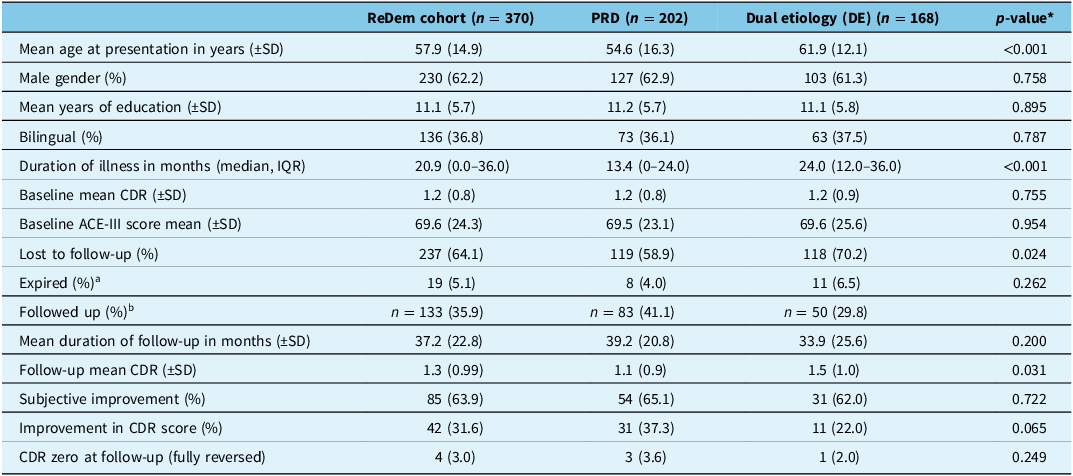
All the patients in the ReDem cohort received appropriate treatment on the basis of their respective diagnoses. Telephonic follow-up and retrospective review of in-person visit records were attempted for all the ReDem cohort. Of the total cohort, 152 patients (41%) could be contacted and were followed up with a mean duration of 37.2 (±22.8) months. Notably, 19 patients (5.1%) expired during the course of illness. Among the remaining follow-up patients (n = 133), 85/133 (63.9%) reported subjective improvement, and 42/133 (31.6%) showed improvement in their CDR scores, with a mean CDR of 1.3 (±0.99) (Table 4).
Comparison of clinical-demographic factors between the potentially reversible dementia and dual etiology dementia subgroups

Table 4 Long description
The table compares clinical-demographic factors between potentially reversible dementia (PRD) and dual etiology dementia (DE) subgroups within the ReDem cohort. It includes data on mean age at presentation, gender distribution, years of education, bilingualism, duration of illness, baseline cognitive measures, follow-up status, and outcomes. The table has 17 rows and 6 columns, with headers for the ReDem cohort, PRD subgroup, DE subgroup, and p-values. Notable trends include differences in mean age, duration of illness, and follow-up outcomes between the subgroups.
ReDem = reversible dementia cohort; PRD = potentially reversible dementia subgroup.
DE is a dual etiology consisting of degenerative dementia with ≥1 PRD subgroup; SD = standard deviation; IQR = interquartile range; CDR = clinical dementia rating scale; ACE-III = Addenbrook’s cognitive examination scale score.
*P-value is calculated between PRD and dual etiology groups.
aExpired patients are part of the lost to follow-up cohort.
b Subsequently, all the percentages are calculated in the followed-up cohort (n = 133).
Subgroup analysis: comparisons between potentially reversible dementia (PRD) and dual etiology (DE) subgroups
Dual etiologies include various neurodegenerative disorders along with ≥1 other potentially treatable etiology. Among the 168 patients with cognitive impairment, AD accounted for 29.8%, followed by MCI (21.4%), FTD (23.8%), DLBD (3.0%), vascular cognitive impairment (11.3%), dementia with parkinsonism (4.2%), CBS (1.2%), Creutzfeldt–Jacob disease (3.0%), neurodegeneration with brain iron accumulation (0.6%) and adult-onset leukodystrophy (1.8%).
Compared with those in the PRD subgroup, patients in the DE subgroup had a significantly greater mean age at presentation (61.9 vs. 54.6 years, p < 0.001) and a longer median duration of illness (24.0 vs. 13.4 months, p < 0.001). They also had a greater percentage of patients lost to follow-up (70.2% vs. 58.9%, p = 0.024) and a higher mean CDR score at follow-up (1.5 vs. 1.1, p = 0.031). The PRD subgroup had a greater prevalence of autoimmune encephalitis (25.2% vs. 3.0%, p < 0.001), Hashimoto encephalitis (5.4% vs. 1.2%, p = 0.027), NPH (16.8% vs. 1.2%, p < 0.001) and other psychiatric diseases (6.4% vs. 1.8%, p = 0.019), whereas it had a lower prevalence of traumatic brain injury (8.4% vs. 1.2%, p = 0.002). However, there were no significant differences in sex, years of education, bilingualism, baseline mean CDR, baseline mean ACE-III score or prevalence of uncontrolled comorbidities between the two subgroups.
In the PRD subgroup, the mean duration of follow-up was 39.2 (±20.8) months, whereas in the DE subgroup, it was 33.9 (±25.6) months. During follow-up, subjective improvement was reported by 54 out of 83 patients (65.1%) in the PRD subgroup and 31 out of 50 patients (62.0%) in the DE subgroup. The CDR score improved in 31 out of 83 patients (37.3%) in the PRD subgroup and 11 out of 50 patients (22.0%) in the DE subgroup. Full reversal (CDR = 0) at follow-up was observed in 4 of 133 patients (3.0%), with no significant difference between the subgroups: 3 of 83 patients (3.6%) with PRD and 1 of 50 patients (2.0%) with DD (p = 0.249) (Table 4).
Red flags for potentially reversible causes in dementia
Several red flags significantly increase the odds of finding a potentially reversible cause in patients with dementia symptoms. Early onset of dementia (<45 years) increased the odds by 2.35 times (95% CI: 1.66–3.31, p < 0.001). Cognitive fluctuations and rapid cognitive decline increased the odds to 3.73 (95% CI: 2.44–5.72, p < 0.001) and 3.02 (95% CI: 2.16–4.21, p < 0.001), respectively. High-risk exposure and behavior dramatically increased the odds to 11.76 (95% CI: 1.22–113.41, p < 0.001) and 35.88 (95% CI: 4.53–284.08, p < 0.001), respectively. Incongruent cognitive assessment findings with the patient’s history presented an odds ratio of 35.15 (95% CI: 23.92–51.66, p < 0.001). Abnormal GPE and unexplained neurological findings further increased the odds to 8.79 (95% CI: 3.04–25.47, p < 0.001) and 13.82 (95% CI: 7.64–25.03, p < 0.001), respectively. The presence of one or more red flags increases the odds ratio by 5.94 (95% CI: 4.65–7.59, p < 0.001), two or more red flags increase the odds ratio by 20.69 (95% CI: 13.19–32.46, p < 0.001) and three or more red flags increase the odds ratio by 25.14 (95% CI: 13.07–43.38, p < 0.001) (Figure 2, Supplementary Table 1). Case vignettes of representative cases are presented in the supplementary article (Supplementary document).
Forest plot of odds ratios for red flags. This forest plot illustrates the odds ratios and 95% confidence intervals (CIs) for various red flags associated with identifying potentially reversible etiologies in patients with dementia symptoms. Red flags such as young age at onset, cognitive fluctuations, rapid cognitive decline, high-risk exposure, high-risk behavior, incongruent neuropsychological assessment (NPA) findings, abnormal general physical examination (GPE) and unexplained neurological examination findings are shown.

Figure 2 Long description
The forest plot displays odds ratios and 95% confidence intervals for various red flags associated with identifying potentially reversible dementia. The x-axis represents the odds ratio, ranging from 0 to 50, while the y-axis lists the red flags: young age at onset, cognitive fluctuations, rapid cognitive decline, high-risk exposure, high-risk behavior, incongruent neuropsychological assessment findings, abnormal general physical examination, and unexplained neurological examination findings. Each red flag is represented by an orange dot with horizontal lines indicating the confidence intervals. Notable high odds ratios include high-risk behavior at 35.88, high-risk exposure at 11.76, and abnormal general physical examination at 8.79. The plot highlights the significance of these red flags in identifying reversible dementia, with all p-values being less than 0.001, indicating strong statistical significance. The green and orange arrows at the bottom indicate the spectrum from degenerative to reversible dementia.
Discussion
In this study, involving a large cohort (n = 1810) of South Asian patients with cognitive impairment, we investigated the incidence of reversible dementia (20.4%), spectrum of reversible etiologies, dual etiologies and associated red flags and the odds of having a reversible etiology. The patients underwent a thorough clinical assessment, investigation and appropriate treatment. Among the patients who were followed up, a substantial number (31.6%) showed partial reversibility, as indicated by improvements in the CDR.
Since the first observational study in 1972, the reported incidence of reversible dementia has varied, reaching 23% in some studies. Reference Weytingh, Bossuyt and van Crevel7,Reference Clarfield9,Reference Clarfield10,Reference Maria Eboli Bello and Rizek Schultz32,Reference Marsden and Harrison33 Our study revealed a similar incidence of 20.4% at the higher end of the spectrum, likely because we included the DE dementia subgroup in our total reversible dementia cohort. Unlike previous studies Reference Weytingh, Bossuyt and van Crevel7,Reference Clarfield9,Reference Clarfield10,Reference Hejl, Høgh and Waldemar30,Reference Maria Eboli Bello and Rizek Schultz32,Reference Freemon and Rudd34,Reference Tripathi and Vibha35 that included only non-degenerative dementias, we considered both PRD without any degenerative illness and DDs with one or more reversible etiologies. This approach is justified by the fact that patients with DD often have comorbidities Reference Bunn, Burn and Goodman36,Reference Ma, Wang and Zhao37 and intercurrent illnesses Reference Klimkowicz-Mrowiec, Furgal, Slowik and Szczudlik38 that exacerbate cognitive decline.
The spectrum of potentially reversible etiologies contributing to dementia is broad and constantly evolving, with specific incidences varying among studies. Reference Chatterjee and Mudher39–Reference Dintica, Calderón-Larrañaga, Vetrano and Xu45 These include nutritional deficiencies (vitamin B12, thiamin, nicotinic acid and vitamin E), metabolic disorders (hypothyroidism, parathyroid dysfunction, adrenal and pituitary disorders, hypercalcemia, hypoglycemia), immune and inflammatory conditions (autoimmune dementia, multiple sclerosis, sarcoidosis, Neuro-Behçet and collagen vascular diseases), infectious diseases (syphilis, chronic meningitis, Whipple’s disease, HIV/AIDS-associated dementia, neurobrucellosis, CNS tuberculosis, parasitic infections, Lyme disease), vascular issues (CNS vasculitis, strategic infarcts), structural abnormalities (hydrocephalus, chronic subdural hematoma, idiopathic intracranial hypotension, intracranial hypertension, NPH, neoplasms, gliomatosis cerebri, radiation effects and lymphoma), toxic exposures (heavy metals, carbon monoxide, liver and kidney diseases), psychiatric conditions (depression, psychosis), epilepsy, drug and alcohol abuse, obstructive sleep apnea, limbic encephalitis, chronic liver, respiratory and renal failure and Wilson’s disease. Reference Chatterjee and Mudher39–Reference Dintica, Calderón-Larrañaga, Vetrano and Xu45 Additionally, there are reports of AD patients whose symptoms worsened due to limbic encephalitis, with treatment leading to symptomatic improvement. Reference Klimkowicz-Mrowiec, Furgal, Slowik and Szczudlik38 Consistent with this, reversible etiologies in our cohort comprised immune-mediated (20.0%), neuroinfectious (6.6%), psychiatric (7.6%), nutritional/metabolic (10.5%), neurosurgical (14.6%) and other miscellaneous causes (12.2%).
Not only are potentially reversible diseases related to cognitive worsening or the risk of dementia, but uncontrolled comorbid conditions, including uncontrolled hypertension, Reference Tadic, Cuspidi and Hering46 diabetes, Reference Wang, Zhao and Lee47,Reference Cholerton, Baker, Montine and Craft48 hypothyroidism, Reference Wieland, Wieland and Wang49 cardiac arrhythmia, Reference Zhang, Liang and Li50 cardiac failure Reference Li, Wu, Zhang, Nie and Onofrj51 and COPD, Reference Wang, Li and Lei52 are also known risk factors for developing cognitive impairment. These unmanaged conditions can exacerbate dementia symptoms, and controlling them is associated with alleviating these symptoms. Reference Bunn, Burn and Goodman36,Reference Ma, Wang and Zhao37,Reference Lin, Li and Chen53 The comorbidities observed in our cohort included uncontrolled hypertension, hypothyroidism, diabetes mellitus, heart failure and arrhythmia. Addressing these comorbidities is crucial as they increase the risk of dementia. Therefore, addressing these comorbidities can improve cognition, as demonstrated by our DE cohort, which showed a 62% subjective improvement and 22% improvement in the CDR score.
In our ReDem cohort, 9.7% of the patients had NPH, with 5.5% of these patients in the DE subgroup. One study indicated that patients with NPH who exhibit CSF constellations typical of AD experience significant cognitive and gait improvements after CSF drainage. Reference Müller-Schmitz, Krasavina-Loka and Yardimci54 Although further research is needed in clinical settings, AD patients with features of concurrent NPH should be further evaluated, and if they respond to a CSF tap test, surgical treatment may improve cognition.
We observed 56 cases of autoimmune encephalitis, 5 of which were in the DE subgroup. Although AD symptoms can be worsened by autoimmune encephalitis, Reference Klimkowicz-Mrowiec, Furgal, Slowik and Szczudlik38 leading to symptomatic improvement with treatment, misdiagnosis of autoimmune encephalitis as neurodegenerative dementia is prevalent, with one study reporting 20.5% of such cases. Reference Flanagan, Geschwind and Lopez-Chiriboga55 One study identified neuronal autoantibodies in 0.8% of presumed neurodegenerative dementia cases, and an observation revealed that 38% of patients with autoimmune encephalitis met the criteria for dementia. Reference Flanagan, Geschwind and Lopez-Chiriboga55–Reference Bastiaansen, Van Steenhoven and De Bruijn57 In our study, the majority of reversible dementia cases (15.1%) were attributed to autoimmune encephalitis, suggesting that autoantibody testing in patients with dementia, especially those with atypical findings, may prevent misdiagnosis and aid in treatment.
Among the B-complex vitamins, niacin, thiamine and vitamin B12 are well known for their impact on mental status. Reference Morris, Schneider and Tangney58,Reference Cardoso, Cominetti and Cozzolino42 Vitamin B12 deficiency is common in AD and has been reported in up to 39.5% of AD cases. Reference Tripathi, Sheshadri, Padma, Jain, Meheshwari and Behari59,Reference Lindenbaum, Rosenberg, Wilson, Stabler and Allen60 Among elderly individuals, B12 deficiency ranges from 5.8% to 15.3%, with low levels linked to decreased cognitive function. Reference Sashindran, Aggarwal and Khera56,Reference Moore, Mander, Ames, Carne, Sanders and Watters61,Reference Jatoi, Hafeez, Riaz, Ali, Ghauri and Zehra62 In our ReDem cohort, 7.6% of the patients had B12 deficiency, which was consistent across subgroups, including patients with DE, emphasizing the need for B12 screening in patients with DD.
Importantly, several neuroinfections such as infectious encephalitis, neurosyphilis and CNS TB are reversible causes of dementia. The prevalence of these infectious etiologies of dementia ranges from 0.3% to 24.5% in African countries, and they frequently present with rapidly progressive dementia. Reference Benyumiza, Kumakech and Gutu63 In our ReDem cohort, 6.5% of the cases were due to neuroinfectious diseases. The incidence varies by study location and referral center type, and our CDC cohort may have underestimated the true prevalence of neuroinfectious diseases.
One patient in our cohort presented with an AD phenotype for four years before being diagnosed with both HIV and AD. Similarly, Calcagno et al. reported four older people living with HIV with neurocognitive impairment who were found to have AD. Reference Calcagno, Celani and Trunfio64 HIV-related hypothalamic-pituitary-adrenal axis dysregulation may promote oxidative stress, neuroinflammation, excitotoxicity, blood-brain barrier disruption and increased amyloid-β, contributing to AD. Reference Calcagno, Celani and Trunfio64 Approximately 6% of patients with DE in our cohort experienced new-onset seizures that led to cognitive decline, which is consistent with studies linking seizures to cognitive deterioration in AD. Reference Hejl, Høgh and Waldemar30,Reference Benyumiza, Kumakech and Gutu63,Reference Tai, Torzillo, Lyall, Manohar, Husain and Sen65 A rare neurosurgical cause of DAVF was observed in two patients, both of whom underwent embolization and achieved improvement in the CDR at the one-year follow-up. Although similar DAVF-associated cognitive impairment in response to the occlusion procedure has rarely been reported, Reference Henderson, Zarghouni, Hise, Opatowsky and Layton66 a high index of suspicion is needed, and treatment can help alleviate the symptoms.
We obtained follow-up data for 41% of the ReDem cohort over an average of three years. A comparison of the PRD and DE subgroups revealed significant differences in age at presentation and illness duration, with the former being younger and having a shorter duration of illness. The PRD subgroup presented a greater frequency of autoimmune encephalitis, Hashimoto encephalitis, NPH and other psychiatric diseases but a lower frequency of traumatic brain injury. There were no significant differences in sex, education, bilingualism, baseline cognitive scores or comorbidities. Both subgroups showed similar rates of subjective and CDR score improvement during follow-up, with no significant difference in the rate of complete reversal between the two subgroups. These findings suggest that patients with DE, similar to those with PRD, may exhibit some degree of reversibility. This emphasizes the importance of recognizing and investigating such cases, even when they are initially labeled as “irreversible” DD.
The presence of reversible causes in 9–23% of dementia cases Reference Weytingh, Bossuyt and van Crevel7,Reference Clarfield9,Reference Tripathi and Vibha35,Reference Hejl, Høgh and Waldemar30 raises questions about the necessity of additional evaluations for all patients. Identifying when to suspect and which clinical, examination and investigation findings favor a potentially reversible etiology is crucial, especially in resource-limited settings. Our study of the diverse red flags observed in this large cohort could offer valuable insights in this regard. Certain red flags can help predict the likelihood of reversible etiology. Factors such as early onset of dementia, cognitive fluctuations, rapid cognitive decline, high-risk exposure or behavior, incongruent neurological examination findings, abnormal general physical examination findings and unexplained neurological findings significantly increase the odds of a reversible cause. For example, the presence of three or more red flags increased the odds by more than 25 times. These red flags serve as valuable indicators, prompting clinicians to conduct further evaluations and potentially uncover reversible causes, thus optimizing patient care and management.
Among 1810 patients with dementia, approximately one in five (20.4%) were classified as having reversible dementia, including both the PRD and DE subgroups, showing subjective and objective improvement. These findings emphasize the importance of considering reversible etiologies in patients with dementia, as a notable proportion of patients may benefit from early recognition and prompt intervention. Despite the current emphasis on biomarker-based diagnosis and emerging treatments such as monoclonal antibodies for DDs such as AD, our study reinforces the ongoing need for clinical vigilance and precise diagnosis to identify and manage reversible forms of dementia, which can lead to significant improvements in patient outcomes.
Strengths and limitations
Our study is strengthened by a large cohort observed over seven years, detailed clinical assessments by cognitive neurologists and focused investigations; however, its retrospective nature, follow-up attrition and potential referral bias due to its setting in a referral institute remain key limitations, along with variability in the diagnostic workup, as not all patients underwent a uniform set of investigations, including neurodegenerative markers in CSF.
Conclusion
In conclusion, our study underscores the spectrum of treatable cognitive impairments and their associated etiologies, highlighting the importance of identifying and treating the potentially reversible causes of dementia, especially in degenerative cases. We evaluated red flags that predicted reversible etiologies, aiding further investigations. A significant proportion of patients with cognitive impairment have reversible etiologies, underscoring the importance of comprehensive evaluation in cognitive disorder clinics. Targeted treatments for these reversible causes have led to notable improvements in cognitive symptoms. These findings emphasize the need for a holistic approach in dementia management, as addressing reversible factors can enhance the quality of life and outcomes of affected individuals and their caregivers. Further research is needed to explore optimal strategies for identifying and managing the reversible causes of dementia.
Supplementary material
The supplementary material for this article can be found at https://doi.org/10.1017/cjn.2025.10133.
Acknowledgments
We acknowledge the support from the Departments of Neurology, Neuropathology and Neurochemistry at the National Institute of Mental Health and Neurosciences, Bangalore. We also extend our sincere gratitude to the dementia patients and their caregivers for their participation and cooperation.
Author contributions
MMS: Conceptualization, methodology, data curation, formal analysis, writing – original draft. FA: Conceptualization, supervision, project administration, methodology, formal analysis, writing – review and editing. PNS: Data curation, investigation, resources, writing – review and editing. KBS: Investigation, validation, data curation. AS: Data curation, resources, writing – review and editing. SG: Formal analysis, visualization, writing – review and editing. SSK: Software, validation, formal analysis. PTT: Methodology, resources, supervision. SR: Resources, writing – review and editing. AM: Supervision, validation, writing – review and editing. SA: Conceptualization, supervision, review and editing.
Competing interests
The authors declare that they have no financial or nonfinancial conflicts of interest that could have influenced the research or its outcomes. There are no relationships or activities within the last three years that could bias or be perceived to bias their work. This work is non-funded.
Financial disclosure
None of the authors has any financial or any relevant disclosures.
Ethical statements
The authors confirm that they have secured the requisite consent forms from the patient(s) involved in the study. These forms include permissions for the publication of images and clinical data in the journal. Efforts have been made to protect patient identities, although absolute anonymity cannot be guaranteed.