The use of milk as an ingredient in the manufacture of alcoholic beverages is a common practice worldwide (O'Kennedy and Donnelly, Reference O'Kennedy, Donnelly and Caballero2003) and destabilisation of casein micelles by combined effect of acid-ethanol (Horne, Reference Horne, McSweeney and O'Mahony2016) is considered a major defect in common milk beverages (Bevers et al., Reference Bevers, Schaminee and van der Hoven1996; O'Kennedy and Donnelly, Reference O'Kennedy, Donnelly and Caballero2003). However, this phenomenon can be used as an alternative method to obtain milk-based alcoholic beverages with varying organoleptic properties. Gallegos (Reference Gallegos1995) has reported the manufacture of an acidified milk liqueur named Licor de Oro (LO) or Gold Liqueur, an artisan beverage made in the Chiloé Archipelago (Chile) consisting of the filtrate obtained from the destabilised mixture of ethanol and acidified milk, along with sugar and spices to obtain a final product with a yellowish-transparent appearance, sweetness and acid taste, milk and alcoholic notes and slightly viscous. However, the quality of this product comes into question because of ambiguous and inaccurate information regarding its manufacturing process (Gallegos, Reference Gallegos1995; Salinas, Reference Salinas2005; Anonymous, 2011), along with the lack of any study describing the chemical, physical and sensory properties. We hypothesise that the extent of acid added during the manufacture of LO modifies its physicochemical and sensory properties. Therefore, the objective of this study was to manufacture LO varying in the amount of acid added to evaluate its effect in the composition, viscosity, appearance and flavour.
Materials and methods
One litre of standardised raw milk (11.9% total solids, 3.0% total protein, 3.5% fat, 0.8% ash and 4.6% lactose) was transferred into six independent plastic containers, followed acidification with 25% (w/v) citric acid (Dilaco Ltda., Santiago, Chile) to pH levels of 6.7 (control; no acidification), 6.0, 5.3, 4.6, 3.9 and 3.2. Milks were then held at room temperature for 30 min and acidified again, when required, to counteract the buffer capacity of milk proteins. Since varying levels of citric acid were added to milk treatments, deionised water was also added to compensate and maintain the same dilution factor in all treatments. These milks were used to make LO according to the protocol described by Salinas (Reference Salinas2005) with some modifications. Each milk treatment was mixed with 1 l of potable alcohol containing ~50% (v/v) ethanol (Aguardiente Chillán, Mitjans S.A., Santiago, Chile), 700 g of sucrose (IANSA, Santiago, Chile), in addition with 15 ml of vanilla extract, 1 ml of almond extract, 0.25 g of cloves and 0.1 g of saffron (Good Food S.A., Santiago, Chile). All treatments were stirred until sucrose was completely dissolved and stored hermitically at room temperature in a dark room. During a storage period of 15 d, the mixtures were stirred on a daily basis, followed a two-stage filtering step, in which cheese cloth and coffee filter paper were used to retain large and small particles, respectively. The obtained filtrates corresponded to LO (online Supplementary Fig. S1) that were bottled and stored at room temperature for further analyses.
One week after LO were obtained, samples were analysed for chemical composition, pH, density, viscosity, turbidity, colour and descriptive sensory analysis using trained panellists. Detailed methods are reported in the online Supplementary Tables S1 and S2. Six treatments of LO varying in the milk pH level (6.7, 6.0, 5.3, 4.6, 3.9 and 3.2) were made in three independent replicate trials performed within one month, based on a randomised 6 × 3 block design. Two-way analysis of variance (ANOVA) was performed on the physicochemical and sensory properties of LO treatments to establish differences at a significance level of P < 0.05 using Minitab® 17 (Minitab Inc., State College, PA, USA). When significant differences were found (P < 0.05), the means of treatments were subjected to Student–Newman–Keuls (SNK) multiple comparison test.
Results
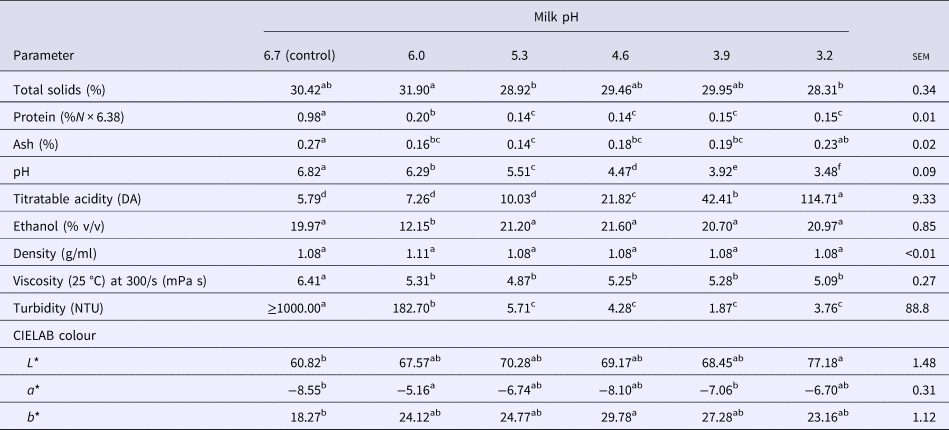
ANOVA showed no differences (P > 0.05) in the physicochemical and sensory properties of LO made from different replicate trials (results not shown). The physicochemical properties of LO samples are detailed in Table 1. An increase of milk acidification (i.e., a reduction in pH) led to LO with reduced (P < 0.05) levels of total solids and total protein, when compared to control (pH 6.7). The protein profile of LO samples analysed by high performance liquid chromatography (HPLC) showed no caseins when pH values were ≤5.3, whereas whey proteins were found in all treatments (online Supplementary Fig. S2). The ash content of control LO was higher (P < 0.05) when compared to other treatments, but there was also an increase (P < 0.05) when pH values were reduced from 6.0 to 3.2. A decrease (P < 0.05) in pH values of LO was associated with higher (P < 0.05) levels of titratable acidity. Only LO at pH 6.0 had lower (P < 0.05) levels of ethanol, when compared to other treatments and there were no significant differences in the density of experimental LO. The viscosity of control LO was higher (P < 0.05) than other treatments. An increase of milk acidification led to LO with reduced turbidity when compared to control, in which treatments made at pH ≤ 5.3 exhibited similar turbidity levels (<10 NTU). LO made with higher levels of acidification were whiter (higher L* values; P < 0.05), exhibited green notes (negative a* values) and had higher levels of yellowness (higher b* values; P < 0.05), when compared to control.
Physicochemical properties of Licor de Oro made with varying levels of milk acidification to different pH values

DA, degree of acidity (ml NaOH 0.1 N/100 ml of sample); NTU, nephelometric turbidity units; L*, whiteness; a*, greenness (−) or redness (+); b*, blueness (−) or yellowness (+).
Data are means and standard error of the mean (sem) of three replicate trials; means within the same row not sharing a common superscript differ (P < 0.05), as compared by SNK multiple comparison test.
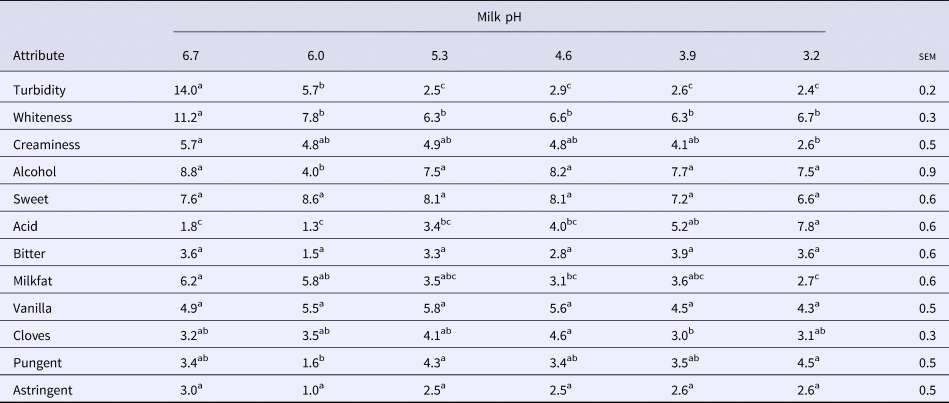
The sensory properties of LO samples are shown in Table 2. Milks acidified to pH ≤ 5.3 led to LO with the lowest scores in turbidity (P < 0.05). In contrast, control LO exhibited the highest scores of whiteness, when compared to other treatments (pH ≤ 6.0; P < 0.05). An increase in milk acidification led to LO with reduced scores of creaminess, when compared to control (P < 0.05). Only LO made at pH 6.0 exhibited the lowest scores of alcohol, when compared than other treatments (P < 0.05). As expected, an increase in milk acidification led to LO with increased scores in acidity and reduced scores in milkfat perception (P < 0.05). There were slight differences in the perception of cloves and pungency scores (P < 0.05). Attributes of sweetness, bitterness, vanilla notes and astringency were not significantly different among treatments.
Sensory properties of Licor de Oro made with milks acidified to different pH values

Data are means and standard error of the mean (sem) of three replicate trials; means within the same row not sharing a common superscript differ (P < 0.05), as compared by SNK multiple comparison test.
Description of sensory attributes can be found in online Supplementary Table S2.
Discussion
The stability of casein micelles in milk systems is highly influenced by the concentration of ethanol and acid (Horne, Reference Horne, McSweeney and O'Mahony2016; Ye and Harte, Reference Ye and Harte2013). In our study, LO made with milks at pH values of 6.7 and 6.0 were turbid (Tables 1 and 2; online Supplementary Fig. S1), probably associated with insufficient levels of ethanol-acidity to completely induce destabilisation of caseins (online Supplementary Fig. S2). Lower levels of ethanol in LO made at pH 6.0 were associated with a reduced perception of alcohol when analysed by sensory analysis (Table 2).
Differences of colour found in LO samples could be attributed due to a decrease in turbidity values as level of milk acidification increased (Table 1). Since a white background was placed for colour measurements, samples with reduced turbidity probably reflected more light from background, leading to higher whiteness (L* values) when compared to those treatments with high turbidity. The green (−a* values) and yellow notes (+b* values) found in all LO samples can be attributed to the presence of riboflavin in the serum phase of milk (Fox et al., Reference Fox, Uniacke-Lowe, McSweeney and O'Mahony2015). The yellowish appearance of LO can also be associated with the addition of saffron, a spice usually used to increase yellowness in food products (Raina et al., Reference Raina, Agarwal, Bhatia and Gaur1996).
The sensory whiteness of LO had an opposite effect when contrasted with instrumental colour analysis (L* values). This could be explained due to differences on how these parameters were measured, since sensory analysis was performed using a transparent cup and instrumental colour measurements were made using a white background. Increased perception of creaminess in LO treatments made with reduced acidity could be associated with higher levels of total protein (Table 2). We believe that certain volatile compounds found in milkfat, such as lactones, give a particular milk flavour to LO samples (Fox et al., Reference Fox, Uniacke-Lowe, McSweeney and O'Mahony2015), although its perception could have been reduced due to a masking effect caused by extensive acid addition in those treatments made with low pH values (Table 2). Nevertheless, flavour perceptions found in LO are also characteristics from other ingredients, such as vanilla and cloves. Hence, the appearance, mouth feeling, flavour and aroma of LO are highly influenced by the addition of milk and non-milk ingredients.
In contrast with caseins, the presence of whey proteins in all treatments of LO (online Supplementary Fig. S2) can be used as authenticity indicator to verify that the final product was originally made from milk, since these components are not affected by the stability of milk ethanol/pH (Garcia Botaro et al., Reference Garcia Botaro, Real de Lima, Aquino, Rocha Fernandes, García and Veiga dos Santos2007; Horne, Reference Horne, McSweeney and O'Mahony2016). Other soluble milk components that may also be found in LO are lactose and Ca. Thus, the presence/absence of proteins, sugars and minerals from milk can be used as indicators to determine authenticity of LO.
In conclusion, a minimum of milk acidification and addition of ethanol is required for destabilisation of milk proteins that leads to LO with a typical transparent appearance. In addition, LO contains combined milk and non-milk components that can be used as markers to certify its authenticity. This is the first study that reports the chemical, physical and sensory properties of LO and can be used as a basis for further research to determine its quality in commercial products.
Acknowledgements
This study was supported by Vicerrectoría Académica and Vicerrectoría de Investigación (Pontificia Universidad Católica de Chile) and Programa Tecnológico de Ingredientes Funcionales y Aditivos Naturales Especializados (Chile; IFAN 16PTECAI-66648-P16).
Supplementary material
The supplementary material for this article can be found at https://doi.org/10.1017/S0022029919000360